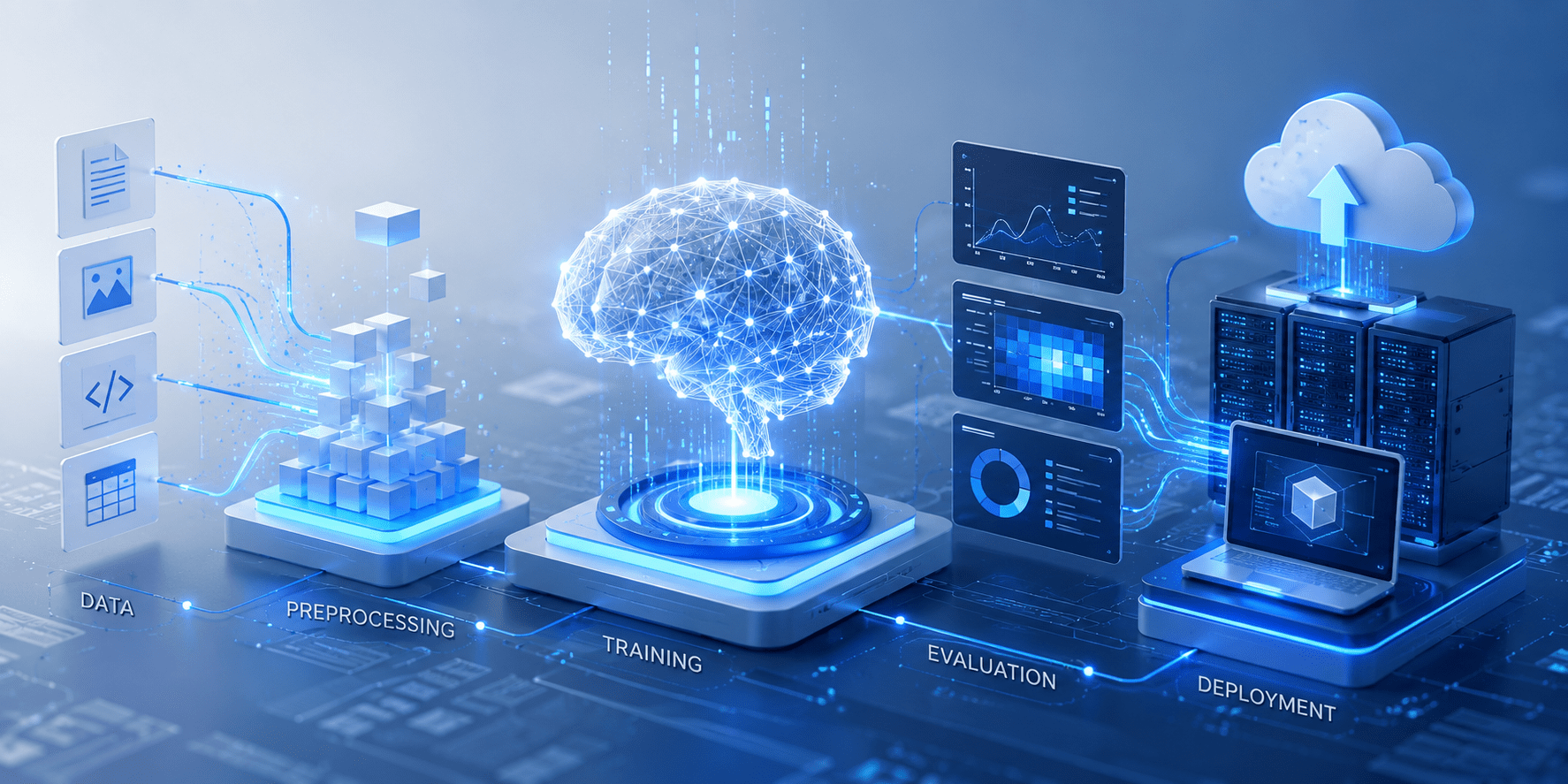
Training determines whether an AI system delivers value or creates risk. This guide walks through how training works, how to choose the right path, a repeatable seven-step workflow, and the tools and governance practices that keep models reliable in production.
TL;DR:
- Training path first. Decide between training from scratch, fine-tuning, AutoML, managed training, or classical machine learning before writing any code – the choice depends on data, budget, and control needs.
- Data readiness is a gate, not a checkbox. Confirm data availability, quality, labeling, and governance before preparation begins, or downstream steps will need rework.
- Follow a repeatable workflow. A seven-step process – define, assess, prepare, select, train, evaluate, deploy – keeps decisions traceable and reduces rework.
- Evaluation must match the business objective. Accuracy alone rarely tells the full story; pick metrics that reflect the cost of false positives and false negatives for your use case.
- Operational readiness is part of training. Scalability, latency, security, monitoring, and retraining plans belong in the project scope from day one, not as an afterthought.
- Responsible AI is operational, not optional. Bias evaluation, privacy controls, and documentation reduce risk and are far cheaper to build in early than to retrofit later.
- Tool choice should follow task type. Frameworks, managed platforms, and specialized libraries solve different problems, match the tool to the workload, team skill, and deployment target.
Introduction
Every AI product traces its behavior back to one decision: how the underlying model was trained. Training turns raw data into a working system, and the choices made during that process shape accuracy, cost, and long-term risk. Teams that treat training as a single coding step often ship models that underperform, drift quickly, or fail compliance review.
This guide treats AI model training as a connected system of decisions rather than an isolated task. It walks through the mechanics of training, a decision framework for choosing a training path, a seven-step workflow with quality gates, and the tooling and governance practices that carry a model from a first experiment to a maintained production system. For a broader view of how training fits into the wider build process, see SmartDev’s overview of AI-powered software development services.
What Is AI Model Training?
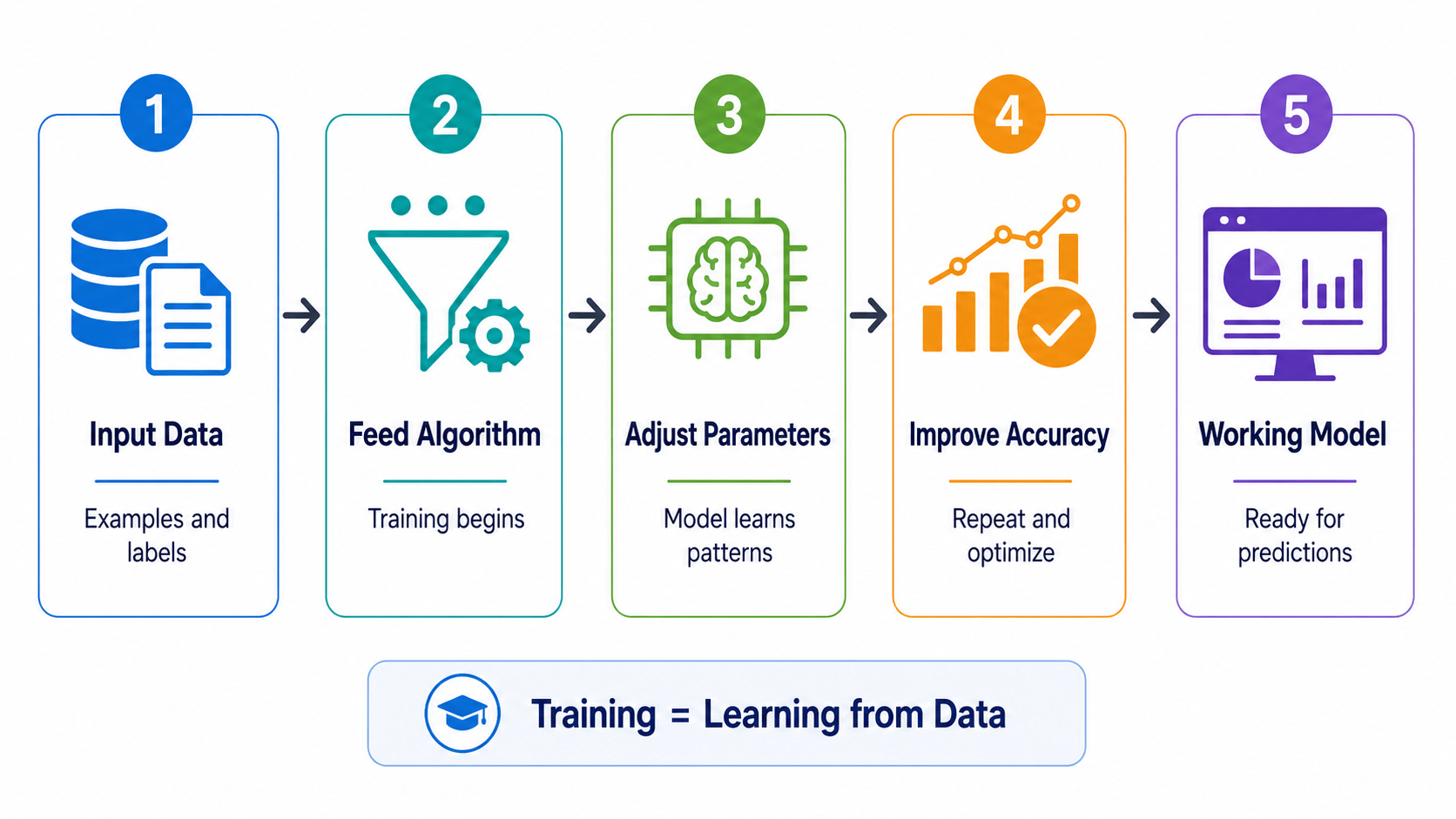
Definition: How an AI Model Learns From Data
A model starts with an algorithm and a set of parameters, usually initialized with small random values. During training, the algorithm processes batches of data, compares its predictions against known outcomes or an optimization objective, and adjusts the parameters to reduce error. Repeating this cycle across the dataset lets the model gradually capture the patterns that connect inputs to outputs.
This differs from how a finished model behaves in production. A trained model does not change its parameters when it makes a prediction; it applies what it already learned. Training is the learning phase, and it happens before a model is ever exposed to real users.
Where Training Fits in the Machine Learning Lifecycle
Training sits in the middle of a longer lifecycle that starts with problem definition and data collection, and ends with deployment and monitoring. Data preprocessing and feature preparation happen before training; evaluation, deployment, and monitoring happen after it.
Because every later stage depends on the choices made during training, weak data or a mismatched algorithm at this stage tends to surface as bias, poor accuracy, or unreliable behavior much later, often after the cost of fixing it has grown. Understanding the surrounding lifecycle can also help teams avoid ambiguity between related terms; SmartDev’s AI model development glossary covers how training relates to design and deployment stages.
Why Model Training Determines Performance, Cost, and Risk
Training decisions directly shape three outcomes. Performance depends on whether the data and algorithm suit the task and whether the model generalizes to new inputs rather than memorizing examples. Cost depends on data volume, compute requirements, and how many training iterations are needed to reach an acceptable result.
Risk depends on whether the training data introduces bias, whether sensitive information is handled correctly, and whether the model’s behavior can be explained and audited. Treating training as a business decision, not only a technical one, keeps these three factors visible from the start.
Training vs. Fine-Tuning vs. Inference
These three terms describe different stages of a model’s life, and mixing them up leads to unrealistic project timelines.
| Term | What Happens | Typical Data Needs | When It’s Used |
|---|---|---|---|
| Training (from scratch) | Parameters learn from random initialization | Large, task-representative dataset | Novel tasks with no suitable pre-trained model |
| Fine-tuning | A pre-trained model’s parameters are adjusted for a narrower task | Smaller, task-specific dataset | Adapting an existing model to a specific domain or format |
| Inference | A trained model produces predictions on new inputs | No labeled data required | Production use after training is complete |
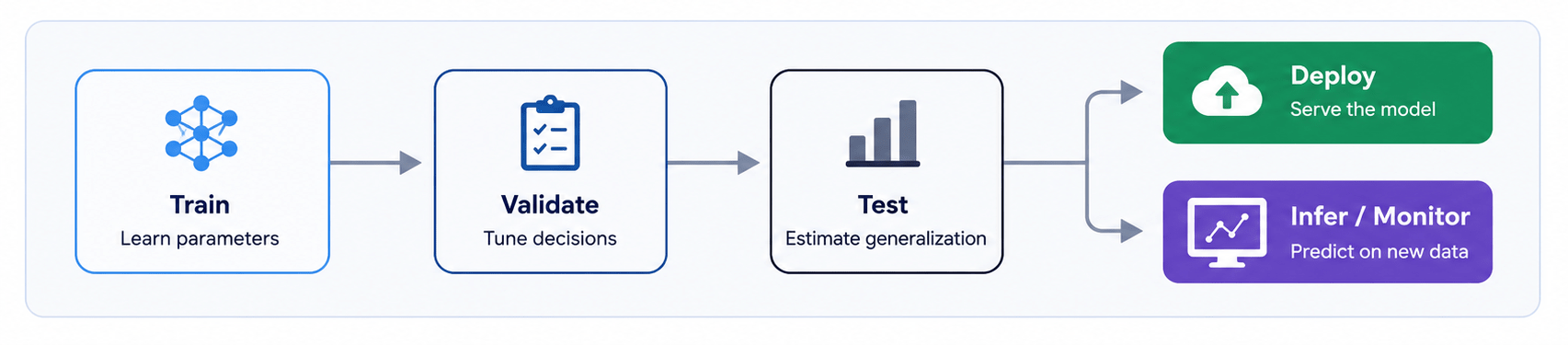
The diagram illustrates the AI model lifecycle from training to production. It begins with Train, Validate, and Test before deployment, then continues with Deploy and Infer/Monitor, where the model serves predictions and is continuously monitored in real-world use.
Choose the Right AI Training Path
Start With the Business Problem and Success Metric
Before selecting a method, define what the model needs to do and how success will be measured. A fraud-detection model and a document-summarization model have very different data, latency, and accuracy requirements, and that difference should drive the training path, not the other way around. Teams that skip this step often choose a sophisticated approach that the underlying data cannot support.
Select a Training Approach
Four broad approaches cover most projects, each with different tradeoffs in cost, control, and time to results.
- Training a model from scratch: Gives full control over architecture and behavior but needs a large, representative dataset and significant compute. Reserved for problems with no suitable existing model or with strict architectural requirements.
- Fine-tuning a pre-trained model: Adapts an existing model’s learned features to a narrower task using a smaller dataset. Usually faster and cheaper than training from scratch, though it inherits any limitations of the base model.
- Using AutoML or managed training: Automates model selection, hyperparameter search, and pipeline setup. Useful for teams that need working models quickly and don’t require deep customization.
- Using classical machine learning instead of deep learning: Algorithms such as decision trees or gradient boosting often outperform deep learning on smaller, structured datasets, and they train faster with less infrastructure.
None of these paths is universally cheaper or better; each shifts cost and effort to a different part of the project. Teams weighing consulting support for this decision can review SmartDev’s AI consulting services, and teams building generative applications specifically may find the tradeoffs discussed in SmartDev’s generative AI development services useful.
Match the Approach to Your Data, Skills, Budget, and Constraints
| Factor | Favors From Scratch | Favors Fine-Tuning / AutoML / Managed |
|---|---|---|
| Data volume | Large and well-labeled | Small to moderate |
| Budget and timeline | Flexible, longer runway | Constrained, faster delivery needed |
| Team expertise | Deep ML engineering skill available | Limited in-house ML expertise |
| Customization needs | Novel architecture or behavior required | Standard task with available base models |
| Governance burden | Full control over training data lineage | Acceptable to rely on vendor-provided base models |
Data preparation and infrastructure decisions that support any of these paths often draw on data analytics services and cloud solutions for compute and storage.
Choose the Learning Paradigm
Independent of the training path, models also learn under one of four paradigms:
- Supervised learning: Trains on labeled input-output pairs; common for classification and regression tasks.
- Unsupervised learning: Finds structure in unlabeled data, such as clustering or anomaly detection.
- Semi-supervised learning: Combines a small labeled set with a larger unlabeled set, useful when labeling is expensive.
- Reinforcement learning: Trains an agent through trial, error, and reward signals, common in robotics and sequential decision-making.
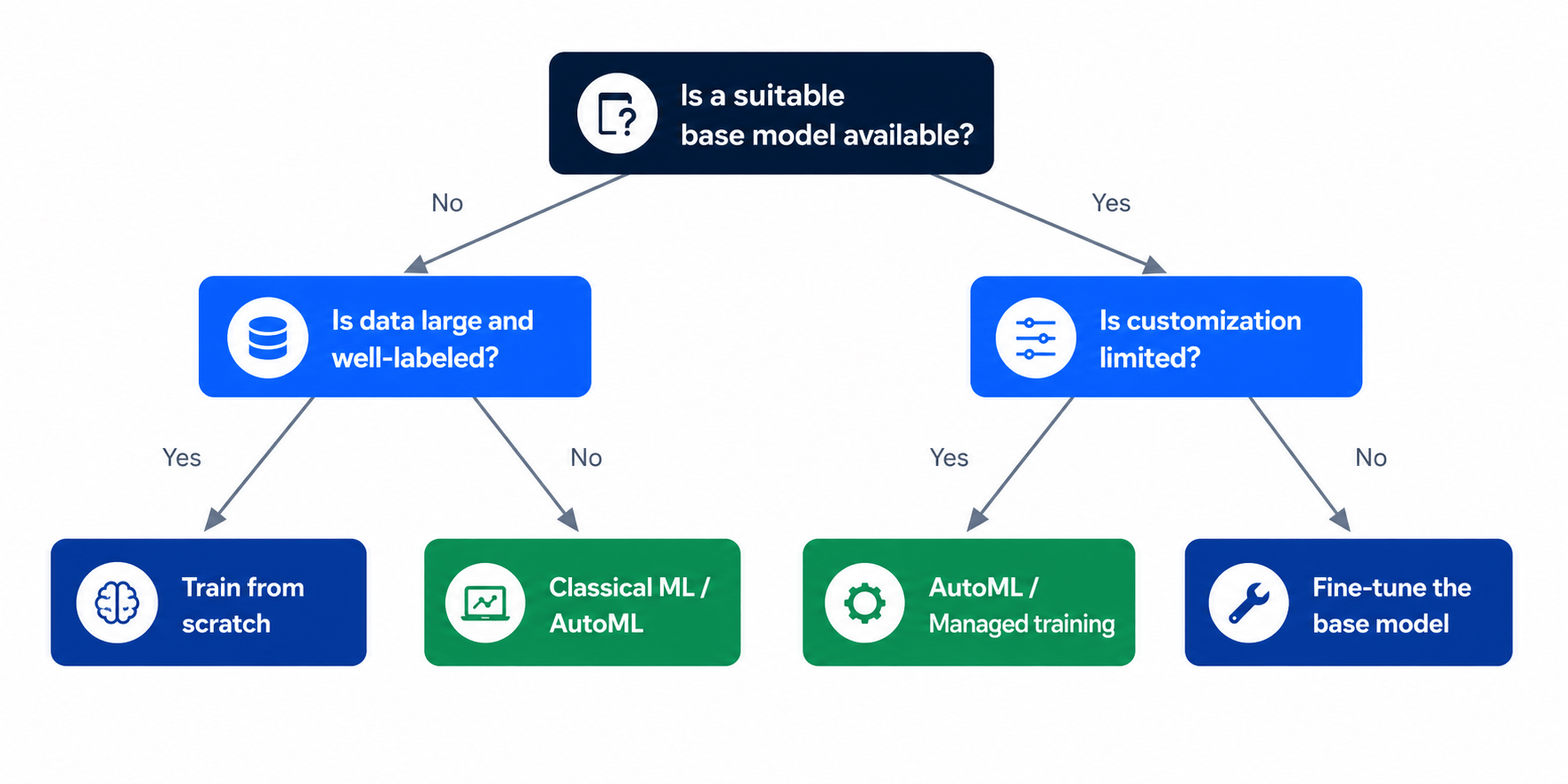
The decision tree helps teams choose an appropriate AI training approach based on available data and foundation models. The process begins by asking whether a suitable pre-trained model already exists.
- If no suitable base model is available, the next consideration is whether the organization has a large, well-labeled dataset.
- Yes → Train from scratch, building a model entirely from proprietary data.
- No → Use Classical ML or AutoML, which typically requires less data and computational resources.
- If a suitable base model is available, the decision depends on the level of customization required.
- Yes (customization is limited) → Choose AutoML or managed training to adapt the existing model with minimal effort.
- No (greater customization is needed) → Fine-tune the base model using domain-specific data to improve performance for the target use case.
The framework illustrates that the right training strategy depends on the availability of pre-trained models, the quality of training data, and the level of customization required, rather than applying a single approach to every AI project.
Takeaway: There’s no universally “best” training path – from-scratch, fine-tuning, AutoML, and classical ML each trade cost, control, and speed differently. Match the choice to your data volume, budget, team skill, and how much customization the task actually needs.
How AI Model Training Works
Data, Features, Parameters, and Algorithms
Four building blocks make up every training run. Data supplies the examples the model learns from. Features are the individual attributes extracted from that data, such as a pixel value or a transaction amount.
Parameters are the internal, learnable variables – weights and biases – that the algorithm adjusts during training. The algorithm itself is the mathematical procedure, such as gradient descent for neural networks, that defines how parameters are updated.
Training, Validation, and Test Data
Datasets are typically split into three parts, each serving a distinct role.
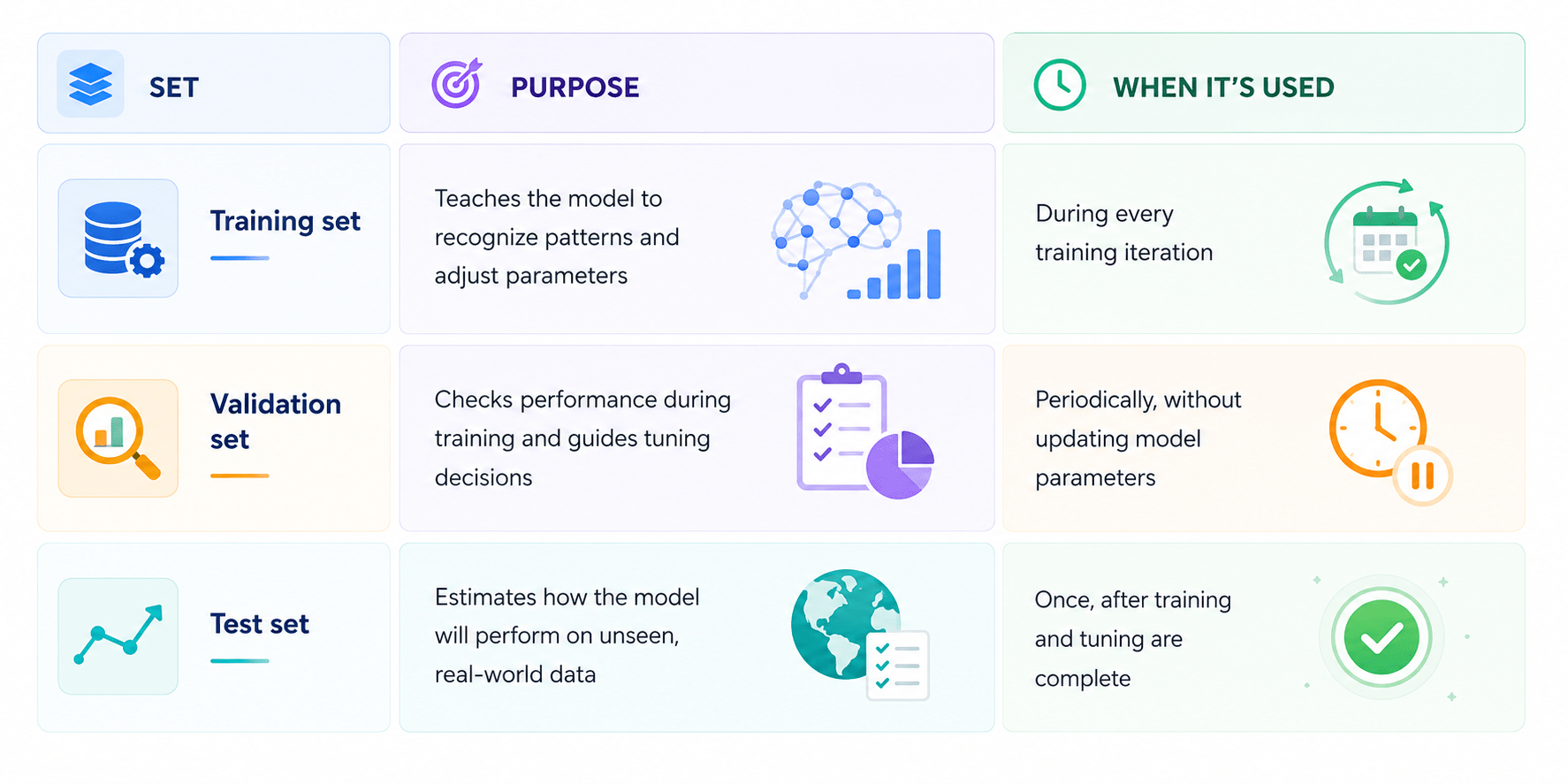
The diagram compares the three datasets used throughout the AI training process, each serving a distinct purpose at a different stage of model development.
- Training set – Used to train the model by learning patterns from the data and updating model parameters.
- Validation set – Used during training to evaluate performance, compare configurations, and guide tuning decisions without changing the model directly.
- Test set – Used only after training and tuning are complete to estimate how well the final model will perform on unseen, real-world data.
Separating these datasets helps produce more reliable performance estimates and reduces the risk of overfitting, ensuring the model can generalize beyond the data it was trained on.
Loss Functions, Optimization, and Iteration
A loss function quantifies the gap between a model’s prediction and the correct answer. Optimization algorithms, most commonly variants of gradient descent, use that loss value to update parameters in the direction that reduces error. One full pass through the training data is called an epoch, and models typically need many epochs before the loss stabilizes.
Generalization: Avoiding Overfitting and Underfitting
Generalization is a model’s ability to perform well on data it has not seen before, and it is the real goal of training, not just minimizing error on the training set. Overfitting happens when a model memorizes training data, including its noise, and performs poorly on new inputs. Underfitting happens when a model is too simple to capture the underlying pattern at all.
Comparing training and validation performance during training is the standard way to catch both problems early. SmartDev’s AI adoption glossary covers related terminology in more depth.
The End-to-End AI Model Training Workflow
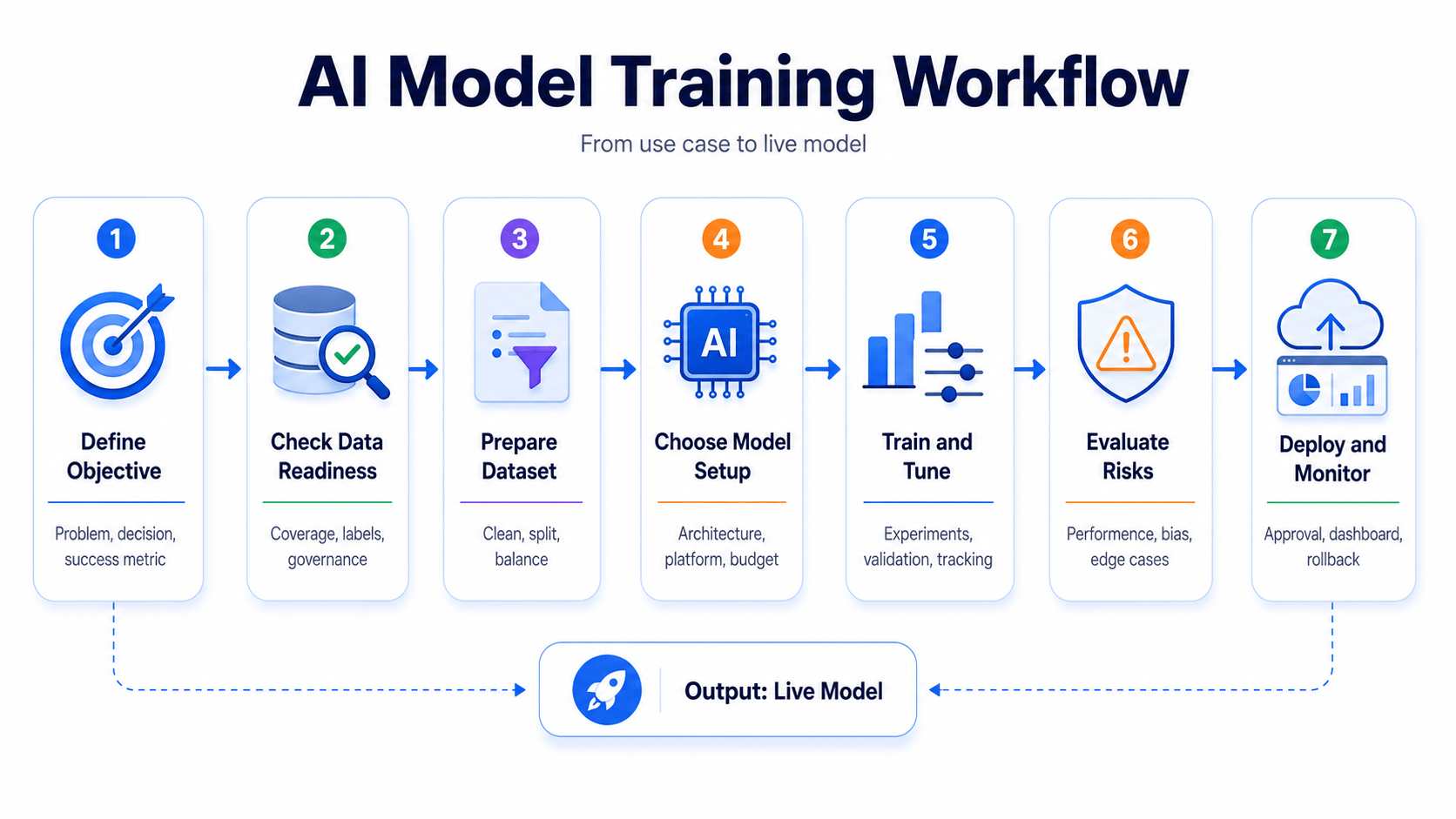
Step 1: Define the Use Case, Constraints, and Evaluation Criteria
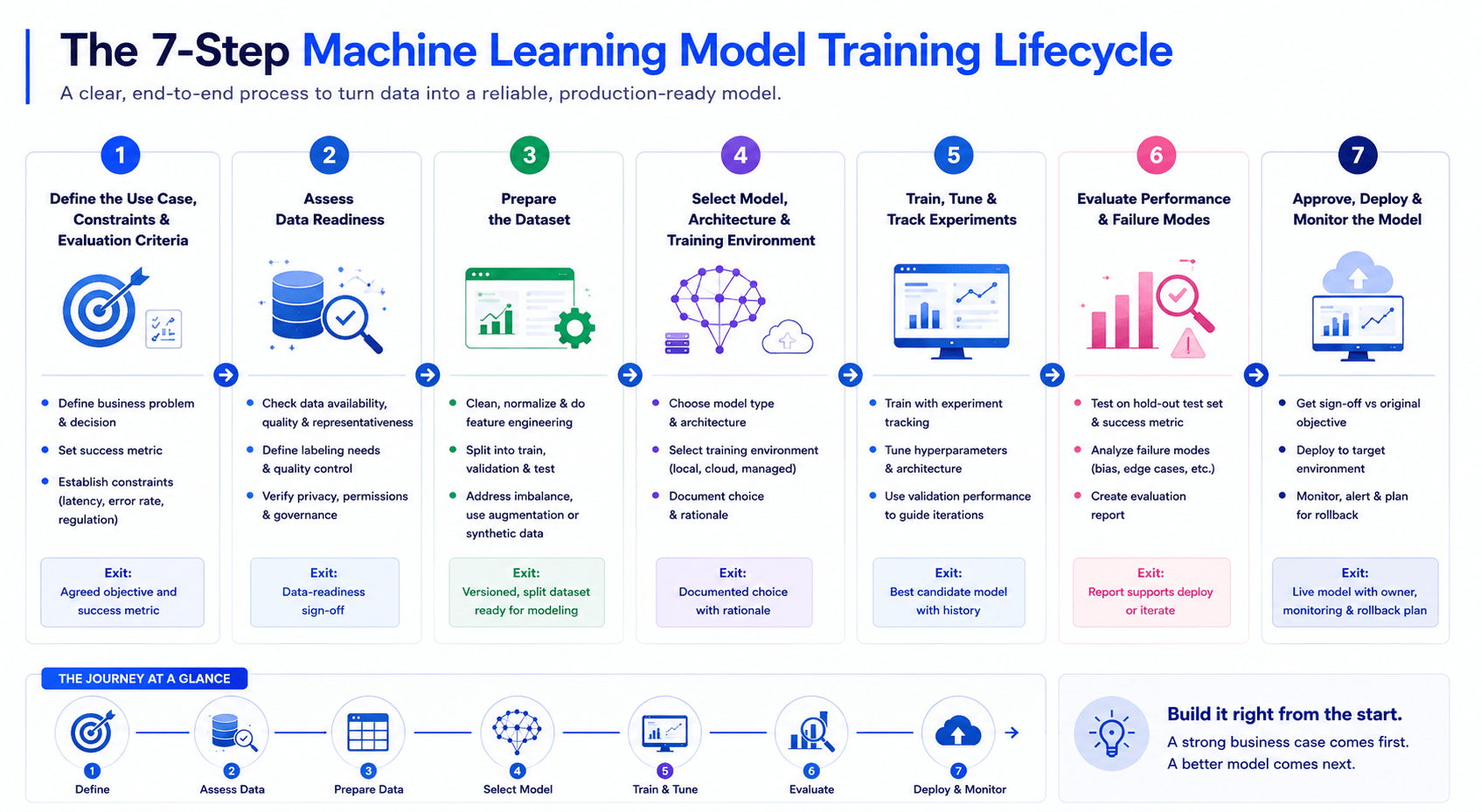
Write down the business problem, the decision the model will support, and the metric that defines success before any data work begins. This step also sets constraints such as latency budgets, regulatory boundaries, and acceptable error rates. Exit criterion: a documented objective and success metric that stakeholders agree on.
Step 2: Assess Data Readiness
- Data availability, quality, and representativeness: Confirm there is enough data, that it reflects real-world conditions, and that known gaps are documented.
- Labeling requirements and quality control: For supervised tasks, define labeling guidelines and a process for checking label accuracy.
- Privacy, permissions, and governance requirements: Confirm the data can legally be used for this purpose and that sensitive fields are identified before preparation begins.
Exit criterion: a data-readiness sign-off, not just a data export.
Step 3: Prepare the Dataset
- Cleaning, normalization, and feature engineering: Remove duplicates and errors, scale values consistently, and construct any derived features the model needs.
- Splitting training, validation, and test data: Separate the data before any modeling begins to prevent leakage between sets.
- Balancing, augmentation, and synthetic data considerations: Address class imbalance and consider augmentation or synthetic data where real examples are scarce, private, or expensive to collect.
Exit criterion: a versioned, split dataset ready for modeling.
Step 4: Select the Model, Architecture, and Training Environment
Match the model type and architecture to the task defined in Step 1, and choose a training environment, local, cloud, or managed platform, that fits the required scale and budget. Exit criterion: a documented model and environment choice with a rationale.
Step 5: Train, Tune, and Track Experiments
Run training with experiment tracking enabled so every configuration, metric, and result is reproducible. Iterate on hyperparameters and architecture choices based on validation performance, not test performance. Exit criterion: a best-performing candidate model with a logged experiment history.
Step 6: Evaluate Performance and Failure Modes
Test the candidate model against the test set and the success metric defined in Step 1, and probe for failure modes such as bias across subgroups or poor performance on edge cases. Exit criterion: an evaluation report that either supports deployment or sends the project back to an earlier step.
Step 7: Approve, Deploy, and Monitor the Model
Secure sign-off against the original objective, deploy the model into its target environment, and establish monitoring before real traffic reaches it. Exit criterion: a live model with an owner, a monitoring dashboard, and a documented rollback plan.
Supporting services for this workflow include MLOps services for pipeline automation, quality solutions for systematic evaluation, and broader AI development services for end-to-end delivery.
Improve Training Performance and Reliability
Hyperparameter Tuning: What to Optimize and Why
Hyperparameters are settings configured before training begins, such as learning rate, batch size, number of epochs, and regularization strength. Unlike model parameters, they are not learned automatically, so they need deliberate tuning.
- Learning rate, batch size, epochs, and regularization: These four settings have the largest influence on training stability and generalization, and small changes can shift results significantly.
- Manual search, grid search, and Bayesian optimization: Manual tuning works for small problems; grid search tests combinations systematically but scales poorly; Bayesian optimization uses prior results to focus the search on promising configurations more efficiently.
Transfer Learning and Fine-Tuning
Transfer learning reuses the features a model learned on one large dataset and adapts them to a new, related task. It typically reduces the data and compute needed to reach strong performance, which is why fine-tuning pre-trained models such as BERT-family or GPT-family architectures has become a default starting point for many natural language processing and computer vision projects.
Scaling Training: GPUs, TPUs, Cloud, and Distributed Training
Larger models and datasets need more compute than a single machine can provide. GPUs and TPUs accelerate the matrix operations at the core of deep learning, and distributed training splits a workload across multiple accelerators or machines.
Cloud-managed training services handle much of this provisioning automatically – Google Cloud’s Vertex AI Training, for example, supports both serverless jobs for experimentation and reserved training clusters for large, long-running workloads. Cloud infrastructure decisions for this kind of scaling are covered in SmartDev’s cloud solutions and machine learning development services.
Federated Learning and Edge AI
Federated learning trains a shared model across many devices without moving raw data to a central server, which helps when data is sensitive or regulated. Edge AI runs trained models directly on local devices to reduce latency and keep data on-device. Both approaches trade some training convenience for privacy and responsiveness benefits.
Troubleshooting Common Training Failures
| Symptom | Likely Cause | Investigate |
|---|---|---|
| High training accuracy, low validation accuracy | Overfitting | Regularization, more data, simpler architecture |
| Low accuracy on both training and validation sets | Underfitting or poor data quality | Model complexity, feature engineering, label noise |
| Loss oscillates or diverges | Unstable training / learning rate too high | Lower learning rate, gradient clipping, batch size |
| Training is prohibitively slow or expensive | Compute or data-pipeline bottleneck | Distributed training, data loading, instance type |
| Good offline metrics, poor real-world results | Data drift or unrepresentative test set | Refresh test data, add real-world edge cases |
SmartDev’s AI model testing guide covers evaluation techniques that support this kind of diagnosis in more depth.
Evaluate, Deploy, and Maintain AI Models
Select Metrics That Match the Business Objective
No single metric fits every use case. A fraud model may prioritize recall to catch as many true fraud cases as possible, while a recommendation model may prioritize precision to avoid irrelevant suggestions. Accuracy alone can be misleading on imbalanced datasets, so metric selection should trace directly back to the cost of different error types for the specific business problem.
Test for Reliability, Robustness, Bias, and Edge Cases
Beyond standard accuracy metrics, production readiness requires testing how the model behaves under stress, unusual inputs, and across different demographic or operational subgroups. Bias testing in particular should compare performance across relevant groups, not just aggregate metrics, since an average score can hide uneven performance.
Prepare for Production: Scalability, Latency, Security, and Cost
Production-Readiness Checklist
- Model meets latency requirements under expected peak load
- Infrastructure can scale to projected traffic without manual intervention
- Access controls and data handling meet security requirements
- Serving costs are estimated and within budget at expected scale
- A rollback plan exists if the deployed model underperforms
Cloud migration and DevOps practices often support this stage; see SmartDev’s cloud migration solutions and DevOps as a service.
Monitor Drift, Retrain, and Release Updates Safely
Production models degrade over time as real-world data shifts away from the training distribution, a phenomenon known as drift. Effective monitoring tracks both prediction quality and input data distributions, and pairs alerts with a defined retraining trigger. New versions should roll out gradually, through approaches such as A/B testing or canary releases, rather than replacing a production model all at once.
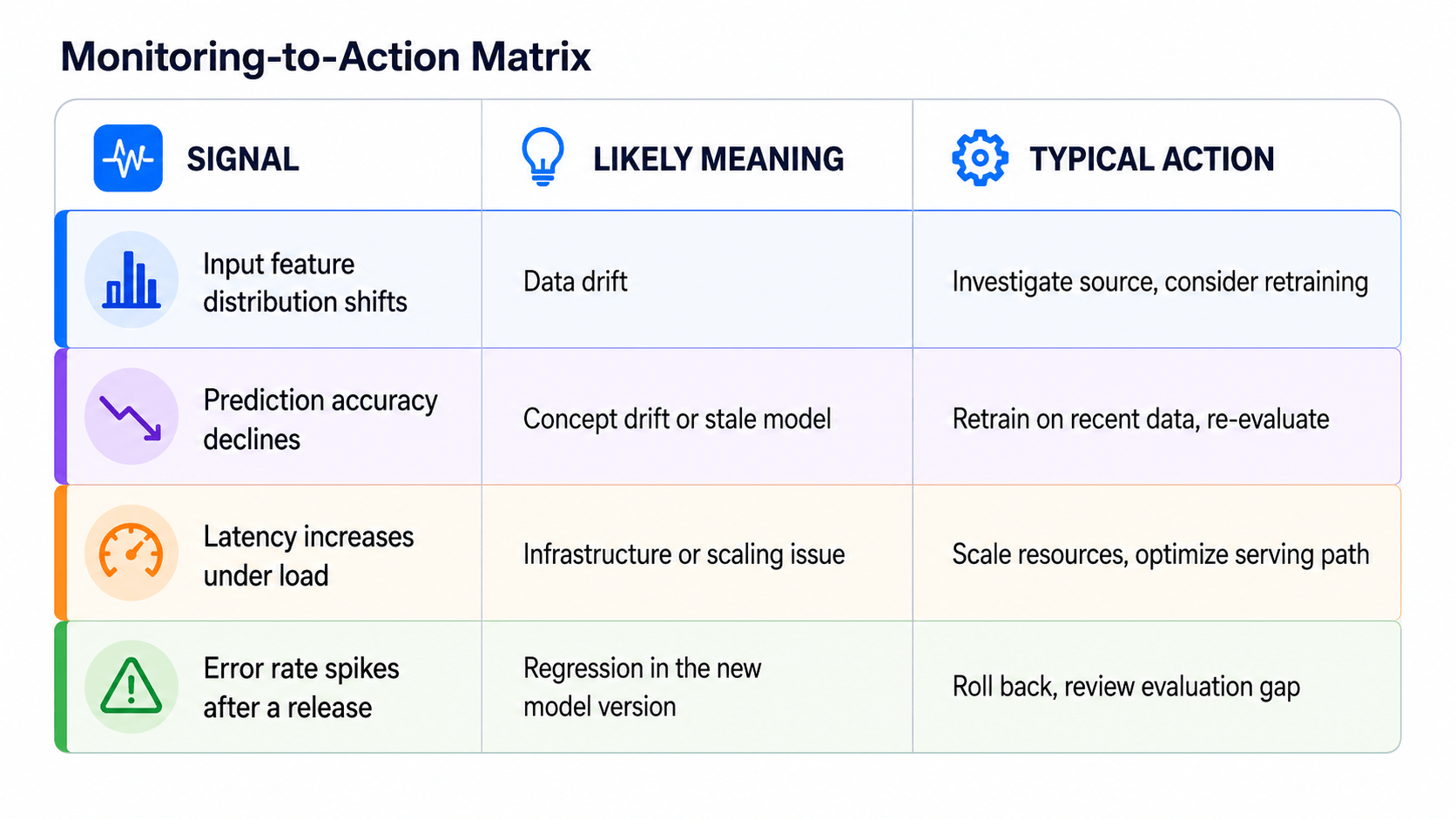
The diagram highlights several operational signals that indicate when an AI model may require attention. Changes in input feature distributions often point to data drift, while declining prediction accuracy may indicate concept drift or an outdated model. Increased latency under load typically reflects infrastructure or scaling constraints, whereas a spike in error rates after deployment can signal a regression introduced by a new model version.
Each signal requires a different response, ranging from investigating data quality and retraining the model to optimizing infrastructure or rolling back a release. Effective AI operations depend on continuously monitoring these indicators and responding before performance issues affect business outcomes
For a deeper look at these monitoring strategies, explore SmartDev’s AI model drift and retraining guide.
Responsible AI Model Training
Detect and Reduce Bias in Training Data and Models
Bias enters models primarily through unrepresentative or historically skewed training data. Reducing it starts with auditing datasets for demographic and category balance, then testing model outputs across subgroups rather than relying on a single aggregate metric. SmartDev’s article on addressing AI bias and fairness expands on mitigation strategies.
Protect Data Privacy and Security
Training data that includes personal or sensitive information needs anonymization, access controls, and, where appropriate, techniques such as differential privacy that limit what can be inferred about any individual record. Under the EU’s General Data Protection Regulation, personal data must be processed lawfully, kept accurate, limited to what is necessary for its purpose, and secured with appropriate technical measures, as set out in Article 5 of the GDPR – principles that apply directly to any training dataset containing personal data.
SmartDev’s overview of AI and data privacy and cybersecurity practices for AI systems covers this in more depth. This guide provides general technical context and is not legal advice; confirm specific obligations with qualified counsel.
Address Compliance and Documentation Requirements
Regulated industries increasingly expect documentation of what data trained a model, how it was evaluated, and who approved its release. Maintaining this record as part of the workflow – not after the fact – makes audits and incident response far faster.
Manage Environmental and Compute Impacts
Large training runs consume significant energy, particularly for deep learning at scale. Teams can reduce this impact by right-sizing models to the task, reusing pre-trained models where possible through fine-tuning, and choosing efficient hardware and scheduling.
Responsible-Training Checklist
- Training data audited for representativeness across relevant groups
- Bias testing performed on model outputs, not only on input data
- Personal or sensitive data anonymized or access-controlled
- Model and data lineage documented for audit purposes
- Compute and energy footprint considered in model and hardware choices
AI Model Training Tools and Platforms
Core Frameworks for Building Models
- TensorFlow: An open-source framework built for scalability across CPUs, GPUs, and TPUs, commonly used for production-scale deep learning.
- PyTorch: Known for its dynamic computation graph and researcher-friendly workflow, widely used for prototyping and NLP or computer vision research.
- Scikit-learn: A lightweight library for classical machine learning algorithms such as regression, classification, and clustering, well suited to smaller structured datasets.
- Hugging Face Transformers: Simplifies fine-tuning pre-trained transformer models for natural language processing and other generative tasks.
Managed Platforms for Training and Deployment
- Google Vertex AI: Combines AutoML and custom training in one platform, with serverless jobs for experimentation and reserved clusters for large-scale distributed training.
- AWS SageMaker: A fully managed environment covering data preparation, distributed training, hyperparameter tuning, and deployment, with options ranging from built-in algorithms to custom containers.
- Microsoft Azure AI (Azure Machine Learning): A cloud service for the full ML lifecycle, supporting open-source frameworks such as PyTorch and TensorFlow alongside built-in MLOps tooling.
Open-Source vs. Commercial Tools
Open-source frameworks are free to use, benefit from large communities, and offer maximum flexibility, but they require in-house expertise to operate at scale. Commercial and managed platforms trade some of that flexibility for reduced operational burden, built-in monitoring, and vendor support – a worthwhile exchange for teams without a dedicated ML infrastructure function.
How to Choose an AI Model Training Tool
- Best for beginners and small teams: Scikit-learn for classical tasks; managed notebook environments for lower setup overhead.
- Best for NLP and generative AI: Hugging Face Transformers for fine-tuning; managed platforms for scaling generative workloads.
- Best for computer vision: TensorFlow or PyTorch, both with mature computer-vision ecosystems.
- Best for enterprise-scale training: Managed platforms such as SageMaker, Vertex AI, or Azure Machine Learning, which handle distributed infrastructure and governance.
AI Model Training Tools Comparison Matrix
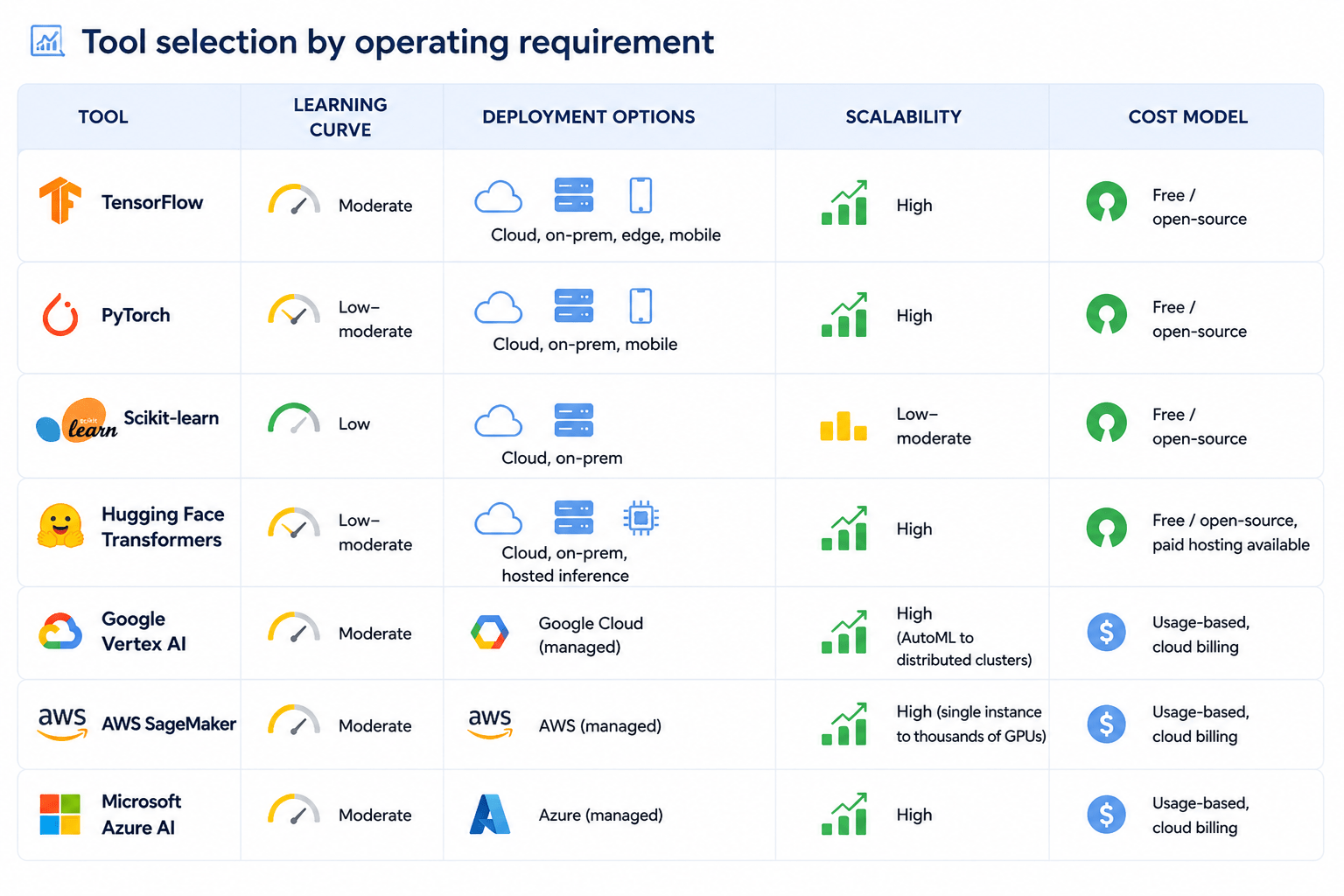
The diagram compares leading AI training platforms based on learning curve, deployment flexibility, scalability, and cost, helping organizations evaluate the most suitable tools for different AI initiatives.
- Open-source frameworks – TensorFlow, PyTorch, Scikit-learn, and Hugging Face Transformers offer flexibility for developing and deploying custom AI models across cloud and on-premises environments. Most are free to use, with optional managed services available on some platforms.
- Managed cloud platforms – Google Vertex AI, AWS SageMaker, and Microsoft Azure AI provide fully managed environments for training, deploying, and operating AI models at scale, reducing infrastructure overhead while supporting enterprise workloads.
The comparison shows that platform selection is driven by technical requirements, deployment strategy, scalability needs, budget, and existing technology investments—not by a single “best” tool.
As AI platforms continue to evolve, organizations should verify the latest features, pricing, and service availability directly with each vendor before making technology or procurement decisions.
SmartDev’s AI engineers work across both open-source frameworks and managed cloud platforms, helping organizations select, implement, and optimize the right tooling for their use case. Learn more about SmartDev’s custom AI model training services or hire an AI developer to support your next AI project.
AI Model Training Use Cases
Healthcare, Retail, Finance, and Autonomous Systems
| Industry | Typical Model Approach | Data Considerations | Key Risk Controls |
|---|---|---|---|
| Healthcare | Supervised learning on imaging or records | Strict privacy, small labeled datasets | Clinical validation, bias auditing, regulatory review |
| Retail | Recommendation and demand forecasting models | Behavioral and transactional data at scale | Fairness across customer segments, drift monitoring |
| Finance | Fraud detection and credit-risk models | Highly imbalanced, sensitive financial data | Explainability, regulatory documentation, bias testing |
| Autonomous systems | Reinforcement and supervised learning on sensor data | Large volumes of real-world driving or sensor data | Safety validation, extensive edge-case testing |
Industry-specific context is available on SmartDev’s Healthcare & Medical Services and BFSI/Fintech pages.
Training Generative AI Models
Generative models, including large language models and image generators, are typically built by pre-training on broad datasets and then fine-tuning for specific behaviors or domains. Evaluation for these models extends beyond accuracy to include factors such as output quality, factual consistency, and safety, which usually require human review alongside automated metrics.
SmartDev Case Example: Applying AI Training in a Production Product
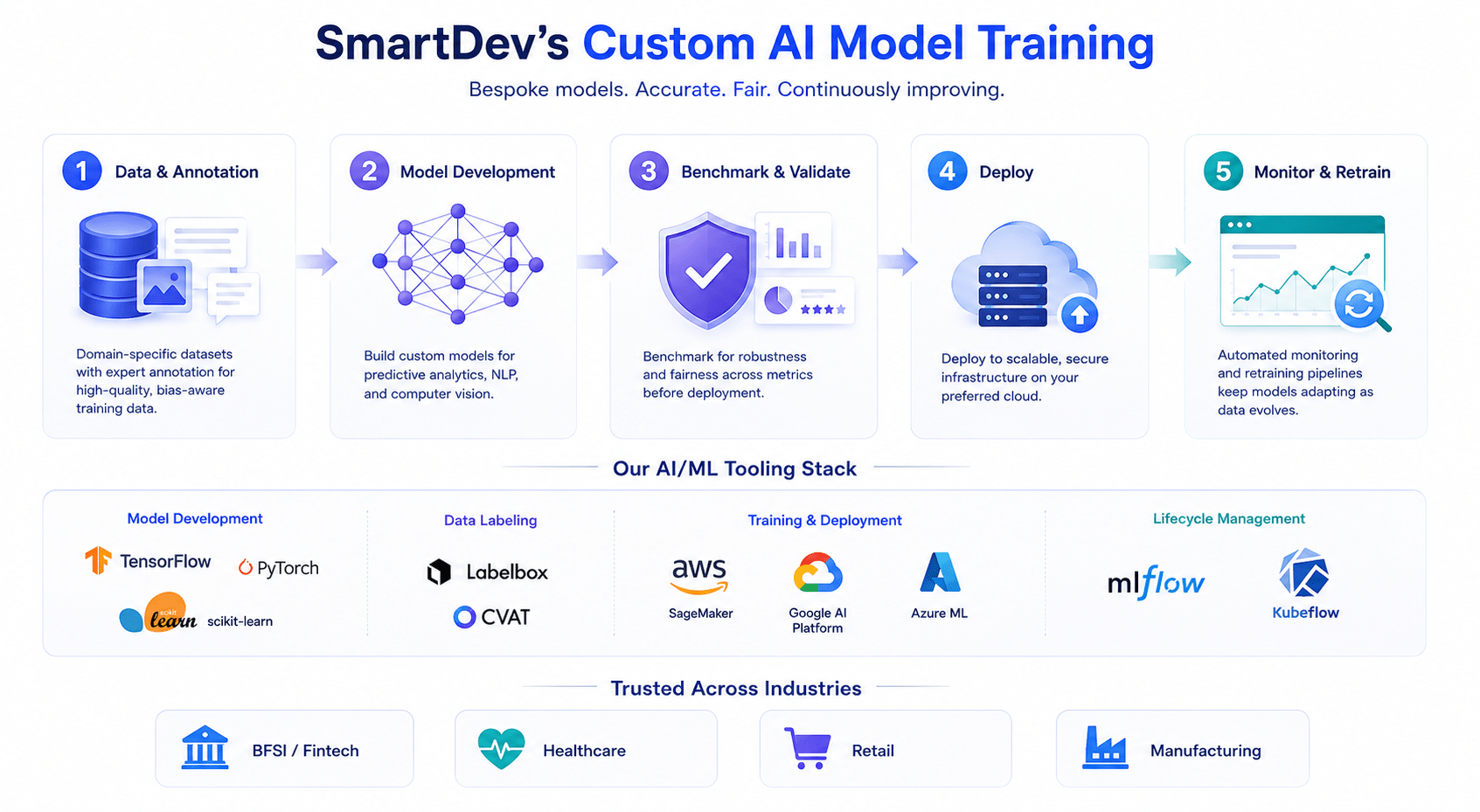
SmartDev’s custom AI model training practice designs and trains bespoke models for predictive analytics, natural language processing, and computer vision using domain-specific datasets and expert annotation to improve model accuracy and reduce bias.
Before deployment, the team benchmarks models for performance, robustness, and fairness, while implementing automated retraining and monitoring pipelines to ensure models continue to perform reliably as production data evolves.
SmartDev’s engineers work with leading AI technologies, including TensorFlow, PyTorch, Scikit-learn, Labelbox, CVAT, AWS SageMaker, Google AI Platform, Azure ML, MLflow, and Kubeflow. This technology stack has been applied across industries such as BFSI, healthcare, retail, and manufacturing.
Learn more about SmartDev’s Train AI Model services and explore real-world implementations in our case studies.
FAQ: AI Model Training
How do you train an AI model?
Training an AI model means defining the business problem and success metric, assessing and preparing data, choosing a model and training environment, running training and tuning experiments, evaluating results against the original objective, then deploying and monitoring the model in production. Each stage acts as a checkpoint, so a team can catch weak data or a mismatched model early rather than discovering the problem after deployment.
What data is needed to train an AI model?
AI models need data that is representative of real-world conditions, sufficiently large for the chosen approach, and correctly labeled when using supervised learning. Teams also need to split that data into training, validation, and test sets, so performance gets measured on examples the model has never encountered during learning.
What is the difference between training from scratch and fine-tuning?
Training from scratch builds a model’s parameters from random initialization using a full dataset, while fine-tuning starts from a pre-trained model and adjusts it on a smaller, task-specific dataset. Fine-tuning generally needs less data and compute, but from-scratch training gives more control over architecture and behavior. The right choice usually comes down to how much data you have and how customized the model needs to be.
Which tools are best for AI model training?
The right tool depends on the task and team. TensorFlow and PyTorch suit custom deep learning, Scikit-learn suits classical machine learning, Hugging Face Transformers suits NLP and generative AI, and managed platforms such as Vertex AI, AWS SageMaker, or Azure Machine Learning suit teams that want less infrastructure overhead. Most teams end up combining an open-source framework with a managed platform rather than picking just one.
How long does it take to train an AI model?
Training time varies widely by data volume, model size, hardware, and approach, so there is no fixed timeline that applies to every project. Fine-tuning a pre-trained model on a narrow task is typically faster than training a large model from scratch, and teams should scope timelines during the planning step rather than assume a standard duration.
How do you know whether a trained model is ready for production?
A model is ready for production when it meets the evaluation metrics tied to the business objective, has been tested for robustness, bias, and edge cases, satisfies scalability, latency, and security requirements, and has a monitoring and retraining plan in place for after release. If any of these are missing, the model needs another iteration before it goes live.
Conclusion: Build a Reliable Training System, Not Just a Model
A single well-trained model is not the finish line – a reliable training system is. Start with a clearly defined outcome, prepare data responsibly, select a training path that matches your data and constraints, evaluate results against more than one metric, and plan for production monitoring before the model ever ships. Teams that build this system once tend to reuse it across many projects, turning each new model into a faster, lower-risk delivery rather than a one-off experiment.
Revisit the end-to-end workflow and the tool-selection guidance above when scoping your next project.
Ready to Train an AI Model That Delivers Real Business Value?
Whether you’re building your first AI model or optimizing an existing one, SmartDev can help you choose the right training strategy, prepare your data, and accelerate your path to production.
Contact our AI experts to discuss your goals, data readiness, and project timeline. We’ll help you define the right approach for your use case, so you can move from experimentation to reliable, production-ready AI with confidence.