TL, DR:
- Core loop: Members earn Stars on purchases, track progress in the app, and redeem Stars for free drinks, food, or merchandise.
- 2026 redesign: Starbucks Rewards now has three tiers – Green, Gold, and Reserve – based on Stars earned in a rolling 12-month period, effective March 10, 2026.
- Personalization and campaigns: Birthday rewards, Double Star Days, and games like Starbucks for Life add episodic, time-limited engagement on top of the always-on loyalty loop.
- The app is the delivery layer: Mobile ordering, payment, and Star tracking make participation low-friction and give Starbucks first-party engagement data.
- Evidence has limits: Starbucks reports 35.5 million 90-day active Rewards members in the U.S. as of Q1 FY26, but that figure reflects the whole program, not gamification mechanics in isolation.
- Transferable lesson: The value lies in an integrated system – value exchange, progression, personalization, and easy digital delivery – not in isolated game gimmicks.
Introduction
Starbucks turns a routine coffee purchase into a tracked, rewarded, and progressively unlocked experience. Every order earns Stars, moves a member closer to a tier, and can trigger a personalized offer or a limited-time challenge. That is gamification: game mechanics such as points, levels, and time-bound goals, applied to a non-game activity to shape behavior.
Starbucks Rewards is not a standalone game bolted onto a coffee brand. It is a behavior-design system built into a loyalty program, a mobile app, and a rotating set of campaigns. According to a Starbucks investor announcement dated January 29, 2026, the company relaunched the program in March 2026 with three membership levels – Green, Gold, and Reserve – making this an ideal moment to re-examine how the mechanics actually work, what is proven, and what a business should evaluate before copying the approach.
1. What Starbucks Gamification Means
Starbucks uses gamification by embedding progress tracking, tiered rewards, personalized offers, and time-limited challenges directly into its loyalty program and mobile app. The goal is to make repeat purchasing feel like advancing through a system, not just paying for coffee.
Gamification in a loyalty-program context
Gamification is broader than a standalone branded game. SmartDev’s overview of gamification and business growth frames it as applying game-design elements — points, levels, and feedback loops — to activities that are not games, in order to increase engagement and motivation. Starbucks Rewards fits this definition. Every purchase feeds a point system, every point moves a member toward a reward or a tier, and the app displays that progress in real time.
Not every Starbucks loyalty feature is a game mechanic on its own. A birthday reward is simply a retention perk. It becomes gamified when it is combined with progress bars, tier status, and optional challenges that reward continued participation.
The game mechanics that matter: progress, rewards, personalization, and time-limited challenges
Four mechanics repeat across the Starbucks system:
| Mechanic | Customer behavior it targets | Intended business value |
|---|---|---|
| Progress tracking (Stars, tier status) | Repeat purchase to keep advancing | Higher purchase frequency |
| Tiered rewards (Green, Gold, Reserve) | Spend more to unlock faster earning and perks | Increased average member value |
| Personalization (offers, birthday reward) | Engage with offers that feel individually relevant | Higher offer redemption and app engagement |
| Time-limited challenges (Double Star Days, games) | Act within a defined window | Short-term spikes in visits and transactions |
2. The Business Context Behind Starbucks Rewards
A global coffee retailer invests in a digital loyalty ecosystem to influence three connected customer behaviors: how often people return, how they pay, and how willing they are to try personalized offers.
Competitive pressure, habitual purchasing, and customer retention
Coffee purchasing is habitual by nature, and habitual categories reward brands that make repeat behavior easy and rewarding. A loyalty system that tracks progress toward a reward can reinforce a habit a customer already leans toward, rather than manufacture demand from nothing. Starbucks’ own January 2026 investor release confirms the company has run some version of a Rewards program since 2009, which points to retention, not novelty, as the program’s original design goal.
Why a digital loyalty ecosystem became central to engagement
Mobile ordering, digital payment, and app-based Star tracking turned a paper punch card into a persistent, personalized channel. That channel lets Starbucks message members directly, tailor offers to purchase history, and collect first-party engagement data at scale. SmartDev’s guide to gamification and customer journey mapping describes this same shift across industries: brands that map the full customer journey can place game mechanics at the specific moments where they change behavior, rather than scattering them across a generic app.
3. How Starbucks Uses Gamification to Drive Engagement
Starbucks Rewards: the core loyalty loop
The core loop is simple to describe and hard to disengage from once a member is in it: a customer buys something, earns Stars, watches progress toward a reward or tier, redeems Stars for value, and repeats. Every stage feeds the next.
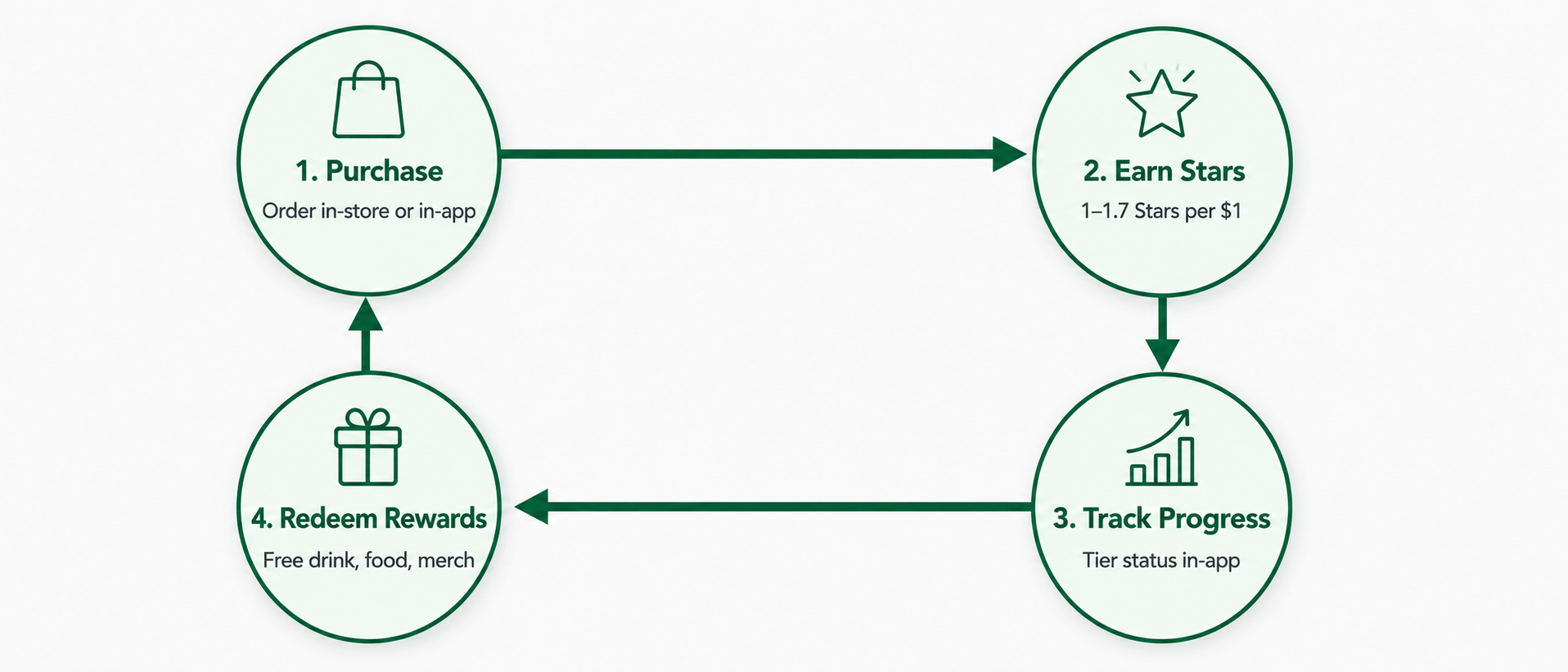
The customer journey follows a repeating four-stage cycle: purchase, earn Stars, track progress, and redeem rewards. Each redemption reinforces future purchases, sustaining long-term engagement with the loyalty program.
The 2026 Green, Gold, and Reserve membership structure
A Starbucks investor announcement dated January 29, 2026, later confirmed by a Starbucks press release on March 10, 2026, details a redesigned Rewards program that launched in U.S. stores on that same March date. The update replaced the earlier single-tier structure with three membership levels based on Stars earned in a rolling 12-month period.
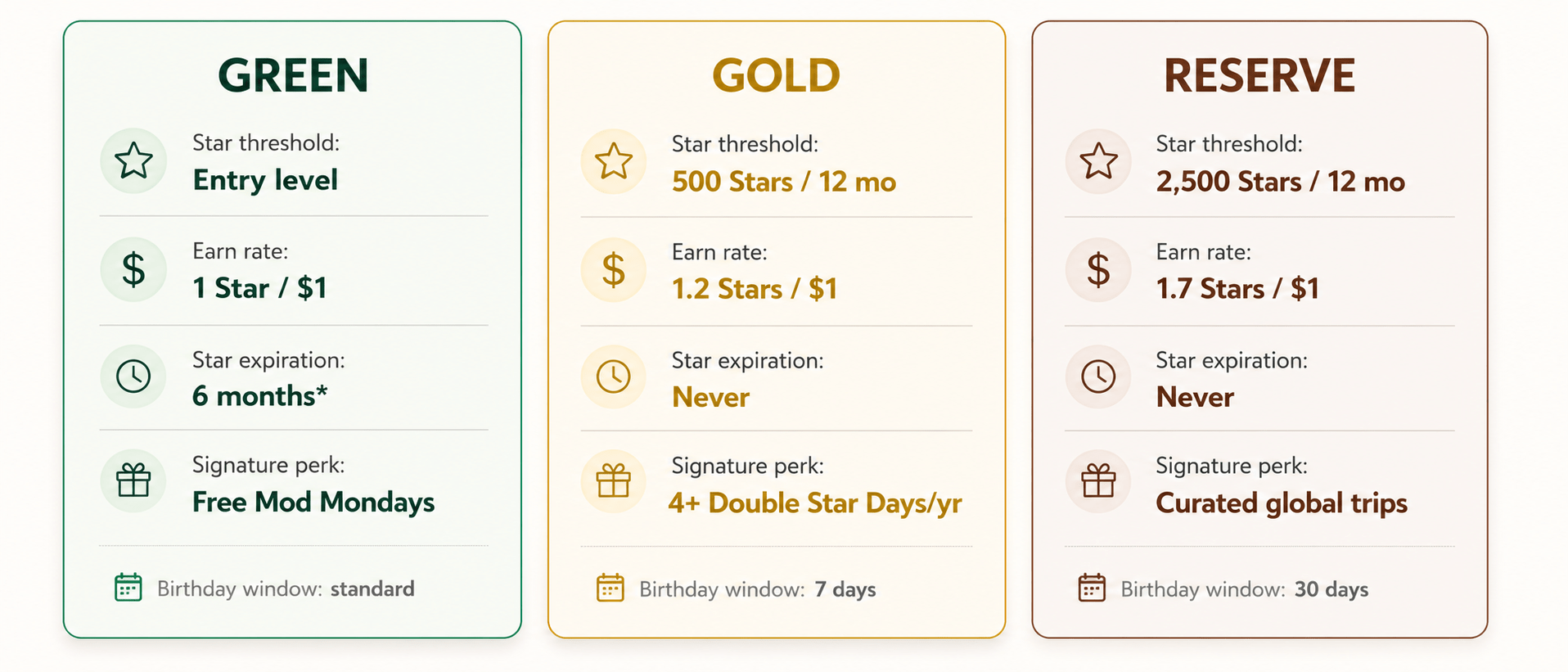 The figure compares the three Starbucks Rewards membership tiers across qualification requirements, earning rates, Star expiration policies, and member benefits, highlighting how rewards become more valuable as customers progress through the program.
- Higher tiers offer faster Star accumulation, longer reward validity, and increasingly exclusive benefits to encourage sustained engagement.
- The progression from transactional perks to premium experiences reinforces long-term loyalty and increases customer lifetime value.
Stars, redemption, and progression mechanics
Stars function as the program’s value-exchange currency. Per the Starbucks investor release from January 29, 2026, members can redeem 25 Stars for a small customization, 60 Stars for $2 off any item, 100 Stars for a drip coffee or bakery item, 200 Stars for a handcrafted beverage or hot breakfast item, 300 Stars for a sandwich or packaged coffee, and 400 Stars for select merchandise. The 60-Star tier is new for 2026 and was added specifically to give members a faster, lower-cost way to redeem value, based on member feedback.
This graduated redemption ladder gives members small wins early and larger wins as Stars accumulate, which is a standard progression-design pattern: frequent, low-cost rewards sustain motivation between rarer, higher-value ones.
Personalized offers and bonus-reward events
On top of the always-on Star system, Starbucks layers personalized offers and scheduled bonus events. Green members receive individually tailored offers and early access to select beverages and food. Gold and Reserve members receive additional Double Star Days, when purchases earn double the usual Stars. These mechanics can support higher perceived relevance and urgency, but Starbucks has not published details of the underlying targeting logic, so any claim about the specific algorithm would be speculation.
Campaign-based engagement, including Starbucks for Life and Starland
Starbucks distinguishes always-on Rewards mechanics from limited-time campaigns. The Starbucks investor release from January 29, 2026 describes Starbucks for Life as an ongoing game opportunity offered to Green-level members, tied to seasonal sweepstakes-style play. Starland, by contrast, is a historical augmented-reality star-collecting game: Today.com reported that Starbucks first launched it in March 2020, and Elite Daily’s coverage of a 50th-anniversary edition shows the game has been revived periodically since. Readers should not assume Starland is currently active; it should be treated as a recurring but not permanent feature until Starbucks confirms an active run.
| Feature | Always-on Rewards | Limited-time campaign |
|---|---|---|
| Availability | Continuous, tied to every purchase | Defined start and end dates |
| Example | Stars, tiers, redemption ladder | Starbucks for Life, Starland |
| Design purpose | Sustain habitual, repeat engagement | Create short-term spikes and novelty |
The mobile app as the experience layer
The Starbucks app is the interface through which members order, pay, track Stars, and view personalized offers. As the Starbucks investor release from January 29, 2026 notes, members can also view their progress toward the next level in the app or through their online account. Without a reliable, fast mobile experience, none of the underlying game mechanics would be visible to the customer in the moment that matters. Businesses evaluating a similar model typically need dedicated mobile app development capability to build and maintain that layer at scale.
4. The Gamification Model: From Mechanic to Business Outcome
Each mechanic is designed to influence a specific customer behavior, and each behavior connects to a business value that requires its own measurement. Mechanics can support outcomes; they do not guarantee them.
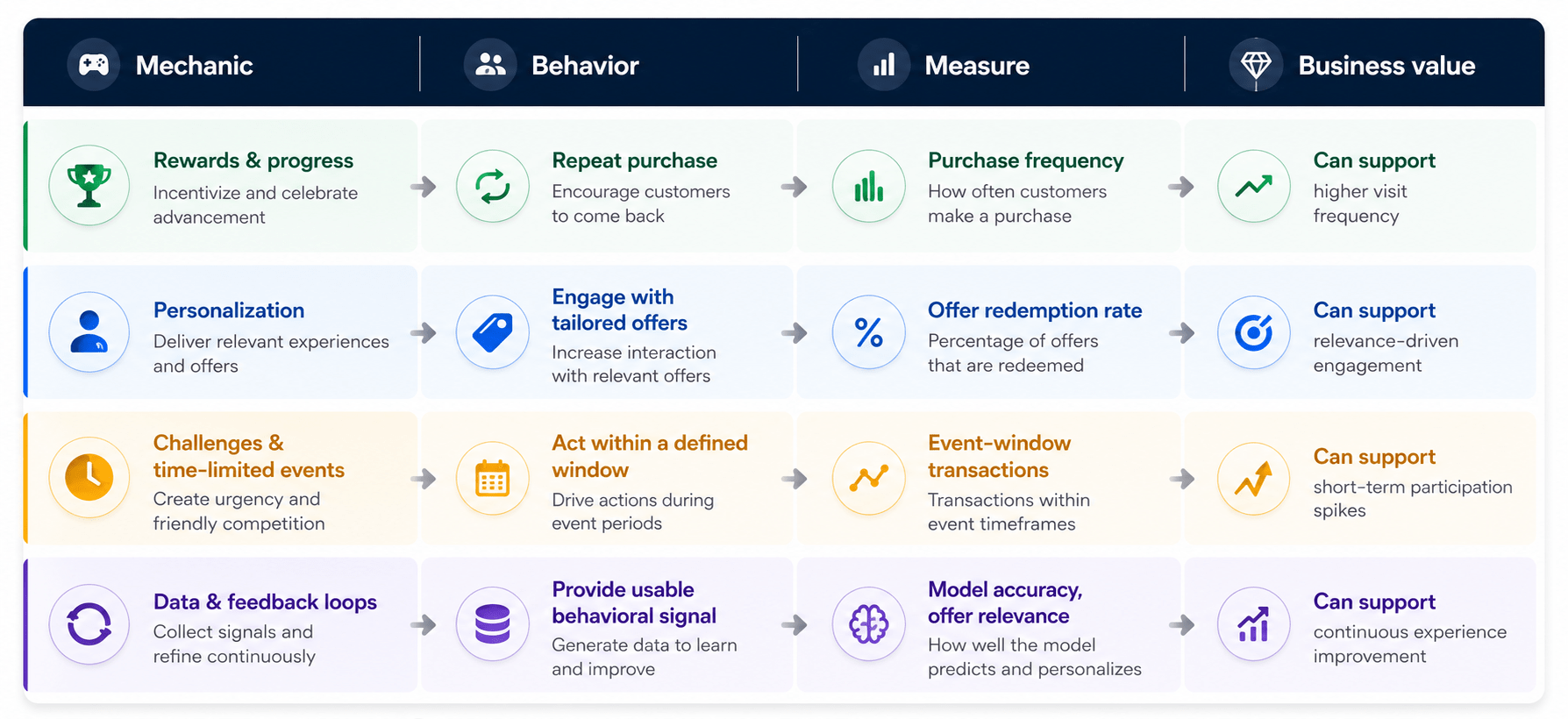 Effective gamification starts by linking each engagement mechanic to a specific customer behavior, a measurable success metric, and a business outcome. Rewards and progress, personalization, challenges, and feedback loops each serve a different role in driving customer engagement.
- Mapping mechanics to measurable behaviors enables evidence-based optimization rather than feature-driven design.
- Framing business value as what each mechanic can support encourages realistic performance evaluation instead of assuming guaranteed outcomes.
Rewards and progress → repeat purchase behavior
Visible progress toward a reward is designed to encourage another purchase before the momentum resets. This is the same principle SmartDev outlines in its gamification and business growth overview: intrinsic motivation grows when people can see themselves advancing.
Personalization → relevance and customer engagement
Tailored offers are designed to feel less like generic advertising and more like a benefit earned through membership. Modern personalization at this scale typically depends on machine learning models trained on purchase history, which is why SmartDev’s work in AI-driven gamification treats personalization engines as a core, not optional, component of a modern loyalty stack.
Challenges and limited-time events → participation and frequency
Double Star Days and seasonal games create a deadline, and deadlines are a well-documented lever for short-term action. The tradeoff is that campaign-driven spikes do not necessarily convert into durable habit change on their own.
Data and feedback loops → experience improvement
Every redemption, skipped offer, and app interaction generates a data point Starbucks can use to refine future offers. Turning that raw activity into usable signal requires data analytics capability built for continuous, high-volume transaction data, not a one-time analysis.
5. Customer and Employee Gamification: Two Distinct Use Cases
Starbucks applies game mechanics to two different audiences with two different goals: customers who need a reason to keep buying, and employees who need a reason to keep learning.
Customer-facing loyalty and digital engagement
Customer gamification, covered throughout this article, centers on participation and value exchange: purchase, earn, redeem, repeat. Its success measures are transactional — visit frequency, redemption rate, membership growth.
Employee learning and recognition: the Coffee Master program
Starbucks Coffee Master is a partner-facing (employee-facing) learning path focused on coffee knowledge, recognized historically with a black apron. According to the Starbucks Global Academy’s Coffee Academy overview, Starbucks has since folded this recognition into the Starbucks Coffee Academy, where eligible partners who complete Coffee Academy levels 100 through 300 and meet tenure and manager-recommendation requirements can still earn the black Coffee Master apron. Existing Coffee Masters keep their certification and apron under the current structure.
This is gamification aimed at capability development and recognition, not transactional frequency. Its success measures are training completion, certification rates, and manager-reported service quality, not Star redemptions.
| Dimension | Customer gamification | Employee gamification (Coffee Master) |
|---|---|---|
| Primary goal | Repeat purchase, retention | Coffee knowledge, service confidence |
| Core mechanic | Stars, tiers, redemption | Course levels, certification, apron recognition |
| Success measure | Visit frequency, redemption rate | Completion rate, manager recognition |
| Risk if overstated | Assuming gamification alone drives sales | Assuming certification alone drives service outcomes |
6. Evidence and Outcomes: What the Starbucks Case Shows
Reported program and engagement indicators
The company’s own investor release dated January 29, 2026 reports that Starbucks Rewards reached an all-time high of 35.5 million 90-day active members in the U.S. in its most recent quarter, Q1 fiscal year 2026. This is a program-wide membership figure, not an isolated measure of the gamification mechanics themselves.
What can and cannot be attributed to gamification
Evidence boundary: Starbucks has not publicly disclosed the isolated impact of its gamification mechanics on revenue, retention, or other business outcomes. Customer engagement and financial performance are influenced by many factors, including brand strength, store network, product offerings, and pricing. As a result, attributing specific performance improvements solely to gamification would go beyond the available evidence.
What the evidence supports: Starbucks designs Rewards to encourage repeat purchases and ongoing app engagement, and the company continues to expand the program as part of its customer engagement strategy. However, Starbucks has not disclosed how much individual mechanics, such as Stars, tier benefits, or challenges, contribute to business performance.
Evidence sources, dates, and interpretation notes
This article relies primarily on Starbucks’ own investor and press communications, dated January 29 and March 10, 2026, for all current program facts, and on independent reporting only for supporting context. Readers implementing similar programs should re-verify tier terms directly with Starbucks before citing them, since loyalty program terms change without notice.
7. Lessons for Loyalty and Customer-Engagement Leaders
The Starbucks case offers lessons that other businesses can adapt, but results will vary by context. Its scale, brand strength, and mobile ecosystem are competitive advantages that cannot be replicated directly.
Design for a clear value exchange
Members need to know exactly what a purchase earns and what that reward is worth. Starbucks’ published redemption ladder, from 25 to 400 Stars, keeps that exchange transparent at every tier.
Balance immediate rewards with long-term progression
Small, frequent rewards keep members engaged early; tier status keeps them engaged over months. Starbucks’ 60-Star tier addition for 2026 shows a business actively tuning that balance based on feedback.
Use personalization responsibly
Personalized offers should feel earned, not invasive. Businesses building this capability should document what data informs an offer and give members visibility into why they received it.
Measure behavior change, not participation alone
Sign-ups and app downloads are participation metrics, not proof of a shifted purchase pattern. Track visit frequency and basket size before and after gamified features launch, and use a proper customer journey mapping exercise to place each mechanic where it will register the clearest signal.
Separate evergreen strategy from campaign tactics
Keep the always-on loyalty system stable while campaigns rotate around it. Starbucks maintains the core Rewards loop as a constant and layers time-limited games like Starbucks for Life on top, rather than the reverse. For platforms with strong social or community dynamics, SmartDev’s work on social gamification shows how competitive and collaborative campaign mechanics can extend an evergreen loyalty base without replacing it.
8. What Is Changing in Starbucks Rewards
The 2026 tiered-program redesign
A Starbucks press release dated January 29, 2026 confirms the company announced the reimagined Rewards program that day and launched it across U.S. company-operated stores on March 10, 2026. The change replaced a single-tier model, where Star-earning was tied to payment type, with a three-tier structure where earning is tied to a member’s rolling 12-month Star total. Starbucks describes the update as a response to direct member feedback, particularly around Star expiration.
Implications for the Starbucks gamification case study
The redesign makes tier status the primary progression mechanic, replacing a flatter and less visible points-based structure. As a result, Starbucks Rewards now provides a clearer example of tiered gamification for businesses evaluating modern loyalty strategies. When using this case for research or benchmarking, treat March 10, 2026 as the transition point between the legacy program and the current design.
FAQ
How does Starbucks use gamification?
Starbucks incorporates gamification through its loyalty program and mobile app by combining Stars, tiered membership, personalized offers, and time-limited challenges. Each purchase advances members through a visible progression, reinforcing engagement with immediate and long-term rewards.
Is Starbucks Rewards a gamified loyalty program?
Yes. Starbucks Rewards applies core gamification mechanics, including points, levels, progress tracking, and rewards, within its loyalty program. Rather than functioning as a standalone game, these mechanics are designed to influence customer behavior and encourage long-term engagement.
What game mechanics does Starbucks use?
The program combines Star accumulation, a tiered redemption ladder, and three membership levels with progressively faster earning rates. It also incorporates Double Star Days, personalized offers, and recurring campaigns such as Starbucks for Life and the former Starland promotion.
What can other businesses learn from Starbucks Rewards?
Build a transparent value exchange and balance frequent rewards with long-term tier progression. Personalize responsibly, measure meaningful behavior change instead of sign-ups, and maintain a stable loyalty foundation while refreshing campaigns over time.
Conclusion
The Starbucks case demonstrates that effective gamification is an integrated system rather than a standalone feature. Value exchange, progression, personalization, and digital delivery work together, with each element requiring deliberate design and ongoing measurement.
The 2026 tier redesign shows that even mature loyalty programs continue to evolve based on member feedback. Businesses should adapt the underlying principles to their own customer journeys. Replicating Starbucks’ tier structure is less effective because it reflects the company’s unique scale, brand equity, and data capabilities.
Explore Customer Engagement Solutions with SmartDev
Thinking about how progress tracking, personalization, or a rewards system could fit your own customer journey? SmartDev builds the AI and machine learning, mobile app, and generative AI foundations that make a gamified engagement strategy possible, and our case studies show how we’ve delivered this kind of work for other clients. Tell us more about your engagement goals and we’ll help you evaluate the right approach.