
En bref :
- A multi-agent system is a network of AI agents that each handle specific tasks, working together to complete complex business processes automatically.
- It moves AI from single-task chatbots to end-to-end automation across departments like HR, finance, procurement, and customer service.
- Businesses adopting multi-agent systems can reduce manual process steps and scale AI-driven workflows across their entire operation.
Multi-agent systems represent the next stage of enterprise AI adoption. Rather than relying on a single AI tool for isolated tasks, businesses are deploying networks of coordinated AI agents to run entire workflows autonomously. This guide explains what a multi-agent system is, why it matters for business leaders, how it works, and who benefits most.
What is a Multi-Agent System?
A multi-agent system is a framework in which multiple AI agents, each specialized for a specific task, work together to complete complex, multi-step processes without constant human oversight. Each agent in the system handles a defined role. One agent might gather data, another validate it, a third execute a transaction, and a fourth ensure compliance. These agents communicate with each other, delegate subtasks, and coordinate actions to achieve a shared goal. Multi-agent systems differ from single AI tools by their ability to handle entire business workflows rather than isolated queries. They are designed to scale across departments, handling tasks in parallel and adapting to changing inputs in real time.
Pourquoi c'est important pour les entreprises
Most enterprise operations involve complex, multi-step processes that cross department boundaries. A single AI tool cannot handle that complexity. Multi-agent systems can.
- Reduce manual handoffs between departments by automating end-to-end workflows that previously required human coordination.
- Increase throughput by running multiple tasks simultaneously across agents, completing in minutes what might take a team hours.
- Améliorer la précision by assigning each task to a specialized agent trained for that specific function, reducing errors from generalist handling.
- Accelerate AI ROI by extending automation beyond single-task pilots into full operational workflows.
For example, Capital One deployed multi-agent workflows to automate procurement and compliance processes, embedding agents directly into operational systems. This allowed teams to focus on exception handling rather than routine task execution, reducing processing time significantly across high-volume workflows.

How Does a Multi-Agent System Work?
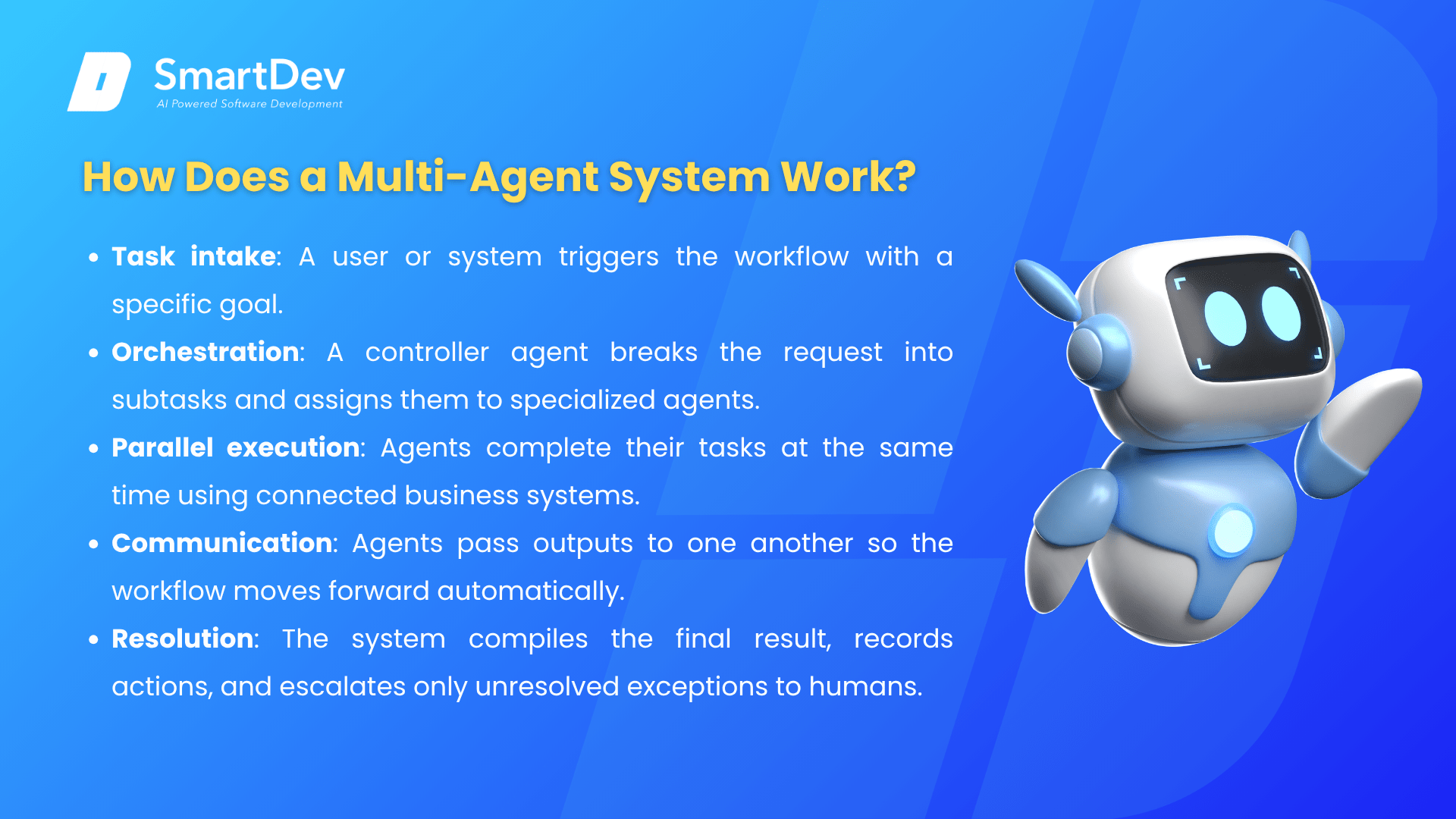
- Task intake: A user or system triggers the workflow with a goal, such as processing a vendor invoice or responding to a customer support escalation.
- Orchestration: A controller agent receives the request, breaks it into subtasks, and delegates each to the appropriate specialized agent.
- Parallel execution: Specialized agents work simultaneously on their assigned subtasks, pulling data from integrated systems and taking defined actions.
- Communication: Agents share outputs with each other as needed, so one agent’s result feeds the next step automatically.
- Resolution: The system assembles the final output, logs the actions taken, and escalates to a human only when the workflow encounters an exception it cannot resolve.
The result is an autonomous, auditable workflow that operates continuously without manual coordination between steps.
Who Uses Multi-Agent Systems?
Multi-agent systems are most valuable for enterprises managing high-volume, cross-departmental processes where speed and consistency are critical.
Industries: Financial services companies use multi-agent systems for transaction processing and compliance monitoring. Healthcare organizations deploy them for patient intake, billing coordination, and claims processing. Logistics companies use them to coordinate supply chain events across procurement, warehouse, and delivery systems.
Roles: Chief Operating Officers and Chief Technology Officers driving enterprise AI strategies use multi-agent systems as the foundation for operational automation. IT Directors evaluating AI infrastructure choose multi-agent architectures when they need systems that scale across business units. Operations managers in large enterprises benefit directly from the reduction in manual coordination that multi-agent workflows deliver.

Autres termes associés
- Agent IA: A single autonomous AI program designed to perform a specific task or set of tasks, and the basic building block of a multi-agent system.
- Probabilistic Output: AI may generate different valid answers for the same input because it predicts likely responses, not fixed rules. In multi-agent systems, each agent’s output can vary, so the final result depends on how agents interpret, pass, and refine information.
- Prompt Engineering: The practice of designing clear instructions so AI understands the task, context, and expected output. In multi-agent systems, prompts define each agent’s role, responsibility, workflow, and how agents communicate with each other.