

Introduction
Most SMEs budget for AI like they’re buying software—one price, done deal. But here’s the reality: ongoing costs often exceed initial development for most enterprise AI initiatives.
The problem isn’t dishonest vendors (well, mostly). It’s that AI implementation resembles adopting a new employee more than installing software. You need training, ongoing support, regular updates, and infrastructure that grows with your business. Businesses routinely underestimate AI project costs when scaling from pilot to production when focusing solely on development expenses.
This guide therefore does not repeat the misleading claim that every SME should expect the same five-year total. It provides a scope classifier, qualified planning signals, a five-year total cost of ownership model, and decision gates for determining whether the investment should proceed.
TL;DR:
Classify Project Scope First: Tailor budgets to the specific project type (e.g., pilot vs. production workflow), as different scopes cannot be compared using the same baseline.
Budget for Five-Year TCO, Not First-Year Costs: Account for long-term expenses like ongoing usage, support, monitoring, retraining, and governance from the start.
Include Adoption Expenses explicitly: Treat training, workflow redesign, and change management as essential budget lines necessary to unlock actual value.
Validate in Phases Before Full Funding: Prove value at the smallest viable scale to minimize financial risk before committing to a complete rollout.
Address Data Readiness Early: Clean up and govern fragmented data first, as poor data quality is often the primary bottleneck for technical execution.
Establish Baselines, Stage Gates, and Contingencies: Measure the “before” state to verify ROI, set clear pause/proceed checkpoints, and allocate buffers for unforeseen legacy or compliance costs.
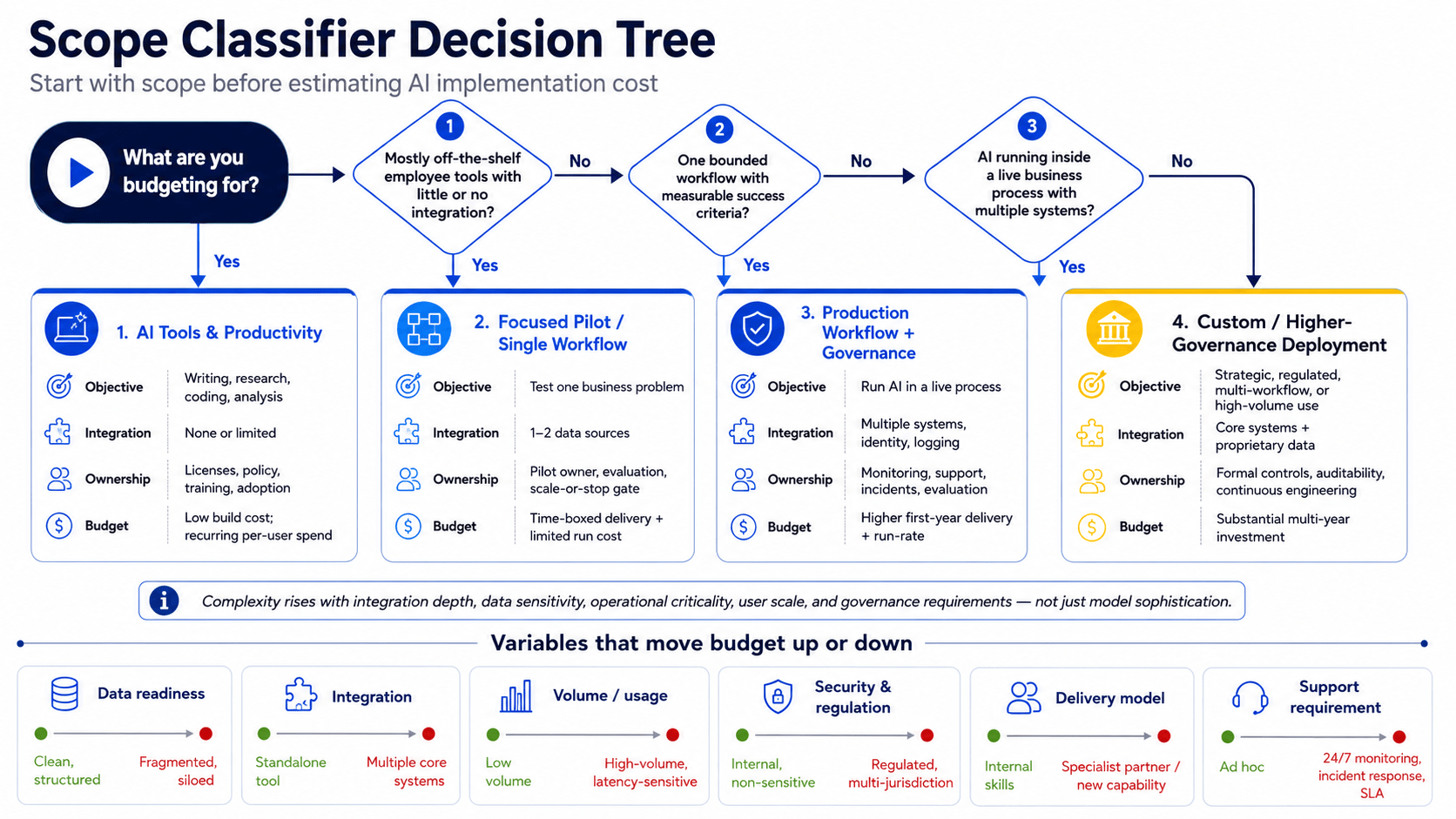
1. Start With Scope: Which AI Implementation Are You Budgeting For?
Before any number is useful, classify what you’re actually funding. Deployment complexity rises with integration depth, data sensitivity, operational criticality, user scale, and governance requirements — not with how advanced the underlying model is.
| Scope | Typical Objective | Integration | Operational Ownership | Budget Pattern |
| AI tools and productivity use cases | Assist employees with writing, research, coding, or analysis | None or limited | License admin, policy, training, adoption | Low initial engineering; recurring per-user cost |
| Focused pilot or single workflow | Test one measurable business problem | One or two data sources | Pilot owner, evaluation, scale-or-stop decision | Time-boxed delivery plus limited operating cost |
| Production workflow with governance | Run AI inside a live business process | Multiple systems, identity, logging | Monitoring, support, incidents, evaluation | Higher first-year delivery and recurring run-rate |
| Custom or higher-governance deployment | Support strategic, regulated, multi-workflow, or high-volume use | Core systems and proprietary data | Formal controls, auditability, continuous engineering | Substantial multi-year capability investment |
1.1 AI tools and employee productivity use cases
This is lightweight adoption: deploying existing tools — a chat assistant, a coding copilot, a writing tool — with limited or no custom integration. Cost drivers here are licenses, onboarding, usage policy, and change management, not custom engineering.
This path is not automatically appropriate for sensitive, regulated, or core operational workloads. Review vendor security, privacy, data retention, and compliance documentation before deploying tools across customer-facing or data-intensive teams.
1.2 A focused AI pilot or single workflow
A focused pilot tests one clearly defined business problem through a bounded workflow with measurable success criteria. A credible pilot includes a baseline, an accountable owner, approved data access, defined evaluation methods, user feedback channels, and an explicit scale-or-stop decision gate.
A prototype proves that a feature can be built. A pilot tests operational value, adoption rate, reliability, and governance readiness. That distinction matters because production planning requires support, monitoring, maintenance, and recurring-cost assumptions from the start — a prototype budget does not.

1.3 A Production Workflow with Integrations and Governance
This is the shift from a proof of value to an operating system. Integration, identity and access management, monitoring, security controls, support ownership, evaluation cadence, and incident response all become recurring requirements — not one-time deliverables. These elements can materially increase generative AI implementation costs for SMEs, especially when the workflow connects to customer data or core business systems. See Section 3 for how these translate into a total cost of ownership model.
For implementations involving AI integration into core systems, plan both the delivery and the ongoing operations from the outset.
1.4 A custom, multi-workflow, or regulated deployment
Bespoke, high-volume, multi-system, or regulated work requires a different planning model entirely. Multiple integrations, proprietary data, auditability requirements, and safety controls raise both the delivery cost and the ongoing engineering burden. Gartner notes that hidden costs — inference at scale, legacy system integration, and ongoing governance — tend to surface only after the pilot ends, which is exactly why this tier needs its own budget model rather than a scaled-up pilot estimate.
If your initiative touches regulated data categories — financial, health, or personal data under GDPR or equivalent frameworks — treat any legal or compliance conclusion as something to confirm with qualified counsel in your jurisdiction. Vendor content supports planning; it does not substitute for specialist legal, security, or regulatory guidance.
1.5 The variables that move an SME AI budget up or down
These variables interact. A project with low integration complexity but poor data readiness can cost as much as one with clean data but multiple integrations. They do not add up linearly.
| Variable | Lower complexity | Higher complexity |
|---|---|---|
| Data readiness | Clean, structured, accessible | Fragmented, siloed, needs governance work |
| Integration | Standalone tool | Multiple core systems, legacy platforms |
| Volume / usage | Low query volume | High-volume, latency-sensitive inference |
| Security & regulation | Internal, non-sensitive data | Regulated data, multi-jurisdiction compliance |
| Delivery model | Internal team, existing skills | Specialist partner, net-new capability build |
| Support requirement | Ad hoc | 24/7 monitoring, incident response, SLA |
2. The Direct Answer: First-Year and Five-Year AI Cost Ranges by Scope
There is no responsible universal price range for “generative AI implementation.” Public pricing can support a reliable license example and a directional project benchmark. Integrated and higher-governance deployments require a scope-specific estimate because public sources do not define them consistently.
2.1 How to interpret cost ranges and assumptions
No two quotes are directly comparable unless they specify the same use case, integrations, data condition, compliance scope, usage volume, operating model, delivery geography, and support period. Before comparing estimates, confirm what each one includes and excludes. The terms “cost estimate,” “budget,” “quote,” and “TCO” answer different questions and should not be used interchangeably in planning conversations.
2.2 Illustrative budget scenarios for SMEs
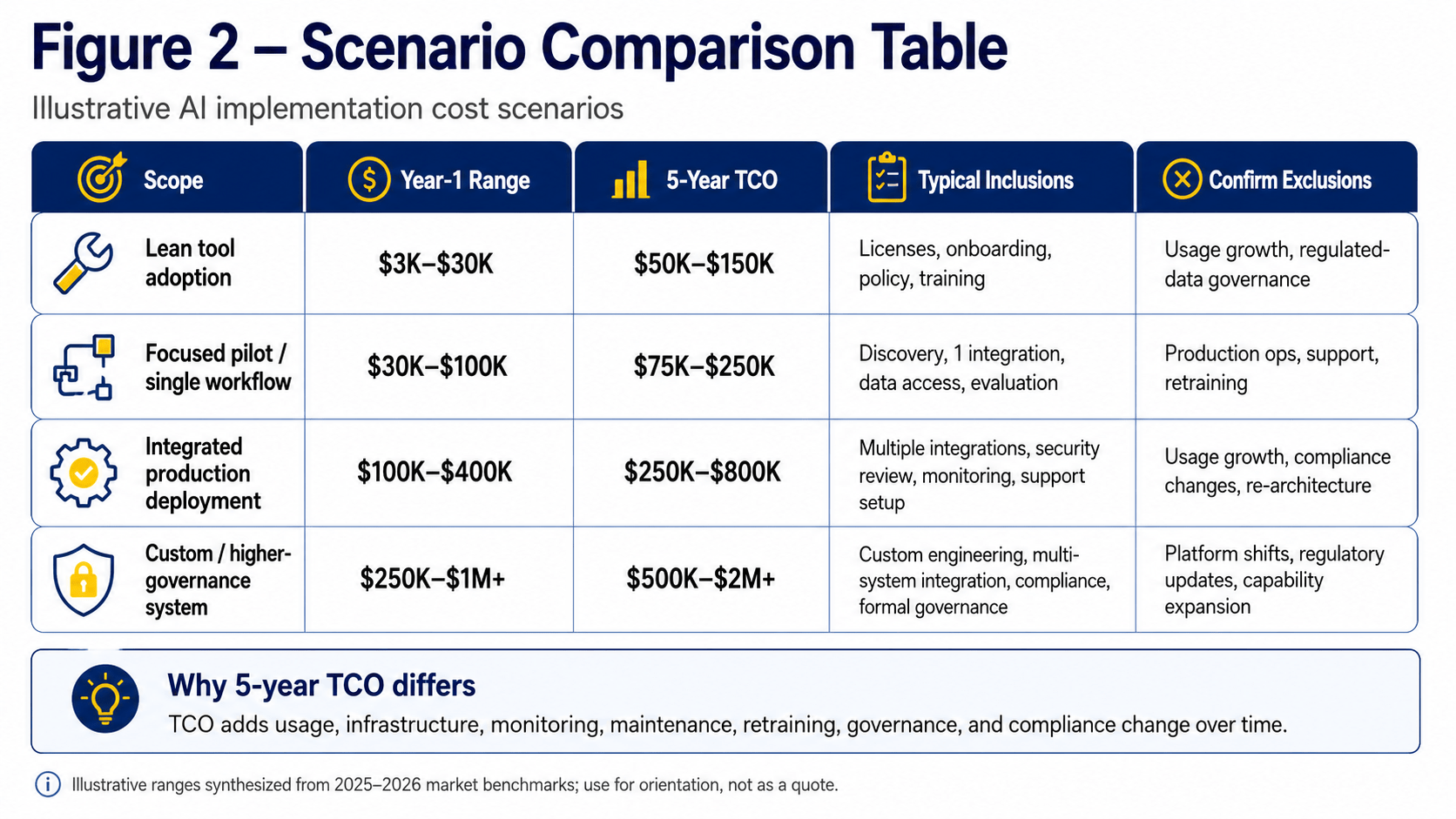
The ranges below are illustrative planning bands, synthesized from published 2026 industry cost guides — not quotes, not guarantees, and not a substitute for a scoped estimate from a delivery partner. Actual figures depend on the variables in Section 1.5.
| Scope | Illustrative Year-1 range | Illustrative 5-year TCO | Typical inclusions | Key exclusions to confirm |
|---|---|---|---|---|
| Lean tool adoption | Low thousands to ~$30K | ~$50K–$150K | Licenses, onboarding, policy documentation, and basic training | Volume-based usage growth and governance upgrades for regulated data |
| Focused pilot / single workflow | ~$30K–$100K | ~$75K–$250K | Discovery, one integration, data access, and an evaluation framework | Production operating costs, support, and retraining |
| Integrated production deployment | ~$100K–$400K | ~$250K–$800K | Multiple integrations, security review, monitoring setup, and support structure | Ongoing usage growth, compliance changes, and major re-architecture |
| Custom / higher-governance system | $250K–$1M+ | $500K–$2M+ | Bespoke engineering, multi-system integration, compliance engineering, and formal governance | Platform-generation changes, regulatory updates, and capability expansion |
*Ranges synthesized from Iternal’s generative AI consulting cost breakdown (2025–2026), Truvisory’s mid-market AI implementation benchmarks (2025–2026), and InData Labs generative AI cost analysis (2025). Each source covers primarily North American and Western European markets; costs in other geographies will differ.
2.3 Why a five-year total is different from an initial project quote
A delivery quote typically covers discovery through launch. Five-year TCO also includes model and API usage, infrastructure, monitoring, maintenance, retraining, governance, change management, and any significant platform or compliance changes over the life of the system.
Whether the five-year total substantially exceeds the initial build depends on usage growth, integration count, regulatory change, and how much the operating model evolves — it is not a fixed multiple. Vendors who offer a universal five-year multiplier should be asked to show the assumptions behind it, including geography, scope, usage volume, and support model.
3. Build the Total Cost of Ownership Model
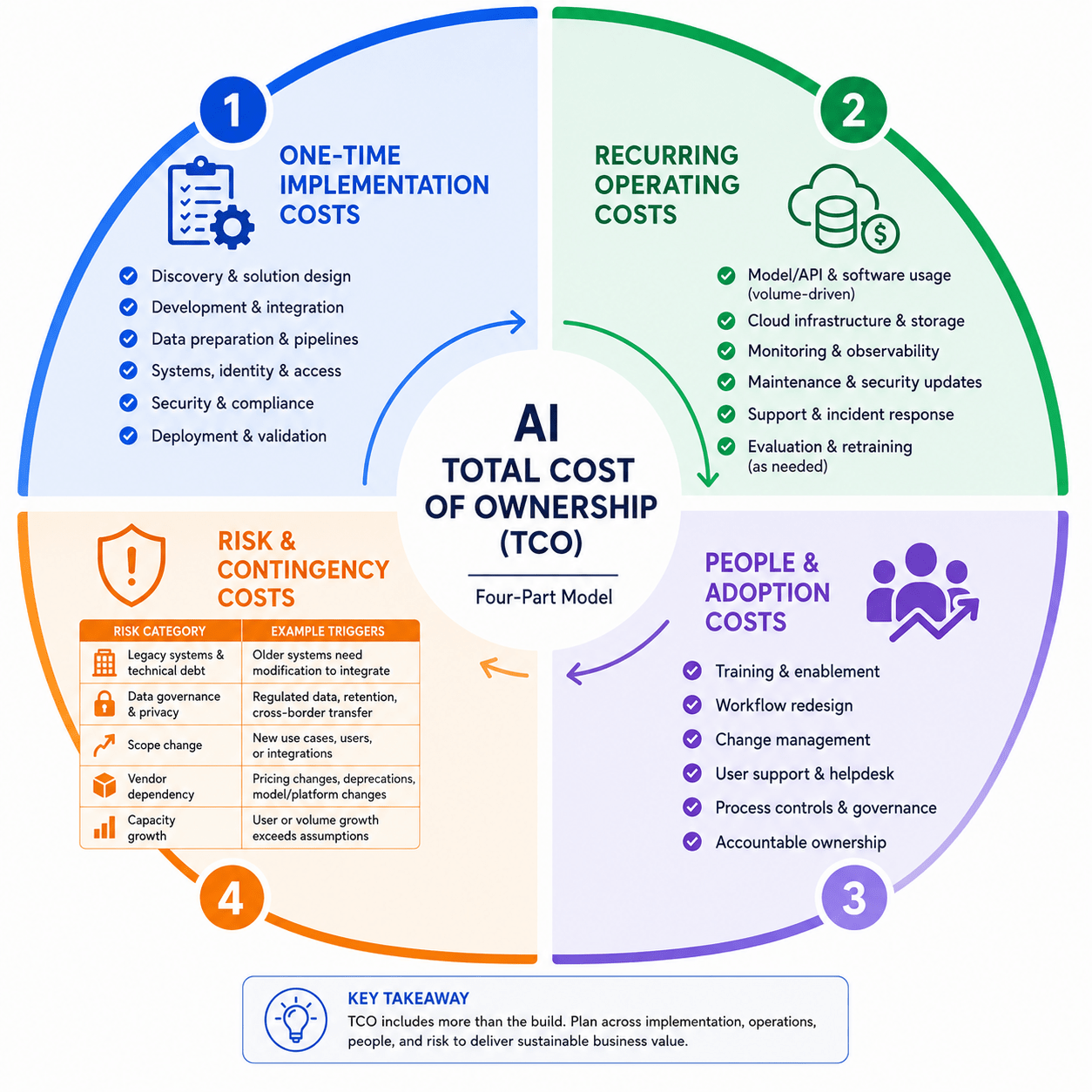
A complete AI budget has four parts: one-time implementation costs, recurring operating costs, people and adoption costs, and risk and contingency costs. These categories overlap in practice and each requires a named owner — not just a budget line.
3.1 One-time implementation costs
What a production deployment quote should include:
- Discovery, use-case selection, and solution design
- Development or configuration and integration testing
- Data preparation, cleansing, and pipeline setup
- Integration work for systems, identity, and access
- Security review and compliance configuration
- Deployment and initial performance validation
Important: Data cleanup and integration work often continue beyond initial launch rather than completing at go-live. Build that into the plan rather than treating it as a one-time, bounded scope. For organizations with significant data engineering needs, that work typically needs to begin before AI development starts.
3.2 Recurring operating costs
Post-launch, the following become ongoing ownership:
- Model/API and software usage fees (volume-driven; per-1K-token rates for major providers currently range from roughly $0.0001 to $0.015 depending on model tier (source: InData Labs generative AI cost analysis), 2025 — but usage volume, not sticker price, typically drives the recurring bill)
- Cloud infrastructure and storage
- Monitoring, observability, and alerting
- Maintenance, bug fixes, and security patches
- Support coverage and incident response
- Periodic evaluation and retraining as data or requirements change
Avoid assuming a fixed retraining frequency or a universal rate at which model performance degrades. Both depend on your specific data, workflow, and business change rate. Retraining needs should be tied to measured performance indicators and business-change triggers, not a calendar schedule.
3.3 People and adoption costs
Training, workflow redesign, stakeholder alignment, user support, process controls, and accountable ownership all affect whether the technology delivers business value. These are planned investments, not afterthoughts.
Under-budgeting adoption is one of the more common reasons pilots stall before scaling. McKinsey’s 2025 State of AI report found that workflow redesign was strongly associated with measurable financial impact from generative AI — organizations that redesigned surrounding processes consistently outperformed those that deployed the tool without process change. (McKinsey, “The State of AI,” 2025)
3.4 Risk and contingency costs
Budget contingency as a planning exercise tied to your specific risk register, not as a fixed percentage applied automatically. Common triggers that expand total cost include:
| Risk category | Example triggers | Planning implication |
|---|---|---|
| Legacy systems and technical debt | Older systems must be modified to connect with modern AI platforms | Conduct integration discovery before finalizing the estimate |
| Data governance and privacy | Regulated data, retention obligations, or cross-border transfers | Involve legal or compliance specialists before solution design |
| Scope change | New use cases, user groups, or integrations added mid-project | Establish a formal change-control process with clear cost implications |
| Vendor dependency | Pricing changes, deprecations, or model updates | Review contract terms and maintain a migration path |
| Capacity growth | User or transaction volumes exceed initial assumptions | Include scaling costs in the Year 2–3 plan, not only Year 1 |
4. What the Five-Year Cost Journey Can Look Like
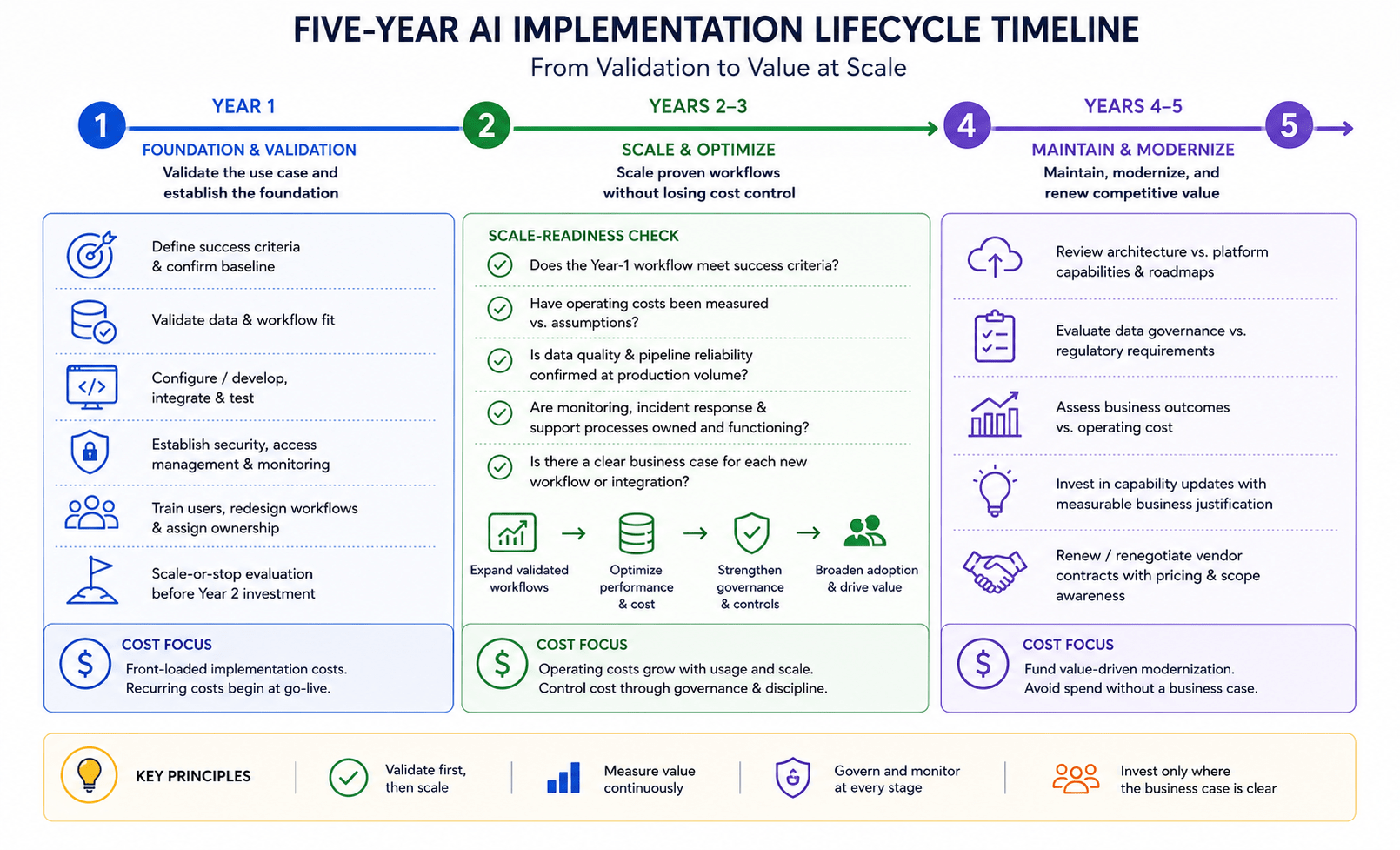
Cost patterns shift across a five-year deployment — from setup-heavy in Year 1, to operational scaling in Years 2–3, to modernization and performance stewardship in Years 4–5. The exact shape depends on adoption rate, usage growth, integration changes, and business priorities. Use “can” and “often under these conditions” as your framing — not fixed annual outcomes.
4.1 Year 1: Validate the Use Case and Establish the Foundation
Year-1 activities determine whether the initiative can scale. Key milestones:
- Define measurable success criteria and confirm the business baseline (see Section 6.2)
- Validate data and workflow fit before committing to the full build
- Configure or develop, integrate, and test the system
- Establish security controls, access management, and monitoring
- Train initial users, redesign surrounding workflows, assign operating ownership
- Conduct a scale-or-stop evaluation before Year 2 investment
Cross-reference Section 1 for scope classification and Section 3 for the cost categories that apply to Year-1 delivery. Year-1 costs are front-loaded; recurring costs begin at go-live.
4.2 Years 2–3: Scale Proven Workflows Without Losing Cost Control
Expand only from workflows validated in Year 1. Controlled scale requires governance, usage monitoring, and operating discipline — not just feature additions.
Scale-readiness questions:
- Does the Year-1 workflow meet the success criteria defined before launch?
- Have operating costs (usage, infrastructure, support) been measured against assumptions?
- Is data quality and pipeline reliability confirmed at production volume?
- Are monitoring, incident response, and support processes owned and functioning?
- Is there a clear business case for each new workflow or integration being added?
Scaling too early — before Year-1 validation is complete — is one of the most common causes of budget overrun in this phase. Cost increases in Years 2–3 are normal when scaling a validated workflow; they are a warning sign when scaling a workflow that has not yet proven its value.
4.3 Years 4–5: Maintain, Modernize, and Renew Competitive Value
Cloud infrastructure for AI workloads require deliberate review rather than passive continuation. Year-4–5 activities:
- Review architecture against current platform capabilities and vendor roadmaps
- Evaluate data governance posture against current regulatory requirements
- Assess whether business outcomes still justify the operating cost
- Plan capability updates only where there is a measurable business justification
- Renew or renegotiate vendor contracts with current pricing and scope awareness
“Competitive maintenance” is not an inevitable spend category. Each investment decision at this stage should be justified by a business case, not assumed as a cost of continuing to operate.
4.4 Events that change the cost trajectory
These are the most common triggers that cause actual spend to diverge from initial assumptions. Each maps to a TCO category in Section 3.
| Event | Primary TCO impact | Action |
|---|---|---|
| New integration or system connection | One-time implementation and recurring operating costs | Rescope and re-estimate before committing |
| New users or business units | Usage fees, support, training, and licensing | Include volume growth in the run-rate plan |
| Vendor model or platform change | Recurring operating costs and possible re-engineering | Monitor contract changes and maintain migration paths |
| Higher usage volumes | Inference, API, and infrastructure costs | Review actual usage against the plan monthly |
| New compliance requirement | Contingency costs and possible re-architecture | Engage a compliance specialist and assess design impact |
| Expansion from one workflow to a platform | All TCO categories | Treat it as a new scoping exercise, not a simple cost extension |
5. Hidden Cost Drivers That Common Budgets Miss
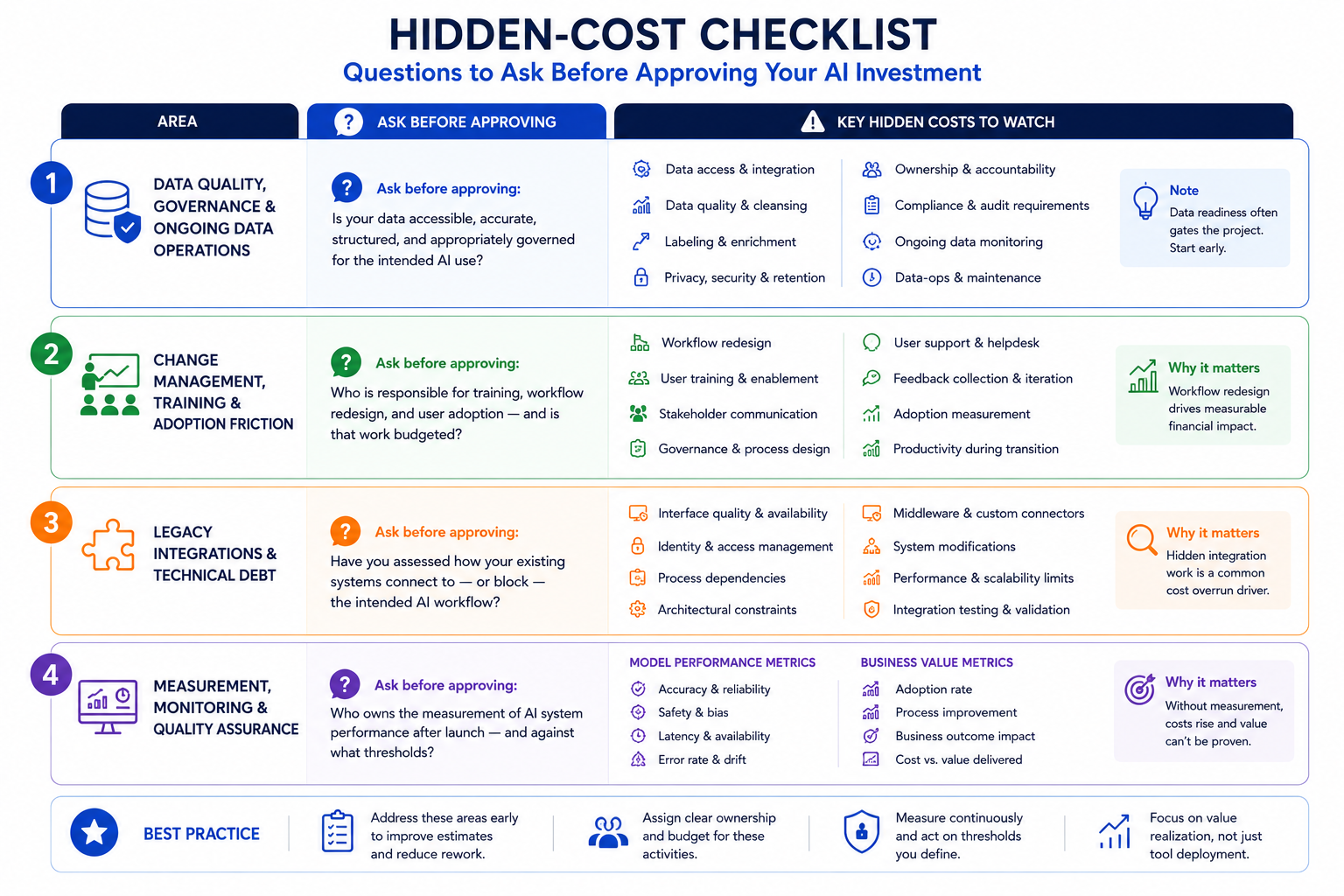
These are the budget omissions most commonly identified in post-project reviews — not a repeated list of TCO categories. Ask these questions before the budget is approved.
5.1 Data quality, governance, and ongoing data operations
Ask before approving: Is your data accessible, accurate, structured, and appropriately governed for the intended AI use?
Data access, quality, labeling, structure, privacy controls, retention obligations, ownership accountability, and continuous monitoring are all prerequisites for reliable AI operation — not optional enhancements. Many organizations discover that data readiness is the gating constraint after the AI development work has already started.
Data analytics, cleansing, and governance work often need to begin before AI development starts, not alongside it. Treating these tasks as early priorities reduces rework, integration delays, and avoidable cost overruns. See SmartDev’s Data Analytics Services for data-readiness assessment support.
Do not assume a fixed data-preparation cost multiplier. The effort depends heavily on how your data is structured, where it lives, who owns it, and what compliance obligations govern it.
5.2 Change management, training, and adoption friction
Ask before approving: Who is responsible for training, workflow redesign, and user adoption — and is that work budgeted?
Deploying a tool without changing the surrounding process consistently weakens adoption and reduces returns. Budget for workflow redesign, stakeholder communication, user training, governance structures, user support, and structured feedback loops. McKinsey’s 2025 State of AI report found that organizations that redesigned workflows in conjunction with AI deployment reported measurably stronger financial impact than those that did not. (McKinsey, “The State of AI,” 2025)
Avoid unsupported productivity-loss percentages and fear-based language. Budget adoption work because it drives value, not because failure is inevitable.
5.3 Legacy integrations and technical debt
Ask before approving: Have you assessed how your existing systems connect to — or block — the intended AI workflow?
Interface quality, data availability, identity management, process dependencies, and architectural constraints all influence effort and risk. Older systems were not built to connect to modern AI platforms; the integration and modification work required is genuinely context-specific, not a universal tax on every project.
A focused integration discovery exercise can reveal hidden constraints, improve estimates, and prevent avoidable delays — often at a small fraction of the total project cost. For custom software development and AI integration projects specifically, integration discovery should happen before final scoping.
5.4 Measurement, monitoring, and quality assurance
Ask before approving: Who owns the measurement of AI system performance after launch — and against what thresholds? A production AI system needs ongoing measurement across two dimensions:
- Model performance metrics: Is the system working correctly — accuracy, reliability, safety, latency, error rate?
- Business value metrics: Is the system worth what it costs — adoption rate, process improvement, business outcome impact?
Define review ownership, measurement frequency, and intervention thresholds before go-live. Without continuous measurement, problems remain hidden, costs can rise undetected, and decision-makers may continue funding workflows that no longer deliver sufficient value.
6. How to Estimate ROI Before You Commit
ROI is a measurable investment decision, not a percentage promised at the outset. The framework below gives you the inputs you actually need.
6.1 Define the business outcome before selecting the AI solution
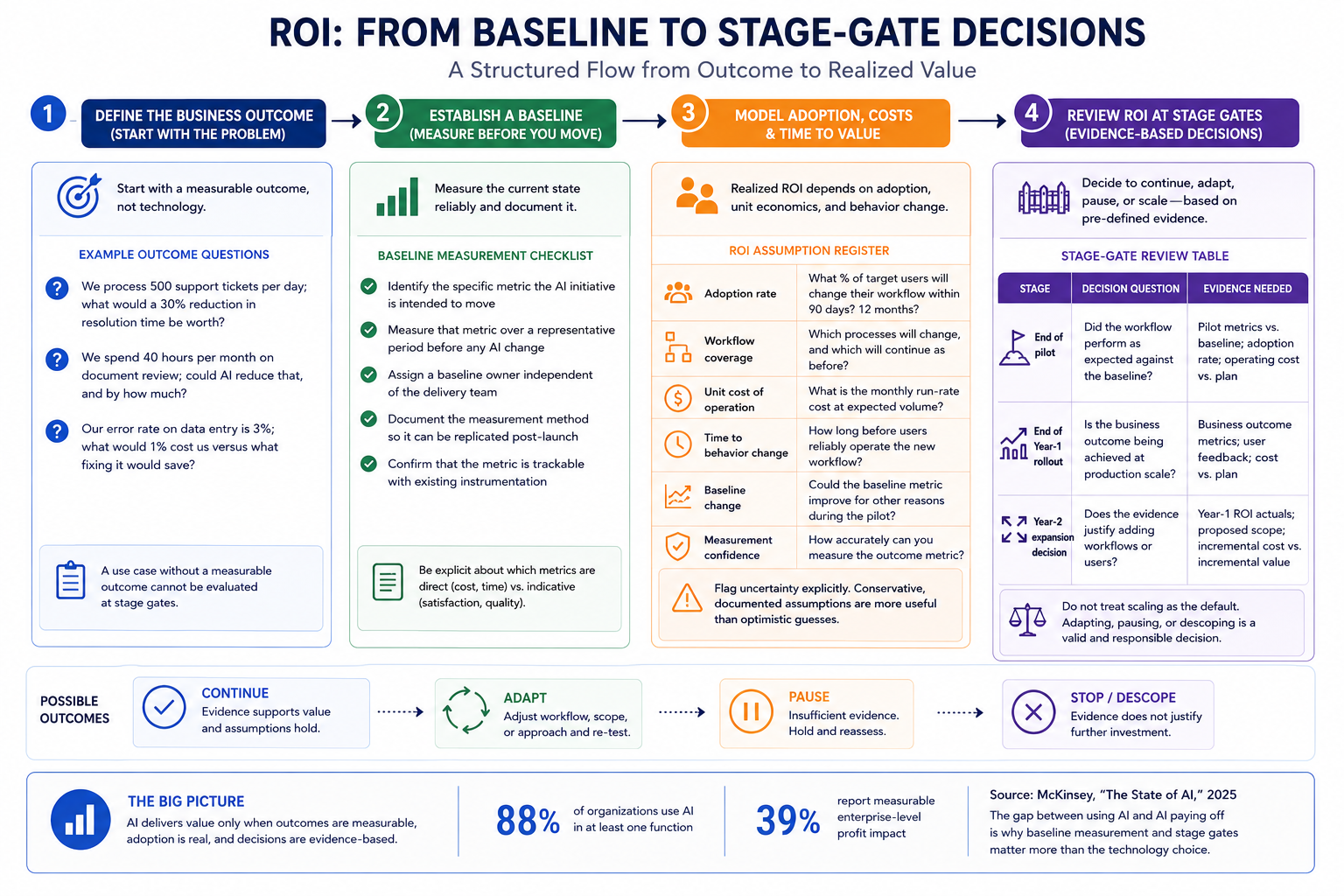
Start with a measurable problem — cycle time, error rate, service capacity, conversion rate, risk exposure, or cost to serve — rather than a technology category or a vendor. The use case follows from the outcome, not the other way around.
Examples of well-scoped outcome questions:
- “We process 500 support tickets per day; what would a 30% reduction in resolution time be worth?”
- “We spend 40 hours per month on document review; could AI reduce that, and by how much?”
- “Our error rate on data entry is 3%; what would 1% cost us versus what fixing it would save?”
6.2 Establish a baseline for cost, time, quality, risk, or revenue
Baselines must be measured before rollout, over a comparable time period, with an accountable owner. Without a real baseline, any ROI claim after launch is unverifiable. Baseline measurement checklist:
Identify the specific metric the AI initiative is intended to move
Measure that metric over a representative period before any AI change
Assign a baseline owner who is independent of the delivery team
Document the measurement method so it can be replicated post-launch
Confirm that the metric is trackable with existing instrumentation
Not every outcome can be monetized with equal confidence. Be explicit about which metrics are direct (cost, time) and which are indicative (satisfaction, quality scores).
6.3 Model adoption, operating costs, and time to value
Realized ROI depends on uptake, workflow fit, unit economics, ongoing operating costs, and how long it takes people to change behavior. Two organizations with identical software can see very different returns based on adoption alone. ROI assumption register:
| Assumption | Question to answer explicitly |
|---|---|
| Adoption rate | What percentage of target users will adopt the new workflow within 90 days and 12 months? |
| Workflow coverage | Which processes will change, and which will remain unchanged? |
| Unit cost of operation | What is the expected monthly run-rate cost at target volume? |
| Time to behavior change | How long will users take to use the new workflow reliably? |
| Baseline change | Could the baseline metric improve for reasons unrelated to the pilot? |
| Measurement confidence | How accurately can the outcome metric be measured? |
6.4 Review ROI at pilot, rollout, and scale milestones
Set stage gates in advance: continue, adapt, pause, or scale, based on evidence defined before the project started — not on enthusiasm partway through it.
On the broader question of whether AI investments pay off: McKinsey’s 2025 global survey found 88% of organizations now use AI in at least one business function, but only around 39% report any measurable enterprise-level profit impact from it. The gap between “using AI” and “AI paying off” is exactly why baseline measurement and stage gates matter more than the technology choice itself.
Set stage gates in advance. At each gate, the decision is: continue, adapt, pause, or scale — based on evidence defined before the project started, not on enthusiasm partway through it.
| Stage | Decision question | Evidence needed |
|---|---|---|
| End of pilot | Did the workflow perform as expected against the baseline? | Pilot results vs. baseline, adoption rate, and operating cost vs. plan |
| End of Year 1 rollout | Is the business outcome being achieved at production scale? | Business outcome metrics, user feedback, and cost vs. plan |
| Year 2 expansion decision | Does the evidence justify adding workflows or users? | Year 1 ROI actuals, proposed scope, and incremental cost vs. value |
Do not treat scaling as the default outcome. Adapting, pausing, or descoping is a valid and responsible decision when the evidence supports it.
On the broader question of AI returns: McKinsey’s 2025 global State of AI survey found that 88% of organizations now use AI in at least one function, but only approximately 39% report measurable enterprise-level profit impact. (McKinsey, “The State of AI,” 2025) The gap between using AI and AI paying off is exactly why baseline measurement and stage gates matter more than the technology choice itself.
7. Choose a Cost-Controlled Implementation Path
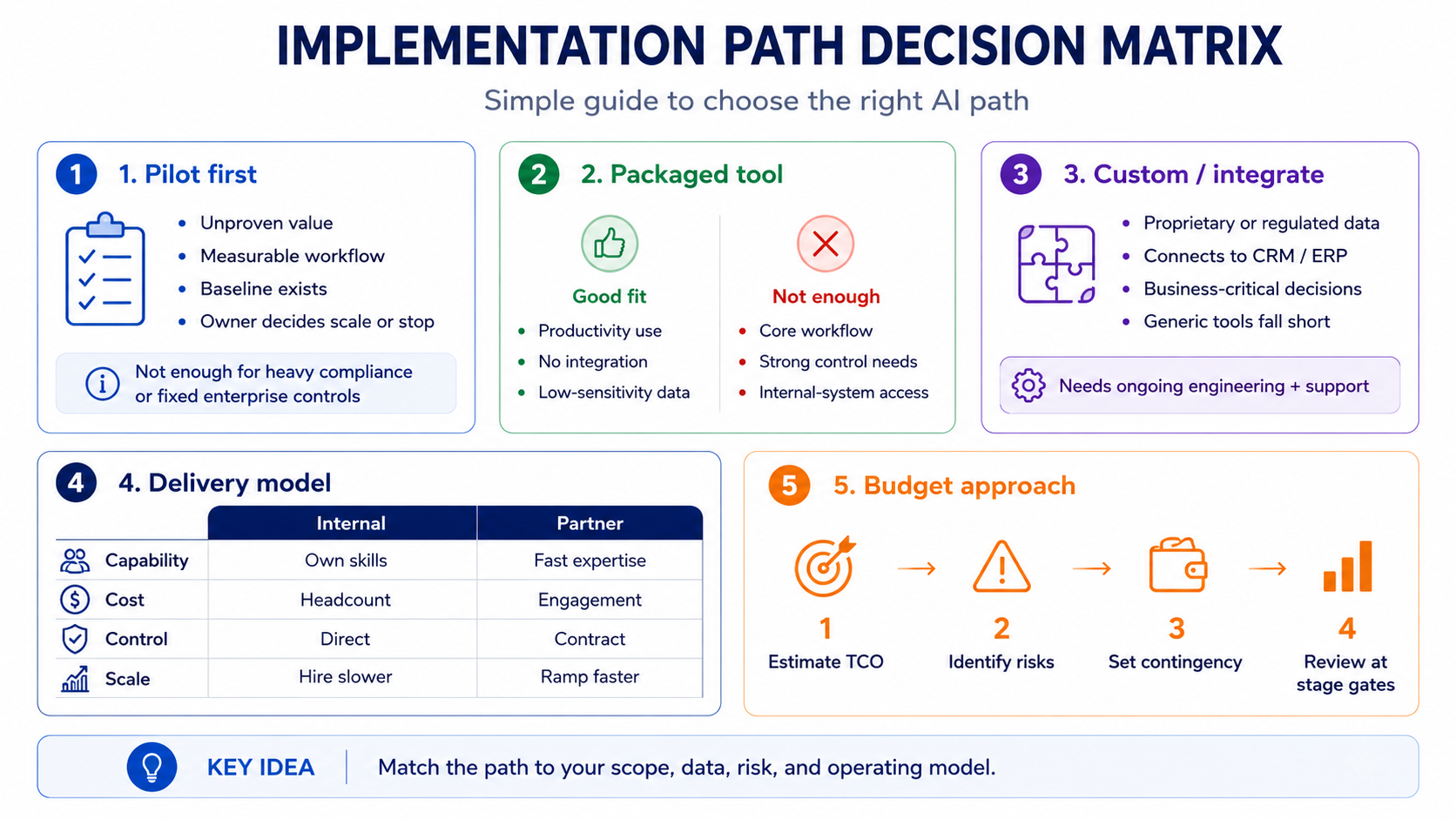
Select an approach proportionate to your uncertainty, data readiness, risk, and required capability — not to headline cost alone.
7.1 When a phased pilot is the right starting point
A phased pilot fits when value, data readiness, or workflow fit is genuinely unproven but measurable. Pilot suitability checklist:
A bounded, representative workflow can be isolated for testing
A baseline for the relevant metric exists or can be established quickly
Measurable success criteria can be defined before work starts
A named owner will evaluate results and make a scale-or-stop decisio
Data access can be approved without requiring full production integration
A pilot is not sufficient on its own when mandatory enterprise controls, regulatory requirements, or fixed integration dependencies already apply — in those cases, plan for production-grade requirements from the start, even during the validation phase.
7.2 When a packaged tool is sufficient — and when it is not
Packaged tools fit standard, low-integration needs well. A packaged tool is likely sufficient when:
- The use case is productivity or assistance, not a core operational process
- No sensitive, regulated, or proprietary data is involved in the tool interaction
- No custom integration to internal systems is required
- The vendor’s security, compliance, and data-handling posture meets your requirements without modification
Customization becomes relevant once workflow differentiation, system integration requirements, control needs, or data-handling obligations exceed what a standalone tool can safely address. When the line is unclear, a scoped AI consulting assessment is a lower-cost way to answer the question than a failed tool rollout.
7.3 When to build custom workflows or integrate core systems
Consider custom or integrated approaches when the workflow is strategic, repeatable, data-dependent, operationally critical, or cannot be safely handled by standalone tools. Questions that indicate custom or integrated work is needed:
- Does the workflow require access to proprietary, confidential, or regulated data?
- Does it need to connect to internal systems of record (CRM, ERP, compliance platforms)?
- Is the output of this workflow used in business decisions with measurable consequence?
- Is there a competitive or operational reason why a generic tool is insufficient?
Mention ongoing ownership alongside potential strategic value: a custom integration requires engineering, monitoring, support, and maintenance for its entire operational life. For custom software development or generative AI development services, confirm the post-launch operating model before committing to the build.
7.4 How internal teams, specialist partners, and delivery models affect cost and control
No delivery model is universally cheaper or better. Evaluate trade-offs across:
| Dimension | Internal team | Specialist partner |
|---|---|---|
| Capability | Existing skills and stronger knowledge retention | Specialist expertise and faster ramp-up |
| Cost | Headcount and opportunity cost | Engagement and management cost |
| Knowledge transfer | Embedded from day one | Requires a deliberate transfer plan |
| Governance | Direct control | Contractual oversight required |
| Scalability | Constrained by hiring capacity | More flexible for time-bounded work |
| Operating burden | Fully internal after launch | Managed service or handoff option |
Delivery-model cost differences — onshore versus offshore, internal versus partner — are real but highly variable by provider, scope, and market. Treat any specific cost-savings percentage you are quoted as something to verify independently against a defined scope and engagement structure, not a universal industry rule.
7.5 A practical budget allocation and contingency approach
There is no fixed allocation rule (such as 40/35/25 or any similar split) that fits every SME AI project. Allocation should follow your specific scope, risk profile, and operating model. A practical approach:
- Estimate each TCO category in Section 3 based on your scope from Section 1
- Identify which risk variables in Section 3.4 apply, and estimate their cost impact
- Set contingency as a planning reserve tied to your specific risk items — not as an automatic percentage
- Review the allocation when any risk variable in Section 3.4 changes materially
- Report actuals against plan at each stage gate in Section 6.4
8. SME AI Budget Planning Checklist
The bottom line: AI implementation for SMEs requires $200,000-$500,000 over five years, but strategic partnerships and phased approaches can reduce costs by 40-60% while improving success rates. The key is budgeting for the full lifecycle, not just the initial build.
Before approving an AI budget, confirm the following are in place:
- Business case and use-case readiness: a measurable outcome, an executive owner, a defined user group, and explicit stop/scale criteria.
- Data, system, security, and compliance readiness: confirmed data access, mapped integration dependencies, and a privacy/security review appropriate to your sector.
- Delivery, ownership, and operational readiness: clear vendor or internal roles, support coverage, monitoring, training, and an escalation path.
- Cost, contingency, and success-measurement readiness: an explicit TCO horizon, stated assumptions, a contingency basis, a measured baseline, and a review cadence.
9. Frequently Asked Questions
| Question | Answer |
| What is the typical first-year cost of implementing generative AI for an SME? | It depends primarily on scope. A lightweight tool rollout sits at the low end of the spectrum; a regulated, multi-system custom build sits at the high end. Before comparing any quote, confirm what’s included — development, infrastructure, security, and initial training are the usual first-year components. |
| What costs continue after an AI system goes live? | Usage-based platform fees, infrastructure, monitoring, maintenance, support, incident response, and periodic retraining all continue post-launch. These recurring costs are why five-year TCO is typically higher than the initial build quote, especially as usage and adoption grow. |
| How should an SME budget for AI when requirements are uncertain? | Start with discovery to firm up assumptions, build in contingency rather than ignoring uncertainty, and make decisions in stages — validate before you scale, and revisit the budget when a risk variable changes. |
| Is a pilot cheaper than a full AI implementation? | A pilot is a bounded validation exercise, not a scaled-down version of production. It answers a different question — whether the use case works — and shouldn’t be compared directly to a production budget, which carries ongoing operational requirements a pilot doesn’t need. |
| What determines whether an AI project reaches positive ROI? | A well-scoped business outcome, a real measured baseline, realistic adoption assumptions, and disciplined operating costs — evaluated at defined checkpoints rather than assumed at the outset. |
Conclusion
The useful question is not “What does AI cost?” — it is “What capability, risk level, and operating model are we committing to fund?”
A scope-first approach changes how you interpret every estimate you receive. A productivity tool, a bounded pilot, a production workflow, and a custom regulated deployment are not points on the same cost curve. They are different initiatives with different first-year budgets, different five-year TCOs, and different conditions under which they pay off.
The framework in this guide — scope classification, four-part TCO model, lifecycle cost mapping, hidden-cost audit, ROI stage gates, and implementation-path decision criteria — is designed to be reusable across every AI budget decision you make, not just the one in front of you today.
The highest-value first step for most SMEs is not the largest one. A smaller, well-scoped, measurable initiative that answers a specific business question is more valuable — and more responsible — than a headline-driven project built on underspecified assumptions.
If you are at the planning stage, the most useful next action is clarifying: your use case and intended outcome, the data and systems involved, your regulatory context, the expected user base, and your decision timeline. A scoped assessment turns these inputs into a grounded cost and implementation plan.
SmartDev’s AI Consulting Services and 3 Weeks AI Discovery Program are designed for exactly this stage. A discovery engagement does not commit you to a full implementation — it gives you the information to make that decision well.
Next Steps: Assess Your AI Use Case, Scope, and Budget Assumptions
SmartDev helps businesses worldwide reduce AI implementation costs by combining offshore delivery efficiency with European-quality project governance.
Accelerate ROI, minimize long-term maintenance overhead, and scale securely with SmartDev’s AI-powered delivery framework.
–