
TL;DR:
- AI development cost is not one number. It depends on project scope, data readiness, integration depth, and how much of the lifecycle you are budgeting for.
- Every credible estimate separates one-time build cost from recurring operating cost, such as model or API consumption, hosting, monitoring, and retraining.
- Data preparation, systems integration, and post-launch operations are the three cost areas businesses underestimate most often.
- Your delivery model – build in-house, buy a platform, or partner with a specialist firm – changes both the size and the shape of your budget.
- A focused proof of concept, usually costing a small fraction of full production, reduces financial risk before you commit to a full build.
- Total cost of ownership, not the initial build quote, determines whether an AI investment pays off over its useful life.
Introduction
Every AI budgeting conversation starts with the same question: how much will this cost? The honest answer is that a responsible AI development cost estimate is always conditional. It depends on the problem you are solving, the data you already have, the systems you need to connect to, and how much risk your industry tolerates.
Two companies can request what sounds like the same AI assistant and land on wildly different bills. One reuses a pre-trained model, has clean data, and integrates with a single system. The other needs custom training, must clean years of fragmented records, and has to pass a compliance review before launch. Treating AI cost as a single price tag hides these differences and sets budgets up to fail.
This guide gives you a scope-first framework instead. You will learn what drives AI development cost, how spending shifts across the delivery lifecycle, what each delivery model costs to run, and how to estimate total cost of ownership rather than just the initial build. If you want to see how this framework applies to a production-ready build, SmartDev’s AI-powered software development team can help you scope a specific use case.
1. How Much Does AI Development Cost?
A useful cost range is conditional, never a quote. AI development cost typically spans from roughly $15,000 for a narrow, single-workflow proof of concept to several million dollars for an enterprise-grade, multi-system generative AI platform. The number that matters for your business sits somewhere inside that range, and only a clear scope narrows it down.
Typical project-cost ranges by solution complexity
The table below groups projects by complexity rather than by industry or use case, because complexity is the variable that most consistently drives cost.
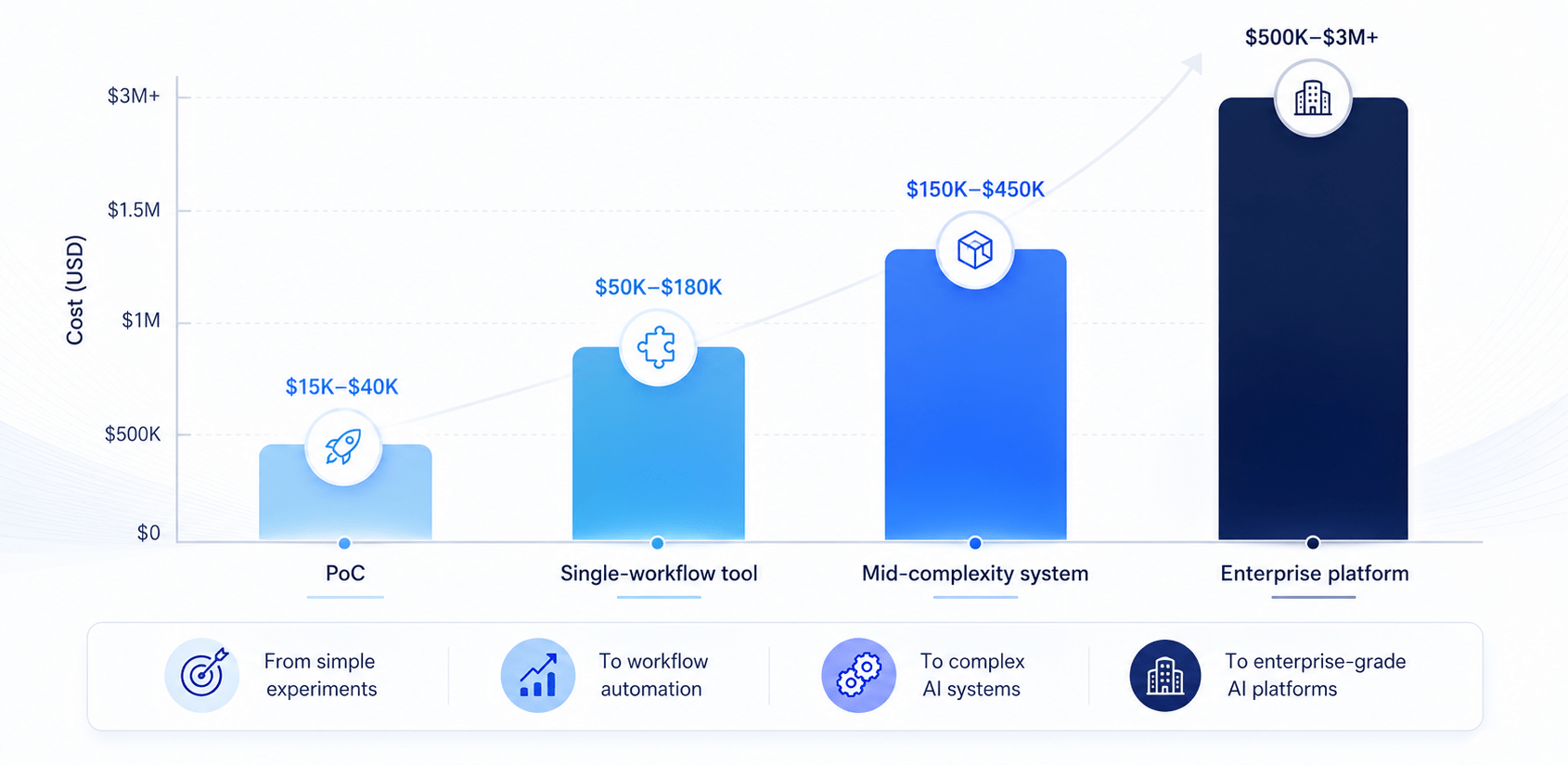 The figure illustrates how AI project costs scale with implementation scope, system complexity, and enterprise integration requirements.
| Project archetype | Illustrative range* | Typical scope assumptions | Common exclusions |
|---|---|---|---|
| Focused proof of concept | $15,000–$40,000 | One workflow, existing pre-trained model, sample dataset | Production hardening, full integration, ongoing operations |
| Single-workflow AI assistant or automation tool | $50,000–$180,000 | One or two system integrations, moderate data cleanup | Multi-language support, advanced governance tooling |
| Mid-complexity predictive or personalization system | $150,000–$450,000 | Multiple data sources, model tuning, staged rollout | Real-time infrastructure at large scale, custom foundation models |
| Enterprise-grade or custom generative AI platform | $500,000–$3,000,000+ | Custom or fine-tuned models, multi-system integration, formal governance | Ongoing model/API consumption, which is billed separately as a recurring cost |
*Ranges are directional planning inputs, not quotes. Actual pricing depends on region, delivery model, data condition, and compliance requirements. Recurring operating cost is billed separately in every archetype above (see Section 7).
What a cost estimate includes, and excludes
A defensible estimate states its scope explicitly. It should name the location and seniority of the delivery team, the delivery model (in-house, outsourced, or platform-based), the data condition assumed, and the timeline. It should also state what falls outside that number, most often recurring cloud and model consumption, long-term maintenance, and future feature requests.
Why two AI projects with similar features can cost very differently
Two chatbots can share the same feature list and still cost five times apart. The gap usually comes from three places: data condition, since messy or siloed records require cleanup work that a demo environment never shows; integration depth, since connecting to five legacy systems costs more than connecting to one modern API; and risk tolerance, since a healthcare or finance use case needs testing, documentation, and review that a marketing tool does not.
Takeaway: Treat any AI cost figure you see online as a starting reference point, not a price. Ask what scope, data condition, and delivery model produced that number before you compare it to your own project.
2. Start With the Right AI Cost Model
Before you request a quote, define what you are actually buying. A cost model starts with the business outcome, not the technology, and works outward toward data, integrations, and risk controls.
Define the business problem and success criteria
Write down the decision or task the AI system should improve, and the metric that will prove it worked. A fraud model succeeds by catching more true fraud; a support assistant succeeds by resolving tickets faster. This clarity keeps vendors from padding scope with features that do not serve your goal.
Choose the implementation approach
Three broad paths exist, and each carries a different cost curve.
Build a custom AI solution
Custom development gives you full control over the model and data pipeline. It usually costs the most upfront because it requires specialized engineering and data science time, but it can fit unusual requirements that off-the-shelf tools cannot meet. Explore SmartDev’s generative AI development services for this path.
Customize an existing model or platform
Fine-tuning a pre-trained model or configuring a vendor platform lowers upfront cost and shortens delivery time, at the expense of some flexibility. This path suits teams with a well-understood, common use case.
Integrate a third-party AI API or SaaS product
Calling an API keeps build cost lowest, but shifts spending toward recurring, usage-based fees that scale with adoption. Budget owners should model this consumption cost the same way they model cloud hosting.
Identify the project scope that drives the budget
Four scope questions shape almost every estimate:
- Users, workflows, and integrations: how many systems, teams, and processes does the AI system need to touch?
- Data availability and data quality: is the data centralized, labeled, and current, or scattered and inconsistent?
- Performance, privacy, security, and compliance requirements: does the use case sit inside a regulated industry, such as BFSI/Fintech or healthcare?
- Launch timeline and expected scale: does the business need a pilot in weeks, or a scaled system serving thousands of users at launch?
Takeaway: A defensible AI budget starts with a written business outcome and four scope answers, not a vendor quote. Get these right first, and every subsequent estimate becomes easier to compare.
For teams that want outside support scoping these decisions before committing budget, SmartDev’s AI consulting services and AI proof-of-concept guide both walk through this scoping stage in more depth.
3. The Main Cost Drivers in AI Development
Once scope is defined, eight recurring factors explain why estimates rise or fall. Each one changes budget through a different mechanism, so treat them as levers rather than as a fixed checklist.
Discovery, feasibility, and proof of concept
Early validation work, including stakeholder workshops and a technical proof of concept, typically represents a small share of total budget but prevents much larger losses later. Skipping it shifts risk, not cost, further down the timeline.
Data acquisition, preparation, and governance
Data work is consistently the most underestimated cost area in AI projects. Gartner’s research on AI-ready data found that most organizations either lack the right data management practices for AI or are unsure whether they have them, and the firm expects a large share of AI projects through 2026 to stall specifically because the underlying data was not ready for AI use (Gartner, 2025). Cleaning, labeling, and governing data before training starts is not optional groundwork; it is a core line item.
Model selection, development, evaluation, and tuning
Choosing between a pre-trained model, a fine-tuned variant, and a fully custom model changes both cost and timeline. Rigorous evaluation against defined metrics, not just accuracy, protects the investment by catching failure modes before launch. SmartDev’s AI model testing guide covers the evaluation techniques this stage requires.
Application engineering and user experience
An AI model rarely ships alone. It needs an interface, an API layer, and application logic around it, which is standard software engineering work billed alongside the AI-specific effort. SmartDev’s custom software development team typically handles this layer.
Systems integration and deployment
Connecting an AI system to CRMs, ERPs, or legacy databases is frequently the most underbid line item in a proposal, because integration complexity is hard to see until engineers open the target systems. Budget contingency here, not just for the model build.
Infrastructure, cloud usage, and model/API consumption
Compute for training and inference, plus any pay-as-you-go API calls, forms a recurring expense that scales with usage rather than staying fixed like a one-time build fee. Cloud solutions planning should treat this as an operating cost from day one, not an afterthought.
Security, privacy, and compliance
Access controls, audit trails, and regulatory review add cost in proportion to industry risk. A consumer chatbot needs far less compliance work than a lending or clinical decision-support tool.
Monitoring, maintenance, retraining, and support
Production models degrade as real-world data drifts away from training data. SmartDev’s guide to AI model drift and retraining explains why this maintenance loop is a recurring cost, not a one-time task, throughout the system’s useful life.
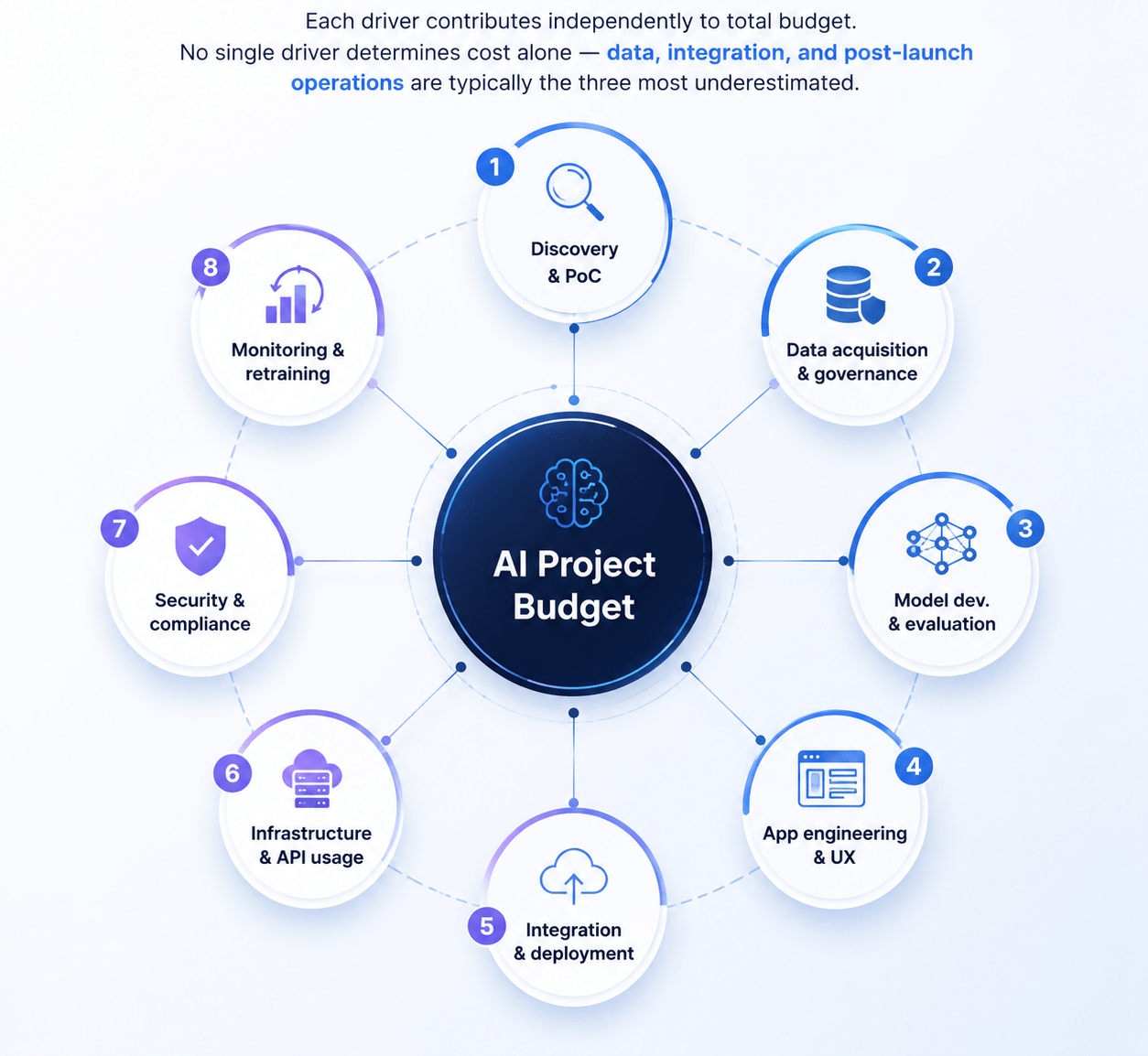
The figure highlights the eight primary cost drivers that collectively determine an AI project’s overall budget.
- AI implementation costs extend well beyond model development, with data, integration, security, and ongoing operations often accounting for a significant share of total investment.
- Evaluating each cost driver early helps organizations build more realistic budgets and avoid underestimating post-deployment expenses such as monitoring and model maintenance.
Takeaway: Data preparation, systems integration, and post-launch operations cause more budget overruns than model development itself. Price these three explicitly instead of folding them into a single “build” line item.
4. AI Development Cost by Project Type
The type of AI application shapes its cost profile as much as its size does. The comparison below uses the same four criteria across every category so you can compare like for like.
| Project type | Data intensity | Real-time requirement | Integration complexity | Typical cost pressure |
|---|---|---|---|---|
| AI assistants & knowledge-search apps | Medium | Medium | Medium (knowledge sources) | Retrieval quality & content upkeep |
| Predictive analytics & ML models | High | Low–Medium | Medium (data pipelines) | Historical data volume & labeling |
| Computer vision solutions | Very high | High | High (sensors/cameras) | Image/video annotation & edge hardware |
| Recommendation & personalization | High | Medium–High | Medium (behavioral data feeds) | Continuous retraining cadence |
| Intelligent automation & document processing | Medium–High | Medium | High (workflow systems) | Exception handling & governance |
| Custom generative AI & foundation-model work | Very high | Medium–High | Medium–High | Compute cost & ongoing evaluation |
Computer vision and custom generative AI initiatives tend to carry the highest cost pressure because they combine data intensity with heavy compute needs. Predictive analytics and recommendation systems cost less to launch but require continuous retraining, which shifts spend toward the operating phase. For automation use cases specifically, SmartDev’s AI workflow automation article breaks down how automation projects scale cost with process complexity.
Takeaway: Compare AI project types on data intensity, real-time needs, and integration complexity, not on the feature list alone. Two “chatbots” can sit in very different cost brackets depending on these three factors.
5. Cost Breakdown Across the AI Delivery Lifecycle
Costs do not arrive all at once. They emerge in phases, each with its own deliverables and decision gates. Understanding this sequence, distinct from the driver framework in Section 3, tells you when to expect spend, not just what causes it.
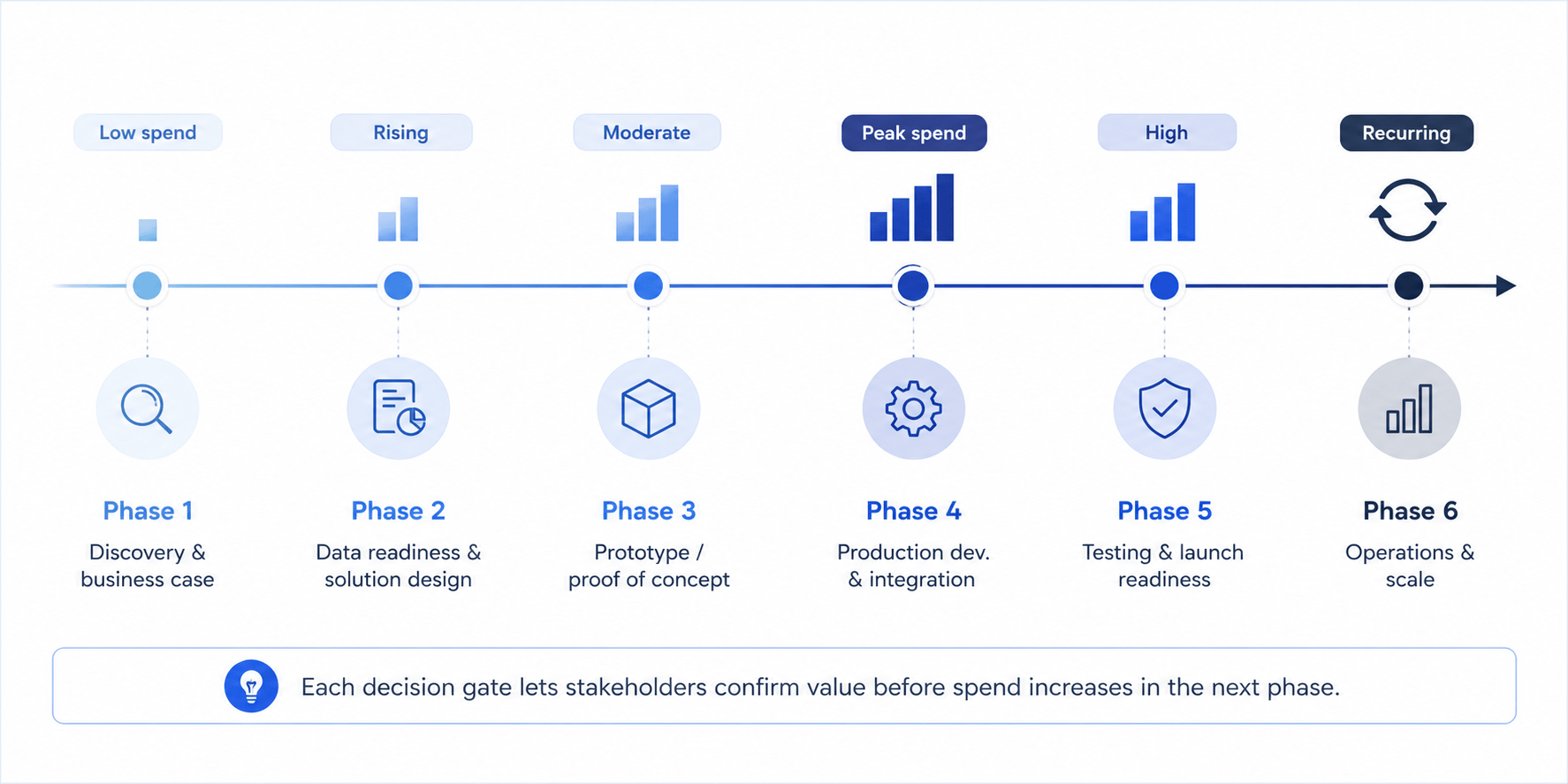 The figure illustrates how AI investment evolves across the project lifecycle, from initial planning to long-term operations.
- One-time implementation costs typically peak during development, integration, and pre-launch testing, while operational expenses continue throughout the system’s lifecycle.
- Budget planning should account for both upfront delivery costs and recurring investments in monitoring, optimization, infrastructure, and model maintenance.
Phase 1: Discovery and business-case validation
Teams define the problem, estimate ROI, and confirm the use case is worth pursuing before writing any code.
Phase 2: Data readiness and solution design
Data audits, architecture decisions, and technical design happen here, setting the foundation the rest of the build depends on.
Phase 3: Prototype or proof of concept
A limited, functional version tests the core hypothesis with real data before the business commits to full production spend. SmartDev’s AI proof-of-concept service is built specifically for this phase.
Phase 4: Production development and integration
This is typically the most expensive one-time phase, combining model refinement, application engineering, and connections to existing systems.
Phase 5: Testing, evaluation, and launch readiness
Formal evaluation against success metrics, stress testing, and security review happen before real users reach the system.
Phase 6: Operations, optimization, and scale
Once live, the system needs monitoring, retraining, and infrastructure scaling – a recurring cost stream, not a closing task. SmartDev’s MLOps services support this phase specifically.
Takeaway: Budget peaks during production development and integration, but cost does not end at launch. Plan for Phase 6 operations from the start rather than treating it as a surprise line item.
6. Build, Buy, or Partner: Which Option Fits Your Budget?
Delivery model is a genuine trade-off, not a right-or-wrong decision. Each option optimizes for a different mix of speed, control, and long-term cost.
In-house AI development
Building with an internal team gives full control over roadmap and intellectual property, but requires hiring specialized talent that remains scarce and expensive in most markets. It suits organizations planning multiple, ongoing AI initiatives.
Outsourced development team or specialist partner
Partnering with an outsourced or dedicated development team gives access to specialized skills without a permanent headcount commitment. Regional rate differences are significant: current market data puts senior engineering rates at roughly $75–$135 per hour in North America, compared with $45–$90 per hour in Eastern Europe and $20–$65 per hour across parts of Asia and Latin America, though quality, communication overlap, and delivery maturity vary as much as price within each region (Geniusee, 2026).
Off-the-shelf AI platforms and APIs
Platforms and APIs offer the fastest path to a working solution and the lowest upfront cost, but usage-based pricing means cost scales directly with adoption, and customization options are limited to what the vendor exposes.
Decision criteria: cost, speed, control, risk, and long-term ownership
| Criteria | In-house | Outsourced / partner | Platform / API |
|---|---|---|---|
| Upfront cost | Highest | Medium | Lowest |
| Speed to launch | Slowest (hiring lead time) | Medium–fast | Fastest |
| Long-term control | Highest | Medium | Lowest |
| Vendor dependency risk | Low | Medium | Highest |
| Best fit | Multiple, ongoing AI initiatives | Defined project with a deadline | Common, well-understood use case |
Takeaway: No delivery model is universally cheaper. In-house suits long-term AI programs, partners suit defined projects, and platforms suit common use cases, match the model to your situation, not to the lowest sticker price.
7. Estimate the Total Cost of Ownership
Total cost of ownership is the full sum of what an AI system costs to build and run across its useful life, including one-time delivery cost, variable usage cost, and recurring operating cost. The initial build quote is only the first of these three categories.
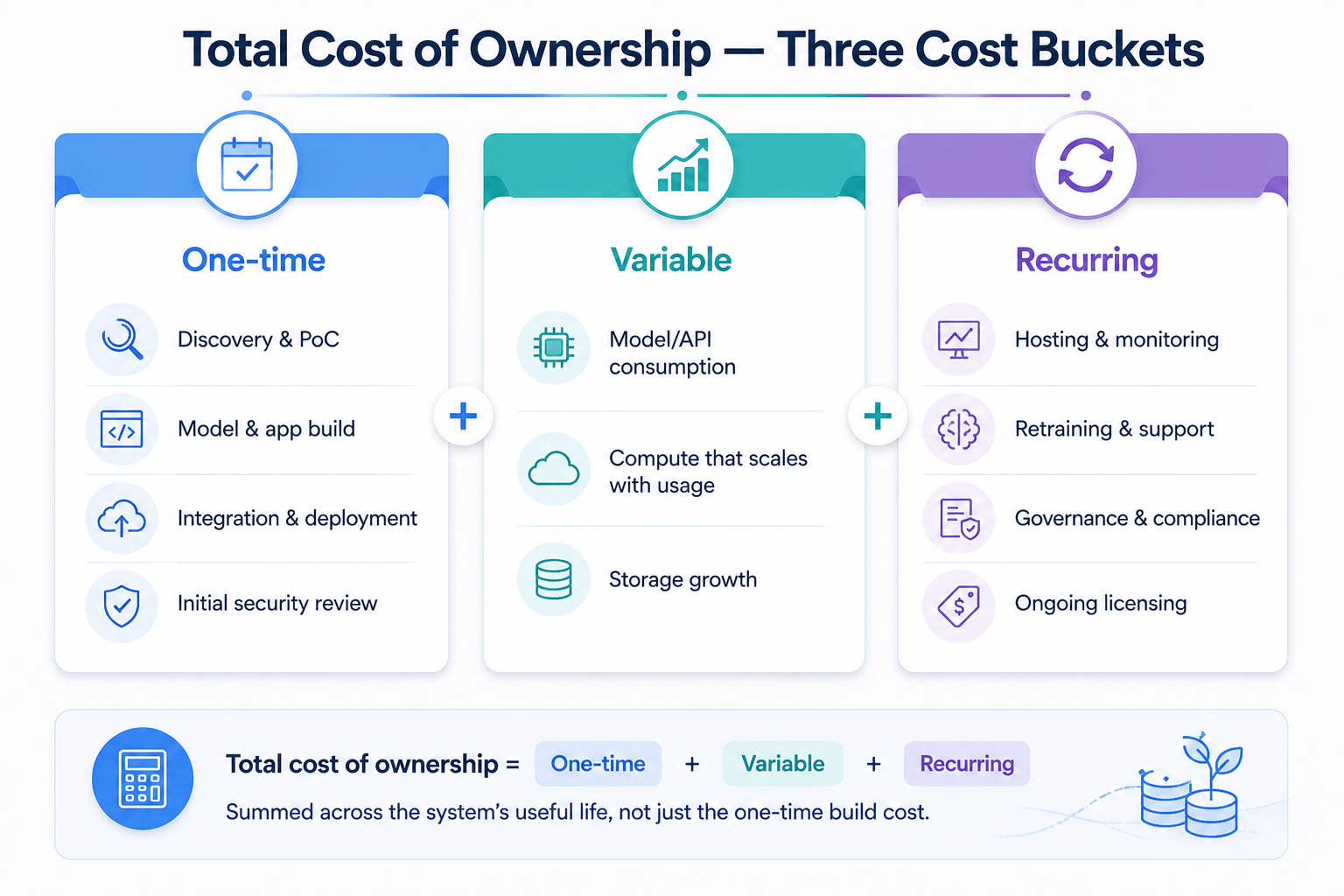 The figure illustrates how AI total cost of ownership extends beyond initial development to include variable and recurring operational expenses throughout the system lifecycle.
9. Common AI Budget Mistakes
Gartner’s research on GenAI cost optimization found that organizations moving from pilot to production often face costs that are an order of magnitude higher than the pilot suggested, and the firm expects at least half of GenAI initiatives to exceed their planned budgets by 2028 due to architectural and operational gaps (Gartner, cited in Campus Technology, 2026). The five patterns below explain most of that gap.
| Mistake | Early warning signal | Mitigation |
|---|---|---|
| Underestimating data work | Data audit keeps surfacing new sources or formats | Budget a dedicated data-readiness phase (Section 5, Phase 2) |
| Treating integration as an afterthought | Target systems lack documented APIs | Scope integration work before finalizing the build quote |
| Ignoring post-launch operations and maintenance | Budget stops at “go-live” with no operating line item | Model recurring cost per Section 7 before approval |
| Selecting technology before defining the business case | Vendor or model chosen before success metrics exist | Return to Section 2 and define outcomes first |
| Using headline cost ranges without comparable assumptions | A quote is compared to a number seen in an article, not a scoped proposal | Apply the scope checklist from Section 1 before comparing |
Takeaway: Most budget overruns trace back to a decision made before scope, data, or success metrics were clear. Slow down at the start to avoid paying for it during production.
Conclusion
AI costs are most predictable when they are evaluated in the context of a specific use case, delivery model, and total cost of ownership. By defining scope early and accounting for both implementation and long-term operational costs, organizations can make better investment decisions and improve the likelihood of achieving measurable business value from AI.
Ready to Estimate the Cost of Your AI Project?
Every AI initiative has a unique cost profile shaped by its objectives, data, integrations, and deployment requirements. Contact SmartDev to discuss your use case and receive a scope-based cost assessment tailored to your business. Whether you are exploring a proof of concept or planning enterprise-scale implementation, our team can help you define a realistic budget and delivery roadmap.