
What Is Generative AI?
Artificial intelligence has evolved rapidly over the past decade, but one of the most transformative developments in recent years is Generative AI. Unlike traditional AI systems that primarily analyze data and make predictions, generative AI creates new content, ideas, and solutions. From generating text and images to designing code and automating complex workflows, generative AI is changing how organizations innovate and operate.
Generative AI refers to a category of artificial intelligence models designed to generate new content based on patterns learned from large datasets. These models can produce text, images, audio, video, code, and even synthetic data. At the core of generative AI are advanced machine learning techniques such as large language models (LLMs), diffusion models, and generative adversarial networks (GANs). These models are trained on massive datasets and learn to understand context, structure, and relationships within the data. As a result, its systems can perform tasks such as writing articles, reports, and marketing copy; generating realistic images and design assets; creating software code and debugging applications; as well as automating document summarization and knowledge extraction.
Why Generative AI Matters?
Generative AI has become a major focus for businesses because it offers a powerful combination of automation, creativity, and scalability. Organizations are increasingly recognizing its potential to improve efficiency while enabling new capabilities. Below are several key reasons why generative AI is gaining widespread adoption:
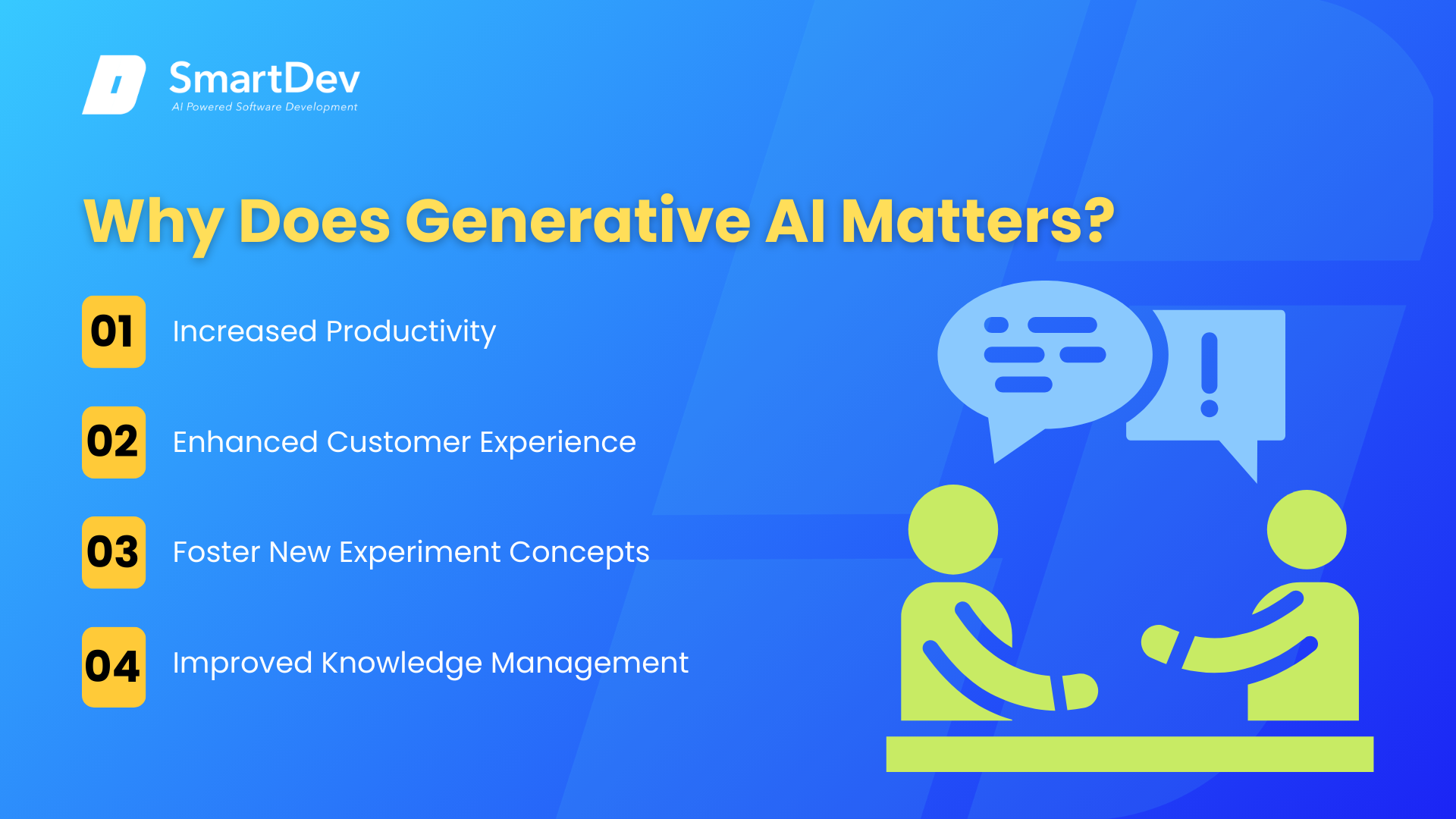
1. Increased Productivity
2. Enhanced Customer Experience
3. Innovation and New Product Development
4. Improved Knowledge Management
Organizations often struggle to manage large volumes of internal documents and data. Generative AI can help by summarizing documents, extracting insights, and enabling conversational access to internal knowledge bases. Employees can quickly retrieve relevant information without manually searching through multiple systems.
5. Competitive Advantage
Companies that adopt generative AI effectively can gain a significant competitive edge. By automating routine tasks and enhancing decision making, businesses can focus more resources on strategy, innovation, and growth.
How Generative AI Works?
Generative AI models typically rely on deep learning architectures trained on massive datasets. The process generally involves three key stages.
1. Data Training
Generative AI models learn from vast amounts of data such as text, images, or code. During training, the model identifies patterns, structures, and relationships within the dataset. For example, a language model trained on millions of documents learns grammar, sentence structures, and contextual meaning.
2. Model Learning
Using neural networks, the model learns to predict the next element in a sequence. In text generation, this might mean predicting the next word in a sentence. In image generation, it may involve reconstructing visual patterns from noise. Over time, the model becomes capable of generating coherent and realistic outputs.
3. Content Generation
Once trained, the model can generate new content based on prompts or input data. Users provide instructions or context, and the AI produces outputs that align with the learned patterns. For example, a user might ask the system to generate marketing content, summarize a research paper, or design an image based on a description.
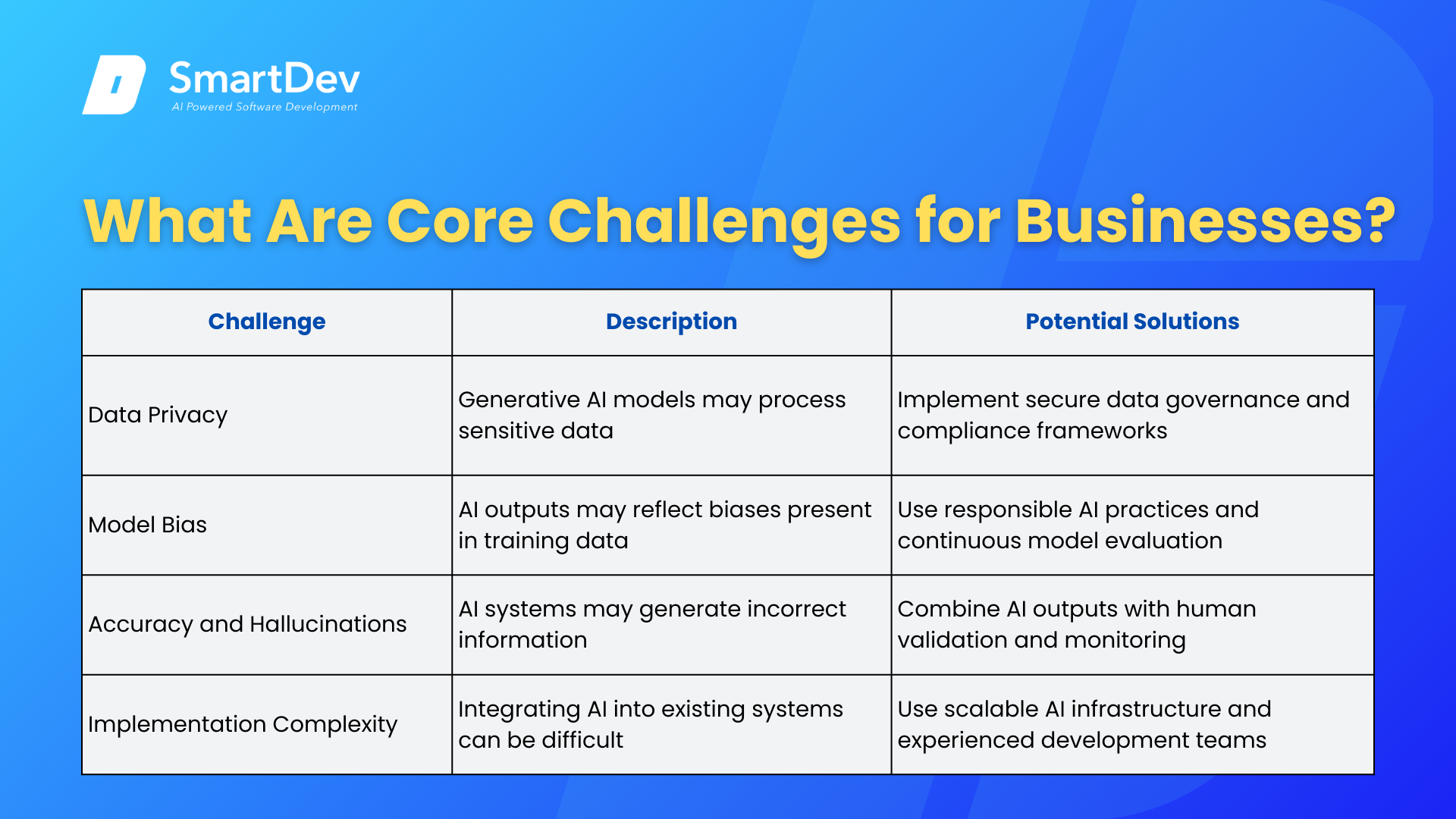
What Are Core Challenges for Businesses?
Despite its potential, implementing generative AI also presents several challenges that organizations must address. Addressing these challenges requires careful planning, strong governance, and a responsible approach to AI deployment. Currently, Generative AI is still evolving, but its impact on business and technology will continue to grow. Advances in model capabilities, computing power, and data availability will unlock new possibilities.
Future developments may include:
- More advanced AI assistants capable of complex reasoning
- AI powered automation across entire business workflows
- Multimodal AI systems that combine text, images, video, and audio
- Industry specific AI models tailored for specialized domains
Other Related Terms:
1. Natural Language Processing (NLP):
This field focuses on the interaction between computers and human language, enabling machines to understand, interpret, and generate text.
2. Machine Learning (ML):
A subset of artificial intelligence that involves training algorithms on data to enable them to make predictions or decisions without being explicitly programmed.
3. Deep Learning:
A specialized area of machine learning that uses neural networks with many layers (deep neural networks) to analyze various types of data, including images, text, and audio, often employed in generative models.