
TL;DR
- Cloud native development is an approach to building software designed specifically to run in cloud environments using containers, microservices, and automation.
- It enables businesses to scale applications on demand, reduce infrastructure costs, and deploy updates faster than traditional software architectures allow.
- Migrating to a cloud native approach is a strategic investment that typically reduces operational overhead and improves system resilience over time.
Cloud native development changes how businesses build and run software. Instead of designing applications for on-premises servers, cloud native teams build apps that take full advantage of cloud infrastructure from the start. This article explains what cloud native development is, why it matters for your business, and what it costs to adopt.
What is Cloud Native Development?
Cloud native development is a software engineering approach where applications are designed, built, and optimized to run in cloud environments such as AWS, Microsoft Azure, or Google Cloud, rather than on traditional on-premises servers.
Unlike traditional applications that were built for local infrastructure and later moved to the cloud, cloud native applications are architected specifically for cloud environments from the ground up. They use modern design patterns that make them faster to deploy, easier to scale, and more resilient to individual component failures.
The four core pillars of cloud native development are:
- Microservices: Breaking an application into small, independent services that can be developed, deployed, and scaled separately without affecting the rest of the system.
- Containers: Packaging each service and its dependencies into a container that runs consistently across any environment, from a developer’s laptop to a cloud production server.
- CI/CD pipelines: Automating the build, test, and deployment process to enable fast, frequent, and reliable releases of application updates.
- Dynamic orchestration: Using platforms like Kubernetes to automatically manage, scale, and recover container instances based on real-time demand without manual intervention.
Why It Matters for Businesses?
Traditional software architectures struggle to keep pace with modern business demands. Scaling up requires expensive hardware purchases and long procurement cycles. Deploying updates takes weeks. A single component failure can bring down the entire application. Cloud native development resolves each of these challenges.
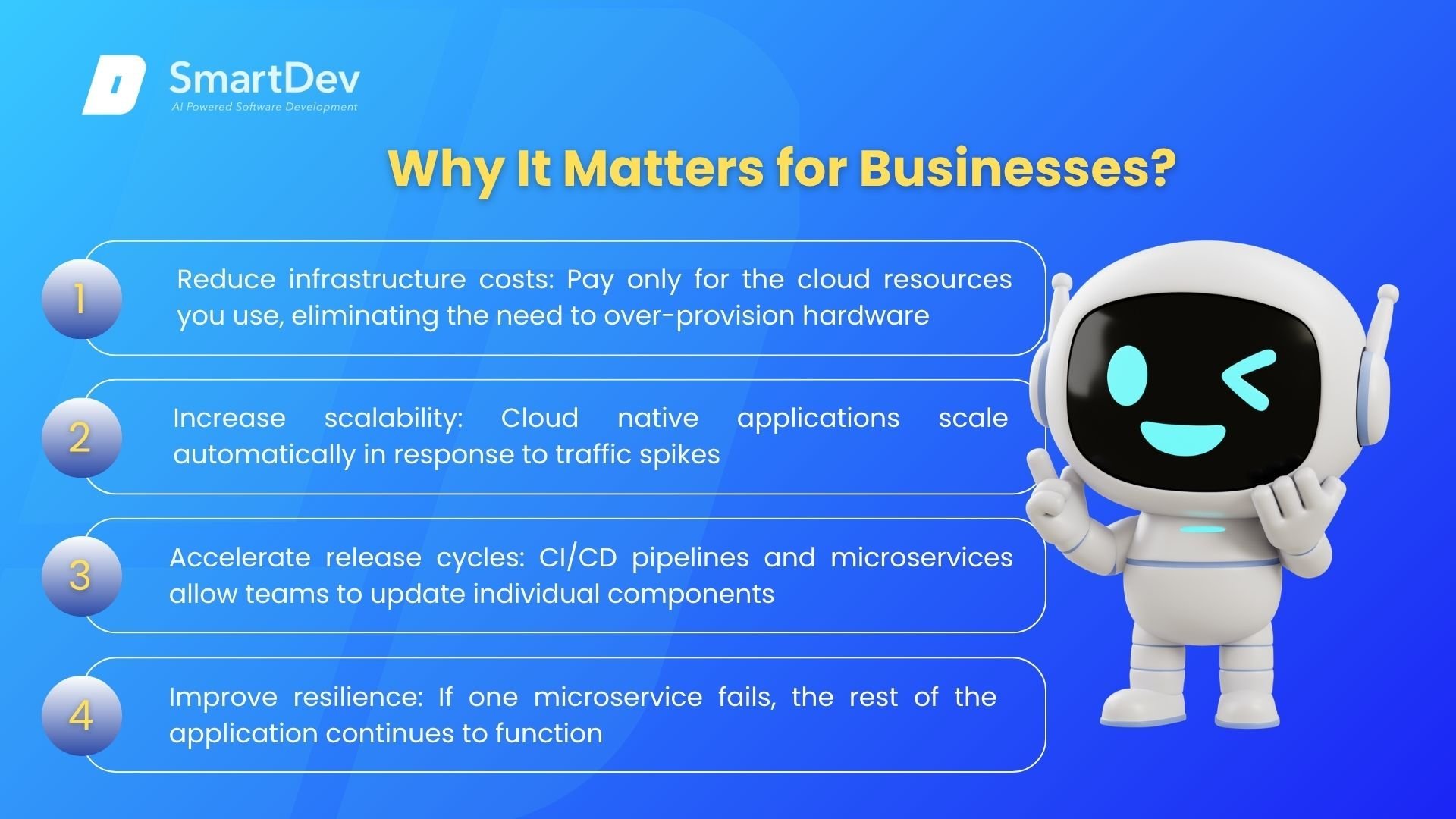
- Reduce infrastructure costs: Pay only for the cloud resources you use, eliminating the need to over-provision hardware for peak demand that occurs only occasionally.
- Increase scalability: Cloud native applications scale automatically in response to traffic spikes, ensuring performance stays consistent without manual intervention from your team.
- Accelerate release cycles: CI/CD pipelines and microservices allow teams to update individual components without redeploying the entire application, cutting release times from weeks to hours.
- Improve resilience: If one microservice fails, the rest of the application continues to function, reducing the blast radius of incidents and improving the experience for end users.
For example, a retail company that migrated its order management system to a cloud native architecture handled a 10x traffic surge during a peak sales period without manual scaling or performance degradation. Their infrastructure costs dropped by approximately 30% compared to their previous on-premises setup.
How Does Cloud Native Development Work?
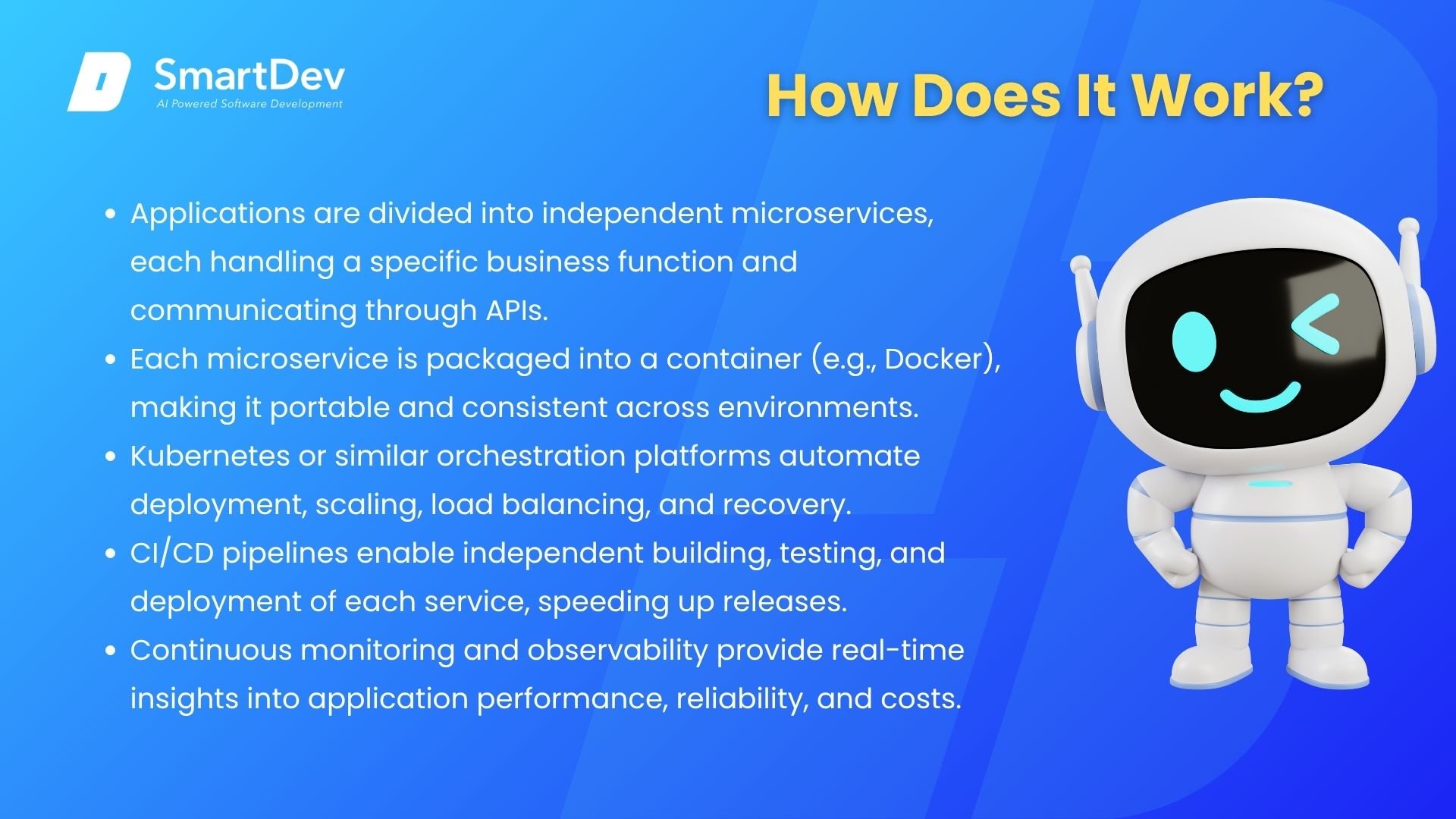
- Architecture design: The application is broken into independent microservices, each responsible for a specific business function such as user authentication, order processing, or payment handling. Services communicate through well-defined APIs (Application Programming Interfaces).
- Containerization: Each microservice is packaged into a container using a tool like Docker, bundling the code, libraries, and configuration files it needs to run into a single portable unit.
- Orchestration setup: A container orchestration platform like Kubernetes manages container deployment, load balancing, and automatic recovery across cloud infrastructure, replacing manual server management.
- CI/CD integration: Automated pipelines build, test, and deploy each microservice independently, enabling teams to release updates to one part of the application without touching or risking other components.
- Monitoring and optimization: Cloud native applications are continuously monitored for performance, cost, and reliability using observability tools that provide real-time visibility into every layer of the system.
The result is a software system that can evolve quickly, scale effortlessly, and recover from failures automatically without the costs and limitations of traditional infrastructure.
How Much Does Cloud Native Development Cost?
Cloud native development costs depend on the scale and complexity of your application and whether you are building fresh or migrating an existing system:
- Cloud infrastructure: Most cloud providers charge based on usage. Small to mid-sized applications typically spend $500 to $5,000 per month on compute, storage, and networking. Enterprise-scale systems with high traffic and complex architectures can spend significantly more.
- Development and migration: Building a new cloud native application or migrating an existing one is a substantial project. Outsourced cloud native development teams typically charge $25 to $80 per hour depending on geography, with migration projects ranging from $50,000 to $500,000 or more depending on system complexity and data volumes.
- Tooling and licensing: Managed Kubernetes services, CI/CD tools, and monitoring platforms add approximately $200 to $2,000 per month for most teams depending on scale.
Compared to maintaining on-premises infrastructure, cloud native architectures typically reduce long-term infrastructure and operations costs while improving the speed and reliability of software delivery. Businesses that outsource cloud native development often see a faster return on investment than those building internal teams from scratch in an expensive talent market.
Other Related Terms
Microservices Architecture: An architectural approach that breaks an application into small, independently deployable services, each handling a specific business function, forming the foundational design pattern of cloud native systems.
Containerization: The practice of packaging software and its dependencies into portable containers, the core building block that makes cloud native applications consistent, portable, and easy to deploy at scale.
Kubernetes: An open-source platform for automating the deployment, scaling, and management of containerized applications, the dominant orchestration tool used to run cloud native workloads in production.