
TL;DR
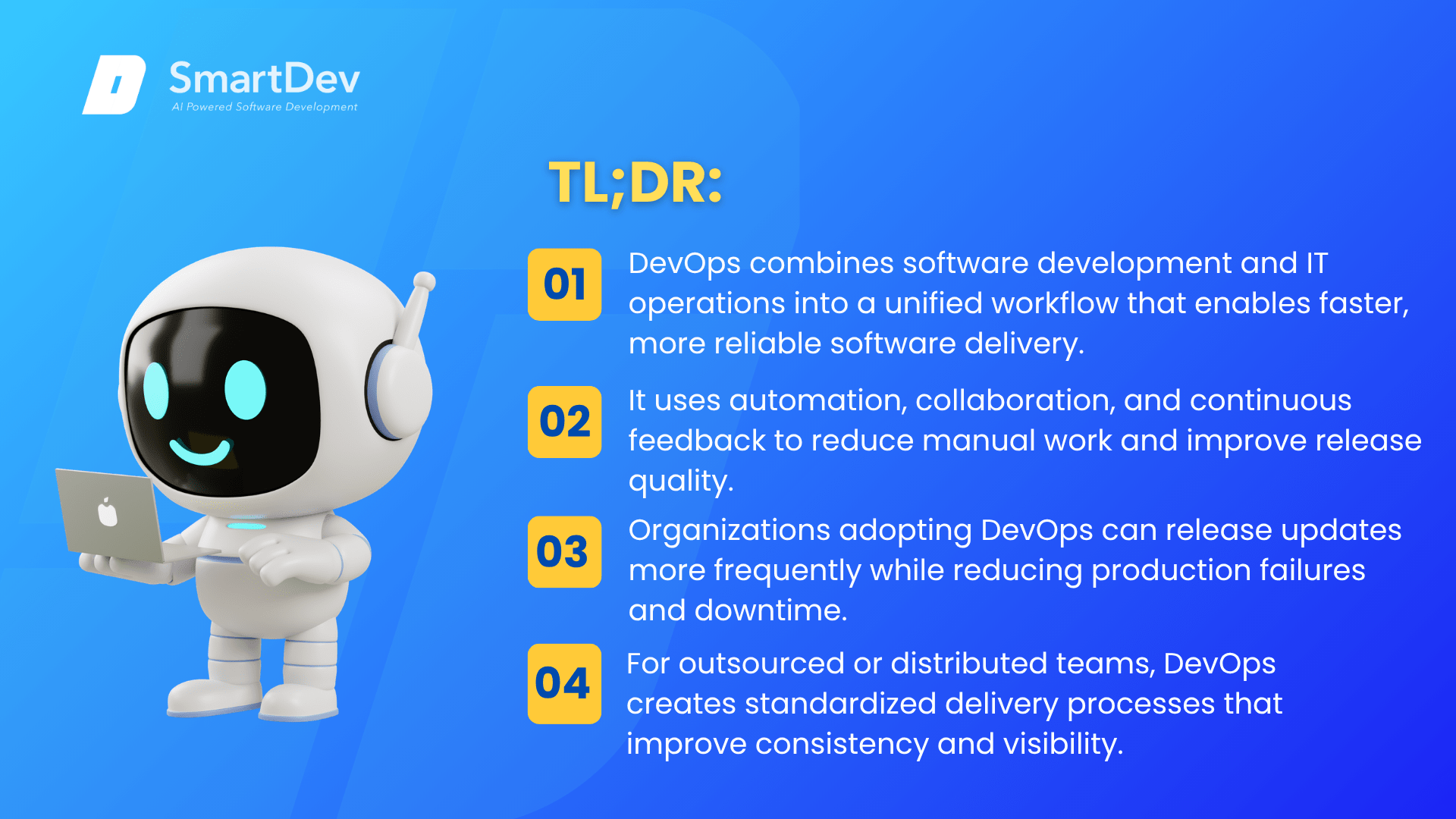
- DevOps is a set of practices combining software development and IT operations to shorten development cycles and deliver software more reliably and frequently.
- It breaks down the traditional wall between development and operations teams, enabling faster releases, fewer production failures, and quicker recovery when problems occur.
- For businesses using outsourced development teams, DevOps practices provide automated quality and delivery standards that scale across geographies without requiring constant manual oversight.
DevOps has become one of the most transformative approaches in modern software delivery. By combining development and operations into a single, automated workflow, businesses reduce release cycles, improve reliability, and respond faster to market demands. This article explains what DevOps is, why it matters for business leaders, and what it costs to adopt.
What is DevOps?
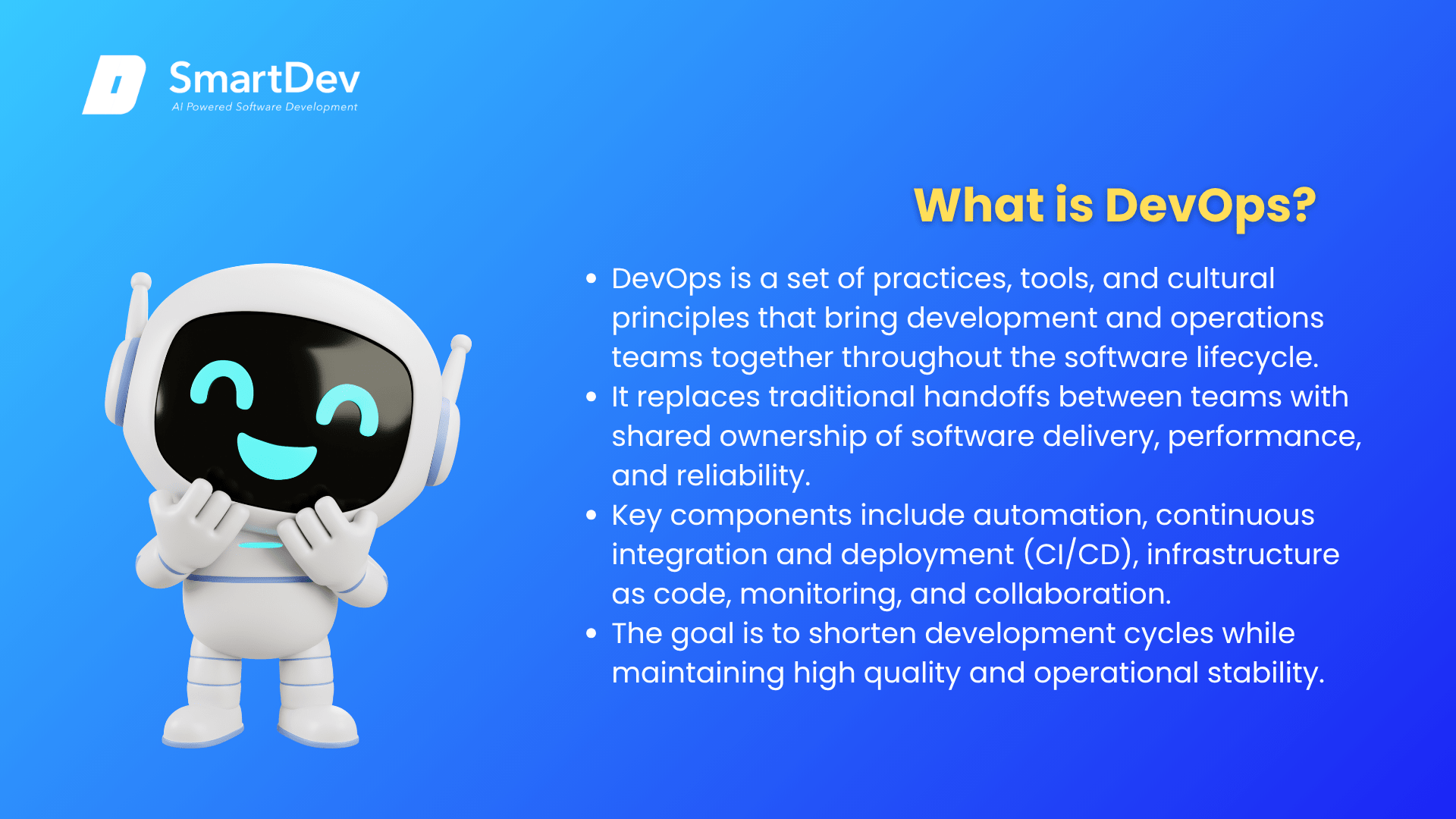
DevOps is a set of cultural practices, tools, and methodologies that integrate software development (Dev) and IT operations (Ops) into a single, continuous workflow. The goal is to shorten the system development lifecycle while delivering features, fixes, and updates more frequently and reliably than traditional approaches allow.
Traditionally, development teams wrote software and handed it off to operations teams to deploy and maintain. This handoff created friction, delays, and disputes when things went wrong. DevOps removes this barrier by bringing both teams together around shared responsibilities, shared tools, and a shared commitment to delivery quality.
DevOps is not a single product or technology. It is a combination of four interconnected elements:
- Culture: Shared ownership of delivery quality and system reliability between developers and operations engineers, replacing blame with collective accountability.
- Automation: CI/CD pipelines, automated testing, and infrastructure-as-code that eliminate manual steps and reduce human error throughout the delivery process.
- Measurement: Tracking deployment frequency, change failure rates, and mean time to recovery to identify bottlenecks and improve continuously.
- Collaboration: Unified tooling, shared dashboards, and joint incident response that keep all teams working from the same information and toward the same goals.
Why It Matters for Businesses?
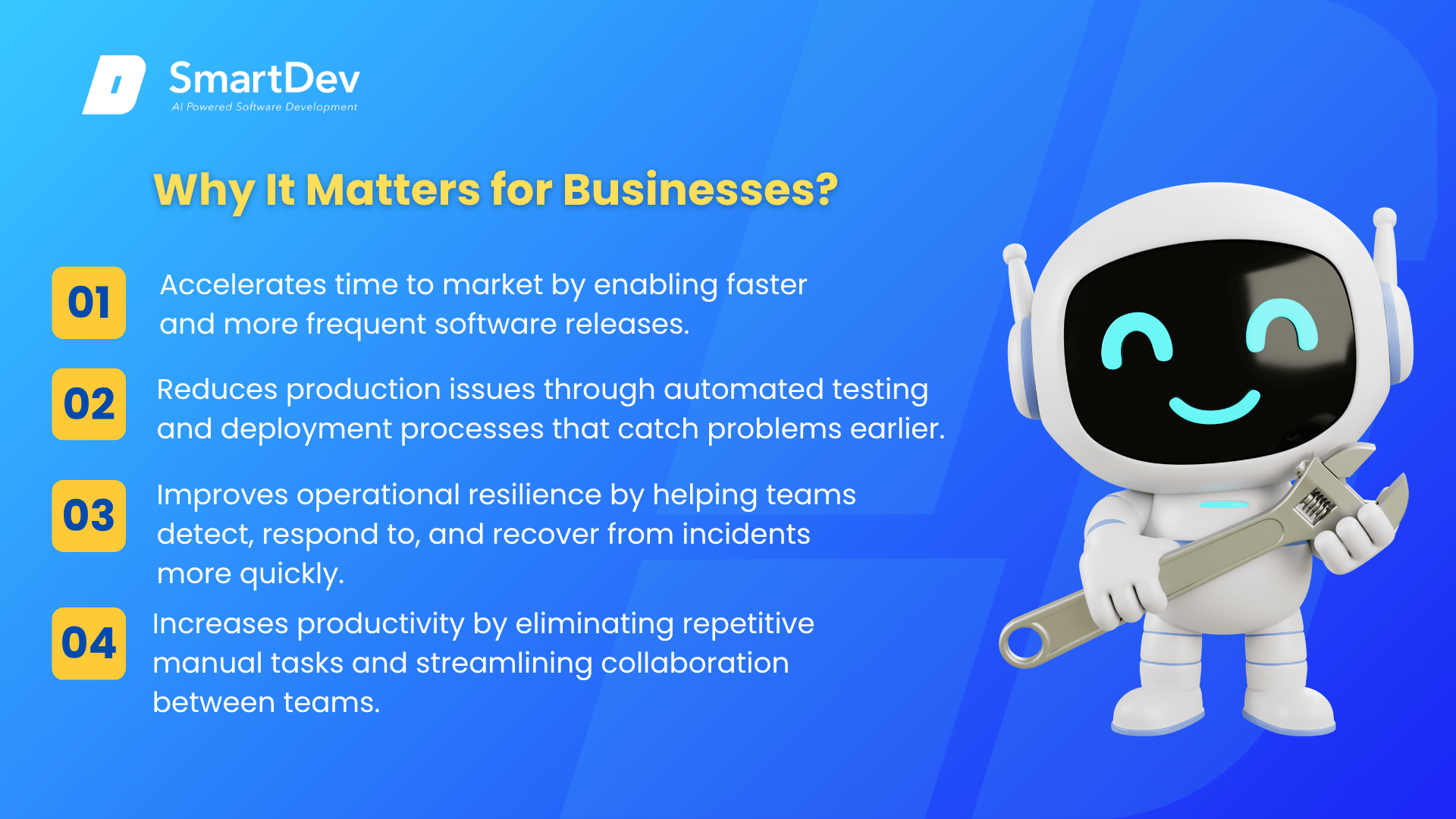
The business case for DevOps is straightforward: faster software delivery with fewer production failures. Organizations that adopt DevOps practices consistently and measurably outperform those that do not, across industries and company sizes.
- Reduce time to market: DevOps teams deploy code many times per day compared to traditional teams that release monthly or quarterly. Research shows high-performing DevOps organizations deploy 417 times more frequently than low performers, allowing faster response to customer needs and competitive pressures.
- Reduce production failures: Automated testing and continuous deployment practices catch defects early in the pipeline. High-performing DevOps teams report up to four times lower change failure rates compared to teams using traditional release processes.
- Accelerate recovery when incidents occur: When problems do reach production, DevOps teams recover up to 30 times faster using shared runbooks, automated rollback capabilities, and comprehensive observability tooling.
- Improve team productivity: Eliminating manual handoffs and repetitive tasks through automation frees developers and operations engineers to spend more time on value-creating work rather than deployment management.
For example, a financial services company that adopted DevOps practices with its outsourced development team reduced its deployment cycle from monthly to weekly within six months. Production incidents dropped significantly, and the team could ship regulatory compliance updates within days rather than waiting for the next scheduled release window.
How Does DevOps Work?
DevOps works by integrating development and operations through a continuous cycle of interconnected practices:
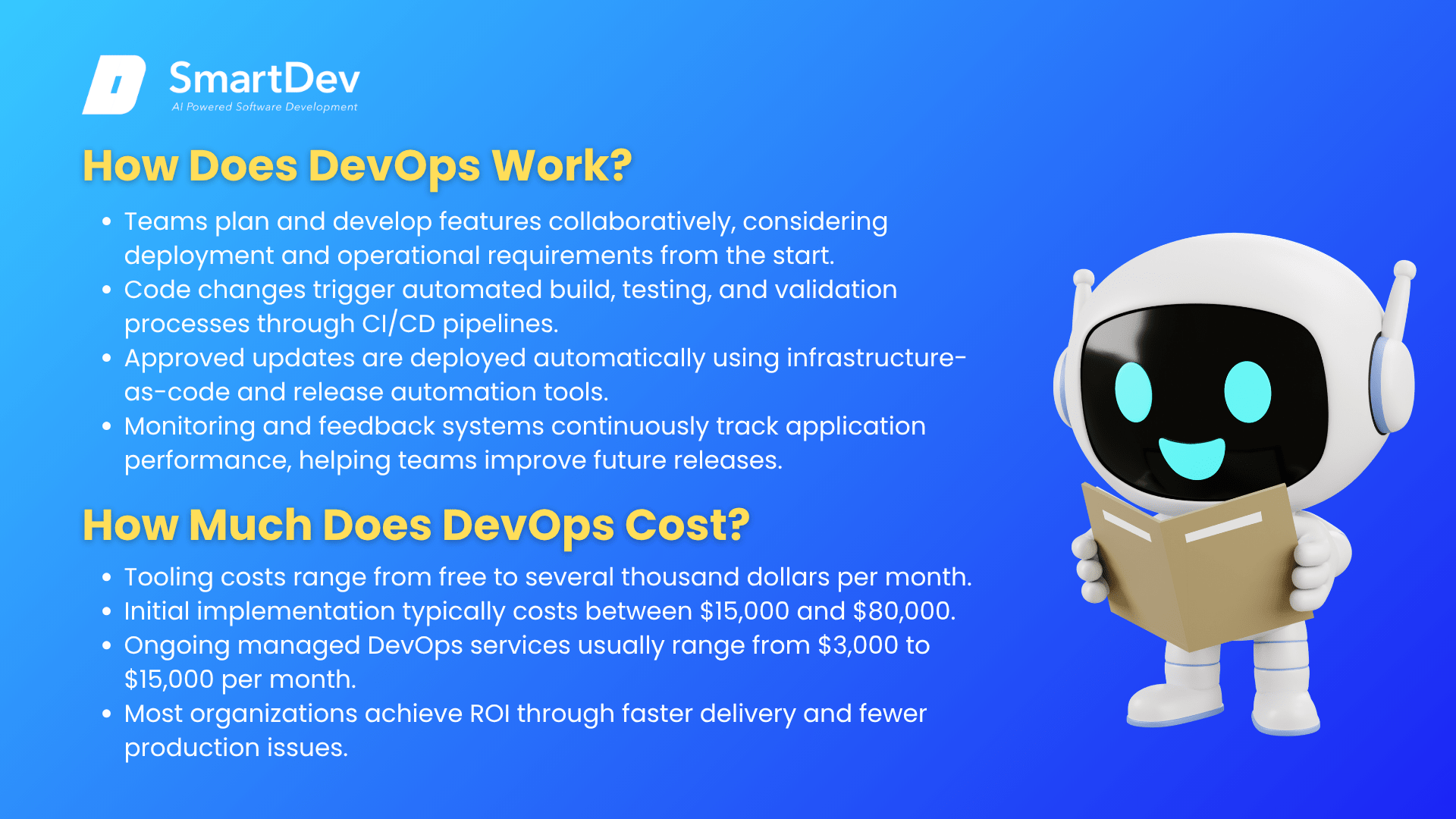
- Plan: Teams use agile methods to break work into small, deliverable increments. Product owners, developers, and operations engineers collaborate from the beginning on requirements and deployment considerations, preventing late-stage surprises.
- Build and test: Developers commit code to a shared repository, triggering automated builds and test suites through a CI/CD pipeline. Issues are caught and reported within minutes of the code being submitted.
- Deploy: Automated deployment pipelines push tested code through staging environments and into production using infrastructure-as-code tools such as Terraform or Ansible, ensuring every environment is configured identically and consistently.
- Monitor and respond: Production systems are monitored continuously with alerting tools that notify the team of anomalies before customers notice them. Incidents are resolved collaboratively using shared runbooks and defined escalation paths.
- Learn and improve: Teams conduct blameless post-mortems after incidents, identifying systemic improvements that prevent recurrence and strengthen the overall delivery system over time.
The result is a delivery cycle where software flows from idea to production quickly, safely, and repeatedly, with each iteration improving on the last.
How Much Does DevOps Cost?
The cost of adopting DevOps varies based on tooling choices, team size, and whether implementation is handled in-house or outsourced to specialists:
- Tooling: Core DevOps tools such as GitHub Actions for CI/CD, Terraform for infrastructure-as-code, and monitoring platforms like Datadog range from free for small teams to $1,000 to $5,000 per month for enterprise-scale deployments with compliance and audit features.
- Implementation: Engaging an outsourced DevOps team to design and set up pipelines, automate infrastructure, and establish working practices typically costs $15,000 to $80,000 depending on the scope and complexity of the existing environment. Day rates for senior DevOps engineers range from $75 to $200 in Western markets and $25 to $60 at offshore rates.
- Ongoing managed services: Outsourced teams that maintain CI/CD pipelines, cloud infrastructure, and monitoring on an ongoing basis typically charge $3,000 to $15,000 per month depending on environment complexity and service level requirements.
The return on investment is substantial. Organizations with mature DevOps practices consistently reduce infrastructure costs by 20 to 30% and dramatically decrease the cost of production incidents through prevention and faster resolution, making the initial investment recover within months for most businesses.
Other Related Terms
CI/CD Pipeline: The automated delivery system at the heart of DevOps practice, taking code from commit through build, test, and deployment with minimal manual intervention, enabling the frequent and reliable releases that DevOps promises.
Site Reliability Engineering: A discipline that applies software engineering principles to operations work, closely related to DevOps and focused on building and maintaining highly reliable, scalable production systems using automation and measurement.
Infrastructure as Code: The practice of managing and provisioning computing infrastructure through machine-readable configuration files rather than manual processes, a foundational DevOps practice that ensures consistent, repeatable, and auditable deployments across all environments.