
TL;DR:
- Model drift in AI is the gradual degradation of an AI model’s accuracy and reliability as the real-world data it encounters changes over time.
- A large-scale industry survey found that 78 percent of executives who experienced model drift reported a significant negative business impact, averaging 3.6 percent of affected business unit revenue.
- Continuous monitoring and automated retraining pipelines are the standard enterprise defense against model drift in 2026.
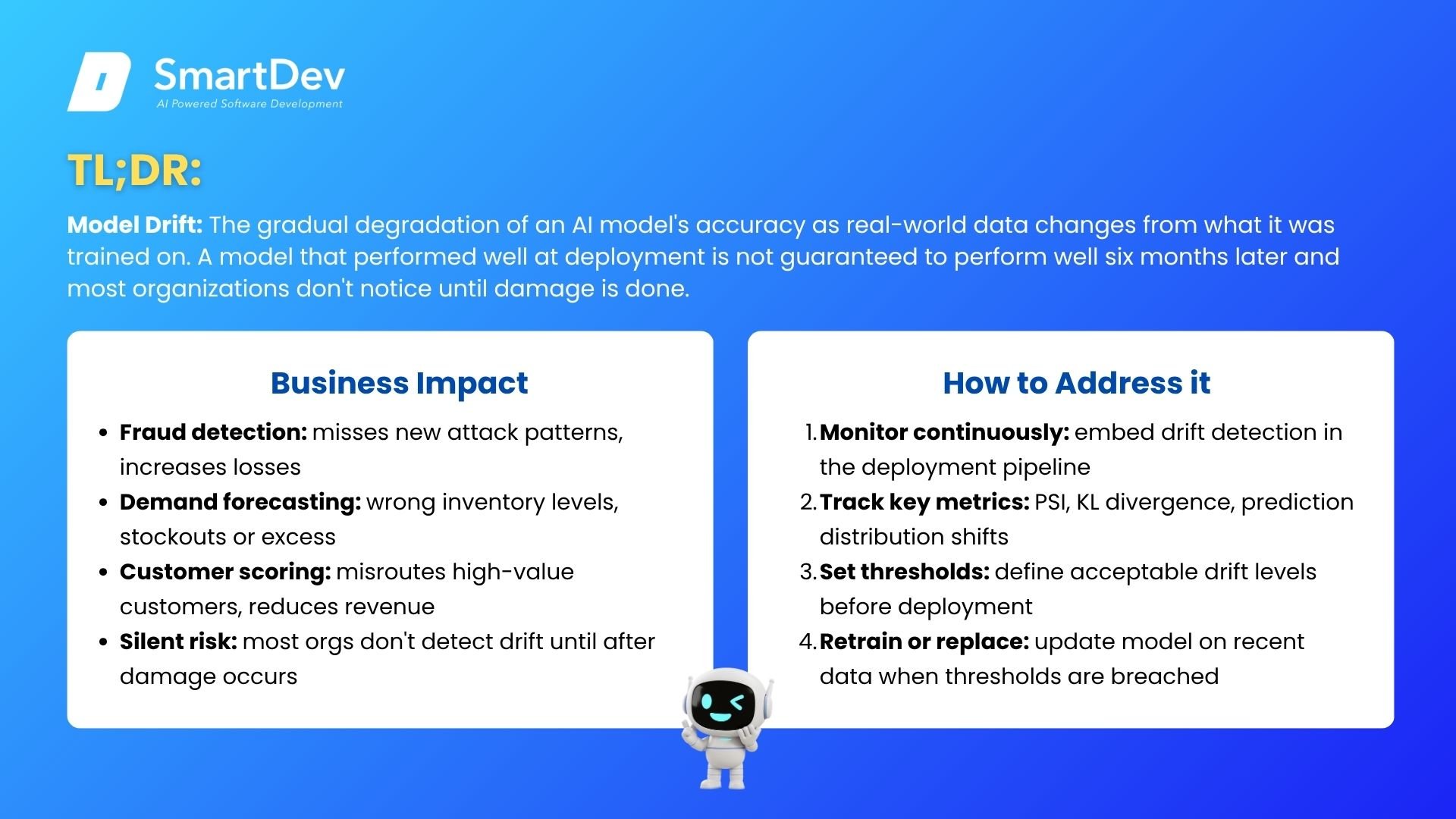
An AI model that performed well when you deployed it is not guaranteed to perform well six months later. The world changes, customer behavior shifts, market conditions evolve, and the data flowing into your AI system today looks different from the data it was trained on. That gap between training reality and current reality is model drift in AI, and it is one of the most underestimated risks in enterprise AI programs.
What Is Model Drift in AI?
Model drift is the phenomenon where an AI or machine learning model’s performance degrades over time because the real-world data it processes has changed from the data it was originally trained on. A model trained on customer behavior from 2024 may produce noticeably less accurate predictions when deployed into 2026 conditions if buying patterns, fraud techniques, or market dynamics have shifted.
There are two primary forms of drift. Data drift, also called covariate drift, occurs when the statistical properties of input data change over time, even if the underlying relationship between inputs and outputs has not. Concept drift occurs when the underlying relationship itself changes: the same inputs should now produce different outputs because the world has fundamentally shifted in a way the model was not trained to anticipate.
Both forms of drift can affect any AI model used in dynamic environments, including fraud detection systems, demand forecasting tools, customer churn predictors, credit risk models, and recommendation engines. The longer a model remains in production without monitoring, the greater the accumulated drift and the larger the business impact.
Why It Matters for Businesses?
AI model drift translates directly into business harm. A fraud detection model that has drifted may miss new attack patterns, resulting in financial losses. A demand forecasting model that has drifted may recommend incorrect inventory levels, causing stockouts or excess. A customer scoring model affected by concept drift may misroute high-value customers, reducing revenue and satisfaction simultaneously.
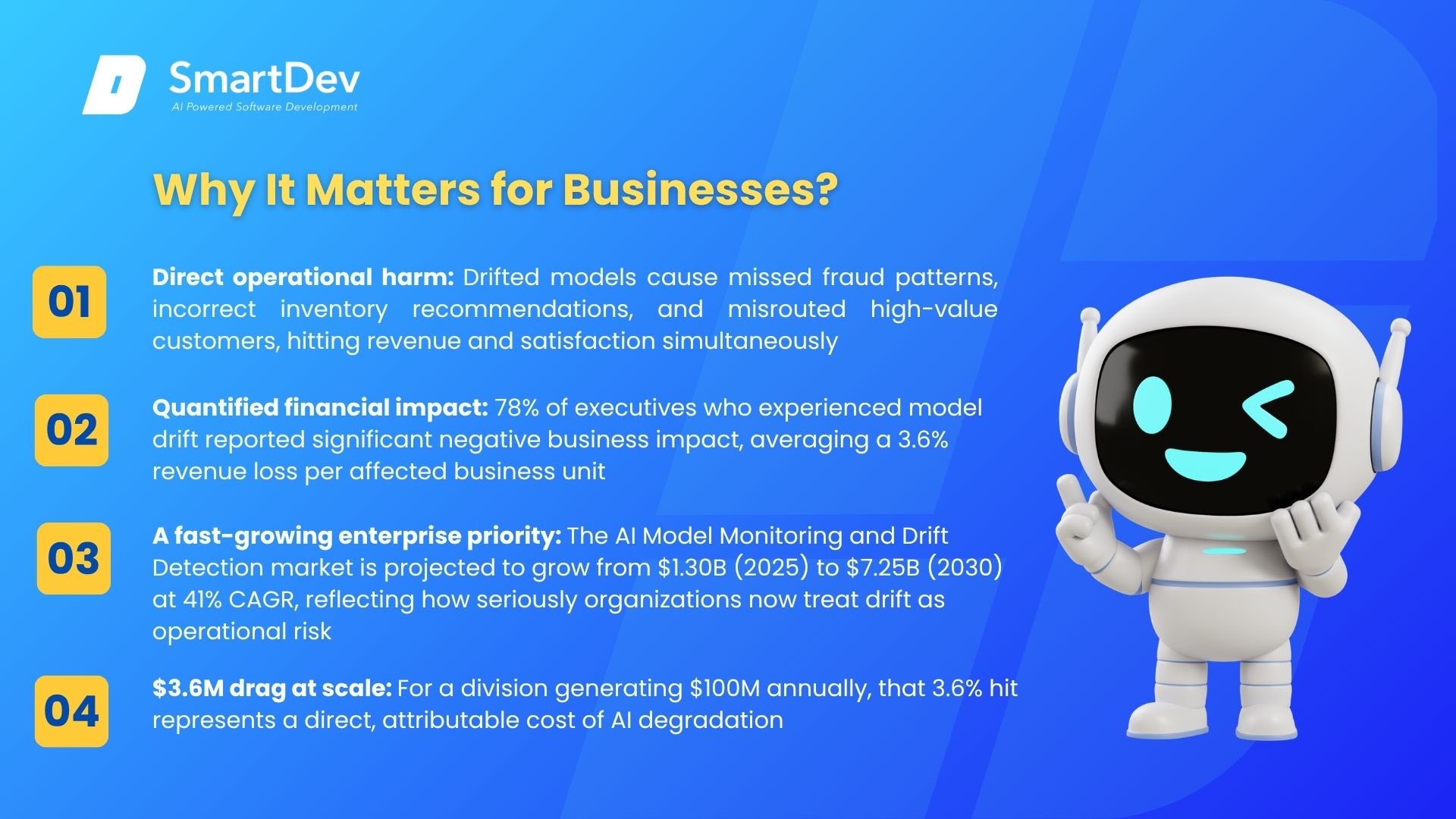
The financial stakes are significant. Research shows that 78 percent of executives who experienced model drift reported a significant negative business impact, with an average revenue hit of 3.6 percent for the affected business unit. For a division generating $100 million in annual revenue, that represents a $3.6 million drag attributable directly to AI degradation.
The AI Model Monitoring and Drift Detection market was valued at $1.30 billion in 2025 and is projected to reach $7.25 billion by 2030, growing at a 41 percent compound annual growth rate. This growth reflects how seriously enterprises are now treating model drift as an operational risk that requires dedicated tooling and ongoing investment.
When Does Model Drift Occur?
Model drift in AI is not a sudden event; it is a gradual process that accelerates under certain conditions. Seasonal changes that shift customer behavior patterns are a common trigger for data drift in consumer-facing models. Macroeconomic shifts, such as inflationary periods or supply chain disruptions, can create concept drift in financial and operational models. New competitive products, changes in marketing strategy, or regulatory updates can all alter the statistical relationships a model relies on.
Technology changes also induce drift. As your organization updates its data collection systems, changes its product catalog, or migrates platforms, the data pipeline feeding your AI models may change in subtle ways that introduce drift without any change in the external environment.
Drift typically becomes detectable within three to twelve months for models operating in dynamic markets. High-frequency environments, such as real-time fraud detection or financial trading, can experience meaningful drift within weeks. Organizations that run models without regular validation cycles are likely already operating on degraded AI performance without knowing it.
How to Detect and Address Model Drift?
The standard approach to managing model drift in AI in 2026 is continuous monitoring using automated drift detection tools embedded in the model deployment pipeline. Statistical metrics used to detect drift include Population Stability Index (PSI), which measures how much input distributions have shifted; Kullback-Leibler divergence, which quantifies differences between probability distributions; and prediction distribution monitoring, which flags when model outputs begin clustering in unusual patterns.
Leading MLOps platforms including AWS SageMaker Model Monitor, Google Vertex AI, Azure Machine Learning, and Fiddler AI provide native drift detection capabilities that can trigger automated alerts when drift exceeds defined thresholds. When drift is detected, the standard response is either model retraining on more recent data, feature engineering to account for new patterns, or model replacement with a freshly trained version.
Governance around model drift requires establishing acceptable drift thresholds before deployment and defining the organizational process for responding when those thresholds are breached. In regulated industries, demonstrating continuous monitoring for model drift is becoming a formal compliance requirement, not just an operational best practice.
Other Related Terms
AI Model Deployment: The process of moving a trained AI model from a development environment into a live production system where it processes real data. Model drift only becomes possible once a model is deployed. The gap between training conditions and live conditions is where drift begins to accumulate.
AI Model Development: The structured process of building, training, and validating a machine learning model before it reaches production. Decisions made during development, such as which data to train on and which validation benchmarks to set, directly determine how quickly a model will drift once real-world conditions diverge from training conditions.
Data Governance: The set of policies and processes that control how data is collected, stored, and used across an organization. Strong data governance enables earlier detection of model drift by maintaining visibility into changes in data quality, structure, and distribution before those changes degrade model performance.