
TL;DR: Key Takeaways
- Core Definition: Technical Architecture acts as the foundational blueprint for a company’s software systems, defining how all technical components interact and function.
- Business Value: It guarantees high scalability, fortifies cybersecurity, and significantly reduces long-term operational costs.
- Key Differentiator: Unlike basic IT infrastructure (hardware/servers), this architecture represents the logical design that dictates how applications utilize that physical infrastructure.
- Primary Roles: It is meticulously designed and managed by Technical Architects, who act as the vital bridge between high-level business strategy and hands-on software development.
- Modern Trends: Currently, businesses are rapidly abandoning outdated monolithic systems in favor of microservices, serverless computing, and AI-driven automated workflows.
What is Technical Architecture?
To begin with, Technical Architecture provides the overarching framework and strict guidelines for an organization’s entire technology landscape. Essentially, it defines the major components of a software system, their complex relationships, and the specific contracts that dictate their internal communications. Therefore, if we view a business as a living organism, this architecture serves as both the skeleton and the central nervous system.
Furthermore, it differs significantly from basic IT infrastructure. While infrastructure provides the raw computing power and physical servers, technical architecture is the logical blueprint that dictates exactly how applications use that power. Consequently, a well-designed architecture supports its own evolution and prevents costly project fragmentation down the line.
Additionally, this concept does not exist merely as an abstract idea. Instead, it is brought to life through tangible artifacts, such as deployment diagrams, data flow designs, and system requirements. By utilizing these visual tools, teams can easily bridge the communication gap between highly technical developers and non-technical business stakeholders.
Why It Matters for Businesses?
Implementing a robust Technical Architecture is not just an IT preference; rather, it is a critical business imperative. First and foremost, it guarantees unprecedented system scalability. For example, when online user traffic suddenly spikes during a major marketing campaign, a horizontally scalable architecture allows the system to seamlessly handle the load without crashing.
In addition to scalability, it dramatically improves overall system quality and developer productivity. By establishing clear, reusable design patterns, software engineers can save thousands of hours that would otherwise be wasted on repetitive coding. Moreover, it plays a pivotal role in risk management and compliance. Specifically, it incorporates strict security policies, zero-trust micro-perimeters, and disaster recovery plans to protect sensitive company data.
Ultimately, a solid architectural foundation prevents massive budget overruns. Through optimized cloud usage and serverless computing models, businesses can transition from rigid capital expenditures to highly flexible operational expenses. Thus, it ensures that technology investments directly align with predictable financial growth.
Who is Responsible for Technical Architecture?
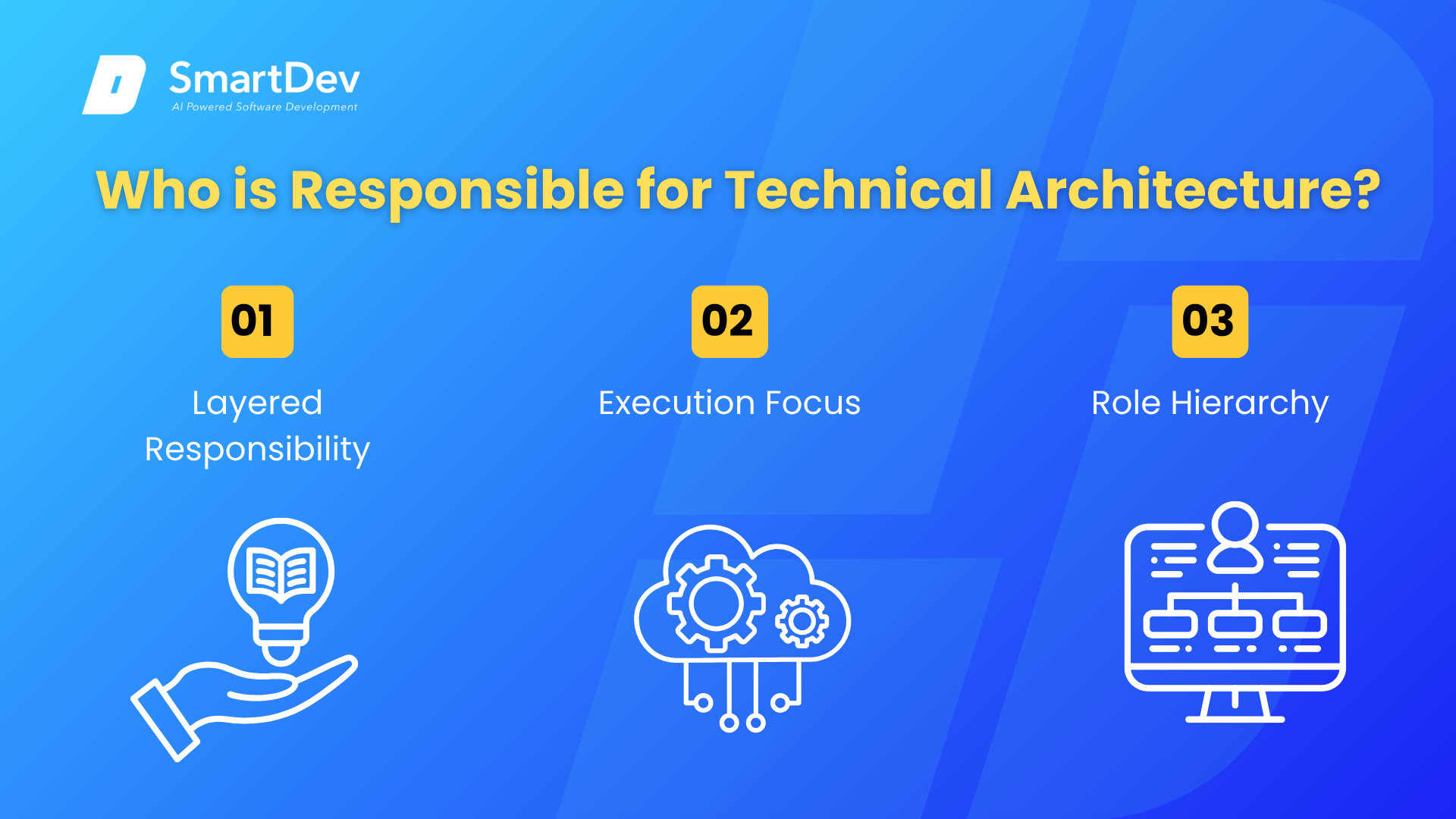
Unquestionably, managing and executing Technical Architecture is not a one-person job. Instead, it involves a deeply structured hierarchy of specialized IT professionals. Typically, the Enterprise Architect sets the abstract, high-level business strategy. Subsequently, the Solution Architect designs a broad solution to meet those specific business needs. Finally, the Technical Architect takes absolute charge of the hands-on execution.
Specifically, Technical Architects focus on the deep technical implementation, ensuring that individual software components work together flawlessly. Furthermore, within this specific discipline, there are multiple levels of expertise. For instance, Associate Technical Architects support daily team designs under supervision.
Conversely, Lead and Principal Technical Architects operate at the highest executive levels. Ultimately, these senior leaders proactively seek out digital transformation opportunities, justify massive budget decisions to stakeholders, and resolve the most complex technical roadblocks.
How to Design and Modernize Technical Architecture?
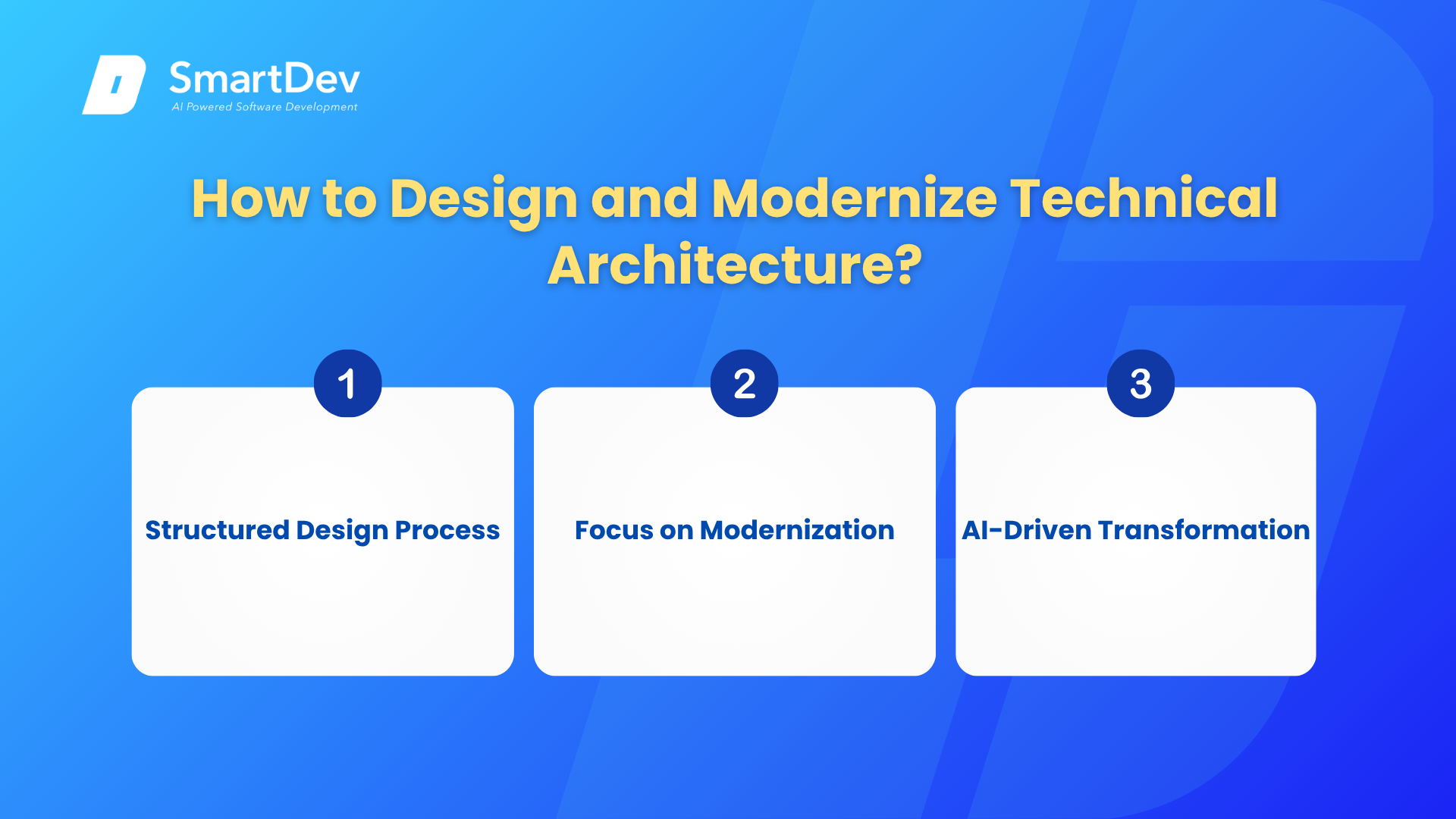
Designing a highly effective Technical Architecture requires a systematic and rigorous approach. Initially, architects must identify the end-users and the specific channels they utilize. Following this step, they map out the required application functionalities and seamlessly interconnect them. Meanwhile, they must also pinpoint critical external integrations, data entities, and the appropriate hardware platforms.
However, in today’s fast-paced digital landscape, professionals rarely build systems entirely from scratch. Instead, they focus heavily on application modernization. For example, companies frequently shift from rigid monolithic applications to agile microservices. By doing so, they can update, scale, or fix individual features independently without disrupting the entire platform.
Additionally, the rapid integration of Artificial Intelligence (AI) is currently revolutionizing this entire process. Indeed, generative AI tools now automatically analyze legacy codebases, identify technical debt, and suggest immediate refactoring strategies. Consequently, this allows organizations to modernize their systems at a fraction of the traditional time and cost.
When Should a Business Restructure Its Architecture?
Knowing exactly when to overhaul your Technical Architecture is crucial for long-term business survival. Generally, a complete redesign is strictly justified when the architecture itself actively blocks business progress. For instance, if your engineering teams are constantly busy but output quality and deployment speeds are steadily declining, it is a glaring red flag.
Similarly, if your team consistently avoids implementing new AI initiatives due to legacy system constraints, your technological foundation is likely too outdated. Besides these internal performance metrics, significant external organizational changes—such as major mergers, acquisitions, or rapid global market expansions—strongly indicate the immediate need for an architectural restructure. Ultimately, acting proactively before the current system entirely collapses is always the safest and most cost-effective strategy.
Other Related Terms
To fully grasp the corporate IT ecosystem, it is highly beneficial to understand several related technical terms:
- Enterprise Architecture: First, this represents the highest-level strategic framework. It perfectly aligns all IT assets, personnel, and operations with the overarching business and financial goals of the corporation.
- Solution Architecture: Next, this discipline focuses entirely on designing specific, project-level IT solutions to solve singular, well-defined business problems.
- Data Architecture: Furthermore, this acts as the blueprint that strictly governs how organizational data is collected, stored, processed, and protected across all platforms.
- Cloud-Native Architecture: Moreover, this is a modern development approach. It involves building applications specifically designed to leverage cloud computing advantages, heavily utilizing containerization and microservices.
- Security Architecture: Lastly, this vital subset focuses exclusively on defensively safeguarding IT assets. It establishes robust identity management, encryption protocols, and network boundaries to block malicious cyber threats.