TL;DR:
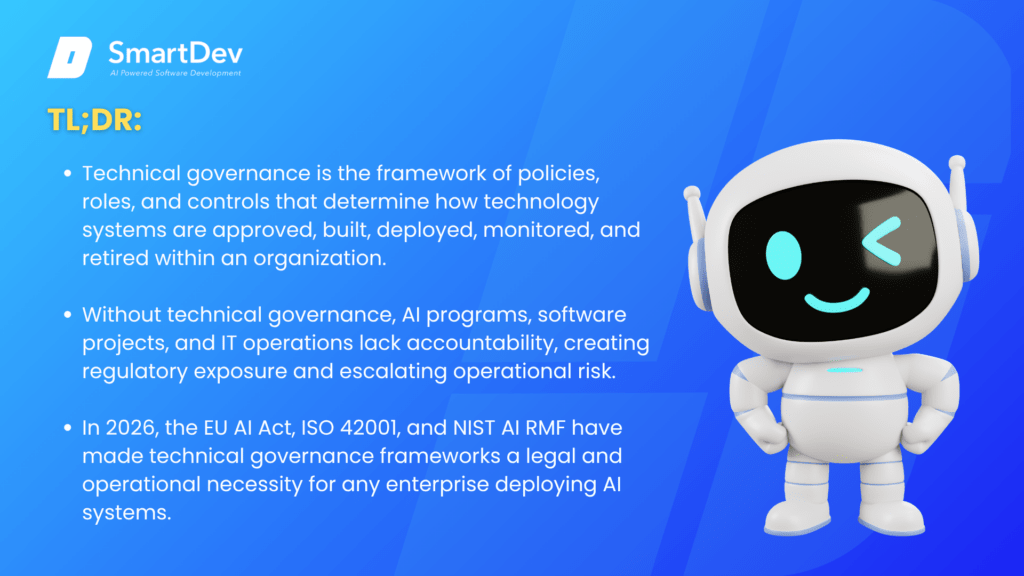
- Technical governance is the framework of policies, roles, and controls that determine how technology systems are approved, built, deployed, monitored, and retired within an organization.
- Without technical governance, AI programs, software projects, and IT operations lack accountability, creating regulatory exposure and escalating operational risk.
- In 2026, the EU AI Act, ISO 42001, and NIST AI RMF have made technical governance frameworks a legal and operational necessity for any enterprise deploying AI systems.
Technology decisions made without structure create problems that compound over time. Technical governance is the organizational discipline that ensures every significant technology decision follows a defined process with clear ownership and documented accountability. It is the difference between a technology organization that learns from its choices and one that repeats its mistakes.
What Is Technical Governance?
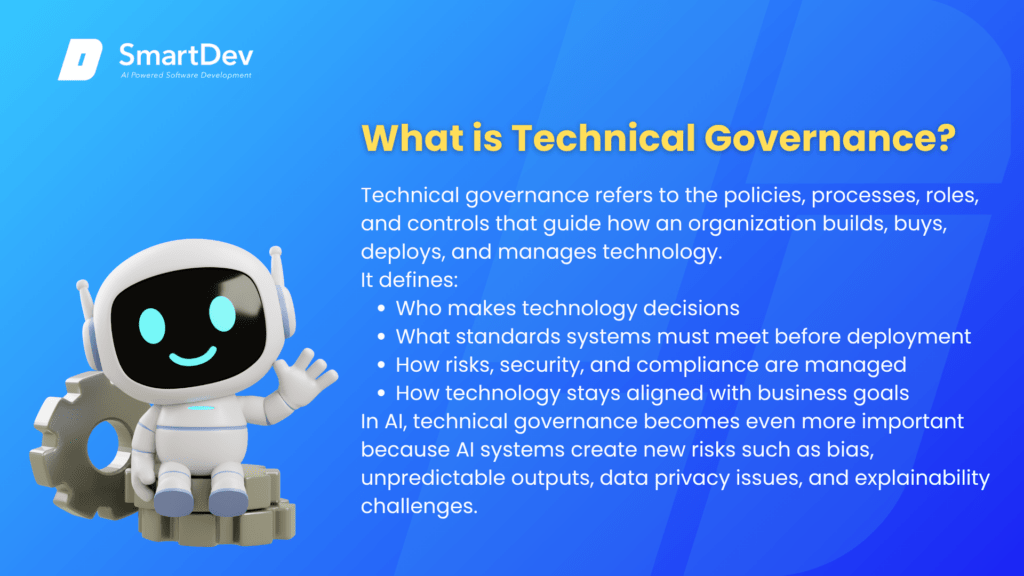
Technical governance is an overarching term for the policies, processes, roles, and oversight mechanisms that control how an enterprise develops, acquires, deploys, and maintains technology. It defines who has decision-making authority over technology choices, what standards must be met before a system goes into production, how risks are assessed and managed, and how compliance obligations are satisfied and demonstrated.
In practice, technical governance encompasses a wide range of activities: software architecture review boards, change management processes, vendor assessment frameworks, security review procedures, data privacy policies, and model performance monitoring protocols. Each of these is a governance mechanism that ensures technology operates within agreed boundaries and supports organizational objectives.
In the AI context specifically, technical governance has taken on heightened importance. AI systems introduce risks that traditional software governance processes were not designed to address, including model bias, unpredictable behavior under novel inputs, data privacy violations in training pipelines, and the challenge of explaining AI decisions to regulators and customers. AI governance is now widely recognized as a distinct specialization within the broader technical governance discipline.
Why It Matters for Businesses?
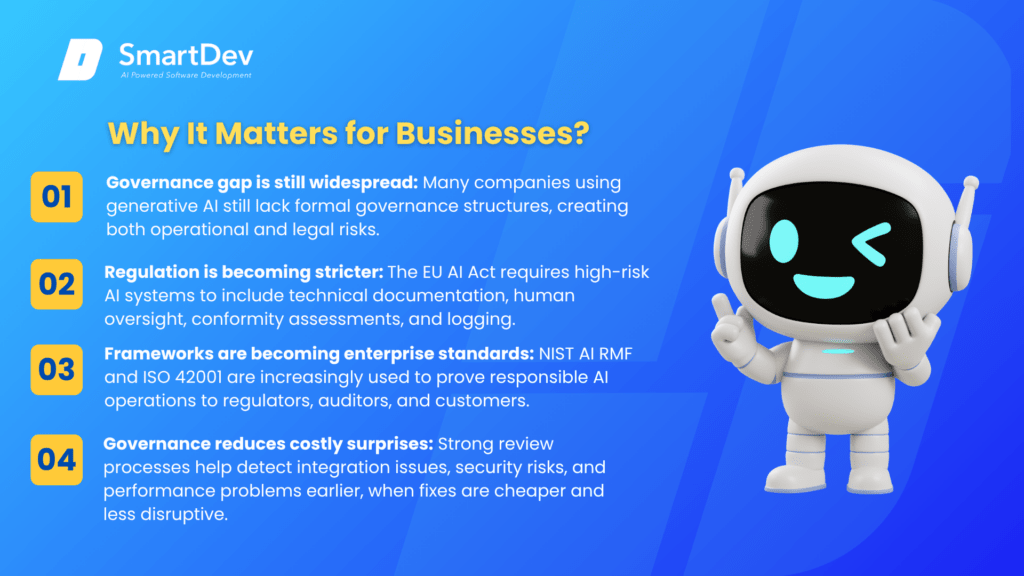
The business case for technical governance has strengthened significantly in recent years. McKinsey’s 2024 Global AI Survey found that 63 percent of companies using generative AI do not have governance structures in place for managing the associated risks. This governance gap is not only an operational risk; it is increasingly a legal one.
The EU AI Act’s high-risk provisions, which take effect in August 2026, require organizations deploying AI in high-risk applications to maintain technical documentation, implement human oversight, conduct conformity assessments, and establish comprehensive logging. The NIST AI Risk Management Framework and ISO 42001 provide additional frameworks that enterprises are adopting to demonstrate responsible AI operations to regulators, auditors, and enterprise customers.
Beyond regulatory compliance, governance creates business value by reducing costly surprises. Technology systems deployed without adequate review often create integration problems, security vulnerabilities, and performance issues that are discovered after deployment when they are most expensive to address. Governance processes move these discoveries earlier in the lifecycle, when corrections are cheaper and disruption is minimal.
Who Is Responsible for Technical Governance?
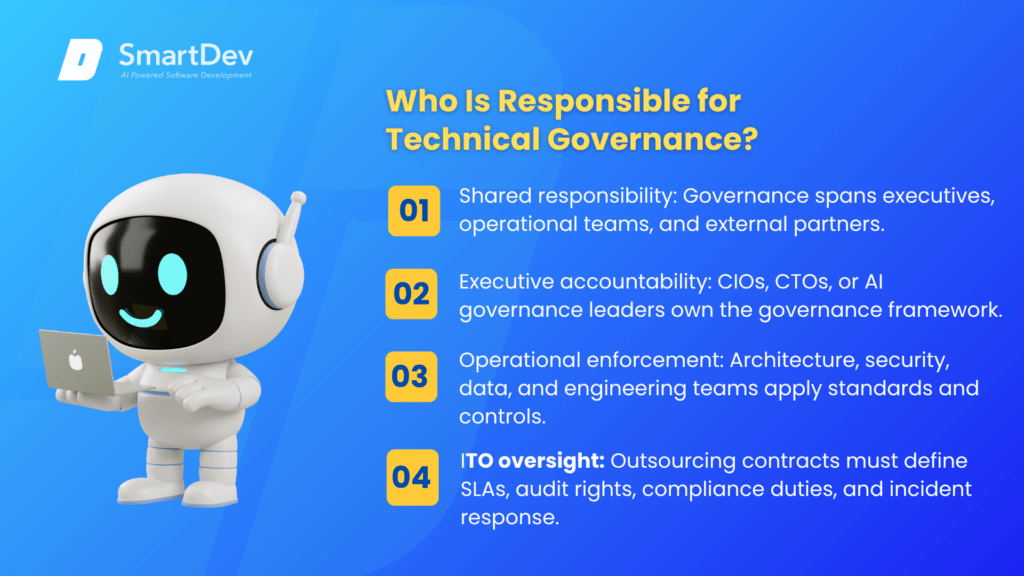
Technical governance is a shared responsibility that spans multiple organizational levels. At the executive level, the Chief Information Officer (CIO) or Chief Technology Officer (CTO) typically owns the overall governance framework and is accountable to the board and regulatory authorities for technology risk management. For AI-specific governance, many organizations have established a Chief AI Officer or AI governance committee with cross-functional membership including legal, compliance, risk, and business unit leadership.
At the operational level, architecture review boards evaluate significant technology decisions against established standards. Security teams conduct risk assessments. Data governance teams enforce data classification and access policies. Engineering teams are responsible for implementing governance requirements in the systems they build, including documentation, testing, and audit logging.
IT outsourcing providers play an important governance role in organizations that have delegated significant technology operations. When a third-party provider manages critical systems, the governance framework must clearly define accountability for performance, compliance, and incident response between the organization and its ITO partner. Governance clauses in outsourcing contracts, including service level agreements, audit rights, and incident notification requirements, are the mechanisms that maintain oversight across organizational boundaries.
When Should Technical Governance Be Implemented?
Governance frameworks should be established before significant technology programs begin, not after problems emerge. Organizations that attempt to retrofit governance onto existing AI systems or technology platforms face higher costs and greater resistance than those that build governance in from the outset.
The triggering events that most commonly accelerate governance adoption include a regulatory examination or audit that exposes control gaps, a technology incident such as a data breach or system failure that reveals absent oversight, or the scaling of an AI program to the point where ad-hoc management becomes untenable. In each case, the organization would have benefited from earlier governance investment.
For organizations just beginning AI programs, the right time to establish governance is during the planning phase of the first significant deployment. Starting with a lightweight governance framework that covers use case approval, data handling, model performance monitoring, and incident response creates habits and processes that scale naturally as the AI program grows.
Other Related Terms
- De-skilling Risk happens when teams rely too much on AI or automation and gradually lose core technical judgment. In software teams, this can weaken code review, debugging, architecture decisions, and long-term system ownership.
- AI Guard Rail is a set of rules, controls, and checks that keep AI systems safe, accurate, and aligned with business policies. It helps prevent harmful outputs, data leakage, bias, compliance breaches, and uncontrolled automation.
- Verification Loop is a process where AI outputs are checked, corrected, and revalidated before they are trusted or acted on. In technical governance, verification loops ensure AI decisions remain auditable, controlled, and accountable.