TL;DR:
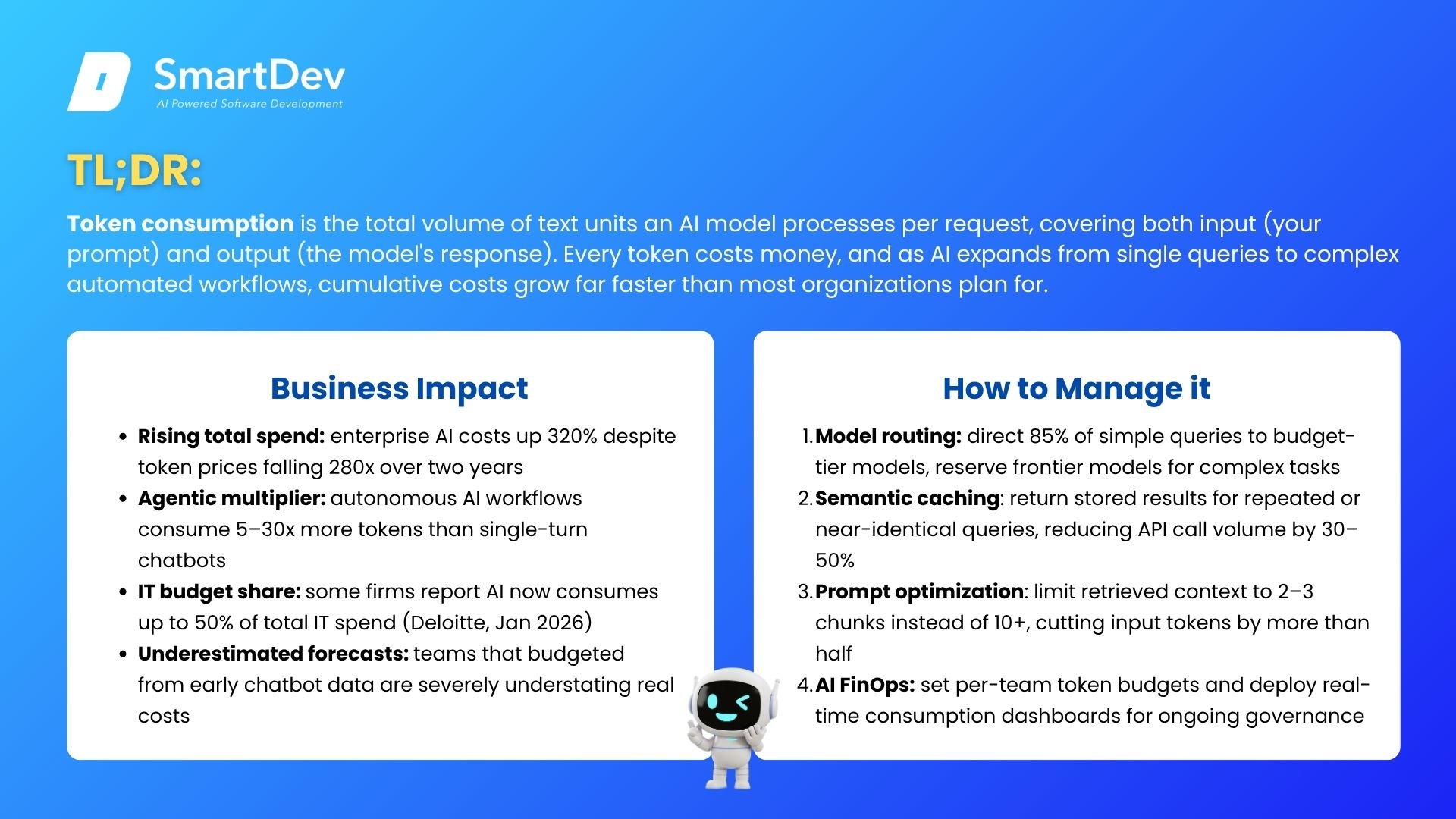
- Token consumption in AI is the number of text units an AI model processes per request, and it directly determines how much you pay to use a large language model.
- Enterprise AI bills are rising rapidly because agentic AI workflows consume 5 to 30 times more tokens than simple chatbot interactions.
- Managing token consumption in AI through model routing, caching, and prompt optimization can reduce AI spend by 60 to 90 percent without sacrificing output quality.
Artificial intelligence is becoming the fastest-growing line item in enterprise technology budgets. The reason is token consumption in AI. Every word your AI system reads and writes costs money, and as AI usage expands from single queries to complex automated workflows, those costs scale in ways most organizations did not anticipate. Understanding token consumption is the first step to controlling it.
What Is Token Consumption?
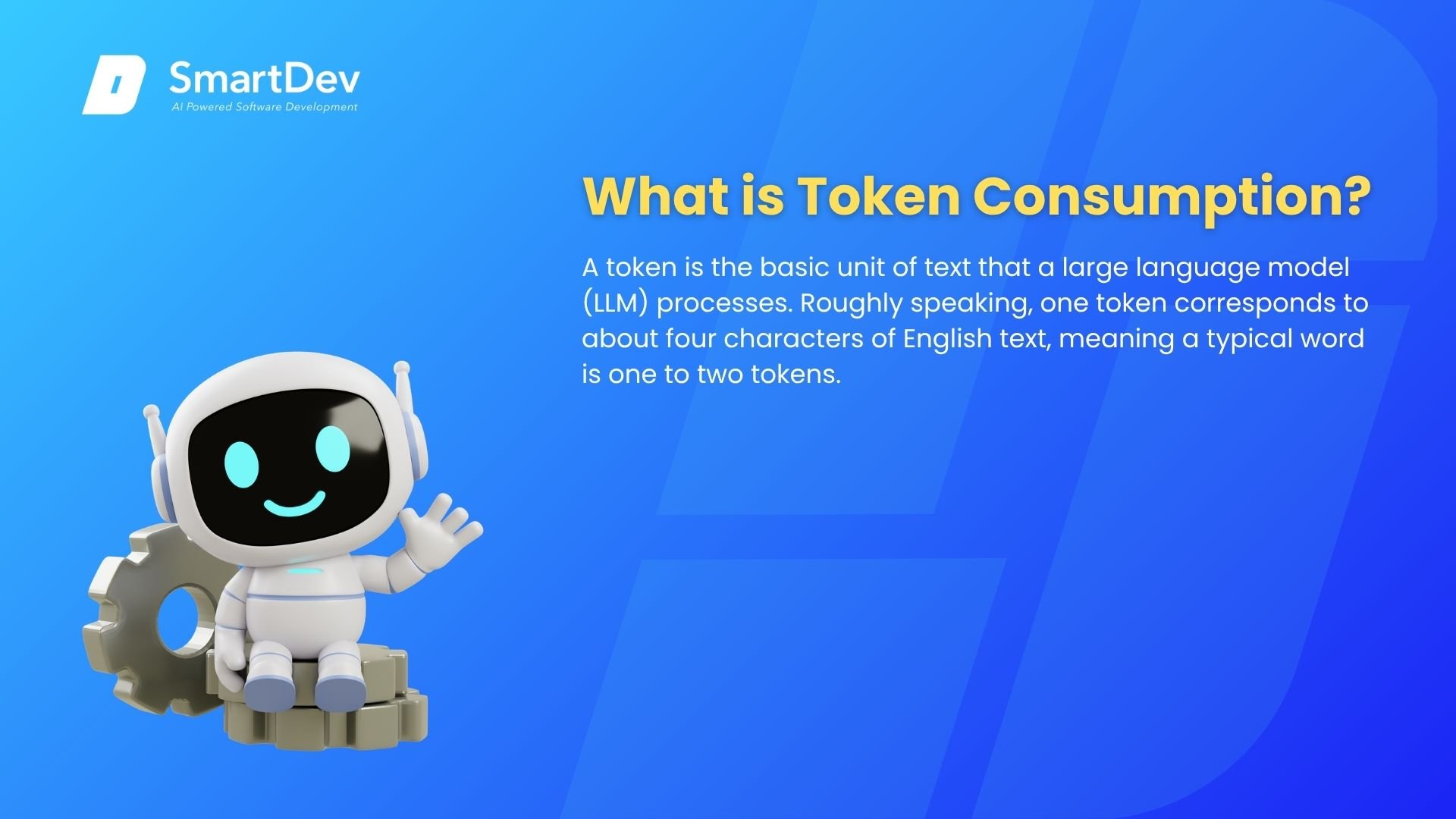
A token is the basic unit of text that a large language model (LLM) processes. Roughly speaking, one token corresponds to about four characters of English text, meaning a typical word is one to two tokens. When you send a request to an AI model, the model reads your input (input tokens) and generates a response (output tokens). You are billed for both.
Token consumption in AI refers to the total volume of tokens an AI system processes over a given period. At a single-query level, token counts are small and costs appear trivial. At enterprise scale, however, the cumulative AI token consumption of hundreds of thousands of AI interactions daily translates into significant and fast-growing operational costs.
Output tokens are universally more expensive than input tokens. Across major AI providers in 2026, the median price ratio between output and input tokens is approximately four to five times. This means that verbose AI responses, lengthy document summaries, and multi-step reasoning chains are significantly more expensive per interaction than focused, concise outputs.
Why It Matters for Businesses?
Despite token prices falling by 280 times over two years, total enterprise AI spend has risen by 320 percent over the same period. More AI usage at lower unit costs still produces higher total bills when adoption grows faster than prices drop.
Agentic AI systems, where AI models take sequences of actions, retrieve information, and call tools autonomously, consume five to thirty times more tokens per task than a simple chatbot. According to Gartner’s March 2026 analysis, token consumption in enterprise environments has grown thirteen times since January 2025. Organizations that budgeted for AI based on early chatbot usage patterns are finding those projections dramatically understated.
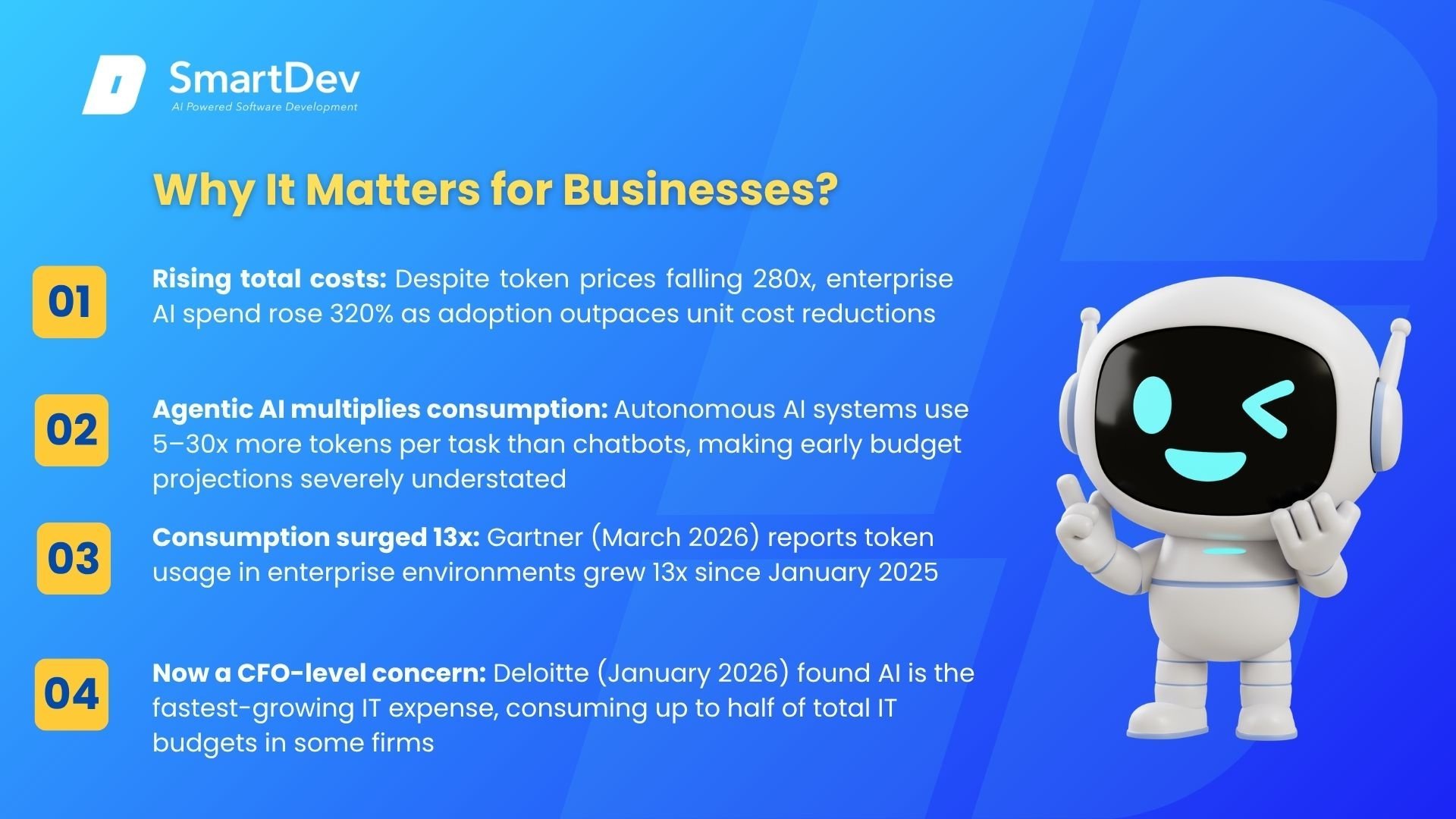
A Deloitte analysis from January 2026 found that AI is now the fastest-growing expense in corporate technology budgets, with some firms reporting that it now consumes up to half of their total IT spend. For IT leaders and CFOs, AI token consumption has moved from a technical detail to a financial management priority.
How Much Does It Cost?
Token prices vary widely by model tier. In 2026, the most cost-effective production LLMs start at approximately $0.04 per million tokens. Frontier reasoning models, used for complex analytical tasks, can reach $180 per million tokens. For most enterprise use cases, the practical range is $0.10 to $15 per million tokens, depending on the model selected.
An enterprise running an AI assistant that handles 100,000 interactions per day, with an average of 2,000 tokens per interaction, consumes 200 million tokens daily. At $1 per million tokens, this equals $200 per day or roughly $73,000 per year for a single application. Multiply this across multiple AI products and agentic workflows, and annual AI token consumption costs for a mid-sized enterprise can easily reach the millions.
RAG-based architectures add what practitioners call a context tax: the cost of retrieving and sending large volumes of background documents to the model with every query. This can double or triple the effective token cost of each interaction compared to a simple prompt-and-response exchange.
How to Manage Token Consumption?
Model routing is the most impactful cost control strategy available. Research shows that approximately 85 percent of enterprise queries can be handled by lower-cost models with no meaningful reduction in output quality. Routing simple tasks to budget-tier models and reserving expensive frontier models for genuinely complex queries can reduce overall AI token consumption by 60 to 90 percent.
Semantic caching stores the results of previous AI queries and returns cached answers when a new query is sufficiently similar. This bypasses the language model entirely for repeated or near-identical requests. Studies show that pairing model routing with semantic caching reduces API call volume by 30 to 50 percent for typical enterprise deployments.
Prompt optimization, specifically shortening system prompts, limiting retrieved context to the most relevant chunks, and requesting concise responses, directly reduces token consumption in AI without requiring any infrastructure changes. Tightening retrieval to two to three document chunks instead of ten or more can cut input tokens by more than half with no loss in accuracy. Establishing AI FinOps practices, including per-team token budgets and real-time consumption dashboards, gives organizations the visibility needed to govern AI costs at scale.
Other Related Terms
- Generative AI: A category of AI systems that produce new content, such as text, code, or images, based on patterns learned from training data. Generative AI is the underlying technology that makes token consumption a cost variable at all.
- AI Agent: A software system that uses AI to analyze inputs, make decisions, and carry out tasks autonomously toward a defined goal. AI Agents are the primary driver of elevated token consumption in enterprise environments.
- Agentic Flow: A structured sequence of AI-driven actions where one model output triggers the next step in an automated workflow. Agentic flows are where token consumption compounds most rapidly.