
Every year, organizations lose billions building software solutions that miss the mark. MIT research from 2025 found that 95% of generative AI pilots fail to deliver measurable business impact, and S&P Global reports that 42% of AI projects were scrapped before production in 2025-up dramatically from just 17% the previous year.
The culprit isn’t technology. It’s clarity-or the lack of it.
Most software failures stem from a preventable problem: teams rush into development before truly understanding what problem they’re solving, for whom, and why it matters. In the AI realm, this challenge intensifies.
AI requirements discovery-the structured process of defining business problems, validating assumptions, and aligning stakeholders before a single line of code is written-has become the difference between transformative AI deployments and expensive disappointments.
This article examines how AI-powered product discovery process methodologies transform vague business pain into precise, actionable problem statements. You’ll learn the SMART framework for AI for problem definition in software projects, the four-phase discovery methodology, and how organizations use AI in the software discovery phase to prevent scope creep, accelerate time-to-market, and dramatically improve project success rates.
 Why Traditional Discovery Falls Short and Leads to Costly Rework
Traditional product discovery methods focus on validating user needs and feature priorities for relatively predictable software systems. But these approaches weren’t designed for the uncertainties AI introduces-data quality requirements, model performance variability, organizational readiness for AI-driven decisions, and ethical considerations that don’t exist in conventional software. This is where AI requirements discovery becomes essential.
The consequences of inadequate AI product discovery are measurable and severe.
The Scope Creep Trap
Poor problem definition at the outset creates a domino effect. Without clear boundaries established during the AI in software discovery phase, requirements expand mid-project as stakeholders “discover” what they actually need. Research shows 78% of projects experience scope creep, and 32% of project failures trace directly to poor requirements management. When the problem statement is vague-“improve customer service” rather than “reduce average ticket resolution time from 48 hours to 18 hours for Tier 2 support issues”-teams build features that sound good but deliver no measurable impact.
AI for problem definition in software projects addresses this by forcing precision upfront. AI-powered tools analyze historical project data, customer feedback patterns, and support tickets to surface quantifiable pain points before teams commit to solutions. This systematic approach to AI requirements discovery prevents costly mid-stream changes.
Siloed Teams, Misaligned Goals
Business stakeholders speak in revenue targets and customer satisfaction scores. Technical teams speak in model accuracy and latency requirements. Product teams speak in user journeys and feature adoption. Without a shared language established during AI product discovery, these groups pursue conflicting definitions of success.
AI-powered product discovery process methodologies facilitate alignment by creating data-driven artifacts-user personas derived from behavioral analytics, prioritized feature lists based on ROI projections, and success metrics that bridge business outcomes with technical KPIs. When everyone sees the same quantified user needs during AI in the software discovery phase, the same competitive landscape analysis, and the same constraints documented in a discovery sprint, cross-functional alignment becomes a byproduct rather than a battle.
SmartDev’s 3-week AI discovery program exemplifies this cross-functional approach, bringing business, technical, and product stakeholders together from day one to ensure alignment throughout the AI requirements discovery process.
Manual Data Analysis Blindness
Human analysts examining customer feedback, market research, and operational data inevitably miss patterns-especially across large volumes. A product manager reviewing 5,000 support tickets might identify three recurring complaints. AI-assisted analysis of the same dataset during AI product discovery might surface 17 distinct pain clusters, rank them by financial impact, and correlate them with customer lifetime value segments.
This capability matters because AI requirements discovery isn’t about automating documentation. It’s about seeing problems humans can’t see at scale, then validating whether those problems justify AI investment or warrant simpler solutions. Modern AI discovery frameworks integrate pattern recognition, stakeholder alignment, and feasibility assessment into a unified methodology.

The AI Discovery Advantage: 5 Core Capabilities
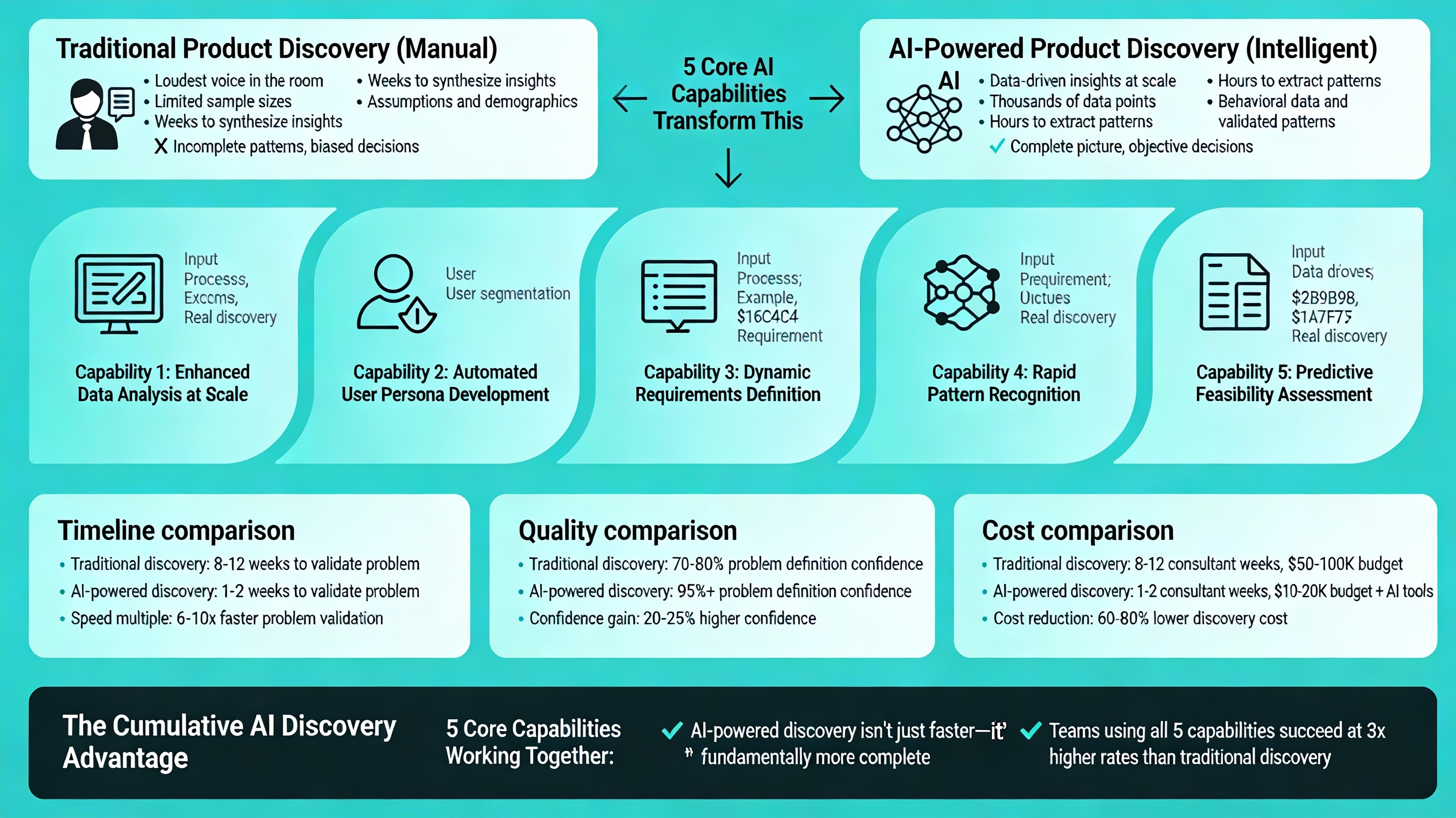
What distinguishes AI-powered product discovery process from traditional methods? Five capabilities fundamentally change how teams identify, validate, and prioritize business problems during AI in the software discovery phase before development begins.
Enhanced Data Analysis at Scale
AI ingests and synthesizes information humans couldn’t process in reasonable timeframes. During AI requirements discovery, AI tools analyze customer interviews, NPS survey responses, support ticket histories, competitive intelligence, sales call transcripts, and internal performance metrics-often thousands of data points-extracting themes and patterns in hours rather than weeks.
For example, an AI-powered product discovery process might analyze three years of customer feedback to identify that 43% of churn correlates with a specific workflow friction point that stakeholders assumed was minor. This data-driven problem identification during AI product discovery replaces the “loudest voice in the room” decision-making that plagues traditional discovery workshops.
Leading AI tools for requirements gathering like ChatGPT, Dovetail, and specialized platforms now automate this analysis, making AI requirements discovery accessible even to smaller teams.
Automated User Persona Development
Traditional personas rely on demographics and qualitative interviews with limited sample sizes. AI-driven personas created during AI in the software discovery phase leverage behavioral data-clickstream patterns, feature usage intensity, support interaction frequency, payment history-to create predictive segmentation.
These personas generated through AI product discovery don’t just describe who users are; they predict which features will resonate with high-value segments, which pain points correlate with revenue opportunity, and which user journeys show the highest abandonment risk. When teams prioritize AI requirements discovery, they ground personas in actual behavior patterns rather than assumptions.
Dynamic Requirements Definition
AI doesn’t replace human judgment in defining requirements during AI for problem definition in software projects-it augments it. During AI-powered product discovery process, machine learning models trained on historical project data suggest potential features, flag technical dependencies teams might overlook, and predict resource needs based on similar initiatives.
For instance, when a team defines “AI-powered customer intent prediction” as a requirement during AI requirements discovery, AI discovery tools can surface that similar projects required 18 months of historical transaction data, three data science FTEs, and integration with four existing systems-information that shapes feasibility assessment and scoping decisions immediately.
Real-Time Problem Clarification
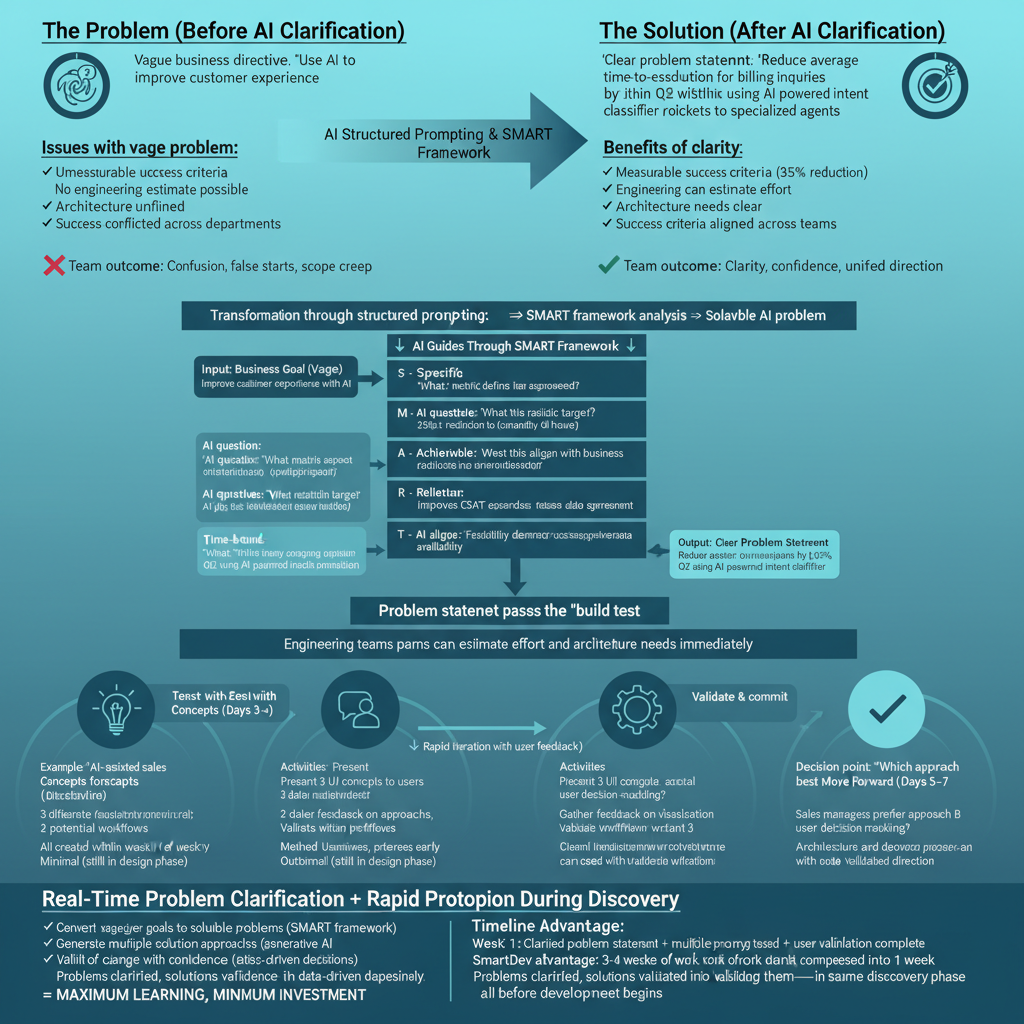
Perhaps the most valuable capability of AI in the software discovery phase: AI assists in converting business goals into solvable AI problems. A vague directive like “use AI to improve customer experience” becomes “reduce average time-to-resolution for billing inquiries by 35% within Q2 using an AI-powered intent classifier that routes tickets to specialized agents.”
This transformation happens through structured prompting during AI product discovery, where AI guides stakeholders through the SMART framework (detailed below), validates that proposed metrics are measurable, and flags when success criteria conflict across departments. The result of effective AI requirements discovery is problem statements that pass the “build test”-they’re specific enough that engineering teams can estimate effort and architecture needs.
SmartDev’s discovery approach uses structured workshops combined with AI analysis to achieve this clarity within the first week, demonstrating how modern AI-powered product discovery process methodologies accelerate decision-making.
Rapid Prototyping & Validation
Generative AI enables teams to create multiple concept prototypes in days during AI product discovery, test them with target users, and gather feedback before committing to full development. During AI in the software discovery phase, this means validating whether a proposed solution resonates with users while the cost of change is still minimal.
For example, a team exploring “AI-assisted sales forecasting” during their AI requirements discovery can generate three different UI concepts, two data visualization approaches, and four potential workflows-all within a week-long discovery sprint-then validate which approach best fits how sales managers actually make decisions.
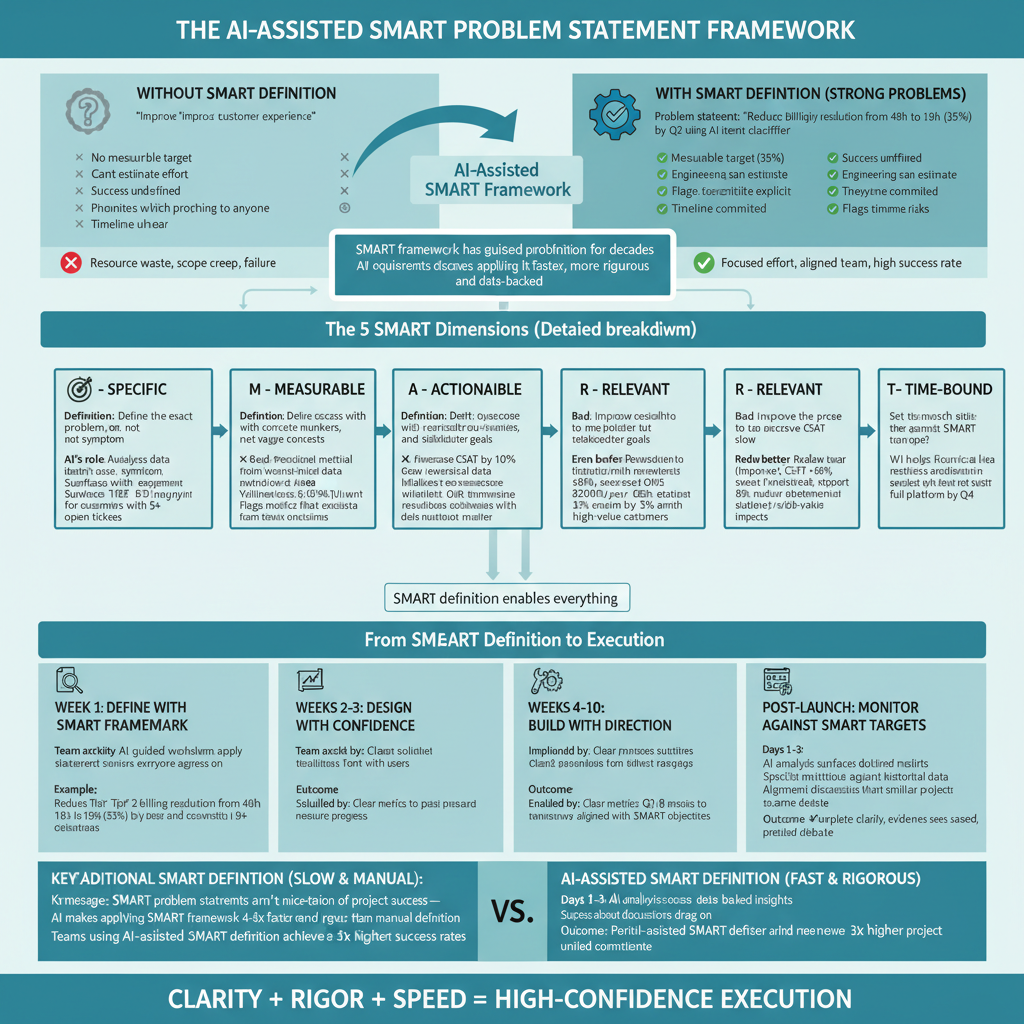
The AI-Assisted SMART Problem Statement Framework
The difference between a problem worth solving and one that wastes resources often comes down to how precisely it’s defined during AI for problem definition in software projects. The SMART framework-Specific, Measurable, Achievable, Relevant, Time-bound-has guided problem definition for decades. AI requirements discovery makes applying this framework faster, more rigorous, and data-backed.
Specific
Vague problem statements like “customers are frustrated” or “sales productivity is low” don’t provide direction for AI product discovery. Specificity requires defining exactly which customer segment, which aspect of the experience, and which context.
AI-assisted specificity during AI in software discovery phase: AI analyzes support tickets, survey responses, and behavioral data to identify precise pain points. Instead of “checkout is confusing,” AI requirements discovery yields “mobile users on iOS abandon checkout at the payment method selection step at 3.2x the rate of desktop users, primarily between 6-9 PM.”
Example: “Mid-market SaaS sales teams (50-200 employees) spend an average of 4.2 hours per week manually updating CRM records for qualified leads, resulting in 23% of high-intent prospects receiving delayed follow-up.”
Measurable
If you can’t measure whether a problem is solved during AI-powered product discovery process, you can’t justify the investment to solve it. Measurable problems attach quantifiable KPIs-time saved, revenue increased, error rate reduced, adoption percentage improved.
AI-assisted measurement in AI requirements discovery: Machine learning models establish baseline metrics and project improvement potential based on similar initiatives. If the problem identified during AI product discovery is “manual data entry errors,” AI can quantify current error rates (e.g., 8.7% of invoices contain data entry mistakes costing $47K monthly in correction labor) and benchmark realistic improvement targets (reducing errors to 2-3%).
Example: “Reduce average customer support ticket resolution time from 48 hours to 18 hours for Tier 2 billing issues, improving CSAT scores from 72% to 85% and decreasing ticket backlog by 40%.”
Actionable
An actionable problem statement in AI for problem definition in software projects suggests the direction of a solution without prescribing the exact implementation. It bridges the gap between business outcomes and technical feasibility.
AI-assisted actionability during AI in software discovery phase: During AI requirements discovery, AI tools suggest potential solution approaches based on the problem definition-rules-based automation, predictive models, natural language processing, computer vision-helping teams understand whether AI is even necessary or if simpler solutions suffice.
Example: “An AI-powered predictive lead scoring model that analyzes behavioral signals (product trial usage patterns, documentation page visits, webinar attendance) to identify conversion-ready prospects within the first 48 hours of trial signup.”
Relevant
Every problem worth solving during AI product discovery connects to strategic objectives-revenue growth, customer retention, operational efficiency, competitive differentiation, or regulatory compliance. Relevance ensures AI-powered product discovery process efforts aren’t technically impressive but commercially weak.
AI-assisted relevance in AI requirements discovery: Discovery tools map proposed problems to strategic goals documented in business plans, OKRs, and executive communications, flagging when initiatives don’t clearly support stated priorities during AI in the software discovery phase.
Example: “This initiative directly supports the Q4 objective of growing ARR by $12M through improving sales team productivity, enabling each rep to manage 30% more qualified opportunities without additional headcount.”
Time-Bound
Problem statements in AI for problem definition in software projects require realistic timelines for validation, solution development, and impact measurement. Time boundaries create urgency and enable milestone-based progress tracking.
AI-assisted time-bounding in AI requirements discovery: Based on historical project data, AI estimates realistic timelines for AI product discovery completion, MVP development, and full deployment, helping teams set achievable milestones rather than arbitrary deadlines.
Example: “Complete discovery and problem validation within 3 weeks; deliver MVP to 10 pilot users within 12 weeks; achieve full deployment across 200-person sales organization within 6 months.”
SMART Problem Statement Template for AI Requirements Discovery:
Problem: [Specific user segment] experiences [specific pain point] when [context/situation], resulting in [quantified negative impact].
Goal: [Measurable improvement target] by [deadline], which supports [relevant business objective].
Approach: [High-level solution direction, e.g., AI-powered automation, predictive model, intelligent routing] to address this problem.
Ready to eliminate hidden technical risks before they cost you millions?
SmartDev's proven discovery process replaces assumptions with validated insights, ensuring your tech stack scales with growth, security is built in from day one, and timelines reflect real complexity, not wishful thinking.
De-risk your investment, align stakeholders around a clear technical strategy, and make confident go/no-go decisions backed by comprehensive feasibility analysis.
Schedule Your Technical Feasibility Assessment TodayThe AI-Assisted Discovery Process: Step-by-Step
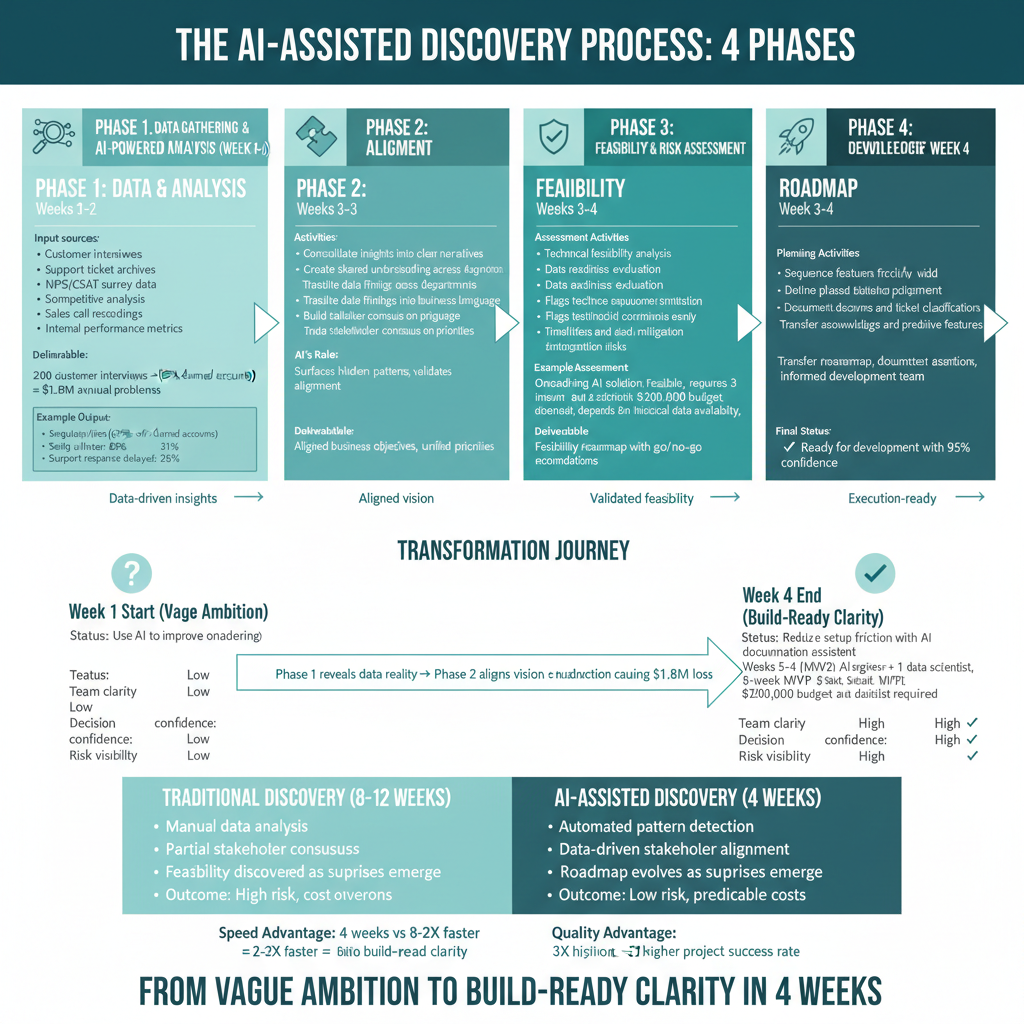
How do organizations move from vague business ambition to build-ready clarity in weeks rather than months through AI requirements discovery? A structured AI-powered product discovery process follows four phases, each building on the previous to systematically reduce uncertainty and risk.
Phase 1 – Data Gathering & AI-Powered Analysis (Week 1-2)
AI product discovery begins with collecting all available information about the business problem, user needs, current processes, and constraints. This includes customer interviews, support ticket archives, NPS/CSAT survey data, competitive analysis, sales call recordings, and internal performance metrics during the AI in software discovery phase.
AI’s role in AI requirements discovery: Automated theme extraction, sentiment analysis, pain point clustering, and pattern identification across thousands of data points. Instead of manually coding 200 customer interviews, AI surfaces the top 12 pain themes during AI-powered product discovery process, ranks them by frequency and emotional intensity, and correlates them with customer lifetime value segments.
Deliverable: A prioritized, data-backed inventory of business problems with quantified impact. For example: “Customer onboarding friction (cited by 67% of churned accounts) correlates with $1.8M annual revenue loss. Primary pain points: unclear product setup (43%), lack of integration documentation (31%), delayed technical support response (26%).”
This phase of AI requirements discovery ensures teams solve real problems, not assumed ones. Modern requirements gathering approaches emphasize this data-driven foundation.
Phase 2 – Insight Synthesis & Stakeholder Alignment (Week 2-3)
Raw data becomes actionable when cross-functional teams-business stakeholders, technical leads, product managers, UX designers-collaboratively interpret findings and align on priorities during AI for problem definition in software projects.
AI’s role in AI in software discovery phase: Facilitates workshops by presenting synthesized insights, suggesting requirements based on pain point analysis, and flagging potential conflicts between stakeholder priorities. For instance, if marketing wants “AI personalization for all users” but technical analysis during AI requirements discovery shows insufficient data for 60% of segments, AI flags this misalignment proactively.
Deliverable: An agreed-upon SMART problem statement, documented success metrics, and stakeholder sign-off on scope. This becomes the project charter that guides all subsequent AI product discovery decisions.
SmartDev’s approach emphasizes this alignment phase because misaligned stakeholders are among the top causes of AI project failure. Their 3-week AI discovery program dedicates substantial time to workshops that create shared understanding across business and technical teams during the AI-powered product discovery process.
Phase 3 – Feasibility & Risk Assessment (Week 3-4)
Not every well-defined problem discovered through AI requirements discovery justifies an AI solution. Feasibility assessment evaluates three dimensions during AI in the software discovery phase: technical, operational, and economic.
Technical feasibility in AI product discovery: Can current AI technology solve this problem? What data is required, and does it exist with sufficient quality? What infrastructure, tools, and expertise are needed during AI for problem definition in software projects?
Operational feasibility in AI-powered product discovery process: Will teams adopt the solution? What process changes are required? What training is necessary? How does this integrate with existing workflows identified during AI requirements discovery?
Economic feasibility in AI product discovery: What’s the total cost of ownership (development + infrastructure + maintenance)? What’s the projected ROI? What’s the payback period?
AI’s role in AI in software discovery phase: Predictive risk flagging based on historical project data. If a proposed solution during AI requirements discovery requires real-time inference at <100ms latency but similar projects encountered infrastructure challenges that delayed launch by 6 months, AI surfaces this risk during discovery, not during development.
Deliverable: A risk register with mitigation strategies, a go/no-go recommendation, and if “go,” a realistic scope and resource plan. SmartDev’s discovery process explicitly addresses these risks before any code is written in their AI-powered product discovery process, ensuring organizations make informed decisions rather than discovering obstacles mid-development.
Phase 4 – Development Roadmap & Knowledge Handoff (Week 4)
The final phase of AI product discovery translates validated problems and feasible solutions into a product development roadmap-a phased plan that defines MVP scope, future enhancements, effort estimates, and timeline milestones.
AI’s role in AI requirements discovery: Generates feature priority matrices, user story backlogs, and sprint-ready requirements based on business value scores and technical dependencies identified during AI in the software discovery phase. AI can also draft technical architecture documentation, API specifications, and data pipeline designs as starting points for engineering teams in the AI-powered product discovery process.
Deliverable from AI for problem definition in software projects: A build-ready product development roadmap that includes:
- MVP definition: Core features that address the highest-value problem with minimal scope
- Phased roadmap: Release plan for incremental capability expansion
- Effort estimation: Time and resource requirements with confidence intervals
- Knowledge transfer documentation: Problem context, design decisions, and stakeholder agreements preserved for the development team
Organizations using SmartDev’s 3-week discovery framework for AI requirements discovery receive a comprehensive solution vision document, technology direction (including candidate tech stack, architecture style, and AI/ML integration points), and a clear go-forward product development roadmap. This ensures seamless transition from AI product discovery to development without knowledge loss during handoff.
The Business Case: How AI Discovery Prevents Costly Mistakes
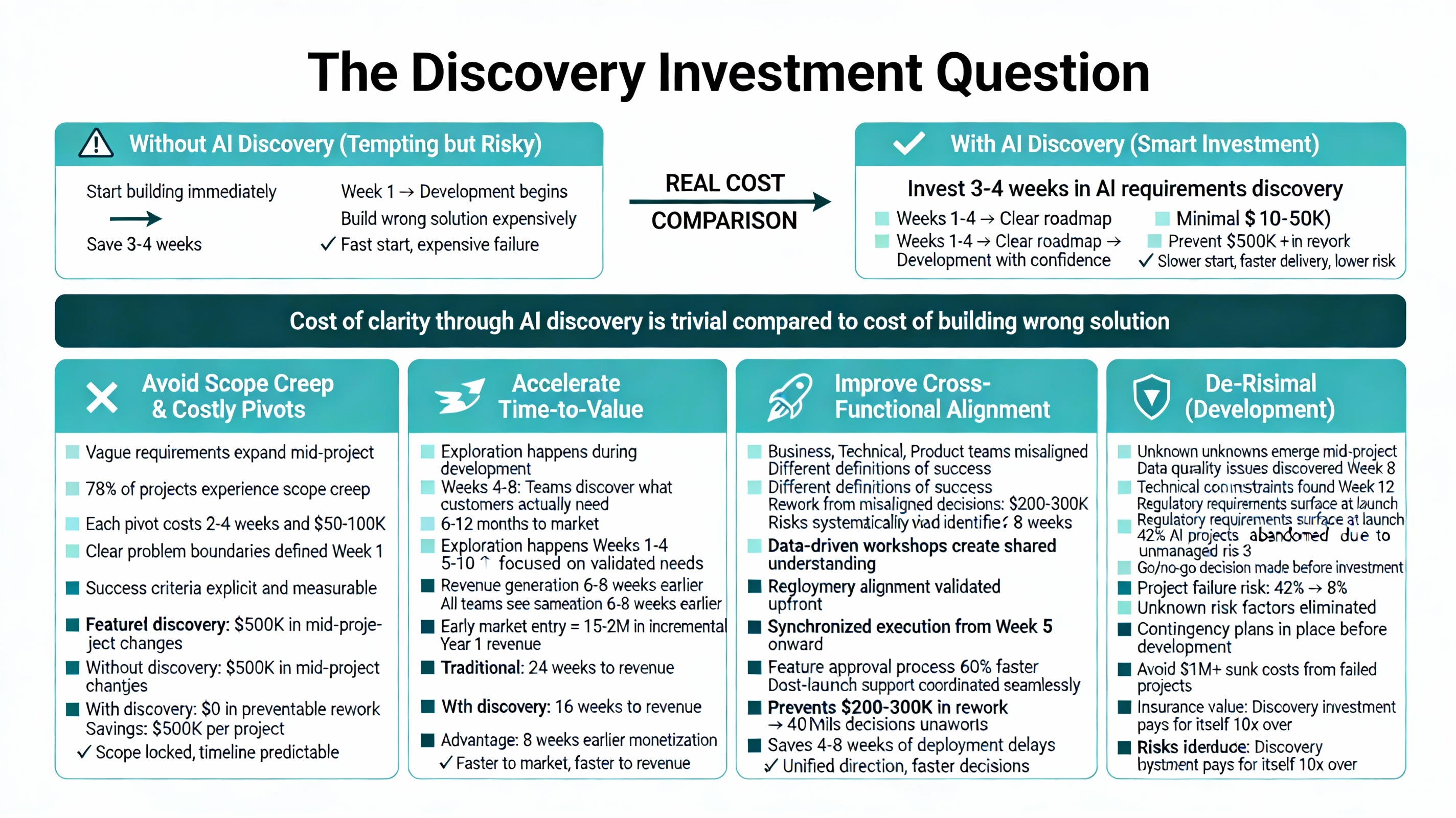
Why invest 3-4 weeks in AI requirements discovery when you could start building immediately? Because the cost of clarity through AI-powered product discovery process is trivial compared to the cost of building the wrong solution.
Avoid Scope Creep & Costly Pivots
The Standish Group reports that 78% of software projects experience scope creep, and 52.7% exceed original budgets by 89% or more. The root cause? Vague requirements that expand as stakeholders “figure out” what they actually need during development-a problem AI in the software discovery phase explicitly prevents.
AI requirements discovery locks in problem boundaries early by forcing stakeholders to define measurable success criteria, validate assumptions with data, and sign off on scope before development begins. When requirements change (and some always do), teams using AI product discovery have a documented baseline to evaluate whether the change aligns with the original problem or represents scope expansion.
Impact: Organizations avoid 4-12 months of rework and $200K-$1M in sunk costs on features that don’t address validated user needs. One SmartDev case study illustrates how AI-powered product discovery process prevented a major pivot that would have cost six months of development time by validating that a proposed AI feature didn’t actually solve the highest-priority user problem.
Accelerate Time-to-Value
When teams build solutions to precisely defined problems with validated user demand through AI for problem definition in software projects, they ship faster and see adoption sooner. AI product discovery eliminates months of debate about priorities, reduces mid-development course corrections, and enables confident, fast execution.
AI-powered product discovery process compresses what traditionally took 8-12 weeks into 3-4 weeks by automating data analysis during AI requirements discovery, accelerating prototype generation, and facilitating rapid stakeholder alignment during AI in the software discovery phase.
Impact: Organizations launch validated solutions 40-50% faster than when they skip AI product discovery. Faster time-to-market means capturing revenue opportunity sooner, responding to competitive threats more rapidly, and learning from real user feedback earlier.
Improve Cross-Functional Alignment
Misalignment between business, product, and engineering teams causes costly delays, feature rework, and launched products that miss targets. When each group operates from different assumptions about user needs, success metrics, and priorities, every decision becomes a negotiation-a problem AI requirements discovery solves systematically.
AI in the software discovery phase creates shared, objective artifacts through AI-powered product discovery process-quantified user pain points, data-driven personas, prioritized feature lists, documented constraints-that become the single source of truth for all teams.
Impact: Fewer meetings spent debating opinions; more time executing agreed-upon plans from AI product discovery. Higher adoption rates because solutions address validated needs from AI requirements discovery. Improved team morale because everyone understands the “why” behind priorities.
De-Risk Development
AI for problem definition in software projects surfaces technical risks, data limitations, integration challenges, and adoption barriers before they become expensive mid-development surprises. Predictive analytics during AI in the software discovery phase flag risks like “similar projects required 6 months of data labeling” or “this architecture typically encounters latency issues at scale.”
When teams know constraints upfront through AI requirements discovery, they design architectures that accommodate them, negotiate realistic timelines in their product development roadmap, and build contingency plans into roadmaps.
Impact: Higher first-time project success rates. SmartDev’s risk-reduction approach through AI-powered product discovery process validates problem-solution fit, aligns business value with technical feasibility, and enables confident go/no-go decisions before substantial capital is committed.
Getting Started with AI-Assisted Discovery: Best Practices & Tools
Organizations ready to implement AI product discovery can accelerate adoption by following proven practices and leveraging appropriate tools for AI requirements discovery.
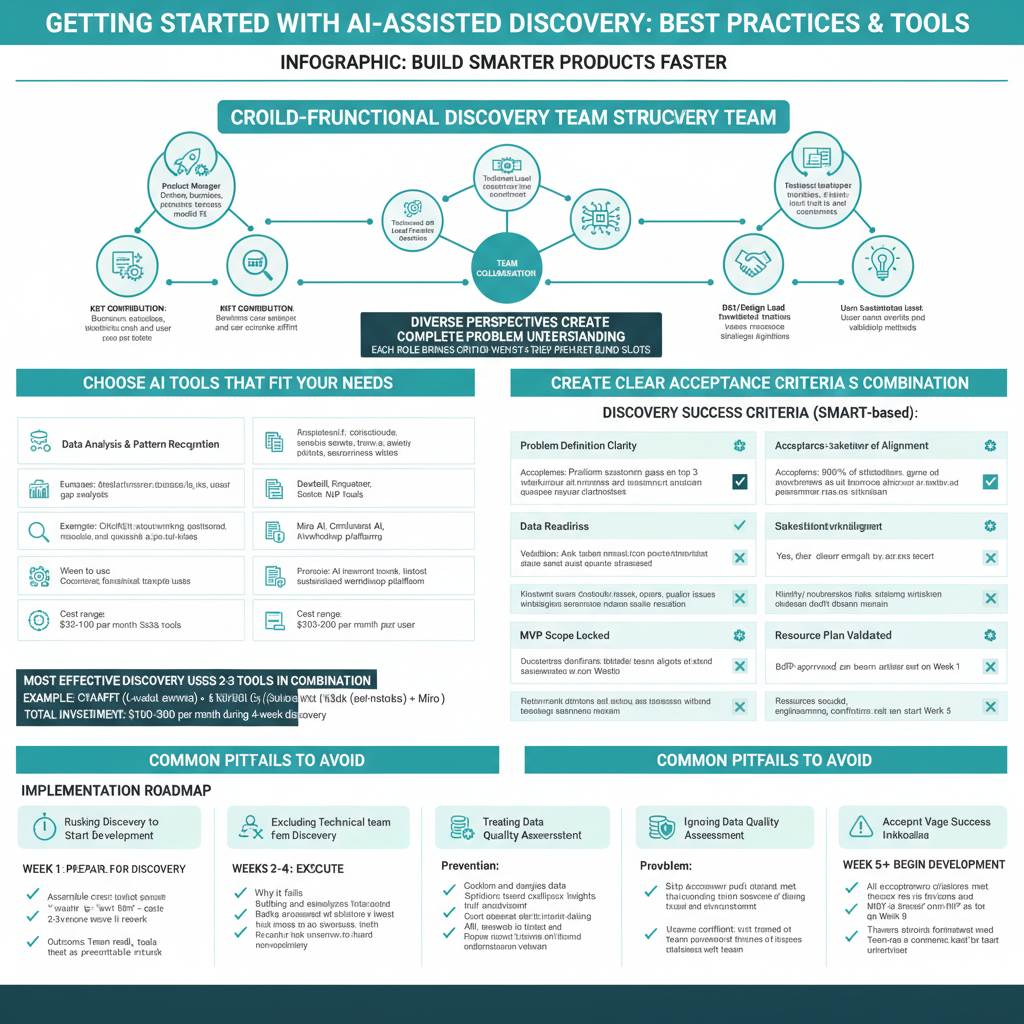
Build a Cross-Functional Discovery Team
Effective AI in the software discovery phase requires representation from business leadership (defines strategic goals), product management (translates goals to user needs), engineering (assesses technical feasibility), UX design (validates usability), data science (evaluates AI feasibility), and customer success (brings user voice).
Assign an AI discovery lead for your AI-powered product discovery process-internal or external-who facilitates workshops, synthesizes findings, and drives decision-making. For complex initiatives requiring AI for problem definition in software projects, organizations often engage specialist firms like SmartDev that bring proven AI requirements discovery methodologies and avoid common pitfalls.
Reserve a minimum of 3-4 weeks for AI product discovery. Shorter engagements sacrifice depth; longer ones risk analysis paralysis.
Choose AI Tools That Fit Your Needs
The AI requirements discovery tool landscape spans general-purpose LLMs to specialized discovery platforms:
Data analysis & synthesis for AI in software discovery phase: ChatGPT, Claude, and Gemini excel at analyzing interview transcripts, customer feedback, and survey responses to extract themes and patterns during AI product discovery. Upload 50 customer interviews, prompt the AI to “identify the top 10 pain points mentioned, rank by frequency, and provide supporting quotes,” and receive structured analysis for your AI-powered product discovery process in minutes.
Structured discovery frameworks for AI requirements discovery: Tools like Visual Paradigm’s AI Problem Description Generator guide teams through structured problem definition during AI for problem definition in software projects. Specialized AI product discovery platforms automate requirements gathering, stakeholder mapping, and product development roadmap generation.
Feature prioritization in AI in software discovery phase: AI-powered roadmapping tools analyze feature requests, estimate business impact, assess technical complexity, and generate prioritized backlogs based on ROI projections during AI requirements discovery.
For comprehensive AI-powered product discovery process that spans business validation through technical architecture, organizations often benefit from structured programs like SmartDev’s 3-week AI discovery, which combines AI tooling with expert facilitation across all AI requirements discovery phases.
Create Clear Acceptance Criteria
Define what “successful AI product discovery” looks like before you start your AI in the software discovery phase. Without explicit criteria, AI requirements discovery can drift into endless research without reaching decisions.
Example acceptance criteria for AI-powered product discovery process:
- SMART problem statement with ≥90% stakeholder agreement
- Validated success metrics tied to measurable business outcomes from AI for problem definition in software projects
- Documented risk register with mitigation strategies for top 5 risks
- Prioritized feature backlog with business value scores for product development roadmap
- Technical architecture direction with feasibility validation from AI requirements discovery
- Go/no-go recommendation with clear rationale
- ≥80% confidence in ROI projections based on comparable initiatives
Document all AI product discovery outcomes and obtain formal sign-off from key stakeholders before transitioning to development.
Common Pitfalls to Avoid
Pitfall 1: AI analysis without human judgment during AI requirements discovery. AI surfaces patterns and suggests requirements in AI in the software discovery phase, but humans must interpret findings through the lens of strategic goals, competitive context, and organizational constraints. AI product discovery becomes data-driven but loses strategic coherence when teams defer to “what the data says” without critical evaluation.
Avoidance strategy for AI-powered product discovery process: Structure discovery workshops where AI presents findings and humans debate implications, prioritize opportunities, and make judgment calls on risk tolerance during AI for problem definition in software projects.
Pitfall 2: Rushing AI requirements discovery to meet arbitrary timelines. When executives demand “just 3 days of AI product discovery” to start development faster, unvalidated assumptions resurface as mid-development crises-scope changes, technical debt, misaligned expectations in your product development roadmap.
Avoidance strategy for AI in software discovery phase: Educate stakeholders on AI-powered product discovery process ROI using data: “Investing 3 weeks in AI requirements discovery reduces the risk of a 6-month costly pivot by 70% based on industry benchmarks.” Frame AI product discovery as insurance, not delay.
Pitfall 3: Ignoring stakeholder input in favor of data during AI for problem definition in software projects. While data should inform decisions in AI requirements discovery, stakeholder buy-in determines adoption. A perfectly data-driven solution from AI in the software discovery phase that ignores organizational culture or change management realities will fail.
Avoidance strategy for AI-powered product discovery process: Balance quantitative analysis with qualitative stakeholder engagement. Use data from AI product discovery to inform debates, not dictate outcomes.
Common Questions About AI-Assisted Discovery
How long does AI requirements discovery take?
Focused AI product discovery for a single AI use case typically requires 3-4 weeks. Complex, multi-stakeholder AI-powered product discovery process initiatives spanning multiple departments may need 6-8 weeks. The duration of AI in the software discovery phase depends on problem complexity, data availability, stakeholder alignment difficulty, and organizational decision-making speed.
SmartDev’s structured 3-week program demonstrates that time-boxed AI requirements discovery engagements force prioritization and rapid decision-making.
Can AI product discovery replace human judgment?
No. AI requirements discovery amplifies human expertise by processing data faster during AI in the software discovery phase, suggesting requirements based on patterns, and flagging risks proactively. But human judgment on strategic fit, risk tolerance, organizational readiness, and ethical implications remains critical in AI for problem definition in software projects.
Think of AI as a research assistant that surfaces insights during AI-powered product discovery process and a junior analyst that drafts requirements-not as a decision-maker.
What if we’re already deep in development-is it too late for AI requirements discovery?
AI product discovery at any stage beats guessing. Mid-development AI requirements discovery can validate whether current direction aligns with actual user needs, identify scope creep early in your product development roadmap, and inform pivot decisions before more resources are wasted. Post-launch AI-powered product discovery process assesses product-market fit and guides enhancement roadmaps.
That said, earlier AI in the software discovery phase is always better-AI requirements discovery before development prevents problems; discovery during development contains them; discovery after launch repairs them.
How do we measure the ROI of AI product discovery?
Track project outcomes with and without rigorous AI requirements discovery: delivery timeline adherence, scope change frequency, budget variance, time-to-revenue, user adoption rates, and post-launch rework costs. Organizations that invest in AI-powered product discovery process report 40-50% fewer mid-project scope changes and 30-40% faster time-to-market compared to teams that skip AI in the software discovery phase.
SmartDev’s approach enables teams to make confident go/no-go decisions through AI for problem definition in software projects, meaning the ROI includes projects wisely not pursued.
Do we need special tools for AI requirements discovery, or can we DIY with ChatGPT?
DIY is viable for simple AI product discovery projects with limited scope. ChatGPT and similar tools handle interview analysis, theme extraction, and requirements drafting effectively for basic AI requirements discovery. For complex AI initiatives involving multiple stakeholders, technical feasibility assessment in AI in the software discovery phase, architecture decisions, and risk evaluation. Structured AI-powered product discovery process methodologies like SmartDev’s discovery framework add significant value through proven processes, expert facilitation, and comprehensive product development roadmap deliverables.

Clarity Before Code: The AI Discovery Advantage
AI promises transformational business impact, but promise doesn’t equal performance. The gap between AI ambition and AI ROI stems from a preventable problem: organizations build solutions before they understand what problem they’re solving through proper AI requirements discovery.
AI-powered product discovery process transforms this paradigm. By applying structured AI in the software discovery phase methodologies-data-driven analysis, SMART framework for AI for problem definition in software projects, feasibility assessment, and cross-functional alignment-teams replace assumptions with evidence, vague goals with measurable outcomes, and risky bets with informed decisions through AI product discovery.
Conclusion
The difference between a successful AI product and a failed one often hinges on decisions made in the first four weeks of AI product discovery. Organizations that invest in rigorous AI requirements discovery-validating problems, aligning stakeholders, assessing feasibility during AI in the software discovery phase, and defining measurable success-move forward with confidence rather than hope.
SmartDev’s 3-week AI discovery program exemplifies this AI-powered product discovery process approach: a time-boxed engagement that brings business discovery, technical feasibility, and architecture planning together to replace uncertainty with clarity before real costs are incurred. Whether the outcome of AI requirements discovery is moving confidently into development, adjusting scope to reduce risk, or deciding not to proceed, AI product discovery ensures every path is intentional.
If you’re planning an AI initiative and want to reduce software product risk, accelerate time-to-value, and improve project success rates through AI for problem definition in software projects, start with discovery. It’s the smartest first step-and increasingly, the difference between AI that transforms business and AI that drains budgets. Implement a proven AI-powered product discovery process and build your product development roadmap on a foundation of clarity, not assumptions.