
Artificial intelligence promises transformational impact, yet many initiatives fail before development begins. This is rarely due to technology alone. Instead, it stems from unclear business problems and untested assumptions. AI discovery bridges this gap by identifying which problems are truly worth solving with AI. Without structured business discovery, teams risk building complex solutions that lack real value. Therefore, the discovery of artificial intelligence must start with problem finding, not model selection.
As a result, a business-first AI discovery process helps organizations reduce software product risk early. By aligning business goals, user needs, and success metrics upfront, teams avoid rework and misdirected investment. At the same time, speed matters. A quick product discovery approach allows early validation, helps reduce development cost, and enables confident decisions before complexity increases.

AI Discovery vs Traditional Product Discovery
Traditional product discovery focuses on validating user needs, feature priorities, and market fit for relatively predictable software systems. AI discovery introduces an additional layer of uncertainty that standard discovery methods are not designed to handle. Discovery of artificial intelligence must address business problems, data realities, and decision logic at the same time. Without this broader scope, teams risk approving AI initiatives that are technically impressive but commercially weak or operationally unviable. This is why AI discovery requires a business-first mindset from the very beginning.
1. What Discovery of Artificial Intelligence Really Involves
Discovery of artificial intelligence goes beyond defining features or user flows. It is a structured process that determines whether AI is the right solution to a specific business problem and whether the organization is ready to support it.
Key elements of AI discovery include:
- Clear definition of the business problem AI is expected to solve
- Identification of measurable business outcomes and success criteria
- Assessment of data availability, quality, and ownership
- Early evaluation of AI feasibility and risk, without building models
- Alignment between business stakeholders and technical teams
This approach ensures that AI is applied intentionally, not experimentally, and supports quick product discovery without sacrificing decision quality.
2. Why Business-First Discovery Is Critical for AI Initiatives
Many AI projects fail because teams start with technology and search for a problem later. A business-first discovery reverses this logic. It starts by validating business value before considering algorithms, tools, or architectures.
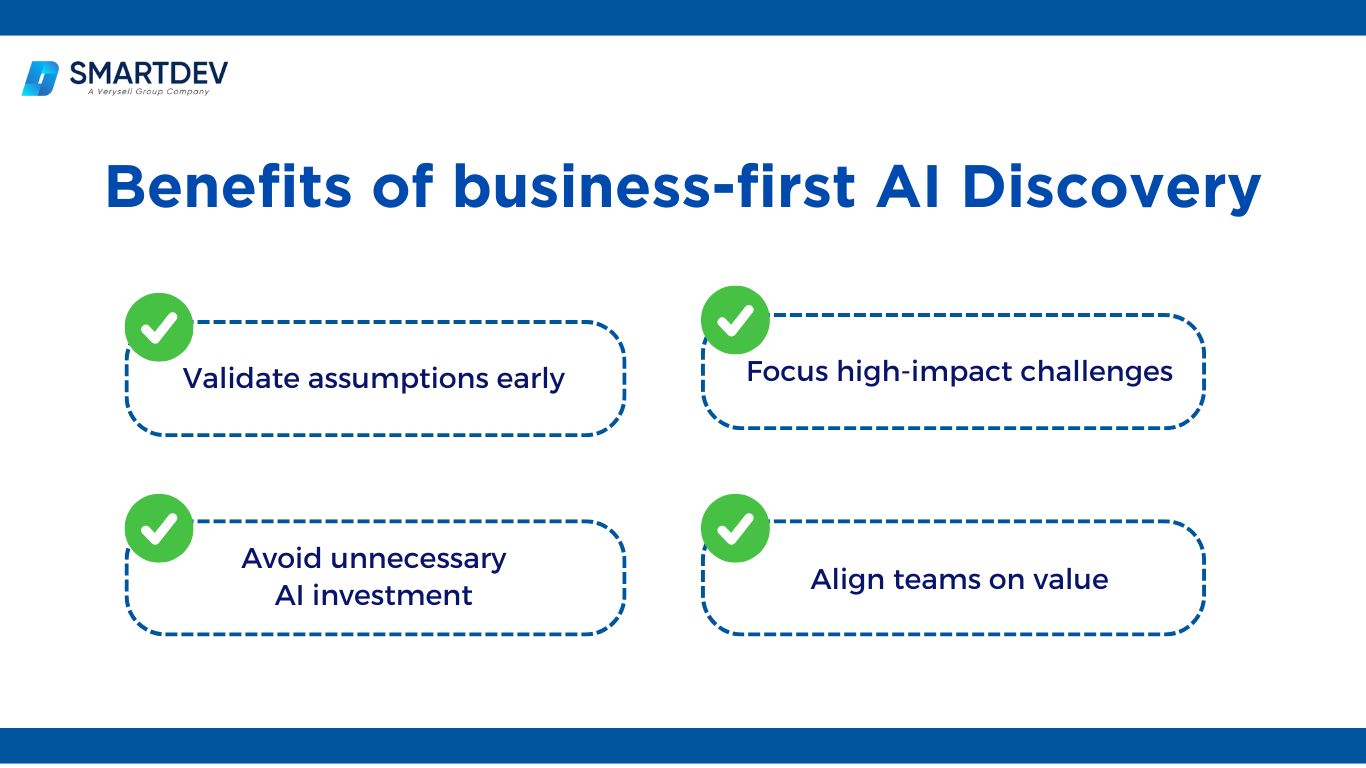
A business-first AI discovery approach helps organizations:
- Reduce software product risk by validating assumptions early
- Focus AI efforts on high-impact, high-priority business challenges
- Avoid investing in AI where simpler solutions are more effective
- Create shared understanding of value across executives, product, and engineering
By grounding AI initiatives in real business needs, teams can reduce development cost and prevent wasted effort on low-impact AI features.
3. Common Mistakes When Teams Skip Structured AI Discovery
Skipping structured discovery is one of the fastest ways to increase risk in AI projects. Teams often move directly into development under pressure to innovate quickly, without validating foundational assumptions.
Common mistakes include:
- Selecting AI technology before defining the business problem
- Assuming data exists without verifying accessibility or quality
- Defining success in technical terms instead of business outcomes
- Underestimating organizational and operational readiness
- Treating AI discovery as a technical task instead of a business process
These mistakes lead to extended timelines, escalating costs, and solutions that fail to deliver value. A structured, business-driven discovery sprint for complex AI systems helps organizations avoid these pitfalls while maintaining speed and focus early in the product lifecycle.
The Business Risks Hidden in Early AI Product Ideas
Early AI product ideas often look promising on the surface. However, without structured AI discovery, many hidden business risks remain undetected until development is already underway. These risks rarely come from algorithms or tools. Instead, they originate from weak problem definition, misalignment, and assumptions that are never validated. Identifying these issues early is a core goal of business discovery and problem finding.
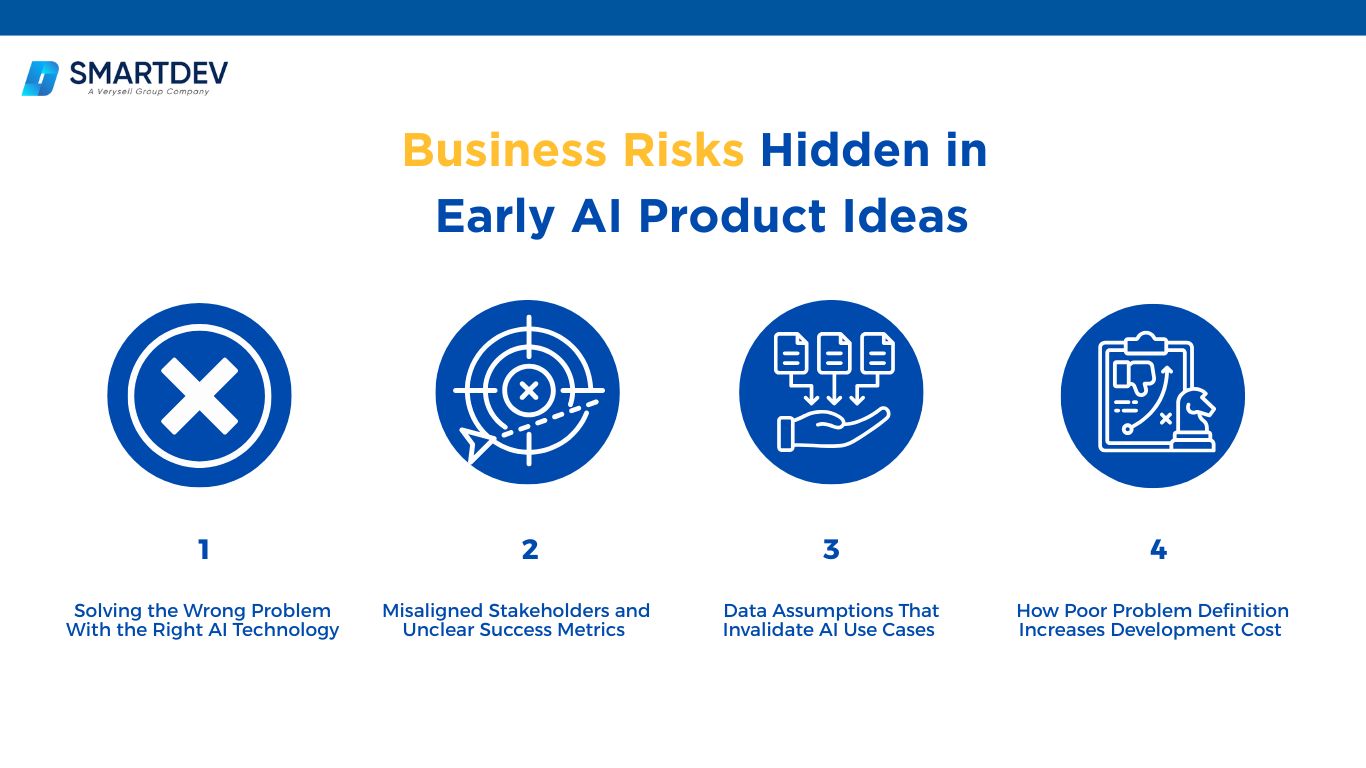
 1. Solving the Wrong Problem With the Right AI Technology
 1. Solving the Wrong Problem With the Right AI Technology
One of the most common risks in AI initiatives is applying advanced AI to the wrong business problem. Teams may identify a technically feasible AI solution but fail to confirm whether the problem is real, urgent, or valuable. When AI discovery does not start with business context, organizations end up optimizing processes that do not impact outcomes. This results in products that work technically but fail commercially.
2. Misaligned Stakeholders and Unclear Success Metrics
AI projects often involve executives, product teams, data teams, and operations. Without business-first discovery, each group defines success differently. This misalignment leads to shifting priorities, delayed decisions, and conflicting expectations. Clear success metrics defined during AI discovery help align stakeholders early and reduce software product risk throughout development.
3. Data Assumptions That Invalidate AI Use Cases
Many early AI ideas rely on assumptions about data availability, quality, or accessibility. When these assumptions prove false, entire use cases collapse. Structured discovery of artificial intelligence forces teams to validate data realities early, preventing late-stage surprises that stall or cancel projects.
4. How Poor Problem Definition Increases Development Cost
When the problem is unclear, scope expands and changes frequently. Engineering effort increases while business value remains uncertain. A quick product discovery phase helps teams define the right problem early, reduce development cost, and avoid building AI solutions that require constant rework without delivering impact.
Explore how SmartDev partners with teams through a focused AI discovery sprint to validate business problems, align stakeholders, and define a clear path forward before development begins.
SmartDev helps organizations clarify AI use cases and feasibility through a structured discovery process, enabling confident decisions and reduced risk before committing to build.
Learn how companies accelerate AI initiatives with SmartDev’s discovery sprint.
Start Your 3-Week Discovery Program NowSmartDev’s 3-Week AI Discovery. A Business-First Approach
SmartDev’s 3-week AI discovery is a time-boxed engagement designed to bring clarity before any development begins. It focuses on structured exploration rather than execution, combining stakeholder workshops and interviews with analysis of current systems, data, and processes. Within this short timeframe, teams define and prioritize features and AI use cases while exploring high-level solution design and technology direction. The scope intentionally covers business discovery, technical discovery, and architecture and planning, resulting in clear delivery and roadmap recommendations that enable confident, low-risk decision-making moving into development.
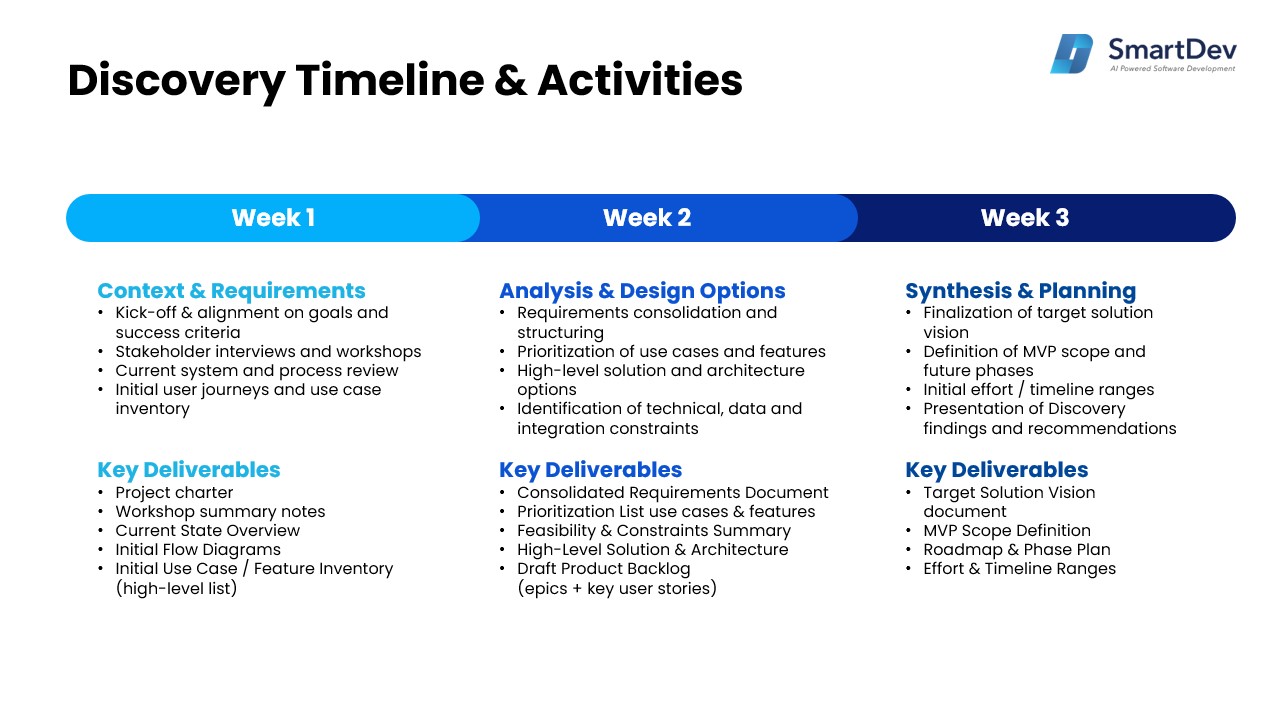
Week 1. Business Goals, User Pain Points, and Problem Validation
 Week 1. Business Goals, User Pain Points, and Problem Validation
The first week focuses entirely on business discovery and context building. The goal is to align stakeholders around what success looks like and to validate that the problem is real, relevant, and worth solving with AI.
Key activities include:
- Kick-off sessions to align on business goals and success criteria
- Stakeholder interviews and collaborative workshops
- Review of current systems, processes, and constraints
- Identification of core user journeys and initial AI use cases
Key outputs from Week 1:
- A clear project charter and shared problem statement
- Documented business objectives and success metrics
- High-level inventory of use cases and features
This foundation reduces software product risk by ensuring AI efforts are anchored in real business needs.
Week 2. Translating Business Problems Into AI-Ready Use Cases
Once problems are validated, Week 2 shifts toward analysis and structuring. Business challenges are translated into concrete, prioritized AI use cases that can realistically be delivered.
Key activities include:
- Consolidation and refinement of requirements
- Prioritization of AI use cases and features based on business value
- Exploration of high-level solution and architecture options
- Identification of data, technical, and integration constraints
Key outputs from Week 2:
- A consolidated requirements document
- Prioritized list of AI use cases and features
- Feasibility and constraints summary
- Draft product backlog with key epics and user stories
This step ensures discovery of artificial intelligence remains practical and aligned with organizational readiness.
Week 3. Decision-Making Framework and Risk Prioritization
The final week focuses on synthesis, planning, and decision-making. Insights from Weeks 1 and 2 are consolidated into a clear path forward.
Key activities include:
- Finalization of the target solution vision
- Definition of MVP scope and future phases
- Estimation of effort and high-level timeline ranges
- Presentation of discovery findings and recommendations
Key outputs from Week 3:
- Target solution vision document
- MVP scope definition
- Roadmap and phased delivery plan
- Clear go-or-no-go decision framework
By the end of the 3-week discovery, teams have the clarity needed to move forward confidently, reduce development cost, and avoid costly missteps before AI complexity increases.
How SmartDev‘s 3-Week AI Discovery Reduces Software Product Risk
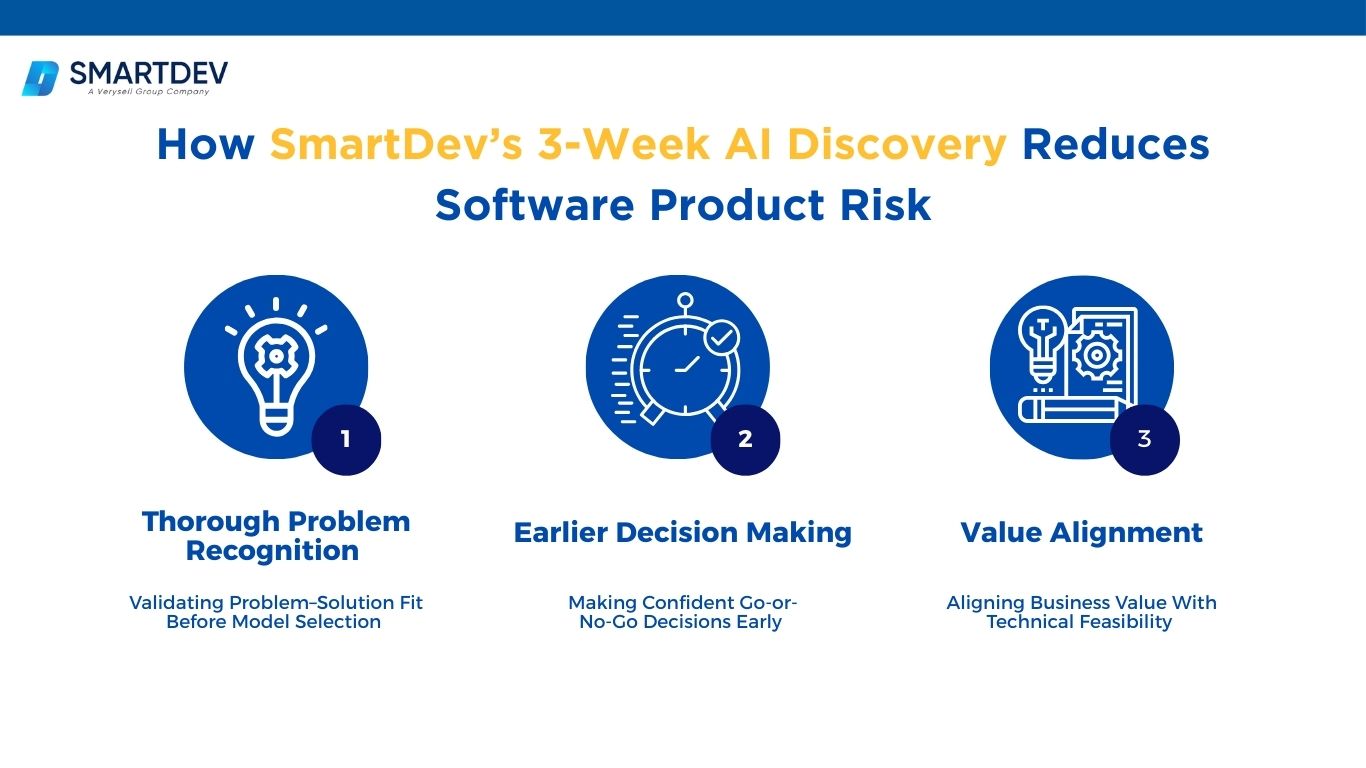
A structured 3-week AI discovery reduces software product risk by forcing clarity before commitment. Instead of moving directly into model development, teams define a shared solution vision and technology direction that connect business value with technical reality. This early alignment prevents misinvestment and ensures that AI is used only where it delivers measurable impact.
1. Validating Problem–Solution Fit Before Model Selection
 1. Validating Problem–Solution Fit Before Model Selection
The first way AI discovery reduces risk is by validating problem–solution fit before any AI models are chosen. During discovery, teams define a clear solution vision that describes what the future product should enable for users and the business.
This includes:
- A short, outcome-focused description of the target solution
- High-level capabilities such as workflow automation, data centralization, reporting dashboards, system integrations, and self-service features
- Clear linkage between each capability and a business objective
By defining capabilities first, teams confirm that AI is truly needed. This avoids building AI components where simpler solutions would be more effective.
2. Aligning Business Value With Technical Feasibility
AI discovery also reduces risk by aligning business ambition with technical feasibility. A clear technology direction is established to ensure that the solution can be delivered realistically.
This typically covers:
- Proposed application style, such as web or mobile, modular services, or a monolith suited to project scope
- Candidate technology stack across frontend, backend, databases, hosting or cloud, and integrations
- Identification of where AI or machine learning adds value, for example automation, recommendations, or analytics
This alignment ensures that business goals are supported by a feasible architecture and prevents late-stage redesigns.
3. Making Confident Go-or-No-Go Decisions Early
Finally, the 3-week AI discovery enables confident decision-making before development begins. With a validated solution of vision and defined technology direction, stakeholders gain a clear view of value, complexity, and risk.
As a result, teams can:
- Approve development with confidence
- Adjust scope to reduce risk or cost
- Pause or stop initiatives that lack sufficient value or feasibility
By making these decisions early, organizations reduce development cost, avoid costly missteps, and move forward with AI initiatives that are grounded in both business value and technical reality.
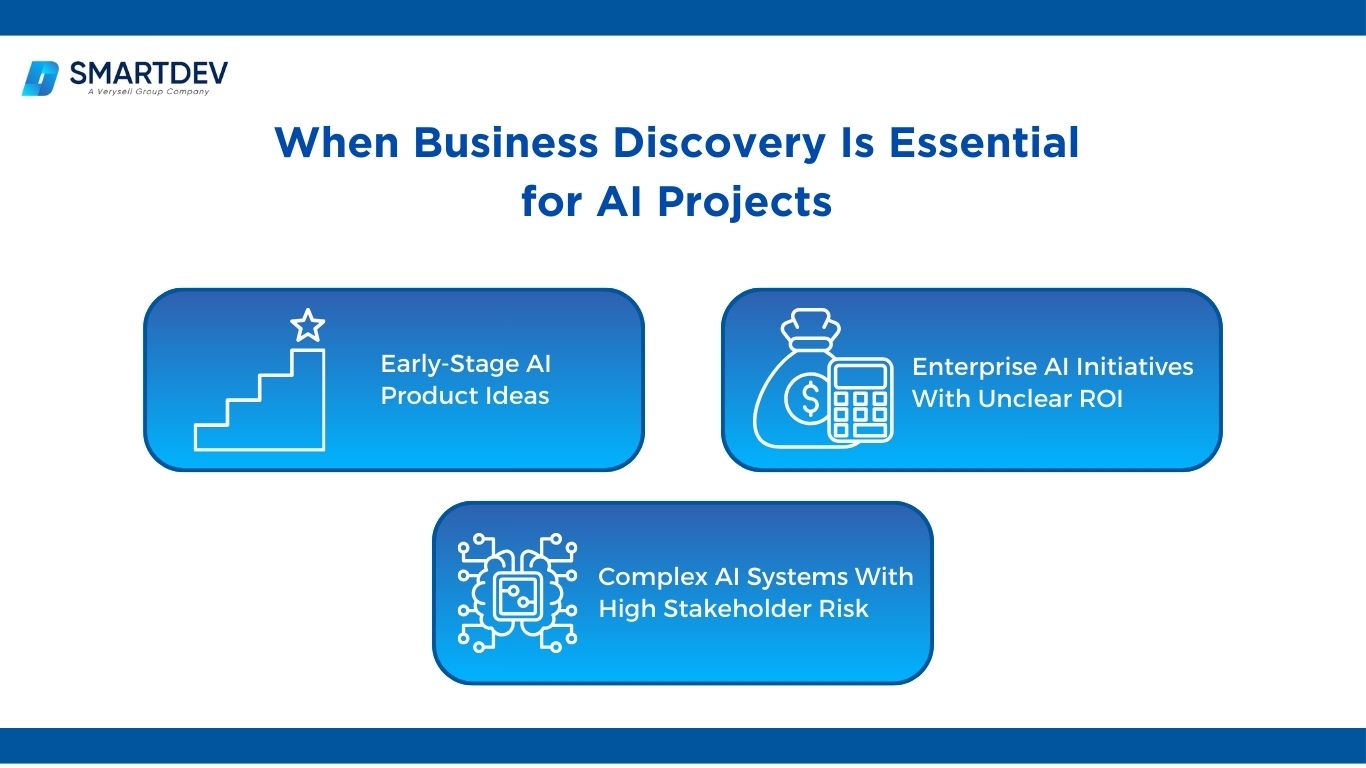
When Business Discovery Is Essential for AI Projects
Business discovery is not a nice-to-have in AI initiatives. It becomes essential whenever uncertainty around value, feasibility, or alignment is high. AI introduces more unknowns than traditional software, from data readiness to organizational impact. Without early discovery, teams often move fast in the wrong direction. A structured AI discovery phase reduces software product risk by replacing assumptions with validated insights before development begins.
Early-Stage AI Product Ideas
Early-stage AI product ideas are typically driven by vision, market trends, or internal hypotheses. While this momentum is valuable, it also carries significant risk. Teams often assume that a problem exists, that users will adopt the solution, or that AI is the best approach.
Business discovery is essential at this stage because it:
- Validates whether the problem is real, frequent, and painful enough to justify investment
- Confirms that AI is the right solution, rather than a simpler rules-based or process improvement approach
- Clarifies who the users are and how success should be measured from a business perspective
Without discovery, teams risk building AI products that demonstrate technical capability but fail to deliver adoption or revenue. Discovery ensures early ideas are grounded in real demand and aligned with clear business outcomes.
Enterprise AI Initiatives With Unclear ROI
Enterprise AI initiatives often start with strategic ambition rather than clearly defined use cases. Executives may push for AI adoption to stay competitive, but teams struggle to translate that ambition into measurable value.
Business discovery becomes critical in these situations because it:
- Connects high-level strategy to concrete business problems and use cases
- Aligns multiple stakeholders around shared goals, priorities, and success metrics
- Provides early visibility into cost drivers, constraints, and potential return on investment
Without this alignment, AI initiatives can become fragmented, over-scoped, or politically driven. Structured AI discovery creates a common language for decision-making and helps enterprises invest in AI with greater confidence and predictability.
Complex AI Systems With High Stakeholder Risk
Complex AI systems amplify risk because they touch core processes, sensitive data, and multiple teams. These initiatives often involve integrations with existing systems, regulatory considerations, and long-term operational impact.
Business discovery is essential for complex AI systems because it:
- Creates shared understanding across business, product, and technical stakeholders
- Surfaces hidden dependencies, data limitations, and governance risks early
- Establishes clear decision frameworks before complexity and cost escalate
By addressing these risks upfront, discovery prevents late-stage surprises that are expensive and difficult to fix. It enables organizations to move forward with complex AI systems in a controlled, informed way, rather than reacting to issues after development has already begun.
Conclusion
 Conclusion
AI product risk builds up long before development starts. It appears when problems are poorly defined, assumptions go untested, and teams move forward without alignment. SmartDev’s AI discovery is designed to eliminate these risks early. In just three weeks, it brings together business discovery, technical insight, and structured planning to replace uncertainty with clarity before real costs are incurred.
By focusing on problem validation, solution vision, and technology direction upfront, SmartDev helps teams make better decisions faster. Whether the outcome is moving confidently into development, adjusting scope, or deciding not to proceed, discovery ensures every path is intentional. If you are planning an AI initiative and want to reduce software product risk, reduce development cost, and move forward with confidence, SmartDev’s 3-week AI discovery is the smartest first step. Get in touch with SmartDev to start your discovery sprint and turn AI ambition into a clear, actionable plan.