

Introduction
In today’s digital age, businesses across various industries are leveraging artificial intelligence to gain a competitive edge. From enhancing customer experiences to improving operational efficiency, AI is transforming how companies operate. However, successfully integrating AI into business processes requires a robust infrastructure—this is where AI-ready architecture design plays a pivotal role.
SmartDev, a leading technology solutions provider, has mastered the art of designing AI-ready architecture in a remarkably short time frame—just three weeks. But how do they achieve this? What is the secret behind this rapid AI architecture implementation? In this blog, we’ll explore the concept of AI-ready architecture, the process SmartDev follows to design scalable AI systems, and how enterprise AI architecture planning can help organizations build AI-first products that scale.
What is AI-Ready Architecture Design?
Before diving into the design process, let’s first define AI-ready architecture design.
In simple terms, it refers to an infrastructure that is specifically tailored to support AI models, tools, and applications. This architecture enables businesses to effectively harness the power of AI by ensuring that the underlying systems—data storage, computing resources, and communication networks—are optimized for the unique demands of AI workloads.
The components of AI-ready architecture include:
- Data Infrastructure: AI requires large datasets, so the architecture needs to support fast data access and processing capabilities.
- Computing Power: AI algorithms often demand high computational power. The system must support scalable computing resources, including GPUs and cloud infrastructure.
- Data Pipelines: Efficient data pipelines are essential to streamline data collection, processing, and feeding into AI models.
- Integration Capabilities: Seamless integration with existing business systems is crucial for making AI applications work in the real world.
AI-ready architecture allows companies to implement AI initiatives more quickly and effectively. But how does SmartDev achieve this in just three weeks?
Building a Scalable AI System Design
One of the fundamental principles of AI architecture design is scalability. AI systems must be able to handle growing datasets, increasing computational demands, and expanding user bases. This is where scalable AI system design comes into play.
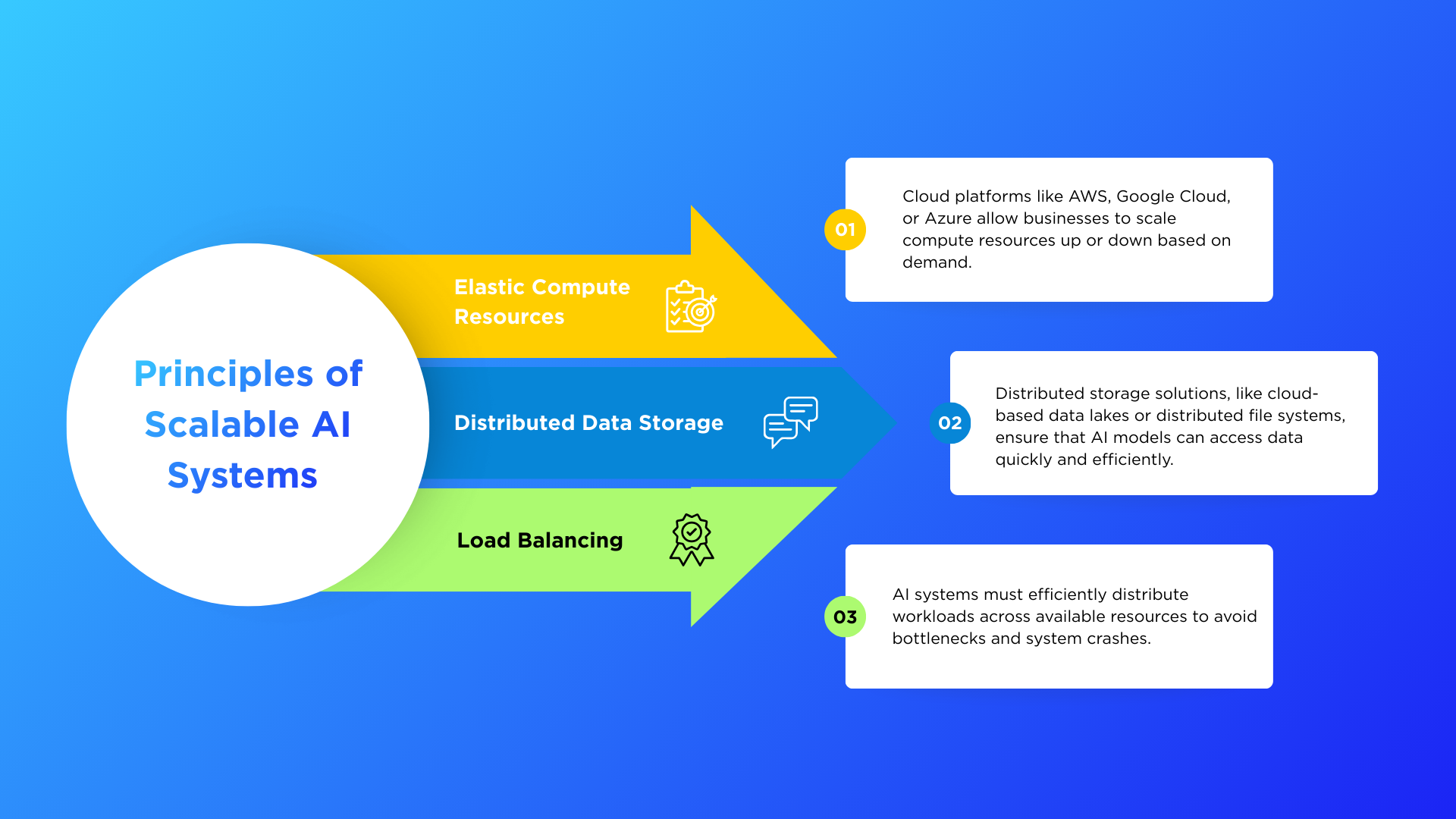
Principles of Scalable AI Systems
Scalable AI systems are designed to grow with the business, offering flexibility and adaptability as the AI needs evolve. To ensure that an AI system is scalable, here are some key considerations:
- Elastic Compute Resources: AI applications often require large amounts of computational power. Cloud platforms like AWS, Google Cloud, or Azure allow businesses to scale compute resources up or down based on demand.
- Distributed Data Storage: AI systems must handle vast amounts of data. Distributed storage solutions, like cloud-based data lakes or distributed file systems, ensure that AI models can access data quickly and efficiently.
- Load Balancing: As user traffic and computational demands grow, AI systems must efficiently distribute workloads across available resources to avoid bottlenecks and system crashes.
Ensuring Flexibility and Adaptability in the Design
AI systems must be adaptable to changes in business needs, evolving AI technologies, and growing data volumes. To maintain flexibility, SmartDev ensures that AI architecture can integrate easily with new AI frameworks, technologies, and evolving business requirements. Whether it’s adding new data sources or scaling to support increased model complexity, an adaptable design is key to long-term success.
Balancing Performance and Cost
Another challenge in scalable AI system design is balancing performance and cost. While it’s tempting to build an AI infrastructure with unlimited resources, such a setup can be expensive and inefficient. SmartDev focuses on optimizing the architecture to provide the necessary performance without overspending on unnecessary resources. Cloud-based infrastructure allows businesses to scale up or down, ensuring that they pay only for the resources they use, thus optimizing costs.
The SmartDev Approach to Designing AI-Ready Architecture
Now that we understand what AI-ready architecture entails and the importance of scalability, let’s dive into how SmartDev designs AI-ready architecture in just three weeks. The secret lies in their streamlined process, which combines expert knowledge, industry best practices, and cutting-edge technologies to deliver results quickly.
The 3-Week Process Breakdown
SmartDev follows a clear three-week framework to design AI-ready architecture. Let’s break down each phase:
Week 1: Planning and Requirements Gathering
The first step is understanding the client’s specific needs. SmartDev works closely with the client to gather detailed requirements for the AI solution. This includes:
- Identifying the business problem that AI will address.
- Understanding the data sources that will feed into the AI models.
- Defining the AI goals, whether it’s improving customer service, automating processes, or enhancing decision-making.
- Assessing existing infrastructure to determine if it can support AI workloads or if upgrades are needed.
During this phase, SmartDev also collaborates with the client’s IT teams to assess the readiness of their current infrastructure. This ensures that the AI architecture will seamlessly integrate with existing systems and that there are no surprises later on.
Week 2: Design and Architecture Prototyping
In the second week, SmartDev’s architects and engineers begin designing the AI architecture. This phase involves:
- Choosing the right infrastructure: SmartDev selects the most appropriate AI infrastructure based on the client’s needs. This could involve cloud platforms like AWS or Azure or on-premise infrastructure depending on data security, performance, and cost considerations.
- Building scalable AI systems: The architecture is designed to be highly scalable, ensuring that the system can handle increasing data loads and computational demands. SmartDev focuses on distributed data storage, high-performance computing resources, and a flexible data pipeline.
- Creating prototypes: SmartDev builds initial prototypes of the AI architecture, testing them with sample data to ensure that the system performs as expected.
By the end of the second week, SmartDev has a clear architecture plan and a working prototype to demonstrate the feasibility of the AI solution.
Week 3: Final Implementation and Optimization
The final week is all about implementation and optimization. During this phase, SmartDev:
- Implements the architecture: The final AI-ready architecture is deployed, ensuring that all components are working together seamlessly.
- Optimizes performance: The team fine-tunes the system, optimizing data pipelines, computational resources, and model performance.
- Conducts testing: The architecture undergoes thorough testing to ensure that it meets all performance, scalability, and security requirements.
By the end of week three, the AI architecture is fully implemented, optimized, and ready for real-world deployment.
AI Infrastructure Considerations
When building AI systems, selecting the right AI infrastructure is crucial. The infrastructure must support the high computational and storage demands of AI workloads while offering flexibility and scalability. Some key AI infrastructure considerations include:
- Compute Resources: AI models often require GPUs or TPUs for training and inference. Cloud-based solutions provide easy access to these resources without the need for on-premise hardware.
- Data Storage: AI systems generate massive datasets that need to be stored and accessed efficiently. Cloud-based storage solutions like AWS S3 or Google Cloud Storage are commonly used.
- Network Infrastructure: Fast data transmission is essential for AI applications, especially when dealing with large datasets. A reliable and high-bandwidth network is critical for performance.
Real-World Examples and Case Studies
Let’s explore some real-world examples to see how SmartDev’s AI-ready architecture has been successfully implemented.
Case Study 1: AI-Ready Architecture for Healthcare Diagnostics

Client: A leading healthcare provider with a network of hospitals and diagnostic centers.
Challenge: The healthcare provider was looking to implement an AI-driven system capable of diagnosing medical images, particularly radiology scans such as X-rays, MRIs, and CT scans. The challenge was twofold: First, the AI system needed to process vast amounts of high-resolution image data in real time. Second, the provider required a solution that could scale as the number of scans and patients increased, while also maintaining high accuracy and compliance with healthcare regulations.
Solution: SmartDev’s team designed an AI-first architecture specifically tailored for medical imaging. The architecture was built on a scalable cloud infrastructure, using cloud-based GPU instances for heavy image processing tasks. These GPUs allowed the AI models to perform deep learning tasks efficiently, such as detecting anomalies in radiology scans and providing real-time results to doctors.
The system was also designed to handle distributed data storage. By using a combination of cloud-based storage and a dedicated database for medical images, the AI model could quickly access the data and perform analysis without delays. The architecture was made flexible enough to incorporate future updates, such as new AI models or additional diagnostic tools.
To meet regulatory requirements (such as HIPAA in the U.S.), SmartDev implemented end-to-end encryption and strict access controls, ensuring that sensitive patient data was securely processed and stored.
Outcome: After the implementation of SmartDev’s AI-ready architecture, the healthcare provider saw a significant reduction in the time required to diagnose medical images. Doctors could now receive AI-driven recommendations almost instantly, speeding up the diagnostic process and enabling quicker treatment decisions. The AI system was able to analyze thousands of medical images daily, scaling seamlessly with the increasing number of patients and scans.
Impact:
- Reduced diagnostic time by 50%.
- Increased diagnostic accuracy by 30% due to advanced AI models.
- Scalable infrastructure that could handle a growing number of patients and scans.
- Compliance with strict healthcare data privacy standards.
Case Study 2: AI Integration in E-commerce for Personalized Shopping Experiences

Client: A major e-commerce retailer specializing in fashion and consumer goods.
Challenge: The client wanted to integrate AI to improve customer experiences through personalized product recommendations, dynamic pricing models, and an AI-powered chatbot for customer service. The challenge was to design an architecture that could handle millions of products, customer interactions, and dynamic pricing strategies, all while scaling to support peak shopping seasons like Black Friday or holiday sales.
Solution: SmartDev designed an AI-ready architecture focused on three main areas: personalized product recommendations, customer service, and dynamic pricing.
- Personalized Product Recommendations: SmartDev implemented a machine learning-driven recommendation engine that utilized customer data—such as browsing history, purchase patterns, and even social media interactions—to provide tailored product suggestions. This engine was powered by scalable cloud resources that allowed for real-time data processing and instant personalization.
- AI-Powered Chatbot: An AI-driven chatbot was integrated into the website and mobile app. This chatbot could handle customer queries 24/7, assisting with product inquiries, order tracking, and even personalized styling advice. The chatbot used natural language processing (NLP) to understand customer queries and provide accurate responses, reducing the load on human customer service agents.
- Dynamic Pricing Engine: SmartDev implemented an AI-based dynamic pricing engine that adjusted prices in real time based on demand, competitor pricing, and customer behavior. The architecture was designed to scale automatically during peak times (e.g., Black Friday), ensuring that the pricing engine remained responsive and accurate.
The entire system was built on cloud infrastructure to ensure scalability and handle large volumes of data during peak seasons. The architecture was designed to quickly scale resources based on demand, so the e-commerce site could maintain performance during high-traffic events.
Outcome: After deploying the AI-ready architecture, the e-commerce retailer saw a significant increase in customer engagement and sales.
- Personalized Recommendations: Customers experienced a more tailored shopping experience, with conversion rates increasing by 25% as a result of more relevant product suggestions.
- AI Chatbot: The AI-powered chatbot successfully handled over 40% of customer queries, reducing customer service response times by 60%.
- Dynamic Pricing: The dynamic pricing engine led to a 15% increase in overall revenue by optimizing pricing in real-time based on demand fluctuations.
The system’s scalability ensured that during peak seasons, such as Black Friday and holiday sales, the infrastructure could handle up to 5x the regular traffic without any slowdown or issues.
Impact:
- 25% increase in conversion rates due to personalized product recommendations.
- 60% reduction in customer service response times through AI chatbot integration.
- 15% boost in overall revenue through AI-powered dynamic pricing.
- Seamless scaling during high-traffic events like Black Friday.
Conclusion
In just three weeks, SmartDev’s approach to AI-ready architecture design allows businesses to quickly implement scalable AI solutions that drive real value. By focusing on rapid AI architecture implementation, SmartDev ensures that businesses can harness the power of AI without unnecessary delays. With scalable infrastructure, seamless integration, and optimized performance, SmartDev’s AI-first product architecture is transforming industries and setting the stage for the next generation of AI-driven innovation.
As the demand for AI continues to grow, AI-ready architecture will remain essential for businesses looking to stay competitive. SmartDev’s proven process demonstrates that rapid, scalable, and flexible AI system design is not only possible but can be delivered in a short time frame—helping businesses accelerate their AI initiatives and achieve long-term success.