
Every successful product begins with the question: “What should we build?” Yet most founders, entrepreneurs, and product teams skip the critical phase that separates thriving products from expensive failures. According to recent research, 42% of startups fail because there was “no market need” for their product.
This statistic doesn’t reflect a lack of innovation or poor execution-it reflects inadequate discovery. The difference between winning products and market failures often lies not in engineering excellence, but in whether teams invested in genuine product discovery to roadmap transformation before committing engineering resources.
SmartDev’s 3-week product discovery process represents a proven methodology for bridging this critical gap. Rather than debating product directions in conference rooms or building features based on assumptions, this structured approach converts vision into validated strategy through intensive collaboration, customer research, technical assessment, and strategic planning.
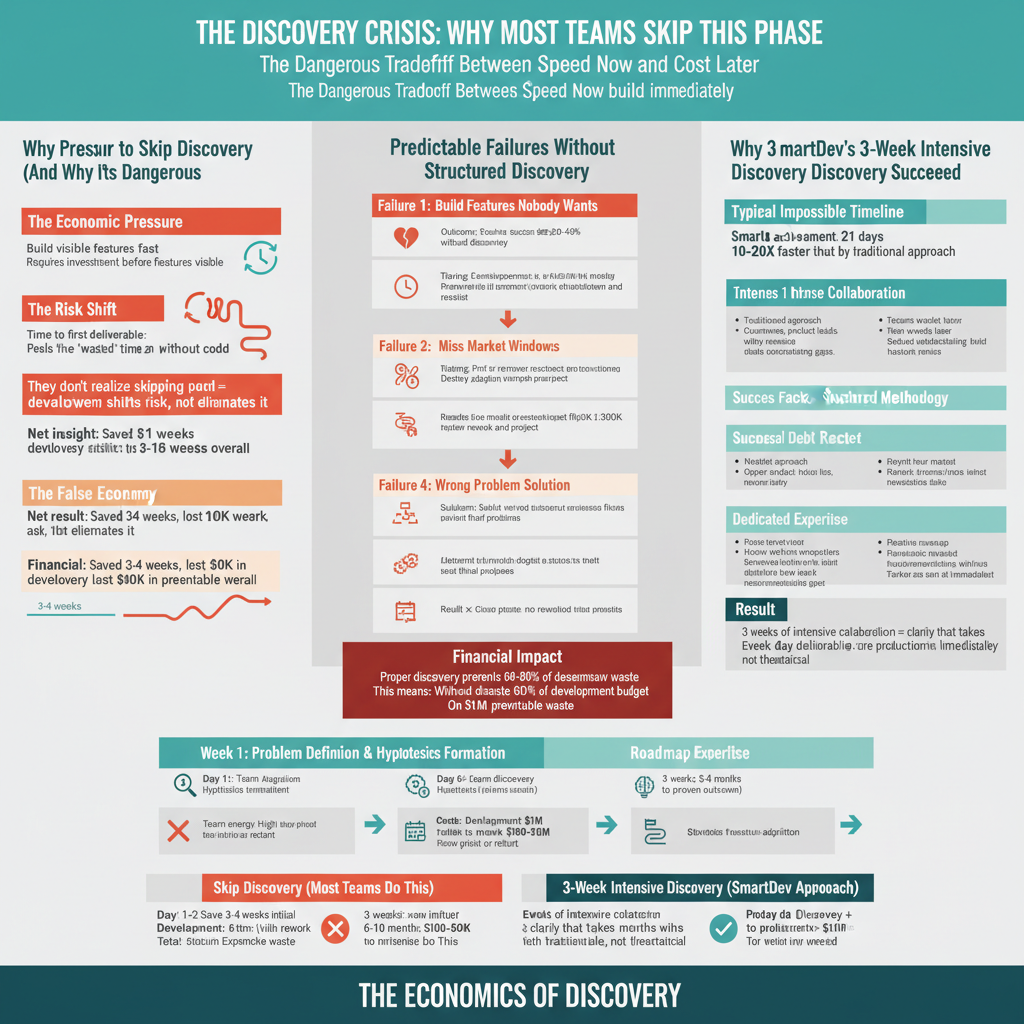
The Discovery Crisis: Why Most Teams Skip This Phase
Product discovery requires investment-time, resources, and expertise before generating visible product features. This upfront cost creates pressure to skip discovery and jump directly to building. Leaders push teams toward “rapid development” without realizing that skipping discovery simply shifts risk from pre-development (when course-correction is cheap) to post-development (when rewriting built features costs 10x more).
The Consequences of Discovery Shortfalls
Teams without structured discovery experience predictable failures. They build features nobody wants, miss market windows while competitors ship first, create technical debt requiring rework, alienate customers with solutions addressing wrong problems, and waste months in development discovering what discovery would have revealed in weeks.
The financial impact is staggering. According to MVP Development’s research, proper discovery phase deliverables prevent 60-80% of downstream development waste. Yet most teams allocate minimal time to discover-perhaps a few weeks of informal customer chats before building begins.
Why the 3-week product discovery process Works
Three weeks seems impossibly short for transforming vision into strategy. Yet SmartDev’s intensive methodology achieves in 21 days what traditional consulting takes months to accomplish. This acceleration comes from several factors:
Intense collaboration: Rather than researchers disappearing to gather data and returning with reports, SmartDev’s discovery process keeps founders, product leads, engineering, and design engaged continuously. Everyone sees the same research, hears customer perspectives firsthand, and builds shared understanding.
Structured methodology: Every hour serves a specific purpose mapped to clear discovery phase deliverables. Rather than open-ended research, the process follows proven frameworks that expose highest-risk assumptions first, test them rapidly, and iterate based on findings.
Dedicated expertise: SmartDev’s discovery teams bring pattern recognition from hundreds of product discovery engagements. They know which questions reveal most truth, which customer segments reveal most insight, which technical spikes expose feasibility risks earliest.
Output focus: Every discovery engagement produces concrete discovery phase deliverables-not just reports gathering dust. The result is a product roadmap after discovery that teams can act on immediately.
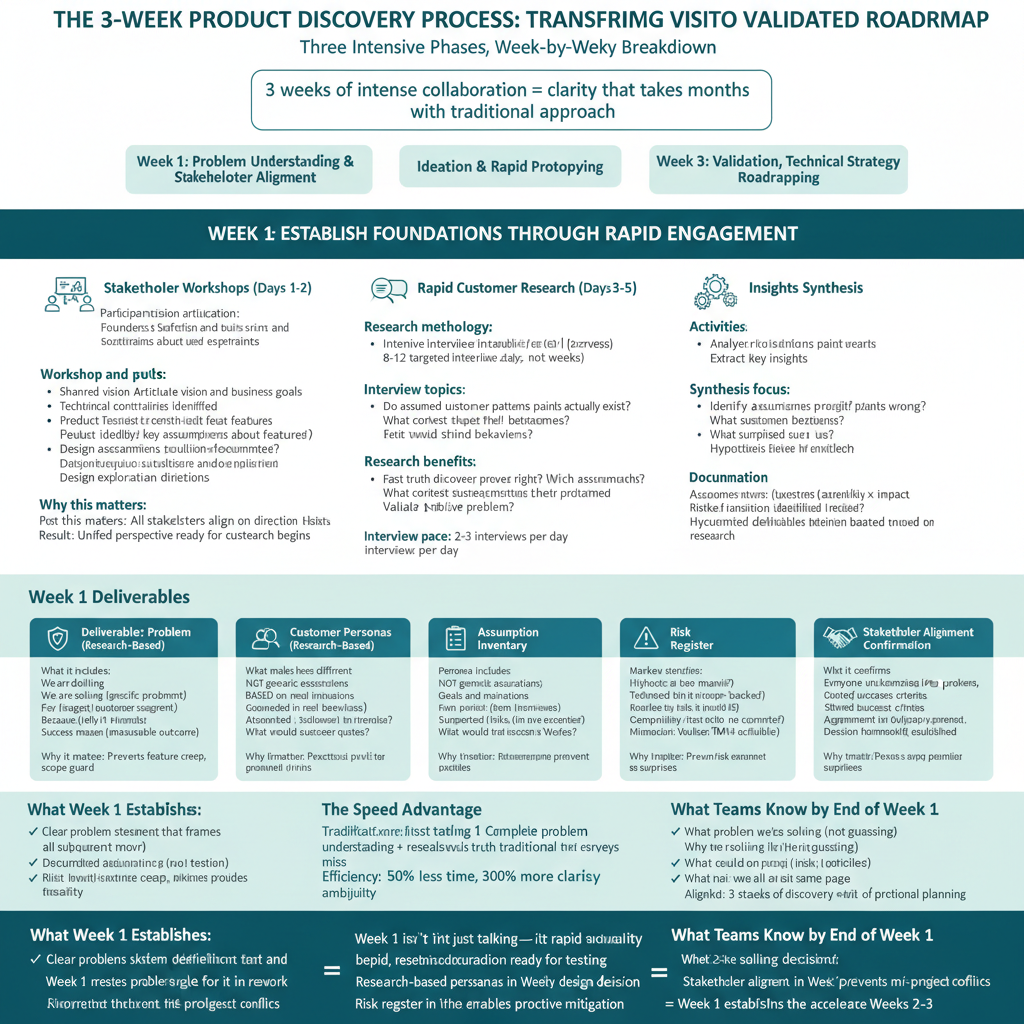
The 3-Week Product Discovery Process: Week-by-Week Breakdown
SmartDev’s 3-week structure transforms raw vision into validated roadmap through three intensive phases.
Week 1: Problem Understanding & Stakeholder Alignment
Week 1 establishes foundations through rapid stakeholder engagement and customer research. The process begins with stakeholder workshops where founders articulate their vision, engineering surfaces technical concerns, product identifies key assumptions, and design explores solution possibilities.
Simultaneously, customer research begins. Rather than survey methodology taking weeks, SmartDev’s discovery process emphasizes rapid qualitative research-intensive customer interviews revealing “why” behind behaviors. Teams conduct 8-12 targeted interviews exploring whether assumed customer pain points actually exist, what context shapes their problems, and what solutions customers have attempted.
Week 1 Deliverables include:
- Problem statement defining what you’re solving and why it matters
- Customer personas based on actual interviews (not assumptions)
- Assumption inventory documenting what must be true for success
- Risk register identifying highest-uncertainty, highest-impact factors
- Stakeholder alignment confirming shared understanding of direction
By week’s end, teams possess documented, shared clarity about the problem landscape, a foundation traditional approaches lack.
Week 2: Solution Design & Prototype Validation
Week 2 bridges from problem understanding to potential solutions. The team moves from “what’s the problem?” to “what solutions might address it?” while simultaneously validating whether customers actually experience the problems identified in Week 1.
Design and product teams prototype possible solutions-not full applications, but clickable flows demonstrating core functionality and user journeys. These prototypes serve two purposes: they communicate concepts clearly enough for testing, and they force concrete thinking about how solutions would actually work.
Customer testing validates both problem understanding and solution direction. Testing isn’t marketing-it’s diagnostic. Teams observe whether users recognize problems, whether proposed solutions resonate with their needs, whether alternative solutions might work better. This rapid iteration reveals what assumptions were correct and which require rethinking.
Simultaneously, engineering conducts technical feasibility assessment. Can this be built within budget and timeline? Does it require specialized expertise (AI, blockchain, real-time processing)? What third-party integrations are needed? These technical spikes, conducted in parallel rather than sequentially, prevent designs requiring impossible engineering.
Week 2 Deliverables include:
- Validated prototype demonstrating the core concept
- Customer research synthesis showing problem confirmation/rejection
- Technical feasibility assessment confirming buildability
- Alternative solutions evaluation explaining why chosen solution beats competitors
- Feature prioritization mapping what’s MVP vs. Phase 2 vs. future
This tangible prototype becomes communication tool with investors, team members, and early users.
<img src=”https://user-gen-media-assets.s3.amazonaws.com/gemini_images/61cc32e5-2334-429f-8c20-bd402a30c3be.png” alt=”The 3-Week Product Discovery Process: Week 2 – Solution Design and Prototype Validation” />
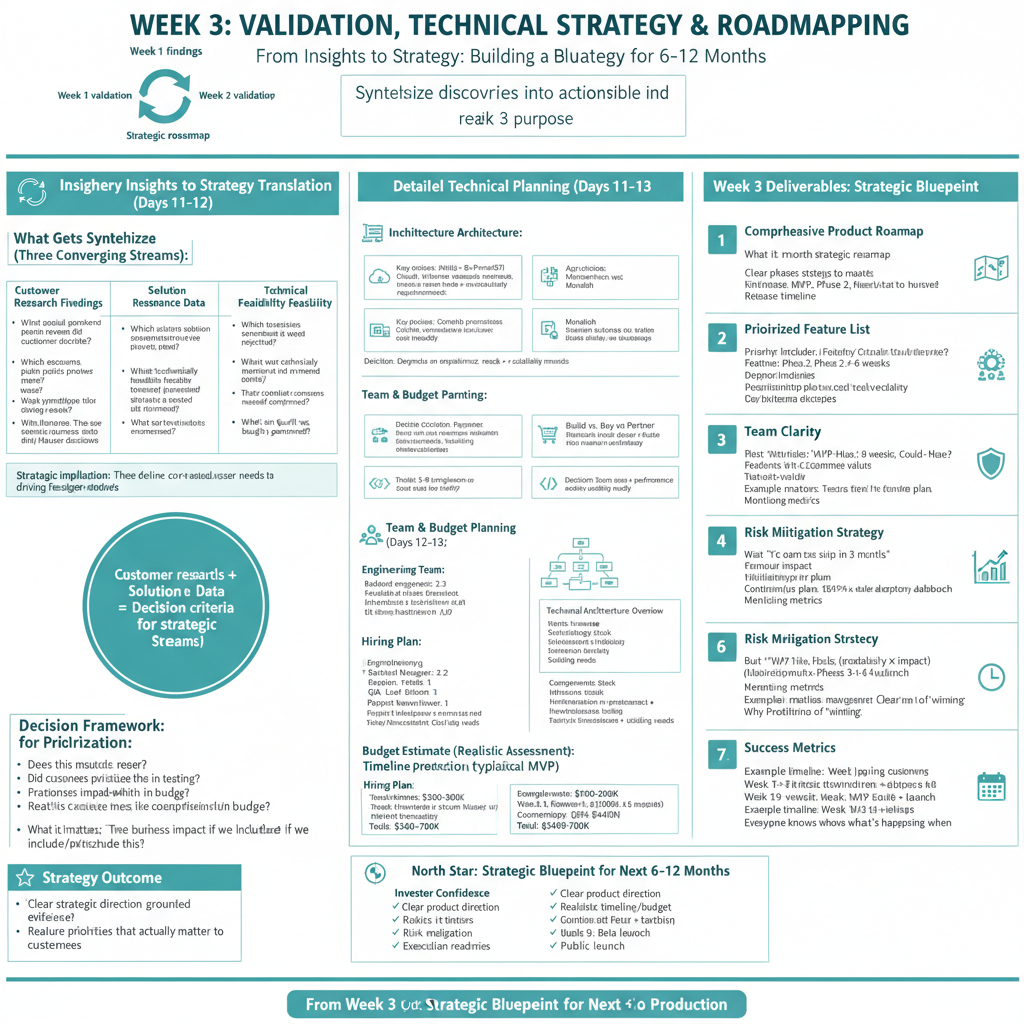
Week 3: Validation, Technical Strategy & Roadmapping
Week 3 converges findings into comprehensive product roadmap after discovery serving as blueprint for next 6-12 months. This roadmap isn’t theoretical-it’s grounded in customer research, technical assessment, and resource planning.
The process synthesizes Week 1-2 findings into clear strategy. SmartDev’s experts guide teams through discovery insights to strategy translation. What did customer research reveal about actual problems? What did prototype testing show about solution resonance? What did technical assessment clarify about feasibility? These converge into decision criteria for prioritization.
SmartDev’s application engineering teams conduct more detailed technical planning. Architecture decisions emerge-cloud vs. on-premise, microservices vs. monolith, build vs. buy for specific components. Resource planning follows-team structure, hiring needs, infrastructure costs. Timeline projections reflect realistic assessment rather than optimistic guessing.
Week 3 Deliverables include:
- Comprehensive product roadmap after discovery spanning 6-12 months with clear phases
- Prioritized feature list with rationale grounded in customer research
- Technical architecture overview showing system design and major decisions
- Resource plan specifying team needs, hiring, and estimated budget
- Risk mitigation strategy addressing highest-uncertainty factors
- Success metrics defining what “winning” looks like for business, product, and technical outcomes
- Implementation timeline with realistic milestones and dependencies
This roadmap becomes your north star-referenced through development, modified as learning emerges, but grounded in genuine customer understanding rather than assumptions.
Discovery Phase Deliverables: What You Own After Three Weeks
Most product discovery engagements conclude with presentations disappearing into company drives. SmartDev’s approach ensures you own tangible, actionable artifacts. These discovery phase deliverables serve as your roadmap forward:
- Research Documentation: Customer interview transcripts, session recordings, observation notes, and synthesized insights. This documentation becomes reference material when assumptions require validation, preventing teams from debating whether “customers actually want this.”
- Validated Prototypes: Clickable, testable interfaces demonstrating core functionality. Rather than building in imagination, teams experience actual user interactions with proposed solutions.
- Decision Frameworks: Prioritization matrices, feature roadmaps, and architectural decisions documented with rationale. When stakeholders ask “why this feature?” teams reference customer research rather than defending opinions.
- Technical Specifications: Architecture overviews, technology selections, and implementation approaches grounded in technical assessment. Engineering teams inherit clarity about “why these technologies” rather than guessing original architects’ intentions.
- Financial Models: Cost projections, resource requirements, and budget allocations based on realistic assessment. You understand what building actually costs before committing funds.
- Operational Roadmap: Clear timeline from discovery conclusion through launch, identifying phases, dependencies, risks, and success metrics.
These artifacts prevent the waste of traditional development: teams don’t cycle through requirements refinement weeks into projects; features don’t get rethought after engineering discovers fundamental feasibility issues; product doesn’t launch to discover customers never wanted the solution.
Explore how SmartDev partners with teams through a focused AI discovery sprint to validate business problems, align stakeholders, and define a clear path forward before development begins.
SmartDev helps organizations clarify AI use cases and feasibility through a structured discovery process, enabling confident decisions and reduced risk before committing to build.
Learn how companies accelerate AI initiatives with SmartDev’s discovery sprint.
Start Your 3-Week Discovery Program NowWhy Startups Choose the Startup Product Discovery Service Approach
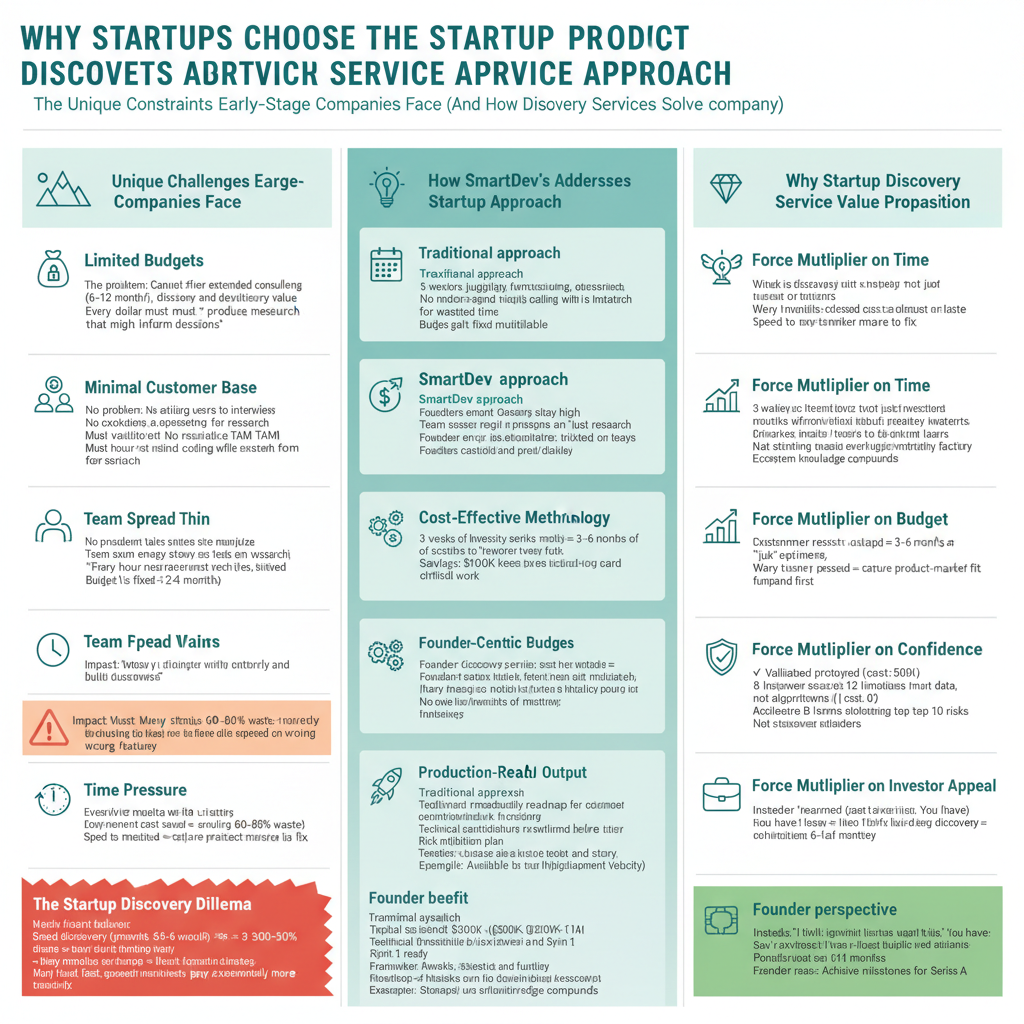
Early-stage companies face unique discovery challenges: limited budgets preventing extended consulting engagements, minimal customer base making research difficult, core team spread thin across fundraising, product, engineering, and operations, and time pressure-investors demand clear vision and execution timelines.
SmartDev’s approach addresses these startup-specific constraints:
- Time-boxed engagement prevents discovery from becoming endless research-three weeks of intensity produces actionable output.
- Cost-effective methodology delivers discovery value within early-stage budgets, preventing founders from choosing between discovery and development.
- Founder-centric process keeps the founding team engaged throughout, preventing parachute consultants from returning with recommendations founders don’t understand or trust.
- Production-ready output means you inherit strategy and prototypes ready for investor pitches, engineering development, and early customer validation. Pattern recognition from hundreds of engagements prevents repeating mistakes discovered by previous founders-your discovery builds ecosystem learning rather than starting from scratch.
For startups, startup product discovery service providers like SmartDev represent force multiplier-achieving in three weeks what would require months of internal discovery, at price points aligning with early-stage financial realities.
Transforming Discovery Insights to Strategy
The final critical component separating strong discovery from merely thorough research lies in converting discovery insights to strategy. Insights alone-customer pain points, behavioral patterns, competitive gaps-don’t automatically translate into winning products.
Effective discovery insights to strategy conversion requires several components:
- Pattern Recognition: Distinguishing signals from noise-which customer problems recur across multiple interviews versus one-off complaints? Which feature requests represent genuine needs versus workarounds for deeper problems?
- Business Alignment: Connecting customer insights into business objectives-revenue requirements, market position, competitive dynamics, and investor expectations. Discovery that ignores business constraints creates technically perfect solutions to irrelevant problems.
- Technical Feasibility Assessment: Ensuring insights translate to buildable features within resource constraints. Valuable insights requiring impossible engineering are insights to revisit.
- Prioritization Framework: Converting multiple opportunities into clear sequences-what delivers most value first, what builds foundation for future phases, what proves highest-risk assumptions.
- Stakeholder Alignment: Ensuring leadership, product, engineering, and design share understanding of “why this strategy” grounded in customer research. Teams with shared understanding execute faster and pivot faster when learning emerges.
SmartDev’s methodology integrates these elements throughout the 3-week process, ensuring discovered insights convert into coherent strategy driving development decisions.
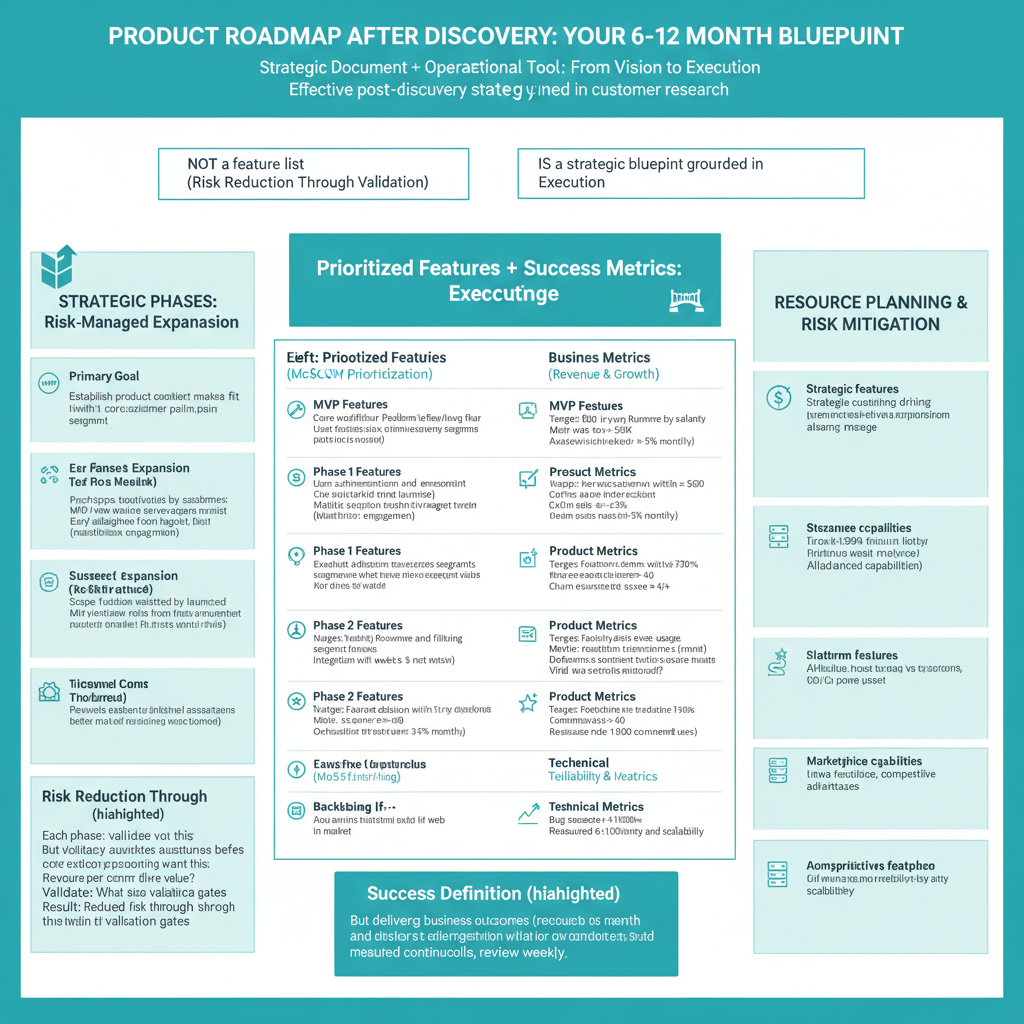
Product Roadmap After Discovery: Your 6-12 Month Blueprint
The comprehensive product roadmap after discovery serves as strategic document and operational tool spanning 6-12 months.
Rather than listing features, effective post-discovery roadmaps specify:
- Strategic Phases: Product launch architecture proceeds through clear phases-MVP establishing product-market fit, Phase 1 expanding to additional customer segments, Phase 2 adding complementary features, and so on. This phasing reduces risk by validating fundamental assumptions before expanding scope.
- Prioritized Features: MVP features earn the highest priority through customer research demonstrating demand. Phase 2 features address secondary opportunities. Backlog items represent “interesting if…” features requiring validation.
- Success Metrics: Clear definition of what success looks like-not just shipping features, but delivering business outcomes (revenue, retention, engagement) and technical objectives (performance, reliability, scalability).
- Resource Planning: Team structure, hiring needs, budget allocation, and timeline estimates grounded in technical assessment. You understand what product costs to build, not guess.
- Risk Mitigation: Identification of highest-risk assumptions and strategies for validating them. Rather than discovering risks during development, your roadmap addresses them proactively.
- Dependency Management: Clear sequencing accounting for technical dependencies, business milestones, and market dynamics.
- Flexibility Mechanisms: Explicit triggers for roadmap updates-customer research revealing new insights, technical discoveries requiring architecture changes, market dynamics shifting priorities.
- This roadmap becomes living document updated as learning emerges but anchored in customer understanding rather than executive opinion changes.
The Business Case: How Discovery Accelerates Success
Why invest three weeks in discovery before jumping to development? Because discovery dramatically improves success odds across multiple dimensions:
- Reduced Development Waste: Features that would require weeks of development discovering wrong assumptions to get validated or rejected in customer interviews. Organizations practicing structured discovery experience 60-80% less rework.
- Faster Time-to-Market: Paradoxically, investing three weeks in discovery accelerates overall delivery. Because development teams understand requirements clearly, architecture aligns with reality, and feature prioritization is evidence-based; teams ship faster than organizations sprinting directly to development.
- Lower Development Costs: Clear requirements, technical assessment, and phased delivery reduce cost surprises. Organizations can estimate accurately and allocate resources confidently.
- Improved Product-Market Fit: Discovery grounds product direction in customer understanding rather than founder assumptions. Products aligned with actual customer needs to achieve stronger adoption, higher retention, and clearer competitive advantage.
- Investor Confidence: Sophisticated investors recognize validated discovery signals of confidence and competence. Founders presenting clear vision grounded in customer research and realistic roadmaps raise capital more successfully than those pitching assumptions.
- Team Alignment: Shared understanding of “why this product direction” built through discovery process creates team cohesion and faster execution. Everyone understands customer problems, agreed success criteria, and realistic constraints.
Getting Started: How to Engage a Discovery Partner
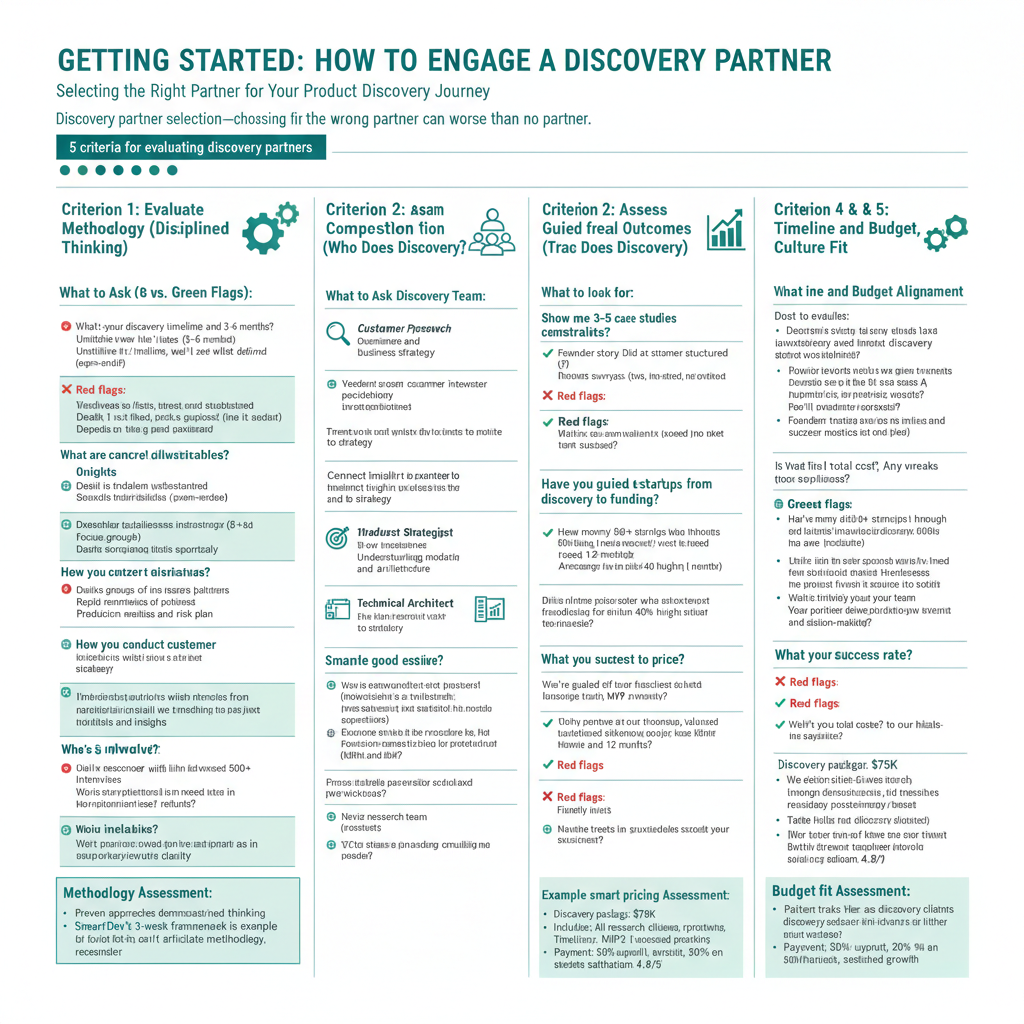
For founders and product leaders recognizing discovery value, selecting the right partner matters.
Evaluate methodology: Ask how discovery works-detailed timeline, deliverables, customer research approach, team composition. Proven approaches like SmartDev’s 3-week framework demonstrate disciplined thinking.
Assess team composition: Who conducts discovery? Experienced researchers understanding customer psychology, product strategists connecting insights to business, technical architects ensuring feasibility assessment, facilitators guiding your team’s engagement. The best discoveries combine expert guidance with founder/team participation.
Verify real outcomes: Ask for case studies showing discovery-to-launch journeys. Has this partner guided startups from discovery to funding? To product launch? To market success? Pattern tracks matter.
Align on timeline and budget: Effective discovery fits early-stage constraints-time-boxed engagement, cost-effective methodology, clear deliverables. If discovery is presented as extended engagement with an undefined timeline, reconsider.
Evaluate cultural fit: Discovery requires founder/team engagement throughout interviews, prototype testing, and decision-making. Partners treating discovery as “our research” rather than “collaborative discovery” miss the team alignment value.
SmartDev’s approach emphasizes transparent partnership, clear timelines, concrete deliverables, and deep team engagement. Initial consultations (typically free 30-minute calls) let you evaluate fit before committing.
Conclusion: Invest in Discovery, Accelerate Success
The difference between thriving products and market failures often lies not in innovation or execution, but in whether teams invested in genuine discovery before committing resources to building. Three weeks of structured discovery prevents months of wasted development chasing wrong opportunities, accelerates time-to-market through clarity, reduces cost through precision, and improves product-market fit through customer understanding.
The 3-week product discovery process transforms raw vision into validated product roadmap after discovery, grounded in customer research, technical assessment, and business strategy. Rather than competing against risk-discovering problems, weeks into development-effective discovery converts risk into knowledge early, when course-correction is cheap.
For startups and product teams ready to transform vision into a validated strategy, SmartDev’s 3-week product discovery represents proven approach to bridging the vision-to-execution gap.
Ready to transform your product vision into a validated roadmap? Schedule a discovery consultation with SmartDev today, and discover how three weeks of structured discovery can accelerate your path to product market fit. Learn more about SmartDev’s Product Discovery Services and how the 3-week product discovery process transforms vision into strategy.