
TL;DR
- Manual invoice processing may look simple, but it creates hidden costs through delays, errors, approval of bottlenecks, and disconnected systems.
- Traditional OCR helps extract text, but it cannot understand invoice context, validate shipment data, or manage exceptions on its own.
- An AI Adoption Accelerator automates invoice processing across four layers: data foundation, intelligence, execution, and autonomous decision-making.
- In 6 weeks, one logistics company automated more than 200 invoices per day, reduced manual review effort, and improved workflow scalability.
- The real value of AI is not faster than data extraction. It is turning fragmented manual tasks into connected, end-to-end operational workflows.
Introduction
Manual workflows seem to be “cheaper” or “simpler” at first glance. However, under the surface, they slowly erode your business in many ways. In logistics, a 10-minute delay on one step of invoice processing may seem small, like a single late truck in a warehouse yard. But across hundreds of daily shipments, those delays compound into hours of lost productivity, slower payments, and operational bottlenecks across the entire logistics chain.
For one logistics company processing 200 invoices per day, the challenge was no longer speed alone. This is where AI adoption becomes critical. By combining the invoice processing with workflow automation, the company transformed a fragmented manual workflow into a more intelligent, scalable, and efficient operation.
The Hidden Cost Of Manual Invoice Processing In Logistics
1. The company’s original invoice process
In supply chain and logistics, invoice processing is the end-to-end workflow of managing supplier invoices. From the moment an invoice is received to when the payment is approved, recorded, and completed within the company’s financial system. It is the process businesses use to handle billing from vendors, partners, and service providers efficiently and accurately.
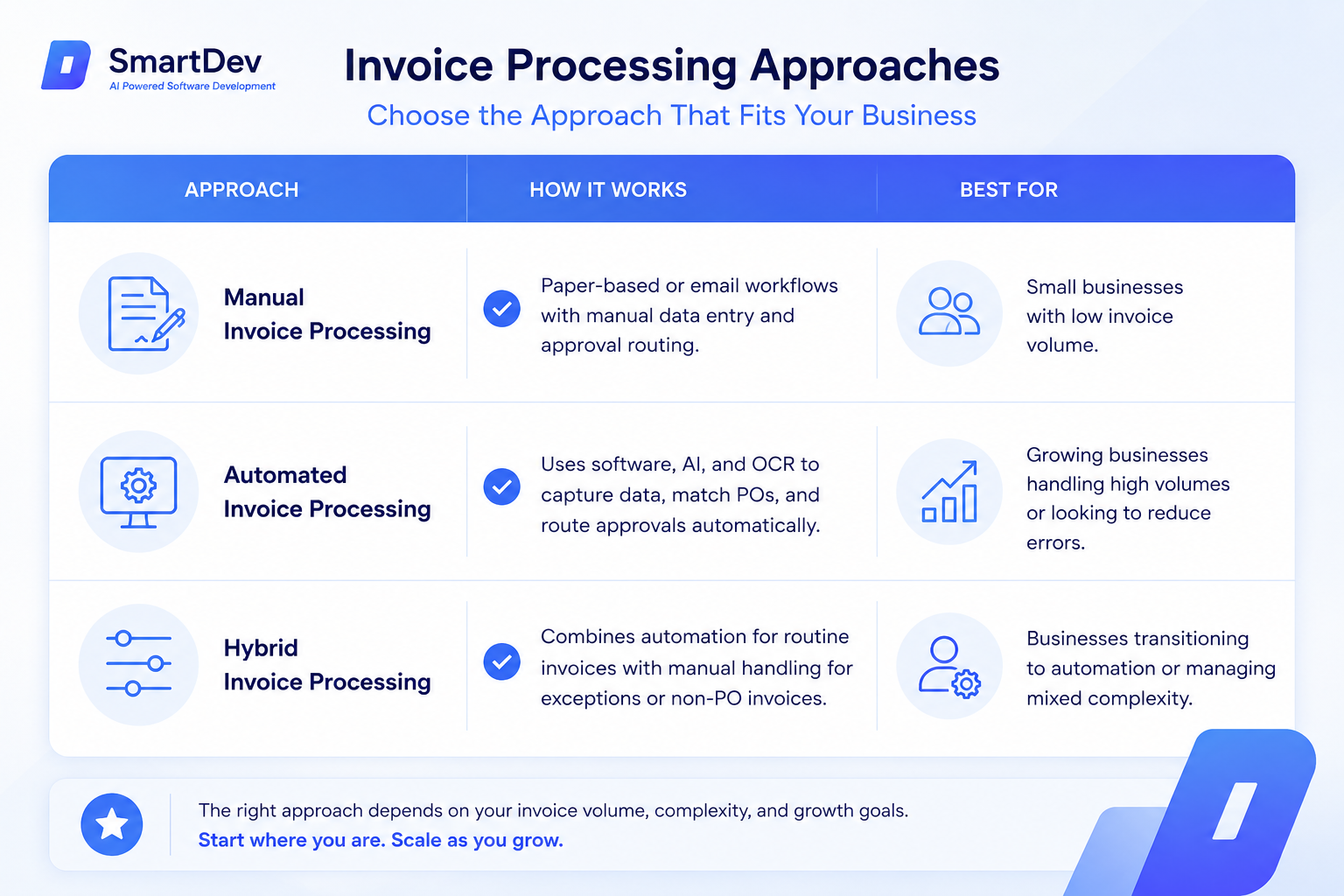
There are three types of invoice processing, depending on your business size, invoice volume, and workflow complexity. They are
- Manual invoice processing
- Automated invoice processing
- Hybrid invoice processing
Traditionally, invoice processing includes 6 steps as follows:
- Step 1: Capture and log the invoice
Collect the invoice from email, mail, or supplier portals, then record key details such as invoice number, vendor name, date, and total amount.
- Step 2: Verify invoice information
Check vendor details, line items, payment terms, and delivery records. For PO invoices, match the invoice against the purchase order and receive the report.
- Step 3: Route for approval
Send the invoice to the right approver based on department, cost center, invoice value, or internal approval rules.
- Step 4: Review payment timing
Assess payment terms, available cash flow, and possible early payment discounts before deciding when to pay.
- Step 5: Schedule and approve payment
Confirm the payment method, vendor details, and payment date, then schedule the transaction through the accounting system or bank.
- Step 6: Archive for audit and reporting
Store the invoice, approvals, related documents, and payment confirmation in an organized system for audits, reporting, and future reference.
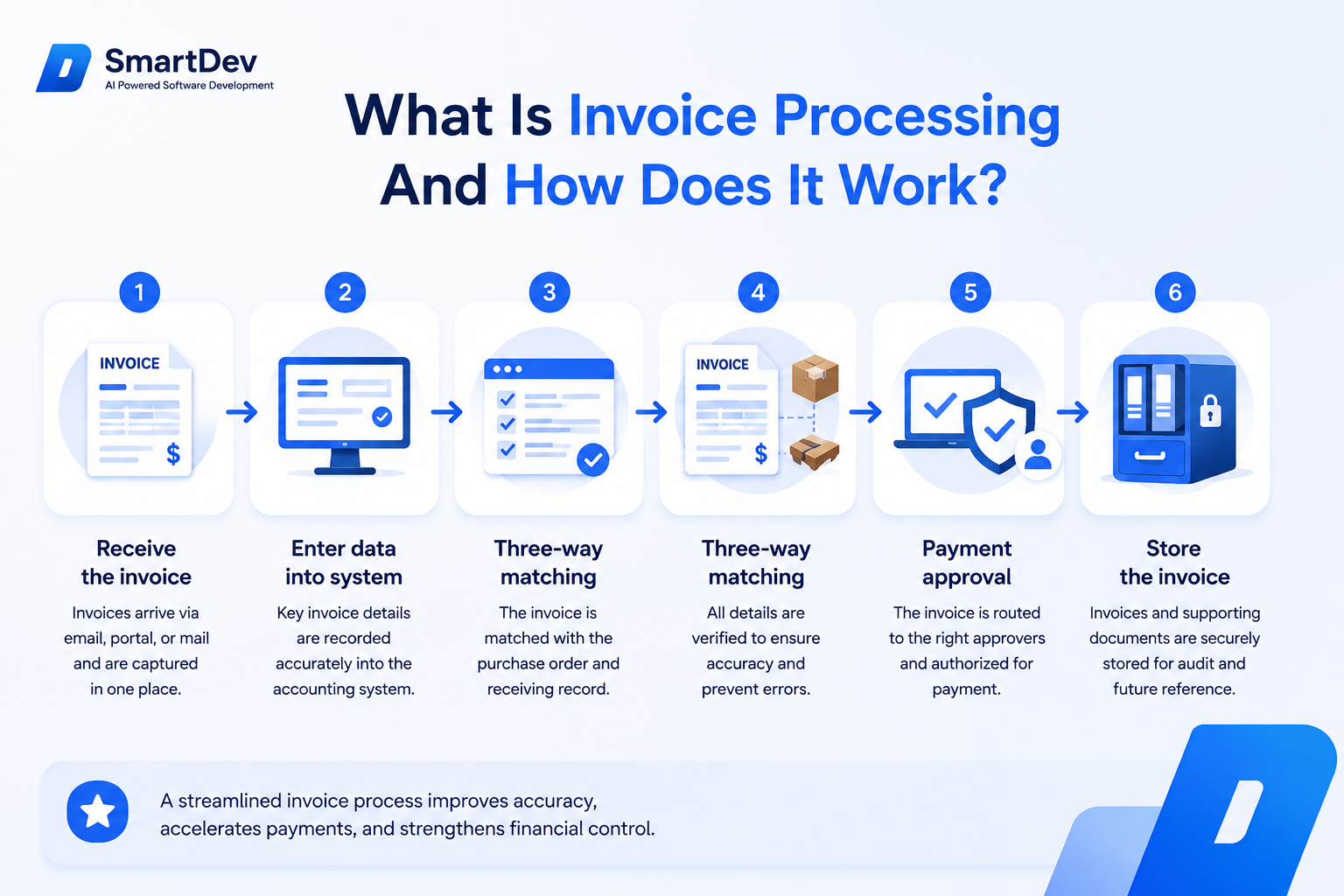
With the scale development, many logistics enterprises must deal with the large number of invoices every day. However, in a traditional invoice workflow, almost all 6 steps involve some level of manual work. But the most heavily manual and time-consuming steps are usually invoicing data entry and three-way matching.
2. The bottlenecks slowing the invoice process down
In logistics traditional process, bottlenecks easily appear at the steps like data entry, three-way matching and payment approval. Many organizations face similar challenges that impede efficiency and increase operational costs. By recognizing these pain points, businesses can target the areas most in need of improvement and develop tailored solutions.
These bottlenecks usually come from three main issues.
First, manual data entry is slow, labor-intensive, and difficult to scale. In logistics invoice processing, teams manually transfer data from emails, PDFs, scans, and supplier forms. This data is entered into ERP systems, spreadsheets, or accounting platforms. The process increases the risk of typos, missing fields, duplicates, and inconsistent records. Manual data entry error rates can range from around 0.55% to 4.0%. This may look small, but it becomes costly across hundreds of invoices. As invoice volume grows, the workload grows with it. Teams spend more time checking, correcting, and reprocessing data instead of improving operations.
Second, approval delays often happen because workflows rely on email chains and unclear handoffs. As invoice volume grows, AP teams struggle to track approval status. They also need to identify missing documents and next-step owners. Approvers may miss requests in crowded inboxes. Finance teams then spend extra time chasing purchase orders, delivery notes, or supplier corrections. These bottlenecks extend invoice processing times and reduce cash flow visibility. They also increase the risk of late payments. Over time, supplier follow-ups and error resolution drain AP resources. These resources could be used for working capital improvements or better payment-term negotiations.
Third, disconnected systems make invoice processing harder to control at scale. Invoice data often sits across emails, ERP systems, accounting tools, logistics platforms, and spreadsheets. This creates no single source of truth. Teams must switch between tools to check invoice status or match shipment data. They also need to confirm payment details and reconcile accounts manually. As invoice volume grows, this fragmentation reduces cash flow visibility. It also increases the risk of missed or duplicate payments. Ultimately, financial reporting becomes less reliable.
Why Does Automated Invoice Processing often fail?
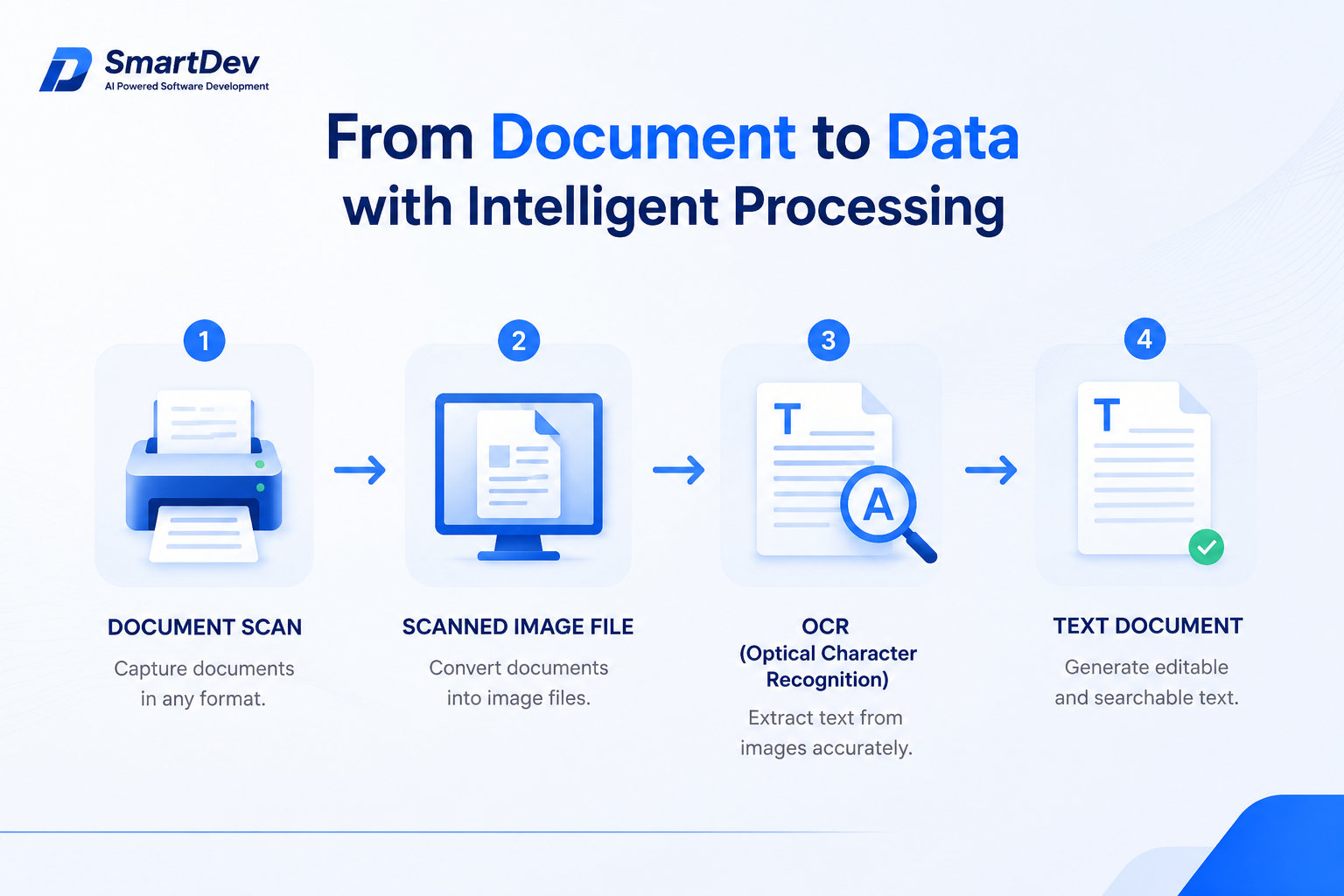
Automated invoice processing and AI-powered invoice processing use machine learning, optical character recognition (OCR) and other modern technologies to ingest, validate, and route vendor invoices, helping streamline accounts payable workflows and reduce manual data entry.
Automated invoice processing often fails because many businesses underestimate how complex real operational workflows are. Traditional automation tools, especially OCR-based systems, are designed for standardized documents and predictable workflows. Invoices arrive through emails, PDFs, supplier portals, or scanned images with inconsistent formats, poor scan quality, missing fields, and varying layouts. A supplier may place the invoice number at the top of one month and at the bottom of the next, which can easily break OCR-driven workflows.
Another major limitation is that OCR only extracts text. It does not understand business context or operational logic. While OCR can identify numbers and words from an invoice, it cannot reliably validate totals, match invoices against purchase orders, compare shipment records, or recognize exceptions like partial deliveries, surcharge discrepancies, or tax mismatches. In logistics environments, where invoices often contain fuel surcharges, accessorial fees, and carrier-specific formats, this becomes a major operational problem. As a result, finance teams still need to manually verify and correct invoice data, which defeats much of the purpose of automation.
Many automation projects also fail because they focus only on one isolated task instead of the entire workflow. Businesses may automate invoice data extraction, but approvals, exception handling, validation, and ERP updates still rely on manual coordination. When exceptions appear, most OCR-based systems simply stop the process and push the invoice back to humans. Without intelligent workflow orchestration and system integration, automation creates fragmented operations rather than true efficiency.
How They Adopt AI To Automate 200 Invoices Per Day
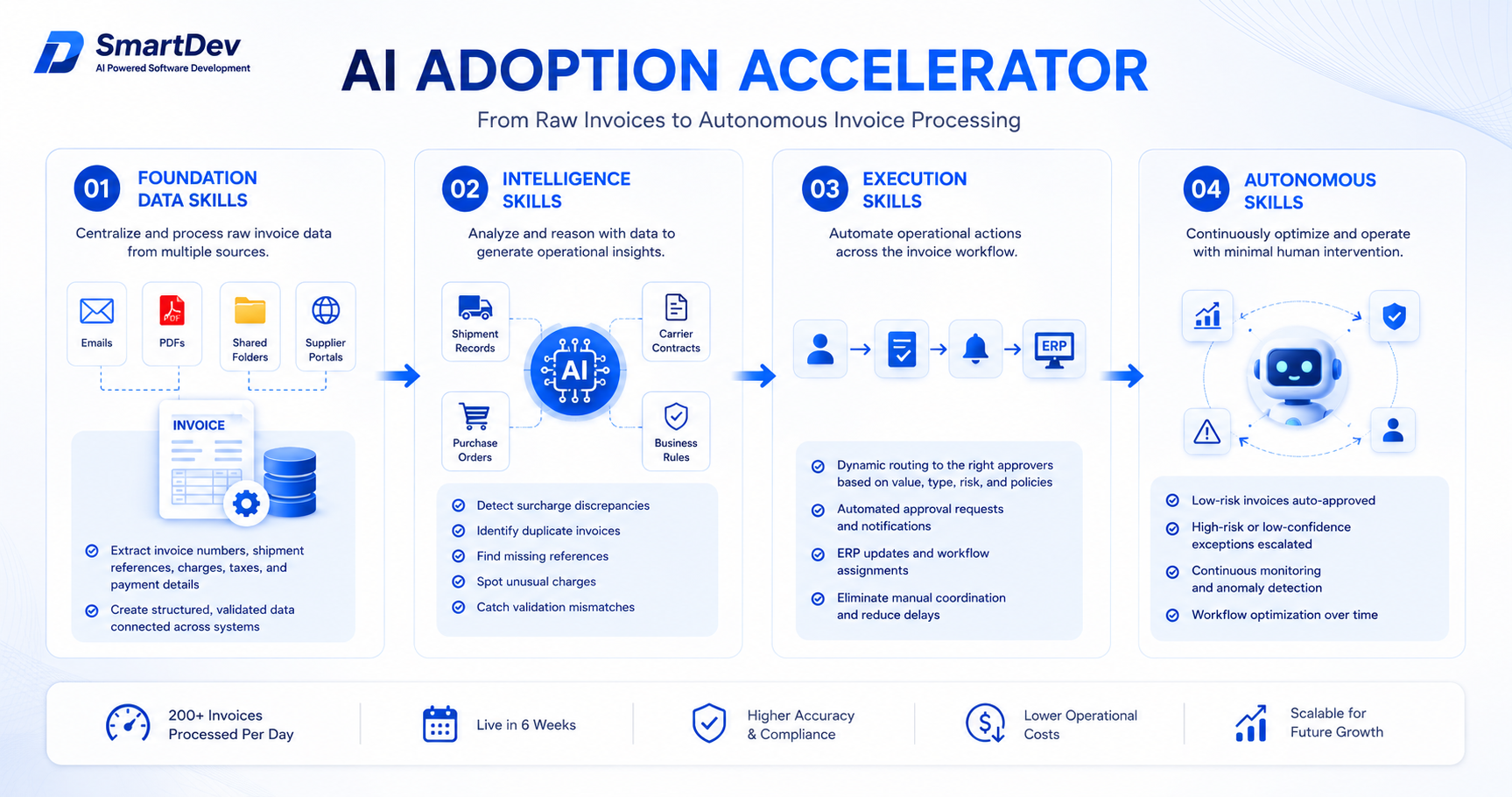
The logistics company automated more than 200 invoices per day by implementing an AI Adoption Accelerator built across four operational layers: Foundation Data Skills, Intelligence Skills, Execution Skills, and Autonomous Skills. Instead of focusing only on OCR or document extraction, the system transformed invoice processing into a connected, intelligent workflow capable of understanding data, reasoning it, acting, and continuously optimizing operations.
At the Foundation Data Skills layer, the system centralized and processed raw invoice data from emails, PDFs, shared folders, and supplier portals. AI-powered document processing extracted invoice numbers, shipment references, carrier charges, taxes, and payment details from highly inconsistent logistics invoice formats. This created a structured data foundation that could be indexed, validated, and connected across finance and logistics systems.
At the Intelligence Skills layer, the AI Adoption Accelerator analyzed and reasoned the extracted information. Instead of simply reading text like traditional OCR systems, it compared invoice data against shipment records, carrier contracts, purchase orders, and business rules in real time. The system could identify surcharge discrepancies, duplicate invoices, missing references, unusual charges, and validation mismatches before invoices entered the approval stage. This transformed raw invoice data into operational insight and reduced the need for repetitive manual verification.
At the Execution Skills layer, the system automated operational actions across the invoice workflow. Invoices were routed dynamically to the correct approvers based on invoice value, shipment type, risk level, or internal approval policies. Approval requests, notifications, ERP updates, and workflow assignments were handled automatically without requiring employees to manually coordinate across emails or spreadsheets. This significantly reduced delays caused by fragmented finance operations.
Finally, at the Autonomous Skills layer, the workflow became increasingly proactive and self-operating. Low-risk invoices moved through validation and approvals automatically, while only high-risk or low-confidence exceptions were escalated for human review. The system continuously monitored invoice processing conditions, flagged anomalies proactively, and optimized workflow routing over time. Instead of finance teams manually monitoring every invoice, the AI Adoption Accelerator handled routine operational decisions autonomously while maintaining human oversight where necessary.
Within just 6 weeks, the company successfully automated the processing of over 200 invoices per day. Manual review effort decreased substantially, invoice turnaround times became faster and more consistent, and approval of bottlenecks across finance operations were minimized. Most importantly, the business established a scalable operational workflow that allowed invoice volume to grow without requiring proportional increases in headcount or administrative workload.
The Difference Between AI Adoption Accelerator & OCR In Workflow Automation
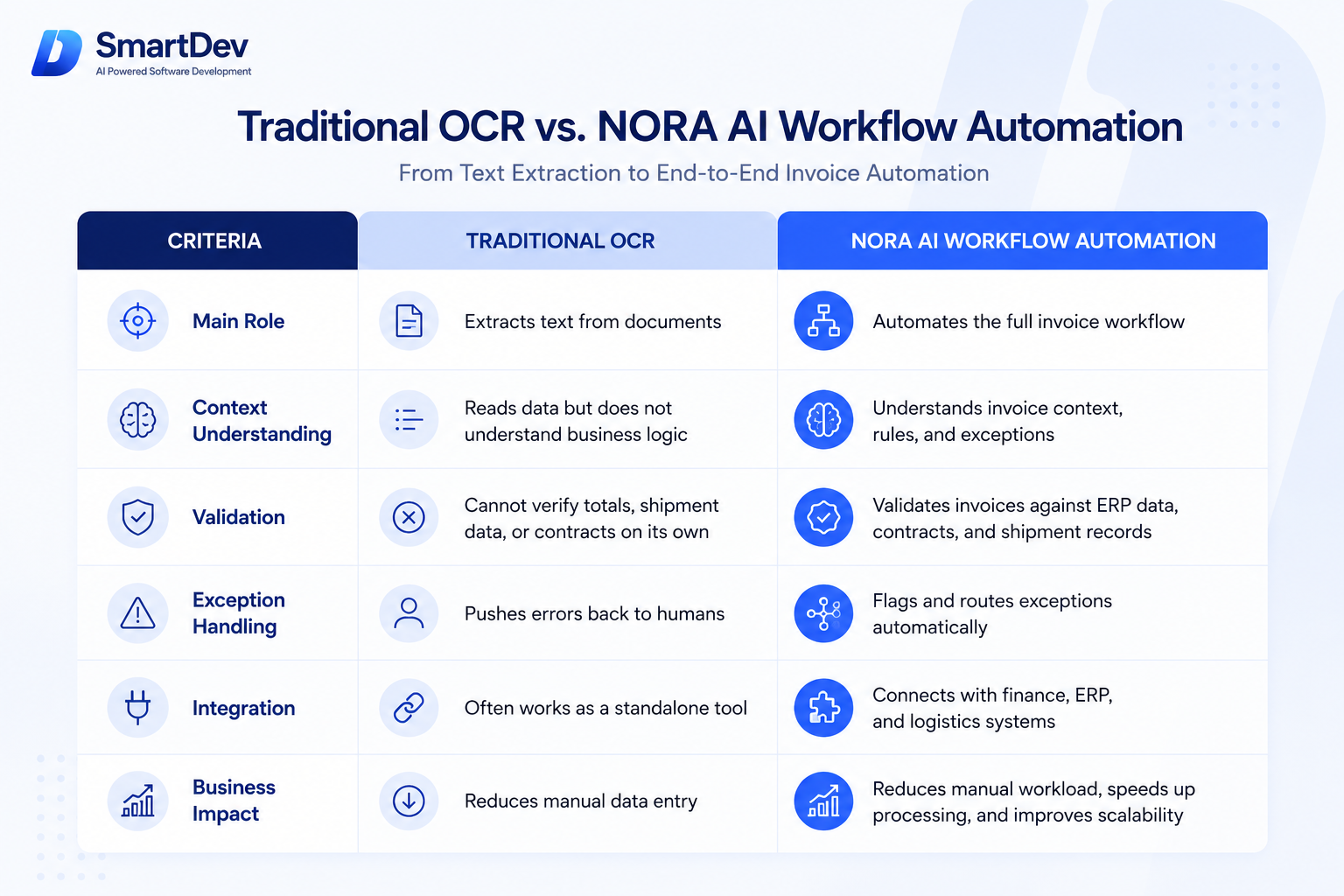
Unlike traditional automation tools such as OCR, AI-powered invoice processing can be embedded across the entire workflow, not just applied to one isolated task. The ability to process 200 invoices per day shows how an AI Adoption Accelerator goes beyond text extraction to improve validation, routing, exception handling, and overall process efficiency.
At SmartDev, NORA is developed to support enterprises across different sectors by integrating directly into their existing workflows. Instead of automating fragmented tasks, NORA helps transform repetitive, manual operations into connected, end-to-end AI-powered workflows.
In the case of logistics companies, traditional OCR and AI workflow automation tools like NORA show the differences. Traditional OCR is primarily designed to extract text from documents, helping businesses reduce manual data entry. However, it lacks the ability to understand operational context, validate business logic, or manage workflow decisions. As a result, finance teams still need to manually verify invoice data, resolve exceptions, coordinate approvals, and reconcile information across multiple systems.
In contrast, AI workflow automation extends far beyond document extraction by orchestrating the entire invoice processing workflow. Instead of simply reading invoice data, it understands invoice context, validates information against ERP systems and shipment records, routes exceptions automatically, and integrates directly with finance and logistics operations. This allows businesses not only to reduce repetitive manual work, but also to improve processing speed, operational visibility, and scalability as invoice volumes grow.
Conclusion
Manual invoice processing is no longer just a back-office inefficiency. In logistics, it directly affects operational scalability, financial visibility, vendor relationships, and the ability to handle growing shipment volumes efficiently. As workflows become more complex, traditional automation tools like OCR are no longer enough to solve the real operational bottlenecks.
The companies achieving meaningful efficiency gains are not simply digitizing invoices faster. They are transforming the entire workflow around them through AI-powered orchestration, intelligent validation, automated decision-making, and proactive exception handling. The ability to automate more than 200 invoices per day in just 6 weeks demonstrates how AI Adoption Accelerators can move businesses beyond fragmented automation toward scalable, end-to-end operational workflows