TL;DR
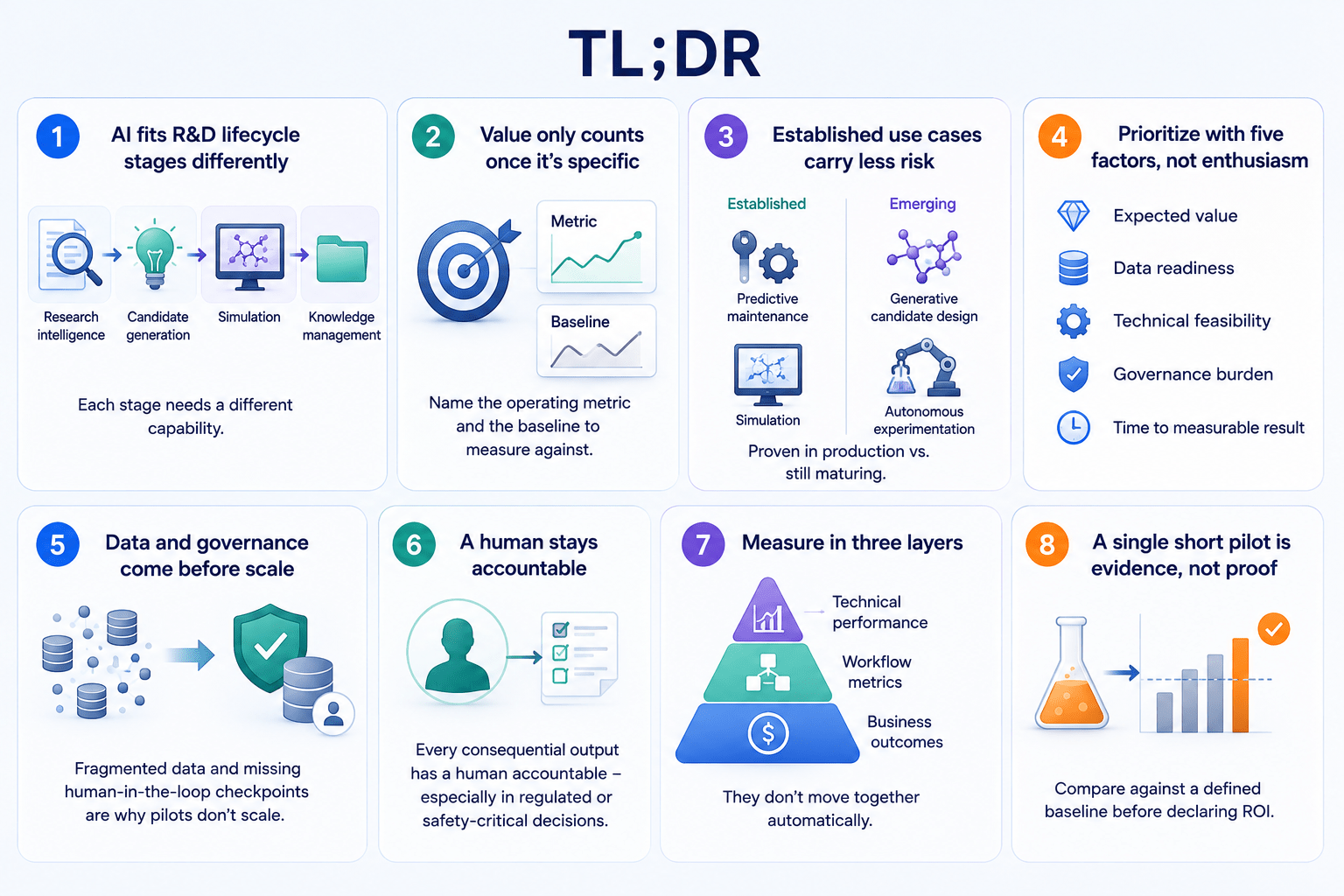
- AI fits R&D lifecycle stages differently – research intelligence, candidate generation, simulation, and knowledge management each need a different capability, not one blanket “AI for R&D.”
- Value only counts once it’s specific. Name the operating metric a use case should move, and the baseline to measure it against – not just “faster.”
- Established use cases carry less risk than emerging ones. Predictive maintenance and simulation are production-proven; generative candidate design and autonomous experimentation are still maturing.
- Prioritize with five factors, not enthusiasm: expected value, data readiness, technical feasibility, governance burden, and time to a measurable result.
- Data and governance come before scale, not after. Fragmented data and missing human-in-the-loop checkpoints are the top reasons a working pilot never scales.
- A human stays accountable for every consequential output – especially where a result feeds a regulated or safety-critical decision.
- Measure in three layers – technical performance, workflow metrics, and business outcomes – since they don’t move together automatically.
- A single short pilot is evidence, not proof. Compare against a defined baseline before declaring ROI.
Introduction
Research and development has a productivity problem. A widely cited study by economists Bloom, Jones, Van Reenen, and Webb, published in the American Economic Review, found that across industries – from semiconductors to pharmaceuticals – research effort has been rising sharply while research productivity keeps declining. Sustaining the same rate of discovery now takes more researchers, more spending, and more time than it used to. That’s the backdrop against which most R&D leaders are now evaluating AI.
This guide treats AI in R&D as a decision system, not a shopping list of tools. The capabilities – machine learning, NLP, generative AI, optimization, AI agents – are well documented elsewhere, including in our AI use cases hub. What’s harder to find is a clear framework for deciding where those capabilities are worth applying, what has to be true about data and governance first, and how to tell afterward whether it worked.
AI is an enabling capability, not a replacement for scientific judgment. It narrows search spaces and reduces repetitive work – but every use case here still depends on a domain expert to validate results and make the calls that carry real consequence. This guide walks through that in order: where AI creates value, which use cases apply where, how to prioritize a first pilot, what governance is required, how to scale, and how to measure whether it worked. It’s a companion to our AI transformation guide, which covers the broader organizational shift.
What AI in R&D Means – and Where It Creates Value
AI in R&D: definition, scope, and core capabilities
AI in R&D is the use of machine learning, natural language processing (NLP), computer vision, generative AI, optimization algorithms, and increasingly AI agents to support the work of discovering, designing, testing, and documenting new products, materials, and processes. Rather than a single tool, it’s a set of capabilities that each do something different:
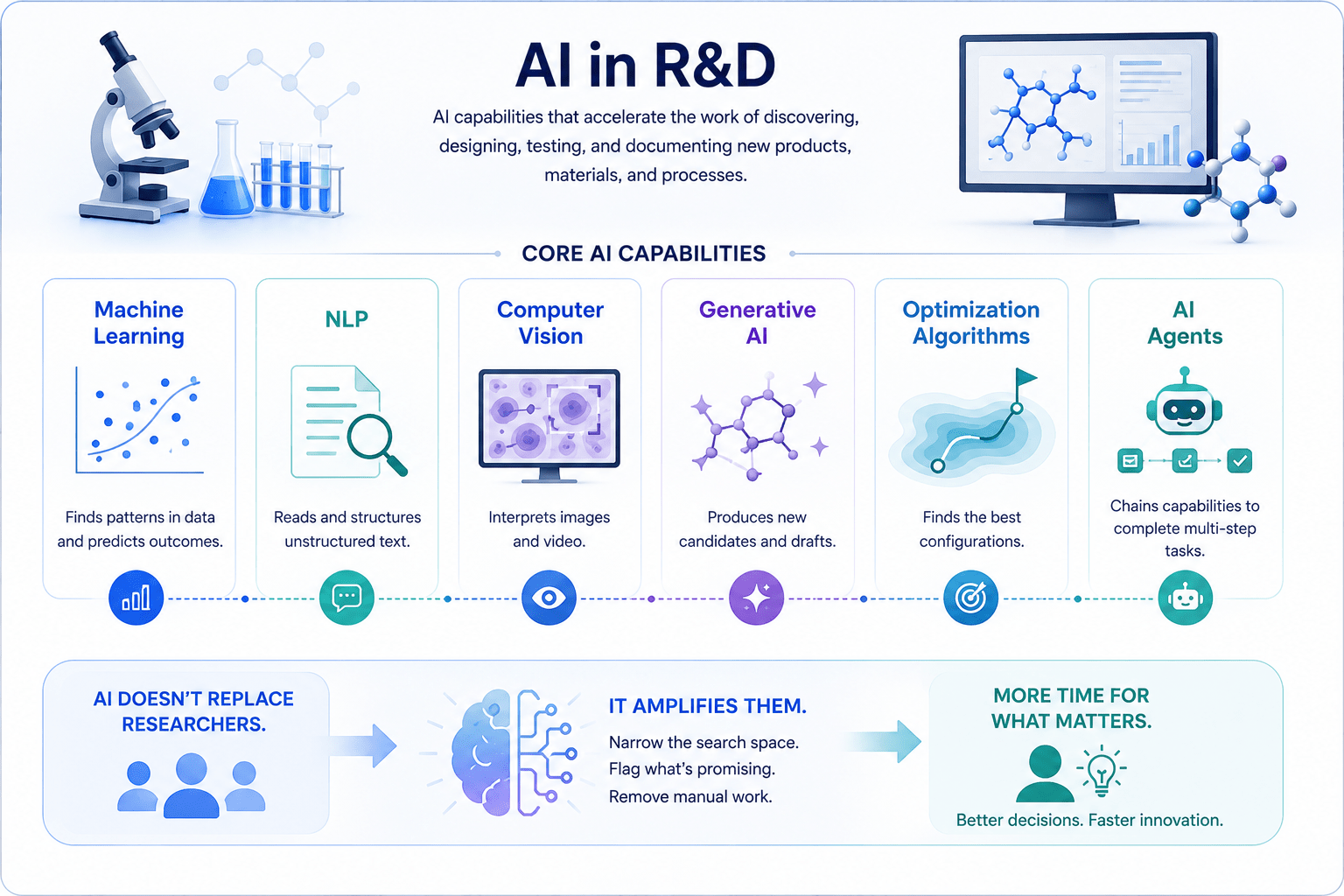
- Machine learning finds patterns in experimental, sensor, or historical data and predicts outcomes (e.g., which compound is likely to work, which component is likely to fail).
- NLP reads and structures unstructured text – papers, patents, lab notes – so research teams can search, summarize, and synthesize faster.
- Computer vision interprets images and video, from microscopy to production-line inspection.
- Generative AI produces new candidates – molecules, designs, code, drafts – that a human then evaluates and refines.
- Optimization algorithms search large design or parameter spaces to find configurations that best satisfy a set of constraints.
- AI agents chain these capabilities together to carry out multi-step tasks – running a literature search, proposing a hypothesis, and drafting a summary – with limited human intervention at each step.
It’s worth separating the capability from the outcome. AI doesn’t discover a drug or design a jet engine on its own – it narrows the search space, flags what’s promising, and removes manual steps, so the people doing the research can spend more time on judgment calls and less on repetitive analysis. For a broader look at how these same capabilities play out across other research-heavy fields, our AI use cases hub documents implementations by industry and function.
The R&D lifecycle AI can support
AI capabilities map onto R&D work differently depending on where in the lifecycle a team is. A useful way to think about it is four stages:
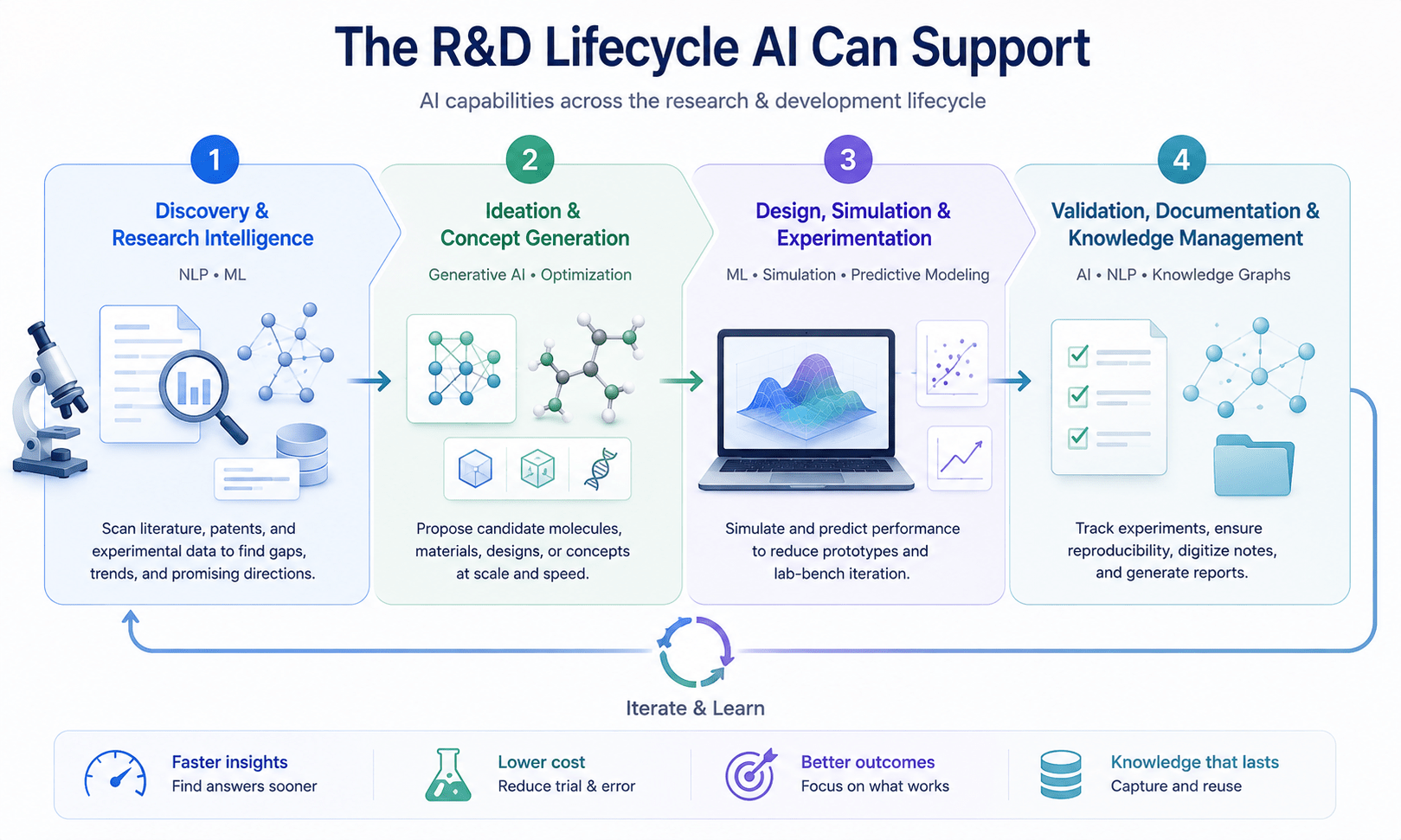
- Discovery and research intelligence – Using NLP and ML to scan literature, patents, and prior experimental data to identify gaps, trends, and promising directions before committing resources to a specific line of research.
- Ideation and concept generation – Using generative AI and optimization to propose candidate molecules, materials, designs, or product concepts, often at a scale and speed no team could match manually.
- Design, simulation, and experimentation – Using ML-driven simulation and predictive modeling to test how a design or compound is likely to perform, reducing dependence on physical prototypes and lab-bench iteration. Turning this stage into a working model usually comes down to sound AI model training practice – defining the problem, preparing data, and evaluating results against a clear objective.
- Validation, documentation, and knowledge management – Using AI to support experiment tracking, reproducibility checks, lab note digitization, and reporting, so findings are captured and reusable rather than lost in individual notebooks.
These stages aren’t strictly sequential in practice – many R&D teams run several in parallel – but they give a shared vocabulary for the rest of this article, and for scoping later where specific use cases (drug discovery, predictive maintenance, simulation, etc.) fit. The tooling underneath each stage also varies significantly by scale and constraint; our AI tech stack guide walks through how to choose infrastructure, models, and operations layers for a given workload rather than picking tools first.
Why AI adoption in R&D is accelerating
Three forces are pushing R&D organizations toward AI faster than in prior technology cycles.
First, research data has grown beyond what manual analysis can handle. Experimental results, sensor streams, and scientific literature now make AI-powered pattern recognition increasingly necessary. Second, generative and predictive models can now produce usable outputs such as designs, molecules, and code. This expands AI’s role from interpreting research to actively supporting its creation. Third, competitive pressure is growing. Organizations that shorten discovery or testing cycles by even a few weeks can bring products to market earlier. That advantage can compound across a portfolio of projects.
This does not mean AI adoption is uniform or guaranteed to pay off, as the next section will explore. But it explains why R&D leaders are evaluating AI now rather than treating it as a future consideration.
The Business Value of AI in R&D
AI can plausibly influence R&D outcomes in several distinct ways. It’s useful to treat these as separate value categories rather than a single “AI = faster R&D” claim, because each has a different mechanism, a different way of being measured, and a different level of evidence behind it.
The value chain, in short: an AI capability changes a specific workflow → that workflow change shows up in an operating metric (e.g., time per experiment, number of candidates screened per week) → and if the operating metric is tied to something the business cares about, it shows up as a business outcome (time-to-market, cost, revenue).
Faster discovery and shorter development cycles
AI’s most cited value is speed. It generates and tests more hypotheses in less time. ML models can screen large datasets of compounds, materials, or designs faster than manual analysis, moving projects from idea to initial validation sooner. Insilico Medicine’s identification of a fibrosis drug candidate in just 46 days is a widely cited example of this compression – traditional methods for this kind of work typically take years. The mechanism is straightforward: AI narrows the candidate pool before expensive human or lab time is spent. As a result, the workflow metric that improves first is candidates screened per week; time-to-insight follows from there.
Better decisions, simulations, and experimental throughput
Beyond raw speed, AI changes the quality of decisions teams can make with the same resources. Predictive simulation reduces reliance on physical prototypes. GE, for example, uses AI-driven simulation for jet engine components, letting engineers test more design variations virtually before committing to a physical build. This isn’t just a cost story. It means teams can explore a wider design space and catch failure modes earlier, which tends to reduce late-stage rework. The operating metric to watch here is usually experimental throughput – how many configurations get evaluated per cycle – rather than speed alone.
Lower cost of prototyping, testing, and rework
Cost reduction in AI-driven R&D usually comes from three sources. The first is fewer physical prototypes, because simulation absorbs some of that testing. The second is less manual labor on repetitive tasks like data entry and sample analysis. The third is fewer late-stage design changes, because problems surface earlier in simulation or screening rather than after a prototype is built. Each source has a different measurement path – prototype counts, labor hours, or change-order rates. A credible cost claim should specify which of the three is being measured, not cite an aggregate percentage without context.
Stronger R&D knowledge reuse and collaboration
A less-discussed but increasingly important value category is what AI does to institutional knowledge. NLP-based tools can digitize lab notes, summarize prior experiments, and make historical research searchable. This reduces the amount of work that gets unintentionally repeated simply because a past finding wasn’t discoverable. The value here shows up less in speed metrics and more in avoided duplication: fewer research paths re-explored, faster onboarding for new team members, and better continuity when staff turn over. It’s harder to quantify than throughput or cost, but it compounds over time as an organization’s research history grows. This category also depends heavily on the underlying data layer – see our data analytics services for how a centralized, governed data foundation makes reuse possible in the first place.
How to define value before selecting a use case
AI’s value in R&D depends heavily on workflow and baseline. That means the categories above are best read as hypotheses to test, not guarantees. Before selecting a use case, it helps to be explicit about four things:
- The baseline metric. What does the current workflow cost in time, labor, or spend, measured before any AI involvement?
- The mechanism of change. Which specific step does AI remove, shorten, or improve – candidate screening, prototype count, literature search time?
- The operating metric that will move first. This is usually not the headline business outcome, like ROI or time-to-market. It’s a narrower workflow measure that’s easier to observe within a pilot timeframe.
- What “proven” versus “projected” looks like. Industry-wide figures, like McKinsey’s estimate of AI’s potential R&D value, describe potential. They aren’t a guarantee for a specific team. Only a team’s own baseline-to-result comparison counts as observed evidence.
Framing value this way – category, mechanism, metric, and evidence type – gives R&D leaders a way to evaluate a proposed AI use case on its own terms. It avoids assuming that value demonstrated in one company’s case study will transfer directly to another’s workflow. Once a use case is defined, the next step is proving it works before scaling; our guide on AI performance metrics covers how to evaluate model effectiveness against that baseline.
AI Use Cases Across the R&D Lifecycle
Each use case below follows the same structure: the problem it addresses, what role AI plays, what data it needs, what it produces, and where human validation stays essential. This keeps the section comparable across stages rather than a flat list of similar-sounding benefits.
Research intelligence and literature, patent, and technical-data analysis
NLP for literature review and knowledge extraction
- Problem: Reviewing scientific papers, patents, and technical reports manually doesn’t scale with the volume of published research.
- AI role: NLP models read, extract, and structure findings from unstructured text at a scale no team could match manually.
- Input: Full-text papers, patent filings, internal reports, prior experiment logs.
- Output: Summarized findings, extracted entities (compounds, methods, results), and searchable knowledge bases.
- Human validation: Domain experts still need to confirm that extracted claims are represented in context – NLP summarization can flatten nuance or miscategorize contradictory findings.
- Example: IBM Watson Discovery is used to help researchers analyze and extract insights from large volumes of scientific literature, cutting the time spent on manual searches.
Research intelligence, trend detection, and hypothesis support
- Problem: Teams often start research without a clear view of which directions are already saturated or which gaps are genuinely open.
- AI role: NLP and ML models scan literature, patents, and citation networks to surface trends, detect white space, and rank candidate research directions.
- Input: Large corpora of publications, patent databases, citation graphs.
- Output: Ranked lists of research gaps, emerging-topic signals, and hypothesis suggestions for a research team to evaluate.
- Human validation: This is decision support, not a decision – researchers still assess scientific plausibility and feasibility before committing resources. Because this application depends on synthesizing large volumes of unstructured text, our guide to unlocking value from unstructured data covers the underlying approach in more depth.
Discovery, formulation, and candidate generation
AI-driven drug discovery
- Problem: Traditional drug discovery takes 10–15 years and costs billions, largely due to the scale of compound screening and lab-based iteration.
- AI role: ML and deep learning models analyze chemical, genetic, and clinical data to predict which compounds are likely to succeed, and to suggest modifications that improve effectiveness or reduce side effects.
- Input: Chemical compound libraries, genetic datasets, prior clinical trial data.
- Output: Ranked candidate compounds, predicted interaction profiles, suggested design modifications.
- Human validation: Every AI-identified candidate still goes through lab validation and regulated clinical testing – AI narrows the field, it doesn’t replace the trial.
- Example: Insilico Medicine identified a novel drug candidate for fibrosis in 46 days using its Pharma.AI platform, versus the years such work typically takes with conventional methods.
Materials science and formulation discovery
- Problem: Material and formulation discovery has historically relied on trial-and-error lab work, which is slow and expensive to iterate on.
- AI role: ML models predict material properties (conductivity, strength, sustainability) from data-driven approaches, reducing the number of physical trials needed.
- Input: Experimental and simulation datasets on prior material performance.
- Output: Predicted property profiles for candidate materials or formulations, and identification of overlooked material combinations.
- Human validation: Predictions still require physical testing to confirm real-world performance and manufacturability.
- Example: BMW uses AI-driven simulations to optimize material selection for automotive production, improving durability and sustainability while reducing cost.
Generative AI for concepts, designs, and candidate exploration
- Problem: Generating a wide set of design or formulation concepts manually is slow and tends to converge on familiar solutions.
- AI role: Generative models produce novel candidate designs, molecules, or formulations within specified constraints, which researchers then filter and refine.
- Input: Constraint definitions (performance targets, cost limits, regulatory boundaries) plus training data relevant to the design space.
- Output: A larger, more diverse pool of candidate concepts than manual ideation typically produces.
- Human validation: Generated candidates are starting points, not finished designs — this is an emerging application, and teams should expect a heavier filtering and evaluation step than with more established use cases like predictive screening.
Simulation, engineering design, and virtual validation
AI for simulation and design
- Problem: Physical prototyping is costly and slow, and testing every design variation isn’t feasible.
- AI role: AI-powered simulation lets engineers model performance under various conditions (extreme weather, material fatigue) and adjust designs in near real time based on predicted outcomes.
- Input: Design specifications, material properties, prior test/simulation data.
- Output: Performance predictions across design variants, flagged failure points before physical build.
- Human validation: Simulated results still need physical validation at key milestones – simulation reduces the number of prototypes needed, not the need for them entirely.
- Example: General Electric uses AI-powered simulations to optimize jet engine component design, reducing reliance on physical testing while improving durability and efficiency.
AI surrogate models and digital twins
- Problem: Full physics-based simulations can be too computationally expensive to run at the scale needed for rapid design iteration.
- AI role: Surrogate models – ML models trained to approximate a full simulation’s output – and digital twins (live, data-fed virtual replicas of a physical system) let teams iterate faster and monitor real assets continuously.
- Input: Historical simulation results (to train the surrogate) and, for digital twins, live sensor data from the physical system.
- Output: Fast approximate predictions for design iteration, or an always-current virtual model for monitoring and what-if testing.
- Human validation: Surrogate models need periodic re-validation against full simulations to catch drift; this is a newer application relative to standard simulation and carries a higher validation burden as a result.
Experimentation, testing, and quality insight
AI-assisted experiment planning and analysis
- Problem: Manually designing experiment sequences and analyzing results is time-consuming, especially across large parameter spaces.
- AI role: AI recommends which experiments to run next (based on prior results) and analyzes outcomes to identify patterns or unexpected effects.
- Input: Historical experiment results, parameter spaces, target objectives.
- Output: Prioritized experiment sequences and structured result analysis.
- Human validation: Researchers set the objective function and interpret whether flagged patterns are scientifically meaningful or statistical noise.
Anomaly detection and predictive quality signals
- Problem: Catching quality issues or equipment failures early is difficult when relying on manual inspection or fixed maintenance schedules.
- AI role: ML models trained on sensor and historical operational data detect anomalies and forecast when equipment or output quality is likely to degrade.
- Input: Real-time sensor streams, historical failure and maintenance records.
- Output: Early warning flags and predicted maintenance windows.
- Human validation: Flagged anomalies need a human decision on response – false positives are common enough that fully automated action is rarely appropriate in R&D or production-adjacent settings.
- Example: Siemens uses AI for predictive maintenance across its industrial operations, forecasting equipment failures and reducing unplanned downtime.
Human validation and reproducibility controls
- Problem: As more of the experimentation and analysis pipeline is AI-assisted, it becomes easier for errors or unreproducible results to propagate unnoticed.
- AI role: This isn’t a single AI capability but a practice: maintaining explicit checkpoints where AI-generated hypotheses, designs, or analyses are independently verified before they inform a decision or advance to the next lifecycle stage.
- Human validation: This is the control layer itself – the point is that every use case above needs one, sized to the stakes of the decision it feeds into.
R&D operations, documentation, and knowledge workflows
Real-time data analysis
- Problem: As research data volume grows, traditional analysis methods are too slow to support timely decisions.
- AI role: ML models continuously process incoming data to surface patterns, trends, and anomalies as they emerge, rather than in a retrospective batch review.
- Input: Streaming or frequently updated experimental, operational, or trial data.
- Output: Real-time dashboards, flagged trends, and recommended next actions.
- Human validation: Real-time flags still require review before they change a research or operational decision.
- Example: Pfizer uses AI to analyze clinical trial data in real time, supporting faster trial-related decisions.
Research documentation and technical knowledge management
- Problem: Findings captured in individual notebooks, disparate file formats, or informal notes are easy to lose and hard to search later.
- AI role: AI supports experiment tracking, automated documentation, and lab note digitization, making prior research discoverable rather than siloed.
- Input: Lab notes, experiment logs, internal reports (often unstructured).
- Output: Searchable, structured records of past research activity and outcomes.
- Human validation: Digitization accuracy should be spot-checked, particularly for handwritten or informal source material.
Developer productivity for research software and internal tools
- Problem: Building and maintaining the internal tools and scripts that support R&D work competes for the same engineering time as the research itself.
- AI role: AI coding assistants generate code, fix bugs, and suggest improvements for internal research software, reducing the time scientists and engineers spend on tooling rather than research.
- Input: Existing codebases, internal tooling requirements.
- Output: Faster iteration on internal software, fewer manual scripting bottlenecks.
- Human validation: AI-generated code still needs standard review and testing before it’s relied on for research-critical tooling – see our AI model testing guide for how to structure that validation, and our guide to AI workflow automation for how these tools fit into a broader operational workflow rather than standing alone.
Real-World AI-in-R&D Examples by Industry
The use cases in Section 3 show up differently depending on industry constraints. Regulatory burden, data availability, and cost of failure all shape what “AI-enabled R&D” looks like in practice. The table below compares how the same underlying capabilities play out across four industry contexts.
| Industry | Common R&D constraint | AI application | Validation burden | Example outcome |
|---|---|---|---|---|
| Life sciences & pharma | Long, regulated development cycles | Compound/target screening, candidate generation | High – regulatory + clinical trial | Insilico Medicine: preclinical candidate nominated in 18 months |
| Materials, chemicals & consumer products | Costly physical trial-and-error | Property prediction, simulation-guided selection | Medium – physical testing still required | BMW: AI-driven simulation informing material and CO2 optimization |
| Engineering, automotive, aerospace & industrial | Expensive physical prototypes | Generative design, predictive maintenance | Medium-high – safety-critical validation | GE Aerospace: design study time cut from months to seconds; Siemens: downtime reduced via Senseye |
| Software-intensive product development | Fast iteration cycles, integration complexity | Code generation, automated testing, real-time analytics | Medium – standard code review + testing | Pfizer: ~50% faster clinical data quality-checks in PAXLOVID trials |
Life sciences and pharmaceuticals
Drug discovery is the sector where AI’s R&D impact is most documented. This is largely because the cost of the traditional process makes even modest compression highly visible. Insilico Medicine’s Pharma.AI platform is the most frequently cited example. But it’s worth being precise about which milestone is being quoted.
In a 2019 Nature Biotechnology paper, Insilico’s GENTRL system demonstrated a 46-day benchmark from project initiation to animal pharmacokinetic studies. This was a proof-of-concept on the underlying method. It was not a result from the fibrosis program itself.
The company’s actual idiopathic pulmonary fibrosis (IPF) candidate followed a separate timeline. Target discovery to preclinical candidate nomination took 18 months, as detailed in Insilico’s own account of the program. From project start to Phase 1 trials took under 30 months, as reported by C&EN at the time of the preclinical announcement. Both figures are legitimate. But they measure different things, and conflating them overstates the compression achieved on any single program.
Pfizer’s use of AI is a related but distinct application. It targets the validation stage rather than early discovery. During the PAXLOVID trials, Pfizer’s clinical teams used AI and machine learning to perform quality checks and analyze patient data. This work ran roughly 50% faster than with prior methods, according to BioSpace’s reporting on Pfizer’s AI/ML clinical strategy. For a broader view of where AI is applied across the pharma value chain, from discovery to manufacturing to commercialization, see our AI use cases in pharma guide.
Materials, chemicals, and consumer-product formulation
Materials and formulation R&D relies heavily on physical trial-and-error. This makes it a natural fit for AI-driven property prediction. BMW’s application is a useful example because it’s well-documented at the infrastructure level.
The company uses AI trained on its own production data, run on NVIDIA DGX systems. It simulates energy and CO2 outcomes for components and materials before committing to physical changes, as described in NVIDIA’s case study on BMW’s deployment. BMW’s own innovation pages confirm the broader pattern. AI is applied across development to reduce dependence on physical prototypes and testing cycles, per BMW Group’s AI overview.
As with the life sciences examples, this is a case of AI reducing the number of physical trials needed. It doesn’t eliminate physical validation. Similar patterns recur across manufacturing more broadly: simulation-guided material and process decisions. Our AI use cases in manufacturing guide covers this at the production-floor level.
Engineering, automotive, aerospace, and industrial systems
This is where simulation, generative design, and predictive maintenance dominate. GE Aerospace’s generative AI design tool produced a preliminary hypersonic ramjet layout that satisfied engineering and flight-condition requirements. The company says this work would traditionally take weeks or months. AI compressed the initial design study to seconds, according to GE Aerospace’s own press release and its published AI capabilities fact sheet. It’s worth noting this describes the design study phase specifically. The output is a preliminary layout for engineers to review and refine, not a finished, flight-ready design.
Siemens’ Senseye Predictive Maintenance is a related but operationally distinct case. It applies ML to sensor data from already-deployed equipment to forecast failures, rather than supporting upfront design decisions. Siemens reports the platform can reduce unplanned downtime by up to 50% and improve maintenance staff productivity by up to 30%, in its own announcement of the Senseye acquisition. A named customer case, BlueScope, a steel manufacturer, reports roughly 2,000 hours of unplanned downtime avoided over three years, per Siemens’ published customer story.
These figures come from the vendor and a customer testimonial rather than independent audit. That’s worth keeping in mind when citing the percentages as a general benchmark. For the broader pattern across engineering disciplines, our AI use cases in engineering guide covers aerospace, construction, and industrial applications in more depth.
Software-intensive product development
R&D that produces software has its own AI pattern, distinct from physical R&D. This includes internal research tools, embedded product code, and data pipelines. AI coding assistants and automated testing tools speed up the build-and-validate cycle for research software itself. Real-time data analysis tools support faster in-flight decisions.
Pfizer’s clinical-data quality-check work, described above, is one instance of this pattern. It’s applied inside a pharma R&D pipeline rather than as a standalone software product. This category spans both R&D tooling and R&D outputs that are themselves software. It’s worth evaluating separately from hardware- or compound-based R&D, where the validation burden and failure cost are usually higher. Our AI use cases in product development guide covers this distinction across a wider set of examples.
Evidence and source-validation note for case examples
The figures above come from a mix of sources. Primary sources include company press releases, an official product fact sheet, and one peer-reviewed publication (Insilico’s GENTRL paper). Secondary sources include one third-party case study (NVIDIA on BMW) and two independent trade-press reports (C&EN, BioSpace).
None of them are independently audited third-party verifications of the claimed outcome. Most describe results specific to a single program or facility, not an average across the company’s full portfolio. A company-reported figure reflects what that organization has chosen to disclose about its own results, under its own conditions. It doesn’t guarantee a comparable outcome in a different R&D environment. GE’s ramjet design study is a good example of this limit: it describes a single proof-of-concept application, not a routine operating benchmark.
Where a figure is a broad industry projection, treat it as directional context rather than a target. McKinsey estimates that AI could unlock $360–560 billion in annual R&D value. That’s a statement about potential across an entire industry base, not a benchmark any individual team should expect to hit.
How to Prioritize the Right AI Use Case
Not every promising AI application deserves to be the first one a team pilots. The strongest use case isn’t necessarily the one with the biggest theoretical upside – it’s the one where value, data, feasibility, and risk all line up well enough to prove something in a reasonable timeframe.
A value-versus-feasibility framework
Five factors determine whether a use case is ready to pilot. Score each candidate against them before committing resources.
- Expected business value. What operating metric would this use case move, and how much does that metric matter to the business? A use case that shaves a few days off an already-fast process is a weaker candidate than one that touches a genuine bottleneck. Refer back to the value categories in Section 2 – speed, decision quality, cost, or knowledge reuse – and be specific about which one applies.
- Data availability and quality. Does the team already have the data this use case needs, in usable form? A compelling idea with no clean historical data behind it isn’t ready yet. It’s a data project wearing an AI project’s clothes.
- Technical feasibility. Is this a well-established application (like predictive maintenance or literature summarization) or an emerging one (like generative candidate design)? Established use cases carry lower technical risk. Emerging ones may still be worth pursuing, but the team should expect more iteration before results are usable.
- Risk, governance, and validation requirements. How much scrutiny will the output need before anyone acts on it? A use case that feeds a regulated decision, like a drug candidate or a safety-critical design, carries a much heavier validation burden than one that only informs an internal literature search. Higher stakes call for a narrower, more controlled pilot.
- Time to pilot and scale. Can this use case produce a measurable result within weeks or a couple of months, or does it require months of data preparation first? A use case that scores well everywhere else but takes a year to reach its first result is a poor choice for an initial pilot, even if it’s the right long-term investment.
Selecting a pilot with measurable outcomes
A good pilot has three things defined before it starts: a baseline, a target metric, and a decision rule. The baseline is what the current workflow costs today, in time, labor, or spend. The target metric is the specific number the pilot is meant to move – not “faster,” but “candidates screened per week” or “hours per literature review.” The decision rule is what result would justify scaling the use case, what result would justify killing it, and what result is ambiguous enough to warrant another iteration before deciding either way.
This structure matters because it prevents a common failure mode: a technically successful pilot that nobody can act on, because no one agreed in advance what “success” would look like. Our AI Proof of Concept guide covers this stage-gated approach in more depth, including how to separate a feasibility test from a production-readiness decision.
When not to use AI
Some R&D problems are better solved without it, at least for now. AI is a weak fit when the underlying data doesn’t exist yet or is too fragmented to clean up within a reasonable budget. It’s a weak fit when the decision at the end of the workflow is high-stakes and low-frequency, where the cost of building and validating a model exceeds the cost of doing the task manually a few more times. And it’s a weak fit when the real bottleneck isn’t the task AI would improve, but something upstream or downstream of it, like unclear ownership, slow approvals, or a workflow nobody has mapped out. In that last case, applying AI to a badly-defined process usually just produces a faster version of the same confusion.
Data, Governance, IP, and Human Oversight
Every use case in Section 3 depends on a set of controls that sit underneath the AI capability itself: whether the data is trustworthy, who owns the outputs, whether a result can be explained, and who signs off before it’s acted on. Skipping these isn’t a shortcut – it’s a way of moving the risk downstream, to a point where it’s harder and more expensive to fix.
Data quality, availability, and integration
AI’s output is only as reliable as the data behind it. R&D teams typically face this problem in three forms: data fragmented across instruments, systems, and file formats; data that’s inconsistent in how it was recorded across labs or time periods; and data that’s simply incomplete for the question being asked. None of these are solved by a better model – they’re solved by data cleansing, integration, and standardization work, which is often the least glamorous but most decisive part of an AI project’s timeline.
A large share of R&D data – lab notes, PDFs, images, free-text reports – is unstructured, which makes it harder to integrate than structured tabular data. Our guide to unlocking value from unstructured data covers the specific techniques for making this kind of data usable. And because data quality is a governance problem as much as a technical one, our guide to AI in data management covers how to build the ownership and process structure that keeps data usable over time, not just at the moment of a single pilot.
Intellectual property, confidentiality, and access controls
R&D data carries IP and confidentiality risk that most other business data doesn’t. A generative model trained on or exposed to proprietary compound libraries, unpublished research, or partner data needs clear boundaries: who can access the model’s outputs, whether those outputs could inadvertently reveal confidential inputs, and whether a third-party AI vendor’s terms of service grant them any claim over the data submitted to their platform. This is worth resolving before a pilot starts, not after – reworking access controls on a system already in use is far more disruptive than designing them in from the beginning.
Explainability, traceability, and scientific validation
Many AI models, particularly deep learning systems, function as “black boxes” whose reasoning isn’t directly interpretable. In R&D, that’s a bigger problem than it is in some other business functions, because a research finding that can’t be explained can’t be defended in a paper, a regulatory filing, or a patent claim. Building explainability and traceability in from the start – documenting what data a model was trained on, what its confidence levels mean, and how a given output was produced – is what lets a research team trust an AI-generated hypothesis enough to act on it. Where a finding touches on bias or fairness – for instance, a model that screens candidates for a clinical trial – our guide to AI bias and fairness covers how to test for and document this before it becomes a problem downstream.
Human-in-the-loop review and accountable decisions
Every use case card in Section 3 included a human validation requirement, and that wasn’t incidental. The pattern that recurs across R&D is the same one used in AI-assisted medicine: a human stays the final decision-maker, and the AI system is a tool that informs that decision rather than replacing it. Our look at human-in-the-loop AI systems covers the ethical and practical reasoning behind this, much of which transfers directly to R&D contexts where a wrong call carries real cost – a failed clinical trial, a flawed material choice, a mis-specified engineering design. The specific checkpoint matters less than having one that’s explicit: who reviews a given AI output, at what stage, and with what authority to override it.
Regulatory and responsible-AI requirements
Regulatory exposure varies sharply by industry. Drug discovery and clinical trial work sit inside a heavily regulated pipeline where every AI-assisted step still has to satisfy the same evidentiary standards as a traditionally-derived one – see our guide to AI use cases in drug discovery for how this plays out in practice. Materials and engineering R&D face a lighter but still real compliance burden, particularly around safety-critical design decisions. Across all of these, responsible-AI practice – fairness checks, explainability documentation, clear accountability – isn’t just a compliance requirement; it’s what allows a research team to trust its own AI-assisted output enough to publish, file, or ship it. Our business-oriented guide to responsible AI covers how these requirements translate into a practical development pipeline, regardless of industry.
Implementing AI in R&D: From Pilot to Scale
Moving from an isolated pilot to something an R&D organization actually relies on requires the same discipline in every stage: define the problem precisely, check readiness honestly, and validate before scaling. The six steps below build directly on the prioritization framework in Section 5 and the governance requirements in Section 6.
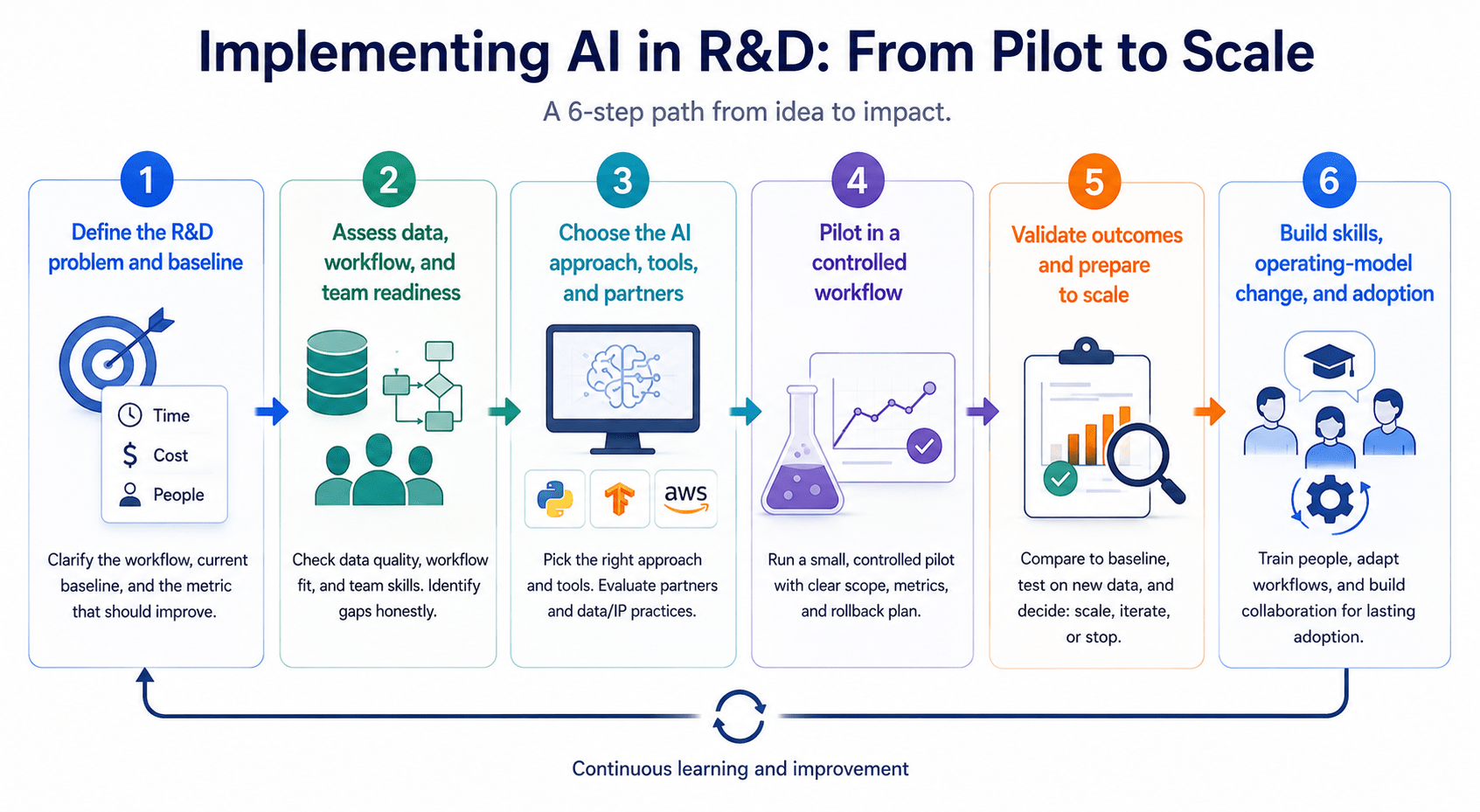
Step 1: Define the R&D problem and baseline
Start by naming the specific workflow this project is meant to change, not a general aspiration like “use AI in our research.” Write down the current baseline: how long the task takes today, what it costs, and who does it. Without this, there’s no way to tell later whether the AI system actually helped. This is also the point to apply the value framework from Section 5 – confirm the use case’s expected value, and identify which operating metric should move first.
Step 2: Assess data, workflow, and team readiness
Before selecting any tool, take stock of three things: whether the necessary data exists and is usable, whether the current workflow can absorb a new step without breaking something else, and whether the team has (or can get) the skills to work with the resulting system. This assessment should be honest about gaps rather than optimistic about a vendor’s promises – a strong tool applied to fragmented data or an unprepared team rarely produces a strong result. Our data analytics services page covers what a data-readiness assessment typically involves for organizations building this foundation from scratch.
Step 3: Choose the AI approach, tools, and partners
With the problem and data landscape defined, select the AI approach that fits – not the newest or most impressive one. Established techniques like supervised ML for property prediction usually beat newer generative approaches on projects where reliability matters more than novelty; Section 3 distinguishes which use cases are established versus emerging for this reason. Choosing infrastructure and tooling is its own decision with real trade-offs; our AI tech stack guide walks through matching workload, data, and constraints to an architecture, and our AI model training guide covers how to choose between training methods and tools once the approach is set. Vendor transparency matters here too – understand how a prospective partner handles your data, including the IP and confidentiality questions raised in Section 6, before signing anything.
Step 4: Pilot in a controlled workflow
Run the use case at small scale, inside a workflow that’s easy to observe and roll back if needed. This is where the baseline, target metric, and decision rule from Section 5 get put into practice. A controlled pilot should touch a limited scope – one research team, one candidate class, one product line – rather than an organization-wide rollout, so that problems surface early and cheaply rather than late and expensively.
Step 5: Validate outcomes and prepare to scale
Once the pilot has run, compare the result against the baseline and the target metric defined in Step 1. This is a technical validation as much as a business one: does the model’s output hold up under the kind of scrutiny described in Section 6, and does its performance remain stable on new, unseen data rather than just the data it was piloted on? Our AI model testing guide and guide to evaluating AI model performance cover the specific techniques for this kind of evaluation. A pilot that meets its target metric is a candidate for scaling; one that falls short needs a clear diagnosis – was the mechanism wrong, the data insufficient, or the target unrealistic – before deciding whether to iterate or stop.
Step 6: Build skills, operating-model change, and adoption
Scaling an AI use case changes how a research team works, not just what tools it uses. This step means training researchers and engineers to work alongside AI rather than be replaced by it, adjusting workflows so the AI-assisted step fits naturally rather than sitting as an awkward extra task, and building cross-functional collaboration between the technical team that built the system and the research team that will rely on it day to day. Skipping this step is one of the most common reasons a technically successful pilot never becomes an operating capability. Our guide to AI adoption for technical leaders covers what this kind of organizational readiness looks like in practice, including the literacy technical leaders need to guide these decisions without necessarily building the models themselves.
Measuring ROI and Performance in AI-Enabled R&D
A pilot that looks successful and a pilot that’s actually created value aren’t always the same thing. This section separates the two by connecting business outcomes down to the technical indicators that actually produced them – and by being explicit about what a single pilot can and can’t prove.
Innovation, speed, cost, quality, and risk metrics
R&D metrics work best as a tree rather than a flat list. At the top are business outcomes such as time-to-market, R&D spend, and portfolio output. The next level covers workflow metrics such as time-to-insight, experimental throughput, prototype count, and knowledge reuse. At the base are technical indicators such as model accuracy, precision, recall, latency, and drift.
These levels are connected. Business outcomes improve when workflow performance changes. Workflow performance, in turn, depends on how well the underlying model performs.
This structure matters because it is easy to focus on the wrong metric. A model may reach 95% accuracy on a validation set while the overall workflow remains just as slow. This can happen when AI-generated outputs require extensive manual correction. In that case, strong technical performance does not translate into real time savings.
Reporting accuracy alone would therefore overstate the result. Teams need to track the full chain from technical performance to workflow change and business outcomes. Our AI performance metrics guide explains this in more detail, including how to separate model-level evaluation from business-level ROI.
Risk also deserves its own place in this framework. A use case that improves speed but increases undetected errors has not created net value. It has simply shifted the cost elsewhere. Track error and rework rates alongside speed and throughput.
Measuring pilot results against the original baseline
This is where the baseline requirement from Section 5 becomes valuable. Once the pilot ends, compare the results with the baseline defined before it began. Do not rely on a general industry benchmark. For example, reducing a task from ten hours to six hours represents a 40% improvement for that team. What another company reported in a case study does not change that result.
Where possible, establish a counterfactual. Ask what the same period would have looked like without the AI tool. The strongest approach is a parallel control group that performs the same task using the traditional process. A full control group is not always practical. In that case, a before-and-after comparison of the same workflow can still provide useful evidence. The limitation should simply be stated clearly.
Finally, record any changes to the workflow, team, or scope during the pilot. An apparent AI-driven improvement may sometimes result from another change introduced at the same time.
Avoiding common ROI measurement mistakes
Three mistakes account for most of the overstated ROI claims in AI-in-R&D reporting. The first is declaring a return from a single short pilot, before the result has had a chance to hold up on new data or a second team. A promising four-week pilot is evidence worth acting on, not a proven return. The second is citing an industry-wide projection, like McKinsey’s estimated R&D value figures discussed in Section 4, as if it were a specific result for your organization. The third is measuring only the technical indicator (model accuracy) and skipping the workflow and business layers of the KPI tree, which is how a technically strong model gets reported as a business win it hasn’t yet delivered.
The fix for all three is the same discipline used throughout this article: state the baseline, name the specific metric that moved, and be explicit about whether the evidence is observed or projected. Our AI model testing guide covers the technical side of this – how to keep validating a model’s performance after deployment, not just at the pilot stage – and our data analytics services page covers what’s needed to keep the underlying measurement data itself reliable over time.
Risks and Common Failure Modes
Most AI-in-R&D projects don’t fail because the underlying technology doesn’t work. They fail at a specific, identifiable decision point earlier in the process. This section connects each common failure back to where it could have been prevented, rather than treating these as separate technology risks.
| Warning signal | Likely cause | Prevention point | Owner |
|---|---|---|---|
| Model outputs are inconsistent or unreliable | Fragmented, poor-quality, or siloed data | Section 6: data quality and integration work | Data/engineering |
| Project stalls after a flashy demo | Tool selected before a use case or value case existed | Section 5: value-versus-feasibility framework | R&D + technical leadership |
| Team stops trusting AI outputs, or over-trusts them | Missing validation checkpoints or unclear ownership of review | Section 6: human-in-the-loop review | Domain experts + AI team |
| Pilot succeeds but never gets adopted | No training, workflow redesign, or change management | Section 7, Step 6: skills and adoption | R&D leadership |
| ROI claims don’t hold up under scrutiny | Measuring one pilot as proof, or citing projections as results | Section 8: baseline and counterfactual discipline | Whoever reports outcomes |
Weak data foundations and fragmented knowledge
This is the most common root cause, and it usually surfaces late – after a team has already invested in a model, when results turn out unreliable. R&D data is particularly prone to this because it accumulates across labs, instruments, formats, and years, often without a shared standard. The prevention point is upstream: the data quality and integration work covered in Section 6, done before model development starts rather than as a fix after results disappoint.
Tool-first implementation without a value case
A recognizable pattern: a team adopts a specific AI tool because it’s new or because a competitor is using it, then looks for a problem to apply it to. This produces demos that impress in a meeting but don’t map to a measurable workflow change, and they tend to stall once the initial novelty wears off. The prevention point is the value-versus-feasibility framework from Section 5 – define the business problem and the metric it should move before selecting a tool, not after.
Poor validation, overreliance, and ungoverned outputs
Two failure modes sit at opposite ends of the same problem. Underreliance happens when a team doesn’t trust an AI system enough to actually change the workflow, so the tool sits unused alongside the old manual process. Overreliance happens when a team stops checking AI outputs closely enough, and an error propagates into a decision, a report, or a filing before anyone catches it. Both point back to the same fix: an explicit human-in-the-loop checkpoint, with a named owner, as described in Section 6. Our business-oriented guide to responsible AI covers how to build this kind of governance without it becoming so heavy that teams route around it.
Skills, workflow, and change-management gaps
Even a well-validated, well-governed AI system fails to take hold if the team using it hasn’t been given the skills or the workflow redesign to use it well. This shows up as a pilot that technically succeeded but was never scaled, because no one updated the surrounding process, or because researchers were never trained on how to interpret and challenge the system’s outputs rather than accept them uncritically. This is the same gap addressed in Step 6 of Section 7, and it’s also where a broader operating-model shift, not just a tool rollout, tends to be required – our AI transformation guide covers what that broader shift typically involves, beyond any single AI project.
What’s Next for AI in R&D
The developments below are grouped by how established they currently are, not by how exciting they sound. Some are already in production use; others are still early enough that a research team should watch them rather than commit budget to them yet.
| Horizon | Status | What it means for R&D teams |
|---|---|---|
| Established now | In production use across multiple organizations | Predictive maintenance, simulation-guided design, NLP literature review (Section 3) |
| Scaling | Working in pilots, moving toward broader adoption | AI surrogate models, agentic workflows for defined multi-step tasks |
| Monitor | Early-stage, promising but unproven at scale | Fully autonomous experimentation loops, closed-loop “self-driving” labs |
AI agents and autonomous research workflows
AI agents – systems that chain together multiple steps (searching literature, proposing a hypothesis, drafting a summary) with limited human intervention at each step – are moving from pilot projects to more routine use for well-defined, lower-stakes tasks. Our guide to building AI agents covers what distinguishes an agent from a simpler AI tool: the ability to take a sequence of actions toward a goal, not just answer a single query. In R&D specifically, this is scaling fastest for tasks like literature triage and draft documentation, where an error is easy to catch and correct. It’s scaling more slowly for tasks that feed directly into a scientific or engineering decision, where the human-in-the-loop requirement from Section 6 still applies at every meaningful step. “Autonomous” in current R&D contexts generally means autonomous within a defined, human-reviewed scope – not unsupervised end-to-end.
AI surrogate models, digital twins, and closed-loop experimentation
Surrogate models and digital twins are moving beyond proof-of-concept in engineering-heavy R&D. Adoption is growing where full physics-based simulation is too computationally expensive for rapid iteration. The next step some labs are exploring is closed-loop experimentation. The system proposes an experiment, a lab runs it, and the results feed back into the model automatically. This can shorten the cycle between hypothesis and result.
For most organizations, however, this remains a “monitor” category. It requires lab automation and model reliability that are not yet standard. Validation also becomes more demanding as more steps run without direct human involvement.
Generative AI is another trend worth tracking. Its role is expanding from candidate generation, described in Section 3, to broader design-space exploration. Our guide to generative AI in business explores wider adoption patterns, which often develop faster than R&D applications.
The continued role of scientists, engineers, and domain expertise
None of the developments above reduce the need for domain expertise – they shift where it’s applied. As more of the routine analysis and drafting work moves to AI, the judgment calls that remain (interpreting an ambiguous result, deciding whether a generated candidate is scientifically plausible, catching an error a model wouldn’t recognize as an error) become the parts of the job that most depend on a trained researcher or engineer. Organizations that treat AI adoption as a headcount reduction strategy tend to lose the very expertise needed to validate AI outputs responsibly. The ones that treat it as a way to redirect expert time toward higher-judgment work tend to see the compounding value described throughout this article – faster cycles, better decisions, and knowledge that reuses well over time. Getting the underlying architecture right for whichever of these applications a team pursues next is its own decision; our AI tech stack guide covers how to make that choice based on the workload rather than the trend.
FAQ: AI in R&D
What is AI in R&D?
AI in R&D is the use of machine learning, NLP, computer vision, generative AI, optimization, and AI agents to support the work of discovering, designing, testing, and documenting new products, materials, and processes. It doesn’t replace the research itself. It narrows the search space, speeds up analysis, and reduces manual, repetitive steps, so researchers can spend more time on judgment calls. See Section 1 for the full capability-to-lifecycle breakdown.
Which R&D activities benefit most from AI?
The activities that benefit most are ones with large datasets, repetitive analysis, or high physical-testing costs: literature and patent review, candidate/compound screening, engineering simulation, predictive maintenance, and experiment documentation. Activities that depend on genuinely novel scientific judgment, or that have little historical data to learn from, benefit less – at least from current, established applications. Section 3 breaks these down by lifecycle stage, distinguishing established use cases from emerging ones.
How should an organization choose its first AI-in-R&D pilot?
Score candidate use cases against five factors: expected business value, data availability and quality, technical feasibility, governance and validation requirements, and time to a measurable result. The strongest first pilot is usually the one that scores reasonably well across all five, not the one with the single highest theoretical upside. Section 5 covers this framework in full, including how to define a baseline and a decision rule before starting.
What data and governance foundations are required?
At minimum: data clean and consistent enough to trust, clear IP and access controls over who can use proprietary research data and where it goes, an explainability and traceability record for how a given AI output was produced, and a defined human-in-the-loop checkpoint for who reviews outputs before they inform a decision. Regulatory requirements add further obligations in regulated industries like pharma. Section 6 covers each of these in detail.
How can teams measure AI’s R&D impact?
Measure across three connected levels: technical indicators (model accuracy, latency), workflow metrics (time-to-insight, experimental throughput, prototype count), and business outcomes (time-to-market, cost, portfolio output). Compare pilot results against a defined pre-pilot baseline, not against another company’s published figures, and avoid declaring ROI from a single short pilot. Section 8 covers the full measurement approach, including common mistakes to avoid.
Conclusion