TL;DR:
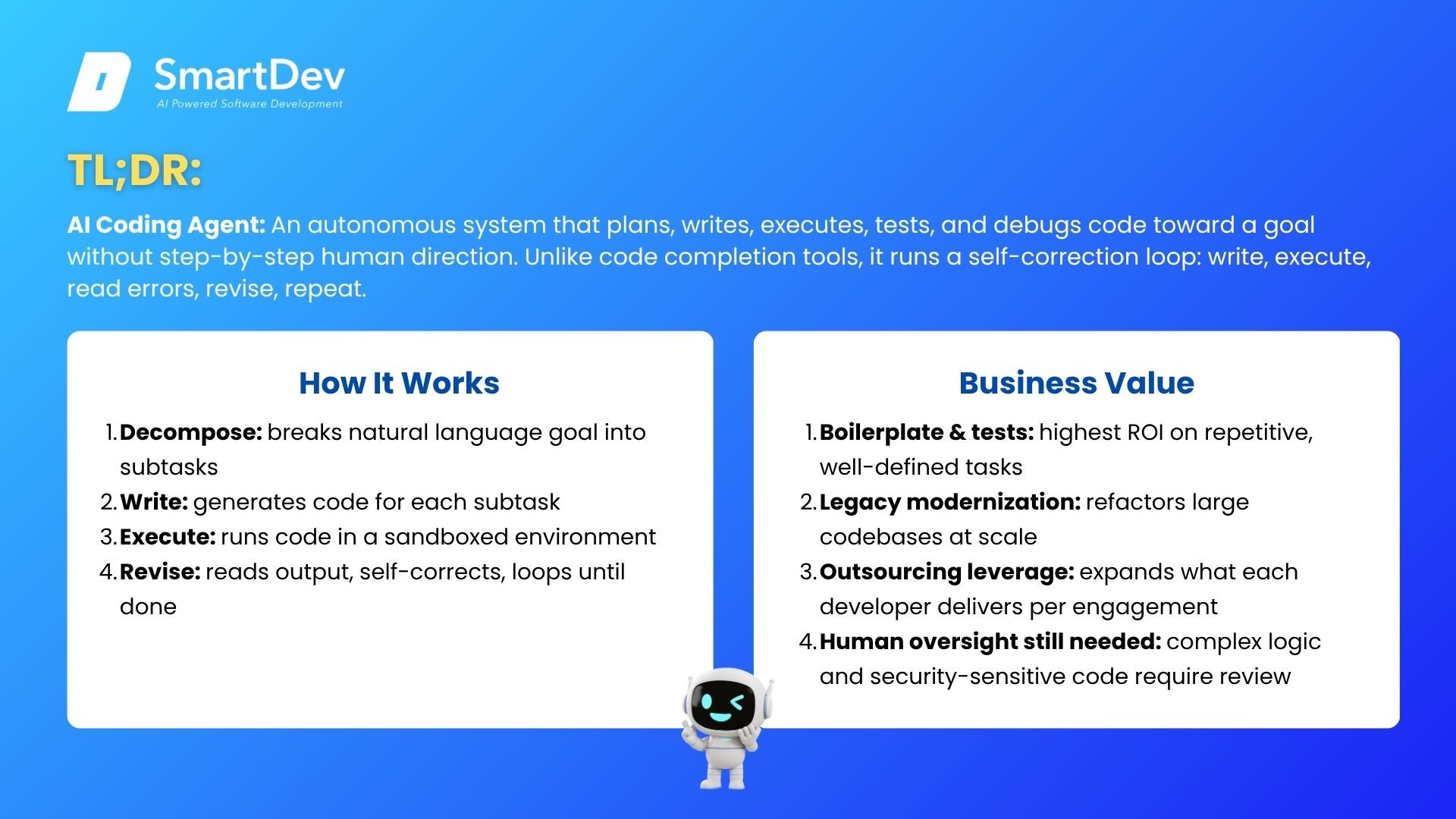
- An AI coding agent is an autonomous system that writes, executes, tests, and debugs code without requiring step-by-step human direction.
- Unlike simple code completion tools, coding agents handle entire features, coordinate across files, and self-correct errors in a continuous loop.
- Enterprise adoption is accelerating rapidly, with the market estimated at nearly $10 billion as of 2026, reshaping both in-house development and IT outsourcing models.
Software development is being redefined by a new category of tool: the AI coding agent. Where earlier AI tools offered suggestions and completions, coding agents execute, test, and iterate autonomously. For business leaders evaluating their development strategy, understanding what these agents can and cannot do is now a strategic necessity rather than a technical curiosity left to engineering teams alone.
What is an AI Coding Agent?
An AI coding agent is an autonomous software system that plans, writes, executes, and revises code to accomplish a development goal. The defining characteristic is autonomy. A traditional coding assistant waits for a developer to accept or reject each suggestion before any action is taken. A coding agent receives a high-level objective, breaks it into steps, writes the necessary code, runs it, reads the result, and iterates without requiring a human to direct each individual action along the way.
At its core, every AI coding agent runs on a large language model (LLM) that handles reasoning, planning, and code generation. What makes it an agent rather than a chatbot is the scaffolding built around that model: tool access, the ability to execute code, observe results, and loop back to refine its approach based on what it observes.
Practical capabilities include generating new code across multiple files, debugging existing code by reading error messages and applying targeted fixes, writing and running test suites, refactoring for performance or readability, and navigating large codebases to understand how components interact. Leading enterprise tools in 2026 include Claude Code, GitHub Copilot’s agentic modes, Cursor, IBM watsonx Code Assistant, and Devin, among others. Claude Code ranked as the most widely used tool in developer surveys, cited by 46% of respondents.
なぜ企業にとって重要なのか
AI coding agents have moved from developer experiment to enterprise infrastructure in a short period. The market for enterprise AI coding agents is estimated at roughly $10 billion annually as of April 2026, and Gartner recognized multiple vendors as Leaders in enterprise coding in its 2026 report, reflecting how quickly this category has matured beyond early adopters.
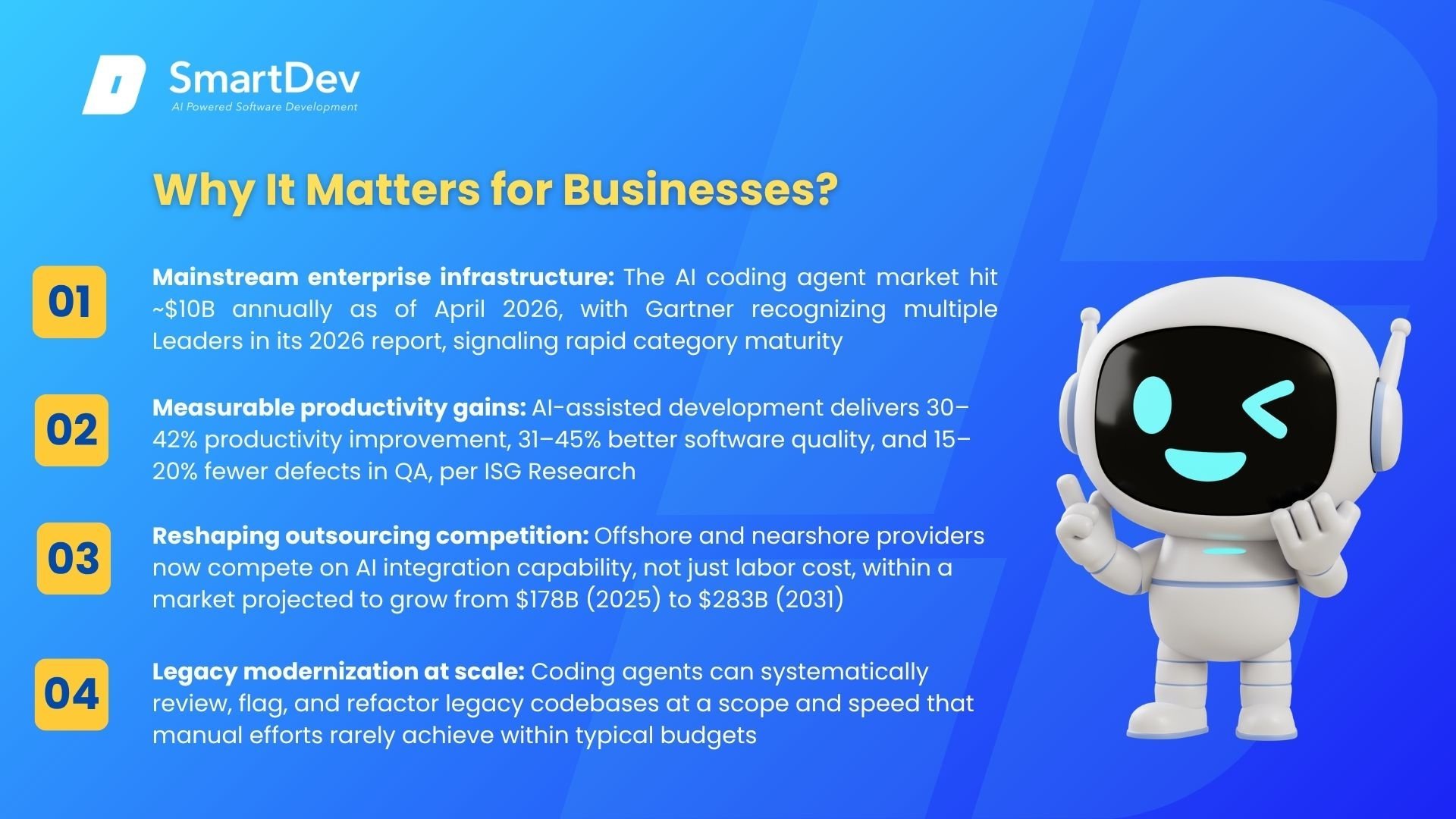
For business leaders, the value proposition is direct: faster software delivery, lower development costs, and the ability to maintain more code with the same headcount. ISG Research estimates that AI-assisted development delivers productivity gains of 30 to 42%, with significant time savings in both coding and testing phases. Teams using coding agents report 31 to 45% improvements in overall software quality and a 15 to 20% reduction in non-productive defects within QA practices.
The implications for IT outsourcing are substantial. Offshore and nearshore development providers now compete not just on labor cost but on how effectively they integrate AI coding agents into client workflows. The global offshore software development market reached $178 billion in 2025 and is projected to reach $283 billion by 2031, partly because AI tools increase the value of skilled outsourced teams by expanding what each developer can deliver per engagement.
For organizations burdened with legacy systems, coding agents offer a compelling modernization path. Agents can systematically review existing codebases, identify outdated patterns, propose upgrades, and execute changes at a scale that manual refactoring rarely achieves within typical project budgets and timelines.
How AI Coding Agents Work
The operating loop of an AI coding agent follows a consistent pattern that distinguishes it from all earlier categories of developer tooling. It begins with goal decomposition: the agent receives a task description in natural language and breaks it into smaller, executable subtasks. It then writes code for each subtask, executes it within a sandboxed environment, and analyzes the output.
If execution produces errors, the agent reads the error message, reasons through the likely cause, and revises the code accordingly. This self-correction loop continues until the agent either completes the task successfully or reaches a defined stopping condition. The loop is what separates a coding agent from a code completion tool, which stops at generation and leaves all execution and verification to the developer.
Agents also rely on tool access to interact with their environment. This includes reading and writing files across an entire codebase, running terminal commands, calling external APIs, querying documentation, and in some configurations, interacting with deployment pipelines. The combination of LLM reasoning with tool execution and environmental feedback creates a system capable of handling tasks that previously required sustained, skilled human attention over extended periods.
Context management is a critical architectural consideration for enterprise deployments. Coding agents working on large projects must maintain awareness of how different files and components relate to each other. The most capable enterprise-grade tools handle this through hierarchical context management, keeping the most relevant code in active focus while retaining broader project structure awareness across long-running sessions.
How Much Can AI Coding Agents Improve Productivity?
The productivity numbers are compelling but carry important nuance that business decision-makers should understand before setting expectations with stakeholders. Enterprise teams report 30 to 42% productivity gains on average. However, actual improvement varies significantly based on the type of work, the maturity of the codebase, and how effectively teams integrate agents into their existing workflows and governance structures.
Coding agents deliver the highest returns on well-defined, repetitive tasks: generating boilerplate, writing test cases, documenting existing code, and applying consistent refactoring patterns at scale. For novel architectural decisions, complex business logic, or security-sensitive code, human oversight remains not just advisable but essential for managing risk appropriately.
A 2026 enterprise survey found that one third of respondents cited quality as their primary concern when adopting coding agents, encompassing accuracy, consistency, and adherence to business logic. Code that looks syntactically correct can still contain logical errors that only become apparent in production, and organizations that deploy agents without sufficient review gates have found that short-term speed gains are offset by quality and security issues discovered later.
The strategic recommendation for business leaders is to treat coding agents as force multipliers for skilled development teams rather than replacements for human judgment. Organizations that integrate agents into structured workflows with appropriate review and approval steps consistently see the strongest productivity outcomes. Those that deploy agents without governance frameworks tend to encounter quality and compliance challenges that erode the initial efficiency gains.
その他の関連用語
Autonomous Coding: A software development approach in which an AI system independently plans, writes, and validates code without requiring step-by-step human direction. Autonomous Coding is the methodology that AI Coding Agents put into practice. Where the coding agent is the tool, autonomous coding describes the mode of working it enables, specifically the shift from human-directed completion to goal-directed, self-correcting execution.
Agentic Engineering: The discipline of designing, building, and governing AI systems that can plan and act across multi-step workflows with meaningful autonomy. AI Coding Agents are one of the most mature applications of agentic engineering principles. The architectural patterns described for coding agents, including goal decomposition, tool access, and iterative self-correction, are core concepts within the broader agentic engineering framework.
AI-assisted Engineering: A development practice in which AI tools support engineers by handling specific tasks such as code generation, review, and documentation while the human developer retains overall direction and judgment. AI-assisted Engineering is the broader category that AI Coding Agents sit within, at its most autonomous end. Understanding the spectrum from AI assistance to full agent autonomy helps teams decide which level of AI involvement suits a given task.