TL;DR:
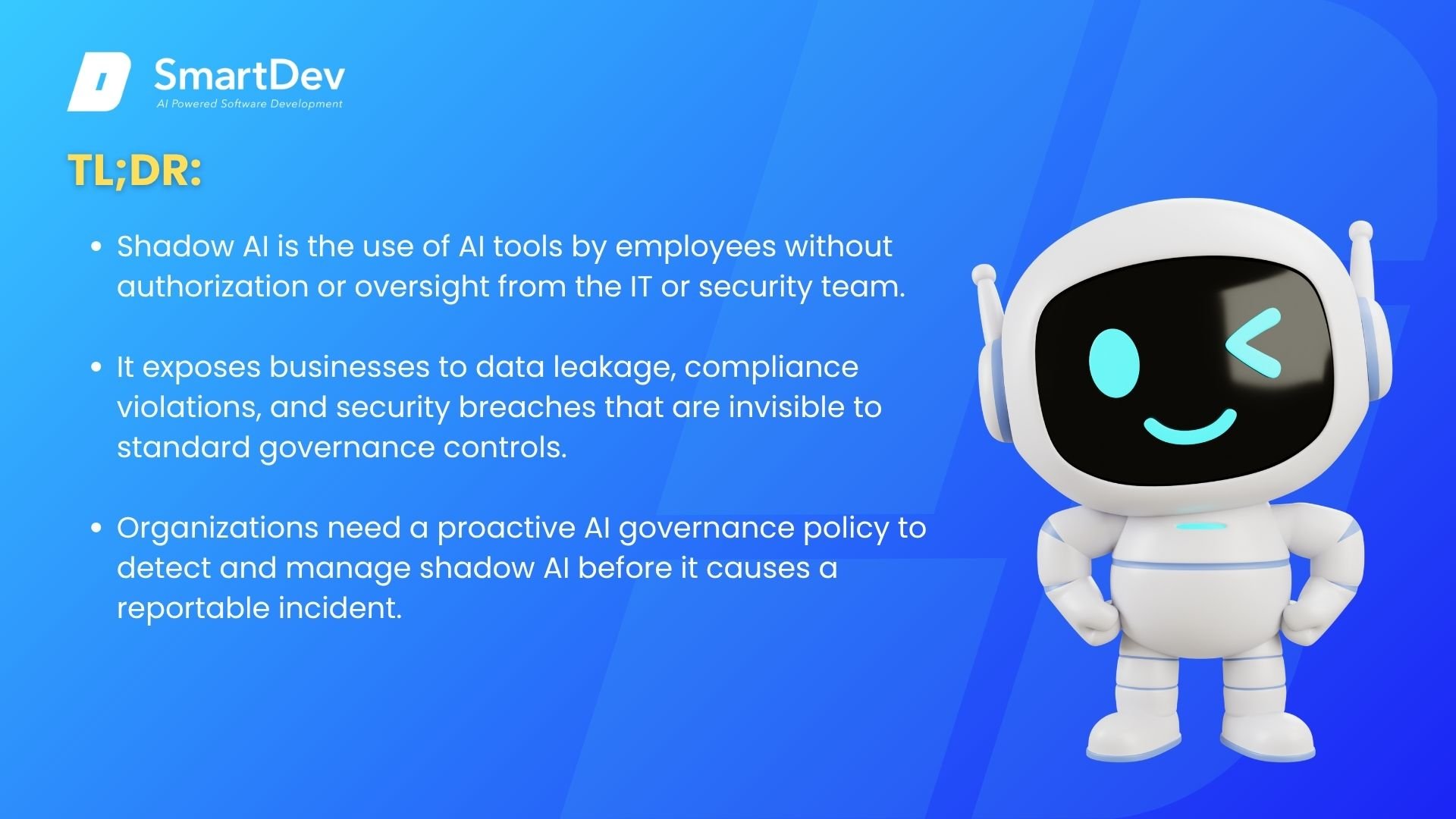
- Shadow AI is the use of AI tools by employees without authorization or oversight from the IT or security team.
- It exposes businesses to data leakage, compliance violations, and security breaches that are invisible to standard governance controls.
- Organizations need a proactive AI governance policy to detect and manage shadow AI before it causes a reportable incident.
 Shadow AI is one of the fastest-growing and least visible risks in enterprise technology today. As AI tools become free, powerful, and instantly accessible, employees across every department are adopting them without waiting for IT approval. The result is a sprawling ecosystem of unauthorized AI usage operating outside your security perimeter, outside your compliance controls, and outside your awareness. For business leaders, shadow AI is not a hypothetical future problem. It is happening inside your organization right now.
What is Shadow AI?
 Shadow AI is the use of artificial intelligence tools, platforms, or services by employees within an organization without the knowledge, approval, or oversight of the IT or information security department.
The term builds on the older concept of shadow IT, which referred to employees adopting unauthorized software applications. Shadow AI is a more serious evolution of that problem because AI tools do not simply store or transmit your data. They process it, generate outputs from it, and in some cases retain it within training datasets or model memories that are entirely outside your control. An employee who pastes a confidential client proposal into a free AI writing assistant has potentially exposed sensitive business information to a third-party platform with no contractual obligations to your organization.
Shadow AI takes multiple forms. Consumer-grade AI chatbots used for work tasks represent the most common category. Unauthorized AI browser extensions that process page content, AI-powered productivity tools installed without IT review, and AI features embedded in approved software that were never formally evaluated all contribute to the shadow AI surface area. According to Gartner, more than 40% of enterprises are expected to experience a security or compliance incident linked to unauthorized AI use by 2030, with many incidents already occurring unreported today.
なぜ企業にとって重要なのか
Shadow AI is not just an IT problem. It is a board-level risk. Data breaches, regulatory violations, and reputational incidents triggered by unauthorized AI use carry the same consequences as any other security failure, without the excuse of a sophisticated external attack. The breach often originates with a well-intentioned employee trying to work more efficiently.
- Reduce data breach exposure by ensuring sensitive business, customer, and employee data is not being processed by unauthorized AI platforms with unknown data retention and sharing practices.
- Protect regulatory compliance by maintaining visibility into how AI tools interact with data covered by GDPR, HIPAA, industry regulations, and contractual data handling obligations.
- Improve security posture by eliminating AI-generated code, AI-suggested configurations, and AI-produced content that entered production systems without security review.
- Accelerate safe AI adoption by channeling employee demand for AI tools into approved, governed alternatives rather than pushing that demand underground where it becomes unmanageable.
For example, a professional services firm discovered during an internal audit that fifteen employees across three departments had been using a free AI summarization tool to process client meeting transcripts for six months. The tool’s terms of service permitted the provider to use submitted content for model improvement. The firm faced a potential breach of client confidentiality obligations, required outside counsel to assess liability, and had to disclose the situation to several clients. The incident cost significantly more in legal fees and client management than a proper AI procurement process would have.
How Does Shadow AI Spread in Organizations?
- Employees discover free AI tools independently. Consumer AI tools are broadly marketed, require no installation approval, and deliver immediate productivity benefits. Employees adopt them without considering the data implications.
- Usage expands informally through peer recommendation. Once one team member finds a useful AI tool, they share it with colleagues. Adoption spreads horizontally across departments through messaging apps and informal channels before IT is aware.
- Sensitive data enters the tools naturally. As employees become comfortable with an AI tool, the scope of what they share with it expands. Initial use of generic tasks gives way to processing confidential documents, client data, and proprietary business information.
- No visibility exists in standard security monitoring. Because the tools are accessed through browsers as personal or consumer services, standard data loss prevention and security monitoring tools typically do not capture the data being transferred.
- An incident or audit reveals the extent of usage. Discovery typically occurs during a compliance audit, a data breach investigation, or a regulatory review, at which point the scope and duration of shadow AI usage creates a significantly more complex remediation challenge.
The result is an AI risk that grows quietly in proportion to your workforce’s enthusiasm for productivity improvement, which in most organizations is considerable.
When to Address Shadow AI?
Shadow AI governance cannot wait for an incident to trigger action. The right time to address it is before unauthorized usage becomes embedded in daily workflows:
- When your organization begins any formal AI adoption program, simultaneously audit for existing unauthorized AI usage to establish a realistic baseline.
- When new categories of powerful, free AI tools enter the market, update your governance policy and communicate approved alternatives to employees before adoption occurs organically.
- When your compliance or data protection obligations tighten, review whether shadow AI exposure creates new gaps in your regulatory posture that require immediate remediation.
- When employee onboarding or change management programs run, include explicit guidance on approved AI tools, prohibited behaviors, and the rationale behind the policy to build a culture of responsible AI use rather than one of avoidance and secrecy.
Effective shadow AI governance is not about restricting AI use. It is about channeling the energy employees are already bringing to AI into tools and practices that are safe, approved, and beneficial to the organization.
その他の関連用語
- AI Governance: The organizational framework of policies, controls, and oversight processes that defines how AI tools may be adopted, used, and monitored within an enterprise, and the primary mechanism for preventing and managing shadow AI.
- De-skilling Risk: A secondary effect linked to shadow AI, where ungoverned AI tool use in development and knowledge work accelerates skill erosion without the oversight needed to manage its organizational impact.
- Data Leakage: The unintentional exposure of confidential information including customer records, intellectual property, financial data, or trade secrets to unauthorized parties.