
Vietnam stands at a pivotal moment in its digital transformation journey. With nearly 170,000 enterprises now adopting artificial intelligence and an AI market projected to reach $1.52 billion by 2030, Vietnamese companies face an unprecedented opportunity and an equally significant risk. While the enthusiasm for AI adoption is undeniable, the critical challenge lies not in whether to pursue AI, but in how to do it successfully.
Recent data reveals a telling paradox: Vietnam’s AI adoption rate has surged 39% year-over-year, with approximately 47,000 new companies implementing AI solutions in 2024 alone. However, rapid growth masks a deeper reality. Many Vietnamese enterprises are jumping into AI projects without adequate preparation, leading to failed implementations, wasted resources, and missed opportunities. The Vietnam AI Annual Report 2025 confirms that while 61% of companies implementing AI report revenue increases averaging 16%, an equal number struggle with execution, integration, and sustainability challenges.
This is where enterprise AI readiness assessment becomes essential. Before investing significant capital and resources into AI initiatives, Vietnamese organizations must conduct a comprehensive AI readiness assessment Vietnam to evaluate their current capabilities, identify critical gaps, and develop a realistic implementation pathway. An enterprise AI checklist isn’t simply a nice-to-have; it’s a strategic necessity that separates successful AI implementations from costly failures.
This article provides Vietnamese enterprises with a practical, actionable 10-point enterprise AI checklist that serves as both a diagnostic tool and a strategic roadmap. Whether you’re a manufacturing firm exploring automation, a financial services organization considering predictive analytics, or a retail company implementing personalized recommendations, this assessment will help you understand where you stand today and chart your course toward successful AI adoption.
10-point enterprise AI checklist that serves as both a diagnostic tool and a strategic roadmap
The Current Landscape of AI Readiness in Vietnam
The Vietnam AI Adoption Boom
Vietnam’s journey toward becoming an AI-ready nation is remarkable by regional standards. The Vietnamese government’s National Strategy on Research, Development and Application of Artificial Intelligence to 2030 has created a supportive policy environment that encourages both AI development and adoption. Government initiatives, combined with substantial infrastructure investments from Vietnamese tech giants like Viettel, FPT, CMC, SmartDev and Vingroup, have created unprecedented momentum.
However, understanding the true state of Vietnam AI adoption requires looking beyond headline statistics. Yes, nearly 170,000 enterprises have adopted AI. Yes, AI talent demand is growing at 30% annually. And yes, Vietnamese companies are experiencing measurable productivity gains. But the depth of adoption remains uneven, and in many cases, it is superficial.
Many Vietnamese enterprises are in the early experimentation phase-testing chatbots, exploring robotic process automation, or piloting recommendation engines-without the foundational infrastructure, data governance, skills, and strategic alignment needed to scale AI beyond proof-of-concept. This is why conducting a thorough AI readiness assessment Vietnam before launching full-scale AI projects is so critical.
The Vietnam AI Forum 2025 revealed that organizations are prioritizing short-term gains over long-term capability building. While 25% of ASEAN organizations are identifying business use cases for pilots, only 13% are genuinely investing in data governance and compliance, the unglamorous but essential foundations of sustainable AI.
The Vietnam-Specific Context for AI Project Preparation
Vietnamese enterprises must consider several market-specific factors when assessing AI project preparation readiness:
- Regulatory and compliance landscape: Vietnam is rapidly developing AI governance frameworks, but regulations remain less mature than in developed markets. Organizations must understand evolving requirements around data privacy, algorithmic accountability, and sector-specific compliance (particularly in finance, healthcare, and critical infrastructure).
- Talent market dynamics: Vietnam’s AI talent pool is growing but concentrated in major tech hubs like Hanoi, Ho Chi Minh City, and a few emerging tech centers. This geographic concentration means many enterprises must either relocate talent, establish satellite offices, or rely on contractors.
- Infrastructure availability: While Vietnam is building world-class AI infrastructure through data centers and 5G networks, availability and costs vary significantly by region. Organizations outside major metros may face higher infrastructure costs or latency challenges.
- Integration with legacy systems: Many Vietnamese enterprises, particularly in manufacturing, retail, and public services, operate with substantial legacy IT infrastructure. AI implementation often requires significant integration of work and business process re-engineering specific to these legacy environments.
- Market competition and differentiation: As more Vietnamese enterprises adopt AI, early movers gain competitive advantage. However, true differentiation comes not from AI adoption itself, but from how effectively AI is integrated into business operations and customer value delivery.
The 10-Point Enterprise AI Checklist: A Comprehensive Assessment Framework
This comprehensive enterprise AI checklist covers the critical dimensions that determine AI project success. Each section includes specific assessment criteria, scoring guidance, and actionable next steps.
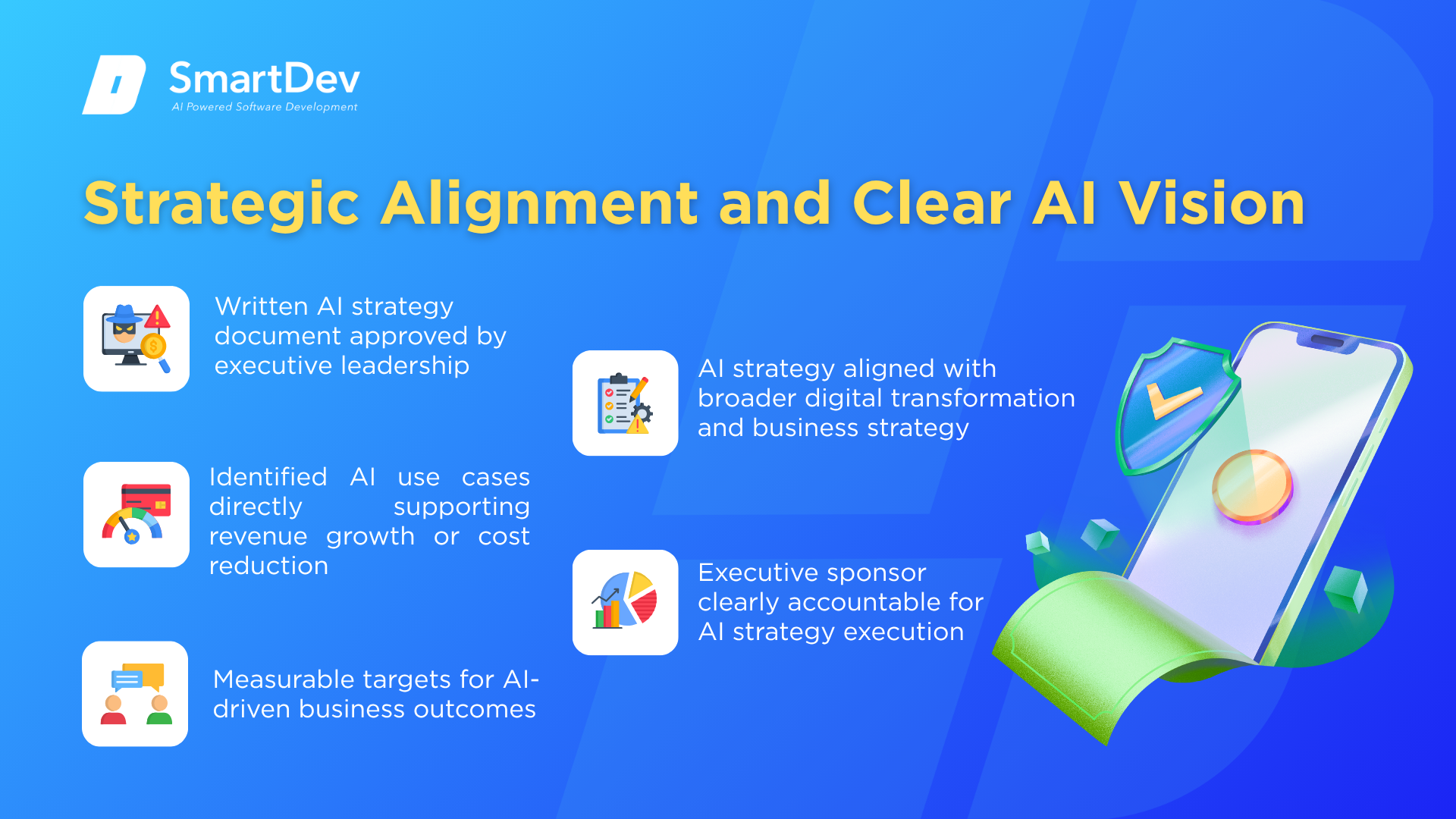
1. Strategic Alignment and Clear AI Vision
Assessment Focus: Does your organization have a clearly defined AI strategy aligned with business objectives?
Before launching any AI implementation planning initiative, your organization must establish a compelling, measurable vision for how AI will create value. Too many Vietnamese enterprises approach AI as a technology initiative rather than a strategic business transformation. This fundamental misalignment doom projects to underperformance regardless of technical execution.
Start by answering these critical questions: What specific business problems will AI solve? Which processes will AI improve? What measurable outcomes do you expect? How does AI contribute to your competitive strategy? Can you articulate the AI vision in language that resonates with employees, customers, and stakeholders?
Vietnamese companies like Viettel, FPT and SmartDev have succeeded partly because they’ve articulated clear AI strategies aligned with specific business outcomes-infrastructure optimization, predictive maintenance, customer personalization rather than pursuing AI for its own sake.
Evaluation Criteria:
- Clear, written AI strategy document approved by executive leadership
- Identified AI use cases directly supporting revenue growth or cost reduction
- Specific, measurable targets for AI-driven business outcomes (e.g., “reduce customer acquisition cost by 12% through AI-powered recommendation engine”)
- AI strategy aligned with broader digital transformation and business strategy
- Executive sponsor clearly accountable for AI strategy execution
For Vietnamese Enterprises: Consider how AI adoption aligns with Vietnam’s digital economy goals (reaching 30% of GDP by 2030) and your sector’s digitalization priorities. Are there government initiatives or incentives relevant to your industry? Understanding this broader context strengthens internal alignment.
Scoring: Rate 1-5 based on clarity, alignment, and leadership commitment. Advance to next stages only if score exceeds 3.
2. Executive Leadership and Governance Structure
Assessment Focus: Does your organization have leadership alignment, accountability, and governance structures needed for AI success?
Strategic alignment means nothing without executive commitment backed by governance structures. Many Vietnamese AI initiatives fail because they lack clear executive sponsorship, decision-making authority, and accountability for results.
Your organization needs a dedicated executive (typically Chief Digital Officer, Chief Analytics Officer, or Chief Technology Officer) with direct board access, adequate budget authority, and cross-functional influence. This person must champion AI initiatives, remove organizational obstacles, align departments around shared goals, and ensure AI projects deliver measurable business value.
Equally important is establishing governance structures-AI steering committees, project review boards, ethical review processes-that ensure projects stay aligned with strategy, maintain quality standards, and adhere to ethical and regulatory requirements.
Evaluation Criteria:
- Dedicated C-suite executive with clear accountability for AI success
- AI steering committee including representatives from technology, business units, legal, compliance, and ethics
- Defined decision-making authority and escalation procedures
- Board-level oversight and reporting of AI initiatives and results
- Clear roles and responsibilities for AI investments, implementation, and risk management
- Quarterly executive reviews of AI strategy execution and business impact
For Vietnamese Enterprises: Many Vietnamese family-owned enterprises and state-owned enterprises have governance structures that may need adaptation for effective AI governance. Consider whether your current decision-making model can support the cross-functional collaboration required for enterprise AI transformation.
Scoring: Rate 1-5 based on executive commitment level, governance maturity, and clarity of accountability.

3. Data Quality and Accessibility Assessment
Assessment Focus: Do you have high-quality, accessible data in the volume and formats needed for AI projects?
This dimension consistently emerges as the primary obstacle in Vietnamese AI implementation planning. Organizations cannot build effective AI models without sufficient volumes of quality data in appropriate formats. Data quality-completeness, accuracy, timeliness, consistency, and relevance-directly determines AI model performance.
Your assessment should evaluate data across multiple dimensions: data inventory (what data do you have, where is it stored), data quality (accuracy, completeness, consistency), data governance (policies, ownership, documentation), data accessibility (can teams easily access needed data), and data security (appropriate protections and compliance).
Start by mapping your data assets. Most Vietnamese enterprises discover that their data is fragmented across multiple legacy systems, spreadsheets, and databases with limited integration. Additionally, data often lacks proper documentation, governance, or security controls.
Evaluation Criteria:
- Comprehensive data inventory: documented sources, volumes, update frequencies, and business context
- Data quality assessment completed: identified data quality gaps and remediation priorities
- Data governance framework established: policies, ownership, usage rights, compliance requirements
- Data integration and accessibility: clear pathways for business users and data scientists to access needed data
- Data security and privacy controls: appropriate protection for sensitive information, compliance with regulations
- Data pipelines and automation: processes to ensure data quality maintenance and timely availability
For Vietnamese Enterprises: Vietnam’s rapidly developing data privacy regulations and the Vietnamese government’s emphasis on data sovereignty mean you should assess compliance requirements carefully. Consider what data remains within Vietnam vs. what might require cloud infrastructure hosted domestically.
Scoring: Rate 1-5 based on data quality, accessibility, and governance maturity. Many Vietnamese enterprises rate 2-3 on this dimension, revealing the most critical development area.

4. Technology Infrastructure and Scalability
Assessment Focus: Does your technology infrastructure support enterprise-scale AI applications?
AI projects require significant computing resources, particularly model training and deployment at scale. Your infrastructure assessment should evaluate cloud capabilities, on-premises computing, data storage, and security infrastructure.
For Vietnamese enterprises, this assessment is particularly important given the evolving data center landscape. Vietnam is rapidly developing domestic AI infrastructure through state-owned enterprises and private investments. Understanding what infrastructure is available locally, what must be accessed regionally or globally, and how to manage data residency requirements is essential.
Evaluation Criteria:
- Cloud infrastructure capabilities: access to scalable computing, storage, and AI/ML services
- On-premises infrastructure: capacity, modernization level, integration with cloud platforms
- AI/ML platform availability: access to TensorFlow, PyTorch, enterprise ML platforms
- Data storage and processing: modern data warehouse, data lake, or similar enterprise data platforms
- API management and integration: ability to integrate AI models into business applications
- Security infrastructure: encryption, access controls, monitoring, and compliance capabilities
- High availability and disaster recovery: redundancy and business continuity planning
- Total cost of ownership assessment: understanding infrastructure costs at scale
For Vietnamese Enterprises: Vietnam’s expanding AI data center network-including projects by Viettel, FPT, CMC, and joint ventures with Microsoft-means Vietnamese organizations increasingly have local infrastructure options. Evaluate what domestic capacity is available for vs. requirements for regional or global infrastructure.
Scoring: Rate 1-5 based on infrastructure capability, scalability, and cost-effectiveness.

Ready to ensure your AI project succeeds from day one?
Discover the essential readiness factors every Vietnamese enterprise must evaluate: strategy, data, talent, infrastructure, and governance before committing serious investment.
Review all 10 pillars side-by-side, uncover hidden capability gaps, and build a roadmap that sets your AI initiatives up for measurable impact.
Explore the Readiness Checklist5. Talent and Skills Assessment
Assessment Focus: Do you have access to the data science, engineering, and domain expertise required for AI success?
Vietnam’s AI talent shortage is real but not insurmountable. The question is whether your organization can access or develop the expertise needed for your specific AI initiatives.
Start by identifying what roles you need: data scientists (who build models), machine learning engineers (who deploy and maintain models), data engineers (who build data pipelines), AI/ML architects (who design solutions), domain experts (who understand business processes), and change management specialists. Then assess gaps between current capabilities and requirements.
Many Vietnamese enterprises cannot find these roles locally and must consider combinations of offshore resources, nearshore resources, contractor relationships, or internal development programs.
Evaluation Criteria:
- Comprehensive skills assessment: current capabilities vs. required capabilities for AI initiatives
- Data science and ML engineering talent: dedicated team members or access to contractors
- Data engineering and infrastructure expertise: ability to build and maintain data infrastructure
- Domain expertise: business stakeholders who understand processes, constraints, and value drivers
- AI literacy: broader organization’s understanding of AI capabilities and limitations
- Learning and development programs: structured programs to upskill existing employees
- Talent retention strategy: how to retain hard-to-find AI talent in competitive market
For Vietnamese Enterprises: Vietnam’s annual 30% growth in AI talent demand means competition for talented people is intense, particularly between enterprises and tech giants. Consider whether your compensation structure, career development opportunities, and organizational culture can attract and retain talent. Many Vietnamese companies are establishing regional centers in Hanoi or Ho Chi Minh City to improve talent access.
Scoring: Rate 1-5 based on talent availability, acquisition strategy, and retention capability.

6. Organizational Culture and Change Readiness
Assessment Focus: Is your organization’s culture and change management capability ready for the transformation AI requires?
This dimension separates successful AI implementations from failures more often than technology factors. AI requires organizations to make difficult decisions, embrace uncertainty, experiment with new processes, and fundamentally change how work gets done. Organizations resistant to change or lacking change management discipline frequently see AI initiatives fail despite good strategy and technology.
Assess your organization’s current change management capabilities, employee attitudes toward technology and transformation, leadership communication effectiveness, and organizational agility.
Evaluation Criteria:
- Change management discipline: proven capability to manage organizational change
- Employee readiness and attitude: openness to new technologies and processes
- Leadership communication: executive team’s ability to articulate vision and maintain momentum
- Organizational agility: speed of decision-making, adaptation capability
- Cross-functional collaboration: ability to work across departments toward shared goals
- Risk tolerance: comfort with experimentation, learning from failures
- Incentive alignment: compensation and recognition systems supporting AI adoption
For Vietnamese Enterprises: Vietnamese organizational culture often emphasizes hierarchy and caution, which can slow AI adoption. Many traditional Vietnamese enterprises struggle with the cross-functional collaboration, rapid experimentation, and risk tolerance that AI requires. Assessing this dimension honestly is critical, and deliberately building change management capability is often as important as building technical capability.
Scoring: Rate 1-5 based on organizational readiness for change and transformation.

7. Process and Workflow Integration Capabilities
Assessment Focus: Can your organization effectively integrate AI into existing processes and workflows?
AI creates value only when it’s integrated into actual business processes and workflows. An excellent AI model sitting in a sandbox creates no value. Your assessment should identify which processes are candidates for AI enhancement, understand current workflow complexity, and evaluate your organization’s capability to redesign processes around AI capabilities.
Evaluation Criteria:
- Process mapping: clear documentation of processes that could be enhanced with AI
- Workflow automation readiness: process optimization and automation capability
- Business process re-engineering experience: organizational experience with fundamental process redesign
- Legacy system integration: capability to integrate AI with existing enterprise systems
- API and data integration: technical capability to connect AI solutions to business processes
- Change management for process change: capability to help teams adapt to redesigned workflows
- Performance measurement: capability to measure process improvement from AI implementation
For Vietnamese Enterprises: Many Vietnamese enterprises operate with significant manual processes and legacy systems. While this creates significant modernization needs, it also represents substantial opportunity for AI-driven improvement. However, the process of redesigning at this scale is organizationally challenging.
Scoring: Rate 1-5 based on process redesign capability and legacy system integration.

8. Cybersecurity and Compliance Framework
Assessment Focus: Do you have an adequate security and compliance framework to support responsible AI deployment?
AI projects create unique security and compliance challenges: AI models can be attacked or manipulated, training data contains sensitive information requiring protection, model outputs can discriminate or violate privacy, and AI systems may be subject to emerging regulatory requirements.
Your assessment should evaluate data security, model security, governance and compliance frameworks, and emerging AI-specific compliance requirements.
Evaluation Criteria:
- Data security: encryption, access controls, monitoring, and compliance with data protection requirements
- Privacy by design: data minimization, anonymization, and privacy-preserving techniques incorporated into AI design
- AI model security: protections against model poisoning, adversarial attacks, and unauthorized access
- Compliance framework: alignment with existing regulations (data privacy, sector-specific requirements)
- AI governance and ethics: frameworks for responsible AI, algorithmic accountability, bias detection
- Regulatory tracking: monitoring and adaptation to emerging AI-specific regulations
- Audit and compliance reporting: capability to demonstrate compliance and responsible AI practices
- Vendor and third-party management: security requirements for external partners and tools
For Vietnamese Enterprises: Vietnam’s evolving data privacy regulations and the government’s emphasis on data sovereignty mean Vietnamese enterprises must carefully consider where data is stored and processed. The regulatory landscape is still developing, so proactive governance is essential.
Scoring: Rate 1-5 based on security and compliance readiness.

9. Budget and Financial Planning
Assessment Focus: Have you realistically budgeted for AI implementation and planned for ROI realization?
AI projects require sustained investment across multiple dimensions: technology infrastructure, talent, data preparation, implementation services, change management, and ongoing operations. Many Vietnamese enterprises underestimate these costs, leading to projects that stall due to budget constraints.
Your assessment should evaluate total cost of ownership (infrastructure, talent, services, operations), funding sources and sustainability, expected ROI timelines, and financial governance around AI investments.
Evaluation Criteria:
- Technology costs: infrastructure, tools, platforms, licenses
- Talent costs: hiring, contractors, training, retention
- Implementation costs: consulting, integration services, change management
- Data preparation and governance: costs to organize, integrate, and govern data assets
- Ongoing operational costs: model maintenance, retraining, monitoring, updates
- ROI modeling: realistic expectations about when and how AI will generate value
- Financial governance: approval processes, progress monitoring, cost control
- Contingency planning: reserve budgets for unexpected challenges or opportunities
For Vietnamese Enterprises: Vietnamese enterprises should consider that AI talent costs in Vietnam are significantly lower than in developed markets, making offshore resource combinations financially attractive. Additionally, Vietnam’s improving data center infrastructure may offer cost advantages compared to relying entirely on international cloud services.
Scoring: Rate 1-5 based on budget adequacy, financial planning clarity, and realistic ROI expectations.

10. Vendor and Partnership Strategy
Assessment Focus: Have you developed a clear strategy for managing AI partnerships, selecting vendors, and balancing build vs. buy vs. partner decisions?
Most organizations cannot build all AI capabilities internally. You’ll need partnerships with cloud providers, AI platform vendors, implementation of consulting firms, and specialized solution providers. Managing these relationships effectively is critical to AI success.
Evaluation Criteria:
- Build vs. buy vs. partner strategy: clear decision framework for different types of capability
- Vendor selection criteria: defined requirements for partners, platforms, and solutions
- Vendor management approach: vendor evaluation, contracting, performance monitoring
- Data security with vendors: requirements for data protection and compliance
- Partnership roadmap: how partnerships will evolve as capabilities develop
- Integration planning: how vendor solutions will integrate with existing systems
- Exit strategy: what happens if vendor relationships don’t work or business needs change
- Local vs. global partners: strategy for when to use Vietnamese partners vs. international providers
For Vietnamese Enterprises: Vietnam’s emerging AI services ecosystem includes both Vietnamese companies with deep local knowledge and international firms with global expertise. Many Vietnamese enterprises benefit from partnerships with domestic firms while accessing specialized expertise from international partners. Understanding which types of partners to use for different requirements is strategically important.
Scoring: Rate 1-5 based on vendor strategy clarity and partnership management capability.
How to Score Your AI Readiness Assessment
Scoring Methodology
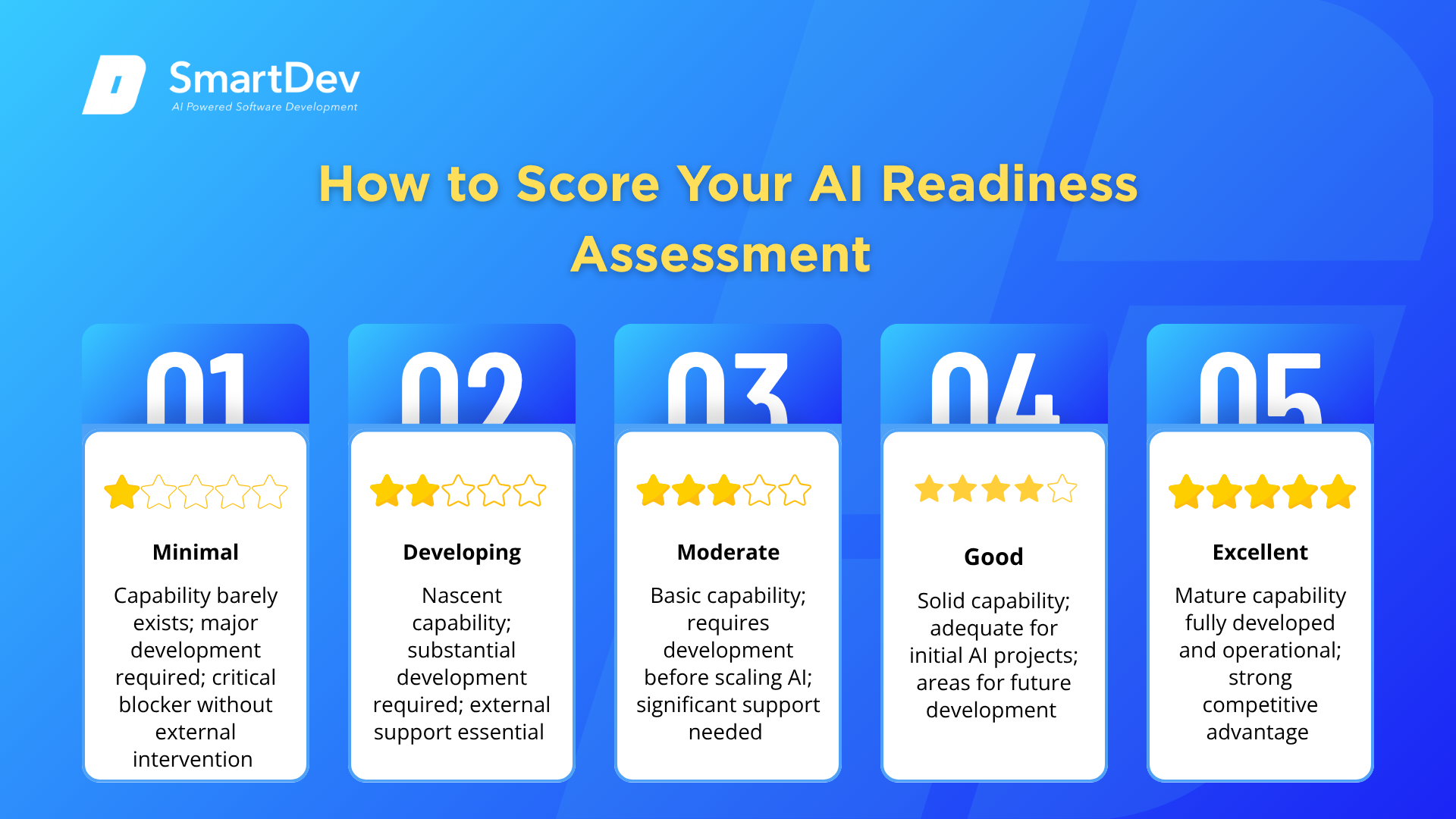
For each of the 10 assessment dimensions, score your organization on a 1-5 scale:
Score 5 (Excellent): Mature capability fully developed and operational; strong competitive advantage
Score 4 (Good): Solid capability; adequate for initial AI projects; areas for future development
Score 3 (Moderate): Basic capability; requires development before scaling AI; significant support needed
Score 2 (Developing): Nascent capability; substantial development required; external support essential
Score 1 (Minimal): Capability barely exists; major development required; critical blocker without external intervention
Interpreting Your Overall Score
Add your scores across all 10 dimensions to calculate your total AI readiness assessment Vietnam score (scale 10-50).
41-50: Highly AI-Ready
Your organization has strong foundations for AI success. You can proceed with ambitious AI initiatives, though you’ll have specific areas requiring attention. Your focus should be accelerating implementation and scaling successful pilots.
31-40: Moderately AI-Ready
You have sufficient foundations to begin AI implementation, but you must address several capability gaps before scaling. Develop a phased approach starting with lower-risk initiatives in your strongest areas, while building capability in weaker dimensions.
21-30: Developing AI Readiness
You have foundational elements but face significant capability gaps that will constrain AI success. Prioritize building capability in your weakest areas before launching major AI project preparation initiatives. Consider starting with very focused pilots to build confidence and capability.
10-20: Limited AI Readiness
Your organization faces substantial challenges in pursuing AI at scale. Significant foundational work is required. Consider beginning with capability building initiatives, external advisory support, or very focused pilots before committing to major AI programs.
Scoring Guidance for Vietnamese Enterprises
Vietnamese enterprises often show a distinctive scoring pattern: relatively strong on strategy and vision (reflecting the influence of Vietnamese business leadership and government policy), but weaker on data quality, infrastructure, and organizational change readiness. Use your scores to identify your specific strengths and gaps rather than comparing them to absolute benchmarks.
Building Your AI Implementation Roadmap
After completing your enterprise AI checklist assessment, translate results into an action-oriented roadmap that guides your AI implementation planning efforts. Not all capability gaps require immediate attention. Prioritize using this framework:
- Critical Path: Gaps that will block successful AI projects if not addressed (typically data quality, infrastructure, and governance)
- High Impact: Gaps that significantly affect AI project success and ROI (typically talent, organization readiness, and process integration)
- Supporting: Gaps that affect implementation efficiency but aren’t absolute blockers (certain vendor relationships, specific skills)
- Strategic: Gaps affecting long-term competitiveness and scaling (cultural transformation, strategic alignment)
Implementation Timeline
Most Vietnamese enterprises benefit from a phased approach:
Months 1-3 (Foundation Building): Address critical path items. If data quality is weak, invest in data assessment and cleanup. If governance is unclear, establish decision-making structures and accountability. This isn’t glamorous work, but it’s foundational.
Months 4-6 (Pilot Preparation): While continuing foundational work, launch focused pilots in areas where you have strength and clear business value. These pilots generate momentum, build confidence, and create learning opportunities.
Months 7-12 (Scale and Capability Building): Scale successful pilots, expand AI applications, and deliberately build organizational capability. Continue addressing gaps identified in your assessment.
Beyond Month 12 (Sustained Advancement): Shift focus to deepen AI integration, expanding use cases, and building distinctive competitive advantages through AI.
Next Steps: From Assessment to Action
Your AI readiness assessment Vietnam is complete. Here’s what to do next:
- Share results with stakeholders: Ensure leadership understands your readiness level, critical gaps, and implications for AI strategy.
- Develop detailed roadmaps for top priority gaps: For your 2-3 most critical gaps, create detailed 90-day plans with specific actions, owners, and milestones.
- Begin high-impact pilots: Even while addressing gaps, launch focused pilots that demonstrate AI value and build organizational capability.
- Establish ongoing assessment: Revisit your AI readiness assessment every 6-12 months to track progress and adjust priorities as needs evolve.
- Build internal and external support: Identify what internal resources you have and what external support (consulting, vendor partnerships, training) will accelerate progress.

Your Path to Successful AI Adoption
Vietnam’s AI opportunity is real and time sensitive. With nearly 170,000 enterprises now adopting AI, the competitive advantage belongs to organizations that adopt effectively, not necessarily those who adopt first. A thorough AI readiness assessment Vietnam followed by disciplined AI implementation planning ensures your enterprise joins the ranks of successful Vietnamese AI adopters rather than becoming another cautionary tale.
The 10-point enterprise AI checklist provided in this article represents distilled experience from successful AI implementations across sectors, adapted specifically for the Vietnamese business context. Your organization’s specific strengths and gaps will vary, but this framework ensures you’ve considered all critical dimensions that determine AI success.
Vietnamese enterprises have tremendous advantages: a supportive policy environment, rapidly developing AI infrastructure, growing AI talent availability, and strong digital adoption momentum. What separates winners from struggling organizations is not AI enthusiasm – its disciplined execution grounded in realistic assessment of capabilities and clear-eyed prioritization of capability building.
As you complete this AI readiness assessment Vietnam, remember that this is not a final judgment but a baseline. Your assessment reveals where you are today and the gaps you must address. More importantly, it provides a clear roadmap for building the organizational capabilities that will define your success in Vietnam’s rapidly evolving AI landscape.
The enterprises that will lead Vietnam’s AI adoption over the next 12-24 months are those starting their AI project preparation journey today with rigorous, honest assessment of their readiness. Begin with this checklist. Share it across your organization. Prioritize ruthlessly. Build methodically. And execute with discipline.
Your organization’s AI transformation isn’t a destination – it’s a journey that begins with an honest assessment of where you stand and clear commitment to building the capabilities required for success. This AI readiness assessment Vietnam checklist provides the starting point for that transformative journey. Contact us today!!