

TL;DR
- Adoption differs from maturity. A McKinsey survey of global organizations published in 2025 found that 78% use AI in at least one function — yet the same research identified only a small share of firms as mature deployers embedding AI across core processes with measurable outcomes.
- Pilot volume does not predict business value. Organizations running many concurrent AI pilots frequently report lower per-initiative value than those with fewer, better-governed deployments. Scale requires operating-model readiness, not just technical experimentation.
- Data and governance are the most common scaling blockers. Talent gaps, fragmented data infrastructure, and unclear accountability structures are the primary reasons AI initiatives stall at the pilot stage — not model quality.
- Value must be measured explicitly. Business, operational, risk, and adoption outcomes each require separate KPIs. Organizations that define these before deployment consistently outperform those that define them after.
- Governance is foundational, not optional. Responsible AI frameworks — covering accountability, fairness, security, and compliance — are prerequisites for enterprise-scale deployment, not post-deployment additions.
- Vietnam and Southeast Asia present a credible opportunity with real constraints. Regional digital infrastructure, youth demographics, and government policy are favorable. Talent depth, data readiness, and governance maturity are the near-term limiting factors.
- Agentic AI is changing enterprise planning horizons. Systems that can act autonomously across multi-step workflows represent a materially different operating-model consideration from previous AI tool integrations.
Introduction
Enterprise AI adoption has moved well past the early-majority phase. Most large organizations now use AI in at least one business function. The harder question — the one this benchmark addresses — is not whether AI is being used, but whether it is being used in ways that produce durable, measurable business value.
The gap between headline adoption rates and actual value realization is the central challenge of enterprise AI in 2026. Organizations report widespread experimentation, yet production deployments that consistently improve a defined business outcome remain a minority. Understanding why that gap exists, and what it takes to close it, requires a clearer vocabulary: adoption, maturity, production-scale deployment, and value realization are four distinct stages, not synonyms.
This article draws on named, dated industry research to benchmark where enterprises stand globally and in Southeast Asia, diagnose the barriers that prevent pilots from scaling, and offer a structured roadmap for moving from AI activity to AI capability. For organizations building or evaluating an AI strategy, the SmartDev AI adoption glossary provides supporting definitions for the core concepts referenced throughout.
A note on evidence: All statistics in this article identify their source, publication year, and population scope. Where the original primary report was available, it is cited directly. Forecasts are labeled as forecasts, not treated as current adoption evidence. No first-party SmartDev survey is cited in this article.
1. What Enterprise AI Adoption Looks Like in 2026
1.1 Defining adoption, maturity, and production-scale AI
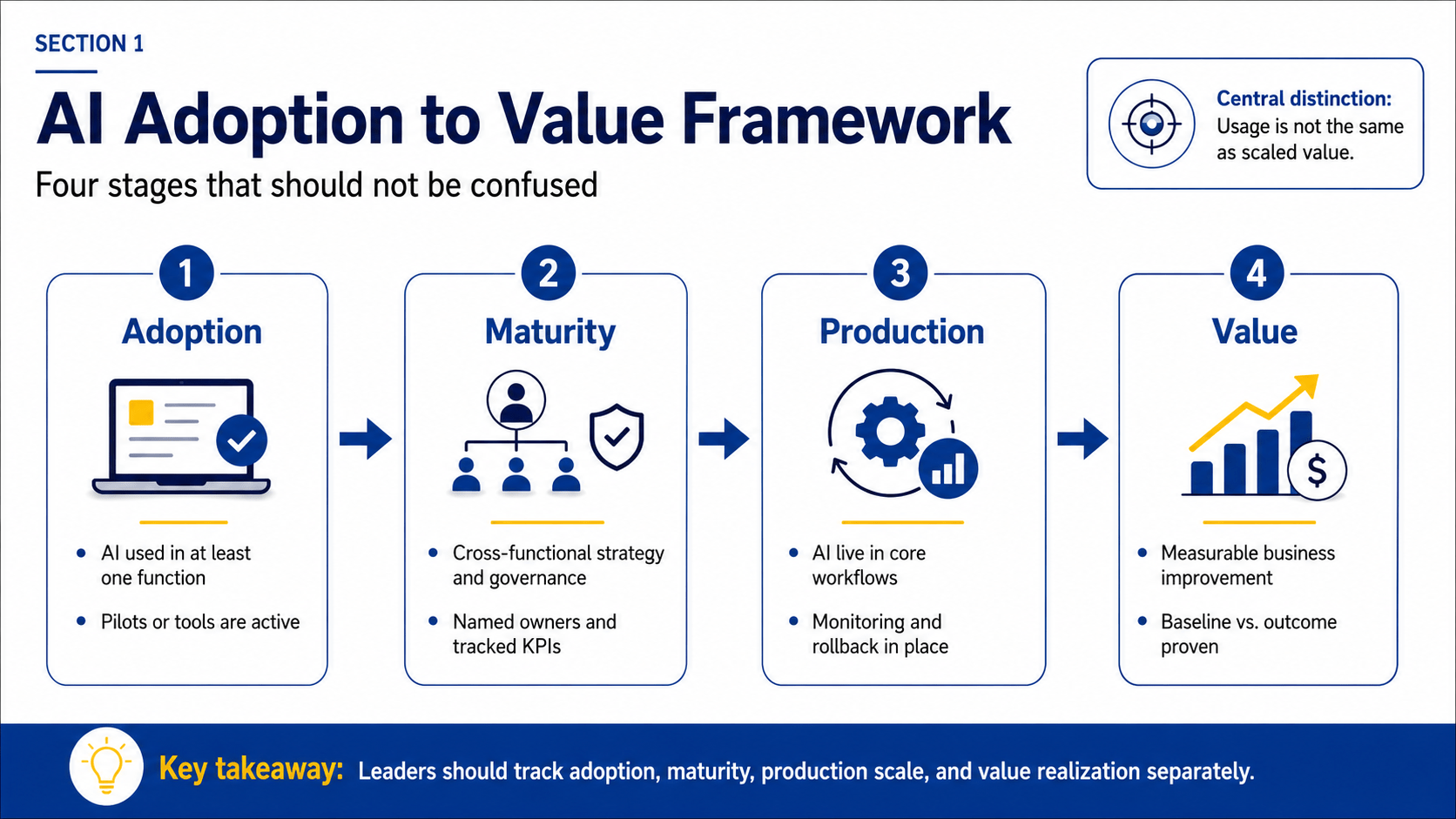
Enterprise AI adoption, maturity, production deployment, and value realization describe four different organizational conditions. Treating them as equivalent produces misleading conclusions about where an organization actually stands.
| Stage | Definition | Typical indicator |
|---|---|---|
| AI adoption | At least one AI tool or system is in active use within a business function | Employees use an AI-assisted tool; a pilot is running |
| AI maturity | AI is embedded across multiple functions with defined ownership, governance, and measurement | Cross-functional AI strategy; named accountable roles; outcome KPIs tracked |
| Production-scale deployment | A model or AI system is live in a business-critical workflow, handling real decisions at volume | Model in production; monitoring active; rollback plan exists |
| Value realization | A deployed model demonstrably improves the business outcome it was built to address | Baseline and post-deployment KPI comparison; business owner sign-off |
The distinction matters because an organization can score high on adoption (many tools in use) while scoring low on maturity (no governance, no measurement) and near-zero on value realization (no outcomes tracked). Most enterprise AI benchmarks measure adoption. Very few measure the other three stages. For a working definition of AI readiness — the organizational capability that bridges adoption and maturity — see SmartDev’s readiness glossary entry.
1.2 The global adoption baseline and why headline numbers can mislead
McKinsey’s 2025 State of AI report — which surveyed more than 1,000 participants across industries and geographies — found that 78% of respondents’ organizations use AI in at least one business function, up from 55% in 2023 (McKinsey & Company, State of AI 2025). The same report found that generative AI use in at least one function reached 71% of respondents.
These figures describe the breadth of AI activity. They do not describe deployment depth, governance quality, or business impact. The same McKinsey research identified that organizations capturing the most value from AI share a set of practices — cross-functional strategy, data infrastructure investment, talent development, governance discipline, and active outcome measurement — that remain uncommon at the enterprise population level.
Headline adoption rates are a starting point for benchmarking, not a conclusion. Any benchmark claim should disclose the source report, publication date, respondent population, geography, and measurement definition. Where those disclosures are absent, the number is not interpretable as evidence.
1.3 From experimentation to enterprise-wide value
Enterprise AI value does not follow automatically from AI use. The path from experimentation to value-generating capability requires four organizational transitions: from isolated pilots to governed deployments; from individual-function tools to cross-functional integration; from activity metrics (tools deployed, models built) to outcome metrics (decisions improved, costs reduced, revenue generated); and from ad-hoc ownership to defined accountability structures. Organizations that have completed these transitions consistently outperform those that have not, across industries and geographies.
1.4 How this benchmark is built: sources, definitions, and limitations
This article synthesizes findings from named, publicly available industry research — primarily McKinsey & Company’s annual State of AI survey, the Oxford Insights Government AI Readiness Index, Asia Society Policy Institute regional research, and relevant government policy documents. Each statistic in the article identifies its source and, where available, its population scope, geographic coverage, and measurement methodology.
This is an editorial benchmark, not a primary survey. SmartDev has not conducted an independent enterprise survey for this article. Where statistics appear without adequate source attribution in other articles on this topic, readers should treat them with caution.
Key takeaway: Adoption measures AI use. Maturity measures organizational readiness. Value realization measures business outcome. Leaders need all three metrics — not just the first.
2. Where Enterprises Are Deploying AI
2.1 Adoption across core business functions
AI deployment is not evenly distributed across enterprise functions. McKinsey’s 2025 research identifies IT, marketing and sales, and service operations as the three functions with the highest rates of AI adoption. Product and service development, supply chain management, and finance and risk functions follow. HR and legal functions report lower adoption rates, though both are seeing growth driven by generative AI tools.
Function-level adoption data, however, requires the same qualification as top-line numbers: a function that “uses AI” may mean one team member using an AI writing assistant, or it may mean a fully integrated predictive model processing thousands of decisions per day. The measurement definition determines what the number means.
2.2 High-priority use cases: automation, analytics, customer experience, and operations
| Use case category | Representative applications | Primary value pathway | Scale considerations |
|---|---|---|---|
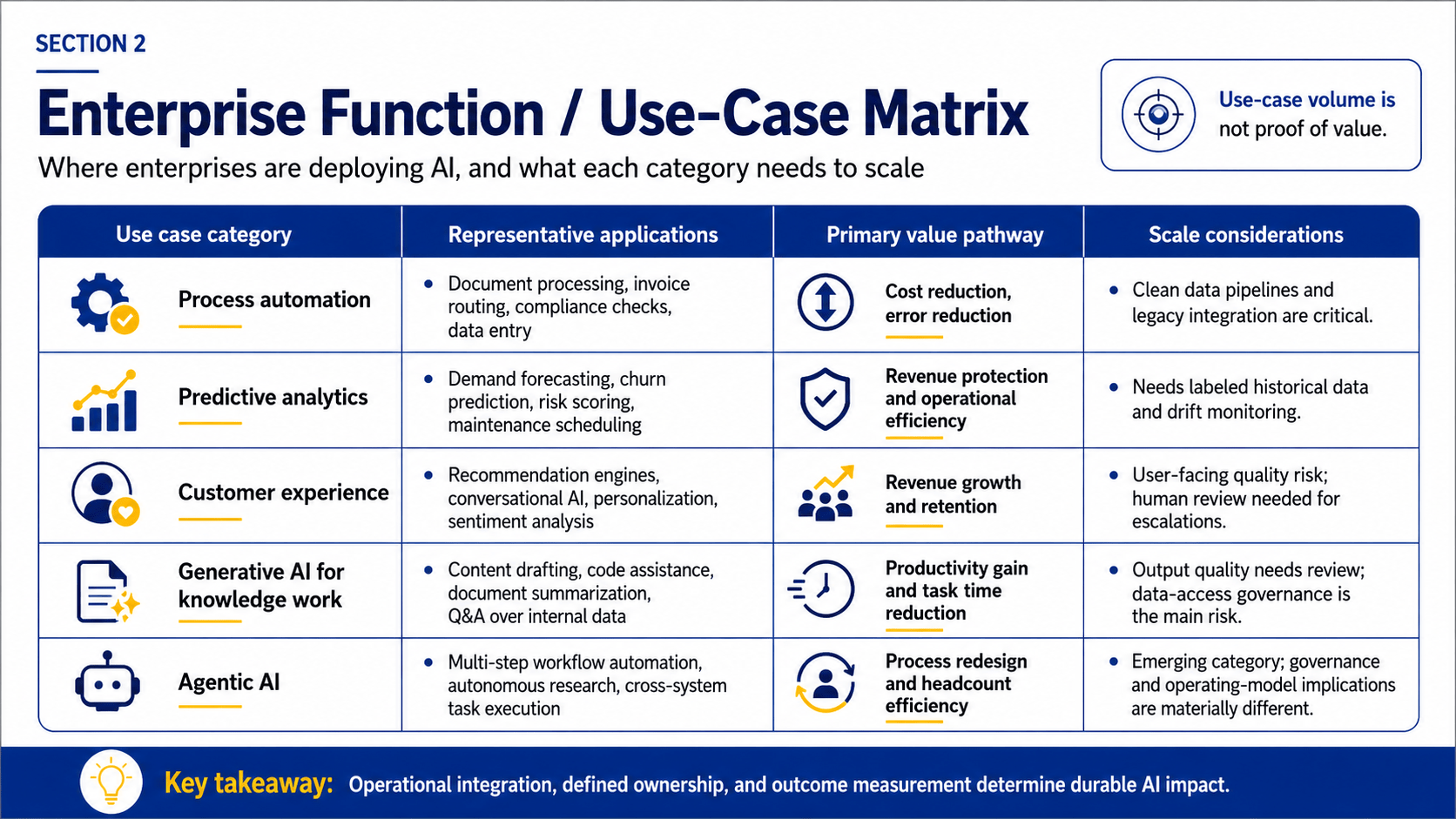
| Process automation | Document processing, invoice routing, compliance checks, data entry | Cost reduction, error rate reduction | Requires clean data pipelines; integration with legacy systems is the common blocker |
| Predictive analytics | Demand forecasting, churn prediction, risk scoring, maintenance scheduling | Revenue protection, operational efficiency | Requires labeled historical data; model drift monitoring is essential post-deployment |
| Customer experience | Recommendation engines, conversational AI, personalization, sentiment analysis | Revenue growth, retention improvement | High user-facing risk if model quality is low; human review paths required for complaints and escalations |
| Generative AI for knowledge work | Content drafting, code assistance, document summarization, Q&A over internal data | Productivity gain, task time reduction | Output quality requires human review; data access governance is the primary risk |
| Agentic AI | Multi-step workflow automation, autonomous research, cross-system task execution | Process redesign, headcount efficiency | Emerging category; operating-model implications are materially different from previous AI tools |
2.3 Generative AI and agentic AI: what is changing in enterprise deployment
Generative AI — systems that produce text, code, images, or structured data from natural-language prompts — has moved from experimentation to mainstream enterprise use faster than most preceding AI categories. Its deployment pattern differs from traditional ML: it requires less labeled training data, it can be integrated into existing workflows via API, and it is accessible to non-technical users. These properties lower the barrier to initial adoption and raise the risk of ungoverned use.
Agentic AI represents the next planning horizon. An agentic system does not just respond to a prompt — it executes a sequence of actions, uses tools, accesses data sources, and makes intermediate decisions to complete a multi-step goal. For enterprises, this is a qualitatively different operating-model consideration: agentic systems can take actions with downstream consequences, which means governance, human oversight, and rollback controls must be designed into the architecture from the start. For a practical introduction to what this means in practice, see SmartDev’s guide to how to create an AI agent.
The practical distinction: generative AI tools are integrated into human workflows. Agentic systems are designed to operate across workflows with reduced human intervention. The governance requirements are different in kind, not just degree.
2.4 Sector examples: retail, manufacturing, and public services
Sector deployment varies significantly by data availability, regulatory environment, and the nature of the decisions AI is asked to support. In retail and e-commerce, recommendation engines, demand forecasting, and dynamic pricing are the most mature applications — they have clear outcome metrics, high data availability, and established evaluation methodologies. In manufacturing, predictive maintenance and quality inspection via computer vision are gaining ground, particularly where sensor data infrastructure is already in place. In public services, AI deployment is early-stage in most markets, concentrated in citizen-facing chatbots and document processing, with higher governance scrutiny than in commercial sectors.
Key takeaway: Use-case volume is not proof of enterprise value. Operational integration, defined ownership, and outcome measurement determine whether a use case creates durable business impact.
3. Adoption Is Not the Same as Value Realization
AI adoption describes what an organization has started. Value realization describes what it has achieved. The distance between the two is where most enterprise AI programs currently sit.
3.1 How enterprises measure value from AI
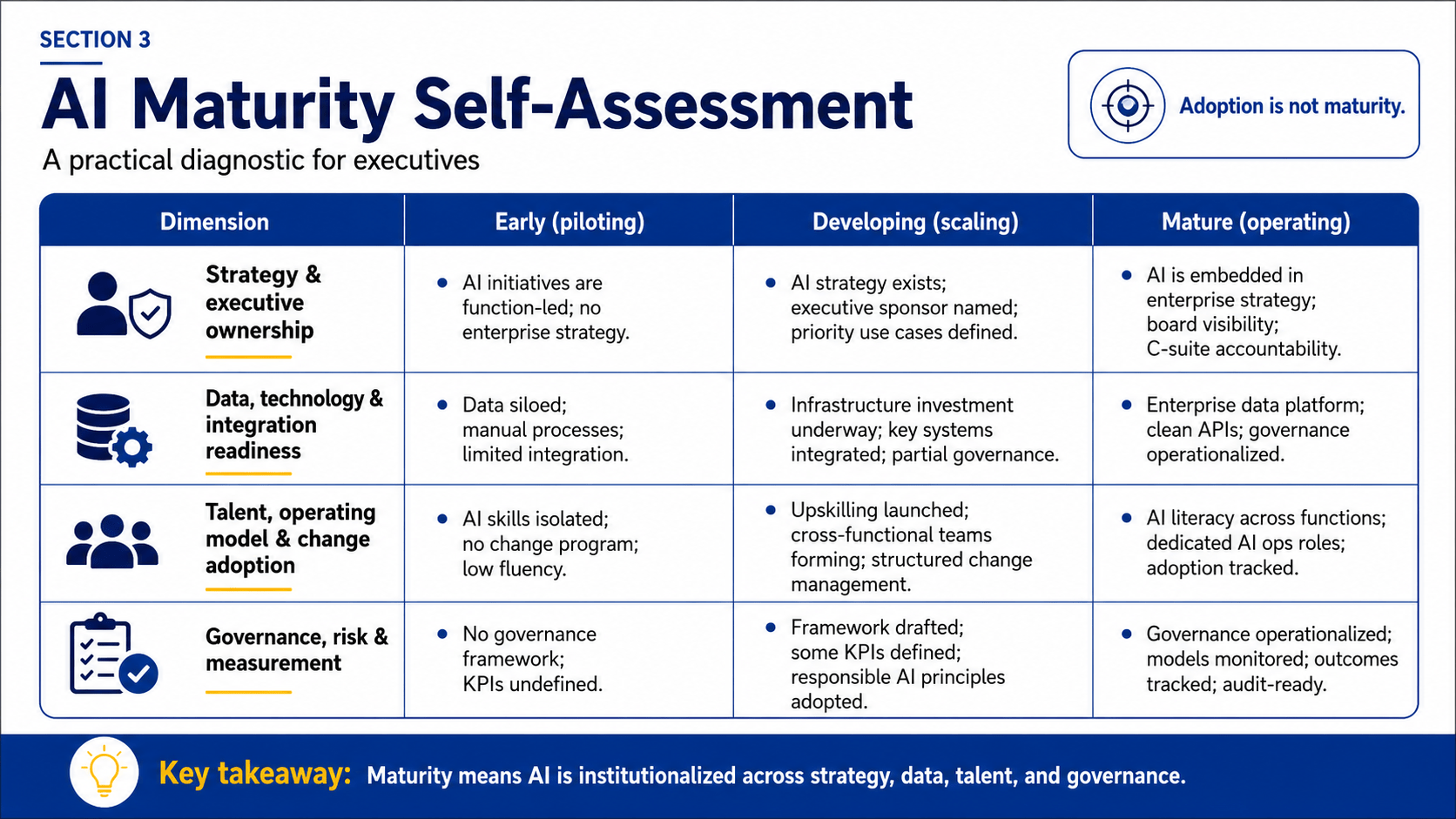
Meaningful AI value measurement requires four distinct KPI categories, not a single ROI figure. Each category captures a different dimension of organizational impact.
| KPI category | Example metrics | Measurement approach |
|---|---|---|
| Business outcomes | Revenue attributable to AI-enabled decisions, cost reduction per process, error rate improvement | Pre/post baseline comparison; A/B testing where feasible; business owner sign-off |
| Operational outcomes | Processing time reduction, throughput increase, manual review hours saved | Process-level measurement before and after deployment; SLA tracking |
| Risk and governance outcomes | Compliance incident rate, bias audit results, model drift events, security incidents | Ongoing monitoring; periodic audit; incident tracking |
| Adoption outcomes | User adoption rate, workflow integration depth, employee confidence scores | Usage analytics; structured feedback; change-management assessment |
Organizations that define these KPIs before deployment — rather than after — consistently demonstrate higher value realization. The definition of success must precede the build, not follow it.
3.2 Efficiency, growth, risk reduction, and customer outcomes
McKinsey’s 2025 research finds that organizations it classifies as top AI performers — those capturing the most measurable value — are distinguished not by which AI technologies they use but by how they manage AI across the full lifecycle: strategy alignment, data infrastructure, talent, operating model, governance, and disciplined outcome measurement (McKinsey & Company, State of AI 2025). These organizations treat AI as an operating capability with defined ownership and accountability, not as a portfolio of technology experiments.
3.3 Why pilots fail to reach production
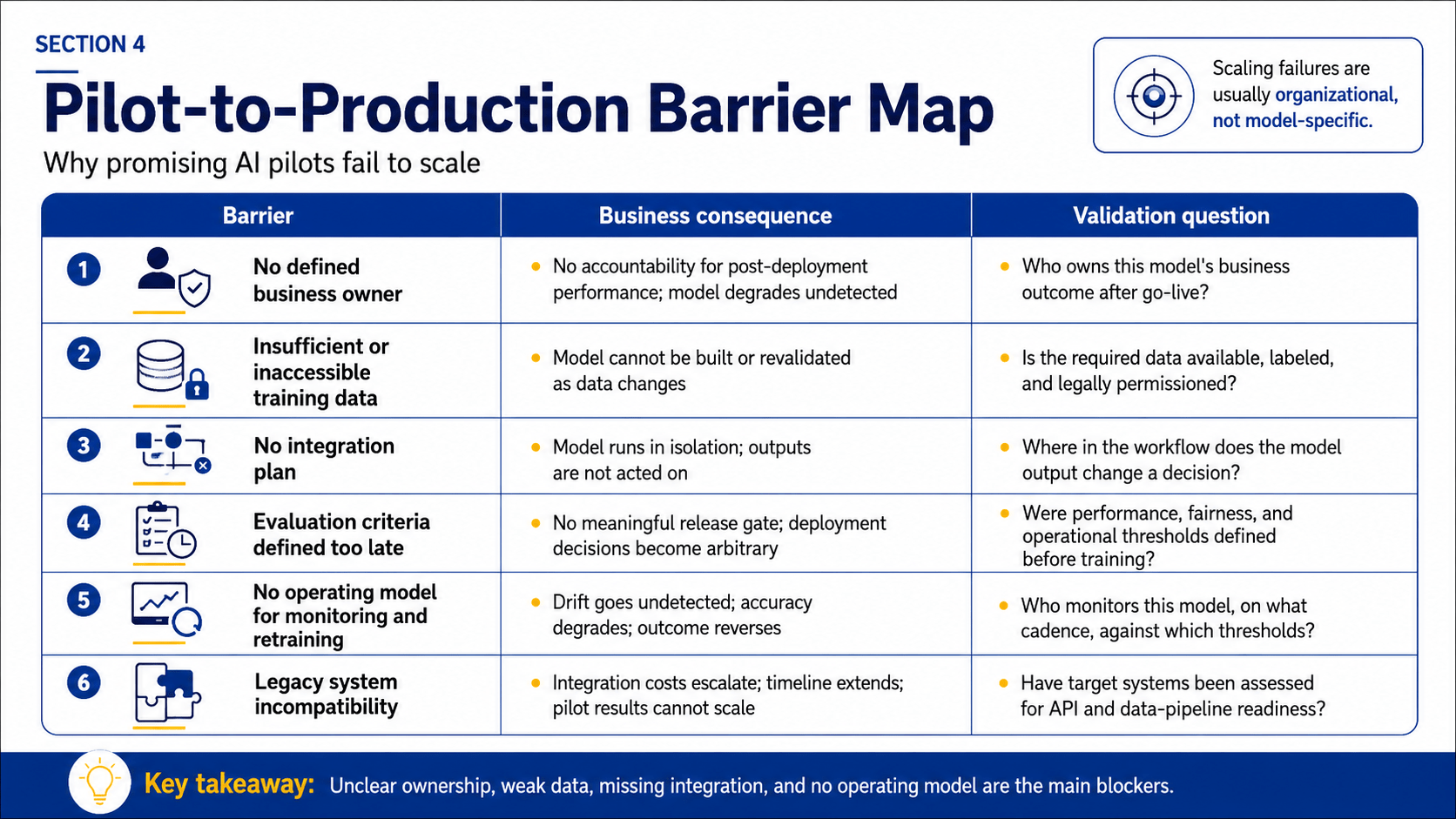
The most common reasons AI pilots fail to reach production are systemic, not technical. They include: no defined business owner for the outcome the model is meant to improve; data that is insufficient, inaccessible, or ungoverned; evaluation criteria defined too late in the process to guide meaningful iteration; no integration plan connecting the model output to the workflow where it will be used; and no operating model for monitoring and maintaining the system post-deployment. These are organizational and governance failures, not model-quality failures. For a detailed treatment of the pilot-to-production transition, see SmartDev’s guide to AI proof-of-concept implementation.
3.4 Enterprise AI maturity self-assessment framework
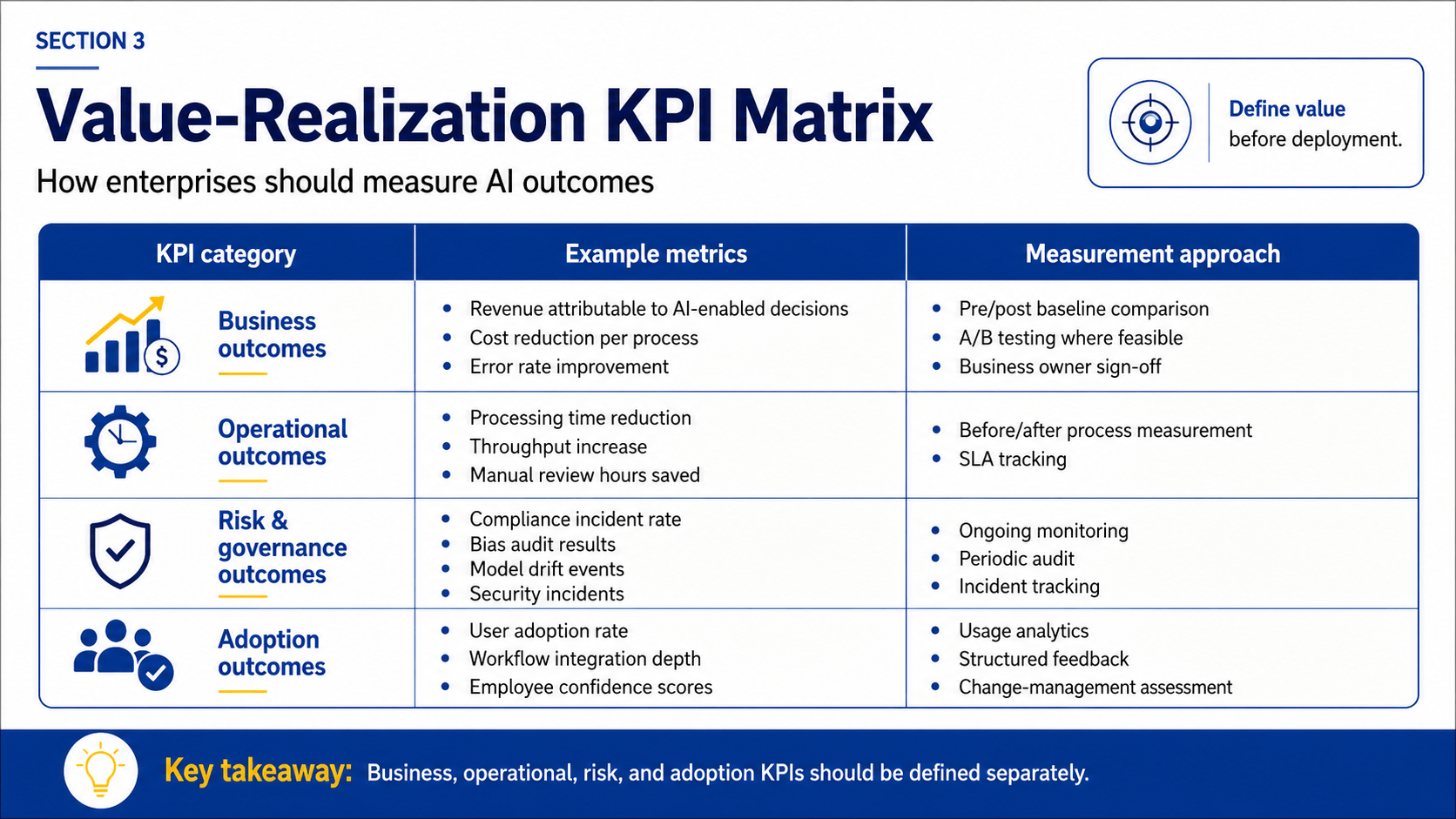
The following framework is an editorial tool for self-assessment. It is not a named proprietary methodology. Organizations should use it as a diagnostic starting point, not as a scored certification.
| Dimension | Early (piloting) | Developing (scaling) | Mature (operating) |
|---|---|---|---|
| Strategy and executive ownership | AI initiatives are function-led; no enterprise AI strategy; C-suite engagement is ad hoc | AI strategy exists; executive sponsor named; priority use cases defined | AI embedded in enterprise strategy; board-level visibility; outcome accountability at C-suite |
| Data, technology, and integration readiness | Data siloed; manual processes dominate; integration with core systems is limited | Data infrastructure investment underway; key systems integrated; data governance partial | Enterprise data platform; clean APIs to core systems; data governance operationalized |
| Talent, operating model, and change adoption | AI skills concentrated in isolated teams; no change-management program; low AI fluency across workforce | Upskilling programs launched; cross-functional AI teams forming; change management structured | AI literacy across functions; dedicated AI operations roles; change adoption measured and tracked |
| Governance, risk, and measurement | No AI governance framework; KPIs undefined; responsible AI not operationalized | Governance framework drafted; some KPIs defined; responsible AI principles adopted | Governance operationalized; all models monitored; outcomes tracked against defined KPIs; audit-ready |
Key takeaway: AI adoption is not the same as AI maturity because adoption describes what has started — maturity describes what has been institutionalized. The gap between them is where most enterprise AI value is currently lost.
4. What Prevents AI From Scaling
Most AI scaling failures are systemic rather than model-specific. The barriers that prevent pilots from becoming durable operating capabilities fall across five organizational dimensions.
4.1 Talent, skills, and organizational change
The talent gap in enterprise AI is not primarily about data scientists. It is about the distribution of AI literacy across business functions: the product manager who can define a meaningful AI use case, the operations lead who can govern a deployed model, the compliance officer who can assess algorithmic risk. McKinsey’s research consistently identifies talent and capability as one of the top self-reported barriers to AI scaling, alongside data and governance.
Change management is the organizational complement to talent. AI deployments that change how people work require structured adoption programs: clear communication of what changes and why, workflow redesign that integrates the AI output at the point of decision, incentive structures that reward the new behavior, and feedback mechanisms that surface adoption barriers early. Without this, technically successful deployments fail commercially because the intended users do not adopt them.
4.2 Data quality, infrastructure, and systems integration
Data readiness is the single most common technical barrier to AI scaling. The failure mode is not that organizations lack data — most large enterprises have more data than they can process. The failure mode is that the data is inaccessible (locked in legacy systems or siloed by function), low quality (inconsistent formatting, missing values, labeling errors), or ungoverned (no documented ownership, lineage, or access policy). A model trained on poor data will produce poor outputs regardless of architectural sophistication. Establishing data readiness before model development is a prerequisite, not a preparatory step. For a detailed treatment of AI model drift and the data conditions that cause it, see SmartDev’s guide to model drift and retraining.
4.3 Governance, compliance, and responsible AI
AI governance encompasses the policies, roles, processes, and controls that determine how AI systems are developed, deployed, monitored, and retired. It is not a compliance checkbox — it is the organizational infrastructure that makes AI deployments auditable, accountable, and correctable when they produce unexpected outputs.
The regulatory environment for enterprise AI is evolving rapidly across jurisdictions. The EU AI Act — which entered into force in August 2024 and applies obligations progressively through 2027 — introduces risk-tiered requirements for AI systems used in high-stakes contexts including employment, credit, and public services (EU AI Act, Regulation (EU) 2024/1689). Organizations operating in or selling to EU markets should be incorporating compliance planning into their AI governance frameworks now, not at deployment. For a broader treatment of ethical AI governance, see SmartDev’s guide to AI ethics concerns for business.
4.4 The pilot-to-production gap
| Barrier | Business consequence | Validation question |
|---|---|---|
| No defined business owner for the AI outcome | No accountability for post-deployment performance; model degrades undetected | Who is accountable for this model’s business outcome after go-live? |
| Insufficient or inaccessible training data | Model cannot be built or revalidated as data changes | Is the required data available, labeled, and legally permissioned for this use? |
| No integration plan connecting model output to workflow | Model runs in isolation; outputs are not acted on; no business value generated | Where exactly in the current workflow does the model output change a decision? |
| Evaluation criteria defined after training | No meaningful release gate; deployment decisions are arbitrary | Were performance, fairness, and operational thresholds defined before training began? |
| No operating model for monitoring and retraining | Model drift goes undetected; accuracy degrades; business outcome reverses | Who monitors this model, on what cadence, against which thresholds? |
| Legacy system incompatibility | Integration costs escalate; deployment timeline extends; pilot results cannot be replicated at scale | Have the target systems been assessed for API compatibility and data pipeline readiness? |
Key takeaway: Most enterprise AI scaling failures originate in organizational and governance gaps — unclear ownership, weak data, missing integration plans — not in the quality of the underlying model.
5. Southeast Asia and Vietnam: A Regional AI-Adoption Lens
5.1 Southeast Asia’s enterprise AI landscape
Southeast Asia presents favorable structural conditions for AI adoption: a large, young digital-native population, rapidly expanding mobile and cloud infrastructure, active government investment in digital transformation, and growing pools of technology talent in major urban centers. These conditions support adoption. They do not guarantee maturity or value realization — the same challenges that constrain enterprise AI globally apply in the region, often with additional complexity from fragmented regulatory environments, talent distribution, and data infrastructure gaps.
Comparative regional data on enterprise AI maturity — as distinct from individual AI tool usage — remains limited. Most available statistics describe individual or developer usage rather than enterprise-wide implementation. Readers should apply caution when regional figures are presented without clear disclosure of population scope.
5.2 Vietnam’s position: readiness, adoption signals, and ecosystem development
Vietnam has made measurable progress on national AI readiness indicators. Oxford Insights’ Government AI Readiness Index — which assesses national-level readiness across government, technology, and data dimensions — ranked Vietnam among the top performers in the ASEAN region in its 2023 edition (Oxford Insights, Government AI Readiness Index 2023). Vietnam’s national AI strategy, established by Decision 127/QĐ-TTg and updated through subsequent policy frameworks, provides a formal commitment to AI ecosystem development through 2030.
At the sector level, a 2024 study examining e-commerce merchants across six ASEAN countries found that Vietnam and Indonesia each recorded an AI adoption rate of 42% among surveyed merchants — the highest in the study group, ahead of Singapore and Thailand at 39%. This figure describes e-commerce merchant usage and should not be generalized to enterprise-wide deployment across Vietnam’s economy. The distinction between individual AI tool use and enterprise deployment is critical when interpreting regional statistics. For broader context on why Vietnam is attracting regional AI investment, see SmartDev’s analysis of Vietnam’s position in Southeast Asia’s AI development ecosystem.
Infrastructure readiness is the near-term constraint. Asia Society Policy Institute’s research on AI readiness in Southeast Asia scored Vietnamese organizations at 49% on an overall AI readiness composite — above the regional average but indicating significant room for improvement across data infrastructure, talent depth, and governance maturity (Asia Society Policy Institute, Raising Standards: Data and AI in Southeast Asia).
5.3 Industry implications for Vietnamese enterprises
Retail and e-commerce. Vietnam’s retail and e-commerce sectors are the most active AI deployment environments in the domestic economy. Recommendation systems, inventory optimization, demand forecasting, and personalized marketing are the primary use cases. The 42% merchant adoption figure cited above reflects this activity. The scaling challenge in this sector is data integration across fragmented point-of-sale and logistics systems, and the absence of standardized customer data infrastructure. For use-case detail in this sector, see SmartDev’s resource on AI use cases in e-commerce.
Manufacturing and supply chains. Vietnam’s export-oriented manufacturing base — electronics, textiles, automotive components — is a natural fit for AI applications in quality inspection, predictive maintenance, and supply-chain visibility. Sensor data infrastructure and enterprise resource planning (ERP) integration are the primary prerequisites. Investment from multinational manufacturers operating in Vietnam is accelerating the technology readiness of domestic suppliers. For sector-specific context, see SmartDev’s resource on AI use cases in manufacturing.
Public-sector digital services. The Vietnamese government has piloted AI in citizen-facing services, traffic management, and administrative processing. These deployments are early-stage relative to more advanced ASEAN economies. The governance and procurement frameworks for public-sector AI are still developing, which creates both opportunity and uncertainty for organizations operating in or selling to government contexts. For a regional comparison of public-sector AI deployment, see SmartDev’s coverage of AI use cases in government.
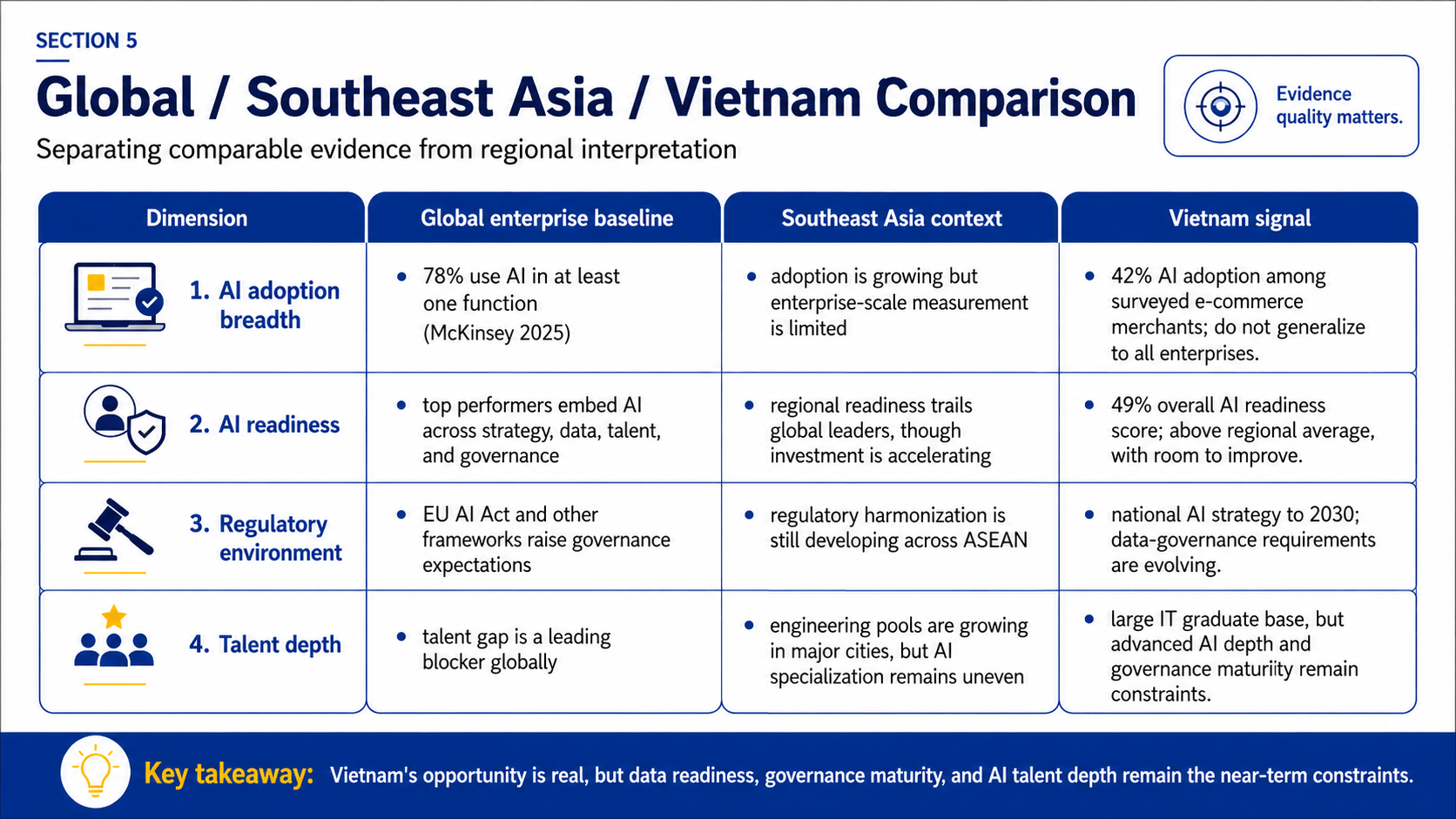
5.4 Regional constraints and opportunities to scale responsibly
| Global enterprise baseline | Southeast Asia context | Vietnam-specific consideration | |
|---|---|---|---|
| AI adoption breadth | 78% use AI in at least one function (McKinsey, 2025; global multi-industry sample) | Adoption growing; enterprise-scale measurement limited | 42% adoption among e-commerce merchants (2024 ASEAN study); enterprise-wide data unavailable |
| AI readiness composite | Varies by country; top-quartile firms embed AI across strategy, data, talent, governance | Regional average below global leaders; infrastructure investment accelerating | 49% overall readiness score (Asia Society PI); above regional average; talent and governance are constraints |
| Regulatory environment | EU AI Act in force; US sector-specific rules; diverse global frameworks | Regulatory frameworks developing; ASEAN harmonization in progress | National AI strategy to 2030; data localization requirements; cross-border data governance evolving |
| Talent depth | Talent gap is top-reported barrier globally | Engineering talent pools in major cities; AI specialization is limited | Large IT graduate population; AI specialization depth is the constraint; upskilling programs expanding |
Key takeaway: Vietnam’s AI opportunity is real and supported by policy, demographics, and growing ecosystem investment. The near-term constraints — data readiness, governance maturity, and AI talent depth — are addressable, but they require deliberate investment rather than assumptions about technology availability alone.
6. The 2025–2026 Enterprise AI Outlook
The following section distinguishes between observed trends (supported by current evidence), developing practices (emerging but not yet well-documented at enterprise scale), and open questions (areas where the evidence base is insufficient to draw conclusions). Forecasts are labeled as forecasts.
6.1 Agentic AI and workflow redesign
Observed trend: Major enterprise software vendors — including Salesforce, Microsoft, ServiceNow, and SAP — have released or announced agentic AI capabilities within their platforms as of 2025. These systems are designed to automate multi-step business processes with reduced human intervention at each step.
Developing practice: Enterprise deployment of agentic AI at production scale is early. Most organizations are in evaluation or limited pilot phases. The operating-model implications — governance of autonomous actions, human oversight checkpoints, rollback procedures for multi-step processes — are materially different from those of previous AI tool integrations and are not yet standardized.
Open question: The appropriate human oversight level for agentic AI in different decision contexts (high-stakes vs. low-stakes, regulated vs. unregulated) is an active area of governance development. Organizations planning agentic AI deployments should build human review checkpoints into their architecture now, before governance frameworks are finalized.
6.2 Responsible AI, cybersecurity, and resilience
Observed trend: Regulatory scrutiny of AI decision-making is increasing across jurisdictions. The EU AI Act is the most comprehensive framework currently in force, establishing risk-tiered obligations for AI systems used in consequential decisions. ISO/IEC 42001:2023 — the international standard for AI management systems — provides a governance framework applicable across sectors and geographies (ISO/IEC 42001:2023, AI Management System Standard).
Developing practice: AI-specific cybersecurity threats — including prompt injection, adversarial inputs, and model extraction attacks — are increasingly documented. The US National Institute of Standards and Technology (NIST) AI Risk Management Framework provides a structured approach to identifying and managing these risks (NIST AI Risk Management Framework, NIST, 2023).
Open question: The long-term liability and accountability structures for AI-generated decisions in regulated industries (healthcare, finance, legal) are not yet settled in most jurisdictions. Organizations in these sectors should maintain human review and audit trails for AI-influenced decisions until regulatory clarity improves.
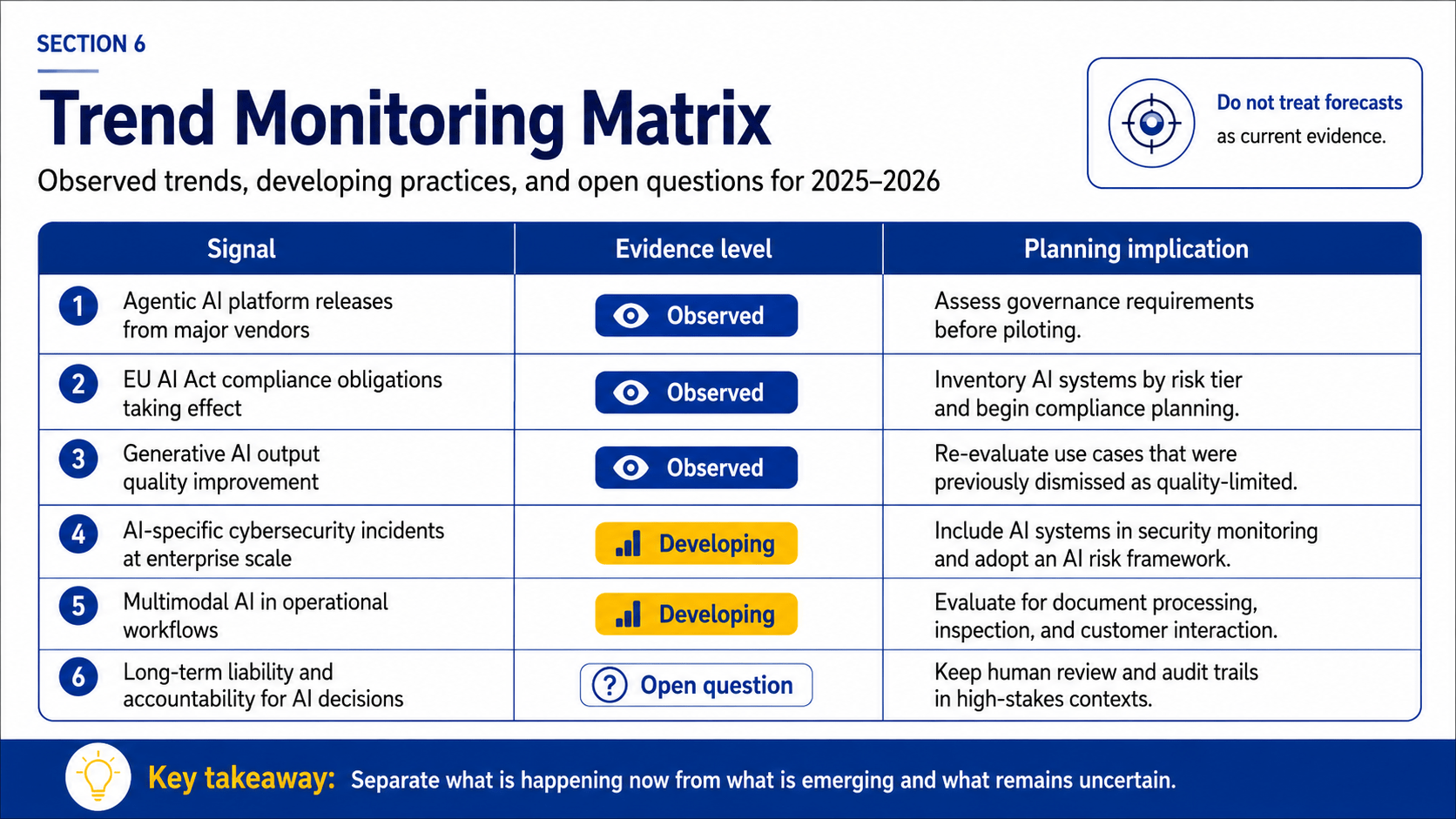
6.3 What leaders should monitor as adoption matures
| Signal | Evidence level | Planning implication |
|---|---|---|
| Agentic AI platform releases from major vendors | Observed (2025) | Assess governance requirements before piloting; do not conflate tool availability with enterprise readiness |
| EU AI Act compliance obligations taking effect | Observed (2024–2027 rollout) | Inventory AI systems by risk tier; begin compliance planning now for high-risk applications |
| Generative AI output quality improvement | Observed (ongoing) | Re-evaluate use cases that were dismissed in 2023–2024 as quality-limited |
| AI-specific cybersecurity incidents at enterprise scale | Developing | Include AI systems in existing security monitoring programs; adopt NIST AI RMF or equivalent |
| Multimodal AI in operational workflows | Developing | Evaluate for use cases involving document processing, inspection, and customer interaction |
Key takeaway: Enterprise AI priorities are shifting from isolated tools to governed, cross-functional workflows. Agentic AI and regulatory compliance are the two planning horizons that most organizations should be addressing now, before deployment rather than after.
7. Enterprise Roadmap: Moving From Adoption to Scaled Value
The transition from AI experimentation to scaled organizational capability requires a phased, decision-gated approach. Each phase has prerequisites that must be satisfied before advancing — skipping phases does not accelerate the timeline; it transfers risk forward to a more costly point of failure. For a detailed treatment of the transformation process, see SmartDev’s practical guide to business AI transformation.
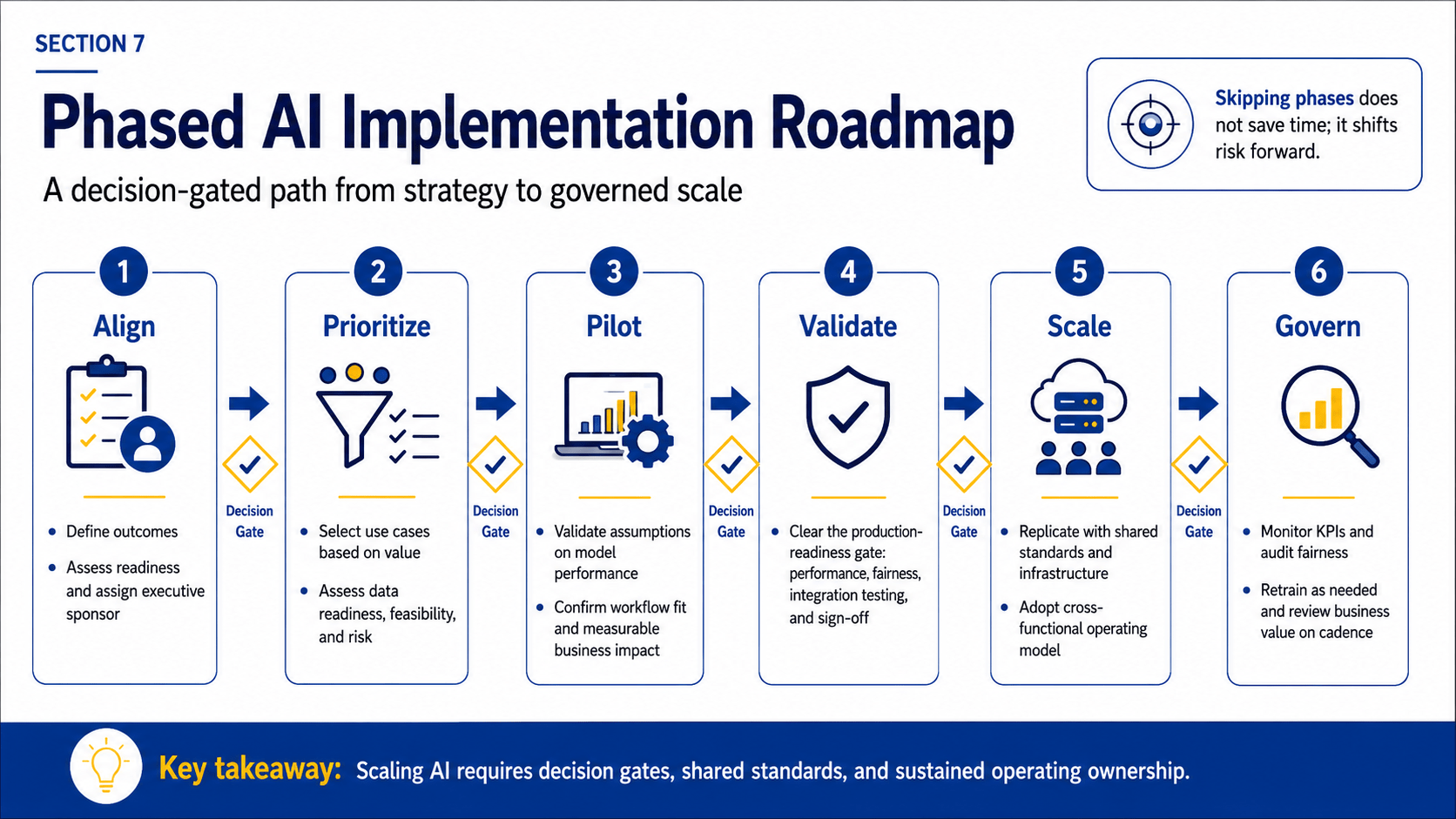
Phase 1 — Align: Define outcomes and assess readiness
The alignment phase produces a documented AI strategy that connects AI investment to specific, measurable business outcomes. It requires executive sponsorship, a named accountability structure, and a readiness assessment across the four maturity dimensions: strategy, data and technology, talent and operating model, and governance. No use case should advance to pilot without a defined success criterion and a business owner. Organizations that skip this phase consistently report the lowest AI value realization.
Phase 2 — Prioritize: Select use cases against evidence-based criteria
Use case prioritization should be governed by four criteria: business value (what measurable outcome improvement is achievable?), data readiness (is the required data available, labeled, and permissioned?), feasibility (does the organization have or can it acquire the technical and operating capability to deploy?), and risk (what are the consequences of an incorrect model output, and what human review path exists?). Use cases that score poorly on data readiness or governance feasibility should be deferred until those prerequisites are addressed — not pursued in parallel. For a framework on investment and cost considerations, see SmartDev’s resource on AI development cost.
Phase 3 — Pilot: Validate assumptions before committing to scale
The purpose of a pilot is to validate business assumptions — that the data supports a model that meets the predefined performance threshold, that the model output can be integrated into the target workflow, and that the business outcome improvement is real and measurable. A pilot that does not produce this validation is not a partial success — it is a signal to revisit the use case definition, data readiness, or both before investing in scale. Governance, monitoring, and rollback controls should be designed in the pilot, not added before production.
Phase 4 — Validate: Apply the production-readiness gate
A model advances from pilot to production only when it has met all predefined thresholds: performance on the held-out test set, fairness checks across relevant population subgroups, integration testing in a staging environment, and sign-off from the business owner, data owner, and risk reviewer. Releasing before these gates are cleared is a governance failure, not a delivery acceleration. For a detailed framework on model testing and validation, see SmartDev’s AI model testing guide.
Phase 5 — Scale: Replicate through operating-model discipline
Scaling AI is not primarily a technology problem — it is an operating-model problem. The practices that produced value in one function must be institutionalized: documented deployment standards, shared data infrastructure, cross-functional AI teams, reusable governance frameworks, and a center of excellence or equivalent coordination structure. Organizations that treat each AI deployment as a bespoke project do not scale. Organizations that treat AI as an operating capability — with standardized practices, shared infrastructure, and accountable ownership — do.
Phase 6 — Govern: Sustain value through disciplined operations
Governance is not a phase that follows scaling — it is a condition that enables it. This phase makes explicit the ongoing practices that keep AI systems reliable, accountable, and aligned to their original business purpose: regular performance monitoring against defined KPIs, periodic bias and fairness audits, model retraining on a defined cadence or trigger, security monitoring, and a regular business-value review that compares current outcomes to the baseline defined at Phase 1. Organizations that omit this phase will see AI value erode as models drift and the business environment changes around them.
7.5 Define KPIs, review cadence, and value-accountability mechanisms
Every production AI system should have: a named business owner; a defined set of performance, operational, governance, and adoption KPIs; a monitoring cadence with automated alerting on threshold breaches; a scheduled business-value review at a defined interval; and a documented decision process for retraining, adjustment, or retirement. These are not bureaucratic requirements — they are the minimum operating infrastructure for treating AI as a business capability rather than a technology experiment.
Key takeaway: Moving from AI pilots to scalable value requires a decision-gated roadmap with defined prerequisites at each phase. What must be proven before scaling is different from what can be improved iteratively — conflating the two is the primary cause of premature scale and subsequent failure.
8. Frequently Asked Questions
8.1 What is the enterprise AI adoption rate in 2026?
The most current comparable benchmark for enterprise AI adoption comes from McKinsey & Company’s 2025 State of AI survey, which found that 78% of respondents’ organizations used AI in at least one business function — up from 55% in 2023. This figure reflects a global, multi-industry sample and measures function-level usage, not production-scale deployment or value realization. No comparable 2026 full-year enterprise benchmark has been published at the time of this article. For methodology and population details, the report is available directly from McKinsey. See Section 1.2 for a full discussion of what headline adoption rates do and do not measure.
8.2 What is the difference between AI adoption and AI maturity?
AI adoption describes whether an organization uses at least one AI tool or system in a business function. AI maturity describes whether AI is embedded across functions with defined strategy, governance, accountable ownership, and outcome measurement. An organization can score high on adoption and low on maturity — which is the most common condition in current enterprise benchmarking. See Section 1.1 for the full four-stage framework distinguishing adoption, maturity, production deployment, and value realization.
8.3 Which AI use cases are most commonly deployed by enterprises?
Based on McKinsey’s 2025 research, the most frequently reported enterprise AI use cases span IT operations, marketing and sales, and service operations. The most common application categories are process automation (document processing, workflow routing, compliance checks), predictive analytics (demand forecasting, churn prediction, risk scoring), and generative AI for knowledge work (content drafting, code assistance, document summarization). Use-case prevalence varies significantly by industry and organization size. See Section 2.2 for a full breakdown by category, value pathway, and scaling considerations.
8.4 Why do many enterprise AI pilots fail to scale?
The most common reasons are organizational and governance failures, not technical ones: no defined business owner for the outcome the model addresses; insufficient, inaccessible, or ungoverned data; no integration plan connecting model output to the business workflow; evaluation criteria defined after training rather than before; and no operating model for monitoring, retraining, or rollback post-deployment. These are addressable, but they require deliberate remediation before a pilot advances to production — not after. See Section 4.4 for a full barrier-to-consequence mapping.
8.5 How should enterprises measure AI business value?
AI value measurement requires four separate KPI categories: business outcomes (revenue, cost, error rate improvements measured against a pre-deployment baseline), operational outcomes (processing time, throughput, manual effort reductions), risk and governance outcomes (compliance incidents, audit results, model drift events), and adoption outcomes (user adoption rate, workflow integration depth, employee confidence). ROI is one useful metric but not a complete measure of AI value. All KPIs should be defined before deployment, not derived from post-deployment results. See Section 3.1 for the full KPI matrix.
8.6 How is Vietnam positioned in Southeast Asia’s AI-adoption landscape?
Vietnam ranks among the stronger performers in Southeast Asia on government AI readiness indicators (Oxford Insights, 2023) and has recorded above-regional-average enterprise AI readiness scores on composite assessments (Asia Society PI, 49% vs. regional average). At the sector level, e-commerce merchant AI adoption in Vietnam is among the highest in ASEAN (42%, 2024 study). The near-term constraints are data infrastructure readiness, AI talent depth beyond large urban centers, and governance framework maturity. Vietnam’s national AI strategy provides a policy foundation; execution against that strategy is the distinguishing variable. See Section 5 for a full regional comparison with evidence sources.
Conclusion
The central finding of this benchmark is that enterprise advantage depends less on AI experimentation than on the organizational ability to govern, integrate, measure, and scale AI as an operating capability. Adoption is necessary but not sufficient. The gap between organizations that use AI and organizations that derive sustained, measurable value from it is an organizational gap — in strategy clarity, data readiness, governance discipline, and operating-model design — not a technology gap.
For enterprises in Vietnam and Southeast Asia, this creates a specific strategic opportunity. The organizations that build governance and operating-model foundations now — before deployment pressure mounts — will be positioned to scale AI more quickly and with less remediation cost than those that treat governance as a post-deployment problem. The regional constraints are real; they are also addressable through deliberate investment.
The roadmap in Section 7 provides a decision-gated framework for the transition from adoption to scaled capability. The maturity self-assessment in Section 3.4 offers a diagnostic starting point. The barrier map in Section 4.4 identifies the specific organizational conditions that most commonly prevent that transition. Used together, they convert the benchmark findings into a set of decisions — which is where enterprise AI strategy needs to start.
Next Steps
The appropriate next action depends on where your organization currently sits in the adoption-to-maturity continuum:
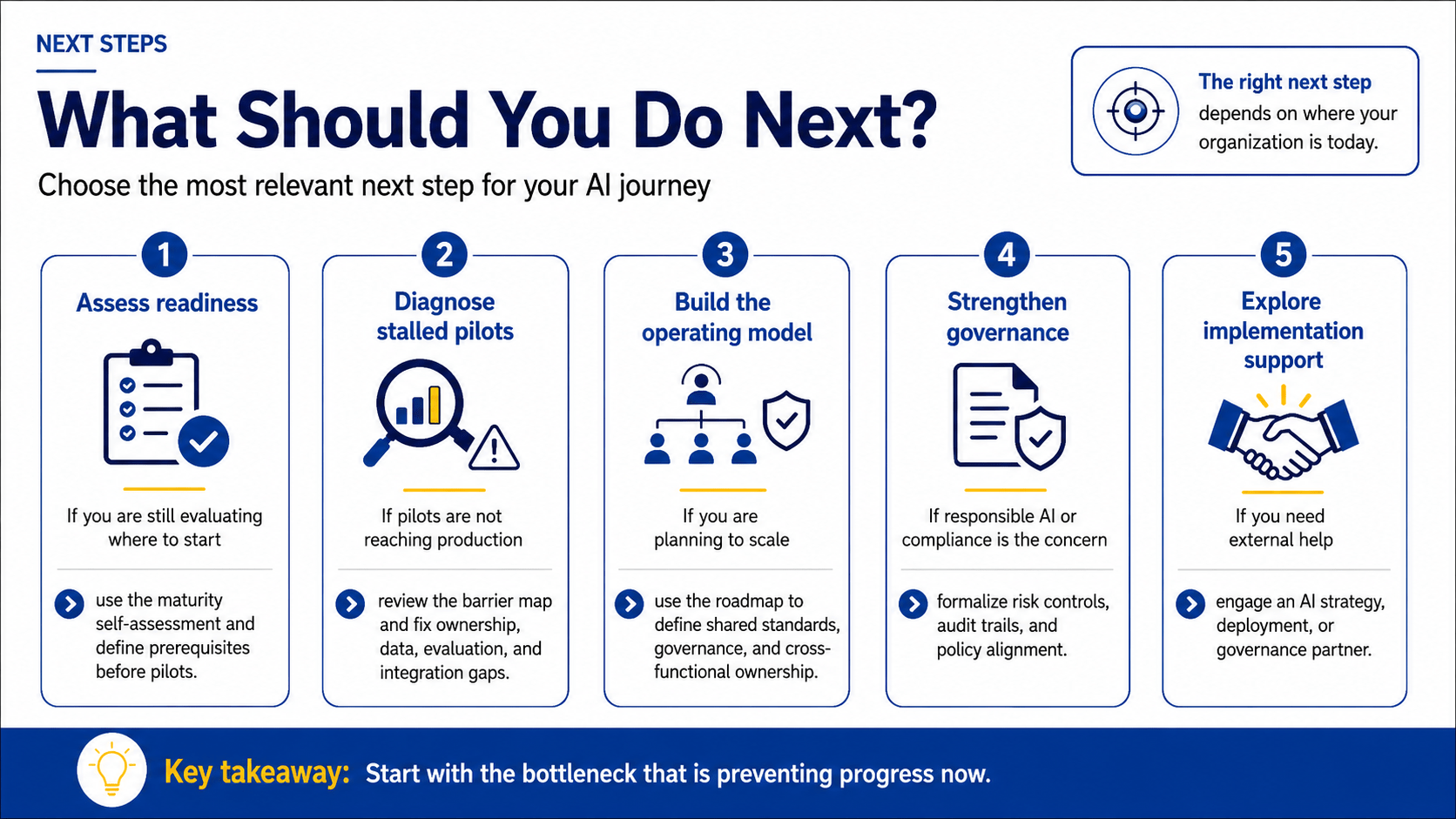
- Assessing readiness before launching AI initiatives: Use the maturity self-assessment framework in Section 3.4 to identify the organizational dimensions that need investment before pilots begin. SmartDev’s AI proof-of-concept guide provides a structured entry point for organizations moving from assessment to first deployment.
- Diagnosing why existing pilots are not reaching production: The pilot-to-production barrier map in Section 4.4 maps the most common failure modes to their organizational causes. SmartDev’s AI model testing guide addresses the evaluation and validation prerequisites for production release.
- Building the operating model for scale: The roadmap in Section 7 provides a phased framework with defined decision gates. SmartDev’s practical guide to business AI transformation supports organizations planning a multi-function AI scaling program.
- Addressing governance and responsible AI requirements: SmartDev’s coverage of AI ethics concerns for business and the ISO/IEC 42001 standard (referenced in Section 6.2) are the appropriate starting points for governance framework development.
- Exploring implementation support: For organizations seeking external support on AI strategy, deployment, or governance, SmartDev’s team works with enterprises across Southeast Asia and globally on AI development and implementation programs.
–
References
- McKinsey & Company — The State of AI 2025. Global multi-industry survey, 1,000+ respondents. McKinsey & Company, 2025.
- Oxford Insights — Government AI Readiness Index 2023. National-level government AI readiness assessment across 193 countries. Oxford Insights, 2023.
- Asia Society Policy Institute — Raising Standards: Data and AI in Southeast Asia. Regional enterprise AI readiness research. Asia Society Policy Institute.
- Regulation (EU) 2024/1689 — The EU AI Act. European Parliament and Council, August 2024.
- NIST AI Risk Management Framework (AI RMF 1.0). National Institute of Standards and Technology, U.S. Department of Commerce, 2023.
- ISO/IEC 42001:2023 — Artificial Intelligence Management System. International Organization for Standardization, 2023.
- Google — Vietnam AI Opportunity Agenda. Policy context for Vietnam’s national AI development strategy. Google Public Policy, 2023.