

TL;DR
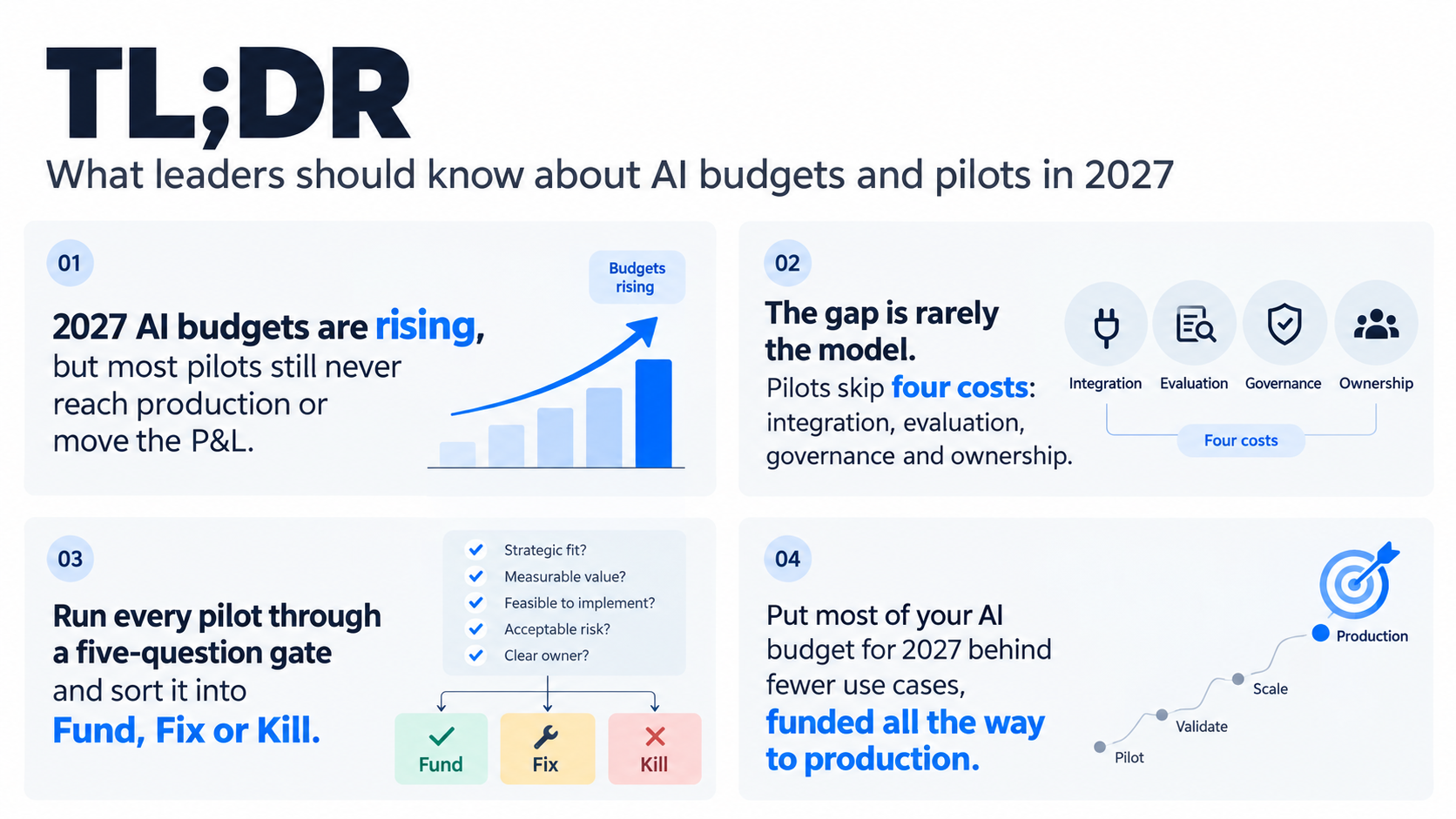
- 2027 AI budgets are rising, but most pilots still never reach production or move the P&L.
- The gap is rarely the model. Pilots skip four costs: integration, evaluation, governance and ownership.
- Run every pilot through a five-question gate and sort it into Fund, Fix or Kill.
- Put most of your AI budget for 2027 behind fewer use cases, funded all the way to production.
1. Introduction
It’s budget season, and the AI line is getting its hardest review yet. Someone from finance asks a simple question: what did last year’s pilots actually return? The room goes quiet. Not because the pilots failed. Most of them “worked.” They just never left the sandbox.
That is the real issue in 2027 planning. Money for AI is not the constraint. Forrester found that 82% of technology decision-makers expect their budgets to grow in 2027. The constraint is where the money goes. When an AI budget for 2027 is spread across another round of experiments, it buys more demos and very little production.
This article sets out what a production-first AI budget looks like: the costs pilots quietly leave out, a simple gate for deciding which pilots deserve funding, and a practical way to split next year’s spend.
2. The 2027 AI Budget Problem Isn’t Money, It’s Where It Goes
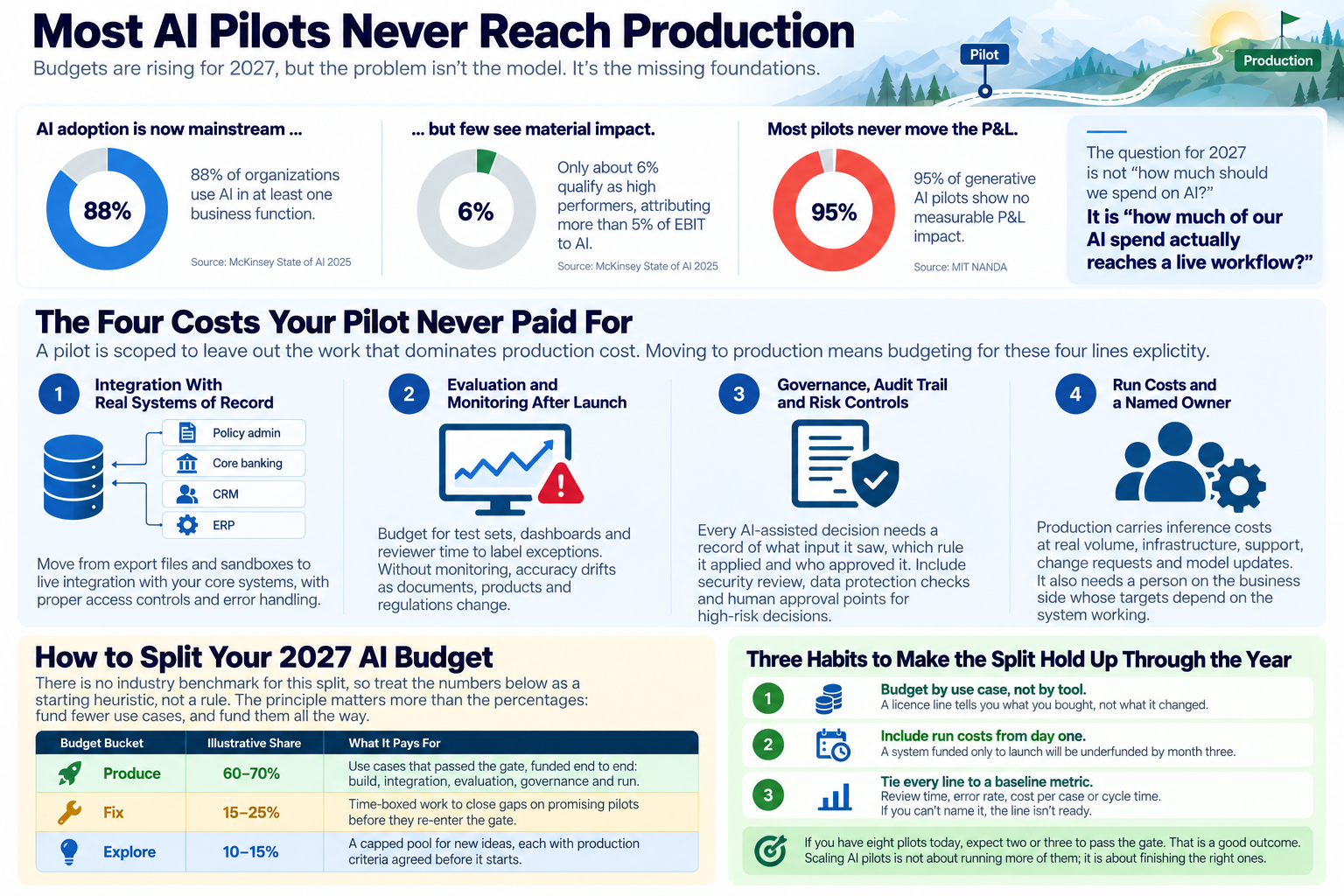
Adoption is no longer the gap. McKinsey’s State of AI 2025 survey found that 88% of organizations use AI in at least one business function, yet only about 6% qualify as high performers attributing more than 5% of EBIT to AI. MIT NANDA’s research is blunter: 95% of generative AI pilots show no measurable P&L impact.
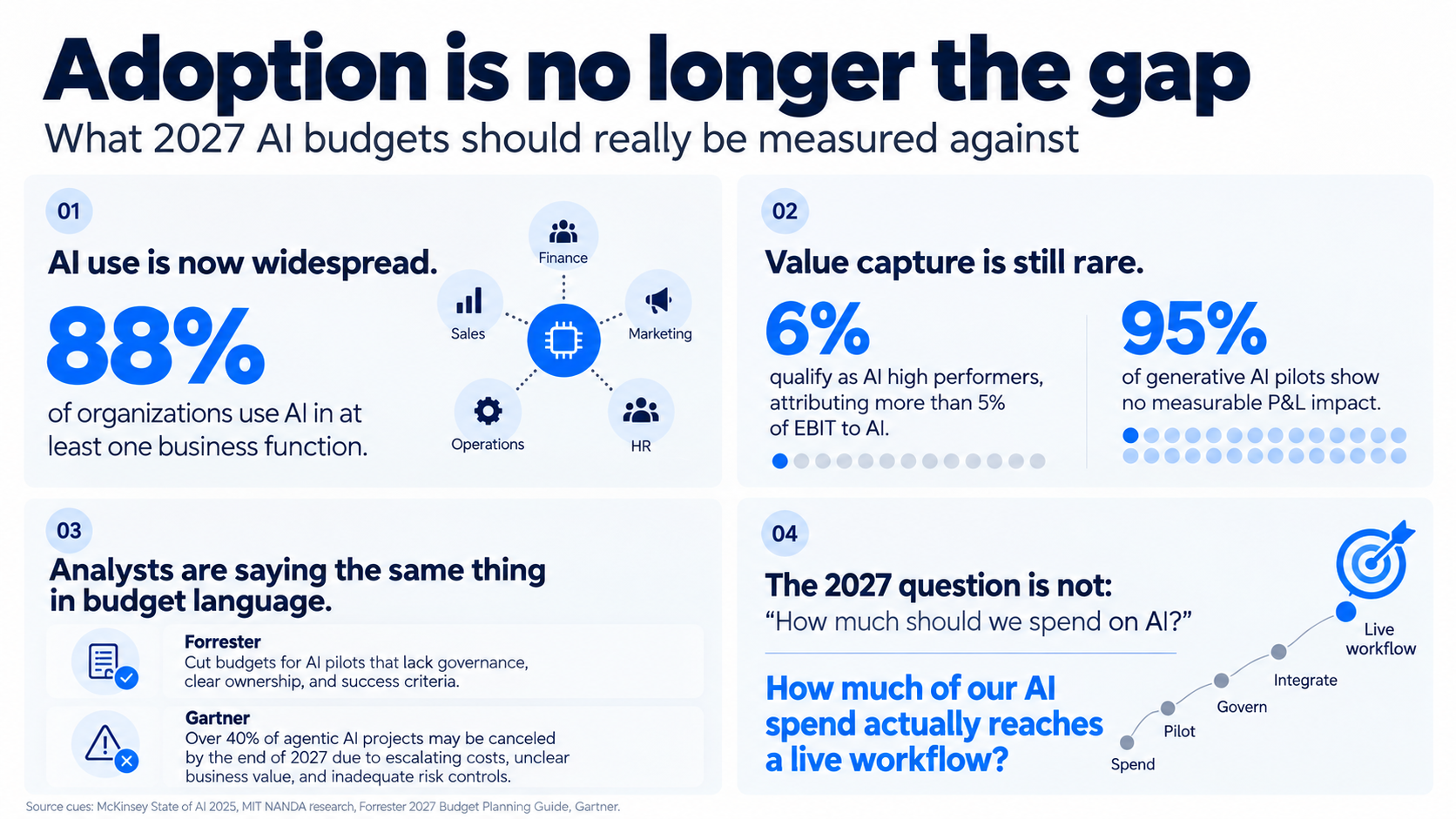
Analysts are now saying the same thing in budget language. Forrester’s 2027 Budget Planning Guide recommends cutting budgets for AI pilots that lack governance, clear ownership and success criteria. Gartner expects over 40% of agentic AI projects to be canceled by the end of 2027, citing escalating costs, unclear business value and inadequate risk controls.
Read together, the message is clear. The question for 2027 is not “how much should we spend on AI?” It is “how much of our AI spend actually reaches a live workflow?”
3. Why a Successful Pilot Still Fails the Budget Review
Most pilots are built to answer one question: can the model do this task? That is a fair question. It is just not the one your CFO is asking.
A pilot succeeds when the demo works on a clean data sample, with a motivated team watching. A production system succeeds when it runs on messy live data, inside the tools people already use, with someone accountable when it gets an answer wrong. Three patterns keep pilots stuck in what many teams now call AI pilot purgatory:
- No baseline. Nobody measured how long the process took, or how often it went wrong, before AI. So there is nothing to prove value against.
- No owner. The pilot belongs to an innovation team or a vendor. No business unit has signed up to run it.
- No path. There is no plan, budget or timeline for integration, security review and support after go-live.
Gartner’s analysts describe the trap well: early experiments can hide the real cost and complexity of deploying AI at scale. The pilot was cheap because it skipped the expensive parts.
4. The Four Costs Your Pilot Never Paid For
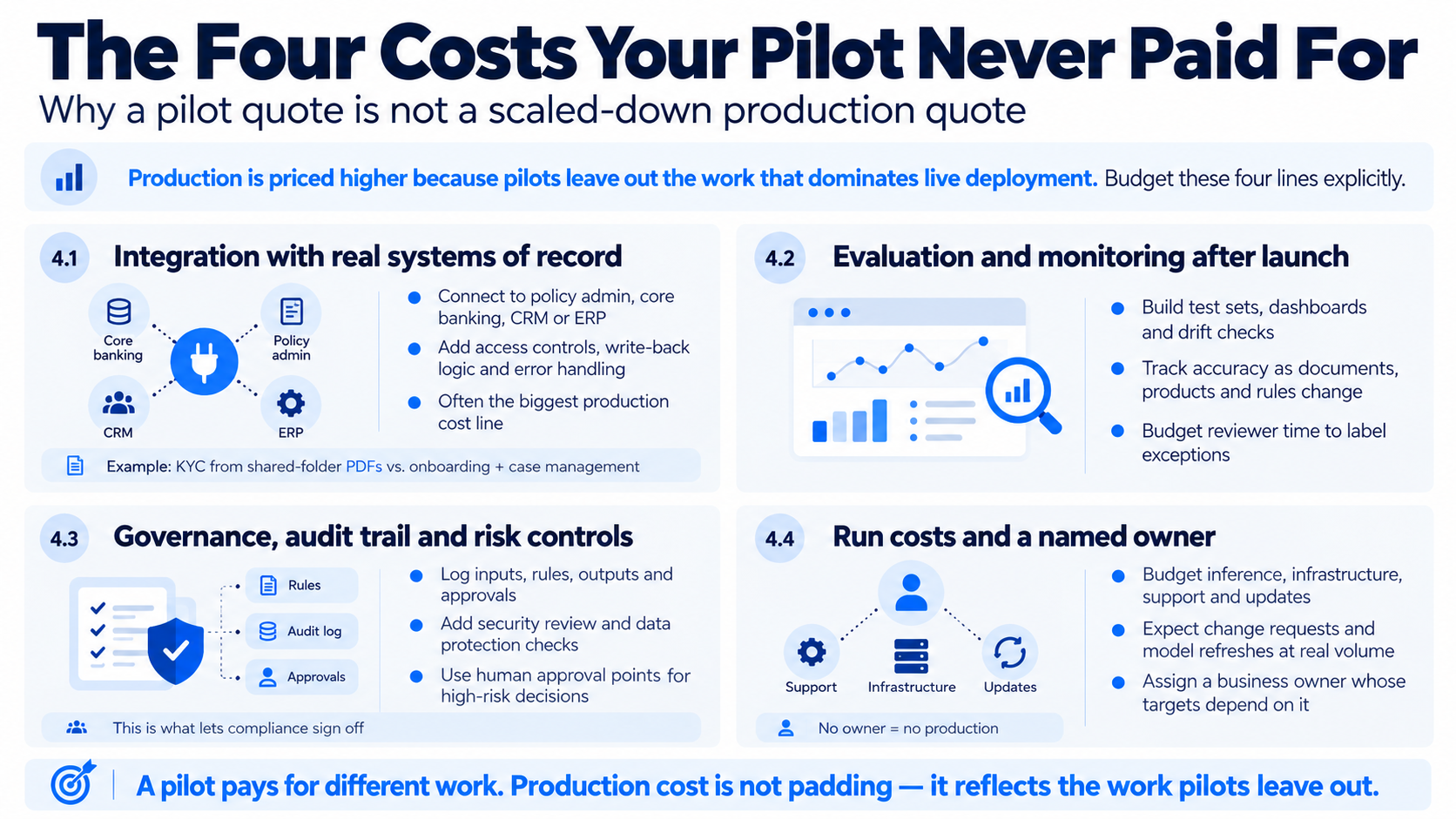
When the production quote comes in several times higher than the pilot, it is usually not padding. A pilot is scoped to leave out the work that dominates production cost, so its price is not a scaled-down version of production. It pays for different work. Moving an AI pilot to production means budgeting for these four lines explicitly.
4.1 Integration With Real Systems of Record
The pilot read from an export file or a sandbox. Production has to read from and write back to your core systems, such as policy admin, core banking, CRM or ERP, with proper access controls and error handling.
Think of a KYC check that reads PDFs from a shared folder, versus one that pulls documents from onboarding and writes results into case management. The second is the one that saves time, and it is usually the largest cost line.
4.2 Evaluation and Monitoring After Launch
An evaluation pipeline is a set of automated checks that tells you whether the AI is still giving correct answers after launch. Without it, accuracy drifts quietly as documents, products and regulations change. Budget for test sets, dashboards and reviewer time to label the exceptions the system gets wrong.
4.3 Governance, Audit Trail and Risk Controls
In regulated industries, “the model said so” is not an answer. Every AI-assisted decision needs a record of what input it saw, which rule it applied and who approved it. Add security review, data protection checks and human approval points for high-risk decisions. This is the work that lets compliance sign off.
4.4 Run Costs and a Named Owner
Production carries inference costs at real volume, infrastructure, support, change requests and model updates. It also needs a person on the business side whose targets depend on the system working. Without a named owner, a pilot does not reach production, however good the model is.
5. A Five-Question Funding Gate for Every Pilot
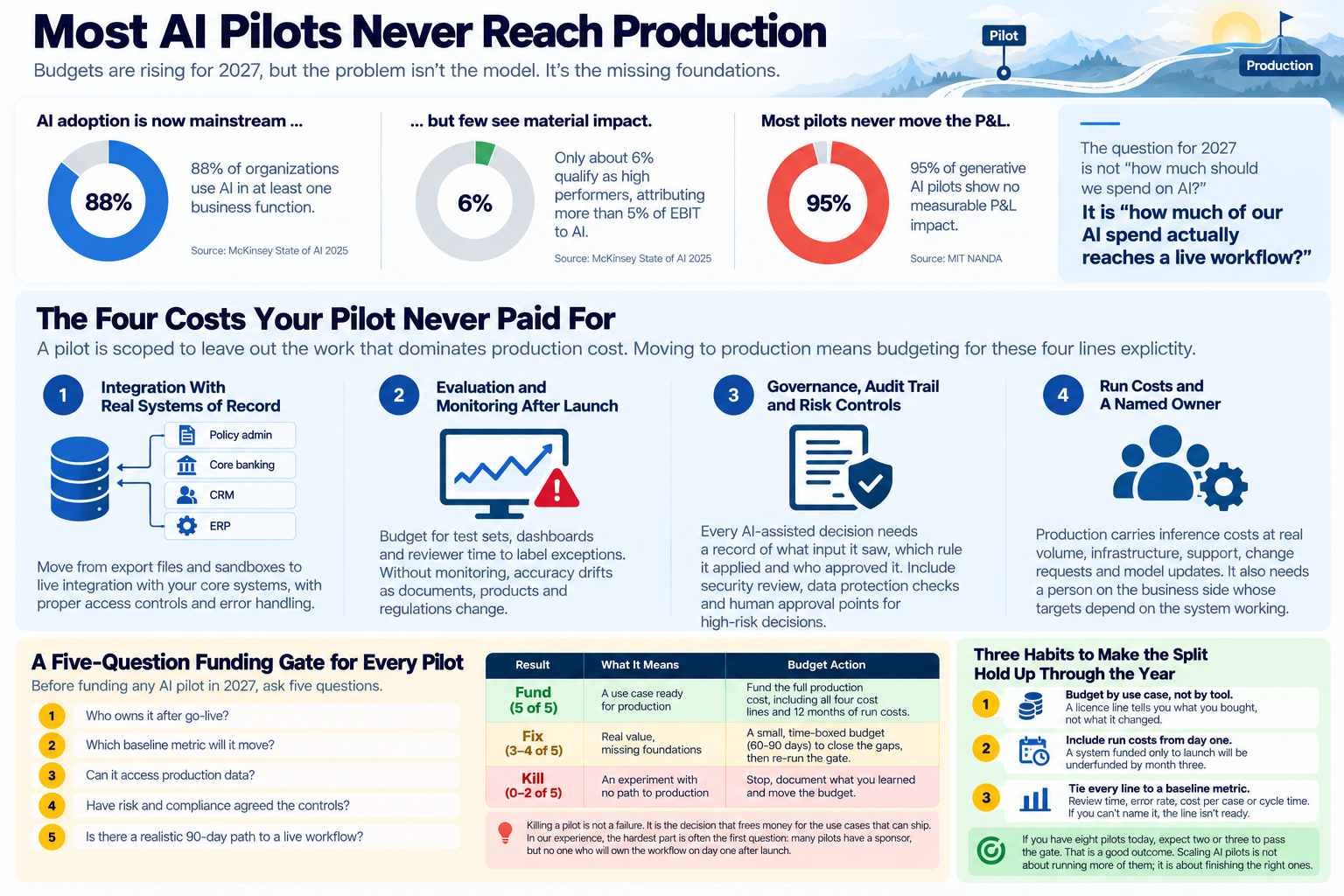
Before funding any AI pilot in 2027, ask five questions:
- Who owns it after go-live?
- Which baseline metric will it move?
- Can it access production data?
- Have risk and compliance agreed the controls?
- Is there a realistic 90-day path to a live workflow?
Five yeses means fund it. Gaps mean fix it or stop it.
| Result | What It Means | Budget Action |
|---|---|---|
| Fund (5 of 5) | A use case ready for production | Fund the full production cost, including all four cost lines and 12 months of run costs |
| Fix (3–4 of 5) | Real value, missing foundations | A small, time-boxed budget (60–90 days) to close the gaps, then re-run the gate |
| Kill (0–2 of 5) | An experiment with no path to production | Stop, document what you learned and move the budget |
Killing a pilot is not a failure. It is the decision that frees money for the use cases that can ship. In our experience, the hardest part is often the first question: many pilots have a sponsor, but no one who will own the workflow on day one after launch.
6. How to Split Your 2027 AI Budget
There is no industry benchmark for this split, so treat the numbers below as a starting heuristic, not a rule. The principle matters more than the percentages: fund fewer use cases, and fund them all the way.
| Budget Bucket | Illustrative Share | What It Pays For |
|---|---|---|
| Produce | 60–70% | Use cases that passed the gate, funded end to end: build, integration, evaluation, governance and run |
| Fix | 15–25% | Time-boxed work to close gaps on promising pilots before they re-enter the gate |
| Explore | 10–15% | A capped pool for new ideas, each with production criteria agreed before it starts |
Three habits make the split hold up through the year:
- Budget by use case, not by tool. A licence line tells you what you bought, not what it changed.
- Include run costs from day one. A system funded only to launch will be underfunded by month three.
- Tie every line to a baseline metric. Review time, error rate, cost per case or cycle time. If you can’t name it, the line isn’t ready.
If you have eight pilots today, expect two or three to pass the gate. That is a good outcome. Scaling AI pilots is not about running more of them; it is about finishing the right ones.
7. How SmartDev Moves Pilots Into Production
We see the same pattern in our delivery work. The model is rarely what decides whether AI ships. Integration, business rules and ownership are. You can discover how SmartDev embed AI across the SDLC to boost velocity and cut technical debt with our paper to ensure your pilot to production.
One example: a Singapore-based financial advisory firm relied on senior administrators to check insurance KYC documents. Accuracy depended on experience, and volume peaks created bottlenecks. We integrated an LLM-based text-validation system into the existing workflow, with product-specific rules and minimal change to how staff worked.
According to the insurance KYC document validation case study, the firm saw a 93% improvement in document validation accuracy and a 40% reduction in manual review time. A feature-rich MVP launched within four months. For risk and compliance workflows, NORA, our AI adoption accelerator, packages this approach into a governed pipeline.
Your 2027 AI budget will probably be bigger than this year’s. The real choice is whether it buys more demos or more working systems. Fund fewer things, fund them all the way and make every pilot earn its place. Bring us your pilot list. We’ll help you sort it into fund, fix and kill before your 2027 budget is locked. Talk to us about your pilots.
Frequently Asked Questions
How Should Companies Allocate Their AI Budget in 2027?
Put most of the budget behind a small number of use cases that can reach production, funded end to end: integration, evaluation, governance and run costs. Keep a smaller, time-boxed budget to fix promising pilots and a capped pool for new experiments. Cut pilots that have no owner, no baseline and no path to production.
What Percentage of AI Pilots Reach Production?
Estimates vary by study, but the direction is consistent. MIT NANDA’s research found that 95% of generative AI pilots showed no measurable P&L impact, and Gartner expects over 40% of agentic AI projects to be canceled by the end of 2027. Most pilots stall on integration, ownership and controls, not on the model.
Why Does Production AI Cost More Than the Pilot?
Because a pilot is scoped to skip the expensive work. It usually runs on sample data, outside core systems, with no monitoring or audit trail. Production adds integration with systems of record, ongoing evaluation, governance and risk controls, and run costs at real volume. The pilot’s cost is not a smaller version of production cost.
What Should a CFO Ask Before Funding an AI Project?
Ask five questions. Who owns it after go-live? Which baseline metric will it move, and by how much? Can it access production data? Have risk and compliance agreed the controls? Is there a realistic 90-day path to a live workflow? If the team cannot answer these, the project is not ready for production funding.
When Should You Kill an AI Pilot?
Kill a pilot when it has no business owner, no baseline to measure against and no realistic path into a live workflow, or when its value will not cover the full production and run cost. Stopping is not failure. Document what you learned, keep reusable components and move the budget to use cases that can ship.