
TL;DR:
- Most AI workflow failures are not model failures — they are validation failures caught too late.
- A complete validation framework covers four stages: pre-deployment testing, UAT, post-deployment monitoring, and continuous drift detection.
- NORA is built with validation checkpoints at each stage, so clients go live with confidence and stay performant long after launch.
Introduction
An AI workflow that passes internal demos and then fails in production is not a rare outcome. According to research compiled by Glean, 42% of organizations abandoned the majority of their AI initiatives in 2025 — up from 17% the year prior — with nearly half of all proof-of-concepts scrapped before reaching production. The most common cause is not that the AI could not do the job. It is that nobody defined what “doing the job correctly” actually meant before go-live, and nobody built a framework to verify it.
Testing AI workflow automation is structurally different from testing conventional software. A traditional application produces a deterministic output: given input X, the system returns output Y every time. An AI workflow produces probabilistic outputs — results that vary with context, input phrasing, and upstream data quality. The same document submitted twice may produce responses that are functionally equivalent but phrased differently. A routing decision made correctly 95% of the time still fails 1 in 20 cases, each of which carries real operational consequences.

This guide covers what a complete validation framework for AI workflow automation looks like in practice — from pre-deployment testing through live production monitoring — what roles are responsible at each stage, and how organizations can implement validation without turning it into a project that outlasts the AI initiative it was meant to support.
Why Standard QA Frameworks Are Not Enough
Quality assurance for conventional software is built around deterministic verification: does the system do what the specification says? Pass or fail. That logic breaks down immediately when applied to AI workflows because the specification itself is probabilistic. You are not asking whether the system returns a specific output. You are asking whether the system returns acceptable outputs across a sufficient proportion of real-world cases, while flagging the ones it cannot handle with confidence.
This distinction has practical consequences that teams often underestimate until they hit production. Testing an AI document extraction workflow against 20 clean sample documents in a controlled environment tells you almost nothing about how the workflow will perform against the actual document mix your suppliers, clients, or internal teams submit — which includes scanned PDFs with misaligned columns, handwritten annotations, inconsistent field labels, and formatting that no training dataset anticipated.
Research on AI testing practices in 2026 confirms that leading enterprise teams now treat AI validation as a continuous discipline embedded throughout the system lifecycle, not a pre-launch gate. The implication for business and technical teams is straightforward: if your validation framework ends at deployment, you do not have a validation framework — you have a launch checklist.
The NIST AI Risk Management Framework (AI RMF 1.0) formalizes this under its Measure function, which requires organizations to identify appropriate metrics and apply them before and after deployment, document risks that cannot be measured, and monitor how production performance diverges from pre-deployment baselines over time. The framework is voluntary, but its logic applies to any AI workflow operating at business scale — regulated or not.
Stage 1: Pre-Deployment Validation
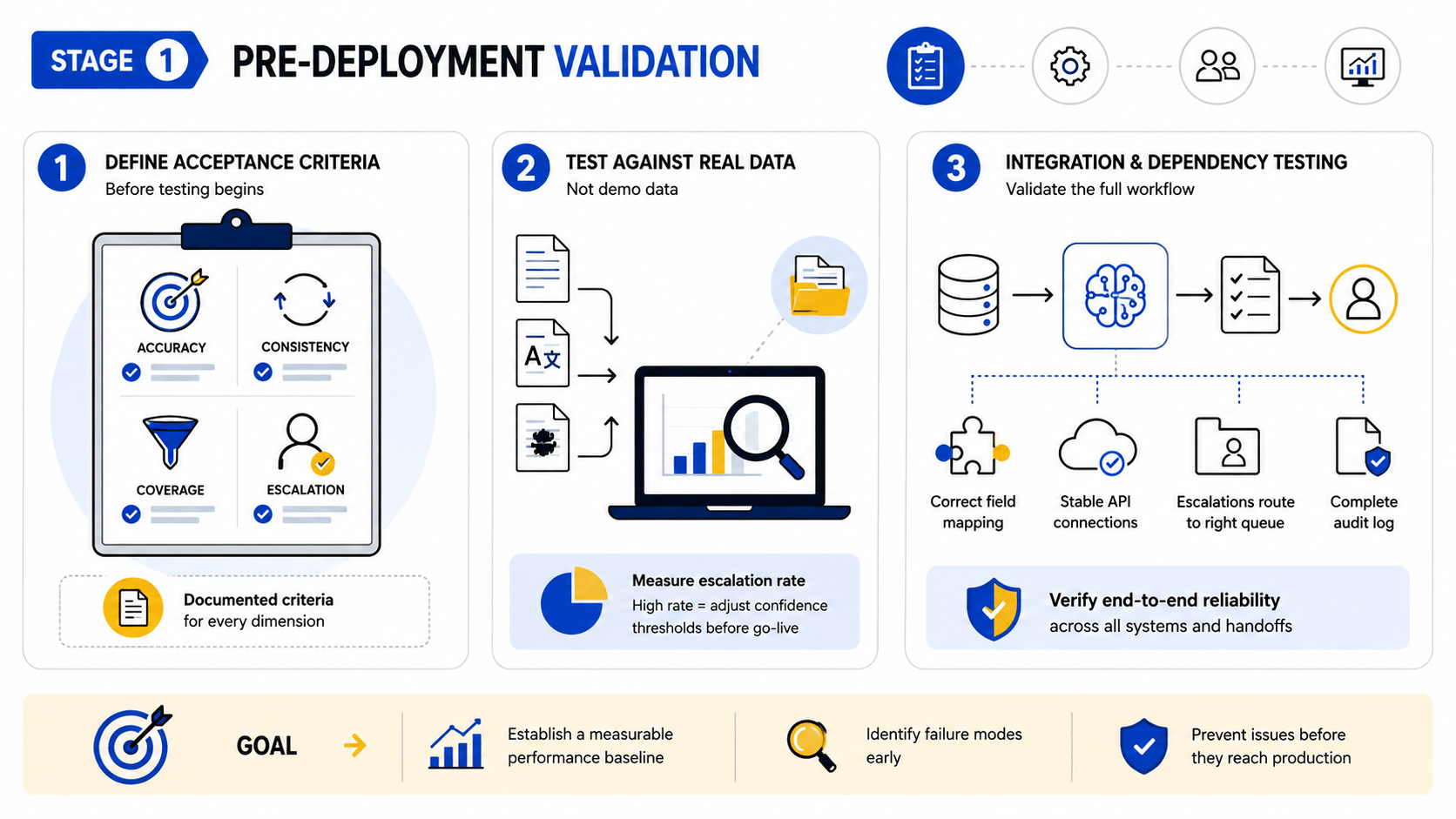
Pre-deployment validation is where most organizations invest the least and suffer the most for it later. The goal at this stage is not to prove that the AI works. It is to establish a documented baseline against which future performance can be measured, and to identify failure modes before they reach real data, real users, and real consequences.
Define Acceptance Criteria Before Testing Begins
The single most common failure in AI workflow validation is beginning testing without defined acceptance criteria. Teams run the workflow against sample inputs, review the outputs qualitatively, and declare it ready because it “looks right.” That approach produces no baseline, no failure taxonomy, and no defensible evidence that the workflow met a defined standard.
Acceptance criteria for AI workflows need to address four dimensions simultaneously: accuracy (does the output match the expected result?), consistency (does the workflow produce equivalent outputs for equivalent inputs?), coverage (does the workflow handle the full range of input types it will encounter in production?), and escalation behavior (does the workflow correctly identify cases it cannot handle confidently and route them to human review?). Each dimension requires its own metric and its own threshold, agreed before testing begins.
For a document extraction workflow, accuracy criteria might define that extracted field values must match verified ground-truth values in at least 95% of cases across a representative test dataset. Escalation criteria might require that any document where the system’s confidence score falls below a defined threshold is automatically routed to human review rather than auto-processed. Both criteria must be documented, not assumed.
Test Against Real Data, Not Demo Data
Clean, well-formatted sample documents are useful for initial configuration testing. They are not a valid proxy for production performance. Enterprise AI accuracy testing consistently shows that models performing strongly against structured test datasets degrade significantly when exposed to the actual document variety they encounter in production — legacy files, scanned originals, multilingual inputs, and edge cases that standard training datasets do not represent.
Pre-deployment validation should use a dataset that reflects the real input distribution the workflow will handle. That means pulling a representative sample from your actual document archives — including the outliers, the poorly formatted submissions, and the edge cases — and testing the workflow against them before go-live. The proportion of documents that trigger escalation during this test is one of the most informative metrics available: if the escalation rate is significantly higher than expected, the workflow’s confidence thresholds need adjustment before the workflow processes live data.
Integration and Dependency Testing
AI workflows rarely operate in isolation. They connect to upstream data sources, downstream systems, and human review interfaces that each carry their own failure modes. An AI workflow that extracts data correctly from a document but writes it to the wrong field in a downstream CRM because of a mapping error has failed the organization just as completely as one that extracted the data incorrectly.
Integration testing for AI workflows should explicitly verify that extracted fields map correctly to destination systems, that API connections to external databases are stable under the expected query volume, that escalated cases route to the correct review queue with the expected context attached, and that the audit log captures each workflow step in a format that satisfies the organization’s documentation requirements. SmartDev’s automation testing services cover this integration layer as a structured phase of the deployment process, not an afterthought.
Stage 2: User Acceptance Testing (UAT)
Technical validation confirms that the workflow functions correctly under controlled conditions. User acceptance testing (UAT) confirms that it functions correctly in the hands of the people who will actually use it — and that those people trust it enough to use it productively rather than working around it.

The Trust Problem in AI Workflow Adoption
Technically functional AI workflows fail in production for non-technical reasons more often than most implementation teams anticipate. If the users responsible for reviewing escalated cases do not understand why the system escalated a particular document, they will either apply inconsistent judgment or escalate everything to a senior reviewer — eliminating the efficiency gain the automation was meant to deliver. If operations leads cannot interpret the risk scores or confidence ratings the system generates, they will either ignore them or override them reflexively.
UAT for AI workflows should therefore focus not just on whether users can complete the process, but on whether they understand what the system is telling them and trust its outputs sufficiently to act on them. This requires structured testing scenarios where representative users work through real cases — including escalations, edge cases, and low-confidence outputs — and provide structured feedback on what the interface communicated clearly and what it did not.
Defining the Human-in-the-Loop Correctly
AI workflow automation consistently performs best when the boundary between automated processing and human review is defined precisely before deployment. UAT is the right moment to validate that boundary against real user behavior. Cases that the system auto-clears should be sampled and reviewed by human users during UAT to verify that the auto-clearance decisions were appropriate. Cases that the system escalates should be reviewed to verify that the escalation context — the specific field, confidence score, and supporting information provided to the reviewer — is sufficient for the reviewer to make an informed decision without additional research.
Where UAT reveals that reviewers are consistently requesting information beyond what the escalation context provides, the workflow’s escalation interface needs adjustment before go-live. Where UAT reveals that reviewers are overriding auto-cleared cases at a high rate, either the auto-clearance thresholds are too permissive or user trust in the system has not been established sufficiently through training and communication.
Stage 3: Post-Deployment Monitoring
Passing pre-deployment validation and UAT does not mean the workflow will continue performing at the same standard indefinitely. The real-world inputs an AI workflow encounters in production evolve continuously. Supplier document formats change. Regulatory requirements update. The composition of the input population shifts as the organization onboards new suppliers, enters new markets, or changes its product mix. Each of these changes can degrade workflow performance without triggering any visible error — the system continues to process documents and produce outputs, but those outputs are progressively less accurate than the baseline established at deployment.
Post-deployment monitoring is what catches this degradation before it becomes a compliance event, an operational failure, or a regulatory finding.

Establishing and Maintaining Performance Baselines
The NIST AI RMF’s Measure function explicitly requires organizations to document how production metrics diverge from pre-deployment baselines over time. In practice, this means the metrics established during pre-deployment validation — accuracy rates, escalation rates, processing times, false positive rates — must be tracked continuously in production and compared against the deployment baseline at defined intervals.
An escalation rate that was 8% at deployment and has risen to 22% three months later is a significant signal that the workflow is encountering inputs it was not configured to handle. That signal does not generate a system error. It requires a monitoring layer that is specifically looking for it. Similarly, an accuracy rate that has drifted from 96% to 89% across a category of documents is invisible unless someone is measuring it — and measuring it against a documented baseline rather than against current outputs alone.
What to Monitor and How Often
Effective post-deployment monitoring for AI workflow automation covers three categories of metrics. Output quality metrics track whether the workflow’s outputs remain accurate against ground-truth validation samples — typically assessed through periodic human auditing of a statistically representative sample of auto-processed cases. Process metrics track escalation rates, processing times, and exception volumes, which are leading indicators of performance change before accuracy metrics confirm it. System metrics track API response times, data source connectivity, and integration stability, which affect workflow reliability independently of model performance.
Monitoring frequency should be proportional to workflow criticality and input volume. A high-volume compliance screening workflow processing hundreds of documents daily warrants daily monitoring of process metrics and weekly sampling of output quality. A lower-volume procurement workflow might operate on weekly process monitoring and monthly quality auditing. The key principle is that monitoring cadence should be defined and documented before deployment, not improvised after a problem surfaces.
Stage 4: Drift Detection and Continuous Validation
Model drift is the gradual degradation of AI performance as the real-world data the model encounters diverges from the data it was trained and configured on. The NIST AI RMF describes drift as one of the primary ongoing risks of production AI systems — not a failure mode that occurs at a point in time, but a continuous process that requires continuous detection.
For AI workflow automation specifically, drift manifests in two ways. Data drift occurs when the characteristics of incoming inputs change — new document formats, new supplier types, new languages, or new field structures that the workflow was not configured to handle. Concept drift occurs when the relationship between inputs and correct outputs changes — for example, when a regulatory update changes what constitutes a compliant supplier declaration, making previously acceptable outputs non-compliant.

Practical Drift Detection Without a Data Science Team
The Population Stability Index (PSI) is one of the most practically accessible drift detection metrics for enterprise AI workflows: PSI below 0.10 indicates negligible drift, 0.10 to 0.25 warrants investigation, and above 0.25 signals significant drift requiring intervention. Monitoring tools including Evidently AI, WhyLabs, and NannyML calculate PSI automatically against defined baselines, making drift detection operationally feasible without requiring a dedicated data science function to run it manually.
For business and operations teams who are not running their own monitoring infrastructure, drift detection should be a contractual and operational responsibility of the AI workflow provider. The governance question is not “what tool detects drift” but “who is accountable for detecting it, what is the defined response when a threshold is breached, and how is that response documented.” Those three questions should have written answers before deployment, not after the first drift event.
Retraining, Rule Updates, and Governance
When drift is detected, the response depends on its cause. Data drift typically requires configuration updates — adjusting extraction templates, adding new document type handling, or updating field mapping rules. Concept drift may require retraining on updated examples, updating screening rule logic, or revising acceptance criteria to reflect the changed regulatory or operational context.
Both types of intervention should follow a documented change management process: the change is proposed, validated against a test dataset, reviewed by a qualified stakeholder, and deployed through a controlled release rather than applied directly to the production workflow. This change log becomes part of the workflow’s governance record — the evidence that the organization responded appropriately to detected drift and maintained a defined performance standard over time. For organizations operating under regulatory oversight, this governance record is not optional. The EU AI Act’s post-market monitoring requirements for high-risk AI systems make continuous performance documentation a compliance obligation, not a best practice.
Validation Roles: Who Is Responsible for What
A validation framework only works if accountability is clearly assigned. The most common failure pattern is a framework that documents what should happen at each stage without specifying who owns each responsibility. When a drift alert fires six months post-deployment, the question “whose job is it to respond?” should have a pre-written answer.

The table below maps validation responsibilities across the two primary stakeholder groups:
| Validation stage | Technical team responsibilities | Business/Operations team responsibilities |
|---|---|---|
| Pre-deployment | Define acceptance criteria, build test datasets, run integration testing | Approve acceptance thresholds, validate escalation scenarios, sign off on UAT |
| UAT | Support testing environment, resolve interface issues | Execute test scenarios, document trust and usability findings |
| Post-deployment monitoring | Configure monitoring pipelines, set alert thresholds | Review monitoring reports, own escalation response decisions |
| Drift detection and response | Identify drift cause, implement configuration or retraining updates | Approve updated acceptance criteria, validate post-update performance |
The pattern across all four stages is consistent: technical teams identify and implement, business teams define, approve, and own the response. Validation frameworks that assign all accountability to the technical team consistently produce AI workflows that perform well technically but are not trusted or used correctly by the operations teams they were meant to support.
How NORA Builds Validation Into the Deployment Process
Most AI workflow implementations treat validation as a separate workstream that follows the build. NORA’s approach is to build validation checkpoints into the deployment process itself, so that acceptance criteria, test datasets, monitoring configuration, and drift response protocols are in place before the workflow goes live rather than being developed in parallel with a production system that is already processing real data.

Pre-Deployment: Structured Discovery and Baseline Establishment
NORA implementations begin with a structured discovery phase that maps the current workflow in detail — the document types, the data sources, the escalation logic, and the downstream systems the workflow must integrate with. That mapping produces the input for pre-deployment testing: a representative test dataset drawn from the organization’s actual document archives, a set of acceptance criteria agreed between SmartDev and the client before testing begins, and an integration test plan that verifies every connection before go-live.
The 3-Week AI Discovery Program is available for organizations that want to establish this foundation before committing to a full implementation. It produces a documented readiness assessment, a realistic performance baseline projection, and a clear specification of what validation will require — so there are no surprises when testing begins. SmartDev’s AI Proof of Concept service extends this into a working prototype validated against real client data before the production build starts.
Post-Deployment: Managed Monitoring as a Service
NORA’s managed service model means that post-deployment monitoring is not the client’s operational responsibility. SmartDev monitors output quality metrics, process metrics, and system performance on a defined cadence, generates structured performance reports at agreed intervals, and alerts the client when metrics breach defined thresholds. Drift detection runs continuously against the baselines established at deployment, and configuration updates follow the documented change management process described above.
This matters particularly for organizations without an internal data science or MLOps function — which is the majority of the mid-market enterprises that NORA is designed to serve. The AI model drift detection and retraining capability is included in NORA’s ongoing managed service, not billed as an additional engagement when a problem surfaces. The validation framework does not expire at launch. It runs continuously as part of the service.
The Governance Record
Every validation action NORA takes — pre-deployment test results, UAT findings, post-deployment monitoring reports, drift alerts, and configuration update logs — is documented in a structured governance record that the client can produce on request for internal audit, regulatory review, or due diligence purposes. This record is what transforms validation from an internal quality process into an externally defensible evidence base.
For organizations operating in regulated environments, this governance record is directly relevant to compliance audit trail requirements — the obligation to demonstrate not just that a decision was made, but that the system making it was validated, monitored, and maintained to a defined standard at the time the decision occurred. NORA’s validation framework produces that evidence as a natural output of the deployment and managed service process, without requiring the client to build or maintain a separate documentation system.
Conclusion
Testing AI workflow automation is not a project milestone. It is an ongoing operational discipline that begins before the first line of configuration is written and continues for as long as the workflow is in production. The organizations that treat validation as a launch gate will consistently discover that their AI workflows perform differently in production than they did in testing — not because the AI failed, but because real-world inputs are not demo inputs, and production conditions are not controlled conditions.
A complete validation framework covers four stages: pre-deployment testing against real data with documented acceptance criteria, user acceptance testing that validates trust and usability alongside technical function, post-deployment monitoring against established baselines, and continuous drift detection with a documented response protocol. Each stage requires defined ownership, defined metrics, and a documented record of what was found and what was done.
NORA brings this full validation framework to AI workflow automation as a fully managed service — built into the deployment process rather than bolted on after go-live, and sustained through the managed service rather than handed off to the client at launch. If your organization is evaluating AI workflow automation and wants to understand what a validation-first implementation looks like, contact SmartDev to discuss your specific workflow and readiness requirements.