
TL;DR
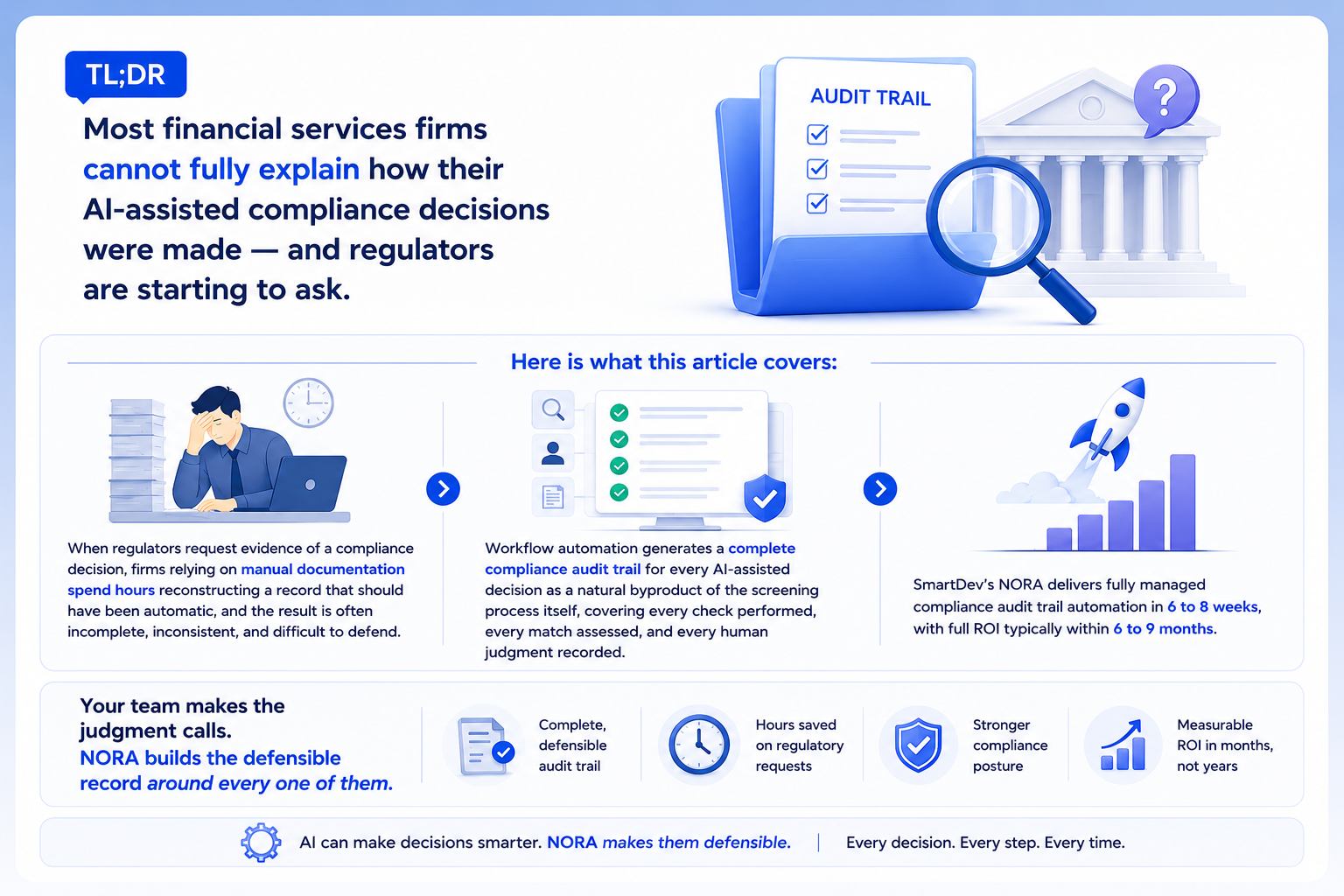
Most financial services firms cannot fully explain how their AI-assisted compliance decisions were made and regulators are starting to ask. Here is what this article covers:
- When regulators request evidence of a compliance decision, firms relying on manual documentation spend hours reconstructing a record that should have been automatic, and the result is often incomplete, inconsistent, and difficult to defend.
- Workflow automation generates a complete compliance audit trail for every AI-assisted decision as a natural byproduct of the screening process itself, covering every check performed, every match assessed, and every human judgment recorded.
- SmartDev’s NORA delivers fully managed compliance audit trail automation in 6 to 8 weeks, with full ROI typically within 6 to 9 months. Your team makes the judgment calls. NORA builds the defensible record around every one of them.
Introduction
A regulator contacts your compliance team and requests complete documentation for every counterparty screening decision made over the past six months. Your team has reviewed thousands of cases across that period. Some were auto-cleared. Others were escalated and reviewed by an analyst. A small number were escalated again to senior review. The regulator wants a timestamped record for each one: what data was checked, what system was used, what the output was, and who made the final call.
If your current compliance process relies on manual documentation, that request is a problem. Not because the reviews were not done, but because the compliance audit trail that proves they were done simply does not exist in the form regulators now expect. Notes sit in email threads. Decisions live in spreadsheets with no timestamp. Escalation records depend on whether an analyst remembered to log the outcome before moving to the next case. Reconstructing six months of decisions from those fragments takes days, produces an incomplete picture, and raises more questions than it answers.
The challenge is structural, not operational. Manual compliance documentation never matched the audit standards regulators now apply to AI-assisted workflows. The FCA’s guidance on AI model governance makes clear that firms must be able to explain and evidence every AI-assisted decision on request. Similarly, the EU AI Act’s requirements for high-risk AI systems place documentation and traceability obligations directly on financial services operators. This guide explains why that gap exists, what a genuinely defensible compliance audit trail requires, and how workflow automation builds that trail automatically, for every decision, without any additional burden on your compliance team.
Why Manual Compliance Documentation Fails Regulators
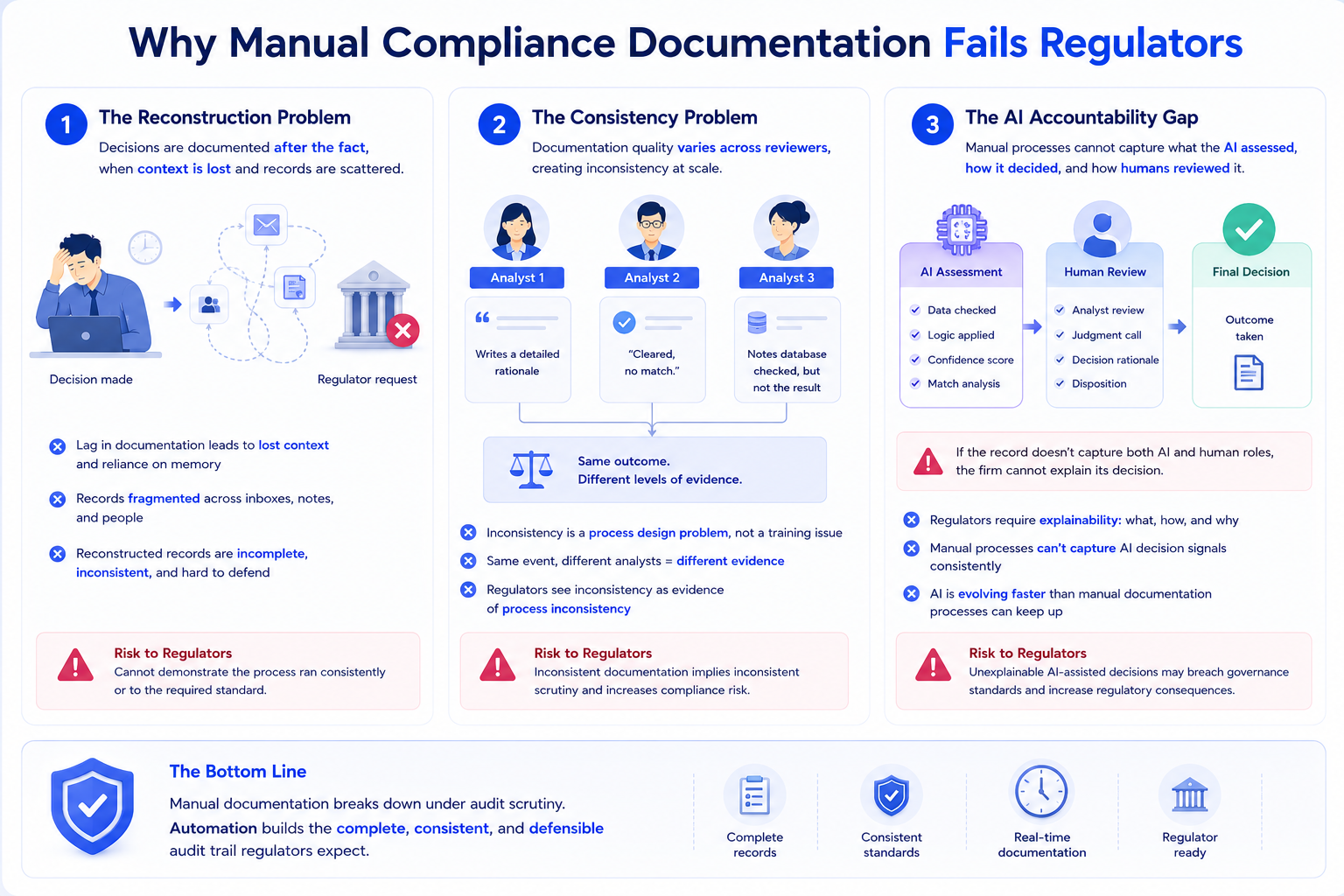
1. The Reconstruction Problem
Most compliance teams do not document decisions in real time. They document them after the fact, when an audit request arrives or a dispute requires evidence. That lag is where the compliance audit trail breaks down. By the time documentation comes together, the analyst who made the decision may have reviewed dozens of cases since. The context is gone. The reasoning comes from memory. The record produced does not reflect what actually happened at the moment of the decision.
The reconstruction problem compounds when multiple people touch the same case. A document passes through one analyst for screening, moves to a second for review, and reaches a third for approval. Each person may apply different documentation practices. One logs the full rationale. Another records only the outcome. The third makes no record at all because the approval happened verbally in a team meeting. The resulting trail fragments across three people’s inboxes, case management notes, and memory, none of which a regulator can access in a structured format.
According to McKinsey’s research on compliance function modernisation, firms consistently underestimate the documentation burden of manual compliance workflows until a regulatory review exposes the gap. Furthermore, the cost of that gap is not only the time spent rebuilding records. It is the regulatory exposure created when the reconstructed record is incomplete, and the firm cannot demonstrate that its screening process ran consistently and to the required standard.
2. The Consistency Problem
Even when compliance teams document decisions in real time, the quality of that documentation varies significantly across reviewers. One analyst writes a paragraph explaining their rationale. Another writes “cleared, no match.” A third notes the database checked but not the result. None of those approaches is necessarily wrong, but the inconsistency they create across thousands of decisions becomes a serious problem when regulators examine the record as a whole.
Inconsistent documentation is not a training problem. It is a process design problem. Manual compliance documentation relies on individual judgment about what is worth recording, in what format, and with what level of detail. When that judgment varies across a team, the compliance audit trail varies with it. Consequently, the same screening event reviewed by two different analysts produces two different levels of evidence, even if the compliance outcome is identical.
Regulators interpret documentation inconsistency as evidence of process inconsistency. If some decisions carry thorough documentation and others do not, the natural inference is that some decisions received more scrutiny than others. In that case, the documentation gap becomes a compliance gap in the regulator’s assessment, regardless of whether the underlying screening was actually thorough. AI workflow automation removes this variability at the source by applying a consistent logging standard to every decision, automatically, without relying on individual reviewer practice.
3. The AI Accountability Gap
AI-assisted compliance decisions introduce a specific documentation challenge that manual processes cannot address. When an AI system flags a potential match or recommends a screening outcome, the compliance team acts on that recommendation. However, if the documentation does not capture what the AI assessed, what confidence level it assigned, and what logic it applied, the firm cannot explain its own decision to a regulator. The AI did the work, but the record does not show it.
This accountability gap is growing in regulatory significance. Authorities across multiple jurisdictions, including the Financial Conduct Authority in the UK and regulators operating under EU AI Act requirements, increasingly focus on explainability: the ability of a firm to demonstrate not only what decision was made, but how and why. For AI-assisted compliance workflows specifically, that means documenting the AI’s role in the decision alongside the human reviewer’s role. Manual documentation processes have no mechanism for capturing that separation consistently.
The risk is not hypothetical. Firms that cannot explain their AI-assisted compliance decisions face the same regulatory consequences as firms that cannot explain their manual ones, plus the additional concern that an unexplainable AI process may operate outside acceptable governance standards. AI use cases in financial services are evolving faster than most manual documentation processes can keep pace with, and the compliance audit trail gap is widening as a result.
What Workflow Automation Does for Compliance Audit Trails
1. Automated Decision Logging at Every Step
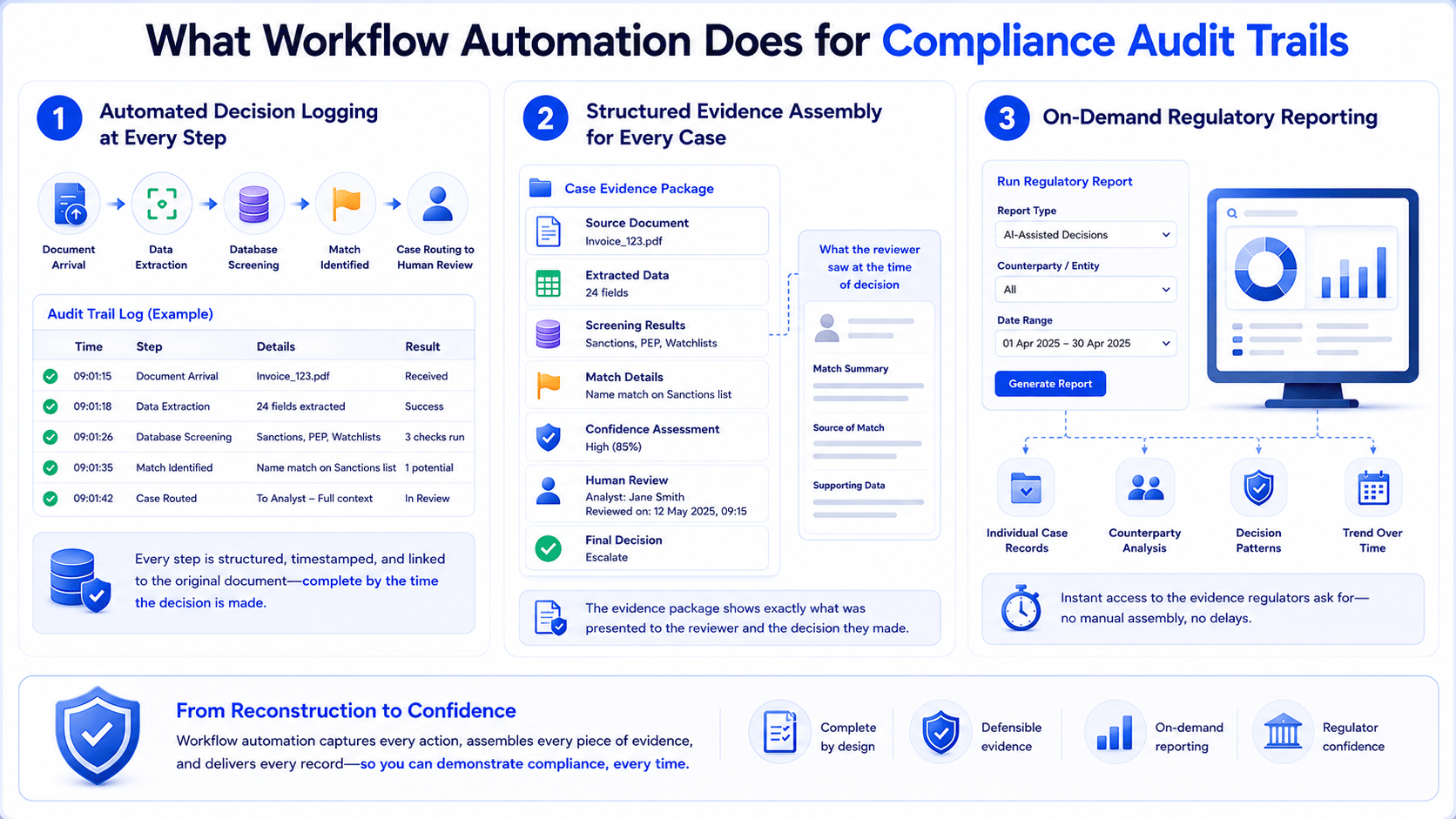
Workflow automation generates the compliance audit trail as a built-in output of the screening process itself, not as an afterthought that relies on someone remembering to document. Every step in the compliance workflow produces a log entry automatically. The system records document arrival, field extraction, database screening with timestamps and results for each check, match identification with the specific field that triggered the flag, and case routing to human review with the full context presented to the reviewer.
The system structures, timestamps, and links each log entry to the original document. The trail does not depend on what an analyst chose to write in a case management note. It does not depend on whether an escalation was recorded before the team moved on to the next case. It exists because the workflow produces it automatically for every document that passes through the system, regardless of whether that document clears automatically or requires senior review.
In practice, this means the compliance audit trail is complete by the time the decision is made, not assembled after the fact when a regulator asks for it. AI-powered document intake and data processing generates this kind of structured, step-by-step record as a natural output of the screening workflow, covering every action from document arrival to final disposition without any additional documentation burden on the compliance team.
2. Structured Evidence Assembly for Every Case
A complete compliance audit trail is not just a log of actions. It is a structured evidence package that a regulator, auditor, or senior reviewer can assess without needing additional context from the compliance team. Workflow automation assembles that package for every case processed, covering the source document, the extracted data, the screening results, the match details, the confidence assessment, and the final decision.
For cases that reach a human reviewer, the evidence package extends to include what information the firm presented to the reviewer at the time of the decision. This matters because it addresses one of the most common regulatory concerns about AI-assisted compliance: that reviewers may have approved or rejected a case without seeing the full picture. When the audit trail records exactly what the reviewer saw, alongside the decision they made, the firm can demonstrate that the human judgment was informed, not cursory.
Furthermore, structured evidence assembly changes what happens when a specific case comes under challenge. Instead of rebuilding the evidence from scattered sources under time pressure, the compliance team retrieves a complete, pre-assembled record in seconds. That record answers every standard regulatory question: what data did the firm use, what system did it involve, who reviewed it, when, and on what basis. AI workflow automation in business processes consistently produces this evidence-first design across compliance and documentation workflows, replacing reconstruction with retrieval.
3. On-Demand Regulatory Reporting
The final output of an automated compliance audit trail is a reporting capability that manual processes cannot match: the ability to produce a complete, structured compliance record for any case, any counterparty, or any time period, on demand, in minutes. When a regulator makes a documentation request, the response does not require days of manual assembly. It requires a query against a structured log that already contains everything needed.
This capability is increasingly important as regulatory requests grow more specific and more time-constrained. Regulators reviewing AI-assisted compliance workflows often request evidence not just of individual decisions, but of the pattern of decisions across a category of counterparty or a defined transaction type. Manual documentation cannot produce that kind of aggregate evidence efficiently. Automated logging produces it as a standard report, because every decision follows the same structured format and every record is queryable in the same way.
Additionally, on-demand reporting changes the compliance team’s relationship with regulatory review from reactive to confident. Instead of approaching an audit with uncertainty about what records exist and in what form, the team knows precisely what the audit trail contains and can produce any part of it immediately. That shift in posture, from scrambling to demonstrate compliance to simply retrieving the evidence of it, is one of the most operationally significant benefits of automated compliance workflow solutions for mid-market financial services firms.
How NORA Delivers Compliance Audit Trail Automation
1. A Fully Managed Approach
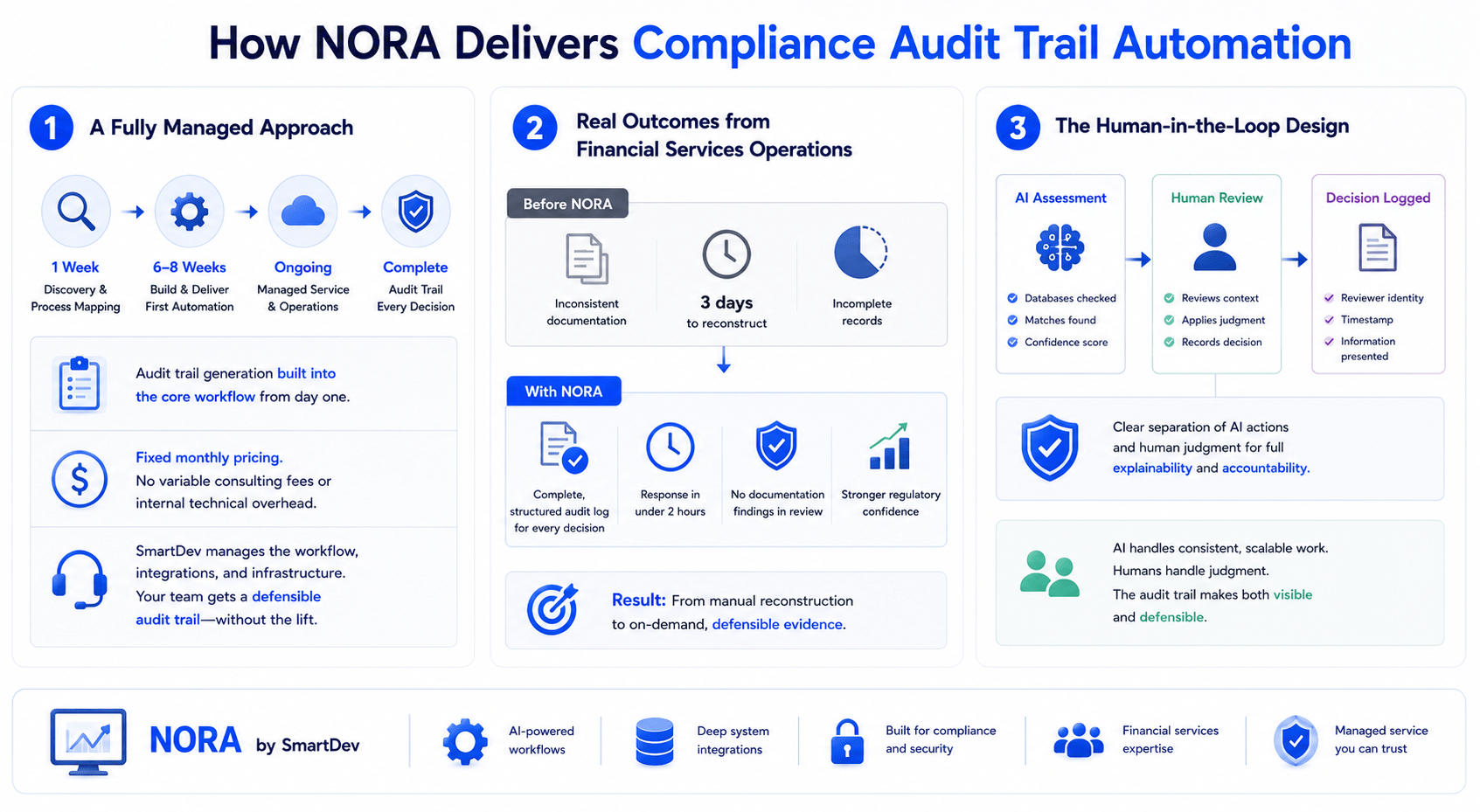
NORA is SmartDev’s AI Adoption Accelerator, a fully managed service that designs, builds, and continuously operates AI-assisted compliance workflows for financial services firms. For compliance audit trail specifically, NORA does not bolt documentation onto an existing process as a secondary feature. It builds the audit trail generation into the core workflow design, so that the system produces complete, structured evidence for every decision from the first day of operation.
NORA’s compliance workflow covers the full decision chain: document intake, sanctions and PEP database screening, adverse media checks, match flagging with confidence scores, human review escalation, and final disposition logging. Each step produces a structured, timestamped record automatically. Your compliance team works within the same process they know, with a complete AI workflow automation layer running beneath it, capturing every action without adding a single manual documentation task. NORA also integrates with your existing case management systems and ERP infrastructure through standard APIs, so there is no rip-and-replace of the tools your team already uses.
2. Implementation and Pricing
The implementation begins with a one-week structured discovery phase. SmartDev maps your current compliance screening process, identifies the documentation gaps that create regulatory exposure, and defines the logging standard that will govern every automated and human decision in the workflow. From that foundation, SmartDev delivers the first working automation in 6 to 8 weeks. The 3-week AI discovery program provides a structured starting point for compliance teams that want to assess their audit trail readiness before committing to a full implementation.
The pricing model covers both setup and ongoing managed service at a fixed monthly cost. There are no variable consulting fees and no internal technical overhead required. SmartDev maintains the workflow logic, database integrations, and logging infrastructure as part of the ongoing service. Your compliance team gains a defensible audit trail capability without needing to build or maintain the system that generates it. For a broader view of how AI supports financial services compliance operations, SmartDev outlines the full range of use cases available to mid-market firms in regulated industries.
3. Real Outcomes from Financial Services Operations
One mid-market financial services firm processed counterparty screening requests across sanctions, PEP, and adverse media databases, with each event requiring manual documentation by the reviewing analyst. Before automation, the compliance team had no consistent documentation standard. Some reviewers logged detailed rationales. Others recorded only the final outcome. When regulators requested evidence of screening decisions for a specific entity category, the team spent three days reconstructing a record that was still incomplete at submission.
After implementing NORA’s compliance workflow automation, every screening decision produced a complete, timestamped audit log automatically. The log captured the document received, the fields extracted, the databases queried, the matches identified with confidence scores, the escalation routing, and the human decision recorded by the reviewing analyst. When the same regulator made a follow-up documentation request six months into deployment, the compliance team produced a complete, structured response in under two hours. No reconstruction was required.
Additionally, the firm’s regulatory posture changed in a measurable way. The compliance function could answer questions about its AI-assisted decision process with specific evidence rather than general assurances. Auditors reviewing the system noted that the structured log format matched the documentation standard they expected for AI-governed workflows, and the firm received no documentation findings in the subsequent review cycle. The operational improvement was significant. However, the regulatory confidence it produced was the more consequential outcome.
4. The Human-in-the-Loop Design
NORA’s compliance audit trail does not obscure the human role in AI-assisted decisions. It makes that role more visible and more defensible. Every case that reaches a human reviewer arrives with the AI’s assessment fully documented: what the system checked, what it found, and what confidence level it assigned. The reviewer’s decision logs alongside that context, creating a clear record that shows the human acted on informed, structured information rather than a black-box recommendation.
This design directly addresses the explainability requirement that regulators increasingly apply to AI-assisted compliance workflows. The audit trail shows not only what decision the firm made, but the division of labour between the AI system and the human reviewer. The system logs automated steps as automated. It logs human decisions as human, with the identity of the reviewer, the timestamp of the review, and the information the firm presented at the time of the decision. That separation is precisely what regulators need to assess whether the AI governance framework operates as intended.
Beyond regulatory compliance, the human-in-the-loop audit trail produces accountability at the individual decision level. If a specific case later comes under challenge, the log shows who reviewed it, when, and on what basis. That accountability does not exist in a manual process where documentation practices vary by reviewer. SmartDev’s compliance automation builds around this principle: AI handles the consistent, scalable work, humans handle the judgment, and the audit trail makes both visible and defensible.
The Business Case for Compliance Audit Trail Automation
1. The True Cost of Manual Compliance Documentation
Manual compliance documentation carries costs that most compliance budgets do not capture accurately, because those costs appear as staff time rather than a discrete line item. When an analyst spends 10 to 15 minutes documenting each screening event in addition to performing the review itself, that documentation overhead consumes a significant share of daily capacity across the team. For a team of five analysts processing 150 documents per day, documentation time alone can account for 12 to 18 analyst hours every working day.
The cost of reactive documentation, triggered by a regulatory request or dispute, is higher still. Rebuilding a compliance audit trail for a period of six months, across multiple case types and reviewers, typically requires several days of senior analyst time and still produces an incomplete record. The direct cost of that effort is measurable. The regulatory risk that an incomplete or inconsistent record creates is not, until a regulator quantifies it in the form of a finding, a remediation requirement, or a financial penalty.
Documentation gaps create a compounding liability over time. Every month of manual documentation practice adds another month of incomplete records to the compliance function’s exposure. Furthermore, as regulatory scrutiny of AI-assisted workflows intensifies, the standard that documentation must meet is rising faster than manual practices can adapt. The gap between what regulators expect and what manual compliance teams can produce is not closing on its own. It requires a structural change, not a training program.
2. ROI Timeline and What to Expect
NORA implementations for compliance audit trail automation typically reach full ROI within 6 to 9 months. The fixed setup fee and monthly managed service model means costs are predictable from the first day of deployment, with no variable consulting hours and no internal development or maintenance overhead. Your compliance budget reflects a known cost, not an open-ended commitment.
The return arrives across two dimensions simultaneously. The first is operational: documentation time disappears as a separate activity, because the workflow generates the audit trail automatically. Analysts spend more time on review and less time on record-keeping. The second dimension is risk reduction: the regulatory exposure that incomplete or inconsistent documentation creates gives way to a complete, structured, and immediately retrievable record for every decision. Both dimensions produce measurable value from the first month of operation.
For compliance teams evaluating where to start with automation, audit trail generation is one of the strongest entry points. The output is entirely structured, the success metric is clear, and the regulatory benefit is direct and demonstrable. Unlike broader AI transformation programmes, compliance audit trail automation does not require an overhaul of existing screening processes. It integrates with your current workflow and adds the documentation layer that should have been there from the start. SmartDev’s compliance automation solutions integrate at this level, adding the audit trail infrastructure without disrupting the operational layer your team already works within.
3. Comparing Your Options
Large consulting firms can design compliance documentation frameworks, but those engagements typically take 6 to 12 months to reach a production standard, bill on a time-and-materials basis, and deliver a designed process rather than a built system. Your compliance team then takes responsibility for implementing and maintaining the documentation practice internally, with all the consistency and enforcement challenges that creates. The engagement ends. The documentation problem often does not.
Point products exist for specific compliance tasks, such as sanctions screening or KYC workflow management, but they rarely include end-to-end audit trail generation as a core output. They log what happens within their own workflow step, but they do not produce a unified record across the full decision chain from document arrival to final disposition. Stitching together a defensible audit trail from multiple point product logs is a manual effort, and the result is exactly the kind of fragmented evidence record that creates problems during regulatory review.
NORA delivers a working compliance audit trail automation in 6 to 8 weeks, fully managed, with complete logging across every step of the AI-assisted decision workflow, from intake to disposition. The audit trail is not a feature. It is a core output of the workflow design. No internal technical overhead is required. SmartDev maintains the logging infrastructure, database integrations, and system performance as part of the ongoing managed service.
Conclusion
A compliance audit trail is not a documentation exercise. It is a regulatory obligation that the manual practices most firms rely on never addressed at the scale and standard now expected for AI-assisted workflows.
The financial services firms that will face the most significant regulatory pressure over the next few years are not those with the weakest compliance processes. They are the ones with the strongest AI-assisted screening capabilities and the weakest ability to explain and document what those systems did. That combination, strong AI output and poor audit trail, is precisely the profile that regulators are examining most closely as AI governance frameworks mature.
Workflow automation closes that gap by building the compliance audit trail into the decision process itself, rather than adding it as a manual task after the fact. Each AI-assisted screening decision produces a complete, structured, and immediately retrievable evidence package. The system logs every human judgment alongside the context that informed it. Your compliance team retrieves a structured report and responds to regulatory requests in minutes, not days.
SmartDev’s NORA brings this capability to financial services compliance as a fully managed service, delivered in 6 to 8 weeks, with full ROI typically within 6 to 9 months. If your compliance function cannot currently answer a regulator’s documentation request in minutes rather than days, that gap is worth closing before the request arrives. Contact SmartDev to discuss your specific requirements, or explore SmartDev’s fintech and financial services solutions to see the full range of compliance audit trail and workflow automation capabilities available for mid-market firms in regulated industries.