
Introduction
Artificial Intelligence has officially transitioned from an experimental luxury to a core operational requirement as enterprises are actively deploying AI to streamline workflows and capture significant operational efficiencies.
However, many organizations encounter a critical “performance cliff” post-launch. Without ongoing optimization, AI models often lose accuracy as data evolves, leading to broken workflows and a decline in user trust. This degradation transforms high-potential projects into underutilized legacy software.
Addressing this challenge requires a fundamental shift in perspective, moving away from static, one-off installations toward a model of Managed AI Services. By integrating specialized AI solution accelerators or robust AI workflow automation frameworks, organizations can bridge the gap between initial deployment and long-term ROI. This proactive approach ensures that the intelligence layer remains resilient, adaptive, and fully aligned with shifting business objectives.
Key Trends that One-Off AI Projects Follow
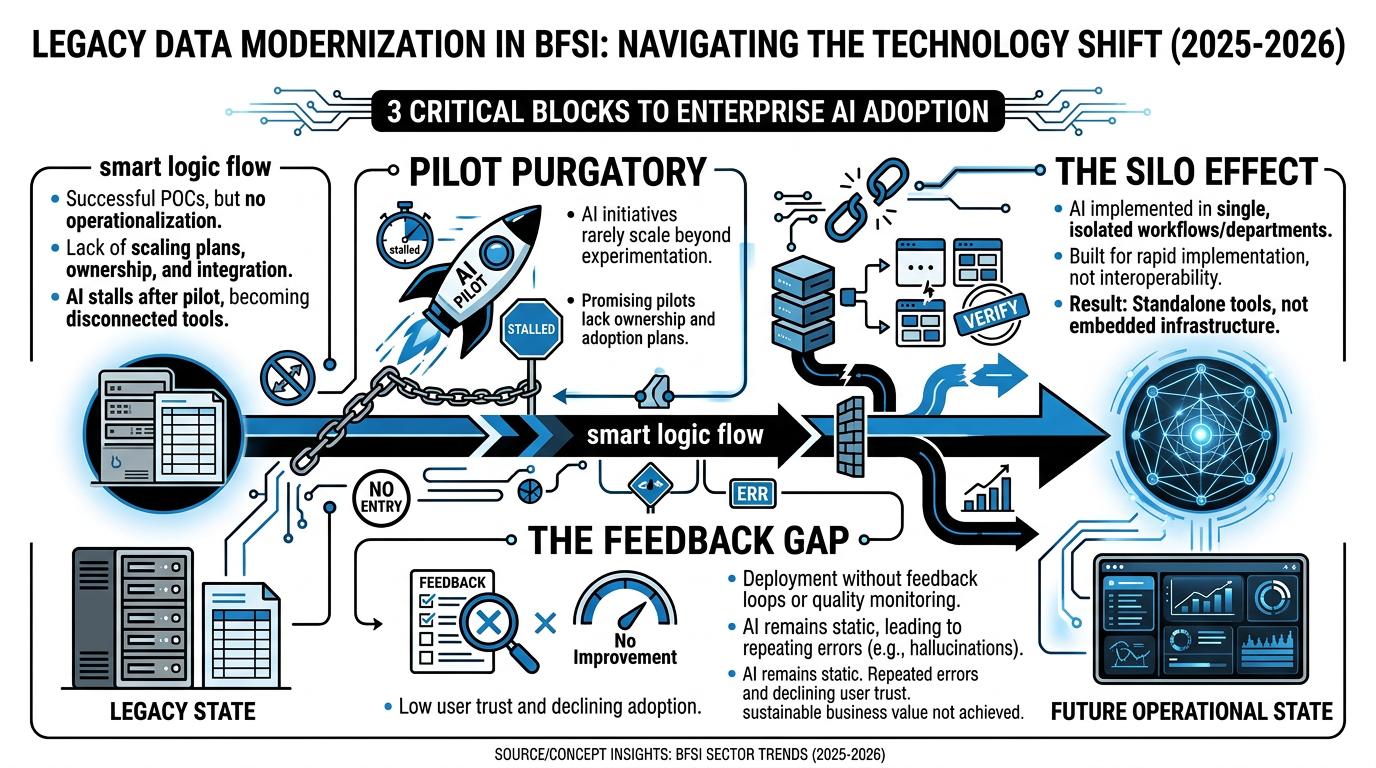
With the increasing application of AI in business, thousands of entrepreneurs over focus on AI and Technology and follow these trends:
| Key Trends/ Shifts | Application | Effects |
| Pilot Purgatory | Companies successfully build AI demos or proofs of concept, but fail to operationalize them across the business. Most AI initiatives stall after the pilot phase because organizations lack a scaling plan, ownership structure, or workflow integration. | AI initiatives rarely scale beyond experimentation. What begins as a promising pilot often becomes a disconnected tool with limited adoption, unclear ownership, and declining business value over time. |
| The Feedback Gap | Organizations deploy AI systems without collecting user feedback, monitoring output quality, measuring business impact, or incorporating human review into the workflow. As a result, the AI remains static after deployment instead of continuously improving over time. | This often leads to repeated errors, unresolved hallucinations, declining user trust, stagnant workflows, and low adoption across the organization. Without continuous feedback and optimization, even technically capable AI systems struggle to deliver sustainable business value. |
| The Silo Effect | Many organizations implement AI within a single department, isolated workflow, or narrow use case without integrating it into broader business systems and operations. These one-off deployments are often built for rapid implementation or pilot success rather than enterprise-wide interoperability. | This creates AI tools that function as standalone assistants rather than embedded operational infrastructure. Employees still need to manually verify outputs, switch between systems, or complete tasks themselves. |
The Performance Paradox: Why “One-Off” AI Projects Fail the Enterprise
In traditional IT, the “Build – Deploy – Forget” lifecycle is a standard operating procedure. For static software, this linear approach works. However, when applied to Artificial Intelligence, this mindset creates a significant strategic vulnerability.
The fundamental difference lies in the nature of the technology: AI is not a static asset; it is a dynamic dependency. Unlike traditional code, AI performance is inextricably linked to fluid environments. When the inputs change, intelligence degrades.
This is exactly the gap that NORA – SmartDev’s AI adoption accelerator – is designed to solve. Rather than treating AI as a standalone project, NORA helps enterprises build scalable AI workflows that continuously evolve alongside business operations.

1. The Reality of Model Decay and Data Drift
AI models are trained on historical snapshots of data. However, the real world is never static. Over time, a gap inevitably forms between the model’s original training and current business realities. This phenomenon, known as data drift or model drift, is the primary reason isolated AI projects degrade.
Consumer behaviors with market trends or buying patterns shift seasonally or in response to global events. Meanwhile, companies adopt new software, restructure supply chains or update internal workflows. New compliance standards in finance or healthcare also render an old model obsolete that needs regulatory updates.
In addition, many AI projects fail because they remain isolated pilots rather than integrated operational systems. Common challenges include low employee adoption, disconnected workflows, unclear ownership, and limited business accountability.
Without continuous monitoring and retraining, AI performance naturally deteriorates. In high-stakes industries like logistics or financial services, even minor inaccuracies can lead to significant operational risks and lost revenue.
With NORA, auto-monitoring capabilities can detect model drift early before it impacts operations as we combine automation with human supervision rather than relying entirely on autonomous AI. Its AI managed service model includes ongoing optimization after deployment. Instead of treating implementation as the finish line, NORA continuously updates workflow, refines prompts evolves alongside the business environment.
2. Lack of Operational Foundation for Long-Term ROI
Another major reason one-off AI projects fail is that organizations often focus heavily on initial deployment while underestimating the long-term operational requirements needed to sustain AI performance. In many cases, AI initiatives launch successfully but lack the governance, optimization processes, and operational ownership required to scale effectively over time. There are several common issues including:
- No clear framework for performance tracking and accountability
- Limited governance around compliance, security, and auditability
- Lack of version control and workflow standardization
- Minimal user feedback integration after deployment
- No structured process for continuous optimization or expansion
As business conditions evolve, these gaps become increasingly problematic. AI systems gradually lose relevance, operational alignment weakens, and ROI declines. This is why many AI pilots generate short-term excitement but fail to deliver lasting business impact at scale. That creates a practical need for managed AI services within organizations.
With concerns stemming from long-term ROI as well as optimizing AI ROI, SmartDev has built up NORA to provide enterprise with a structured AI adoption framework around continuous optimization, workflow orchestration and governance readiness. Instead of treating AI as a standalone implementation, NORA helps organizations establish the operational foundations necessary to maintain, scale, and evolve AI capabilities over time.
As enterprise AI adoption matures, long-term success is increasingly determined not by how quickly AI is deployed, but by how effectively it is operationalized and continuously managed across the organization.
Why AI Workflow Automation is the Optimal Choice for Businesses?
1. Accelerated Time-to-Value
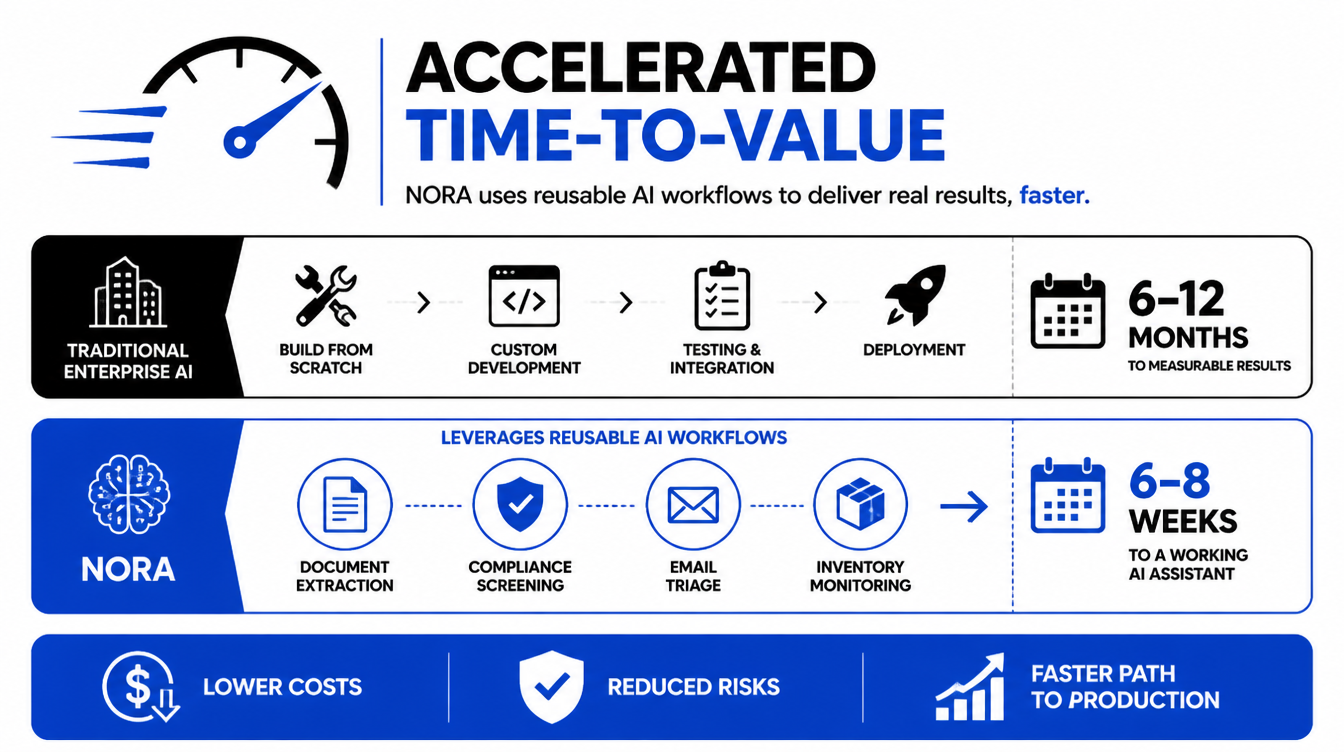
Traditional enterprise AI projects often take 6–12 months before delivering any measurable business results, largely due to complex planning cycles, heavy infrastructure requirements, fragmented data systems, and the need for extensive model development and validation. These extended timelines not only slow down innovation but also significantly increase overall project costs, as organizations must continuously allocate technical resources, manage multiple stakeholders, and maintain parallel experimentation environments over long periods.
AI solution accelerators solve this by using reusable AI components, workflow templates, and pre-built integrations that dramatically shorten deployment timelines.
NORA is designed around this model. Instead of building AI systems from scratch, NORA leverages reusable AI workflows for use cases like: Document extraction, Compliance screening, Email triage or Inventory monitoring. This enables businesses to deploy a first working AI assistant in just 6–8 weeks, helping organizations move from PoC to production much faster while reducing experimentation costs and operational risk.
2. Continuous Optimization Over Static Deployment
AI accelerators are built to support continuous improvement rather than one-time deployment. Through ongoing monitoring, retraining, and workflow refinement, organizations can maintain high AI accuracy even as business conditions evolve.
Through AI workflow automation, business can be supported by automated monitoring, drift detection, human-in-the-loop validation, continuous retraining or workflow optimization. NORA is built based on those benefits to guarantee that data and workflow is monitored and updated in reality, to avoid errors or out-of-date information that is no longer suitable, creating managed AI services.
3. Seamless Enterprise Integration
AI generates the greatest value when embedded directly into day-to-day business operations. NORA’s architecture is designed to integrate across ERP systems, CRM platforms, enterprise email, internal databases, and operational tools. This allows organizations to unify fragmented workflows and automate actions across departments.
In practice, NORA’s AI workflow automation can streamline a wide range of business operations by extracting invoice data directly into ERP systems, generating workflow actions from incoming emails, triggering automatic inventory restocking processes, and supporting real-time compliance operations. By integrating these functions into a unified AI workflow layer, NORA enables businesses to reduce manual workload, improve operational efficiency, and scale processes more effectively across departments.
4. Scalability Across Business Functions

high-definition digital interface displaying a financial audit process flowchart, used for training new auditors
Instead of approaching AI as a series of isolated projects, enterprises can establish a scalable framework for deploying, managing, and optimizing AI capabilities across the business. AI solution accelerators provide organizations with a reusable operational foundation that supports multiple departments and use cases without requiring teams to rebuild infrastructure for every new initiative.
NORA’s modular architecture allows organizations to expand AI capabilities across: Operations, Finance, Customer support, Compliance and Internal knowledge management. This enables businesses to scale AI adoption consistently while maintaining governance, operational alignment, and implementation speed.
5. Lower Long-Term Operational Costs
AI accelerators help organizations reduce long-term operational complexity by centralizing governance, standardizing workflows, and simplifying the overall management of AI systems across the enterprise. Instead of dealing with fragmented tools, duplicated efforts, and inconsistent deployment practices across departments, businesses can adopt a unified framework that ensures AI initiatives are aligned, controlled, and easier to maintain over time.
In this context, NORA combines reusable AI infrastructure with managed AI operations, enabling organizations to implement AI solutions without needing to build and maintain large in-house AI teams or manage multiple disconnected systems. This approach significantly reduces the technical and financial burden typically associated with enterprise AI adoption, while still ensuring that AI capabilities remain scalable, reliable, and adaptable to different business needs.
Conclusion

As enterprise AI adoption matures, long-term success depends less on launching AI quickly and more on sustaining performance over time. Businesses are increasingly shifting away from isolated AI projects toward scalable AI ecosystems built around continuous optimization, integration, and operational resilience.
AI solutions accelerators like NORA can help support this shift by combining rapid deployment, managed AI services, and workflow automation into a reusable operational framework. Instead of functioning as standalone tools, AI systems become integrated business capabilities that continuously evolve alongside organizational needs. NORA here serves as a practical tool for managed AI services.
Ultimately, sustainable AI is not defined by the initial deployment, but by the ability to maintain accuracy, scalability, and measurable business value over the long term. If your organization is looking to move beyond one-off AI initiatives and build scalable AI