
TL;DR
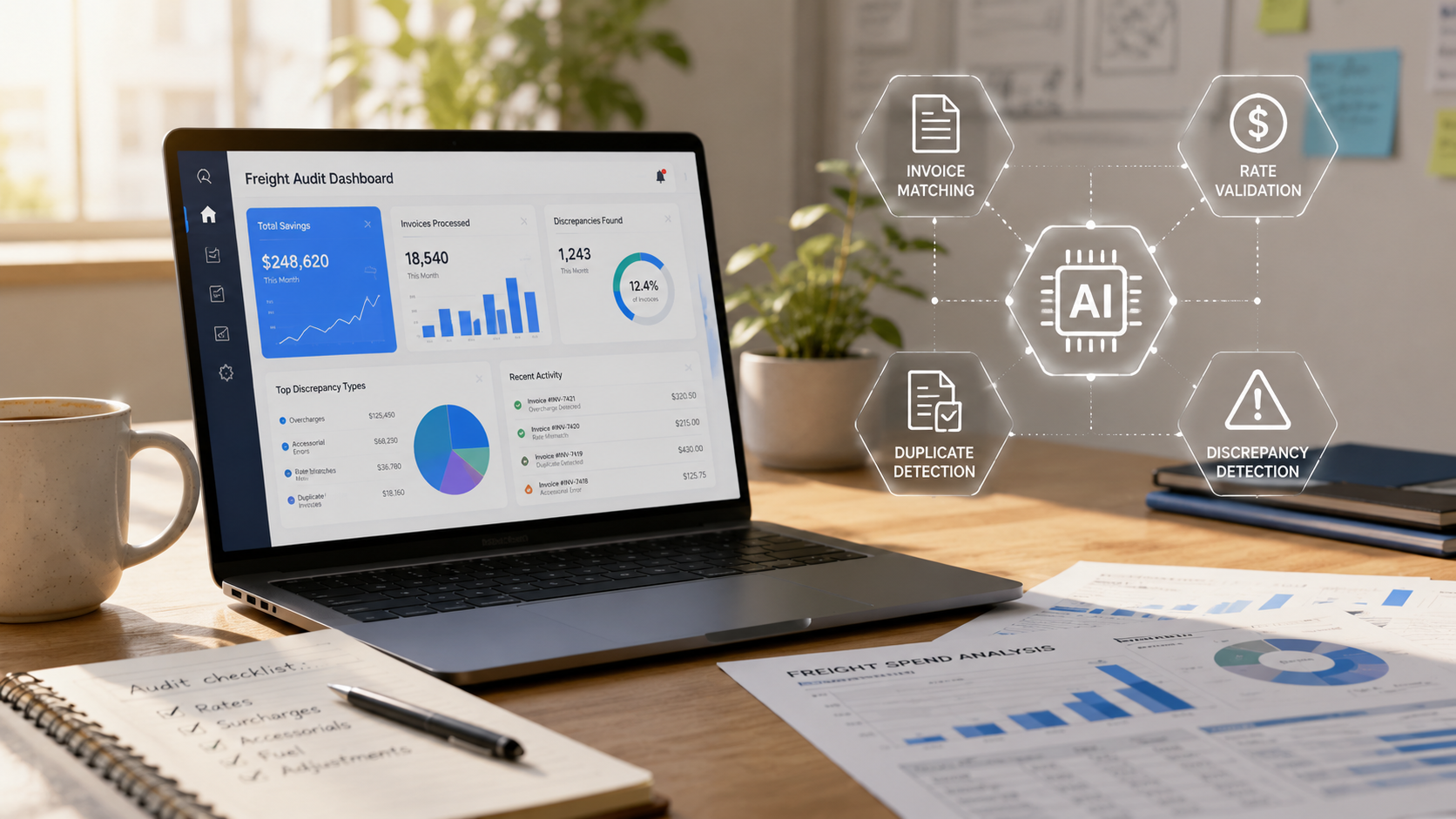
Freight billing errors are more common than most logistics teams realise, and most go unrecovered. Here is what this article covers:
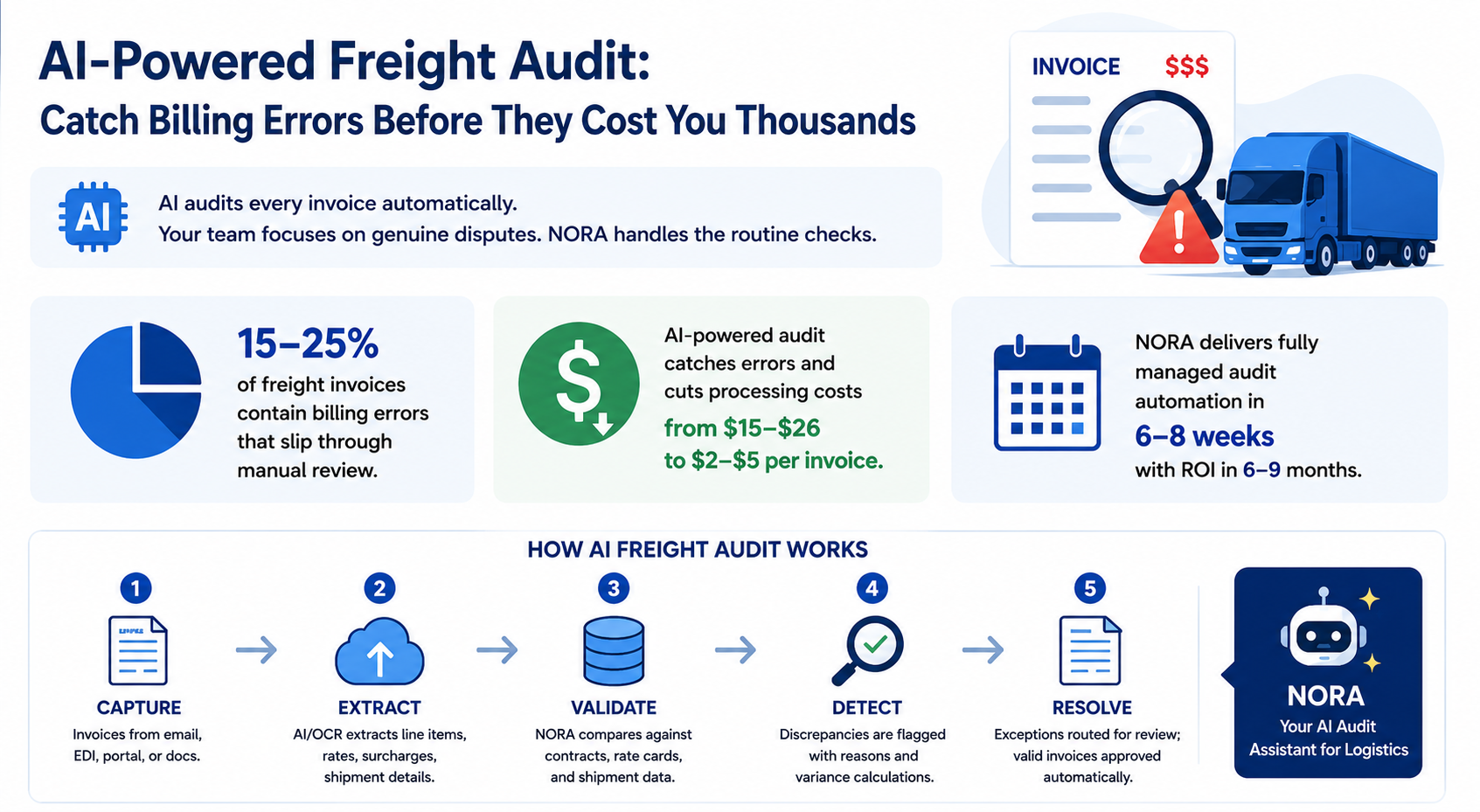
- Between 15-25% of freight invoices contain billing errors that slip through manual review unnoticed.
- AI-powered freight audit catches those errors automatically, cutting processing costs from $15-$26 per invoice down to $2-$5.
- SmartDev’s NORA delivers a fully managed audit automation in 6-8 weeks, with full ROI typically within 6-9 months. Your team focuses on genuine disputes. NORA handles the routine checks at scale.
Introduction
Your freight invoices look correct. That is exactly the problem. Most billing errors in logistics are not obvious mistakes. They are small, quiet discrepancies that pass through manual review without anyone noticing. Duplicate charges, misapplied surcharges, incorrect weight brackets: each one costs your business money. Over hundreds of shipments per month, the losses accumulate fast.
According to research from Cass Information Systems, freight billing errors affect between 15% and 25% of all invoices processed. For a mid-market logistics operation, that translates to tens of thousands of dollars in overbilling each year. Most of those errors go unrecovered because manual auditing is too slow, too inconsistent, and too expensive to run at scale.
AI-powered freight audit changes that equation. It runs every invoice against your contracts, rate cards, and shipment records automatically. It catches discrepancies in seconds, not days. In addition, it does so at a fraction of the cost of manual review. This guide explains how it works, why traditional auditing fails, and what a working AI freight audit looks like in practice.
Why Manual Freight Auditing Fails at Scale
1. The Volume Problem
Manual freight auditing made sense when shipment volumes were low. A finance team could realistically review 20 or 30 invoices per week with reasonable accuracy. However, as logistics operations grow, that model breaks down quickly.
Consider a logistics company processing 200 freight invoices per day, arriving via email and fax from dozens of carriers in different formats. A finance team of three or four people cannot realistically review every line item on every invoice before approving payment. In practice, teams spot-check a sample and approve the rest on trust. As a result, billing errors slip through routinely. By the time someone notices a pattern, months of incorrect charges have already been paid and the window for dispute has often closed.
Take a logistics operation processing 200 invoices per day: the finance team was spending 4 hours on manual data entry alone, with weekly supplier disputes stemming directly from entry errors and cash flow reconciliation consistently 2 to 3 days behind.
The volume problem compounds over time. More shipments mean more carriers, more rate structures, and more opportunities for discrepancy. Headcount grows to keep pace with volume instead of efficiency improving. Manual processes simply do not scale with that complexity, and at a certain point, the cost of the auditing process itself rivals the cost of the errors it fails to catch.
2. The Accuracy Problem
Even when auditors have enough time, human review is inconsistent. Freight invoices often contain dozens of line items, including base rates, fuel surcharges, residential delivery fees, dimensional weight adjustments, and accessorial charges. Checking each item against the correct contract version requires close attention and significant experience.
A single carrier contract can run to dozens of pages, with different rates for different lanes, weight brackets, and service levels. One reviewer may interpret an accessorial charge differently from a colleague, and neither may be wrong, but the inconsistency creates gaps that carriers can exploit unintentionally or otherwise.
In practice, fatigue affects accuracy. An auditor reviewing their fortieth invoice of the day catches fewer errors than the same person reviewing their fifth. Furthermore, contract terms change frequently. Keeping every reviewer updated on the latest rate agreements is difficult to guarantee across a team, particularly when carriers issue mid-year surcharge adjustments with little notice. According to research published by PayStream Advisors, the average error rate in manual invoice processing sits between 1% and 4%, with each error requiring 15 to 30 minutes of staff time to identify and resolve.
The result is a review process that looks thorough but misses a significant share of recoverable billing discrepancies. A 2% error rate across 200 invoices per day means four invoices flagged incorrectly or missed entirely, every single day. Over a 12-month period, that adds up to more than 1,400 invoices with unresolved discrepancies, each representing a financial loss already absorbed into operating costs.
Specifically, inconsistency in manual review is one of the core reasons that billable discrepancies go undetected month after month, and why freight overbilling remains a persistent operational drain for logistics teams of every size. For more on how AI workflow automation addresses this kind of systemic inconsistency, SmartDev outlines the technical approach in detail.
3. The Recovery Problem
Identifying a billing error is only the first step. Recovering the overcharged amount requires documentation, carrier communication, and persistent follow-up. For small errors under $50, many companies simply write off the cost because the recovery effort does not seem worth the time.
That calculation changes, however, when you consider how those small errors accumulate. A $30 discrepancy across 500 invoices per month amounts to $15,000 in annual losses written off as “not worth chasing.” In that case, the recovery problem is not really about the size of any single error. It is about the cumulative cost of letting errors pass uncontested at scale.
What AI-Powered Freight Audit Actually Does
1. Automated Invoice Matching
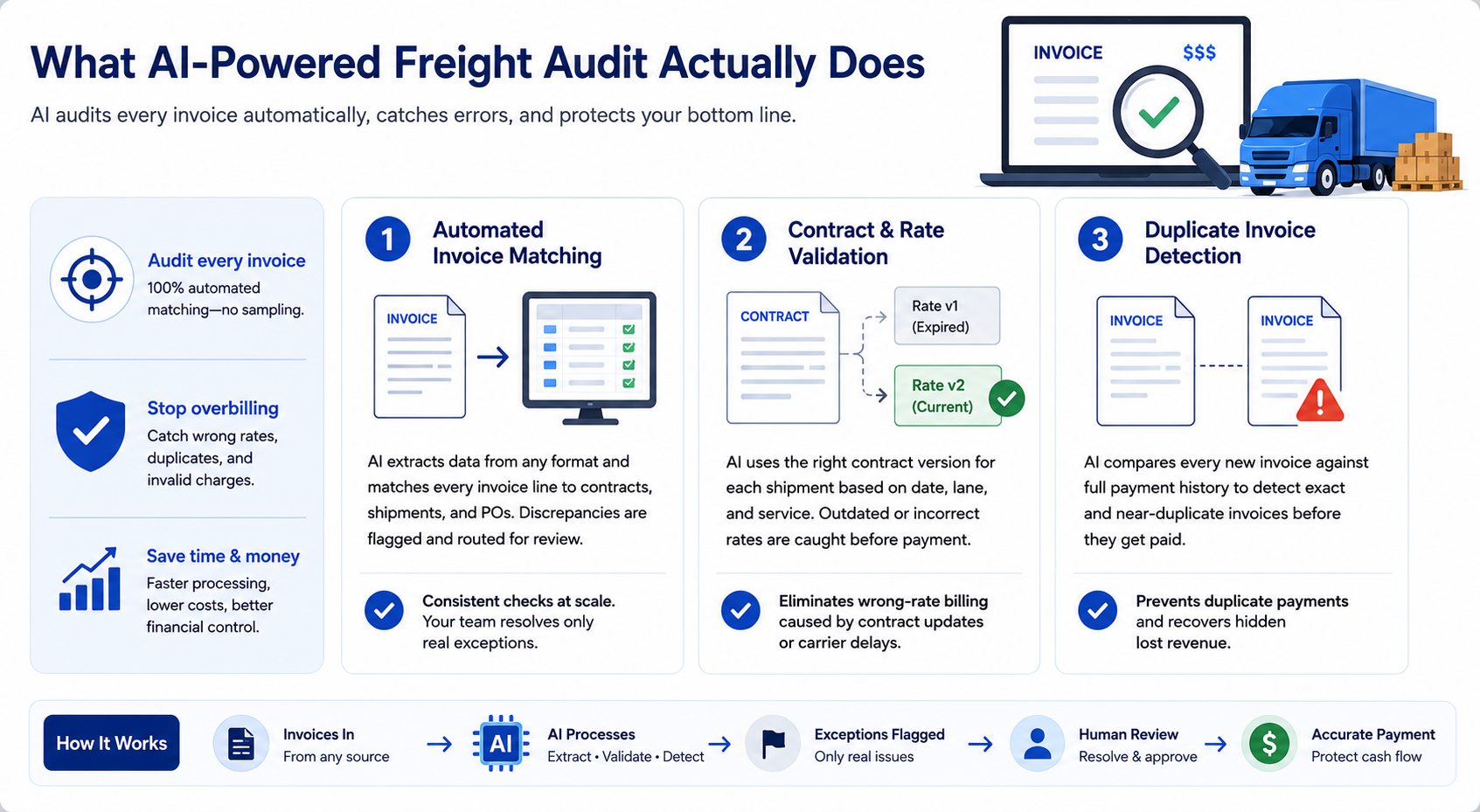
An AI-powered freight audit system reads every incoming invoice and matches it against your contracted rates, shipment data, and purchase orders. It does this automatically, for every invoice, without sampling or manual selection.
The system extracts structured data from PDFs, EDI files, and email attachments regardless of carrier format. It then validates each line item against the correct rate agreement for that carrier, lane, and service type. Discrepancies are flagged automatically and routed to a review queue for human confirmation before any payment is released.
This is the core of AI workflow automation applied to freight: predictable checks run consistently at scale, while genuine exceptions go to the right person for resolution. Your team stops reviewing everything and starts resolving only what actually needs judgment.
2. Contract and Rate Card Validation
Freight billing errors often originate from carriers applying the wrong rate version. A contract update takes effect, but the carrier’s billing system does not reflect the change immediately. Without automated validation, those errors are nearly impossible to catch unless someone manually compares each invoice rate to the current contract.
AI-powered freight audit maintains a live record of your carrier contracts and rate cards. Moreover, it applies the correct version for each shipment based on shipment date, lane, and service type. When a carrier bills at an outdated rate, the system catches the discrepancy immediately, before payment is released.
This kind of automated document and data processing eliminates an entire category of errors that manual review consistently misses. In practice, it means your finance team is no longer responsible for maintaining a mental map of which rate version applies to which carrier, lane, and shipment date. The system holds that map and applies it without variation, every time.
Moreover, when a carrier issues a rate update, the system reflects the change immediately. There is no lag between when the new rates take effect and when invoice validation starts using them. That gap, which in manual processes can stretch for weeks or months, is where a significant share of overbilling originates. Closing it does not require additional headcount. It requires the right automation in place.
3. Duplicate Invoice Detection
Duplicate invoices are more common than most finance teams expect. Carriers occasionally submit the same invoice twice under slightly different reference numbers. Without a system that cross-references every submission against payment history, duplicates can pass review and get paid without anyone noticing.
AI freight audit compares each new invoice against the full history of submitted and paid invoices. It flags potential duplicates based on shipment reference, amount, date, and carrier combination. In addition, it surfaces near-duplicates as a second layer of protection. These are invoices that differ slightly in one field but match in all others.
For logistics businesses running high invoice volumes, the financial recovery from duplicate detection alone can be significant. A single duplicate invoice for a large freight shipment can represent hundreds or thousands of dollars paid twice. Across a high-volume operation, those amounts accumulate quietly month after month because no individual payment looks unusual enough to trigger a manual check.
AI-powered machine learning solutions surface these patterns systematically, comparing every new submission against the full payment history rather than relying on individual reviewers to remember what was paid weeks or months earlier. The result is a layer of financial protection that operates continuously, without the fatigue or memory limitations that make manual duplicate detection unreliable at scale.
How NORA Delivers AI-Powered Freight Audit
1. A Fully Managed Approach
NORA is SmartDev’s AI Adoption Accelerator. It is a fully managed service that designs, builds, and continuously operates AI workflow automation for mid-market businesses. For freight audit specifically, NORA handles document intake, data extraction, validation logic, and exception routing as a single integrated workflow.
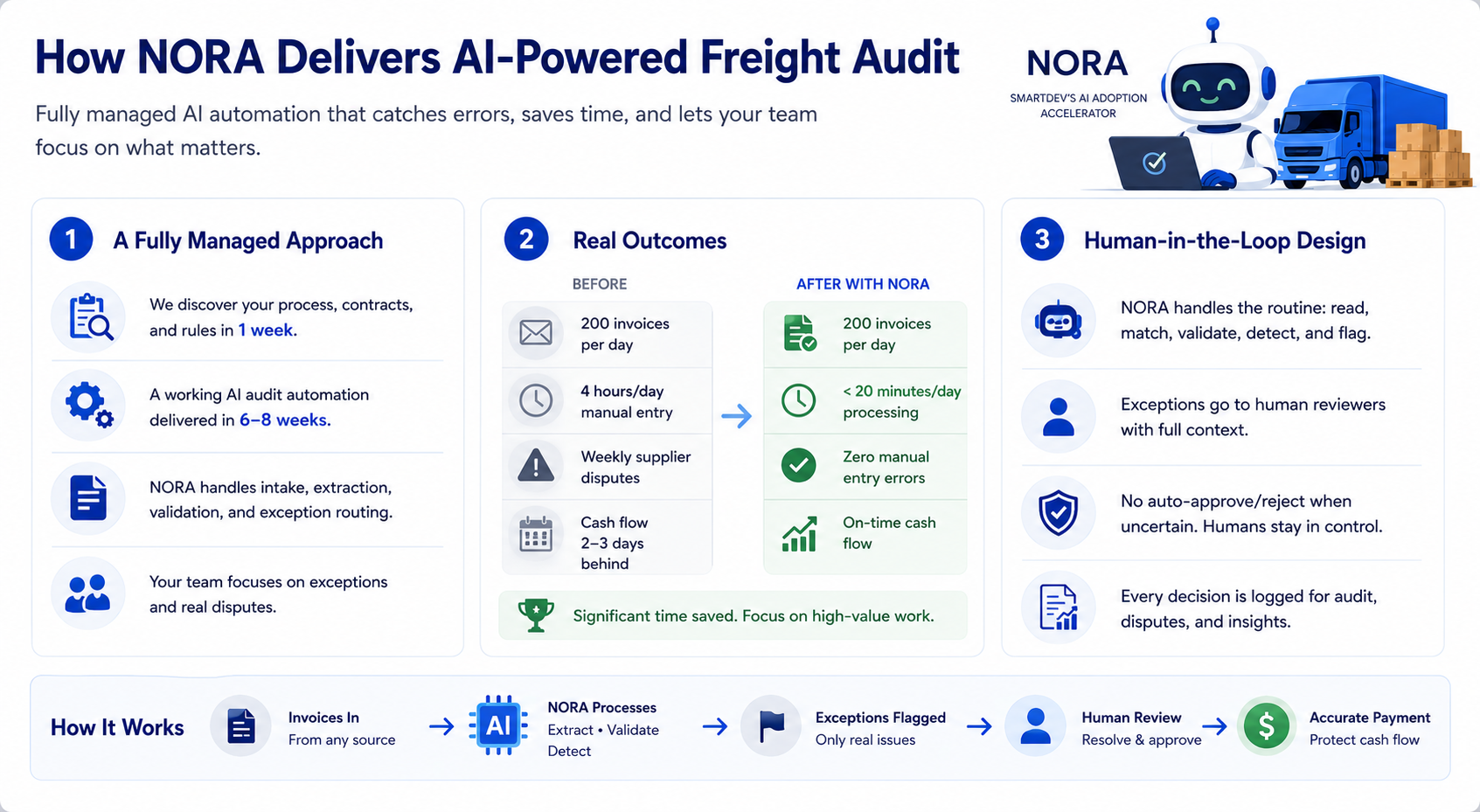
The implementation process starts with a one-week structured discovery phase. SmartDev maps your current invoice process, identifies your carrier contracts and rate structures, and defines the validation rules that govern automatic approval and escalation. From that foundation, a working automation is delivered in 6 to 8 weeks. You can learn more about how this structured approach works through the 3-week AI discovery program.
In practice, NORA processes every invoice automatically, flags discrepancies for human review, and produces a clean audit trail for each decision. Your team focuses on exceptions and genuine disputes, not on routine line-item checking.
2. Real Outcomes From Logistics Operations
One logistics company was processing 200 invoices per day through a combination of email and fax. Before implementing AI automation, the finance team spent 4 hours per day on manual data entry alone. Entry errors caused weekly supplier disputes, and cash flow reconciliation ran 2 to 3 days behind schedule consistently.
After implementation, processing time dropped to under 20 minutes per day. Zero manual entry errors occurred in the first 90 days of operation. The team recovered significant time that had previously been absorbed by routine checking. Instead, they focused on genuine disputes and supplier relationship management, work that actually required their expertise.
For a detailed look at how the AI adoption accelerator model works in practice, SmartDev’s guide to AI adoption accelerators covers the full implementation approach and what mid-market logistics businesses can realistically expect from a managed automation deployment.
3. The Human-in-the-Loop Design
NORA does not replace human judgment in the freight audit process. It handles the predictable, repetitive work: reading invoices, matching line items, validating rates, detecting duplicates, and flagging discrepancies. Exceptions and genuine disputes go to a human review queue with full context attached, so your team can resolve them efficiently.
This design matters because it addresses the concern most operations leaders raise when evaluating AI for finance workflows: what happens when the system is wrong? With NORA, the answer is clear. When the system encounters an invoice it cannot validate with confidence, it does not approve or reject automatically.
It routes the exception to a human reviewer with the full invoice, the relevant contract clause, and the specific discrepancy flagged for attention. The reviewer sees exactly what triggered the escalation and makes an informed decision in a fraction of the time it would take to audit the invoice from scratch.
Beyond exception handling, the human-in-the-loop model produces something equally valuable: a complete, auditable record of every decision made in the freight audit process. Each invoice carries a log of what was validated automatically, what was escalated, who reviewed it, and what outcome was recorded. That record supports carrier dispute negotiations with documented evidence rather than reconstructed memory. It satisfies compliance requirements without manual report preparation. Furthermore, it gives operations leaders visibility into error patterns across carriers, lanes, and time periods, which is information that manual auditing processes rarely produce in a usable form.
The AI workflow automation approach SmartDev applies keeps humans firmly in control of judgment calls while removing the manual burden of routine checks. In practice, this means your finance team spends less time on invoice processing and more time on the supplier relationships, dispute resolution, and financial analysis that actually require their expertise. The shift is not just operational. It changes what your team is able to accomplish each week.
The Financial Case for AI-Powered Freight Audit
1. Cost Per Invoice
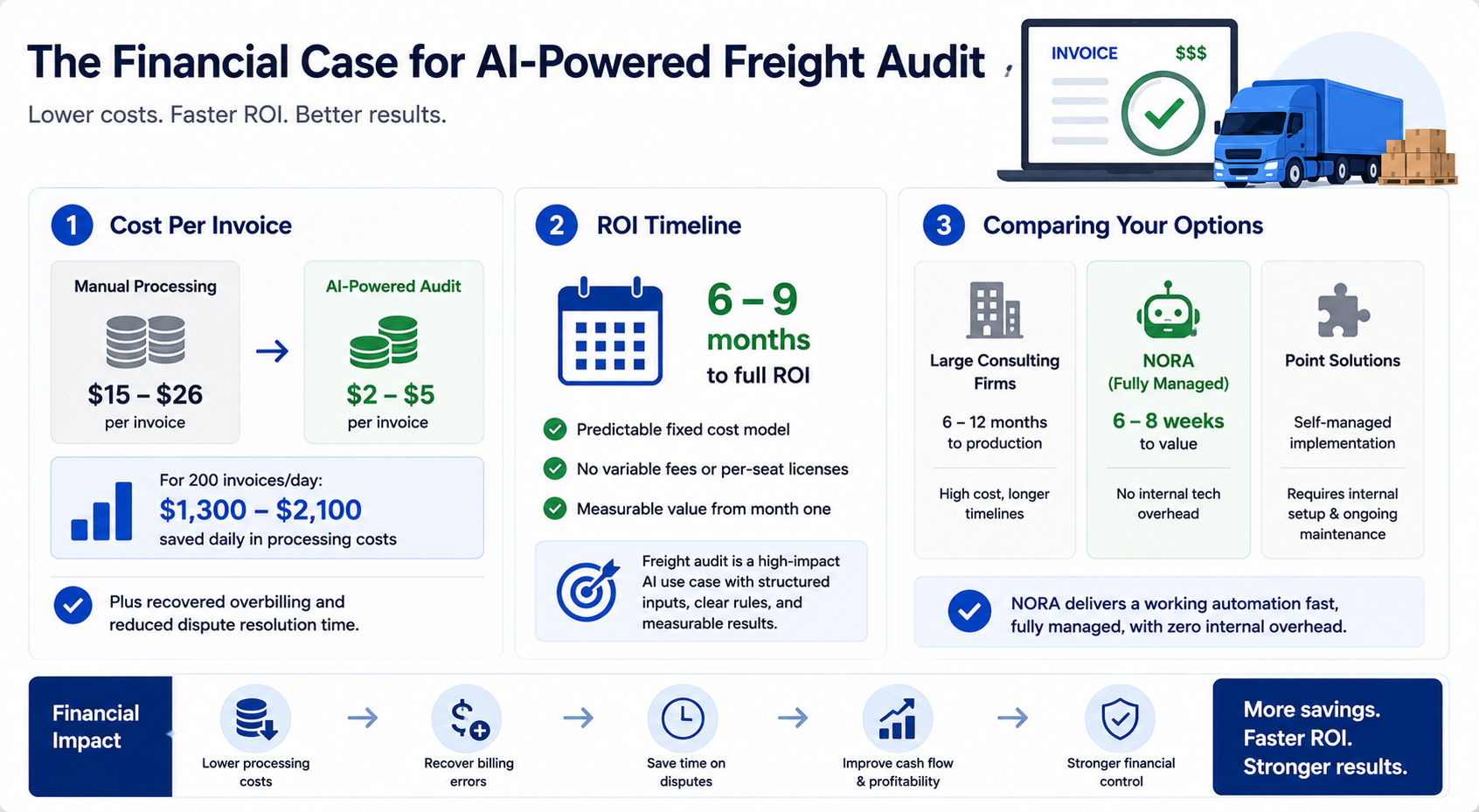
Manual invoice processing in logistics costs between $15 and $26 per invoice when you account for staff time, error correction, and delayed resolution. Automated processing reduces that cost to $2 to $5 per invoice. For a company processing 200 invoices per day, that difference represents $1,300 to $2,100 in daily processing cost savings alone.
That calculation does not include recovered overbilling. Furthermore, it does not account for the staff time previously spent on disputes, reconciliation follow-up, and chasing credits from carriers. The full financial impact is typically larger than the direct processing cost suggests.
2. ROI Timeline
NORA implementations in logistics typically reach full ROI within 6 to 9 months. The fixed setup fee and monthly managed service model means costs are predictable from day one. There are no variable consulting hours, no internal development costs, and no per-seat licensing fees that scale unexpectedly with invoice volume.
For logistics operations evaluating where to start with AI automation, freight audit is one of the strongest entry points. The inputs are structured, the validation rules are well-defined, and the error recovery value is measurable from the first month of operation. Unlike broader AI transformation initiatives, freight audit does not require a lengthy discovery process or a complete overhaul of existing systems. It integrates with your current ERP, TMS, and carrier communication workflows, and delivers measurable results from the first invoices processed.
3. Comparing Your Options
Large consulting firms offer AI transformation programs that take 6 to 12 months to reach production. Point products exist for freight audit, but they require internal teams to configure, maintain, and update rate cards manually over time. NORA delivers a working automation in 6 to 8 weeks, fully managed, with no internal technical overhead required.
That comparison is worth considering carefully before committing to any approach. Understanding what a fully managed AI service actually delivers versus the alternatives helps operations leaders make a realistic assessment of timelines, costs, and risks. For most mid-market logistics businesses, the managed service model removes the primary barriers, specifically technical resource requirements and implementation risk, that have historically slowed AI adoption.
Conclusion
Freight billing errors are not rare edge cases. They are a routine part of high-volume logistics operations, and most of them go unrecovered because manual auditing cannot keep pace with invoice volume or contract complexity. The finance teams responsible for catching these errors are not failing at their jobs.
They are working within a process that was designed for a lower volume of simpler invoices, from fewer carriers, with more stable rate agreements. As operations scale, the gap between what manual review can reliably catch and what is actually flowing through the system widens, and the financial cost of that gap grows with it.
AI-powered freight audit closes that gap by processing every invoice automatically, validating against current contracts, flagging discrepancies in real time, and routing exceptions to the right person with full context attached. The result is faster processing, fewer errors, measurable cost recovery, and a clean audit trail for every decision. More importantly, it gives your finance team the capacity to focus on work that actually requires their judgment, including supplier negotiations, dispute resolution, and financial planning, rather than spending hours each day on routine line-item checks that a well-designed system can handle more reliably.
SmartDev’s NORA brings this capability to mid-market logistics operations as a fully managed service, with no internal technical overhead required. A working automation is delivered in 6 to 8 weeks. Full ROI is typically reached within 6 to 9 months. Your team handles the genuine disputes. NORA handles everything else, from day one.
If you are ready to stop writing off billing errors and start recovering them systematically, contact SmartDev to discuss your freight audit requirements. Alternatively, explore SmartDev’s AI workflow automation solutions to see the full range of automation options available for logistics and supply chain operations.