

TL, DR:
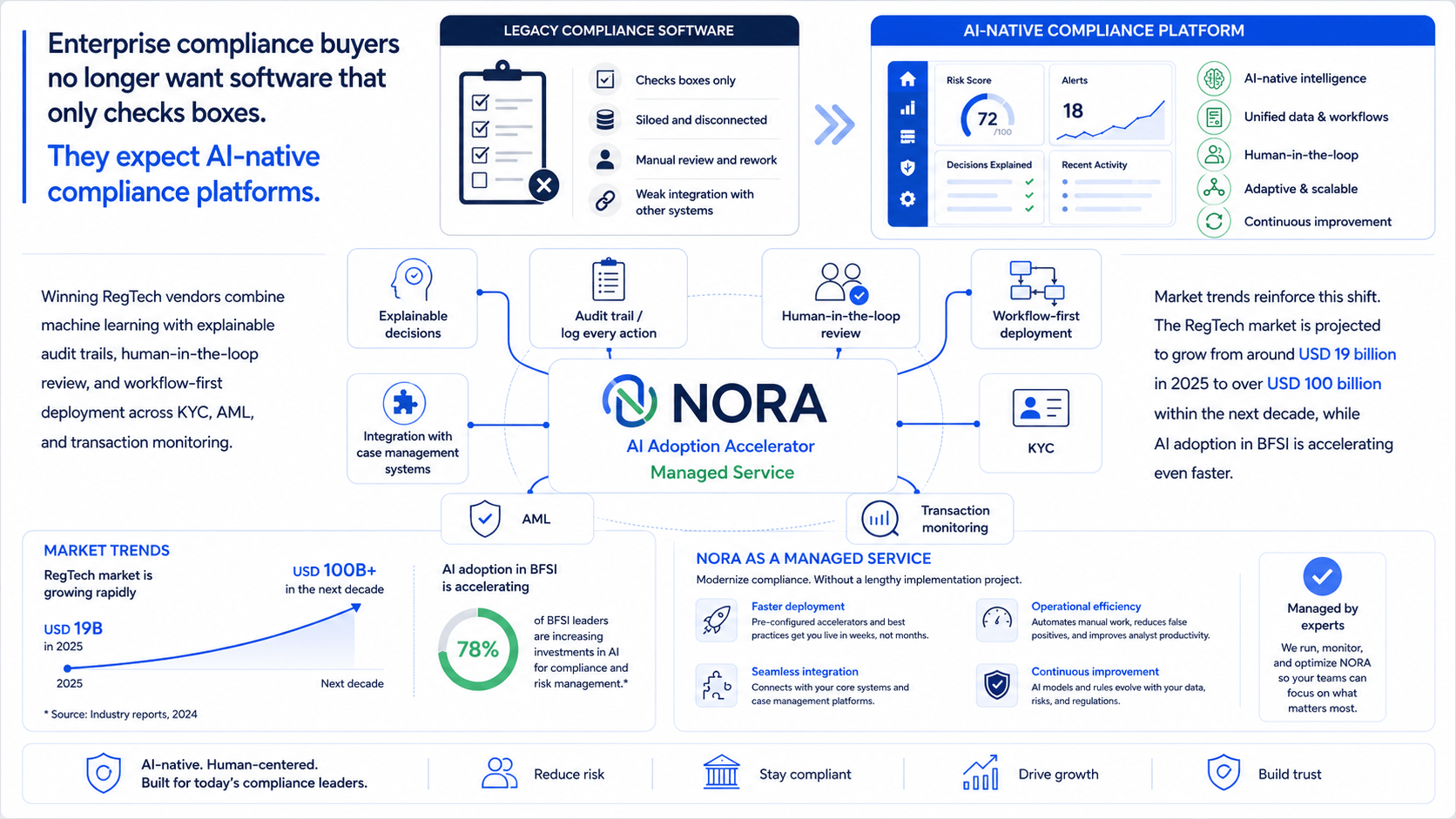
- Enterprise compliance buyers no longer accept software that simply checks boxes.
- They expect AI-native platforms that explain every decision, log every action, and integrate with existing case management systems.
- Winning RegTech vendors combine machine learning with explainable audit trails, human-in-the-loop review, and workflow-first deployment across KYC, AML, and transaction monitoring.
- Market trends reinforce this shift. The RegTech market is projected to grow from around USD 19 billion in 2025 to over USD 100 billion within the next decade, while AI adoption in BFSI is accelerating even faster.
- SmartDev’s AI Adoption Accelerator, NORA, delivers these capabilities as a managed service, helping RegTech vendors and financial institutions modernize compliance without a lengthy implementation project.
Introduction
Enterprise compliance buyers have changed how they evaluate vendors. A decade ago, a RegTech pitch built around rule-based automation and static dashboards could win a contract. Today, procurement teams ask sharper questions. They want to know how the system reasons, not just what it outputs. They want proof that every flagged transaction carries a traceable, auditable explanation before a regulator ever asks for one.
This shift is a big part of why AI-native compliance has become such a strong differentiator in large enterprise deals. That doesn’t mean rule-based logic is obsolete. Many compliance systems still lean on rules for the parts of a decision where the regulatory requirement is fixed and unambiguous, such as a sanctions-list match or a hard reporting threshold.
The distinction enterprise buyers are drawing is narrower. Vendors whose AI features sit bolted onto an otherwise static rule engine tend to struggle when procurement asks how a specific decision was reasoned through. In contrast, vendors that build reasoning, explainability, and governance into the core architecture move through due diligence faster. They use rules where rules are the right tool and AI, where judgment is required. As a result, they close larger enterprise contracts.
This article breaks down what enterprise buyers evaluate, which regulations shape their checklist, which capabilities separate winning RegTech vendors from the rest, and how SmartDev helps compliance teams build this capability without a multi-year infrastructure project.
The Regulatory Backdrop Behind Every RegTech Deal
Global Standards Every RegTech Deal Must Satisfy
Enterprise buyers rarely separate “AI capability” from “regulatory alignment.” Both sit on the same scorecard. Global frameworks such as GDPR, PCI DSS, ISO 27001, Basel III, and SOC 2 shape almost every requirement document a compliance team writes, because each addresses a different layer of risk: data privacy, payment security, information security management, capital adequacy, and service-provider assurance, respectively. A RegTech platform that cannot map its controls against these five frameworks rarely survives an enterprise security review, regardless of how advanced its models are.
Regional Rules That Complicate Cross-Border Deals
Global institutions must also comply with regional regulations. In the European Union, PSD2 requires secure open APIs and Strong Customer Authentication. In the United States, Title VII of the Dodd-Frank Act mandates trade reporting for swap dealers and other market participants, forming the backbone of its reporting requirements.
In Singapore, MAS’s FEAT principles and proposed AI Risk Management Guidelines emphasize fairness, accountability, and AI governance. In India, the RBI’s IT Governance Master Direction (effective April 2024) requires board-approved cybersecurity policies and continuous security monitoring.
Together, these overlapping requirements raise the bar for enterprise compliance platforms. For vendors operating across multiple regions, meeting one framework is no longer enough. They need a platform flexible enough to satisfy overlapping regulatory requirements simultaneously. This is why SmartDev’s guide to digital transformation for BFSI treats compliance as an architectural decision rather than a late-stage checklist.
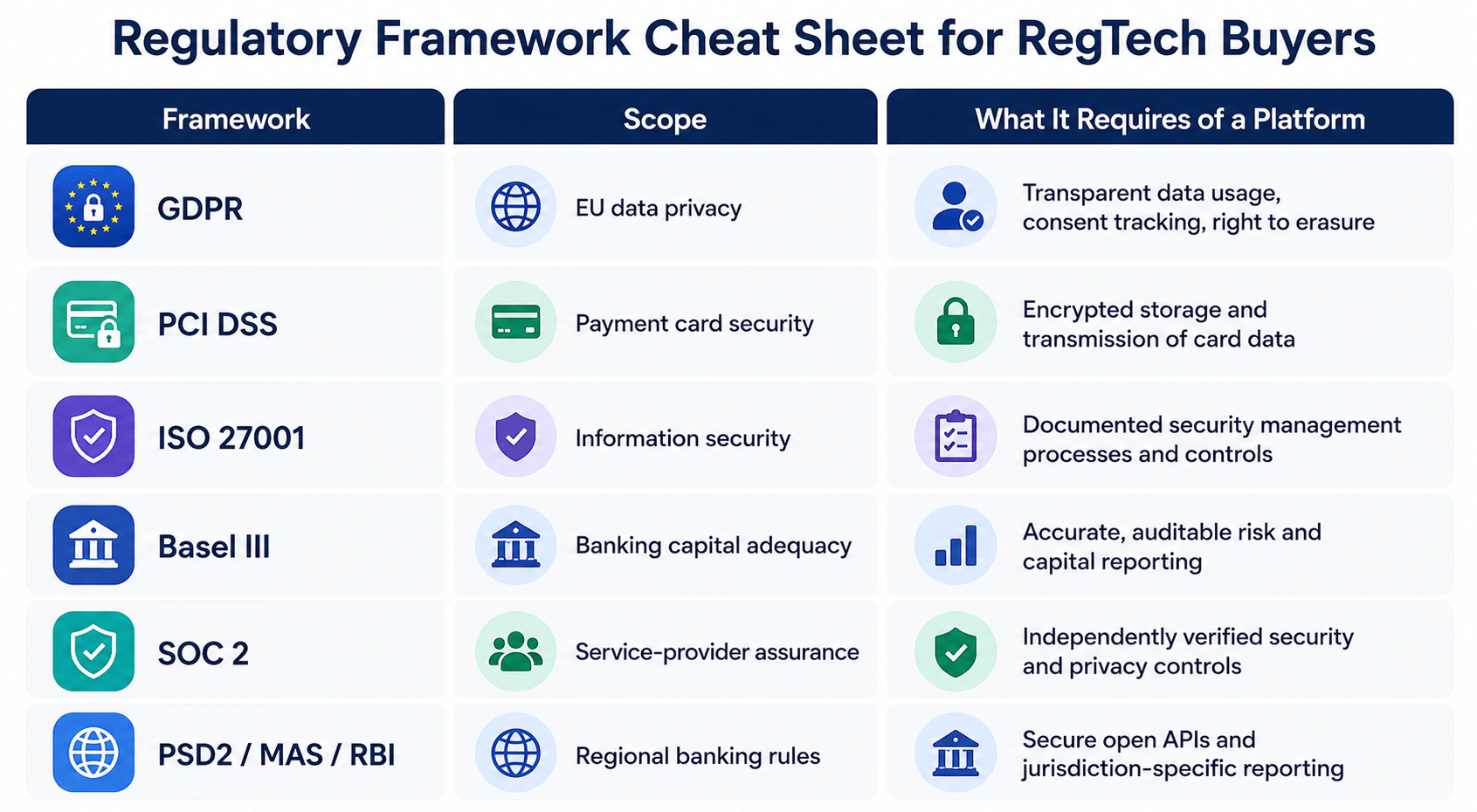
Enterprise RegTech evaluations typically reference multiple regulatory frameworks, each defining a distinct set of compliance, security, and governance requirements.
- GDPR, PCI DSS, ISO 27001, Basel III, and SOC 2 define baseline requirements for privacy, security, risk management, and service assurance.
- Regional frameworks such as PSD2, MAS, and RBI add requirements for secure APIs, local reporting, and jurisdiction-specific compliance.
- Together, these frameworks set the baseline for enterprise RegTech platforms, especially in security, auditability, governance, and regulatory reporting.
Takeaway: Enterprise deals depend on strong regulatory alignment. Vendors that translate GDPR, PCI DSS, ISO 27001, Basel III, SOC 2, and regional regulations into platform controls move through security reviews faster than those treating compliance as an afterthought.
Why Enterprise Buyers Now Demand AI-Native Compliance
The Shift from Manual to AI-Native RegTech
Regulatory technology began by digitizing paperwork. Early platforms moved manual checklists onto screens. Compliance teams still reviewed cases by hand. That model no longer matches the volume financial institutions handle. The global regulatory technology market continues to expand quickly as institutions replace manual review with automated, cloud-based platforms. Grand View Research puts the large-enterprise segment as the dominant share of that spending in 2025, ahead of small and mid-sized institutions. AI adoption inside BFSI is growing even faster than the broader RegTech category, with the global AI-in-BFSI market moving from roughly USD 26 billion in 2024 toward nearly USD 193 billion by 2034. Consequently, vendors must prove their systems can reason over data, not just store it.
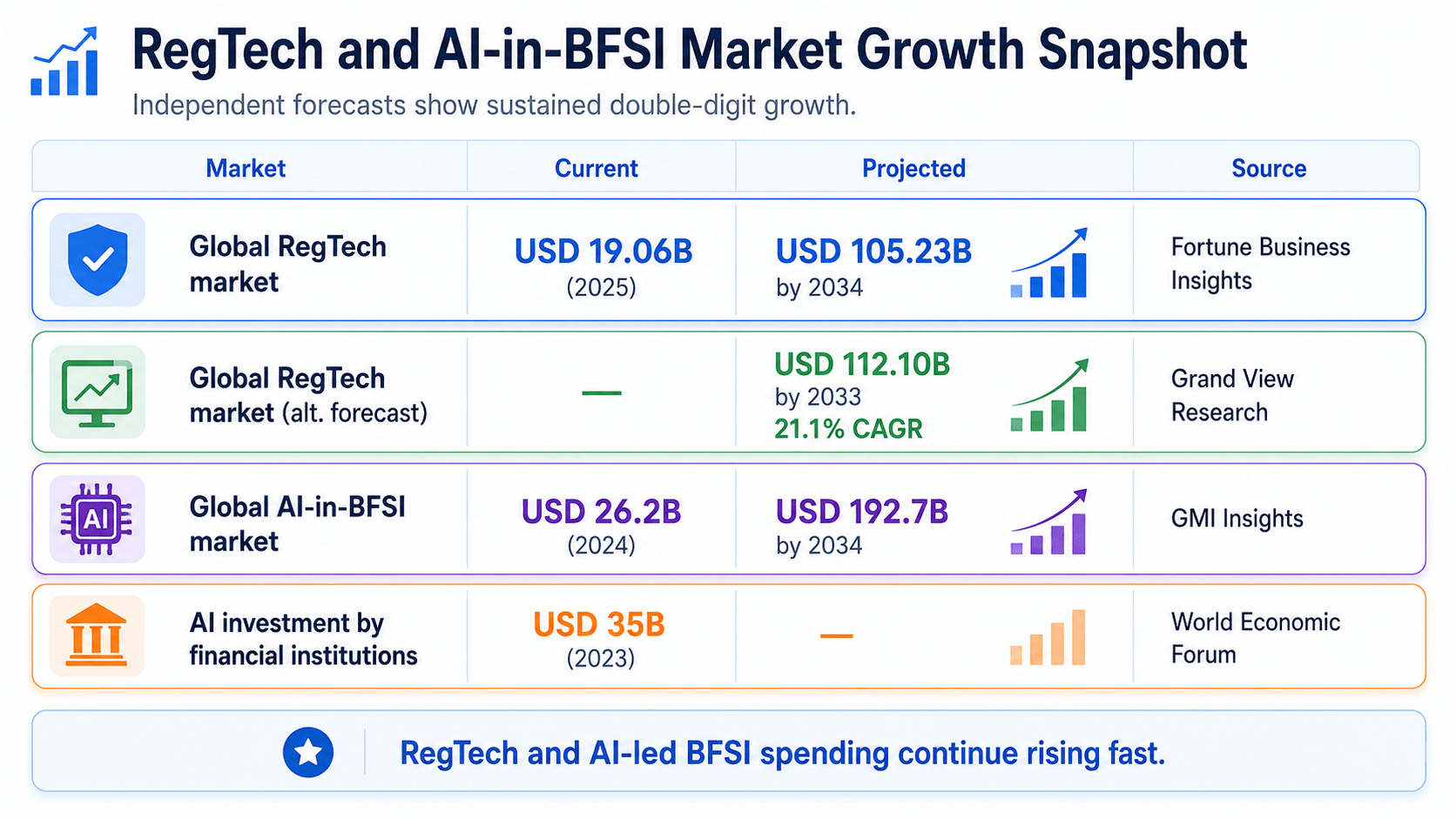
This compares current market estimates and long-term forecasts for the global RegTech and AI-in-BFSI markets, highlighting sustained investment momentum across both sectors.
- The global RegTech market is projected to grow from USD 19 billion in 2025 to over USD 105 billion by 2034. Multiple industry reports point to a similar growth trajectory.
- The AI-in-BFSI market is expected to expand from USD 26.2 billion in 2024 to nearly USD 193 billion by 2034. This reflects accelerating AI adoption across financial services.
- Financial institutions invested USD 35 billion in AI during 2023 alone. The trend confirms AI-powered compliance and risk management as long-term strategic priorities.
What Enterprise Procurement Teams Actually Evaluate
Enterprise buyers use structured evaluation criteria. AI capabilities are assessed alongside security and integration. Procurement teams typically evaluate three areas. First, the AI must explain its conclusions. Second, every action must leave an auditable trail. Third, the platform must integrate with existing case management and ERP systems. SmartDev’s guide on BFSI compliance and regulatory frameworks outlines these evaluation criteria in more depth for teams preparing a vendor shortlist.
Who Actually Sits on the Buying Committee
A single champion rarely closes an enterprise compliance deal alone. Buying committees typically include multiple decision-makers. The chief compliance officer focuses on regulatory defensibility. The CISO evaluates data security and API integrity. Procurement leaders assess total cost of ownership. Operations leaders prioritize reducing manual work. Vendors addressing all four priorities move through committee reviews faster than those focused only on compliance.
| Stakeholder | Primary Concern | Proof They Need to See |
| Chief Compliance Officer | Regulatory defensibility | Explainable risk scores and a complete audit trail |
| CISO | Data security and API integrity | ISO 27001 / SOC 2 alignment, secure integration design |
| Procurement Lead | Total cost of ownership | Fixed-cost managed service pricing, no hidden fees |
| Operations Leader | Manual workload reduction | Pilot data showing measurable time and error savings |
Each stakeholder on the buying committee evaluates a RegTech proposal through a different lens.
Takeaway: Winning vendors treat the RFP as a multi-stakeholder of conversation. They pair out explainability evidence for compliance officers with integration proof for CISOs and ROI data for procurement leads.
The Enterprise Deal-Breakers: What Kills RegTech Sales Cycles
Audit Trail Gaps
Many RegTech platforms automate a decision but fail to log how the system reached it. When a regulator later asks for documentation, the compliance team cannot reconstruct the reasoning. This gap kills deals during legal and risk review, long before the business team gets a final say on price or timeline.
Integration Friction and Explainability Concerns
Large enterprises run dozens of legacy systems. A RegTech tool that demands full data migration adds months to deployment and raises internal resistance. Equally damaging is a “black box” model that cannot explain a risk score in language a human reviewer can defend a regulator. Both issues push deals back into procurement limbo, sometimes for a full budget cycle.
Common Objections and How AI-Native Vendors Answer Them
Three objections repeat across almost every enterprise compliance sales cycle. First, buyers ask whether the model can be audited independently; AI-native vendors answer with a documented reasoning log attached to every output. Second, buyers ask what happens when the model is uncertain; AI-native vendors answer with confidence scoring that automatically routes uncertain cases to a human reviewer. Third, buyers ask how quickly the platform can go live without disrupting existing operations; AI-native vendors answer with a phased rollout that starts on top of, not instead of, current systems.
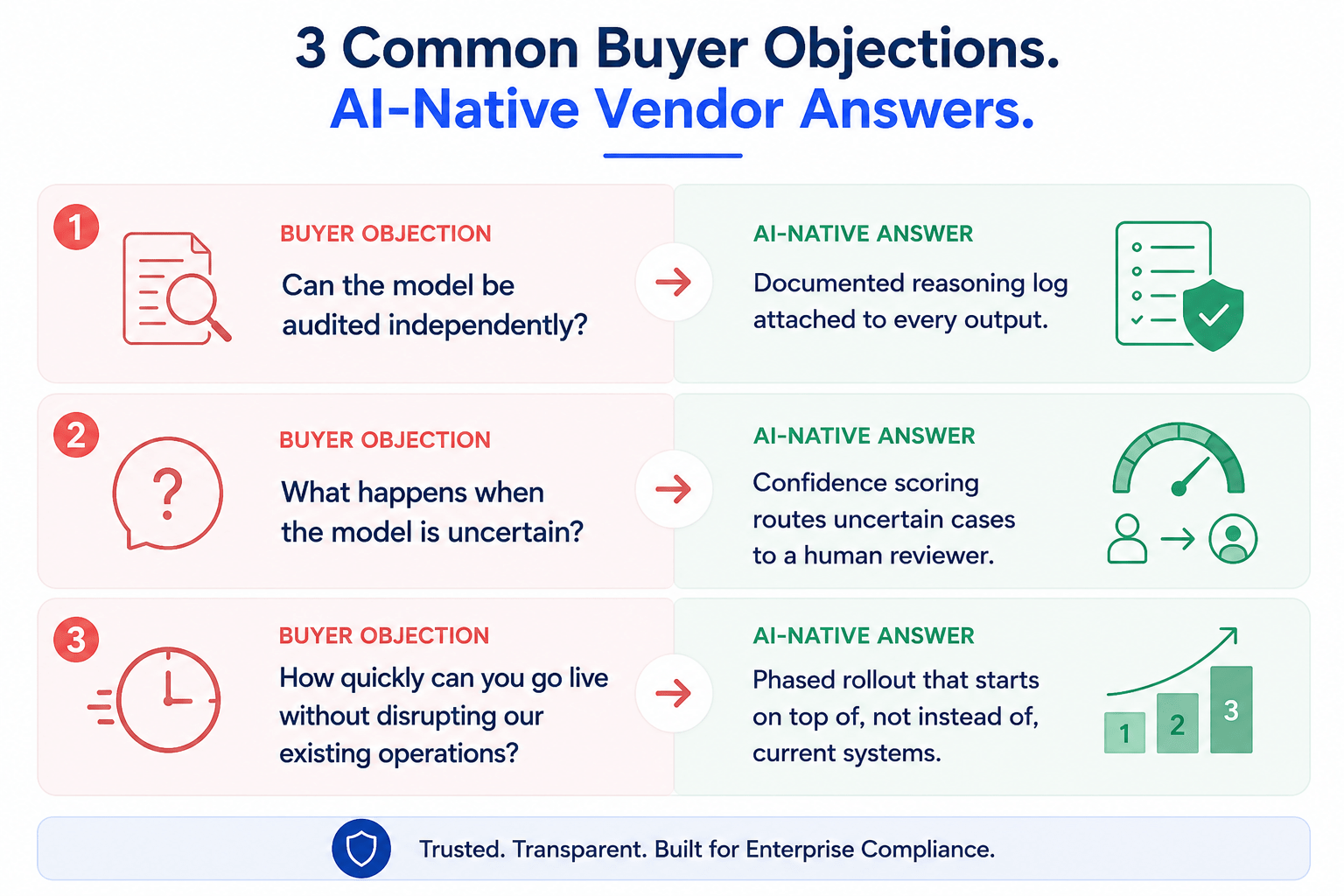
Takeaway: Deals stall less often because of missing features and more often because of missing proof, proof of traceability, proof of explainability, and proof the system fits existing infrastructure without disruption.
Five AI-Native Capabilities That Win Enterprise Trust – and How NORA Delivers Them
Intelligent Document Processing and Real-Time Monitoring
Modern document intelligence reads context rather than relying on rigid templates, so it correctly interprets varied formats, headers, and terminology across documents. Paired with continuous transaction monitoring, this reduces the manual triage load that traditionally overwhelms compliance teams during peak volume periods.
Explainable Risk Scoring and Human-in-the-Loop Governance
Enterprise buyers increasingly require risk scores that come with a documented rationale attached to every decision. A well-designed workflow keeps a human reviewer in the loop for high-risk cases while letting AI clear low-risk items automatically, which balances speed against accountability. SmartDev’s article on moving from automation to assurance in compliance screening explains how this governance model works in a live deployment.
Automated, Regulator-Ready Audit Trails
The third capability ties the first two together: an audit trail generated automatically as a byproduct of the workflow, not as a separate reporting task. SmartDev’s compliance audit trail automation guide details how this approach turns every AI-assisted decision into a defensible record within weeks rather than months.
KYC, AML, and Sanctions Screening at Scale
RegTech deals almost always touch identity verification and financial crime prevention directly. AI-driven KYC and AML tooling analyze behavioral and transactional patterns in real time, catching anomalies that static, rule-based screening misses. This capability matters most to enterprise buyers because false positives in sanctions screening create operational cost and reducing them without weakening detection is one of the clearest ROI stories a vendor can tell during a pilot.
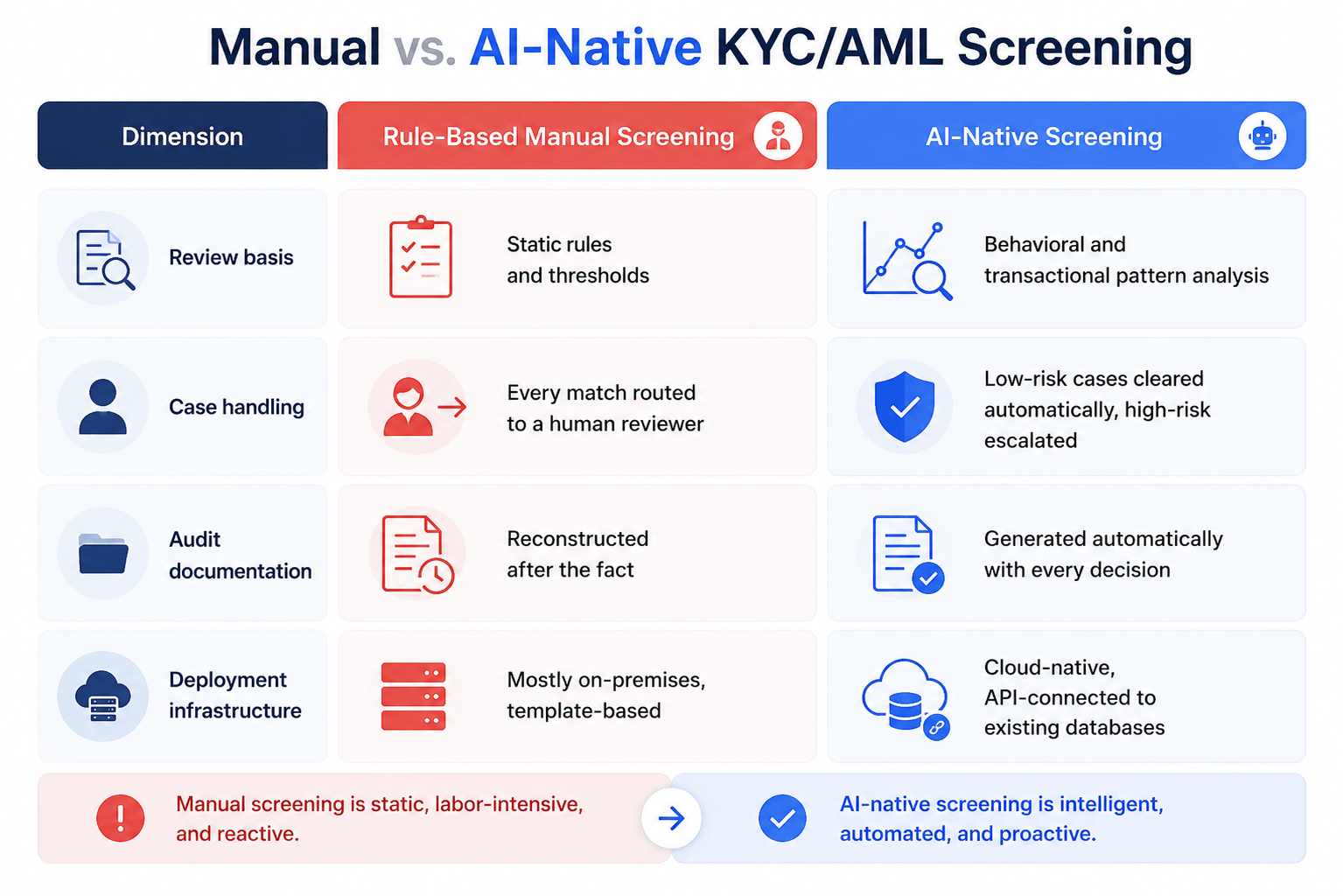
AI-native KYC and AML screening extend beyond automating manual review by fundamentally changing how compliance decisions are made and documented.
- Traditional rule-based screening relies on predefined rules, requires manual review for every flagged case, and often reconstructs audit evidence after decisions have been made.
- AI-native screening analyzes behavioral and transactional patterns, automatically clears low-risk cases, generates audit records in real time, and integrates seamlessly through cloud-native APIs.
- By reducing manual workloads while strengthening auditability and scalability, AI-native approaches enable financial institutions to improve compliance efficiency without compromising regulatory oversight.
Cloud-Native, API-First Architecture
Roughly 65 percent of RegTech deployments already run on cloud infrastructure, largely because cloud environments support real-time policy enforcement and secure storage aligned with regulatory requirements. An API-first design lets the platform plug into existing sanctions of databases, case-management tools, and ERP systems, which is often the single factor that determines whether an enterprise IT team approves the deployment.
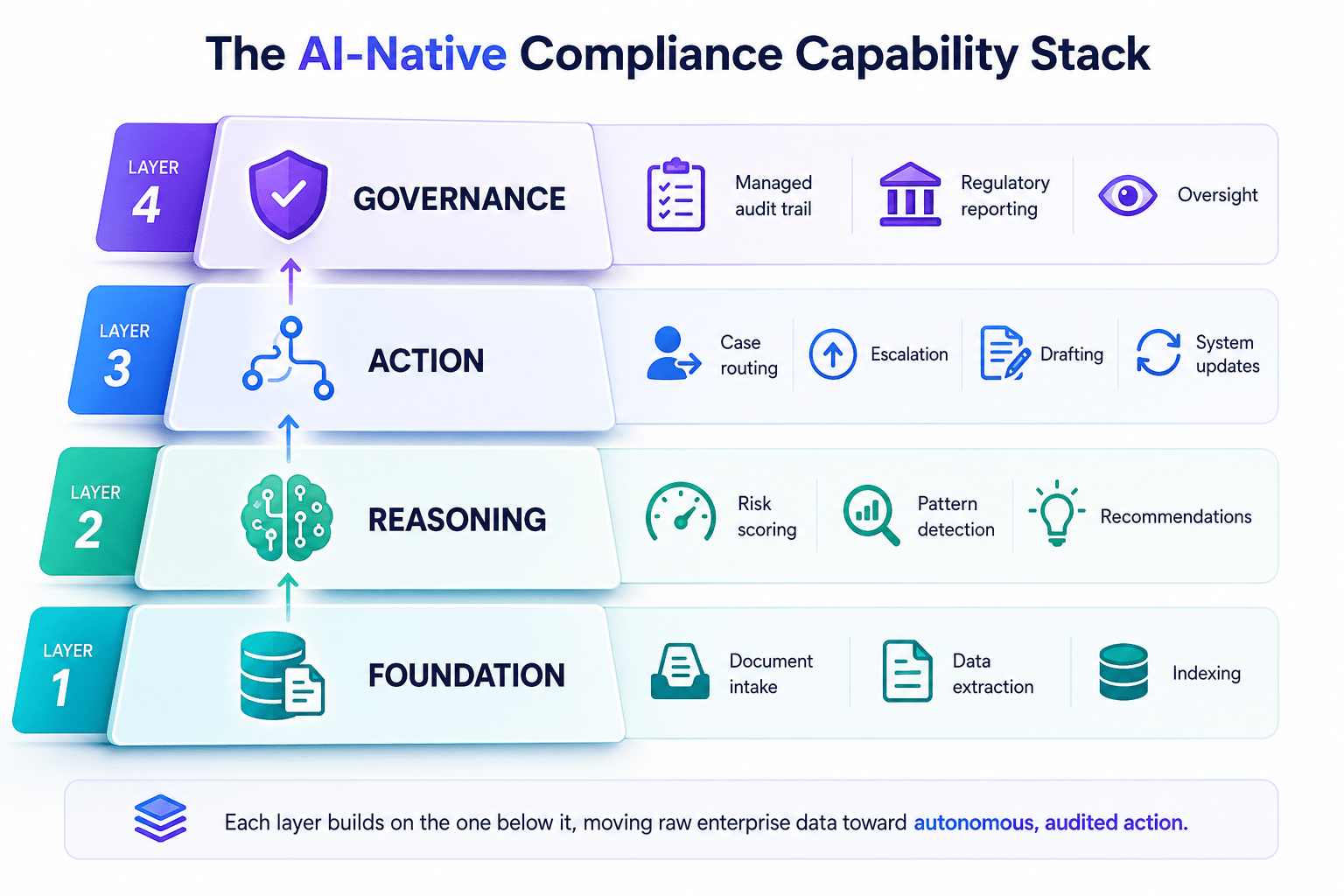
Breaking Down the Four Layers
The stack reads bottom to top for a reason: it mirrors how raw enterprise data becomes an audited, defensible decision. Each layer depends on the quality of the layer beneath it, so a weak Foundation layer quietly undermines everything built above it.
Layer 1 – Foundation: Turning Raw Data into Usable Input
Role: the entry point, converting unstructured documents into data, the rest of the stack can act on.
- Inputs: invoices, emails, system alerts, scanned KYC files, and transaction records.
- Core tasks: document intake, field-level data extraction, indexing for later retrieval.
- Why enterprise buyers test it first: during a pilot, this is the layer buyers probe hardest, because every downstream risk score inherits any error made here.
- What separates AI-native from legacy OCR: Legacy OCR reads documents based on fixed positions. It expects fields to appear in the same location every time. A template change or new supplier can break extraction. AI-native extraction reads documents by field meaning instead of position. It recognizes that “Gross Weight” and “BRUT WT” represent the same value. It also adapts to unfamiliar document layouts. As a result, it continues working without manual template updates.
Layer 2 – Reasoning: Turning Data into Risk Insight
Role: the intelligence layer, converting structured data into decisions a compliance officer can act on.
- Inputs: extracted data from Layer 1, plus reference data such as sanctions lists and historical transactions.
- Core tasks: risk scoring, pattern and anomaly detection, generating recommended next actions.
- Why it decides the deal: this is the layer a Chief Compliance Officer scrutinizes most closely, since an unexplained risk score gets rejected during legal and risk review almost immediately.
- What separates AI-native from rule-based: static rule engines match fixed thresholds and generate heavy false positives; AI-native models read behavioral patterns over time, cutting false positives without missing real risk.
Layer 3 – Action: Turning Insight into Execution
Role: the execution layer, translating a Reasoning-layer recommendation into a real action inside connected business system.
- Inputs: risk scores and recommendations produced by Layer 2.
- Core tasks: case routing to the right reviewer, escalation of high-risk items, drafting reports, and updating downstream systems such as ERP or case management.
- Why it matters to buyers: this layer defines how human-in-the-loop review works in practice, clearing low-risk cases automatically while sending high-risk cases to a person, which is the balance every procurement committee asks about.
- Beyond simple extraction: the Action layer cross-checks relationships between documents and existing business data, catching a mismatch between a filing and internal records before a human ever opens the file.
Layer 4 – Governance: Turning Actions into a Defensible Record
Role: the oversight layer, sitting above the other three and making every decision traceable rather than processing individual cases itself.
- Inputs: activity logs generated continuously across the Foundation, Reasoning, and Action layers.
- Core tasks: automated audit trail generation, regulatory reporting, and ongoing oversight aligned with frameworks such as GDPR and ISO 27001.
- Why regulators and internal audit care most: the real test is not whether the system is automated, but whether the team can reconstruct exactly why a specific decision was made months earlier.
- Why this layer sets the delivery timeline: because the audit trail is generated automatically as a byproduct of the workflow rather than compiled afterward, SmartDev can typically activate this capability within six to eight weeks.
The defining property of the stack is that it is progressive, not all-or-nothing. Each layer depends on the one below it, and an organization can stop at whichever layer matches its current readiness. A team just getting started might deploy only the Foundation and Reasoning layers first, then add Action and Governance once it trusts the outputs. This is exactly why NORA is built as an expandable capability stack rather than a single, one-time implementation project, which lowers the perceived risk that often stalls an enterprise’s signature.
NORA: A Productized AI Compliance Platform
The stack above is not a theoretical model, it is the actual architecture behind NORA, SmartDev’s AI Adoption Accelerator, a fully managed service that designs, builds, and continuously operates AI workflow automation rather than leaving clients to maintain custom infrastructure alone. What NORA adds on top of the stack is execution: a compliance-specific audit trail, a defined delivery timeline, and API-based integration into systems that are already in place.
NORA for compliance, briefly:
- Audit trail: built automatically at every step of the decision workflow, AI assessment, confidence scoring, escalation routing, and human review, in a single structured log.
- Delivery: Compliance Audit Trail Capability lives in six to eight weeks; full ROI is generally realized within six to nine months.
- Integration: connects to existing case management, sanctions of databases, and ERP infrastructure through standard APIs; no rip-and-replace required.
Where NORA Sits in an Enterprise Compliance Stack
| Document sources | → NORA Foundation layer |
| Sanctions databases, case management | → NORA Reasoning & Action layers |
| Regulators, internal audit | → NORA Governance layer output |
How NORA connects existing enterprise systems into one governed compliance workflow.
Rollout: NORA Live in Six to Eight Weeks
Architecture alone doesn’t close a deal; enterprise buyers also evaluate how disruptive a deployment will be. This is where the four layers turn into a dated project plan. A clear, time-boxed roadmap reduces perceived risk and shortens the final approval stage of the sales cycle.
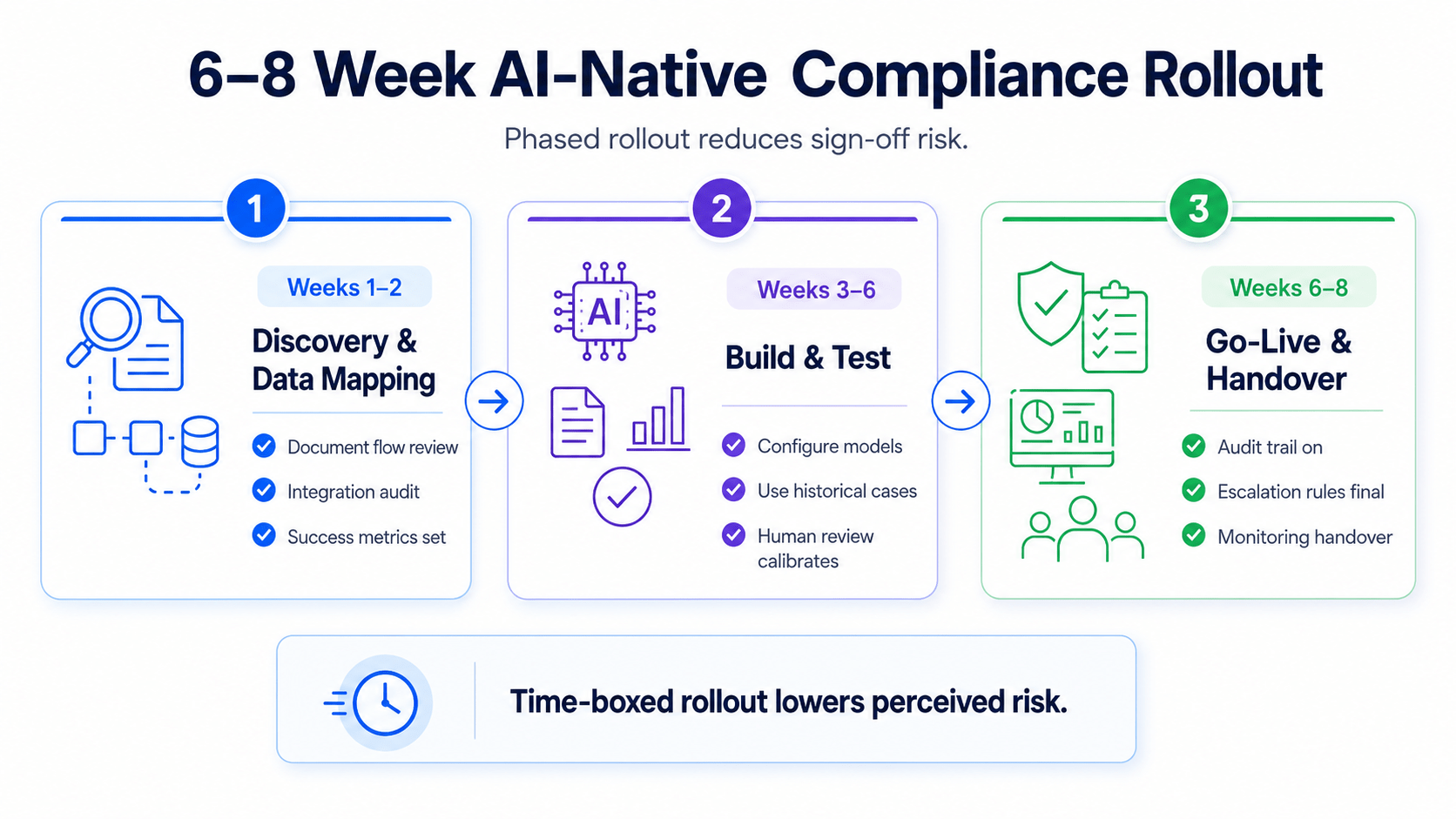
AI-native compliance deployments typically follow a phased rollout. This approach lets organizations validate results before full-scale implementation.
- Weeks 1–2: Map compliance workflows, assess existing systems, and define success metrics.
- Weeks 3–6: Configure and validate AI models using historical cases, with human reviewers refining accuracy.
- Weeks 6–8: Deploy to production with continuous audit trails, governance controls, and ongoing monitoring.
Takeaway: Winning RegTech platforms treat explainability, KYC/AML capabilities, and auditability as core architectural features. NORA packages these capabilities into a pre-built platform with a six-to-eight-week rollout. That gives enterprise buyers both technical proof and deployment certainty early in the procurement process.
How Workflow-First Compliance Automation Closes Deals
From Fragmented Tools to a Single Workflow
Enterprises often run separate tools for screening, case management, and reporting, which forces compliance staff to copy data between systems manually. A workflow-first approach connects document extraction, risk scoring, exception routing, and reporting into one continuous process. This reduces headcount pressure and gives sales teams a concrete efficiency number to present in the business case, which speeds up budget approval.
Proving ROI During the Sales Cycle
Enterprise buyers rarely approve compliance platforms without measurable results. They expect pilots to demonstrate clear time savings and lower error rates within a defined timeframe.
SmartDev’s guide to workflow automation ROI explains how to structure pilots that generate this evidence quickly. Thomson Reuters’ Future of Professionals research also shows organizations with a defined AI strategy achieve stronger returns than those adopting AI without a clear plan.
Investment trends reinforce this shift. Financial institutions invested approximately USD 35 billion in AI technologies during 2023, highlighting the growing commitment to AI-powered compliance and operations.
Takeaway: A connected, workflow-first platform gives sales teams a measurable ROI story, which is often what moves a stalled enterprise deal to signature.
The Solution: Building AI-Native Compliance with SmartDev
SmartDev helps RegTech firms and financial institutions build AI-native compliance platforms without starting from scratch. We combine AI and machine learning engineering, data analytics services, MLOps services, and generative AI development with deep experience across the BFSI and fintech industry. Our security and QA teams also validate integrations using proven software testing for BFSI methodologies and API testing platforms for BFSI, helping clients meet PCI DSS and ISO 27001 requirements before go-live.
We have delivered automation for financial services organizations, including projects that transformed manual support into intelligent automation. You can also explore our BFSI domain, AI in BFSI, and BFSI payments infrastructure, and broader case studies for related implementations.
Whether you’re evaluating vendors, building an in-house compliance platform, or preparing enterprise procurement, our AI consulting services can help. We assess your current technology stack, identify practical opportunities, and define a realistic roadmap. Every engagement begins with a discovery workshop focused on your business goals, not a lengthy sales pitch.
Frequently Asked Questions
What makes compliance software “AI-native” rather than just “AI-enabled”?
AI-native platforms embed reasoning, explainability, and audit logging into their core architecture. AI-enabled platforms simply layer machine learning onto legacy rule-based systems. This often creates audit gaps that enterprise buyers reject during procurement.
How long does an enterprise RegTech procurement cycle usually take?
Timelines vary widely, but security review, legal review, and pilot period commonly stretch the process across two to six months. Vendors who arrive with pre-mapped controls against GDPR, PCI DSS, ISO 27001, and similar frameworks tend to move through this faster.
Does adopting AI-native compliance require replacing existing systems?
Not usual. Platforms built with an API-first architecture, including NORA, connect to existing case-management, ERP, and sanctions-screening tools instead of replacing them, which is one of the main reasons enterprise IT teams approve the deployment.
What is the realistic ROI timeline for AI-native compliance automation?
Based on SmartDev’s deployments, teams typically see the compliance audit trail capability live within six to eight weeks, with full return on investment generally realized within six to nine months.
Conclusion
Enterprise AI adoption is entering a new phase where governance matters as much as innovation. Buyers increasingly expect AI to be explainable, auditable, and aligned with regulatory requirements, not simply efficient. For RegTech vendors, those capabilities are no longer optional; they are becoming the foundation of enterprise procurement.
Organizations that invest in AI-native, governance-first architectures will be better positioned to adapt to evolving regulations. They will also strengthen customer trust and compete for larger enterprise compliance opportunities.
How to Get Started
Moving toward AI-native compliance begins with understanding where existing workflows create operational or regulatory bottlenecks. A structured assessment can help identify opportunities to reduce manual effort, improve audit readiness, and strengthen governance without disrupting existing operations.
To begin:
- Assess your current compliance workflow to identify manual bottlenecks, repetitive reviews, and audit pain points.
- Prioritize high-impact use cases such as KYC, AML, document review, or regulatory reporting where AI can deliver measurable value.
- Build on a governed foundation by ensuring explainability, security, integration, and auditability are embedded from the outset.
- Validate with a phased rollout before expanding AI across broader compliance operations.
Whether you’re modernizing an existing RegTech platform or building AI-native capabilities, SmartDev provides practical guidance. Our team helps evaluate your architecture and plan a realistic path to enterprise-ready compliance with NORA.