
TL;DR
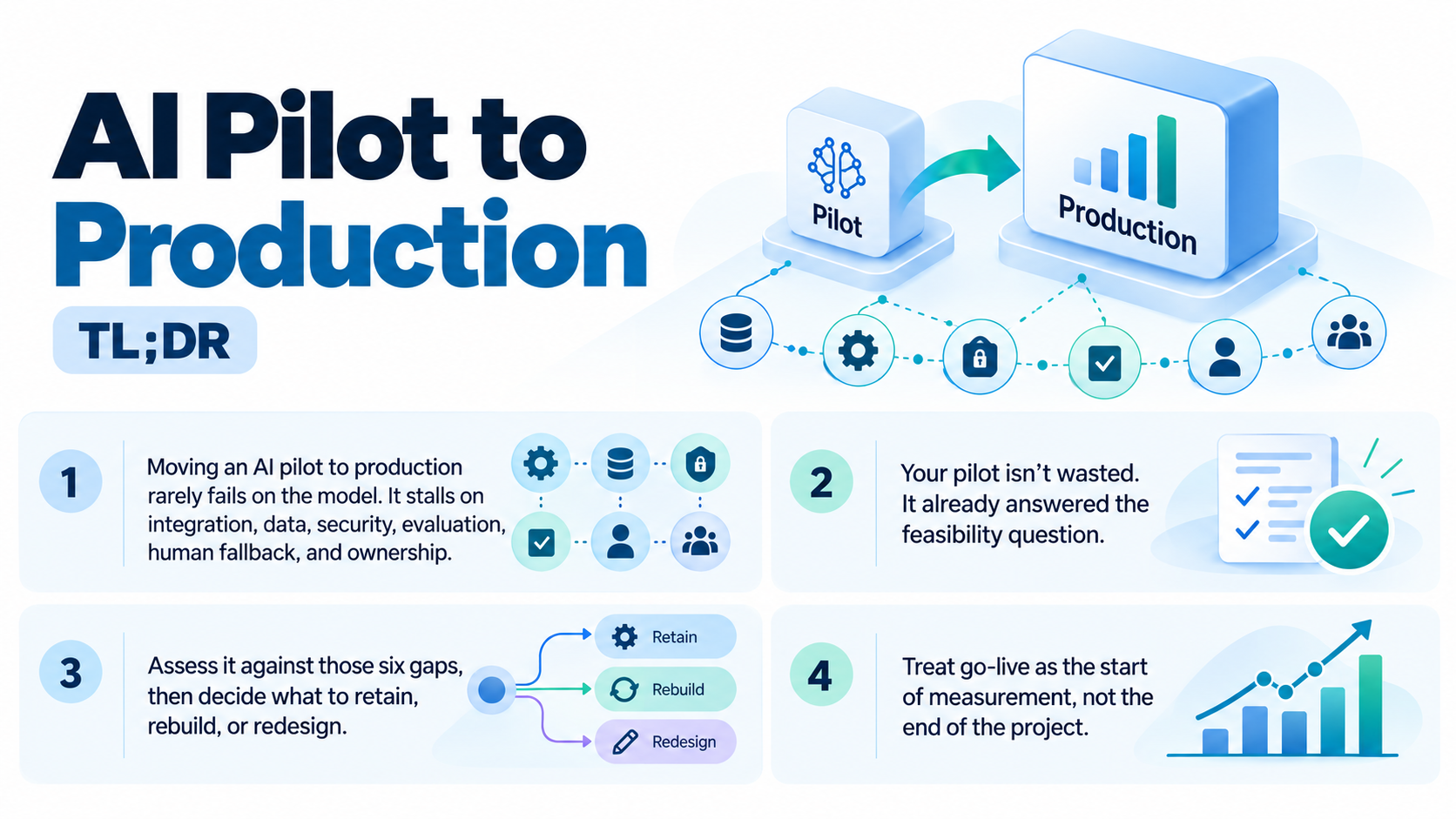
- Moving an AI pilot to production rarely fails on the model. It stalls on integration, data, security, evaluation, human fallback, and ownership.
- Your pilot isn’t wasted. It already answered the feasibility question.
- Assess it against those six gaps, then decide what to retain, rebuild, or redesign.
- Treat go-live as the start of measurement, not the end of the project.
1. Introduction
The demo went well. The model answered correctly, the stakeholders nodded, and someone said “let’s roll it out next quarter.” That was two quarters ago.
If that sounds familiar, your team probably isn’t the problem. Most stalled pilots work. What they lack is everything a production system needs around the model: real integrations, real data, controls your risk team will sign off on, and someone who owns the result on a Monday morning.
This guide is for teams that already have something running, whether it’s a proof of concept, an internal agent, or a Copilot workflow, and need to move that AI pilot to production. It covers where the gaps usually hide, how to decide which parts of the pilot to keep, and what has to happen after go-live.
2. Why Working AI Pilots Stall Before Production
The numbers are consistent across studies. MIT’s NANDA initiative found that 95% of generative AI pilots show no measurable P&L impact. Gartner predicts that over 40% of agentic AI projects will be canceled by the end of 2027, citing escalating costs, unclear business value, and inadequate risk controls.
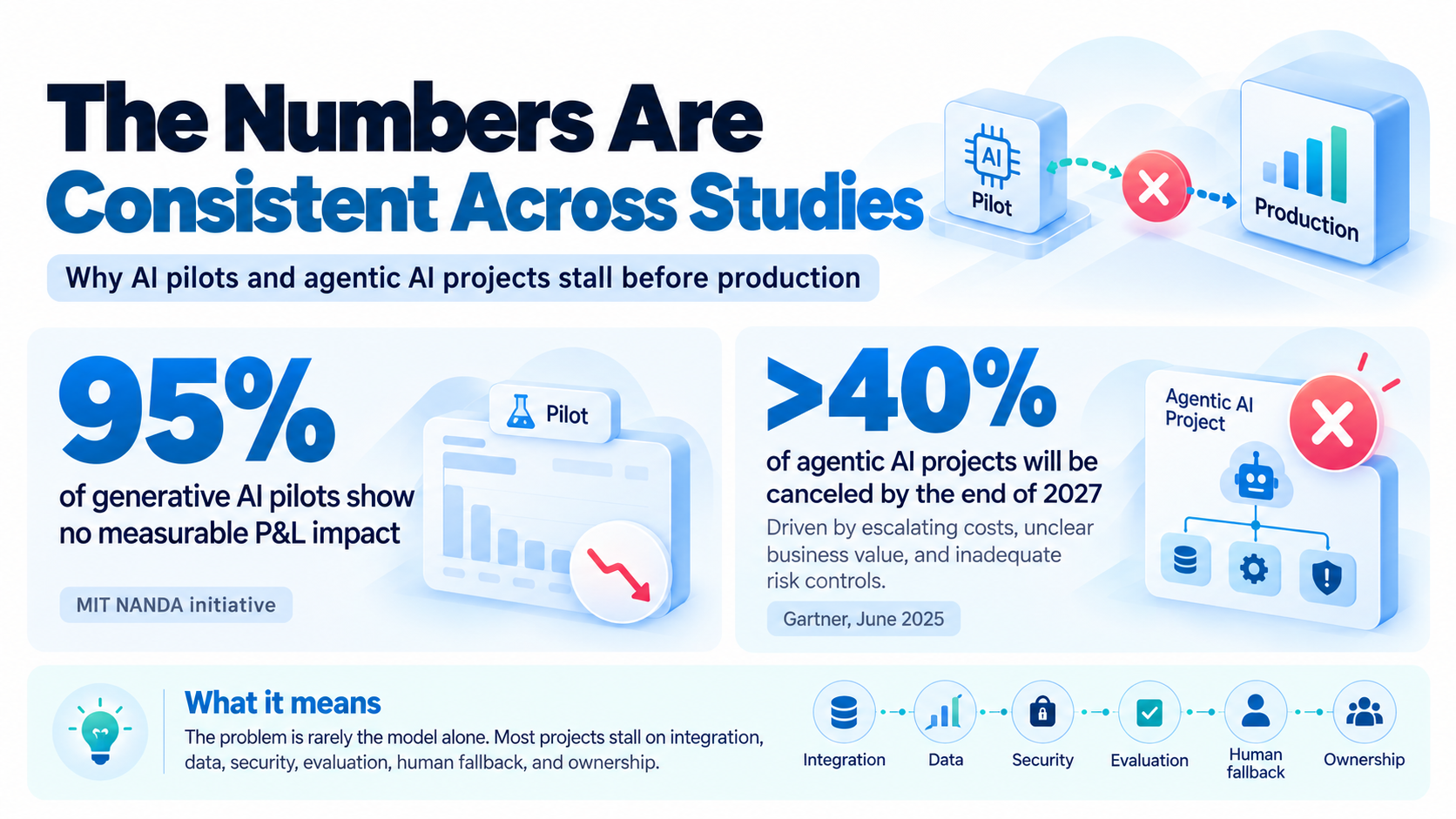
Notice what’s missing from that list: model quality. The model is rarely the bottleneck. Evaluation, integration, exception design, and operational ownership are.
A pilot is built to answer one question: can AI do this task? Production asks harder ones. Can it do the task on messy data at ten times the volume? What happens when it’s wrong? Who notices, and who fixes it? A pilot that was never designed to answer those questions won’t graduate just by running longer.
3. Your Pilot Isn’t Wasted: What It Already Proved
Teams sometimes write off a stalled pilot as a sunk cost and start over. That’s usually a mistake. Choosing a model, writing prompts, and proving the task is feasible is the least differentiated part of the work, and it’s already done. Building on ChatGPT, Copilot, or a foundation-model API isn’t a liability.
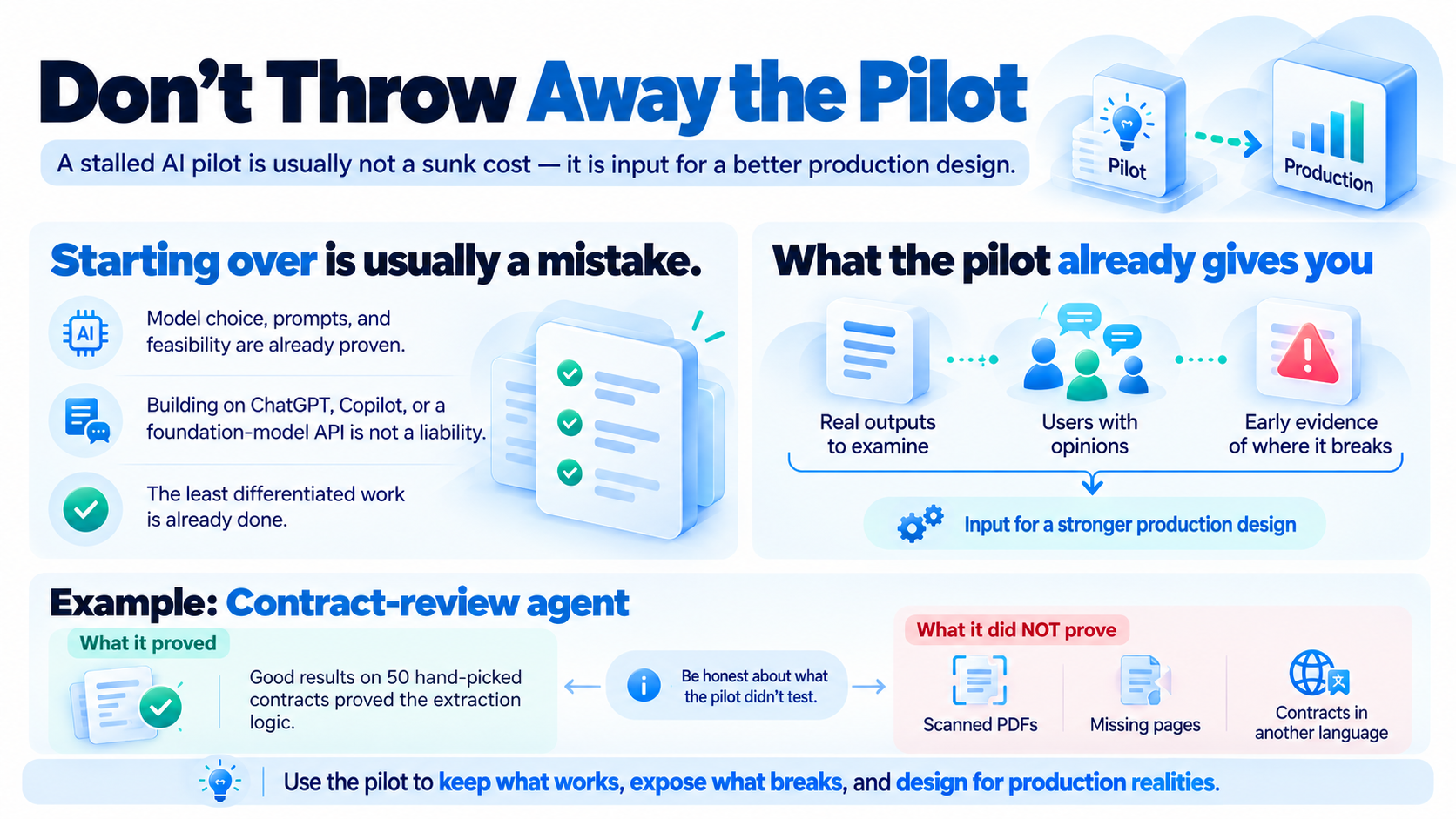
The pilot also gives you real outputs to examine, users with opinions, and early evidence of where it breaks. That’s valuable input for a production design, as long as you’re honest about what it didn’t test.
For example, an internal contract-review agent that performs well on 50 hand-picked contracts has proved the extraction logic. It has proved nothing about scanned PDFs, missing pages, or the handful of contracts written in another language.
4. The Six Gaps Between an AI Pilot and Production
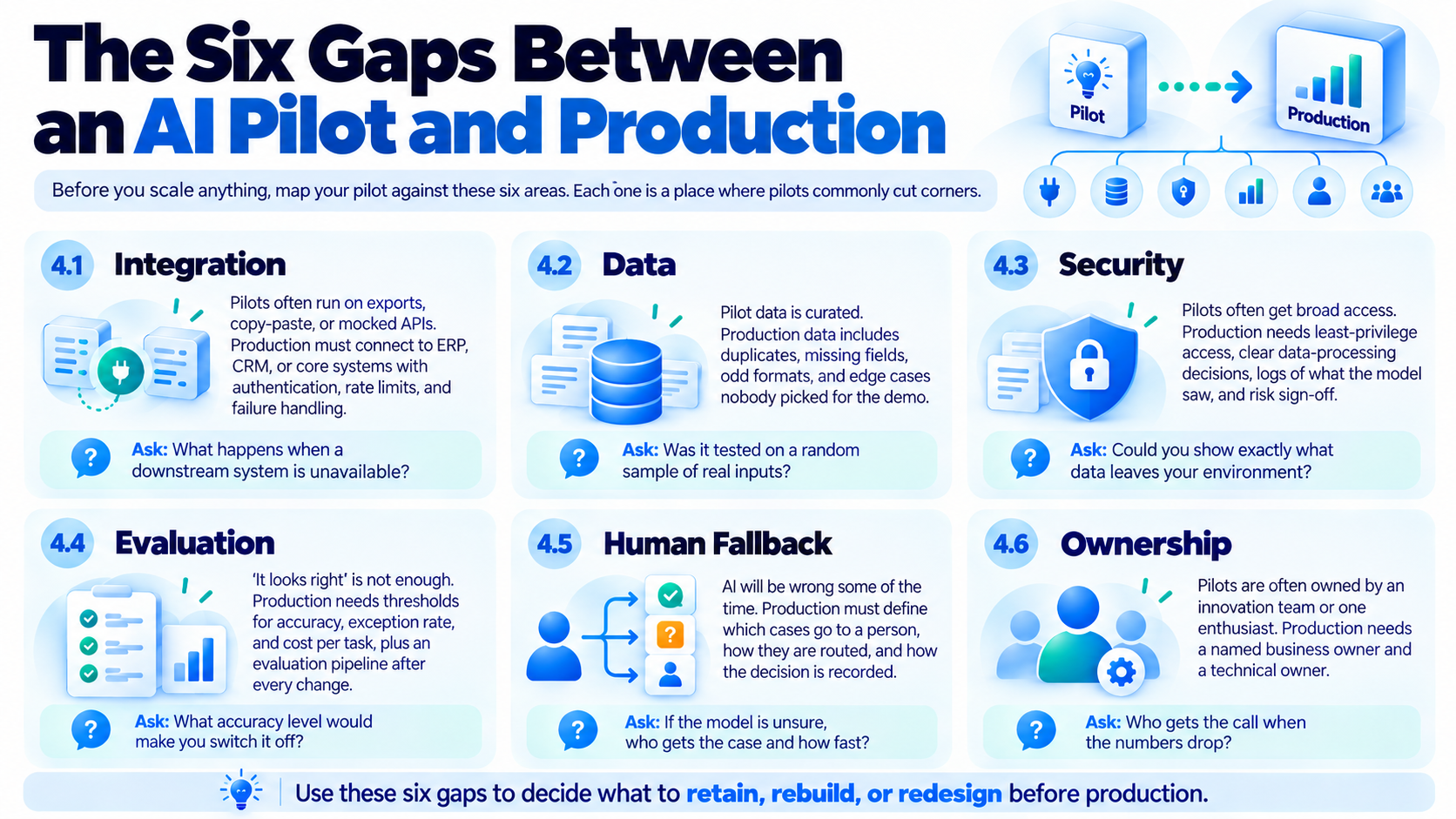
Before you scale anything, map your pilot against these six areas. Each one is a place where pilots commonly cut corners, often for good reasons at the time.
4.1 Integration
Pilots typically run on exports, copy-paste, or a mocked API. Production means reading from and writing to your ERP, CRM, or core system, with authentication, rate limits, and failure handling. Ask: what does the workflow do when the downstream system is unavailable?
4.2 Data
Pilot data is usually curated. Production data includes duplicates, missing fields, odd formats, and edge cases nobody picked for the demo. Ask: was the pilot tested on a random sample of real inputs, or on good examples?
4.3 Security
A pilot often gets broad access because it was faster to set up. Production needs least-privilege access, clear decisions on where data is processed, logs of what the model saw, and sign-off from whoever owns risk. Ask: could you show your security team exactly what data leaves your environment?
4.4 Evaluation
This is the gap teams underestimate most. “It looks right” is not an acceptance criterion. Production needs agreed thresholds for accuracy, exception rate, and cost per task, plus an evaluation pipeline: a set of automated checks that tells you whether the AI still gives correct answers after every change. Ask: what accuracy level would make you switch it off?
4.5 Human Fallback
Every AI workflow will be wrong some of the time. What matters is what happens next. A production design defines which cases go to a person, how they’re routed, and how that person’s decision is recorded. In regulated workflows, that record is what makes the decision defensible. Ask: if the model is unsure, who gets the case, and how fast?
4.6 Ownership
Pilots are often owned by an innovation team or a single enthusiast. Production needs a named business owner accountable for outcomes and a technical owner for the system. Ask: who gets the call when the numbers drop?
| Gap | What the Pilot Usually Hides | Production Question |
|---|---|---|
| Integration | Manual exports or mocked APIs | What happens when a connected system fails? |
| Data | Curated, clean samples | Does it hold up on random real inputs? |
| Security | Broad, convenient access | Can you show exactly what data leaves? |
| Evaluation | “Looks right” judgment | What threshold switches it off? |
| Human fallback | Undefined error handling | Who handles uncertain cases, and how fast? |
| Ownership | An enthusiast or project team | Who is accountable after go-live? |
5. Retain, Rebuild, or Redesign: Deciding What Survives
Once the gaps are mapped, every component of the pilot gets one of three labels.
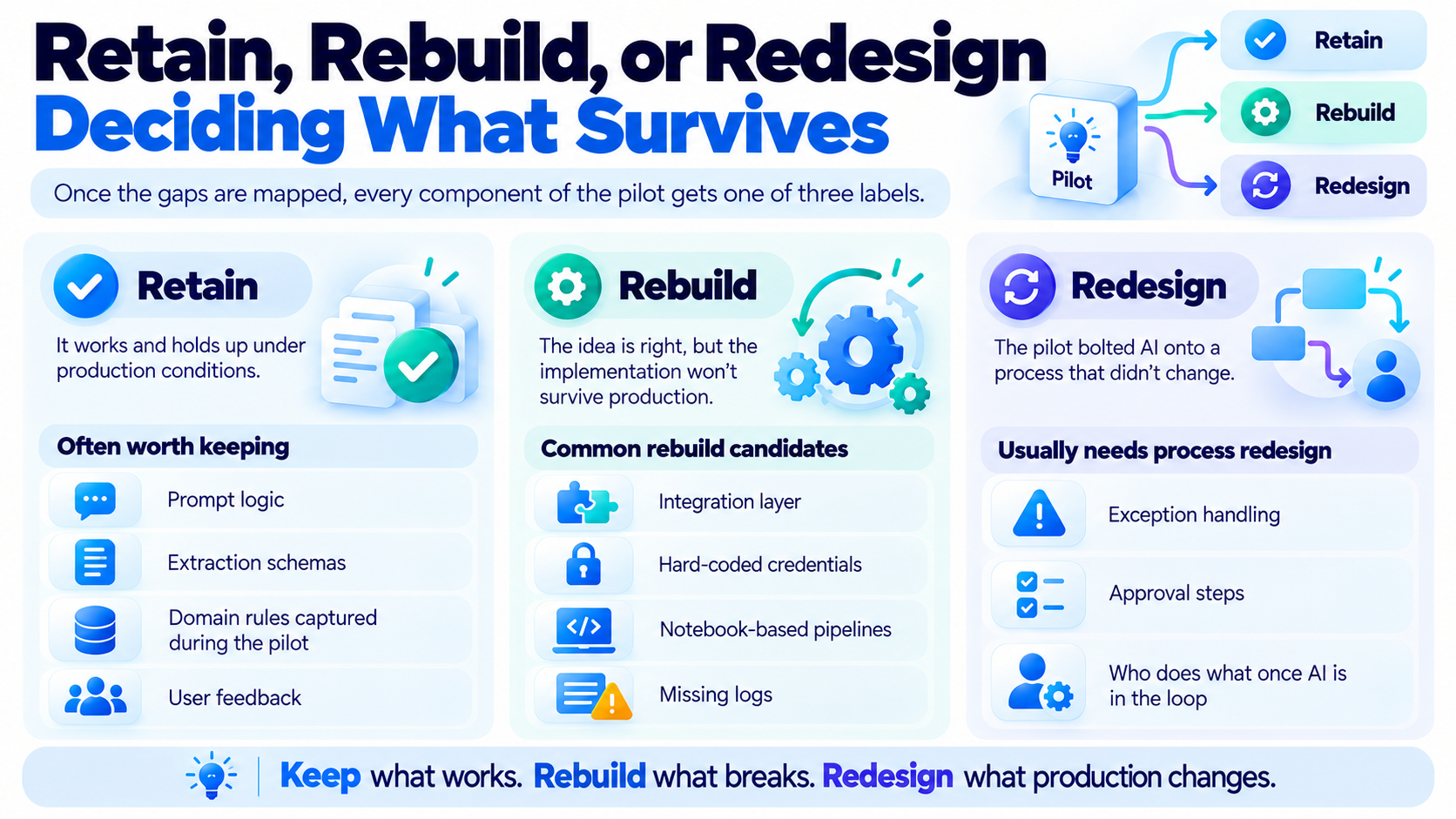
- Retain: it works and holds up under production conditions. This is often the prompt logic, extraction schemas, domain rules captured during the pilot, and user feedback.
- Rebuild: the idea is right, but the implementation won’t survive production. Common candidates are the integration layer, hard-coded credentials, notebook-based pipelines, and missing logs.
- Redesign: the pilot bolted AI onto a process that didn’t change. This usually covers exception handling, approval steps, and who does what once the AI is in the loop.
For example, a KYC review pilot might retain its document classification and field extraction, rebuild its connection to the case management system with proper audit logs, and redesign the review step so analysts handle only flagged files instead of double-checking every one.
A useful rule: don’t rebuild something that works just because production feels serious, and don’t keep a shortcut just because it’s already written. Every decision should trace back to a specific gap.
The output is a productionization design: scope, controls, owners, and what “good” looks like in numbers, agreed before deployment work starts.
6. Going Live Is Where Measurement Starts
An AI workflow left alone after launch doesn’t fail loudly. It drifts. Accuracy slips as real-world data shifts, exceptions pile up unnoticed, and the controls you approved at go-live gradually stop matching what’s actually running. Too often, a customer, auditor, or regulator spots the gap first.
Ongoing operation looks like this:
- Monitor accuracy and exception rates continuously, not only when someone complains.
- Tune the workflow as volumes and edge cases change.
- Review KPIs against the baseline you set before launch.
- Track cost per task so usage growth doesn’t quietly erase the business case.
Before you go live, agree on three things: who reviews these numbers, how often, and what triggers a fix.
6. How SmartDev Takes an Existing Pilot to Production
This is the problem NORA, our AI Adoption Accelerator, is built to solve. Path A is for teams that already have a pilot, and it runs in five stages:
- Production Readiness Assessment: find the real gaps in integration, data, security, evaluation, control, and ownership.
- Productionization Design: decide what to retain, rebuild, or redesign.
- Production Deployment: integrated, hardened, and live in your environment with agreed controls.
- Operate & Optimize: monitor performance, control risk, and keep improving reliability, cost, and outcomes.
- Scale: extend to adjacent workflows where reuse and ROI support it.
There’s no separate proof step. Your pilot has already resolved most of the technical uncertainty, so we start from what you’ve built rather than from zero. You keep ownership of the domain truth: business rules, risk appetite, and sign-off. We turn that into a working, evidenced production operation.
For a sense of what production looks like, see how we cut KYC review time without adding headcount for an insurance client in Singapore. An LLM-powered pipeline parses documents, validates them against compliance rules, and flags risk automatically. The result: 60% faster KYC validation, 75% less manual document handling, and 40% fewer review inconsistencies. For workflows where AI decisions must hold up against approved rules, NORA Compliance applies the same model.
7. The Next Step for Your Pilot
If your pilot works but isn’t live, the answer isn’t another demo. It’s an honest look at the six gaps, a clear decision on what to keep, and a plan for who owns the result after launch.
Bring us the pilot you have, and we’ll show you where the production gaps are. Talk to us about your pilot.
Frequently Asked Questions
Why Do AI Pilots Fail to Reach Production?
Most pilots don’t fail because the model underperforms. They fail because the work around it was never done: integration with real systems, testing on messy data, security review, evaluation thresholds, a fallback for wrong answers, and a named owner. A pilot proves feasibility; production needs all six of those in place.
What Is AI Pilot Purgatory?
Pilot purgatory is when an AI pilot works well enough to keep running but never gets approved for production. It usually happens because nobody defined what “ready” means in measurable terms, so every review ends with “almost there.” Agreeing on acceptance thresholds and a named owner is what breaks the loop.
What Should an AI Production Readiness Assessment Cover?
At minimum: integration with live systems, data quality on real inputs, security and access controls, evaluation thresholds and how they’re monitored, human fallback for uncertain cases, and ownership after go-live. The result should be a clear decision on what to retain, rebuild, or redesign, not just a readiness score.
Should We Rebuild Our AI Pilot From Scratch for Production?
Rarely. Prompt logic, extraction schemas, and domain rules often carry over. What usually needs rebuilding is the integration layer, logging, and access controls. What needs redesign is the surrounding process. Decide component by component, based on the specific gap each one fails, rather than rewriting everything at once.
How Long Does It Take to Move an AI Pilot to Production?
It depends on the gaps. For one bounded workflow, production deployment typically runs 6 to 10 weeks once the readiness assessment and design are agreed. Pilots with heavy integration or compliance requirements can take longer. Treat any timeline as a range based on your specific gaps, not a fixed promise.