

TL;DR
- REST often fits public and partner-facing APIs because it works with conventional HTTP clients, gateways, documentation tools, and integration patterns.
- GraphQL often fits application-facing aggregation layers where clients need different combinations of data from multiple sources.
- gRPC often fits controlled internal environments that benefit from generated clients, typed service definitions, and unary or streaming RPC patterns.
- Using AI does not automatically require gRPC or GraphQL. The decision should follow the interface requirements, not the presence of a machine-learning model.
- No protocol has a universal latency advantage. Model execution, payloads, serialization, network conditions, caching, backend dependencies, concurrency, and implementation quality all affect results.
- Production readiness matters as much as protocol capability. Authorization, quotas, observability, compatibility, retries, cost controls, and operational ownership remain necessary across all three approaches.
- Hybrid architecture is a legitimate outcome. Different boundaries in the same AI platform may use different interfaces.
- Migrate only when a demonstrated requirement cannot be addressed adequately by improving the current API and its supporting architecture.
Introduction
Choosing an API protocol for an AI-powered product is an architecture decision, not a speed contest. REST, GraphQL, and gRPC each solve a different interface problem — and the right choice depends on where the API sits and what it must do, not on which protocol wins a synthetic benchmark.
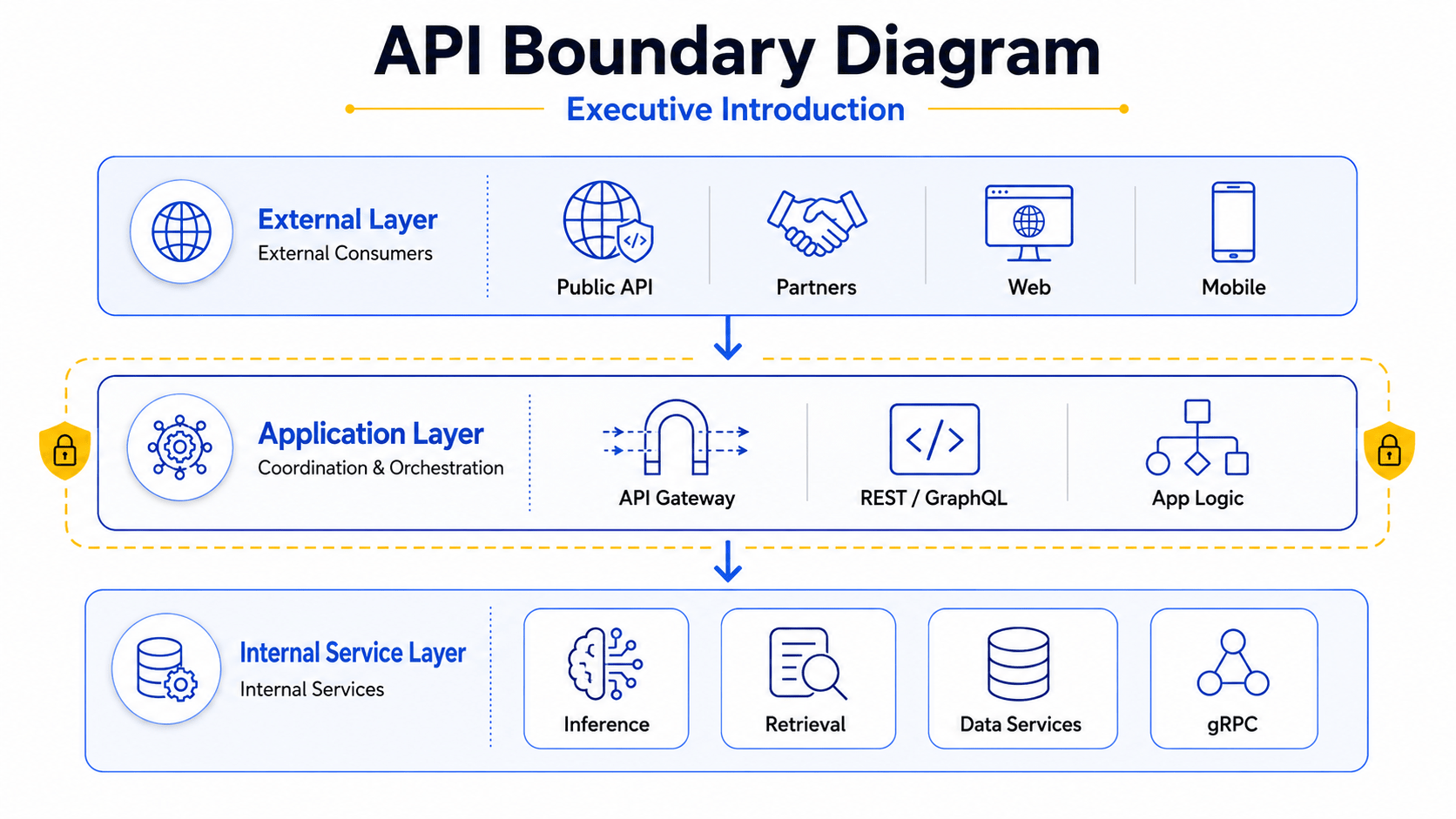
This guide covers the API boundaries that matter for AI workloads: public model endpoints, application-facing data aggregation, internal inference services, real-time pipelines, and hybrid architectures that combine more than one style. It applies equally to teams building new systems and to teams evaluating whether their current interface still fits their requirements.
1. Start With the Decision: What Must Your AI API Do?
Choose an API style by evaluating your consumers, data needs, real-time requirements, and operating constraints before comparing raw performance.
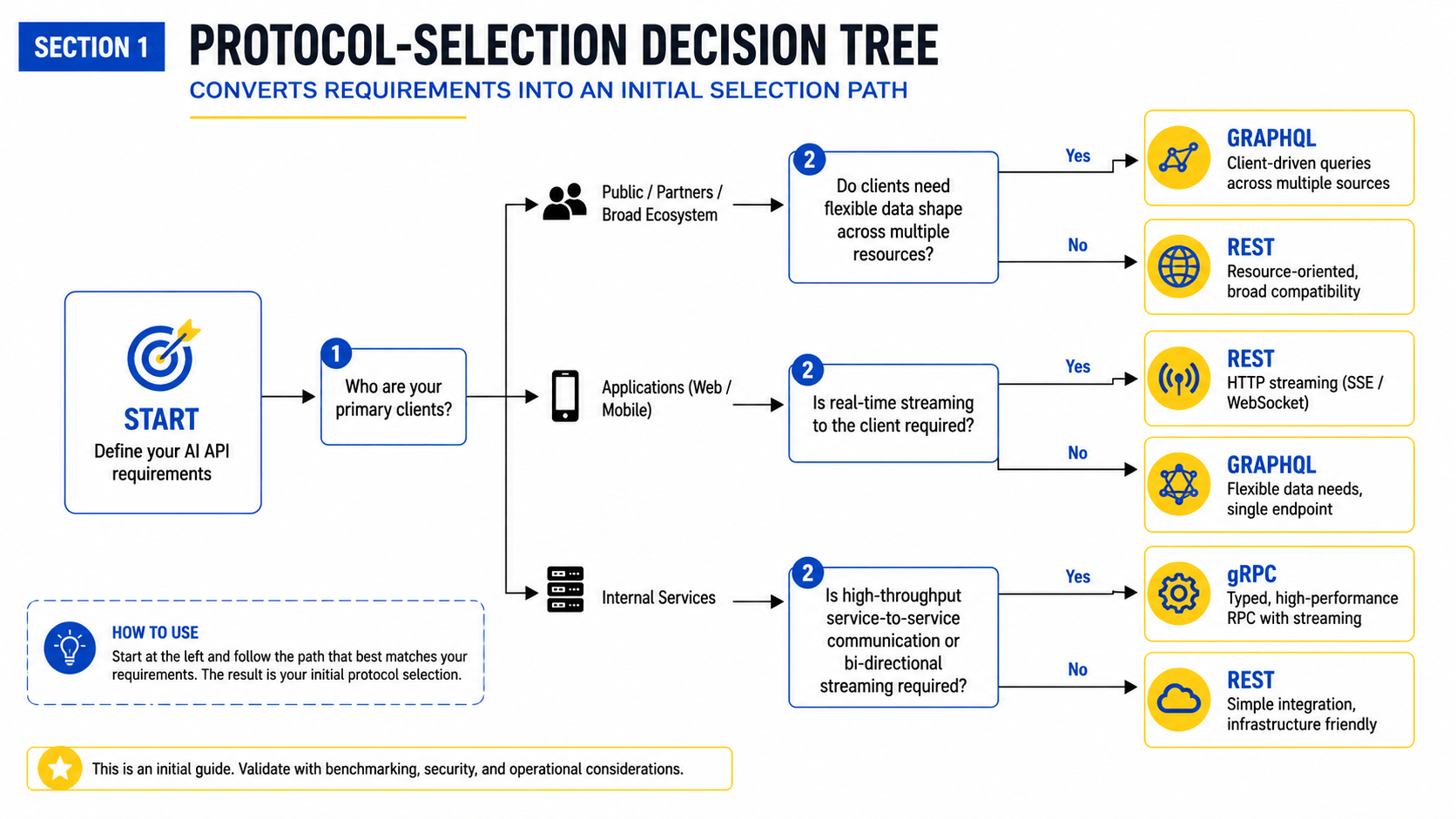
Before comparing REST, GraphQL, and gRPC, define the interface problem you are actually solving. The questions below form a repeatable selection framework.
1.1 The Architecture Decisions That Determine Protocol Fit
The following criteria interact; no single factor determines the right choice in every case.
Client audience and compatibility. Who will call this API — public developers, browser-based applications, mobile clients, internal services, or partner systems? Each audience has different tooling expectations and compatibility constraints. If your team is still defining AI development requirements, this question is the right place to start.
Data access pattern. Do clients always need the same fields, or does data shape vary significantly by context? Does the API aggregate data from multiple sources, or serve a single resource type?
Latency, throughput, and payload. What are the service-level objectives for this interface? What is the typical payload size — small structured results, large embeddings, or streaming token sequences?
Streaming and real-time interaction. Does the workload require continuous typed message exchange between services, or server-to-client event updates for a browser UI? These are different problems requiring different approaches.
Security model. What authentication, authorization, and data minimization requirements apply? Do field-level or method-level access controls matter?
Observability and tooling. What debugging, tracing, and monitoring capabilities does your platform provide? Binary protocols require protocol-aware tooling that may not exist in your current stack.
Team capability and operational ownership. Which protocols can your team implement, debug, govern, and maintain sustainably? Teams evaluating architectural readiness may benefit from an AI consulting engagement before committing to a protocol stack.
1.2 The Short Answer: When REST, GraphQL, and gRPC Fit Best
| Protocol | Often a good fit when… | Watch out for… |
|---|---|---|
| REST | Public APIs, partner integrations, broad client compatibility, and conventional request–response resource access | Highly variable client data needs, chatty aggregation, and sustained bidirectional streaming |
| GraphQL | Client-driven data access across multiple sources, flexible field selection, and dashboards or mobile apps with varying data requirements | Query complexity, N+1 resolver risks, field-level authorization, and production query governance overhead |
| gRPC | Typed internal service-to-service communication, high call volumes with controlled clients, and server or bidirectional streaming between services | Browser compatibility limitations requiring gRPC-Web, load balancer and infrastructure support requirements, and debugging tooling overhead |
| Hybrid | Different boundaries within the same platform have genuinely different requirements | Contract ownership across multiple interface styles, observability across protocol boundaries, and avoiding unnecessary migration |
2. REST vs GraphQL vs gRPC at a Glance
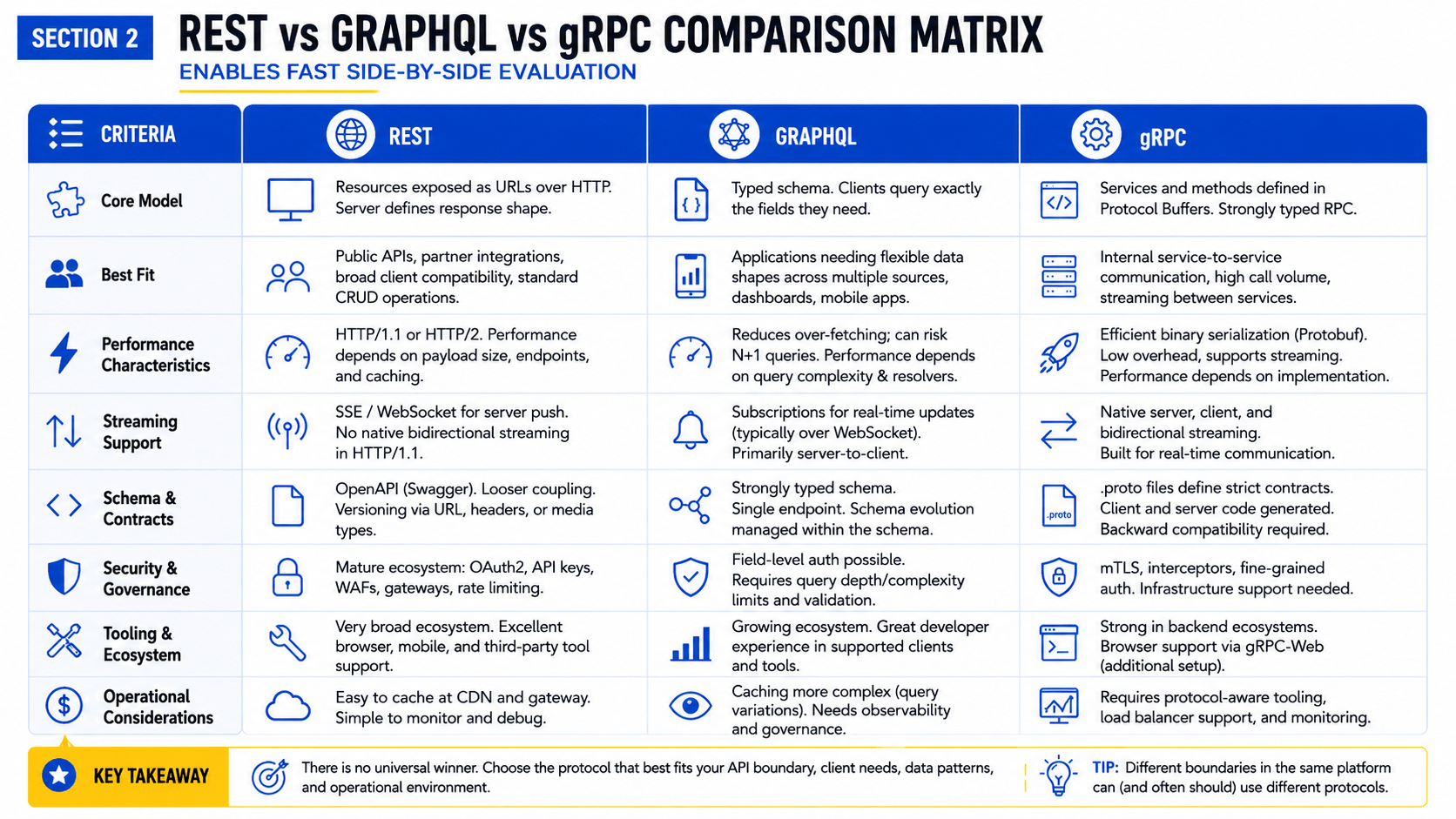
This section provides a unified decision matrix for fast, consistent comparison across the criteria that matter for AI API design.
2.1 Core Model and Request-Response Style
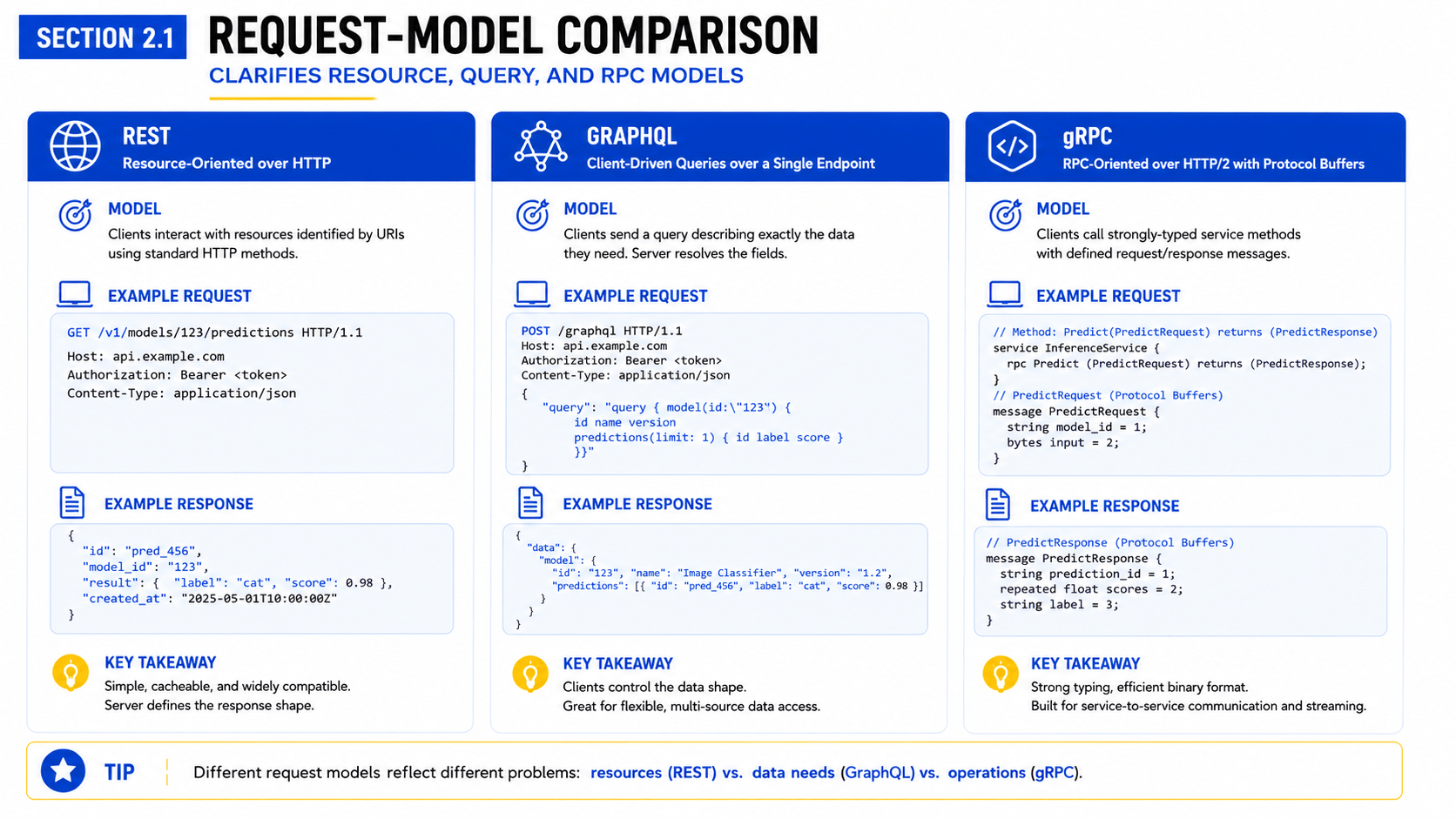
REST exposes resources as URLs over HTTP. Clients call standard HTTP methods (GET, POST, PUT, DELETE) to interact with named resources. The server defines the response shape.
GraphQL exposes a typed schema. Clients write queries that specify exactly which fields they need, and a single endpoint resolves them. The client controls the response shape within the schema’s constraints. The full GraphQL specification is maintained by the GraphQL Foundation.
gRPC defines service methods and typed messages in Protocol Buffers. Clients call methods as if they were local functions; the framework handles serialization and transport over HTTP/2. The contract is defined in the .proto file, not in URLs. See the gRPC core concepts documentation for a formal overview of service definitions and call types.
2.2 Client Compatibility and Developer Experience
REST has the broadest client compatibility. Any HTTP client — browser, mobile app, CLI, third-party integration — can call a REST API without special libraries.
GraphQL requires a schema-aware client. Browser and mobile clients are well-supported through maintained client libraries, but developers must learn query syntax and schema navigation.
gRPC relies on generated client stubs. This provides type-safe, multi-language clients, but browsers require a proxy layer (gRPC-Web), and client generation must be maintained as the schema evolves. gRPC commonly benefits environments where all clients are controlled services.
2.3 Data Fetching, Payloads, and Schema Contracts
REST returns a fixed resource representation. Clients that need fewer fields receive extra data (over-fetching); clients that need data from multiple resources make multiple calls (under-fetching). This is manageable for stable, simple resource access patterns.
GraphQL is useful when a client must shape the returned data across multiple sources. A single query can traverse related types, filter fields, and combine model predictions with user context. The trade-off is schema governance: the schema becomes a shared contract that requires careful evolution and authorization at every field.
gRPC uses Protocol Buffers for binary serialization, producing compact payloads and strongly typed contracts. Schema evolution follows Protocol Buffers compatibility rules — new fields can be added without breaking existing clients if field numbering conventions are followed. This governance burden is real and requires discipline.
2.4 Streaming and Real-Time Communication
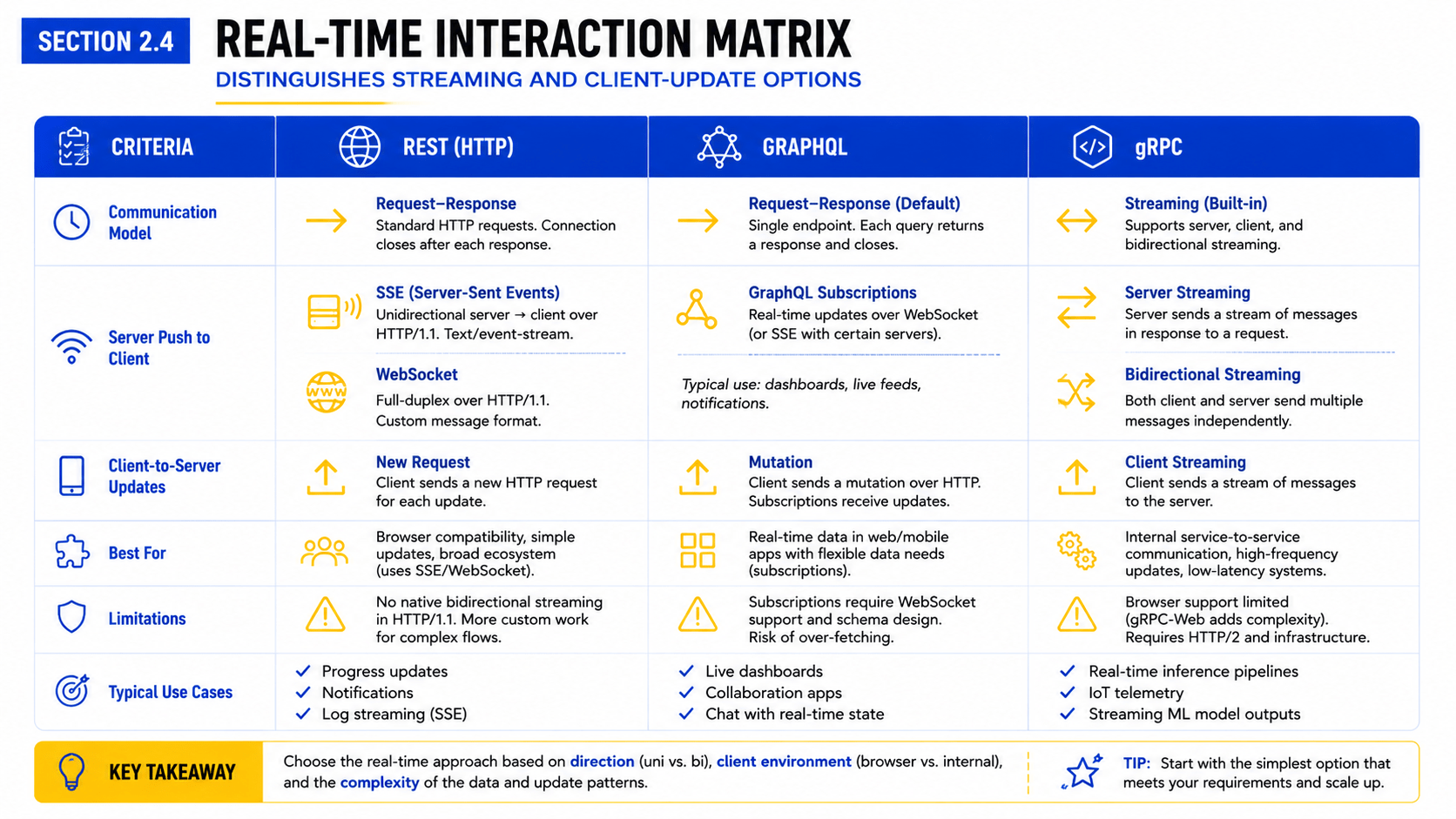
The right streaming approach depends on the interaction model and the deployment environment, not on a protocol brand.
REST supports polling and server-sent events (SSE) for one-directional server-to-client streaming. SSE works over standard HTTP and is well-suited to browser clients receiving continuous updates.
GraphQL subscriptions support event-driven client updates when the deployment model — including WebSocket infrastructure and connection management — supports them. Subscriptions are appropriate for UI-facing real-time features; they are not designed for high-volume service-to-service streams.
gRPC streaming supports four patterns: unary (request-response), server streaming, client streaming, and bidirectional streaming. gRPC streaming is appropriate when the interaction requires continuous typed message exchange between services — not merely a faster request-response API. Load balancers and service mesh infrastructure must support HTTP/2 streaming for this to work reliably in production. The gRPC core concepts page describes each streaming type and its intended use.
| Scenario | Common approach |
|---|---|
| Browser receives live prediction updates | SSE over REST or GraphQL subscriptions |
| Service streams large result sets to another service | gRPC server streaming |
| Bidirectional real-time inference pipeline | gRPC bidirectional streaming |
| Polling for model job status | REST polling or webhooks |
2.5 Performance and Resource Considerations
No protocol has a universal latency advantage across every workload.
End-to-end AI API performance depends on: model inference time, database and retrieval latency, payload size, serialization format, connection behavior, query complexity, cache hit rate, concurrency characteristics, and infrastructure configuration. Transport protocol is one variable among many.
Protocol Buffers produces smaller payloads than JSON for equivalent data structures, which can reduce serialization time and bandwidth — particularly for large or high-frequency payloads. Whether this translates to meaningful end-to-end latency improvement depends on how large model inference time is relative to transport overhead in your specific workload.
GraphQL query complexity can increase backend processing time if resolvers are not optimized or if deeply nested queries are permitted without limits.
The only valid performance comparison is one conducted on your actual workload, under comparable infrastructure conditions, measuring the metrics that correspond to your service-level objectives.
2.6 Security, Caching, Versioning, and Observability
Protocol choice changes implementation details, but authorization, rate limiting, observability, and compatibility remain production requirements regardless of which protocol you choose.
Authentication: OAuth 2.0 and OpenID Connect apply across REST, GraphQL, and gRPC. Service-to-service authentication in gRPC commonly uses mutual TLS (mTLS).
Authorization: REST authorization typically applies at the resource level. GraphQL requires field-level authorization controls — a schema that allows any client to query any field without restrictions is a misconfiguration. gRPC authorization applies at the method level.
Caching: REST over HTTP supports standard HTTP caching through GET semantics and cache-control headers. GraphQL’s single POST endpoint does not cache through HTTP mechanisms by default; persisted queries can enable CDN caching for specific operations. gRPC does not use HTTP caching.
Versioning: REST commonly uses URL versioning (/v1/, /v2/) or header-based versioning. GraphQL evolves through schema deprecation without breaking existing queries. gRPC relies on Protocol Buffers field compatibility rules and service versioning conventions.
Observability: All three protocols benefit from distributed tracing (trace context propagation), request and error metrics, and latency breakdowns. gRPC’s binary encoding requires protocol-aware tooling — standard HTTP debugging proxies cannot inspect gRPC traffic without transcoding.
2.7 Protocol Selection Matrix
This matrix maps common AI API scenarios to likely protocol choices and relevant caveats. “Consider” rather than absolute prescriptions — your workload, team, and constraints may shift the outcome.
| Scenario | Primary constraint | Likely fit | Caveat |
|---|---|---|---|
| Public model API for external developers | Broad HTTP compatibility and standard documentation expectations | REST | Design for versioning and deprecation from day one |
| Partner integration with stable resource access | Interoperability and conventional tooling | REST | Evaluate aggregation requirements before committing |
| Mobile or web app with variable data requirements | Reducing over-fetching across multiple data types | GraphQL | Requires query governance and field-level authorization |
| ML-powered dashboard combining model outputs and user data | Aggregating data across heterogeneous sources | GraphQL | N+1 resolver risk; implement the DataLoader pattern |
| Internal microservice calls within a controlled environment | Typed contracts and high call volumes | gRPC | Verify load balancer and infrastructure support |
| Internal AI inference service receiving typed requests | Typed contracts with potential streaming requirements | gRPC | Plan for client generation and schema evolution |
| Real-time streaming between backend AI services | Bidirectional, typed message exchange | gRPC streaming | Infrastructure must support HTTP/2 streaming |
| Browser client receiving live prediction updates | Browser compatibility and server-to-client events | SSE over REST or GraphQL subscriptions | gRPC-Web adds proxy complexity for browser clients |
3. REST for Public and Partner-Facing AI APIs
REST is often a practical fit when interoperability and conventional HTTP client support are primary requirements.
3.1 Where REST Is the Practical Default
REST is a reasonable starting point for:
- Public AI model endpoints consumed by external developers who bring their own HTTP clients
- Partner integrations where both parties expect standard HTTP behavior and OpenAPI documentation
- Conventional request-response workflows where clients always need the same resource shape
- Systems where the breadth of HTTP tooling — load balancers, CDNs, API gateways, monitoring — provides operational advantages
The key distinction is between “practical default” and “automatic default.” REST is a reasonable choice for these scenarios, not the only possible choice. Evaluate your specific requirements.
3.2 API Design, Versioning, and Compatibility Considerations
Public AI APIs need a compatibility and deprecation strategy regardless of the chosen API style. For REST, this means:
Resource design: Define stable, noun-based resource paths. Treat inference endpoints as resources, not remote procedure calls — /predictions rather than /runModel.
Versioning policy: Establish a versioning scheme before the first external consumer. URL versioning (/v1/) is common and explicit. Define what constitutes a breaking change and communicate it in advance. Teams working through API design decisions early in a project may find custom solution architecture services useful for establishing these conventions.
Error contracts: Standardize error response shapes. Clients that cannot parse your error format cannot handle failures gracefully.
Pagination and idempotency: Design pagination for endpoints that return large result sets. Make POST endpoints idempotent where possible using client-supplied idempotency keys.
Deprecation timeline: Announce deprecations with sufficient lead time. Maintain older versions long enough for consumers to migrate.
3.3 Performance and Caching Considerations for Inference Endpoints
Before concluding that REST is too slow for an AI inference workload, separate model latency from transport cost. In most AI inference scenarios, model execution time dominates end-to-end latency. Optimizing the transport layer without measuring this first produces limited gains.
Performance improvements worth measuring before a protocol migration:
- Response caching: Cache identical inference requests where input-output relationships are stable and freshness tolerances permit. Reducing model calls is more impactful than reducing transport overhead.
- Payload compression: gzip or Brotli compression reduces JSON payload size at the cost of CPU for encoding and decoding.
- HTTP/2: Enables request multiplexing over a single connection, reducing head-of-line blocking for concurrent requests. Available in most modern HTTP stacks without protocol migration. See High Performance Browser Networking for a detailed treatment of HTTP/2 connection behavior.
- Connection pooling: Maintain persistent connections to inference backends rather than establishing new connections per request.
- Asynchronous workflows: For long-running model jobs, consider a request-and-poll or webhook pattern rather than synchronous blocking.
3.4 REST Limitations That Signal a Different Interface May Be Needed
Consider a complementary or different interface when:
- Clients require significantly different data shapes from the same underlying data, and over-fetching is measurably harming performance or cost
- Aggregating data from multiple sources requires multiple sequential REST calls, and the coordination cost is a demonstrated bottleneck
- Internal service-to-service calls require strongly typed contracts with generated clients across multiple languages
- The workload requires sustained bidirectional streaming between services at high message frequency
These signals suggest adding GraphQL, gRPC, or a complementary pattern — not necessarily replacing REST at every boundary.
4. GraphQL for AI Product Experiences and Data Aggregation
GraphQL can be useful when clients need one interface across multiple data sources with different data requirements.
4.1 Where GraphQL Adds Value for AI-Enabled Applications
GraphQL reduces client coordination complexity when:
- A single screen or feature requires data from multiple sources — model predictions, user context, product metadata, permissions — that would otherwise require multiple REST calls
- Mobile and web clients have different data requirements for the same underlying types, and over-fetching is a measurable concern
- A recommendation, personalization, or dashboard feature combines model output with structured business data and the composition logic belongs at the API layer, not in each client
GraphQL is not necessary simply because a product uses AI. If a client always needs the same fields from a single resource, REST is simpler and GraphQL adds cost without proportionate benefit.
4.2 Aggregating Model Outputs, Context, and Application Data
The architectural problem GraphQL can address is composition: assembling a coherent response from model predictions, user state, retrieved context, and authorization-aware business data in a single client request.
A conceptual “AI response assembly” pattern might look like:
- A model inference resolver calls the inference service and returns the prediction
- A context resolver fetches relevant user history or retrieved documents
- A business data resolver pulls product or account data gated by the caller’s permissions
- GraphQL assembles these into a single response shaped to what the client actually needs
This pattern is powerful when the sources are genuinely heterogeneous and the composition is nontrivial. It requires careful resolver design — each resolver should be independently cacheable and observable.
For GraphQL federation or schema composition across separately owned services, refer to the official GraphQL Federation documentation for current tooling and governance considerations.
4.3 Subscriptions and Event-Driven User Experiences
GraphQL subscriptions support event-driven client updates in scenarios where:
- A UI needs to reflect live model output (streaming token responses, real-time scoring updates)
- Event frequency is moderate and WebSocket infrastructure is available and maintained
- Connection lifecycle, reconnection handling, and delivery guarantees are accounted for in the implementation
GraphQL subscriptions are designed for browser and mobile UI updates, not for high-volume service-to-service event streams. For internal service streaming, gRPC streaming or a message queue is typically more appropriate.
Consider fallback mechanisms for clients operating in environments where WebSocket connections are unreliable or blocked.
4.4 Query Complexity, Authorization, and Resolver Performance Risks
GraphQL requires explicit query governance and resolver performance controls in production.

Query depth and complexity limits: Without limits, clients can construct deeply nested or computationally expensive queries. Implement query depth limits and complexity scoring before exposing GraphQL to external or untrusted clients. The GraphQL security documentation covers depth limiting, complexity analysis, and query whitelisting approaches.
Field-level authorization: Every resolver that returns sensitive data must enforce access controls. A schema that returns data correctly in tests but bypasses authorization in production is a security gap, not a GraphQL problem.
N+1 resolver problem: Naive resolver implementations issue one database call per object in a list, producing N+1 queries. The DataLoader pattern (batching and caching within a request) is the standard mitigation.
Persisted operations: For trusted clients, persisted (pre-registered) operations restrict the query surface to known, reviewed queries and enable server-side caching.
Introspection in production: Disable schema introspection for public-facing GraphQL APIs unless your use case explicitly requires it. Introspection exposes the full schema to any caller.
5. gRPC for Internal AI Services and Streaming Workloads
gRPC is commonly evaluated for typed internal service communication and streaming workflows.
5.1 Where gRPC Is a Strong Fit
gRPC can be appropriate when:
- All clients are controlled services — not public browsers or third-party partners
- Call volumes are high and typed contracts across multiple language implementations are valuable
- The workload involves streaming: server streaming large inference results, client streaming batched inputs, or bidirectional streaming for interactive inference sessions
- The team has, or can build, the operational capability to maintain
.protofiles, generated clients, and protocol-aware tooling
gRPC is not a drop-in replacement for REST for public-facing APIs. Browser support requires gRPC-Web, which adds a proxy layer and its own operational overhead.
5.2 Typed Contracts, Protocol Buffers, and Service-to-Service Communication
Protocol Buffers define the service interface: message types, field names, field numbers, and RPC method signatures. Generated clients are derived from these definitions, providing compile-time type checking across Go, Java, Python, and other supported languages.
The value of this contract is consistency: clients and servers share a single source of truth for message shapes. The governance burden is real: every schema change must follow Protocol Buffers compatibility rules (adding optional fields is safe; renaming or removing fields requires care), and all consuming services must regenerate clients after schema updates.
Key compatibility principles from the Protocol Buffers documentation:
- Use field numbers consistently; never reuse a deleted field number
- New fields added with
optionalare backward-compatible - Changing field types is generally not backward-compatible
5.3 Streaming Patterns for Real-Time Inference and Event Flows
gRPC streaming is appropriate when the interaction requires continuous typed message exchange, not merely a faster request-response API. Match the streaming pattern to the actual data flow:
| Pattern | When to use |
|---|---|
| Unary | Single inference request, single response |
| Server streaming | Client sends one request; server streams back multiple results (e.g., token-by-token generation) |
| Client streaming | Client streams multiple inputs; server returns one aggregated result (e.g., batch scoring) |
| Bidirectional streaming | Continuous two-way message exchange (e.g., interactive session with a model) |
For each pattern, design for backpressure, connection lifecycle, and failure handling. A streaming RPC that does not handle disconnections or slow consumers will cause production problems.
5.4 Operational Requirements: Load Balancing, Error Handling, and Debugging
gRPC requires operational readiness before adoption:
Load balancing: gRPC uses long-lived HTTP/2 connections. Standard L4 load balancers distribute connections, not individual RPC calls, which can cause uneven load distribution. L7-aware load balancers (such as Envoy or platform-native gRPC load balancers) or client-side load balancing address this. Teams adopting gRPC within a service mesh should review DevOps-as-a-Service options for infrastructure configuration and operational support.
Deadlines and timeouts: Set deadlines on every RPC call. A gRPC call without a deadline can hold resources indefinitely if the server is slow.
Error handling and retries: gRPC status codes are distinct from HTTP status codes. Design retry logic with exponential backoff and respect server-side Retry-After signals.
Health checking: Implement the gRPC Health Checking Protocol so load balancers and orchestrators can detect and route away from unhealthy instances without custom probes.
Debugging and observability: Standard HTTP debugging tools cannot inspect gRPC binary traffic. You will need protocol-aware tools (such as grpcurl, gRPC reflection, or observability platforms with gRPC support) and distributed tracing instrumentation from the start. The gRPC performance best practices guide includes tooling and configuration recommendations for production deployments.
6. Evaluate Performance Without Misleading Benchmarks
Benchmark the actual workload. Compare end-to-end latency, tail latency, throughput, errors, resource use, and cost under the same conditions.
This section replaces any fixed cross-protocol performance comparison table. Generic benchmarks — including any table asserting fixed millisecond values or requests-per-second figures — are not valid guidance for your workload unless they were produced under conditions directly comparable to yours.
6.1 Why Protocol Performance Cannot Be Reduced to One Fixed Number
A published benchmark comparing REST and gRPC at a fixed latency ratio was conducted with specific payloads, serialization settings, hardware, network conditions, concurrency levels, and application logic. Change any of those variables and the ratio changes.
For AI API workloads, the dominant latency component is typically model inference time — not transport overhead. A benchmark that measures transport performance in isolation while ignoring model execution time tells you almost nothing about the end-to-end performance of your AI API.
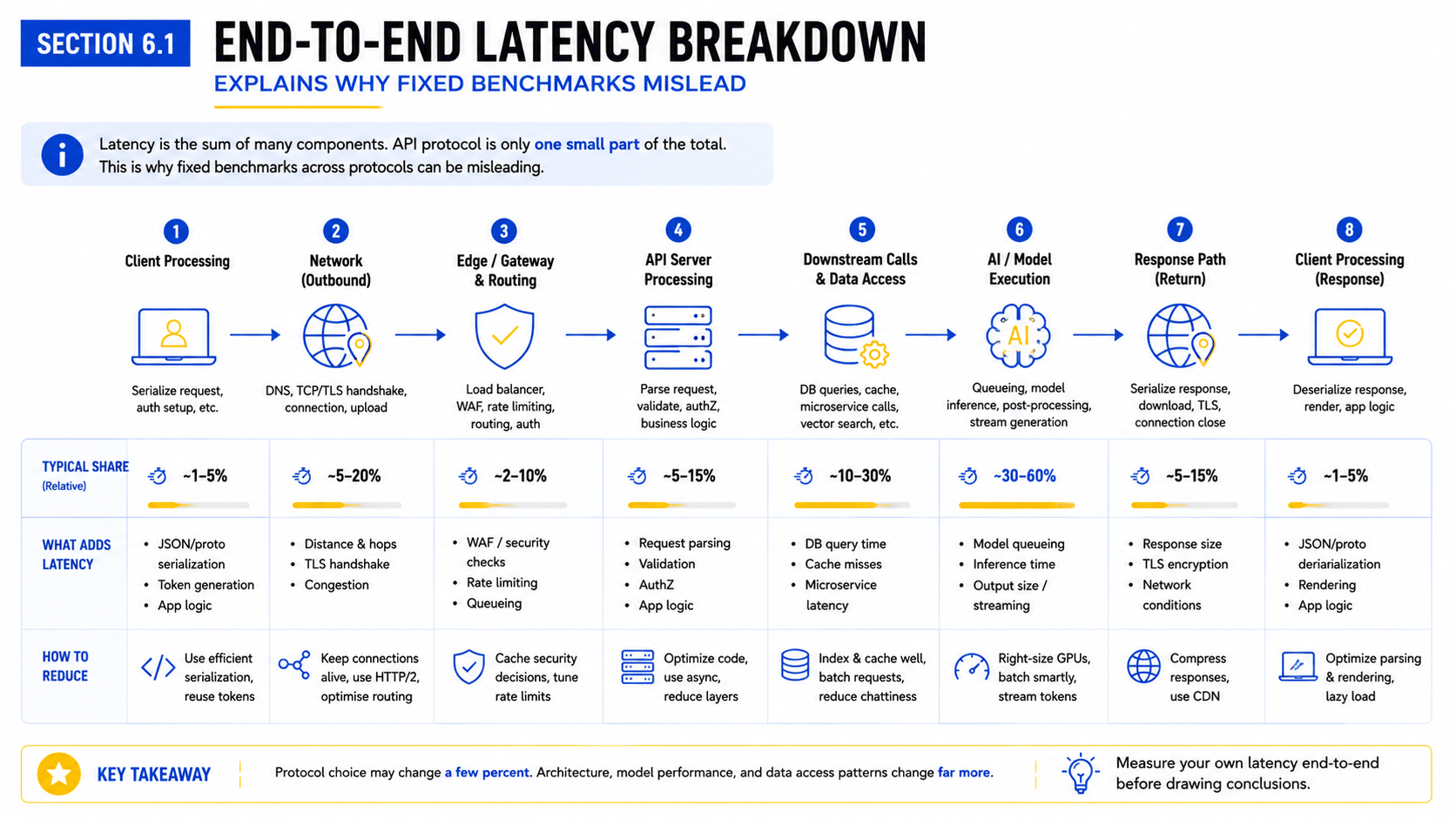
Variables that determine actual end-to-end latency in an AI API:
- Model execution time (often the largest contributor)
- Database or retrieval system latency
- Payload size and serialization format
- Cache hit rate for repeated requests
- Connection management (pooling, keep-alive, HTTP version)
- Query complexity (for GraphQL)
- Concurrency and queue depth
- Network conditions between client and server
- Infrastructure configuration
6.2 Variables That Affect API Performance
Before running a benchmark, identify which variables your system can control and which are workload-dependent:
| Variable | Controllable? | Notes |
|---|---|---|
| Model inference time | Partially — through hardware, batching, and caching | Typically the largest contributor to latency |
| Payload size | Yes — through schema design and compression | Affects serialization time and network bandwidth |
| Serialization format | Yes — such as JSON, Protocol Buffers, or other binary formats | Impact depends on payload size and request frequency |
| Connection behavior | Yes — through connection pooling, HTTP version, and keep-alive settings | Particularly relevant at high call volumes |
| Cache hit rate | Yes — through caching strategy and TTL policies | Can eliminate inference calls entirely |
| Query complexity | Yes — through GraphQL query governance | Unconstrained queries can cause sudden spikes in backend load |
| Concurrency | Partially — through client behavior and queue design | Test under realistic concurrency rather than single-threaded conditions |
| Network conditions | Partially — through infrastructure placement | Must remain constant for a valid comparison |
6.3 A Practical Benchmark Plan for Your Workload
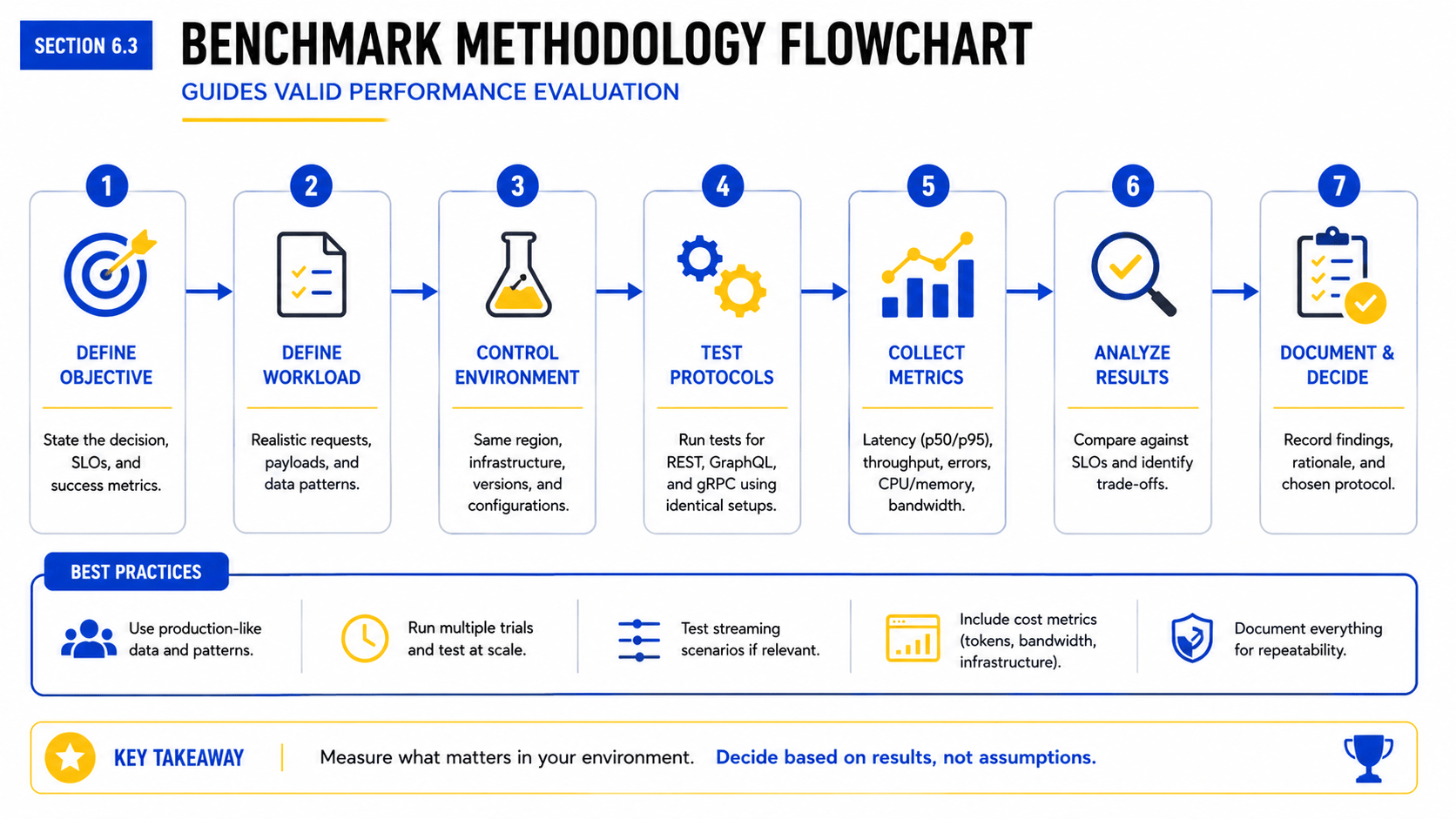
- Define service-level objectives first. What median latency, P95 latency, and throughput does the interface need to meet? What error rate is acceptable?
- Construct representative requests. Use payload sizes, query patterns, and concurrency levels that reflect real production traffic — not synthetic minimum-overhead requests.
- Control infrastructure. Run comparisons in the same environment, on the same hardware, with the same backend services, to isolate the variable you are testing.
- Measure what matters. Collect: median latency, P95 and P99 latency (tail latency matters for user experience), throughput, error rate, CPU and memory utilization, and per-request cost if relevant.
- Test degradation and recovery. Measure performance under sustained load and during failure conditions — not only at optimal throughput.
- Compare against your SLOs. The question is not “which protocol is fastest?” but “does this protocol meet our objectives under realistic conditions?” If your team does not have in-house performance engineering capacity, SmartDev’s AI development services include workload profiling and API architecture review.
7. Production Controls for AI APIs
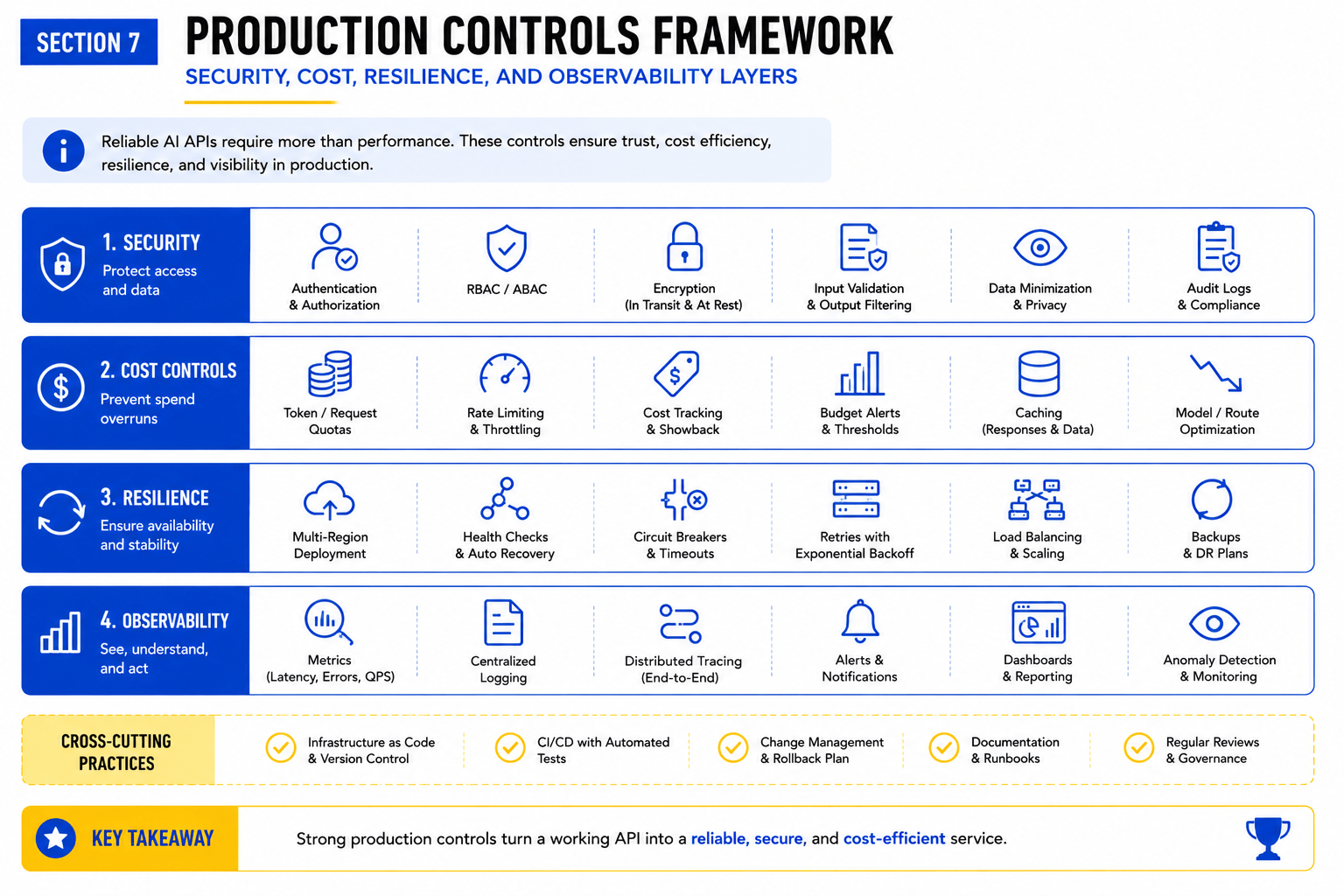
Protocol choice does not remove the need for authorization, rate limits, observability, and resilience controls.
Security, cost management, resilience, and observability are cross-cutting requirements. They apply regardless of whether your AI API uses REST, GraphQL, or gRPC.
 7.1 Authentication, Authorization, and Least-Privilege Access
Authentication verifies identity. OAuth 2.0 and OpenID Connect are the standard approaches for user-facing APIs. Service-to-service authentication commonly uses mutual TLS (mTLS) or signed tokens.
Authorization controls what an authenticated identity can do. Design authorization at the appropriate granularity:
- REST: resource-level and HTTP method-level controls
- GraphQL: field-level controls enforced in resolvers, not only at the schema layer
- gRPC: method-level controls enforced in server interceptors
Least-privilege principle: Tokens and service accounts should carry only the permissions required for the specific operation. Propagate identity through service calls rather than re-authenticating at each hop. The OWASP API Security Top 10 provides a practical reference for common authorization failures in API design.
Data minimization: Return only the fields required by the caller. For GraphQL, field-level authorization should filter response data; it should not only determine whether the query is allowed.
7.2 Rate Limits, Quotas, and Cost Protection for Model Endpoints
AI inference endpoints can be expensive to operate. Cost protection is a production requirement, not an afterthought.
- Usage limits: Apply per-client or per-token rate limits at the API gateway layer before requests reach inference infrastructure.
- Model-specific quotas: Different models have different costs. Apply quotas proportional to inference cost, not just request count.
- Request validation: Validate inputs before passing them to the model. Oversized or malformed inputs can cause disproportionate compute consumption.
- Abuse monitoring: Monitor for abnormal usage patterns — repeated identical requests, sudden volume spikes, or requests designed to maximize model compute.
- Cost alerting: Set budget alerts on inference infrastructure to detect runaway costs before they escalate.
7.3 Caching, Idempotency, Retries, and Resilience Patterns
Caching: Cache inference results only where the input-output relationship is stable and response freshness tolerances permit. Semantic or exact-match caching can reduce model calls significantly for repeated queries.
Idempotency: Design write and inference endpoints to be idempotent where possible. Client-supplied idempotency keys allow safe retries without duplicate processing.
Retries: Use bounded retries with exponential backoff. Do not retry indefinitely — set a deadline. Respect any Retry-After signals from the server.
Timeouts: Set timeouts on every outbound call, including calls to inference services. A slow model should not hold application threads or connections indefinitely.
Circuit breaking: Implement circuit breakers to prevent cascading failures when an inference service becomes degraded. Fail fast and serve a degraded response rather than queuing requests that will time out anyway.
7.4 Scaling Inference Infrastructure and Managing GPU Capacity
API-layer scaling and model-serving capacity are separate problems that require separate planning.
Separate concerns: Adding API replicas does not increase inference capacity if the bottleneck is GPU availability. Profile which layer is saturated before scaling either.
Warm-up time: GPU-accelerated models typically require time to load weights before serving requests. Account for this in autoscaling policies — scale out before you need capacity, not after.
Batching: Many inference frameworks support request batching — grouping concurrent requests into a single model call. Batching can improve GPU utilization significantly but adds latency for individual requests. Tune batch size and wait time for your SLO.
Queue management: Under high load, an unbounded request queue can cause latency to grow without bound. Set queue depth limits and return capacity-exceeded errors to clients that can retry later. Teams managing GPU-backed inference at scale may benefit from dedicated MLOps services for model serving infrastructure and capacity planning.
Cost controls: GPU compute is expensive. Track cost per inference, set autoscaling policies that scale down aggressively during low traffic, and review capacity regularly.
7.5 Logging, Tracing, and Protocol-Aware Observability
Instrument before you scale or migrate. Observability data is what tells you whether your protocol choice is working.
Distributed tracing: Propagate trace context (such as W3C Trace Context headers) across all API calls, including internal service calls. This allows you to trace a single user request through every service it touches, including the inference service.
Request metrics: Collect request count, error rate, and latency percentiles (median, P95, P99) for every API endpoint. Aggregate by client, operation, and model type where relevant.
Model metrics: Track inference latency separately from API transport latency. This tells you whether a latency increase is a model problem or an infrastructure problem.
Error taxonomy: Define standard error categories — client errors, model errors, infrastructure errors, timeout errors — and log them consistently. Undifferentiated 500 errors make root cause analysis difficult.
Protocol-aware tooling: For gRPC, ensure your observability platform can decode Protocol Buffers or use a sidecar that translates gRPC to a format your existing tools understand. Plan this before production deployment.
8. Common AI API Architecture Patterns
A hybrid architecture can expose REST externally, use GraphQL for application aggregation, and use gRPC internally where those boundaries have different needs.
Rather than choosing one protocol for an entire platform, assign each protocol to the boundary where it fits. The following patterns describe how REST, GraphQL, and gRPC can coexist within a single AI platform.
8.1 Public Model and Partner Integrations: REST at the Edge
Public and partner-facing model APIs benefit from REST’s conventional HTTP behavior, documentation tooling (OpenAPI), and broad client compatibility. External developers bring their own HTTP clients; they should not need to generate Protocol Buffer stubs or install GraphQL libraries to call your API. If you are building a generative AI service with an external-facing endpoint, REST is typically the starting point for the public boundary.
Design the public edge API with:
- Stable versioned resource paths
- Standard authentication (OAuth 2.0 tokens or API keys via headers)
- OpenAPI documentation generated from code or schema
- Rate limiting and quota enforcement at the API gateway
- Comprehensive error contracts that external developers can handle
8.2 AI Dashboards and Applications: GraphQL Where Aggregation Is the Bottleneck
Application-facing interfaces — dashboards, recommendation surfaces, personalization UIs — often need data from multiple sources that REST requires multiple calls to assemble. GraphQL’s ability to compose this data in a single request, shaped to what the client needs, can reduce client complexity when aggregation is genuinely the bottleneck.
Design the application-layer GraphQL interface with:
- Query complexity limits enforced at the schema layer
- Field-level authorization in resolvers, not only at the gateway
- DataLoader or equivalent batching for resolver efficiency
- Persisted operations for trusted clients
- Observability that captures resolver-level latency, not only total query time
8.3 Internal Inference and Retrieval Services: gRPC Where Typed, Efficient Communication Matters
Internal services — the embedding service, the retrieval service, the model inference service — communicate with each other in a controlled environment. gRPC’s typed contracts, generated clients, and streaming support are well-matched to this boundary.
Design internal gRPC services with:
.protofiles under version control, with a clear schema evolution policy- Generated clients for every consuming service language
- Method-level authorization enforced in server interceptors
- Health checking per the gRPC Health Checking Protocol
- L7-aware load balancing or client-side load balancing
- Distributed tracing instrumentation in every service interceptor
8.4 Hybrid API Architecture: Assigning Each Protocol to the Right Boundary
A hybrid architecture is a first-class outcome, not a compromise. The goal is to match each interface to its boundary’s requirements, not to use a single protocol everywhere for consistency.
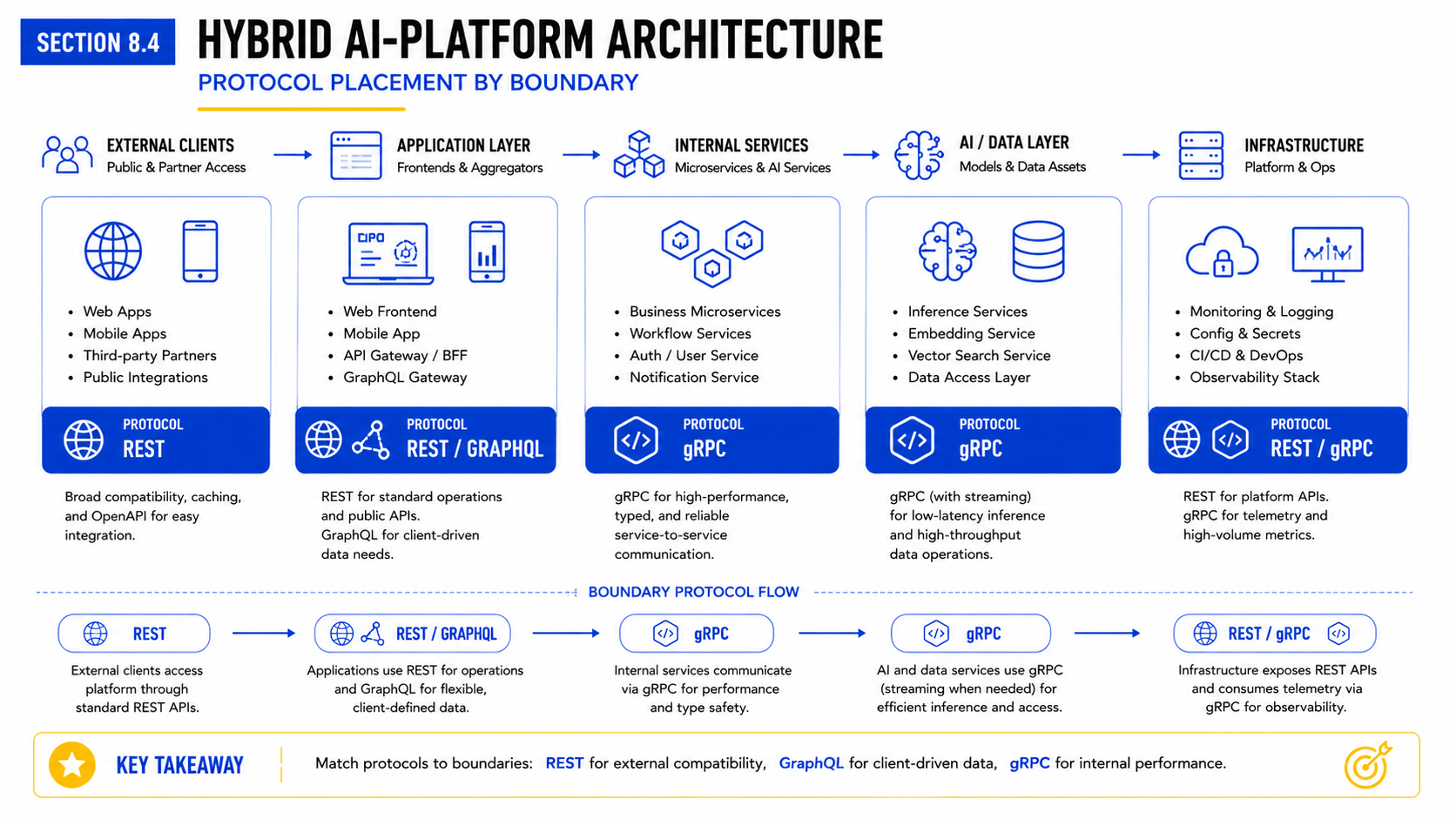
Boundary allocation framework:
| Boundary | Likely protocol fit | Rationale |
|---|---|---|
| Public model API | REST | Broad compatibility, conventional tooling, and OpenAPI documentation |
| Partner integration | REST | Stable resource access and familiar HTTP-based integration |
| Application data layer | GraphQL | Client-driven aggregation and support for variable data shapes |
| Internal microservices | gRPC | Typed contracts, high call volumes, and controlled clients |
| Internal inference service | gRPC, potentially with streaming | Typed requests with support for server-side or bidirectional streaming |
| Browser real-time updates | SSE or GraphQL subscriptions | Strong browser compatibility; gRPC-Web introduces additional complexity |
Operational considerations for hybrid architectures:
- Use an API gateway to enforce consistent authentication, rate limiting, and observability at the perimeter, regardless of the backend protocol
- Define contract ownership clearly: who owns each
.protofile, each GraphQL schema, each REST OpenAPI definition? - Instrument across all protocols so a trace that starts at the public REST edge can be followed through GraphQL resolvers and into internal gRPC calls
- Avoid migration for its own sake: a hybrid architecture does not mean every service must eventually converge on one protocol
9. Choose a Path and Plan the Transition
Migrate only when a demonstrated requirement cannot be addressed adequately by the current interface and its supporting architecture.
9.1 A Protocol-Selection Checklist for Engineering Teams
Before committing to a protocol choice:
Have you defined the client audience for this interface?
Have you identified the data access pattern (fixed resource, flexible aggregation, typed service call)?
Have you established service-level objectives for latency and throughput?
Have you identified real-time and streaming requirements?
Have you assessed your team’s ability to implement and maintain this protocol?
Have you verified infrastructure support (load balancers, gateways, observability tools)?
Have you benchmarked a representative workload, or confirmed that a benchmark is unnecessary because the choice is driven by non-performance constraints?
Have you documented the trade-offs of the options considered?
Teams that need implementation support after completing this checklist can explore SmartDev’s backend development services for API design, implementation, and production readiness reviews.
9.2 Team Skills, Tooling, and Operating-Model Constraints
Protocol capability and organizational capability are both required. A technically superior protocol choice fails if the team cannot implement, debug, govern, and maintain it. Consider:
- Debugging tools: REST is debuggable with browser developer tools and curl. gRPC requires protocol-aware tooling. GraphQL has specialized browser extensions and query explorers. What does your current stack support?
- Client generation: gRPC requires generated stubs to be maintained and distributed to consuming services. This is operational overhead.
- Governance: GraphQL schema changes and Protocol Buffer schema changes both require review processes to prevent breaking changes. Who owns this?
- Training: New protocols require learning investment. Account for onboarding time realistically.
- Support burden: Who will debug production issues at 2am? Ensure the on-call team is equipped.
9.3 When to Improve the Existing API Instead of Migrating
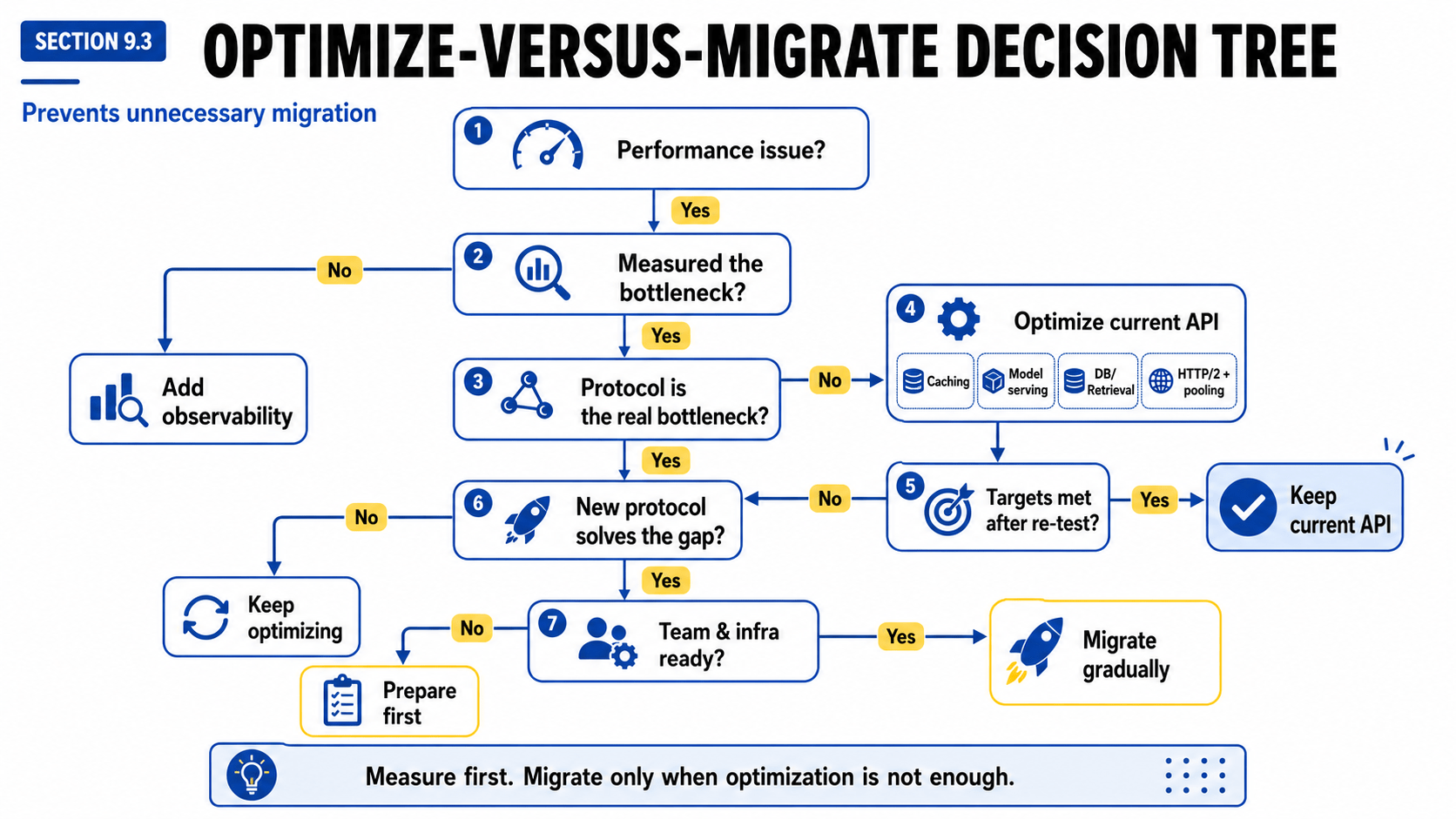
Before planning a protocol migration, confirm that the bottleneck is actually the protocol.
Common non-protocol bottlenecks that are cheaper to fix:
- Model inference latency: Adding a caching layer or optimizing model serving infrastructure often has more impact than changing the transport protocol.
- Database or retrieval latency: Slow backend calls dominate end-to-end latency. Profile before migrating.
- Payload design: Over-fetching in REST can often be addressed with more focused endpoints or field filtering, without adopting GraphQL.
- Missing observability: If you cannot measure what is slow, you cannot make a valid migration decision.
- Connection overhead: Enabling HTTP/2 and connection pooling on an existing REST API may address performance requirements without protocol migration.
If after optimizing the existing interface the demonstrated requirement still cannot be met, then evaluate a migration or a complementary interface.
Optimize vs. migrate decision:
- Measure: Identify the actual bottleneck with production data
- Optimize: Apply non-protocol improvements first (caching, batching, connection management, endpoint design)
- Re-measure: Confirm the bottleneck persists after optimization
- Evaluate: Assess whether a different protocol would address the remaining gap
- Migrate: Only if the answer to step 4 is yes, and organizational readiness in step 9.2 is confirmed
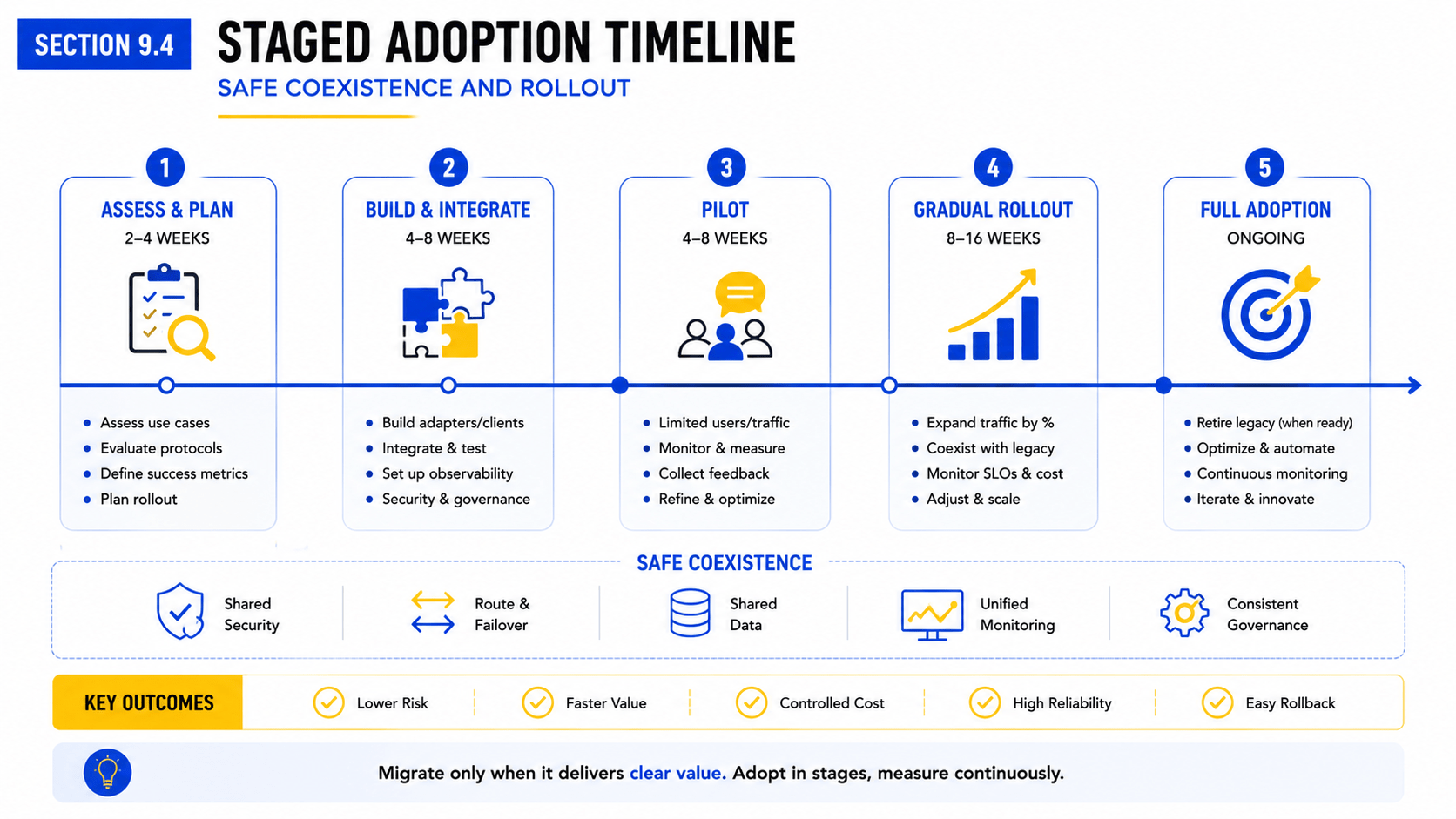
9.4 Staged Migration and Coexistence Strategies
Introducing a new protocol interface incrementally is lower risk than a big-bang replacement. A low-risk adoption sequence:
- Start with a specific boundary. Introduce the new protocol for one well-defined service boundary — not the entire platform.
- Run interfaces in parallel. Where justified, operate the existing and new interfaces simultaneously. This allows progressive consumer migration without forcing coordinated cutover.
- Apply compatibility policies. Define how long the legacy interface will be maintained and communicate this to consumers.
- Add observability first. Instrument the new interface fully before migrating any production traffic.
- Migrate consumers progressively. Move consumers in batches, validating correctness and performance at each step.
- Retire legacy paths deliberately. Set a deprecation date, communicate it, and follow through.
9.5 Framework and Platform Considerations
The choice of framework and tooling affects how well a protocol integrates with your existing infrastructure.
For any framework or library choice, evaluate:
- Active maintenance and community support
- Compatibility with your primary programming language(s)
- Integration with your API gateway and service mesh
- Observability and tracing integration
- Security feature support (authentication plugins, TLS configuration)
- Deployment and operational documentation
For current framework recommendations, refer to the official documentation for each ecosystem: the gRPC documentation, the GraphQL Foundation resources, and the HTTP framework documentation for your language. Framework maturity and community support change over time; verify current status at implementation.
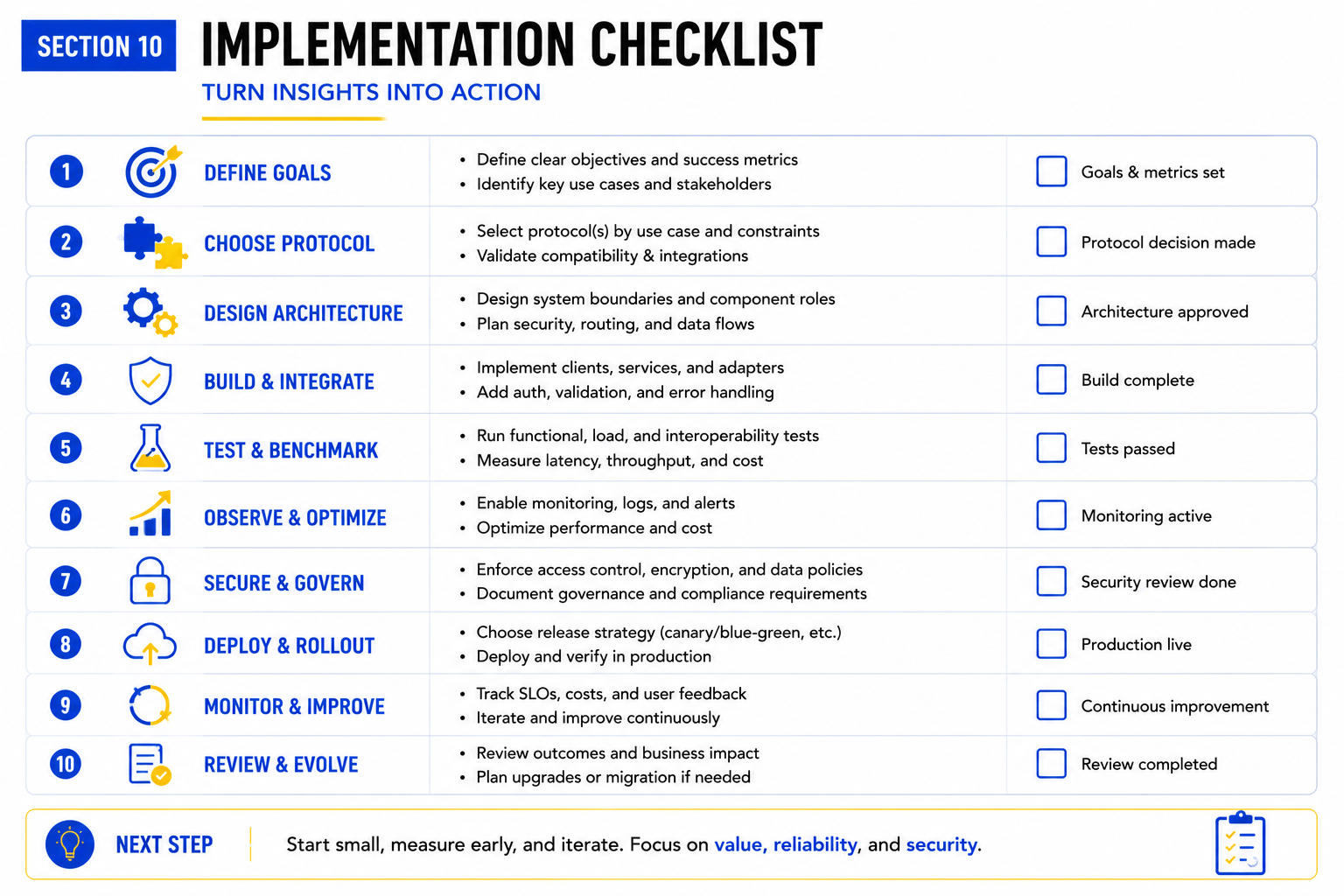
10. Implementation Checklist
Use this checklist before launching or migrating an AI API interface:
Use case and boundary
The client audience and interface boundary are defined
The data access pattern has been assessed (resource access, aggregation, service-to-service)
The protocol choice is documented with the trade-offs considered
Contracts and compatibility
API contract (OpenAPI, GraphQL schema, or .proto file) is under version control
A versioning and deprecation policy is defined\
Schema evolution rules are documented and understood by the team
Performance and reliability objectives
Service-level objectives (median latency, P99 latency, error rate, throughput) are defined
A representative benchmark plan has been run or confirmed unnecessary
Timeout and retry policies are configured on all client calls
Security and cost controls
Authentication is implemented and tested
Authorization is enforced at the appropriate granularity (field, method, or resource level)
Rate limiting and quotas are configured before production exposure
Input validation is in place before requests reach inference infrastructure
Observability
Distributed tracing is instrumented (trace context propagated through all service calls)
Request metrics (count, error rate, latency percentiles) are collected
Model inference latency is tracked separately from API transport latency
Protocol-aware debugging tools are available for the on-call team
Deployment
Load balancer and infrastructure support is verified for the chosen protocol
Health checks are implemented
A rollout plan (staged traffic migration or parallel operation) is defined
A rollback path is documented
FAQ
Is gRPC always faster than REST or GraphQL?
No. Protocol transport is one factor in end-to-end AI API latency; model inference time, backend dependencies, payload size, serialization, caching, concurrency, and infrastructure configuration are typically more significant contributors.
Published benchmarks showing gRPC at a fixed latency multiple over REST reflect specific workloads, payloads, and infrastructure setups that may not match yours. Benchmark your actual workload under comparable conditions before concluding that a protocol migration is necessary.
When is GraphQL a better choice than REST for an AI application?
GraphQL can be a better fit when clients have genuinely variable data requirements across multiple sources — for example, a dashboard that must aggregate model predictions, user context, and business data in a single request, where the fields needed vary by client or context.
The qualification is important: GraphQL also requires query governance (depth limits, complexity scoring), field-level authorization in resolvers, and N+1 mitigation. If the client always needs the same fields from a single resource, REST is simpler. If over-fetching is a concern, consider whether more focused REST endpoints would address it before adding GraphQL.
Can one AI platform use REST, GraphQL, and gRPC together?
Yes. Hybrid architectures that assign each protocol to the boundary where it fits are common and appropriate. A typical pattern: REST for public model APIs and partner integrations, GraphQL for application-facing data aggregation, gRPC for internal service-to-service communication and streaming inference workloads.
The operational requirements — consistent authentication at the gateway, observability across all protocols, clear contract ownership — apply to each interface regardless of protocol.
How should teams benchmark API options for AI inference?
Define service-level objectives before running tests. Construct representative requests using real payload sizes and query patterns. Control infrastructure so comparisons are valid. Measure median latency, P95 and P99 latency, throughput, error rate, and resource utilization.
Separate model inference time from API transport time — these are different bottlenecks requiring different solutions. Test under realistic concurrency and failure conditions, not only at optimal throughput. Compare results against your SLOs, not against other protocols in isolation.
What should a team evaluate before migrating an existing API?
Before migrating, confirm that the bottleneck is the protocol. Profile the current interface: separate model inference latency from transport latency, database latency, and client-side processing time. Apply non-protocol optimizations first — caching, connection pooling, compression, endpoint design, HTTP/2 if not already in use.
If a demonstrated requirement remains unmet after optimization, evaluate whether a different protocol addresses the specific gap. Assess organizational readiness: team skills, tooling support, governance processes, and the cost of maintaining multiple protocol interfaces during a transition. Migrate incrementally, with parallel operation and progressive consumer migration.
Conclusion
Protocol selection for AI APIs is an architecture-fit decision, not a performance ranking. REST, GraphQL, and gRPC solve different interface problems at different system boundaries. The appropriate choice — or combination of choices — depends on your client audience, data access patterns, real-time requirements, operational maturity, and the specific bottlenecks your system actually has.
Workload evidence matters more than benchmark headlines. Measure before you migrate, optimize before you replace, and assign each protocol to the boundary where its strengths genuinely apply.
Next Steps
If you are evaluating API architecture for an AI product or platform, SmartDev’s AI development services can help your team assess interface boundaries, review protocol fit for your specific workloads, and design production-ready API architecture with appropriate security, observability, and scaling controls. Talk to our team about your requirements.
–
References:
- HTTP/2 — High Performance Browser Networking, Ilya Grigorik (O’Reilly)
- REST Architectural Constraints — Roy Fielding Doctoral Dissertation, UC Irvine
- GraphQL Specification — GraphQL Foundation
- GraphQL Security — graphql.org/learn/security/
- Protocol Buffers Language Guide (proto3) — Google
- gRPC Core Concepts — grpc.io
- gRPC Performance Best Practices — grpc.io
- gRPC Health Checking Protocol — GitHub
- OWASP API Security Top 10
- OAuth 2.0 — RFC 6749
- W3C Trace Context
- ASP.NET Core gRPC Performance — Microsoft Learn