
TL,DR
- The AI stack should follow the business use case, not a list of popular tools
- Traditional ML, GenAI, RAG, and AI agents share core layers but have different operating requirements
- Data quality, security, governance, evaluation, and observability are cross-cutting capabilities
- Startups and enterprises should optimize for different constraints, not merely different tools
- Architecture choices should balance quality, latency, cost, control, and time to market
- A stack must be designed for operation after launch, not just for initial prototyping
Introduction
Most teams building an AI system today start with the wrong question: “Which tools should we use?” The better question is: “What is this workload actually asking of us?” An AI tech stack is not a shopping list of popular frameworks, it’s the architecture that connects data, models, applications, infrastructure, and operating controls into a system that can be trusted to run in production. Get that architecture wrong, and no amount of tooling will save the project.
This is why “one-size-fits-all” stacks consistently fail. A recommendation engine, a retrieval-augmented chatbot, and an autonomous agent that takes actions on a company’s behalf are not variations of the same problem, they carry different data requirements, different latency and scale demands, different risk profiles, and different operational obligations once deployed. A stack copied from a case study or a vendor’s reference architecture may work beautifully for someone else’s workload and quietly fail for yours, showing up later as cost overruns, compliance gaps, or systems that can’t be monitored or governed once they’re live.
The right architecture, instead, is one that’s derived, not borrowed. It starts with the workload itself: what the AI system needs to do, and under what constraints. From there, decisions cascade in sequence: what data the workload depends on and how it must be governed, what scale and performance the business context demands, what risk and regulatory exposure the use case carries, and finally, what business objective the stack needs to serve. Only once these are clear does it make sense to talk about which components, shared capabilities versus workload-specific ones, and which lifecycle controls belong in the stack.
This guide walks through that decision sequence: workload → data → constraints → architecture → operations. Whether you’re a startup assembling a lean AI setup or an enterprise scaling AI across multiple business units, the goal is the same, build a stack you can defend, not just one you can demo.
As you work through the architecture and decisions ahead, it’s worth connecting them to execution. For organizations looking to turn the right stack into measurable business results, see how AI-assisted software development can help translate architecture decisions into delivery velocity.
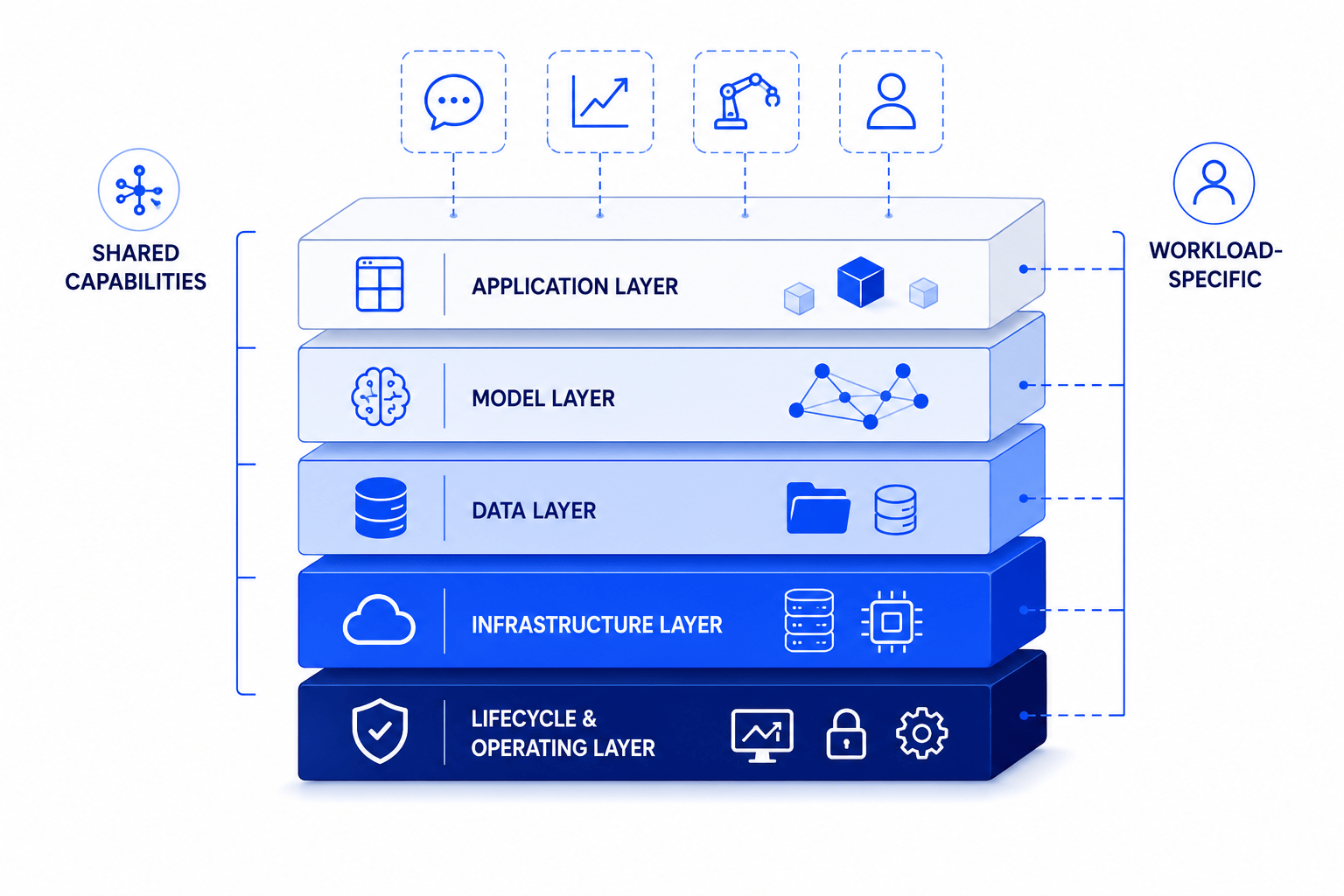
1. What is an AI Tech Stack?
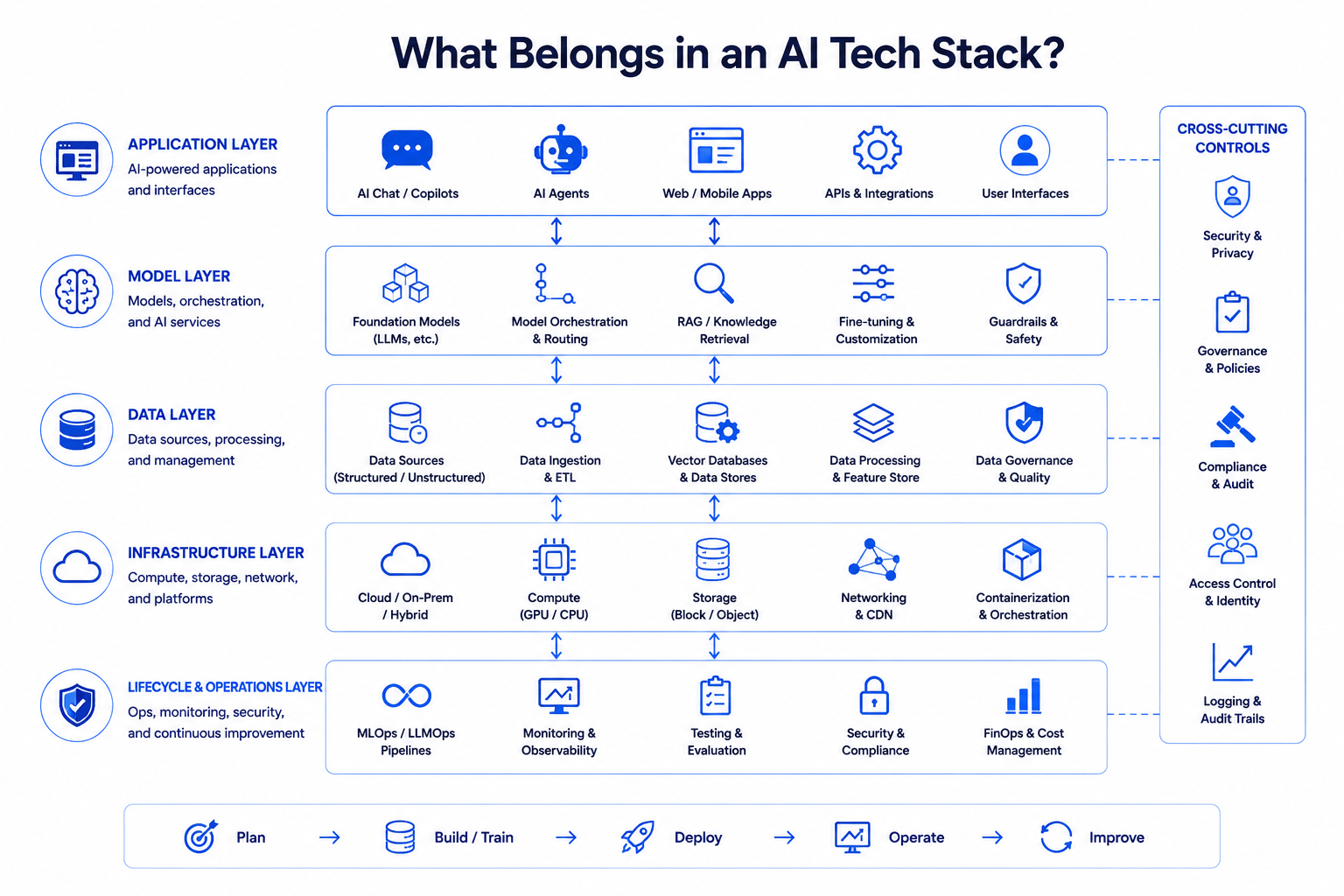
1.1 Definition: The Layers That Turn AI Models Into Working Products
A model is not a stack, and neither is an application built on one. An AI tech stack is the full set of business, data, model, application, deployment, operations, and governance layers that together let an AI capability run reliably in production, not just once in a demo.
Definition: an AI tech stack is the combination of data, models, applications, infrastructure, and operating controls that connects a business objective to a working, production-grade AI system. Only a small fraction of a real-world AI system is actually the model code itself; the surrounding data, infrastructure, and operational elements make up the far larger part of what has to be built and maintained.
What it is not: a model is a single component, not a stack. An AI application (a chatbot, a summarizer) is the user-facing product built on top of a model, still not the full stack. A tool list (a vector database plus an LLM API plus a UI framework) is a set of parts, not an architecture, until those parts are connected through defined data flows, orchestration logic, evaluation, and governance.
What belongs in the stack, layer by layer:
- Business and product layer — the use case, success criteria, and risk tolerance driving every decision below it
- Data layer — the pipelines, storage, and governance controls the workload depends on
- Model and inference layer — the model itself, however it’s accessed or served
- Retrieval layer — present only when the workload needs grounding in external or current knowledge
- Application and orchestration layer — the logic connecting the model to real users and systems
- Deployment and runtime infrastructure — what keeps the system running under real load
- Operations, evaluation, and observability — what proves the system still works after launch
- Security, governance, and compliance — cross-cutting controls that apply to every layer above
Component checklist — a system only qualifies as a stack, not just a tool, once it has:
- A defined business objective and success criterion
- A governed data source, not an ad hoc data pull
- A model access path with a documented reason for that choice
- Application logic connecting the model to an actual user workflow
- A deployment environment with defined reliability expectations
- An evaluation and monitoring plan that runs after launch
- Security and governance controls appropriate to the data and risk involved
The difference between a stack and a tool list is architecture: whether these pieces are deliberately connected and operated as a system, or just assembled and hoped to work together. For organizations translating this definition into a working system, AI-assisted software development is where that architecture actually gets built.
1.2 Why AI Stacks Differ by Business Use Case
The fastest way to build the wrong AI system is to start from someone else’s stack. A forecasting model and a RAG chatbot might both be labeled “AI,” but they place almost entirely different demands on data, latency, and architecture. A forecasting system consumes structured, time-series data on a batch cadence and has no need for a retrieval layer at all; a RAG application exists specifically because it needs to ground answers in current or proprietary knowledge the model wasn’t trained on. Bolting a retrieval layer onto the first, or skipping it on the second, produces either wasted complexity or a system that hallucinates from stale training data.
Workload-to-requirements matrix:
| Workload type | Data pattern | Latency needs | Risk profile | Core layers required |
|---|---|---|---|---|
| Forecasting / prediction | Structured, time-series | Batch / near-real-time | Moderate | Data pipeline, feature store, training, monitoring |
| RAG / knowledge assistant | Unstructured + structured, frequently updated | Real-time query response | Moderate-high | Retrieval layer, orchestration, grounding & evaluation |
| Autonomous AI agents | Mixed, tool-connected | Real-time, multi-step | High | Orchestration, permission scoping, audit logging |
| Real-time fraud/anomaly detection | Streaming, transactional | Sub-second | High | Stream processing, low-latency inference, alerting |
A retrieval layer is unnecessary whenever the workload has no dependency on external, current, or proprietary knowledge, structured prediction tasks and most classification workloads fall into this category. Adding one anyway is complexity with no corresponding benefit. Matching architecture to workload, not to whatever’s trending, is the single decision this entire guide is built around.
1.3 Who This Guide Is For
Stack decisions aren’t made by one role; they’re made across several, and confusion about who owns which decision is itself a common source of stalled AI projects.
Responsibility matrix (RACI-style):
| Decision | Business/Product leaders | Data team | ML/AI engineering | Security/Compliance | Operations |
|---|---|---|---|---|---|
| Use case & success criteria (Sec. 5.1) | Accountable | Consulted | Consulted | Informed | Informed |
| Data readiness & governance (Sec. 3.2) | Informed | Accountable | Consulted | Consulted | Informed |
| Model & architecture selection (Sec. 3.3–3.5) | Consulted | Consulted | Accountable | Informed | Consulted |
| Deployment & reliability (Sec. 3.6, 7.2) | Informed | Informed | Consulted | Informed | Accountable |
| Security & compliance sign-off (Sec. 3.8, 4.5) | Consulted | Consulted | Consulted | Accountable | Informed |
| Ongoing evaluation & monitoring (Sec. 3.7, 9) | Informed | Consulted | Accountable | Informed | Consulted |
This guide is written for anyone holding one of these boxes: leaders defining what success looks like, product and data teams shaping the workload and its inputs, engineering teams building the architecture, and security, compliance, and operations teams responsible for keeping it trustworthy once it’s live. Nobody needs to own every row, but every row needs an owner, a lean team can hold several of these boxes across fewer people (Section 7.5, 8.1) without any of them going unowned. For organizations formalizing these responsibilities before a build begins, AI transformation and AI consulting are typically where this discovery work happens.
2. Start with the Workload, Not the Tools
As mentioned above, building an AI solution is like crafting a complex machine – it requires a series of carefully selected components working seamlessly together. Let’s delve into the key components of an AI tech stack and their critical roles.
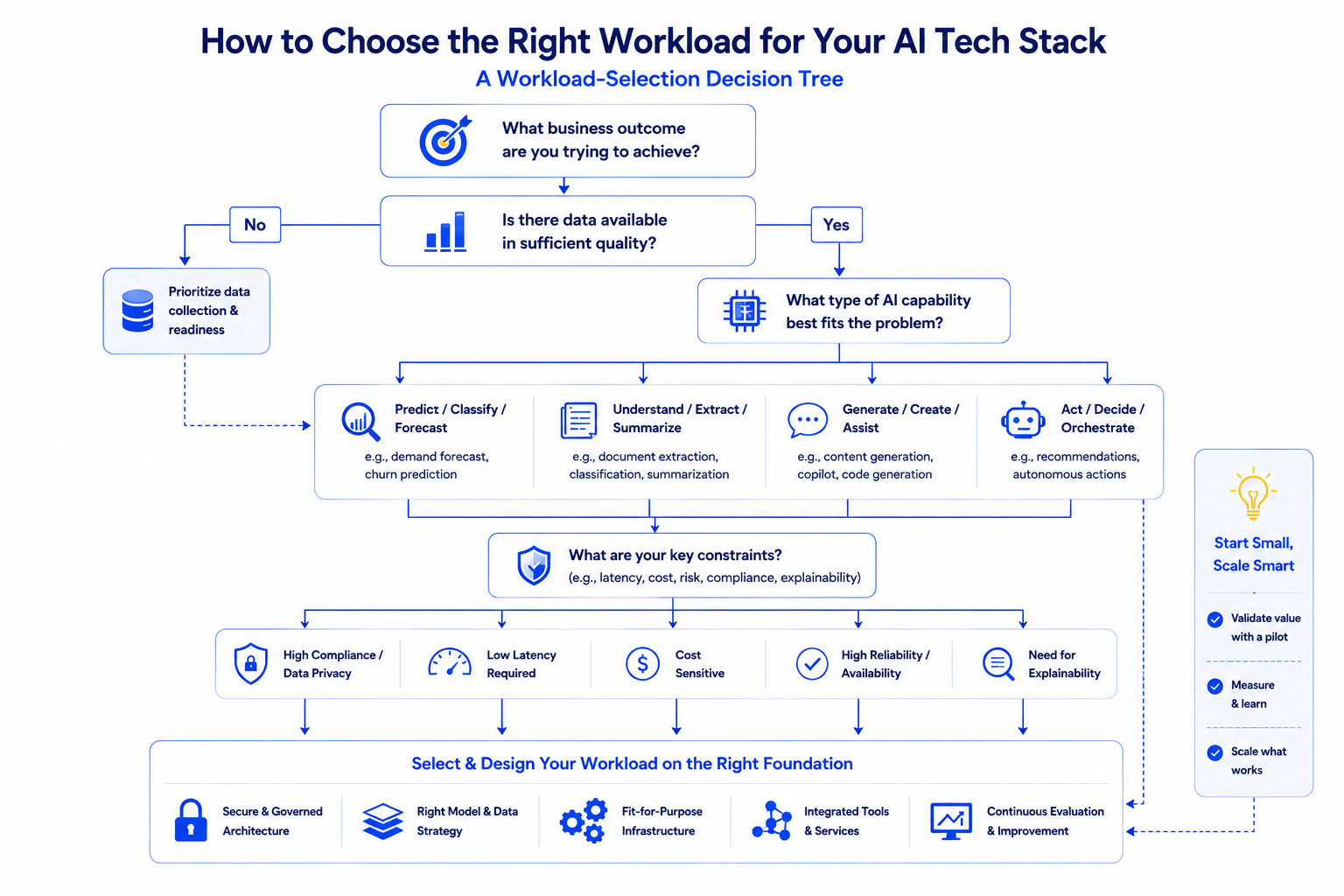
2.1 Traditional Machine Learning Systems
Prediction, classification, forecasting, and optimization all follow a mature, well-documented pattern: MLOps. Only a small fraction of a real-world ML system is actually the model code itself—the surrounding data and infrastructure elements are far larger.
Core stages of a classical ML stack:
- Data pipeline – ingesting and cleaning structured/time-series data on a schedule
- Feature preparation – engineered variables managed through a feature store
- Training & evaluation – measured against ground truth (accuracy, RMSE, AUC)—unlike GenAI, which lacks a single correct answer to check against
- Model registry/versioning – tracking, governing, and securing models in production so teams know which version made which prediction
- Serving – delivering predictions at the latency the business case requires
- Monitoring – catching both technical failures and accuracy drift
- Retraining – triggered on a schedule, new data availability, performance degradation, or shifts in data statistics, not just at initial launch
These stages loop continuously: data → features → training → registry → serving → monitoring → retraining. Skipping the registry or retraining loop is the most common reason classical ML systems become unmanageable at scale. For teams formalizing this, AI model development turns these stages into a repeatable practice.
2.2. Generative AI Applications
Copilots, summarization, content generation, and multimodal assistants all look simple on the surface—type a prompt, get an output. But a production architecture needs a persisted orchestration layer managing interactions between data sources, models, and users, not a raw API call wired into a UI. Microsoft is explicit that basic proof-of-concept setups aren’t built for production and require a separate baseline architecture with additional design decisions.
Core components of a production GenAI stack:
- Model access – hosted API, private deployment, or self-hosted model
- Prompting & application logic – system prompts, formatting, business rules
- Model routing – selecting the best-performing model per prompt in real time, balancing quality, cost, and latency
- Output safeguards – guardrails filtering harmful content on both input and output
- Evaluation – automated and human evaluation plus LLM-as-a-judge, backed by stored ground truth
- Observability – tracing orchestration so it’s possible to understand how an output was actually produced
- Cost control – token-level tracking, since costs scale with usage intensity, not just infrastructure
A demo built directly against a model API skips every layer on this list. That gap—between what a prototype needs and what production requires, is where most GenAI pilots stall.
2.3 Retrieval-Augmented Generation (RAG) Systems
Not every chatbot needs RAG, only those that must answer from current, proprietary, or frequently-changing information a model wasn’t trained on. RAG vs. fine-tuning: if the goal is answering questions grounded in your own documents, RAG is the recommended starting point; fine-tuning is for teaching a model new tasks like summarization, and the two can be combined.
Core pipeline: ingestion → parsing → chunking → embedding → indexing → retrieval → reranking → prompt assembly → citations → evaluation → access controls. Hybrid queries combining keyword and vector search, along with semantic ranking, are recommended when the highest possible relevance and accuracy is needed for complex or conversational queries.
Retrieval quality and source governance matter as much as model choice: a well-chosen model fed poorly-ranked or ungoverned source content still produces unreliable, unauditable answers—which is why chunking strategy, reranking, and document-level access control belong in the architecture from day one, not as an afterthought. For teams exploring where this fits, see AI integration.
2.4 Agentic AI Systems
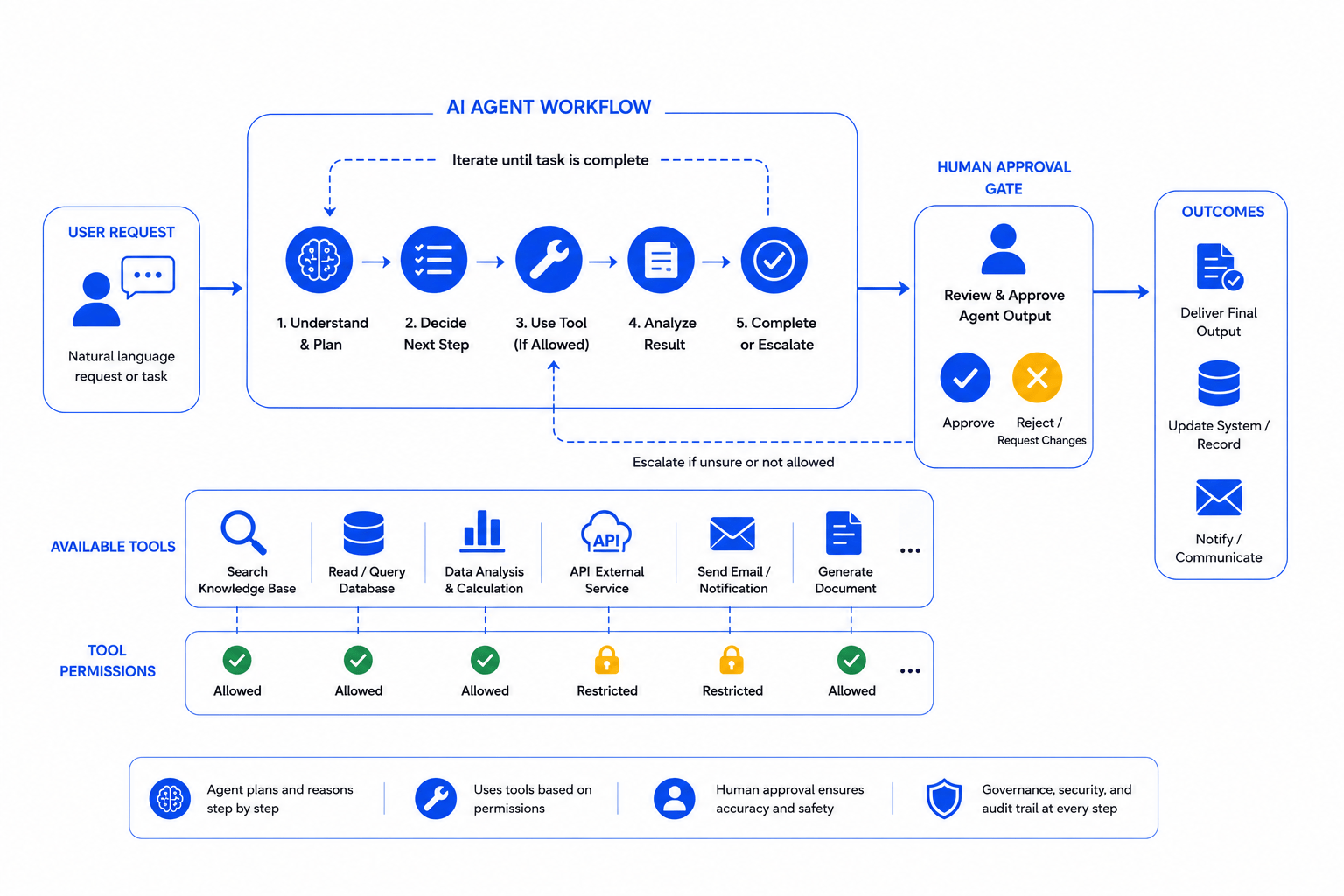
A chatbot answers; an agent acts. The difference is action autonomy—and with it, risk.
Chatbot vs. Agent:
| Chatbot | Agent | |
|---|---|---|
| Output | Text response | Tool calls, side effects |
| Risk | Low (informational) | Scales with action reversibility |
| Oversight needed | Content review | Permission gates, approval steps |
Decision rule: use an agent only when the task requires taking actions on external systems; if it only needs to inform, a chatbot or RAG assistant is sufficient and lower-risk.
Core components: an orchestration runtime that manages the tool-calling loop, hands off between specialists, and pauses runs for approval, plus human review that pauses execution so a person can approve or reject a sensitive action before it proceeds. The more irreversible the action, the stronger the guardrail should be—read access can often be automated, while high-impact actions should require human confirmation.
This isn’t about maximizing autonomy; it’s about bounded permissions with a clear escalation path.
2.5 Real-Time, Edge, and Embedded AI
Edge deployment becomes relevant when latency, connectivity, privacy, or on-device constraints make cloud round-trips impractical. According to Digitalthoughtdisruption, regulations like HIPAA, GDPR, and ITAR can require data to stay within specific facilities or borders, and edge inference lets latency-sensitive, low-latency processing happen where the data is generated.
Cloud vs. Edge decision checklist:
- Does the workload need sub-second or offline response? → Edge
- Is data residency or privacy regulation a hard constraint? → Edge/hybrid
- Does the model need frequent retraining on fleet-wide data? → Cloud (with edge inference)
- Is device hardware severely constrained (power, compute)? → Requires quantization/smaller models
Trade-offs to weigh: edge AI deployment requires balancing model complexity, latency, and power consumption—there is no universally “perfect” architecture. Centralized model management and incremental over-the-air updates matter especially in narrow-bandwidth environments, since edge devices are often deployed where connectivity is poor.
3. Types of AI Tech Stacks
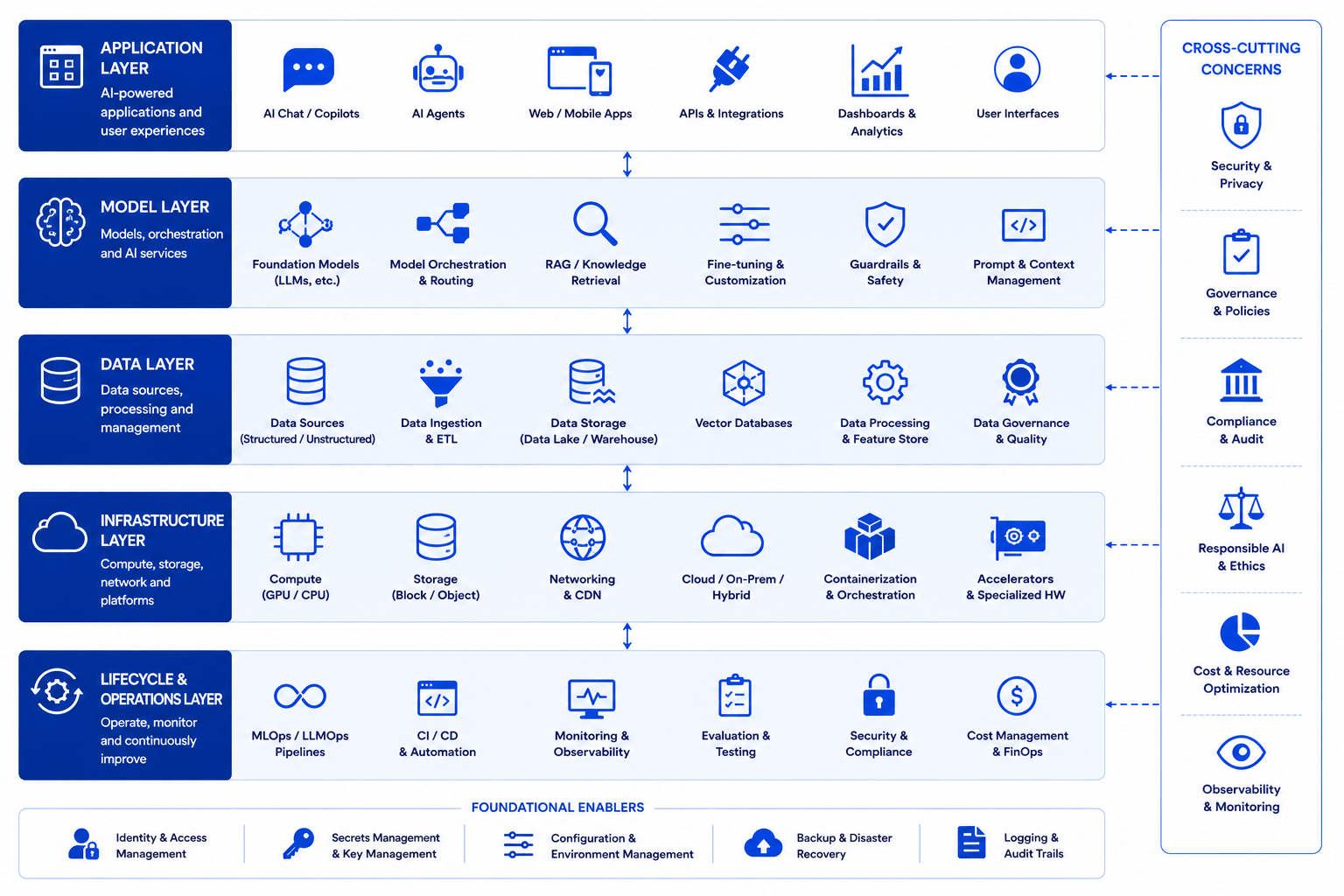
Not all AI tech stacks are created equal. Different use cases and objectives require tailored approaches. Let’s explore the main types of AI tech stacks and what makes them unique.
3.1 Business and Product Layer
Every layer below this one inherits its constraints from decisions made here. Skip this layer, and even a technically flawless stack ends up solving the wrong problem.
Its role: connect the stack to a user workflow, a business outcome, an acceptable level of risk, and a named owner accountable for it. Before any architecture decision, four questions need answers: who uses this and what job are they trying to get done, what business metric does success move, how much error or failure can this workload tolerate, and who owns the outcome once it’s live.
Pre-architecture discovery checklist:
- User workflow the AI system fits into (not the AI system in isolation)
- Business outcome/metric it’s meant to move (cost, revenue, time, risk)
- Risk tolerance (informational vs. action-taking; reversible vs. irreversible)
- Data sensitivity and compliance exposure
- Operating owner (who’s accountable once it’s in production)
- Success threshold (what “good enough to ship” looks like)
Use-case-to-success-metric worksheet — for each candidate use case, map: workflow touched → business metric → risk tier → owner → success threshold. This single artifact does more to prevent scope drift than any technical spec, because every later architecture decision (which layers are needed, how much governance, what latency budget) traces back to it.
Skipping this layer doesn’t eliminate these decisions—it just means they get made implicitly, usually by whoever picked the tools. For organizations formalizing this step, AI transformation services helps translate business objectives into the discovery work this layer requires before architecture begins.
3.2 Data Foundation
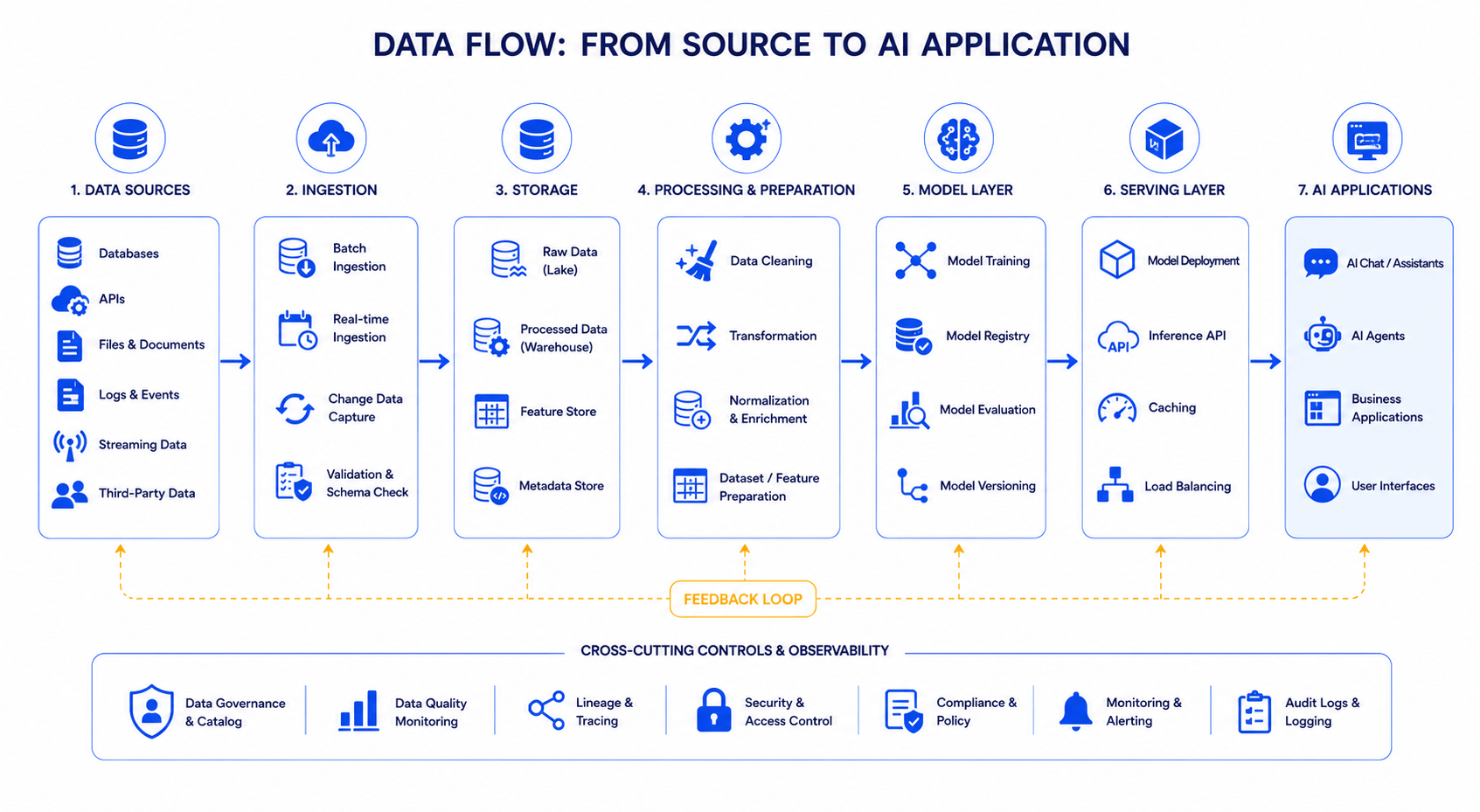
Every capability above this layer—training, retrieval, personalization, analytics—runs on the same underlying question: can this data be trusted, accessed, and kept current enough for the job it’s being asked to do?
Its role: determine what’s architecturally possible before a single model or pipeline gets chosen. Data quality, access rights, lineage, freshness, storage pattern, pipeline mode (batch vs. streaming), and privacy classification all gate what the layers above can do. According to Elevate, RAG system without freshness guarantees serves stale answers; a personalization engine without lineage can’t explain why it made a recommendation; a training pipeline without documented provenance turns the model into a black box that users, regulators, and affected people can’t audit.
Why this is foundational, not preparatory work: continuous quality validation catches issues before they reach model training, and lineage tracking traces data from raw sources through feature engineering to model outputs—skipping this doesn’t remove the risk, it just moves the failure downstream to production. Derived assets like embeddings, indexes, summaries, and caches are copies of source data, so ownership, classification, access, and lineage controls must carry forward to them—when a copy drifts out of sync with its source, the AI system may retrieve stale or already-deleted information without anyone noticing.
3.3. Models and Inference
This layer decides how your application actually gets a prediction or a generated output—and it’s where “which model” quietly becomes “who operates it, on whose infrastructure, under what constraints.”
Its role: convert a workload’s requirements (from 3.1 and 3.2) into a deployment decision across five options: traditional/classical models, foundation models via managed API, managed cloud AI services, open-weight models, and fully self-hosted serving.
What each path actually trades off:
- Managed foundation model API — buys speed, reliability, and low operational burden; best when prompt formats and traffic patterns are still changing and evals are immature.
- Managed cloud AI (Azure OpenAI, AWS Bedrock, GCP Vertex AI) — frontier models served inside your cloud boundary with private networking and enterprise SLAs, at a pricing markup over direct API access.
- Open-weight models via hosted API — open-model flexibility without owning GPUs, though data still passes through a third party, which matters if strict privacy or data residency is the reason for choosing an open model in the first place.
- Self-hosted serving — gives full control over model selection, inference configuration, data privacy, and cost structure, but makes the team responsible for GPU allocation, model loading, and optimization end to end. This is the only path to genuine on-prem data sovereignty, and compliance requirements are worth checking before the cost question: a HIPAA or GDPR data-residency gap can remove managed APIs from consideration entirely, turning the decision into a sizing exercise rather than a build-vs-buy one.
None of these is universally “best”—each shifts the same underlying costs (latency, control, ops burden, compliance risk) somewhere else in the stack.
3.4. Retrieval and Knowledge Layer
This layer answers a narrower question than “which model”: given a query, what’s the right evidence to hand it, and who is allowed to see that evidence in the first place?
Its role: retrieve trusted, access-appropriate knowledge and hand it to the model as grounding—not just “search,” but access-aware retrieval, where every result is filtered by what the requesting user or agent is actually permitted to see, not just what’s semantically relevant. A retrieval layer that returns the most relevant document regardless of the requester’s permissions is a data-leakage risk dressed up as a feature.
Retrieval methods compared:
| Method | How it works | Best for | Weakness |
|---|---|---|---|
| Keyword | Exact term matching (BM25) | Product codes, names, technical identifiers, exact-phrasing requirements | Misses conceptually related content when the query and document use different vocabulary |
| Vector | Embedding similarity search | Paraphrased content, conceptual/cross-lingual queries | Can surface semantically similar but technically or factually wrong results, especially on rare terms the embedding model never learned |
| Hybrid | Vector + keyword, fused and reranked | Most enterprise RAG; mixed exact-term and natural-language queries | Added indexing/tuning complexity |
| Graph | Traverses entities and relationships | Multi-hop questions, provenance, relational reasoning | Without an embedding layer, it can’t rank by semantic relevance or handle unstructured natural-language queries directly |
Hybrid search with semantic re-ranking typically outperforms vector-only or keyword-only retrieval by a meaningful margin in RAG applications, which is why hybrid queries combining keyword and vector search are the recommended default when the highest possible relevance is needed for complex or conversational queries. Graph retrieval adds something neither of those methods can: for high-stakes or governance-heavy use cases, a knowledge graph provides explainability, access control, and multi-step reasoning that a vector layer alone cannot.
Access-aware retrieval, standalone: retrieval that resolves not only “what’s relevant to this query” but “what is this specific requester authorized to see,” enforced at the retrieval layer itself rather than left to the model to self-police. The strongest architectures combine a graph layer for access control and relational reasoning with a vector layer for semantic coverage, typically through graph-scoped search—narrowing the search space by permission or ownership before applying vector similarity within that subset.
Choosing among these isn’t about picking a “winner”—it’s about matching retrieval method to query pattern and governance requirement, often combining more than one in the same system.
3.5 Application, Orchestration, and Integration Layer
This is the layer users and business systems actually touch—everything below it is invisible until this layer decides how to expose it.
Its role: connect AI capabilities to real user journeys and existing business systems, at four distinct levels of coupling that get progressively more complex and higher-risk:
- API integration — a system calls a model or service and gets a response back; no persistent state, no multi-step logic. The simplest and lowest-risk pattern, suitable when an AI capability is just one input into an existing application.
- Workflow orchestration — a persisted, defined workflow that manages the interactions between data sources, models, and the user across multiple steps, rather than a single request/response. This is where chat history, retrieved context, and business logic get assembled into a coherent sequence.
- Tool use — the model itself decides, mid-workflow, to call specific functions or APIs (a database lookup, a calendar check, a CRM update) based on the task at hand. The orchestration runtime manages the tool-calling loop, switches between specialist agents on handoff, and stops the run when it finishes or pauses for approval.
- Autonomous actions — the system executes side-effecting operations (sending an email, canceling an order, updating a record) without a human confirming each step. Human review pauses the run so a person or policy can approve or reject a sensitive action before it proceeds—a control that becomes mandatory, not optional, once autonomy reaches this level.
Why this distinction matters architecturally: each level up this list adds state, decision-making, and risk. A system built for API integration doesn’t need approval gates or persistent memory; a system doing autonomous actions needs both, plus audit logging, from day one. Treating “connect the model to the app” as a single undifferentiated task is how teams end up giving a workflow orchestrator the permissions of an autonomous agent, or building approval gates into a system that never needed them.
Sequence, in practice: user request → orchestrator assembles context (retrieval, chat state) → model reasons and optionally proposes a tool call → orchestrator validates the call against policy → tool executes (or pauses for human approval if the action is irreversible or high-impact) → result returns to the model → response reaches the user.
Getting this layer right is largely an integration and systems-design problem, not a model problem—which is why it’s often where system integration services and custom software development do the most load-bearing work in an AI stack, connecting orchestration logic to the actual systems of record it needs to read from and act on.
3.6 Deployment and Runtime Infrastructure
This layer answers a question that has nothing to do with model quality: when real traffic hits, does the system stay up, stay fast, and stay within budget?
Its role: run models and AI applications reliably in production—compute selection, serving, scaling, resilience, and cost, treated as one connected decision rather than five separate ones. A model that performs well in a notebook and a model that performs well under production load are evaluated by entirely different criteria.
Runtime selection framework:
| Dimension | Key decisions |
|---|---|
| Compute | CPU vs. GPU vs. specialized accelerators; on-demand vs. reserved capacity |
| Serving | Managed endpoint vs. self-hosted inference server; batching and queueing strategy |
| Scaling | Horizontal Pod Autoscaler for CPU/memory-driven scaling, or event-driven autoscaling (e.g., KEDA) based on queue length or request rate for bursty workloads |
| Resilience | Health checks, graceful shutdown, multi-zone redundancy |
| Cost | Utilization efficiency, idle capacity, autoscaling responsiveness vs. over-provisioning |
Why scaling is harder than it looks for AI workloads: an autoscaler is a control loop with inherent delay—metrics take time to reach the server, and a new pod needs time to start, so the gap between new load arriving and a new pod serving traffic often runs 30 to 90 seconds. If traffic grows faster than that window, existing pods return errors while the autoscaler catches up, and users notice—which is precisely why load testing that ramps traffic realistically, rather than assuming flat load, belongs in the release process, not after the first incident.
Resilience isn’t optional at scale: a horizontally scaled application must avoid storing state on local disk, handle long-lived connections so new replicas actually receive traffic, and shut down gracefully so scale-down doesn’t drop in-flight requests. Skipping any of these turns routine autoscaling events into user-facing failures.
3.7 AI Operations, Evaluation, and Observability
This layer is what separates “the demo worked” from “we can prove it keeps working.” Unlike traditional software, AI systems degrade in ways that don’t throw errors—they underperform silently, which makes identifying and resolving issues especially challenging without dedicated evaluation and monitoring built in from the start.
Its role: provide continuous evidence that the system is behaving correctly—not just at launch, but throughout its life in production, across four distinct stages that get conflated far too often:
- Offline evaluation — testing against curated datasets and known ground truth, run during development. This should combine automated and human evaluation with LLM-as-a-judge pipelines, backed by stored ground-truth data, and it’s where a model or prompt change gets validated before it ever sees real traffic.
- Pre-release testing — validating a specific release candidate against production-like conditions before rollout: load, edge cases, adversarial inputs, and regression checks against the previous version.
- Online monitoring — tracking system performance alongside output quality, behavior patterns, and user satisfaction once the system is live—including input/output monitoring for token usage, response quality, and anomaly detection, and guardrail monitoring to catch when filters need adjustment or new categories of harmful content emerge.
- Incident response — what happens when monitoring catches a problem: a defined path to detect, contain, and recover, not just an alert that fires into silence.
Metric categories (thresholds are workload-specific, not universal — set them against your own baseline and risk tolerance, not a generic industry number):
- Quality/correctness — accuracy, groundedness, relevance to the query
- Safety — hallucination rate, toxicity, PII leakage, guardrail trigger rate
- Performance — latency (p50/p90/p99), throughput, error rate
- Cost — token usage for cost tracking, with alerting thresholds when costs or latency exceed expectations
- Drift — accuracy or relevance decay as real-world inputs shift away from what the system was validated against
Why these can’t be collapsed into one step: offline evaluation tells you a change is safe to ship; online monitoring tells you whether it’s actually still safe three months later, after real users, real edge cases, and real data drift have had time to surface problems no test set anticipated. Observability identifies issues, guardrails enforce control, and infrastructure enables both to operate efficiently at scale—together they form a continuous loop, not a one-time setup.
Continuous improvement lifecycle: offline evaluation → pre-release testing → deployment → online monitoring → incident detection → root-cause analysis → fix/retrain/re-prompt → back to offline evaluation.
Treating evaluation as a pre-launch checkbox rather than a running discipline is one of the most common reasons AI systems that performed well in review quietly degrade in production without anyone noticing until a customer does.
3.8 Security, Safety, Governance, and Compliance
This layer isn’t a review step bolted on before launch—it’s why the system can be trusted at all. Every other layer feeds into it: the data foundation’s access rules, the model layer’s output controls, the orchestration layer’s permission gates, and the runtime’s audit logs all become evidence this layer has to produce on demand.
Its role: make trustworthy use an architectural requirement, not a policy document. Governance frameworks define what to govern and what accountability structures should exist, but they don’t by themselves prevent an attack during execution—that requires technical controls enforced at the infrastructure layer where the AI system actually runs, not just documented in a compliance binder.
The standards landscape, and what each one actually covers:
- NIST AI RMF provides the governance model—what to govern, organized around Govern, Map, Measure, and Manage functions.
- OWASP’s LLM Top 10 and Agentic Top 10 provide the engineering-level baseline for what to monitor—prompt injection, insecure output handling, data poisoning, excessive agency, unbounded consumption.
- MITRE ATLAS documents how attacks are actually executed, supporting threat modeling and red-teaming.
- ISO/IEC 42001 governs the AI lifecycle (data, third parties, human oversight), while ISO/IEC 27001 secures the underlying infrastructure through access control and data classification.
- Regulation (EU AI Act, sector-specific rules) sets the legal floor these controls need to demonstrably meet.
None of these stacks are optional add-ons for “high-risk” projects only—they’re layered because no single framework addresses AI security comprehensively on its own.
4. Reference Architectures by Use Case
The layers covered so far are ingredients, not a meal. This section shows what they look like assembled into four recognizable patterns: classical ML, generative AI applications, RAG systems, and agentic AI. Each one is a starting shape to adapt, not a fixed product list — the goal is recognizing which pattern your workload actually matches, then seeing which components are required and which are optional for that specific case. For each architecture, we’ll walk through the same lens: inputs, processing, outputs, controls, and measurement – so the patterns stay comparable even as the components underneath them differ.
4.1 Classical ML Reference Architecture
This is a pattern, not a shopping list—the point is to recognize the shape of a working classical ML system, then adapt component choices to your own workload.
Full lifecycle: data pipeline → feature processing → experimentation → training → validation → deployment → monitoring → retraining (loops back to data pipeline).
Inputs → processing → outputs → controls → measurement:
- Inputs: structured/time-series source data (transactions, sensor readings, historical records)
- Processing: ingestion and cleaning → feature engineering (via feature store) → model training against labeled data → validation against held-out ground truth
- Outputs: a versioned, registered model artifact ready to serve predictions
- Controls: model registry with version tracking, data/model validation gates before promotion, rollback capability
- Measurement: accuracy metrics (precision/recall, RMSE, AUC) against ground truth, plus drift monitoring once live
Batch vs. real-time inference — this is a design decision, not an implementation detail:
Online inference is a synchronous request made to a model deployed to a live endpoint, used when a response is needed in reaction to application input or in situations that require a timely answer. Batch inference is an asynchronous request made directly against the model resource without deploying it to an endpoint, used when an immediate response isn’t required and a large volume of accumulated data needs processing in one pass.
The trade-off is straightforward: online prediction serves real-time, low-latency requests such as scoring a transaction for fraud in milliseconds, while batch prediction handles high-volume, latency-tolerant work such as scoring an entire day’s transactions for audit purposes— and batch removes the need to keep prediction infrastructure running around the clock, so you pay for compute only while the job runs rather than for an always-on endpoint. Choosing batch when the business need is actually real-time (or vice versa) is one of the more common and avoidable architecture mistakes in this pattern
4.2 Production Generative AI Reference Architecture
Before diving into the components, it’s helpful to understand that an AI system processes each request through a structured workflow. This workflow ensures that inputs are properly handled, responses are generated safely and accurately, and performance can be monitored and improved over time.
- Inputs: The system receives the user’s request, relevant information retrieved from connected sources when needed, and context from the current conversation. These inputs help the system understand what the user is asking and provide a response that is relevant to the situation.
- Processing: The request first passes through a model gateway, which manages authentication, rate limits, and model routing. Prompt management then combines the user’s request with system instructions, examples, retrieved context, and conversation history. The application layer applies business rules before sending the final prompt to the AI model. Once the model generates a response, output checks review it for safety, policy compliance, accuracy, and formatting before it reaches the user.
- Outputs: The system delivers a validated and safety-checked response. At the same time, it records telemetry and logs from each stage of the process, allowing teams to track how the request was handled and identify potential issues.
- Controls: Controls operate across the entire workflow. These include authentication and rate limits at the gateway, model-routing rules, content filters, safety guardrails, format validation, and human review gates for sensitive or high-risk outputs.
- Measurement: System performance is measured through a combination of automated evaluations, human review, LLM-as-a-judge pipelines, user feedback, and token-level cost tracking. Token tracking is especially important because AI costs increase based on how frequently the system is used and how much information each request processes.
The complete request flow is: user request → model gateway → prompt management → application layer → model call → output checks → response to the user. Feedback and telemetry are collected throughout the workflow, rather than only after the final response is delivered.
How this differs from a simple API integration: a raw API call is a single request/response pair with no memory of what came before it, no policy enforcement beyond what the provider applies by default, and no visibility into why a given output was produced. This reference architecture adds five things a bare API call doesn’t have:
- A gateway layer that centralizes authentication, rate limiting, and model routing instead of hardcoding a single provider into the application
- Prompt management as a versioned, testable artifact rather than a string buried in application code
- Policy controls that run independent of the model — guardrails filtering input and output for harmful content, enforced at the infrastructure layer, not left to the model’s own judgment
- Evaluation as an ongoing process, not a one-time check before launch — evaluation treated as a core foundational component, not an afterthought
- Observability that traces the whole path — orchestration-aware observability that makes it possible to understand how a given output was actually produced, rather than only seeing the final text
Skip these five, and what you have is a demo wired directly to a model API — which is exactly the gap that causes GenAI pilots to stall when they meet real users, real edge cases, and real cost pressure.
4.3 RAG Reference Architecture
A Retrieval-Augmented Generation, or RAG, system improves AI responses by finding relevant information from approved internal or external sources before generating an answer. Instead of relying only on the model’s existing knowledge, the system retrieves supporting content, adds it to the model’s context, and uses it to produce a more accurate and traceable response.
- Inputs: The system receives information from source systems such as documents, databases, internal wikis, support tickets, and knowledge bases, along with the user’s query. Access permissions remain attached to the source content so the system knows which information each user is allowed to retrieve.
- Processing: Source content first goes through ingestion, where the system parses documents and divides them into smaller, searchable chunks. It then creates embeddings and stores the content in vector and keyword indexes. When a user submits a query, the retrieval layer searches these indexes for relevant information while filtering results according to the user’s permissions. A reranking step then evaluates the retrieved candidates more precisely and selects the most useful content. The system combines these selected chunks with the user’s query and system instructions before the AI model generates the final answer.
- Outputs: The system delivers a grounded response supported by information retrieved from the source systems. Citations or links to the original documents are attached to the answer so users can verify where the information came from.
- Controls: Access permissions must be enforced during retrieval, rather than only at the application layer. This prevents the system from retrieving sensitive documents that the user is not authorised to access. Source governance also controls which documents can be indexed, how they are updated, and whether outdated or unapproved information should be excluded.
- Measurement: RAG performance should be evaluated at both the retrieval and answer-generation stages. Retrieval quality measures whether the system finds relevant and complete information, using metrics such as relevance and recall. Answer quality measures whether the generated response is supported by the retrieved sources, with particular attention to groundedness and citation accuracy. These stages must be measured separately because even a capable model will produce poor results when it receives irrelevant or incomplete retrieved context.
The complete end-to-end flow is: source systems with access permissions → ingestion and chunking → embedding and indexing → user query → permission-filtered retrieval → reranking → context assembly → answer generation → source citations → continuous quality evaluation. Evaluation results feed back into the system, helping teams improve document chunking, retrieval settings, ranking logic, and overall response quality.
Why permissions belong inside the pipeline, not around it: a retrieval layer that finds the most relevant document regardless of who’s asking is a data-leakage risk wearing a search feature’s clothes. Accroding to Glean, Graph-scoped search — narrowing the search space by ownership or access before applying similarity search within that subset — is how the strongest architectures keep retrieval both relevant and safe.
RAG vs. fine-tuning vs. no external knowledge layer:
| Approach | Best for | Trade-off |
|---|---|---|
| RAG | Question-answering that references custom, current, or proprietary documents. | Requires ingestion/indexing infrastructure; retrieval quality gates answer quality |
| Fine-tuning | Teaching a model to perform additional tasks, such as summarization in a specific style | Doesn’t update easily as source facts change; retraining cycle needed for new knowledge |
| Combined (RAG + fine-tuning) | Cases needing both task-specific behavior and grounding in custom documents — the RAG architecture stays the same, but the underlying model is also fine-tuned | Highest complexity and cost; justified only when both needs are real |
| No external knowledge layer | Tasks fully answerable from general knowledge, with no proprietary or fast-changing data dependency | Not a shortcut — using it where grounding is actually needed produces stale or hallucinated answers |
The decision starts with a simple question: does the answer depend on information the model wasn’t trained on, or that changes over time? If yes, that’s a RAG signal. If the need is a different behavior (tone, format, task type) rather than different knowledge, that’s a fine-tuning signal — and the two aren’t mutually exclusive.
Citations aren’t optional polish — because the system tracks which document each piece of information originated from, it can present that information with a clickable source, and asking the model to say “I don’t know” when the answer isn’t in the retrieved context substantially reduces false information. A RAG system without citation and an explicit fallback for “not found in context” quietly reintroduces the hallucination risk RAG exists to prevent.
4.4 Agentic AI Reference Architecture
Inputs → processing → outputs → controls → measurement:
- Inputs: user goal or trigger event, available tools, current state/context
- Processing: planning/orchestration decides the next step → tool calls execute against external systems → state persists across steps → guardrails validate each action before execution → approval gates pause for human sign-off where required
- Outputs: completed action(s) or an escalation to a human, plus a full record of what happened
- Controls: permission scoping per tool, approval gates tied to risk level, audit logging of every decision and action
- Measurement: task success rate, escalation rate, guardrail trigger rate, time-to-human-resolution when escalated
End-to-end flow can be demonstrated as follow:
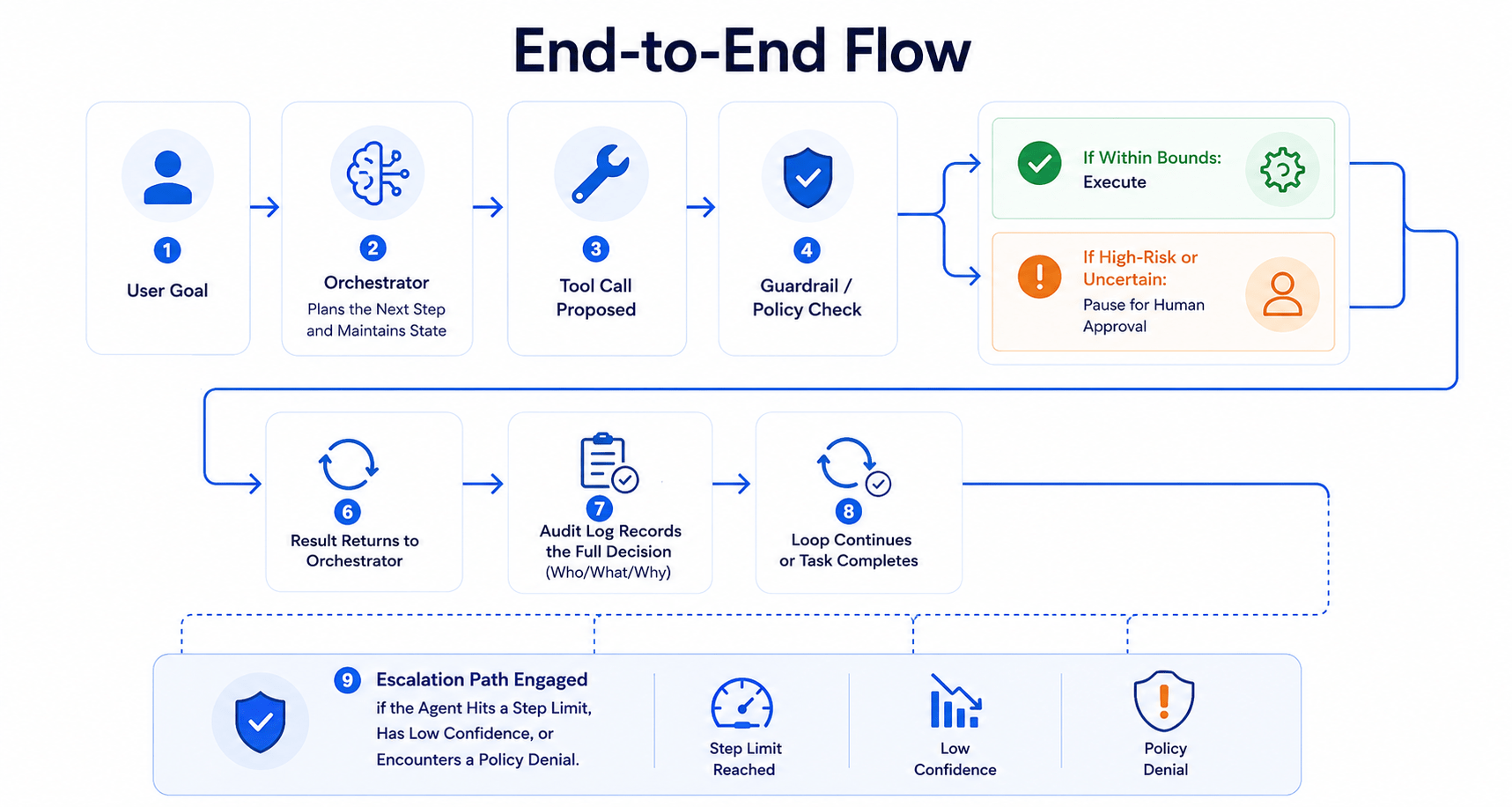
The orchestration runtime manages this tool-calling loop, hands off between specialist agents, and stops the run when it finishes or pauses for approval — the architecture is built around the assumption that not every step should complete without a checkpoint.
Action-risk matrix — permissions scale with what the agent can actually do, not with how capable the underlying model is:
| Tier | Example actions | Required controls |
|---|---|---|
| Read-only assistance | Answering questions, summarizing, looking up records | Standard output safeguards; largely automatable |
| Recommended actions | Drafting an email, proposing a refund, suggesting a schedule change | Human reviews before anything is sent or applied |
| Supervised actions | Updating a record, creating a draft change request | Write access narrowed, logged, and reviewed — action executes but is auditable and reversible |
| High-risk autonomous actions | Sending payment, canceling an account, applying infrastructure changes | Mandatory human confirmation before execution — the more irreversible the action, the stronger the guardrail must be |
A read-only agent does not carry the same risk as an agent that can initiate transactions or make compliance-sensitive decisions — treating every agent as equally risky either over-controls the low-risk ones into uselessness or under-controls the high-risk ones into a liability.
Why permissions and oversight — not model capability — determine whether a deployment is safe: business owners, not developers, must decide what agents may do independently and what requires human approval; without that explicit tier definition, agents default to full autonomy. A more capable model does not reduce the need for approval gates on irreversible actions — it just makes the agent better at executing them, for better or worse. According to OpensecurityarchitectureOpenai, human review pauses the run so a person or policy can approve or reject a sensitive action before it proceeds, and that pause has to be designed in at the architecture level, not bolted on as a prompt instruction the model might ignore or route around.
Non-negotiables regardless of tier: a structured, immutable audit log entry for every action — capturing identity, action type, tool arguments, and policy evaluation result — and a defined escalation path for when the agent’s confidence is low or a policy denies an action, so “stuck” doesn’t silently become “stopped” or, worse, “proceeded anyway.”
4.5 Industry and Regulatory Adaptations
The four architectures above assume a blank slate. In regulated industries, the constraints aren’t optional design choices — they’re inherited obligations that reshape which components are mandatory and which controls can’t be skipped.
Healthcare — a scenario: a clinical documentation assistant summarizing patient encounters touches Protected Health Information (PHI), which means it inherits HIPAA obligations rather than operating outside them. The Security Rule’s access controls require that only authorized persons or software programs access ePHI, its audit controls require mechanisms to record and examine activity in systems containing ePHI, and its breach notification provisions require notification within 60 days of unauthorized disclosure. Architecturally, this means the retrieval and application layers can’t be generic — access control and audit logging aren’t nice-to-haves, they’re the same legal requirement that already governs the human clinicians the AI is assisting. If an AI model is trained on PHI, that data must be de-identified according to HHS-recognized methods, or the model and its surrounding infrastructure must meet full HIPAA compliance.
Finance — a scenario: a credit-risk or fraud-detection model influencing a lending decision falls under model risk management guidance. This guidance requires ongoing monitoring of model performance and outcomes analysis, with changes in performance triggering renewed validation activity — meaning the observability layer (3.7) isn’t optional instrumentation, it’s the evidence a bank must produce to examiners. GLBA requires protecting customer nonpublic information against unauthorized access, and any AI agent touching that information must meet the same safeguard standard as a human employee would. If the system touches cardholder data, PCI DSS restricts AI agent access under the same need-to-know and unique-identification requirements that apply to human users.
Retail — a scenario: a personalization engine recommending products from purchase history is lower-stakes than healthcare or finance, but still touches consumer data subject to privacy regulation (GDPR in the EU, sector-specific privacy laws elsewhere) the moment it processes identifiable customer behavior. And any retail AI system that touches payment data — a checkout assistant, a fraud-screening layer — inherits PCI DSS obligations the same way a bank’s systems do. The architectural implication is smaller in scope than healthcare or finance but not absent: data minimization, consent tracking, and clear boundaries on what personalization data an AI system can retain.
Other sensitive contexts: the pattern generalizes. Any workload touching a regulated data category (health data, financial data, payment data, biometric data, data about minors) inherits the regulatory obligations attached to that data category — the AI system doesn’t get a carve-out because it’s “just a model.”
5. How to Choose Your AI Tech Stack
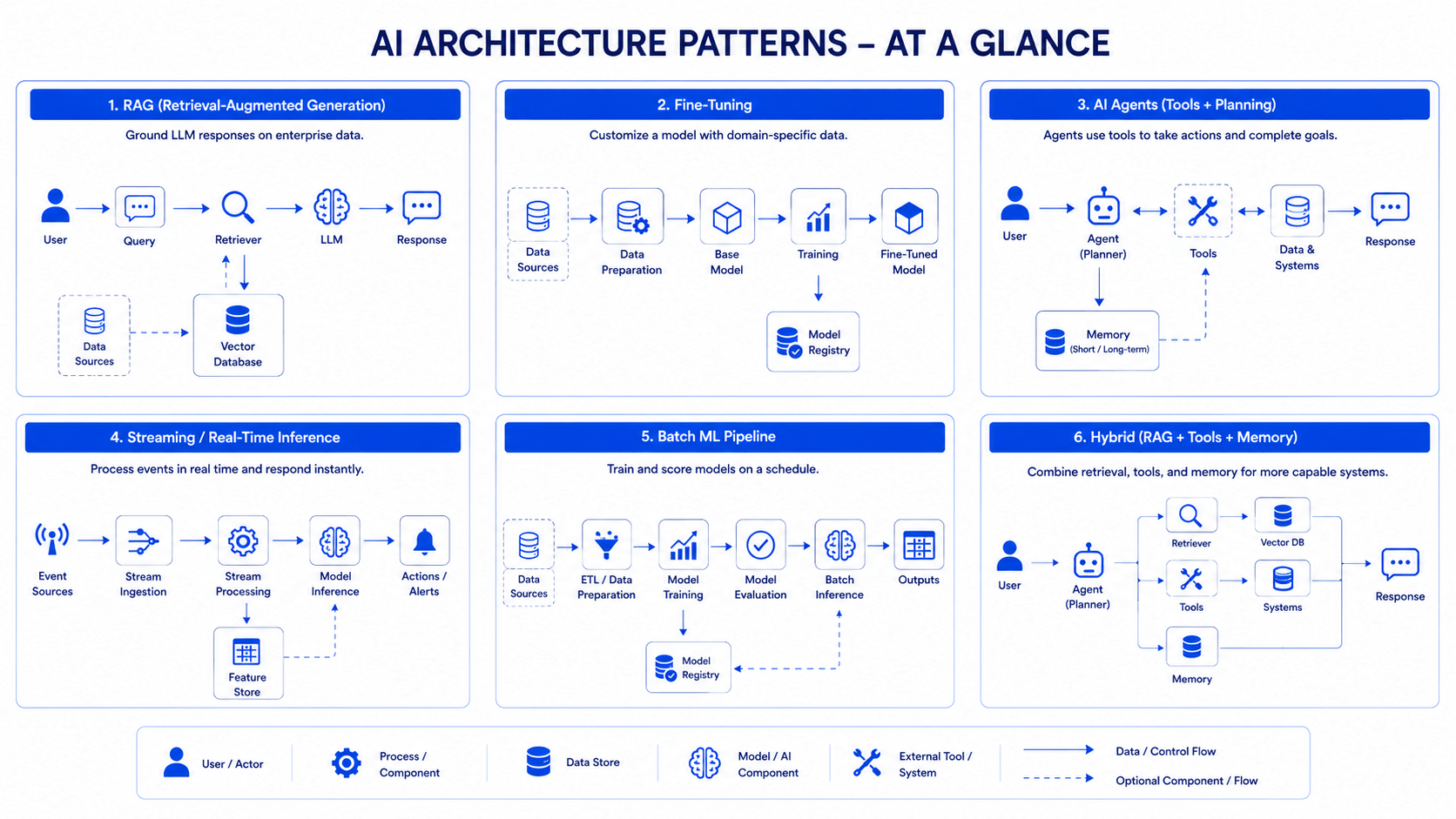
Every decision so far in this guide has been architectural — what the layers are, how they connect, which patterns fit which workloads. This section is about sequence: what to decide first, second, and third, so the architecture serves an actual outcome instead of a preferred vendor. The selection process below follows the same logic threaded through the whole guide: workload → data → constraints → architecture → operations. None of the seven steps that follow are absolute rules — they’re conditional. The right answer to “which model,” “which deployment,” or “how much governance” depends entirely on what gets settled in the steps before it. Skipping ahead to tool selection before the earlier steps are answered is the single most common reason AI stacks end up mismatched to the problem they were meant to solve. Validate each assumption through staged delivery rather than committing the full architecture upfront — a pilot on real data will surface constraints a planning document won’t.
5.1 Define the Use Case and Success Criteria
This is step one for a reason: every later decision — which layers are required, how much governance, what latency budget — traces back to what gets settled here. Skip it, and those decisions get made implicitly, usually by whoever picked the tools first.
What needs to be established before any architecture conversation starts:
- Problem — what specific job is this system doing, stated as a workflow, not a technology (“summarize claims intake” not “use GenAI for claims”)
- User — who interacts with the output, and what decision or action they take because of it
- Business outcome — what metric moves if this works (cost, revenue, time saved, risk reduced) — and how it will actually be measured
- Acceptable error — how wrong can this system be before the cost of a mistake outweighs the benefit; this differs enormously between “draft suggestion a human reviews” and “action taken automatically”
- Workflow integration — where in an existing process this fits, and what happens to that process if the AI system is wrong or unavailable
- Owner — who is accountable for this system once it’s in production, not just who built it
Discovery questions to ask before scoping architecture:
- What does the user do today, without this system, and where does that break down?
- What decision or action follows from the AI system’s output — and who makes it?
- What business metric is this meant to move, and how will we know if it moved?
- If this system is wrong 1 time in 10, is that acceptable? 1 in 100? 1 in 10,000?
- Is this system informational (advises) or does it take action? That answer alone changes almost everything downstream in the architecture.
- What existing workflow does this replace, augment, or sit alongside — and what’s the fallback if it fails?
- Who owns this system’s outcomes after launch — and do they have the authority to pause or roll it back?
Only move forward once the use case has clear, measurable answers. “Improve customer experience” is too vague; “reduce billing response time from two days to two hours” is actionable.
For each use case, define the problem, target user, success metric, risk level, workflow, owner, and launch criteria. A strong definition does not guarantee success, but a weak one guarantees the system will solve the wrong problem. AI consulting can help structure this discovery before development begins.
Getting this step right doesn’t guarantee the rest of the stack will be right — but getting it wrong guarantees the rest of the stack solves the wrong problem, no matter how well-architected it is. For organizations working through this discovery formally, AI consulting is often where this step gets structured before any build work begins.
5.2 Assess Data Readiness and Risk
Once the use case is defined, the next question isn’t “which model” — it’s whether the data this system needs actually exists, is trustworthy, and is legally usable. Skipping this step is how teams discover mid-build that the data they assumed was available is incomplete, ungoverned, or off-limits.
What to assess before committing to an architecture:
- Availability — does the data this workload needs actually exist in a usable form, or does it need to be created, licensed, or aggregated from multiple systems first?
- Quality — is it complete, accurate, and consistent enough for the error tolerance defined in 5.1? A workload with low acceptable error (autonomous action) needs a much higher quality bar than one with high acceptable error (draft suggestion, human-reviewed).
- Permissions — is this specific source approved for AI use, with a named owner accountable for its accuracy and freshness — being connected to a source is not the same as being approved to use it.
- Sensitivity — does this data fall into a regulated category (health, financial, payment, biometric, data about minors)? If so, the obligations from Section 4.5 apply regardless of how the AI system is framed.
- Freshness — how current does this data need to be for the use case to work, and what’s the actual update cadence of the source (real-time, hourly, daily, static)?
- Governance — can this data’s lineage be traced from source to output, and do the same retention, deletion, and access rules that apply to the source carry forward to any derived asset (embeddings, indexes, caches) built from it?
5.3 Set Constraints: Latency, Scale, Cost, and Compliance
These four constraints, set together, narrow every downstream choice before a single model or vendor gets named. Setting them separately — or after the fact — is how teams end up with an architecture that’s technically sound but operationally wrong for the workload.
How each constraint reshapes choices:
- Latency — a sub-second requirement (fraud screening, voice interaction) rules out batch inference and most self-hosted setups without dedicated low-latency serving; a workload tolerant of minutes-to-hours delay can use batch prediction instead of an always-on endpoint, at meaningfully lower cost.
- Scale — an autoscaler is a control loop with real delay — new capacity typically takes 30 to 90 seconds to come online — so traffic that spikes faster than that needs pre-provisioned capacity, not just autoscaling rules. Sustained high volume shifts the cost math toward self-hosting; bursty or unpredictable volume favors managed services that scale to zero.
- Cost — GenAI costs scale with usage intensity, not just infrastructure, so longer prompts, retries, and inefficient retrieval directly inflate the bill — cost constraints often push toward smaller models, aggressive caching, or tighter prompt design before they push toward a cheaper vendor.
- Compliance — a hard data-residency or sector-specific requirement (from Section 4.5) can eliminate managed APIs from consideration entirely, regardless of cost or latency preference — compliance is worth checking before the cost question, not after.
Constraints trade-off matrix:
| If this constraint dominates… | …it pulls the architecture toward |
|---|---|
| Sub-second latency | Real-time serving, pre-provisioned capacity, possibly edge/on-device |
| High, sustained volume | Self-hosted or reserved capacity over pay-per-token APIs |
| Tight/unpredictable cost | Managed APIs with usage caps, smaller models, aggressive caching |
| Hard data residency/compliance | Self-hosted or in-region managed cloud AI; managed APIs may be ruled out entirely |
These constraints frequently conflict — the lowest-latency option isn’t the cheapest, and the most compliant option isn’t the most scalable by default. The point of setting them explicitly, together, is deciding which one wins the trade-off before evaluating vendors, not during a vendor demo.
5.4 Choose the Deployment Model
With constraints set, deployment model is the next decision — and it’s genuinely conditional, not a single best answer.
- Choose managed cloud when iteration speed matters more than infrastructure control, compliance requirements are met by the provider’s certifications, and volume doesn’t yet justify the operational overhead of running your own serving stack.
- Choose self-hosted/open-source when strict data sovereignty or air-gap requirements rule out third-party processing, or when sustained token volume crosses the point where GPU ownership beats per-token pricing — and only when the team has the MLOps capacity to own that infrastructure.
- Choose hybrid when some workloads need in-house control (sensitive data, latency-critical paths) while others don’t — most mature organizations end up here rather than at either extreme.
- Choose edge/on-device when data sovereignty regulations require processing where the data is generated, or when connectivity is unreliable and sub-second local response is required.
Deployment decision tree (simplified): Does compliance require in-region or on-prem processing? → Yes: self-hosted/edge/in-region managed cloud only. No → Is sustained volume high and predictable? → Yes: self-hosted or reserved capacity likely cheaper. No → Managed cloud/API, revisit as volume and requirements firm up.
This decision isn’t permanent — most teams start managed, instrument actual usage, and move specific workloads to self-hosted or edge only once volume, control, or regulation genuinely justify it. For teams weighing this against existing infrastructure, cloud solutions and software development services are usually where this decision gets pressure-tested against what’s already running.
5.5 Select Models, Data Stores, and Orchestration Capabilities
This is where the architecture in Section 3 becomes concrete choices — but categories and selection criteria come first; specific products are non-exhaustive examples, not a shortlist to default to.
Layer-by-layer selection worksheet:
| Layer | Category options | Selection criteria |
|---|---|---|
| Model | Traditional ML, foundation model API, open-weight, self-hosted | Task type, quality bar, latency, cost at expected volume, data sensitivity |
| Data store | Relational, vector, graph, or hybrid | Query pattern (exact match vs. semantic vs. relational), access-control granularity needed |
| Retrieval | Keyword, vector, hybrid, graph | Hybrid with reranking for most enterprise RAG; graph when relational reasoning or fine-grained access control is required |
| Orchestration | API integration, workflow orchestrator, agent framework | Level of autonomy needed (Section 3.5) — pick the least coupled option that satisfies the use case |
For each layer: name the requirement first (from the use case, data, and constraints already set), then evaluate categories against that requirement, and only then compare specific implementations within the category that fits. Jumping straight to “which vector database” before deciding whether vector search is even the right retrieval method is the ordering mistake this worksheet is meant to prevent.
5.6 Design for Evaluation, Monitoring, and Continuous Improvement
A stack isn’t done at deployment — it needs a designed plan for staying trustworthy afterward.
What needs a plan before launch, not after an incident:
- Evaluation plan — automated and human evaluation combined with LLM-as-a-judge pipelines, backed by stored ground-truth data, run before every release, not just once at the start
- Release criteria — explicit, measurable thresholds a candidate release must clear (quality, safety, cost) before it reaches production traffic
- Monitoring — tracking system performance alongside output quality, behavior patterns, and cost, with alerting thresholds when any of them degrade
- Incident response — a defined path from detection to containment to fix, not just an alert firing into silence
- Feedback loops — a route for real usage data and failures to flow back into evaluation datasets and prompt/model iteration
- Rollback — a tested path to revert to the previous version when a release underperforms, not a hope that it won’t be needed
AI operating lifecycle: offline evaluation → release criteria check → deployment → online monitoring → incident detection → root-cause analysis → fix/retrain/re-prompt → back to offline evaluation.
Treating this as a one-time setup rather than a running discipline is precisely how systems that passed every pre-launch check quietly degrade in production, unnoticed until a customer or an auditor finds the gap.
5.7 Pilot, Measure, and Scale
The last step in the sequence — and the one that validates every assumption made in the previous six.
What a pilot needs to establish before wider rollout:
- Validation scope — a real but bounded slice of the actual workload (not a synthetic demo), representative of the edge cases production will bring
- Success thresholds — the same measurable criteria from 5.1 and 5.6, agreed before the pilot starts, not evaluated retroactively against whatever result comes back
- Governance gates — explicit checkpoints (data, security, compliance, business sign-off) the pilot must clear before scaling, tied to the risk tier established in Sections 3.8 and 4.5
- Rollout sequencing — staged expansion (limited users → broader cohort → full production) rather than a single cutover, so failures surface at small scale rather than at full exposure
Pilot-to-production roadmap: define use case & success criteria (5.1) → assess data readiness (5.2) → build against a narrow, representative slice → measure against pre-agreed thresholds → pass governance gates → expand to a wider cohort → monitor continuously → full production rollout, with the option to pause or roll back at every stage.
Scaling past this checklist without every item checked doesn’t make the system faster to ship — it just moves the failure from a controlled pilot to an uncontrolled production incident, which is the exact outcome the seven-step sequence in this section was built to prevent.
6. Decision Frameworks and Trade-Offs
Every choice covered so far — model, deployment, retrieval, orchestration — is really the same decision wearing a different label: how much control do you want, and what are you willing to trade for it? This section makes that trade explicit across four recurring decisions: managed vs. self-hosted, build vs. buy vs. integrate, and the axes that cut across both — cost predictability, speed, customization, security, and operational burden. None of these decisions has a universally correct answer; each matrix below is meant to be applied to your specific constraints from Section 5, not read as a ranking of one approach over another. The right choice for a well-funded team with strict data residency requirements looks nothing like the right choice for a lean team validating a new use case — and both can be correct for their own context.
6.1 Managed Platforms vs. Open-Source and Self-Hosted Components
Decision matrix:
| Factor | Managed platform | Open-source/self-hosted |
|---|---|---|
| Speed to first deployment | Fast. Buys speed, reliability, and low operational burden while prompt formats and traffic patterns are still changing | Slower; requires standing up serving infrastructure first |
| Flexibility/customization | Bounded by provider’s exposed configuration | Can be fine-tuned, modified, and extended within license terms using any tooling the team chooses |
| Operations burden | Minimal; provider handles scaling, patching, uptime | Full responsibility for GPU allocation, model loading, optimization, and monitoring |
| Data control | Data typically leaves your infrastructure | Full control over model selection, inference configuration, and data privacy |
| Tuning depth | Limited to prompt/config-level tuning | Full access to fine-tuning, quantization, custom serving optimizations |
| Support | Vendor SLA, documented escalation path | Community support or internal team; commercial self-hosted arrangements can restore vendor support at a licensing cost |
| Total cost | Predictable, usage-based; can exceed self-hosting only past a high, sustained volume threshold | Lower per-unit cost at scale, but GPU utilization waste at low load can inflate effective cost well above managed pricing |
Choose managed when iteration speed and low operational overhead matter more than infrastructure ownership, which is most teams, most of the time, in the early stages of a use case. Choose self-hosted when data sovereignty is a hard requirement, sustained volume clears the break-even point, or the team already has the MLOps capacity to absorb the operational burden. Neither is a default; each is conditional on constraints already set in Section 5.3.
6.2 Cloud vs. On-Premises vs. Hybrid vs. Edge
Deployment-context table:
| Factor | Cloud | On-premises | Hybrid | Edge |
|---|---|---|---|---|
| Compliance | Depends on provider certifications and region | Full data sovereignty by design | Sensitive workloads on-prem, rest in cloud | Meets data residency where regulations require processing where data is generated |
| Latency | Variable and provider-dependent; adds internet round trips | Predictable, local | Best of both, if routed correctly | Sub-10ms achievable, with no network dependency |
| Resilience | Provider-managed redundancy | Owned redundancy, owned risk | Depends on integration design | Continues operating through connectivity loss |
| Cost profile | No upfront cost, pay-as-you-go, can surprise at scale | High upfront capital, lower marginal cost | Mixed: capital plus usage-based | Hardware cost per device, no ongoing cloud fees for inference |
| Connectivity dependency | High | None for local operation | Partial | Designed for intermittent or unreliable connectivity |
| Skills required | Lowest; provider abstracts infrastructure | Highest: GPU provisioning, patching, monitoring, security in-house | Both skill sets, plus integration expertise | Embedded/edge-specific deployment and fleet management skills |
None of these four is a more advanced version of another; they answer different constraint profiles. Cloud suits fast-moving, compliance-flexible workloads. On-premises suits strict sovereignty or predictable high-volume needs. Hybrid suits organizations with a genuine split between sensitive and non-sensitive workloads. Edge suits latency- or connectivity-constrained physical environments. Most mature AI stacks end up mixing more than one of these rather than committing to a single deployment context.
6.3 Build vs. Buy vs. Integrate
The question isn’t whether something can be built; nearly anything can be built. It’s whether building it creates a differentiated advantage worth the ongoing cost of owning it.
What to build: capabilities that are core to your competitive differentiation and don’t exist adequately off-the-shelf, typically the application logic, domain-specific prompt/orchestration design, and proprietary data pipelines that encode business-specific knowledge.
What to buy: commodity infrastructure that every organization needs and that a vendor operates better at scale than you would: model serving, vector databases, observability tooling, base foundation models.
What to integrate: connecting existing systems of record (CRM, ERP, ticketing) to the AI stack via APIs, rather than rebuilding those systems’ functionality inside the AI application.
Decision tree (simplified): Does this capability directly differentiate us from competitors? If yes, consider building. If no, does a mature vendor solution already solve this well? If yes, buy. If no, can existing systems be connected via integration rather than rebuilt? If yes, integrate. If no, reconsider whether this capability is actually needed.
Warning signs of overbuilding:
- Building a custom vector database or model-serving layer when a managed option would meet requirements at a fraction of the engineering cost
- Re-implementing evaluation, observability, or guardrail tooling that mature open-source or vendor options already provide
- Spending more engineering time maintaining infrastructure than improving the differentiated application logic it supports
- No clear answer to what would be lost by buying this instead, beyond a vague preference for control
6.4 Cost, Performance, Control, and Time-to-Market
These four factors trade against each other in a fairly consistent pattern: pushing hard on any one usually costs ground on at least one other.
Four-factor prioritization framework. Rank these for your specific use case, since optimizing for all four simultaneously isn’t possible:
| Factor | What optimizing for it looks like | What it costs |
|---|---|---|
| Cost | Smaller models, aggressive caching, managed APIs at low volume, batch over real-time | Slower response, less customization, sometimes lower quality ceiling |
| Performance | Larger/frontier models, real-time serving, generous compute | Higher cost, more infrastructure complexity |
| Control | Self-hosted, custom fine-tuning, in-house data pipelines | Slower to ship, higher operational burden |
| Time-to-market | Managed APIs, off-the-shelf components, minimal customization | Less differentiation, potential vendor dependency |
Measurement should track the same categories: cost per outcome (not just per token), latency against the budget set in 5.3, degree of customization actually needed versus available, and elapsed time from decision to production. Pick the two factors that matter most for this specific use case and let the other two flex; treating all four as equally non-negotiable is how projects stall.
6.5 Avoiding Tool Sprawl and Vendor Lock-In
Every component chosen in Section 5.5 is also a future dependency. This section is about keeping that dependency manageable rather than letting it accumulate into an unmaintainable, unswitchable stack.
What reduces lock-in risk without slowing delivery:
- Integration standards. Favor components with open, documented APIs over proprietary-only integration paths, so a future swap doesn’t require rebuilding the whole orchestration layer.
- Portability. APIs across open-weight hosting providers often look similar, making it possible to prototype against a hosted API and move to self-hosted later with minimal code changes. Favor this kind of interchangeability where the option exists.
- Observability. Centralized monitoring and logging that isn’t tied to a single vendor’s dashboard, so switching a component doesn’t mean rebuilding visibility from scratch.
- Ownership. Clear internal ownership of prompts, configurations, and data pipelines, kept in version control rather than living solely inside a vendor’s proprietary interface.
- Documentation. Architecture decisions and integration points documented well enough that a team change or vendor change doesn’t require reverse-engineering the system.
- Exit planning. A documented answer to what it would take to leave this vendor, for every major component, established at adoption time rather than discovered during a forced migration.
Avoiding lock-in doesn’t mean avoiding vendors; nearly every stack in this guide depends on some vendor somewhere. It means making the dependency a conscious, documented trade-off rather than an accidental one discovered only when it’s time to leave.
7. Operating the Stack in Production
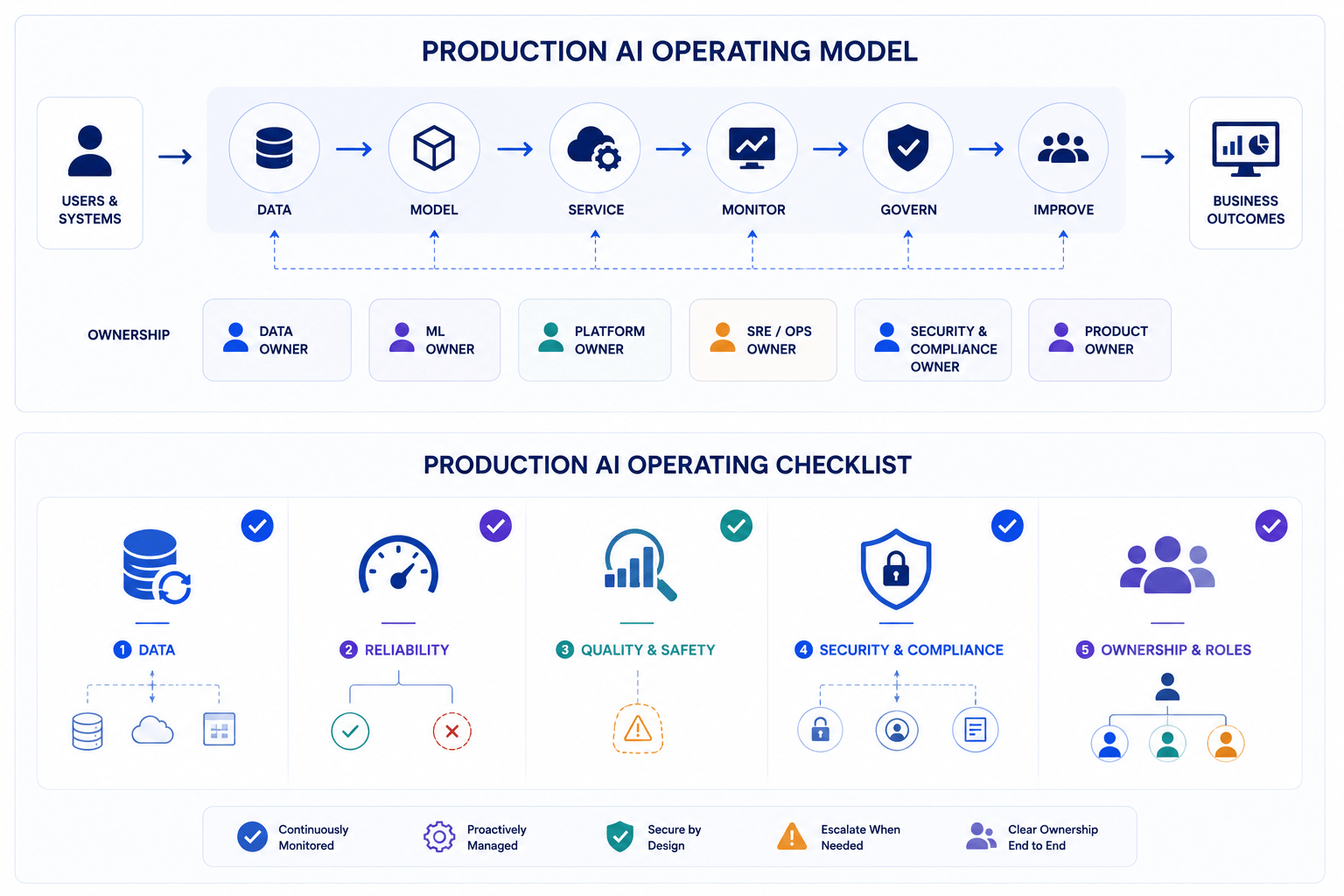
Launch is the midpoint, not the finish line. Everything in Sections 3 through 6 exists to get a system live; this section is about what keeps it trustworthy, available, and valuable after that point, when real users, real edge cases, and real cost pressure start testing every assumption made during design.
Production AI operating checklist (the categories this section walks through in detail):
- Data stays fresh, validated, and interoperable with the systems feeding it
- The service meets defined reliability and performance targets, with a tested fallback when it doesn’t
- Output quality and safety are monitored continuously, with a real escalation path
- Security, privacy, and compliance controls run continuously, not just at launch review
- A named team owns each part of the stack, with responsibilities that don’t silently fall through the cracks
7.1 Data Quality, Freshness, and Interoperability
Production data drifts from what a system was validated against; this section is about catching that before it becomes a silent failure.
What needs an owner and a process, not just a one-time check:
- Validation. Continuous quality validation catches issues before they reach model training or inference, rather than being discovered when a customer notices.
- Change management. Data contracts establish explicit producer commitments (schema stability, freshness SLAs, completeness thresholds), verified continuously through automated assertions, so upstream changes don’t silently break downstream AI behavior.
- Access. Permissions on source data carry forward to every derived asset (embeddings, indexes, caches) built from it, not just the original table.
- Source reliability. Each source has a named, accountable owner responsible for its accuracy and freshness, and that source is explicitly approved for AI use rather than merely connected.
- Integration ownership. Someone is accountable when a pipeline breaks or a source changes format, with a documented path to fix it, not an assumption that “it just works.”
7.2 Reliability, Scalability, and Performance
Reliability for an AI system means something slightly different than for traditional software: the system can be fully “up” and still be wrong, slow, or expensive in ways standard uptime monitoring misses.
What to define and test before an incident forces the question:
- Service objectives. Explicit latency, availability, and error-rate targets, matched to the constraints set in Section 5.3, not generic industry defaults.
- Capacity. An autoscaler is a control loop with real delay; new capacity typically takes 30 to 90 seconds to come online, so traffic that can spike faster than that needs pre-provisioned headroom, not just autoscaling rules.
- Degradation behavior. What the system does when it’s overloaded or a dependency fails: does it queue, shed load gracefully, or fail outright?
- Fallback. A defined lower-capability path (a smaller model, cached response, or human handoff) for when the primary path is unavailable or too slow.
- Incident response. A tested path from detection to containment to fix, with clear ownership and escalation.
- Performance testing. Load tests that ramp traffic realistically rather than assuming flat load, measuring p99 latency and error rate through the entire ramp.
Reliability testing matrix:
| Test type | What it validates |
|---|---|
| Load ramp test | Behavior under realistic, non-flat traffic growth |
| Scale-down test | Whether in-flight requests survive graceful shutdown during autoscaling |
| Failure injection | Behavior when a dependency (model API, vector store, tool) is unavailable |
| Cost-under-load test | Whether cost scales predictably or spikes unexpectedly at peak traffic |
7.3 AI Quality, Safety, and Human Oversight
This is where “the model works” and “the system is safe to operate” diverge, and where most of the ongoing operational risk in AI systems actually lives.
What needs continuous attention, not a one-time evaluation:
- Evaluation datasets. Stored ground-truth data supporting automated and human evaluation, along with LLM-as-a-judge pipelines, refreshed as real usage surfaces new edge cases.
- Response quality. Tracking not just system performance but output quality, behavior patterns, and user satisfaction over time (Calmops)
- Hallucination-risk handling. A defined fallback for low-confidence or ungrounded responses, such as citing sources or declining to answer rather than guessing.
- Guardrails. Monitoring guardrail effectiveness to identify when filters need adjustment or new categories of harmful content emerge, since a guardrail that worked at launch can drift out of date.
- Escalation. A clear path for low-confidence outputs or high-risk actions to reach a human before they cause harm, matched to the action-risk tier from Section 4.4.
- Feedback. A route for real usage data, corrections, and failures to flow back into evaluation and retraining, not just into a support ticket queue.
Risk-and-oversight matrix:
| Risk tier | Oversight needed |
|---|---|
| Informational, low stakes | Periodic sampling review |
| Informational, high stakes | Continuous evaluation, citation/grounding required |
| Action-taking, reversible | Logged, reviewable, spot-checked |
| Action-taking, irreversible | Mandatory human approval before execution |
7.4 Security, Privacy, and Compliance
Security for AI systems extends past standard application security into the model, data, and agent layers, and it has to run continuously rather than as a launch gate.
What needs to run continuously, not just be documented once:
- Identity. A distinct, persistent identity for every agent or service, correlated in audit trails, not a shared credential. (Predictionguard)
- Least privilege. Read access can often be automated; write access should be narrowed, logged, and reviewed; high-impact actions require human confirmation. (Rootcode)
- Data classification. Every data source and derived asset tagged by sensitivity, with controls that match the classification, not a blanket policy applied uniformly.
- Retention. Clear rules for how long prompts, outputs, and logs are kept, aligned with the regulatory obligations identified in Section 4.5.
- Logging. Immutable, tamper-evident logs capturing identity, action, and policy evaluation result for every model, tool, and agent interaction.
- Model and tool access. Permission scoping enforced at the infrastructure layer, not left to the model’s own judgment or a prompt instruction.
- Auditability. Enough documented evidence, mapped to a recognized framework (NIST AI RMF, ISO 42001, or sector-specific regulation), to withstand external review on demand.
Cross-layer controls matrix:
| Layer | Control focus |
|---|---|
| Identity/access | Least privilege, distinct identity per agent/service |
| Data | Classification, retention, lineage |
| Model/application | Input/output filtering, permission scoping |
| Audit | Immutable logging, framework mapping |
7.5 Talent, Team Design, and Operating Model
Not every organization needs a large specialist bench to run this safely; what matters is that every responsibility below has a clear owner, even if one person holds several.
Responsibilities that need an owner, regardless of team size:
- Product — defines the use case, success criteria, and acceptable risk
- Data — owns data quality, access, and governance
- ML/AI engineering — owns model selection, evaluation, and retraining
- Platform/infrastructure — owns deployment, scaling, and reliability
- Security — owns identity, access control, and audit logging
- Legal/compliance — owns regulatory mapping and sign-off
- Operations — owns incident response and day-to-day monitoring
Team responsibilities matrix (roles can combine in smaller organizations; what can’t disappear is the responsibility itself):
| Responsibility | Small team | Larger organization |
|---|---|---|
| Product + risk ownership | Founder/PM, part-time | Dedicated product owner |
| Data governance | Shared with engineering | Dedicated data governance function |
| ML/AI engineering | 1–2 generalists | Dedicated ML/AI team |
| Security/compliance | Outsourced or part-time | Dedicated security and compliance functions |
| Incident response | On-call rotation, informal | Formal incident management process |
A lean team covering all of these roles across fewer people is not a lesser operating model; it’s an appropriately scaled one, as long as nothing on this list is left with no owner at all. The failure mode to watch for isn’t small team size; it’s an unowned responsibility, discovered only after something breaks. For organizations that want to formalize this without building every function in-house, managed services and AI transformation support are often where the gap gets closed.
8. AI Stack Patterns for Startups and Enterprises
Everything in this guide so far assumes a workload defines the architecture. Organizational maturity is a second, independent variable: two companies running the exact same RAG use case can reasonably build very different stacks, not because one is right and one is wrong, but because their risk exposure, integration complexity, and operational criticality differ. Company size is a proxy for these factors, not the factor itself. A handful of AI experiments rarely justifies heavy governance investment; once production AI reaches a meaningful number of live systems, that light-touch approach breaks down, regardless of whether the organization behind it is a ten-person startup or a business unit inside a large enterprise.
8.1 Lean Stack for Startups and Fast Validation
At this stage, the goal is validating whether the use case works at all, not building infrastructure for scale that may never arrive.
What this stage should prioritize: speed to a working system, managed services over self-hosted infrastructure, a narrow integration scope (one or two systems, not a full enterprise data fabric), and a clear, measurable validation signal before committing further investment.
What this stage can reasonably defer: multi-region deployment, custom fine-tuning, dedicated MLOps tooling, and formal governance committees. Deferring these isn’t cutting corners; it’s matching investment to actual risk and stakes, which at this stage are usually low.
Skipping this floor doesn’t speed up validation; it just means the first real incident becomes a governance problem instead of a quick fix.
8.2 Scale-Up Stack for Growing Products
Once a validated use case starts handling real production volume, or a second and third use case gets added, the lean stack’s informal patterns start generating friction rather than speed.
What needs to change at this stage:
- Standardization. Multiple use cases sharing common patterns (same evaluation framework, same logging format, same deployment pipeline) instead of each one reinventing its own approach.
- Observability. Centralized monitoring across systems, not per-project dashboards that nobody but the original builder understands.
- Cost governance. Usage tracked and attributed by use case, not a single opaque cloud bill.
- Integration growth. More systems connected, which raises the cost of tight coupling and the value of the integration standards discussed in Section 6.5.
- Reliability. Formal service objectives (Section 7.2) replace “it’s usually fine.”
- Ownership. Responsibilities from Section 7.5 need explicit assignment as more people touch the stack; ambiguity that was harmless with one team becomes costly with three.
Trigger points for platform investment: the signal isn’t a headcount number or a revenue milestone; it’s when any of the following starts happening: the same integration problem gets solved more than once by different teams, an incident takes longer to diagnose because nobody can trace what happened across systems, cost becomes unpredictable enough to threaten the business case, or a second regulated use case appears and manual governance stops scaling. Once production AI hits roughly ten or more live systems, ad hoc governance reliably breaks down, and that threshold is a more reliable trigger than company size alone.
8.3 Enterprise Stack for Integration, Governance, and Control
At this stage, the constraints from Sections 3.8 and 4.5 stop being occasional considerations and become the default operating condition for every new use case.
What this stage requires as a baseline, not an aspiration:
- Identity. Centralized identity and access management spanning every model, agent, and data source, not per-project credentials.
- Data boundaries. Enforced data classification and access boundaries that hold across business units, not just within a single team’s project.
- Compliance. A risk-classified system inventory with current classifications and clear accountability, capable of producing audit evidence on demand rather than reconstructing it after a regulator asks.
- Shared platforms. Common infrastructure (model gateways, evaluation tooling, observability) that multiple teams reuse instead of rebuilding, reducing both cost and inconsistency.
- Operating model. The full set of roles from Section 7.5 formalized, typically with dedicated functions rather than shared part-time ownership.
- Procurement. Vendor risk assessment, data processing agreements, and security review built into how new AI tools get adopted, not bypassed for speed.
Modularity and controlled reuse matter more than centralization for its own sake: a shared platform that forces every team into one rigid pattern slows innovation as much as no platform at all. The stronger pattern is modular shared components (a common evaluation framework, a common gateway, common logging) that individual teams can compose differently for their own use case, with governance enforced at the shared layer rather than re-implemented per team.
8.4 How Priorities Change by Organization Maturity
None of these stages is “better” than another; each is matched to a different level of risk, integration complexity, and operational stakes. A startup validating a low-risk internal tool and an enterprise deploying a customer-facing agent in a regulated industry are optimizing for genuinely different things, and that difference isn’t fully explained by company size alone.
How AI stack priorities change with organization maturity:
| Priority | Startup (lean) | Scale-up | Enterprise |
|---|---|---|---|
| Speed | Highest priority | Balanced against standardization | Balanced against governance and risk |
| Control | Low; managed services preferred | Growing, especially for cost and data | High; identity, data boundaries enforced |
| Reliability | Best-effort, manual fallback | Formal service objectives | Formal SLAs, tested failover |
| Cost | Minimize absolute spend | Attribute and govern by use case | Optimize at portfolio scale |
| Governance | Minimum viable controls | Standardized across use cases | Formal, audit-ready, risk-classified |
| Talent | Generalists, shared roles | Emerging specialization | Dedicated functions per Section 7.5 |
This table is a direct extension of the trade-off framework in Section 6: the axes (control, cost, speed, security, operational burden) don’t change with company maturity, but which axis gets prioritized does. A startup correctly favors speed and managed services for the same reason an enterprise correctly favors control and governance: each is matching the stack to its actual risk and stakes, not to a generic template for “how AI should be done.”
9. How to Measure Whether Your AI Stack Works
“The AI works” is not a measurement; it’s a feeling that hasn’t been decomposed yet. A production AI stack actually needs six separate measurement categories, checked separately, because a system can score well on one and fail badly on another without either result showing up in the others: model quality, retrieval and grounding, system performance, cost, adoption, and business outcome. Collapsing these into one vague “is it good” question is how teams end up shipping a system that tests well and performs poorly, or the reverse.
AI stack metrics by layer:
| Layer | What it measures | Typical owner | Decision it informs |
|---|---|---|---|
| Model/output quality | Is the output correct, relevant, safe | ML/AI engineering | Ship/hold a model or prompt change |
| Retrieval/grounding | Is the answer supported by real, current sources | ML/AI engineering, data | Fix chunking, indexing, or source coverage |
| System performance | Is it fast and available enough | Platform/infrastructure | Scale, fallback, or SLA changes |
| Cost efficiency | Is it affordable at this volume | Platform, finance | Model choice, caching, deployment model |
| Adoption | Are people actually using it | Product | Continue, redesign, or sunset the feature |
| Business outcome | Did it move the metric from Section 5.1 | Product, business owner | Continue investment or reprioritize |
No single number here substitutes for the others. A model with excellent output quality that nobody adopts hasn’t succeeded; a heavily adopted feature that’s quietly expensive per outcome hasn’t succeeded either.
9.1 Model and Output Quality
Evaluation looks different depending on what kind of model is producing the output, and conflating the two evaluation styles is a common measurement mistake.
Classical ML is evaluated against a known ground truth: accuracy, precision/recall, RMSE, AUC, calculated against labeled data the model has never seen. There’s a single correct answer to check against.
Generative output doesn’t have that luxury. Evaluation needs to combine automated and human evaluation with LLM-as-a-judge pipelines, backed by stored ground-truth data, because “is this a good answer” is a judgment call, not a distance calculation. Qualitative human review stays necessary even with automated scoring in place, since automated judges can miss nuance that a domain expert catches immediately.
The task-appropriate lens matters: a summarization task is scored on faithfulness to the source and completeness; a classification task is scored on precision/recall; a creative-writing task is scored almost entirely by human judgment. Applying one universal metric across all of these produces numbers that look precise but measure the wrong thing for at least some of them.
9.2 Retrieval and Grounding Quality
A RAG system’s answer quality is gated by two separate failure surfaces, retrieval and generation, and they need to be measured separately to know which one to fix.
Context Precision and Context Recall assess the quality of the retrieved context, while Faithfulness and Answer Relevance assess the quality of the generated response, and considered jointly they distinguish retrieval failures (irrelevant or incomplete context) from generation failures (unsupported or unresponsive answers). Faithfulness is the fraction of claims in the answer that can actually be inferred from the retrieved context, which matters because an answer can be faithful to an incorrect retrieved context, meaning a high faithfulness score alone doesn’t guarantee a correct answer if the underlying source was wrong or stale.
That’s the gap standard metrics miss: a pipeline can score very high on faithfulness and still return wrong business answers if the retrieved index is stale, unowned, or misaligned with the canonical source — which is why source freshness and ownership (Section 7.1) belong alongside the standard four metrics, not as a separate afterthought.
RAG evaluation checklist:
- Context precision — are retrieved chunks actually relevant, ranked with the best first?
- Context recall — does the retrieved context contain everything needed to answer?
- Faithfulness — does the answer only make claims supported by the retrieved context?
- Answer relevance — does the answer actually address what was asked?
- Citation correctness — do citations point to the actual source the claim came from?
- Source freshness — is the underlying index current, or could a correct-sounding answer be built on stale data?
- Continuous sampling — is every user correction treated as a signal that the retrieval index needs improvement, not just a one-off complaint?
9.3 System Reliability, Latency, and Scalability
This category answers a question independent of whether the output is any good: does the system stay available and fast enough to be usable at all?
Operational metrics table:
| Metric | What it captures |
|---|---|
| Uptime | Percentage of time the system is available to serve requests |
| Error rate | Proportion of requests failing outright (timeouts, 5xx errors, tool failures) |
| Latency (p50/p90/p99) | Response time distribution, not just the average |
| Throughput | Requests handled per unit time at peak load |
| Load behavior | How the system degrades under traffic beyond its provisioned capacity |
| Fallback performance | How well the degraded/backup path performs when the primary path fails |
None of these has a universal target: a batch scoring job and a real-time fraud check tolerate wildly different latency, and what counts as “good enough” uptime depends entirely on how critical the workflow is. The right approach is setting these against the specific service objectives defined in Section 7.2, not against an industry benchmark pulled from an unrelated use case.
9.4 Cost Efficiency and Unit Economics
Cost for an AI system rarely lives in one line item, which is exactly why it’s easy to lose track of until the bill arrives.
What actually needs to be tracked, separately:
- Model usage — token consumption, API calls, or compute-hours, broken down by use case rather than aggregated into one number
- Infrastructure — serving, storage, and networking costs, including idle capacity that isn’t doing useful work
- Storage — vector indexes, logs, cached context, which grow continuously and are easy to undercount
- Engineering effort — the ongoing time spent maintaining, tuning, and fixing the system, which is a real cost even when it doesn’t show up on a cloud invoice
- Support — human review, escalation handling, and incident response tied to the system
- Cost per meaningful outcome — total cost divided by the actual business result (resolved tickets, correct predictions, completed workflows), not cost per token or per API call in isolation
Cost-accountability checklist:
- Cost is attributed per use case, not lumped into one cloud bill
- Cost per meaningful outcome is tracked, not just aggregate spend
- Idle or underutilized capacity is visible, not hidden inside a flat infrastructure line
- Engineering and support time is counted as a real cost, not treated as free
- Alerting exists for cost anomalies, not just a monthly review after the fact
- Cost is reviewed against the constraints set in Section 5.3, not against last month’s number alone
9.5 User Adoption and Business Outcomes
This is the category that actually answers Section 5.1’s original question: did the system move the metric it was built to move? Everything else in this section is a leading indicator; this is the outcome.
What to measure, matched to the use case:
- Workflow completion — did users actually finish the task the AI system was meant to support, not just interact with it once
- Quality improvement — measurable change in the underlying work product (fewer errors, more consistent output)
- Time saved — actual elapsed time reduction on the target workflow, compared against a real baseline, not an estimate
- Conversion — for commercial use cases, whether the AI system measurably moved a conversion or retention metric
- Risk reduction — for compliance or safety-oriented use cases, whether incidents, errors, or exposure measurably declined
Baselines and causal caution matter more here than anywhere else in this section. A metric that improved after launch didn’t necessarily improve because of the AI system, other changes (seasonality, a separate product change, a shift in user mix) can move the same number. Establishing a real baseline before launch, and ideally a comparison group, is what separates “this metric went up” from “this system caused the metric to go up.” Without that discipline, it’s easy to credit an AI system for a result it didn’t actually produce, and just as easy to miss that a system is failing because a favorable trend elsewhere is masking it.
10. Architecture Trends to Monitor
Every year brings a fresh set of predictions about what will “change everything” in AI. This section skips the predictions and focuses on something narrower and more useful: shifts that are already visible in primary documentation and research, and that plausibly affect how a stack should be architected, not just what gets talked about at conferences. The framework here is deliberately unglamorous: monitor, evaluate, adopt selectively. Watch a trend, test it against your own workload and constraints, and adopt only the parts that actually improve your specific system. None of what follows is a call to rearchitect immediately; it’s a watchlist for what to track as the stack in this guide gets built and maintained.
Watchlist: architecture changes and the decisions they affect
| Trend | Decision it should influence |
|---|---|
| More modular, composable systems | Which components get coupled tightly vs. kept swappable |
| Agentic workflows with stronger controls | Where approval gates and permission scoping get built in |
| Retrieval and knowledge grounding | Whether and how a retrieval layer gets added |
| Efficient inference | Model sizing, routing, and caching decisions |
| Evolving governance and security expectations | Which compliance framework to map against, and when (Section 3.8) |
10.1 More Modular, Composable AI Systems
The pattern running through this entire guide, layers connected through defined interfaces rather than a single monolithic system, is becoming the default expectation rather than a best practice reserved for large teams. A modular system exposes each layer (model, retrieval, orchestration, evaluation) through a documented interface, so any one component can be swapped without rebuilding the others around it.
This connects directly to the lock-in discussion in Section 6.5: portability and modularity are the same design goal viewed from two angles. A stack built on documented, standard interfaces at each layer boundary is the stack that can actually adopt new models, new retrieval methods, or new orchestration tooling as they mature, without a full rebuild each time. The trend to monitor isn’t a specific technology; it’s whether the industry’s tooling (model gateways, orchestration frameworks, evaluation platforms) continues converging toward interchangeable interfaces, which makes modularity easier to achieve without custom engineering.
10.2 Agentic Workflows With Stronger Controls
Section 4.4 already treats bounded permissions and human approval as non-negotiable for action-taking systems. What’s shifting is that this discipline is moving from a manual, team-specific practice toward something increasingly built into agent frameworks themselves. Orchestration runtimes are increasingly designed to manage the tool-calling loop, hand off between specialist agents, and pause runs for approval as a native capability, rather than something every team has to hand-build.
The decisions this affects: as approval gates, permission scoping, and tracing become built-in framework features rather than custom code, the cost of implementing the agent reference architecture from Section 4.4 properly should keep dropping, making “we didn’t have time to add guardrails” a weaker justification for skipping them. The trend to monitor is whether audit logging and tracing standards mature enough to become genuinely interoperable across frameworks, rather than locked to a single vendor’s tooling.
10.3 Retrieval, Knowledge Graphs, and Data Grounding
Grounding a model’s output in trusted, current data, rather than relying solely on what it learned during training, keeps expanding beyond vector search alone. Combining a graph layer for access control and relational reasoning with a vector layer for semantic coverage is a pattern worth tracking, particularly for use cases with genuine multi-hop reasoning or governance requirements.
This is not a claim that every system needs retrieval, let alone graph retrieval. Section 2.3’s core point still holds: a workload with no dependency on current or proprietary knowledge doesn’t need a retrieval layer at all, and adding one anyway is unnecessary complexity. The trend worth monitoring is whether hybrid and graph-augmented retrieval methods become easier to adopt (better tooling, clearer patterns) as they mature, which would lower the bar for using them where they’re genuinely needed, not a signal that they’re now mandatory everywhere.
10.4 Efficient Inference and Sustainable AI Operations
The efficiency conversation has shifted meaningfully in the last two years. Inference now accounts for the majority of frontier-model lifecycle energy use, having overtaken training as deployment volume scales faster than training runs do. That shift changes where efficiency effort pays off: key-value cache management and quantization techniques have demonstrated substantial throughput and inference-speed improvements, and smart model routing has been able to maintain response quality while meaningfully reducing cost.
Right-sized models matter more than defaulting to the largest available option: routing that switches between reasoning and non-reasoning modes, or between model tiers, can reduce per-query energy substantially by avoiding unnecessarily long outputs for simple queries. Caching, quantization, and monitoring aren’t separate concerns from cost control in Section 9.4, they’re largely the same levers viewed through an efficiency lens rather than a pure cost lens.
A note on evidence: any specific efficiency or environmental claim in this space should be checked against current, peer-reviewed or primary-source data before being repeated, since per-query energy estimates are easy to get wrong when they don’t account for the full serving stack, including routing, tool calls, retries, and orchestration overhead behind what looks like a single request. Broad claims like “AI is becoming dramatically greener” or “AI energy use is unsustainable” are both oversimplifications of a more nuanced, actively-researched picture.
10.5 Evolving Governance and Security Expectations
The regulatory floor described in Section 3.8 and 4.5 is not static, and the clearest current example is the EU AI Act. Following a political agreement reached in May 2026, high-risk AI system rules covering areas like biometrics, critical infrastructure, education, employment, and migration will now apply from December 2, 2027, a deferral from the original August 2026 date. This is a live, evolving situation rather than a settled fact: the changes only take legal effect upon formal adoption and publication in the Official Journal, and until that happens, the original 2026 deadline technically remains in force as written.
The practical implication for architecture: jurisdiction-specific compliance deadlines are moving targets, and any stack built against a specific regulatory date should be checked against current official sources rather than a fixed assumption baked in at design time. The broader trend to monitor isn’t any single deadline, it’s the direction of travel: more sectors and more jurisdictions are formalizing AI-specific obligations (audit trails, human oversight, documentation) on top of frameworks like NIST AI RMF and ISO/IEC 42001 covered in Section 3.8, which makes building auditability in from the start (rather than retrofitting it) the more durable choice regardless of exactly when any one deadline lands.
Frequently Asked Question (FAQs):
1. What is the minimum viable AI tech stack for a startup?
A minimum viable stack covers five things, no more: a defined use case with a measurable success criterion, a managed model API rather than self-hosted infrastructure, a narrow integration scope limited to one or two systems, basic logging sufficient to reconstruct what happened if something fails, and a named owner accountable for the system. A managed API buys speed, reliability, and low operational burden, which matters most while prompt formats and traffic patterns are still changing and evaluation criteria are still immature. Self-hosting, custom fine-tuning, and formal governance committees can wait until volume, risk, or regulation genuinely justify the added operational cost. For a detailed breakdown of what this typically costs to build and run, see AI development cost.
2. How does a RAG stack differ from a standard generative AI stack?
A standard GenAI stack (model access, prompting, application logic, output safeguards, evaluation, observability) answers from what the model already knows. A RAG stack adds a retrieval and grounding layer on top: ingestion, indexing, retrieval, reranking, and citation, so the system can answer from current or proprietary information the model was never trained on. RAG is the right choice when the goal is answering questions grounded in your own documents; fine-tuning is for teaching a model a new task or behavior, and the two can be combined when both needs are real. Not every GenAI application needs this layer: a chatbot with no dependency on external or fast-changing knowledge doesn’t gain anything from adding retrieval. Learn more about building this layer correctly through AI integration.
3. When should a business use an AI agent rather than a chatbot?
A chatbot answers; an agent acts. The deciding factor is whether the task actually requires taking action on an external system (updating a record, sending a payment, canceling an order), not how advanced the underlying model is. A read-only agent does not carry the same risk as an agent that can initiate transactions or make compliance-sensitive decisions, so the decision rule is: if the task only needs to inform a human, a chatbot or RAG assistant is the lower-risk choice; an agent is appropriate only once bounded permissions, approval gates, and audit logging are in place to match the risk of what it can actually do. Human review that pauses execution for approval on sensitive actions is what makes agentic deployment safe, not the model’s capability alone. For help scoping and building this safely, see AI-assisted software development.
4. Should we use managed AI services or self-host models?
Neither is universally better; the choice depends on data sensitivity, volume, and team capacity. Choose managed when iteration speed matters more than infrastructure control and compliance requirements are met by the provider’s certifications. Choose self-hosting when strict data sovereignty requirements rule out third-party processing, or when a HIPAA or GDPR data-residency gap removes managed APIs from consideration entirely, or when sustained, high-volume usage crosses the point where owning the infrastructure costs less than pay-per-token pricing. Most teams start managed and move specific workloads to self-hosted only once volume or regulation genuinely justifies it. Explore deployment options through cloud solutions.
5. How do MLOps and LLMOps differ?
Both share the same underlying lifecycle discipline: data pipeline, training or prompting, evaluation, deployment, monitoring, and retraining, treated as a continuous loop rather than a one-time build. In classical MLOps, evaluation happens against a known ground truth using metrics like accuracy or RMSE, since only a small fraction of the system is actually the model itself. LLMOps extends this to generative outputs, where there’s no single correct answer to check against: evaluation instead combines automated and human evaluation with LLM-as-a-judge pipelines, and adds concerns classical MLOps didn’t need, like prompt management, output safety guardrails, and token-level cost tracking. LLMOps is best understood as MLOps’s lifecycle discipline applied to a fundamentally fuzzier evaluation problem. See how this gets operationalized through AI model development.
6. How can non-technical teams participate in AI implementation?
Non-technical teams own several of the highest-leverage decisions in an AI stack, not just the technical build. Product and business owners define the use case, success criteria, and acceptable error tolerance (Section 5.1) before any architecture decision is made. Compliance and legal teams map regulatory obligations and sign off on risk tier (Sections 3.8, 4.5). Domain experts contribute to evaluation, since human evaluation remains a core part of judging output quality, not an optional supplement to automated scoring. Business owners, not developers, are the ones who should decide what an AI agent may do independently versus what requires human approval, and operations teams own the feedback loop that flows real usage data back into improvement. None of this requires technical fluency, it requires clear ownership. For structuring these roles formally, see AI transformation.
7. How should we measure AI quality, safety, and business value?
These need to be measured as six separate categories, not one blended “is it good” judgment: model and output quality, retrieval and grounding quality (for RAG systems), system reliability and latency, cost efficiency per meaningful outcome, user adoption, and business outcome against the baseline set before launch. Quality evaluation should combine automated scoring, human review, and LLM-as-a-judge methods, backed by stored ground-truth data, while business value requires a genuine baseline and causal caution, since other factors can move the same metric an AI system gets credit for. No single number substitutes for the others; a well-performing model that nobody adopts, or a heavily adopted feature that’s quietly unprofitable, both count as failures by this framework. For a full walkthrough of this measurement model, see AI consulting.
Conclusion
Every section of this guide has pointed back to the same starting question: what does this specific workload actually need? A forecasting model, a RAG assistant, and an autonomous agent were never variations on the same architecture, and no amount of tooling fixes a stack that was matched to the wrong workload from the start. The right AI tech stack is derived from the use case, the data behind it, and the constraints around it, not borrowed from a case study or defaulted to whatever’s trending.
That’s why this guide moved in a specific sequence: classify the workload, understand the layers that make up a modern AI architecture, see those layers assembled into recognizable reference patterns, choose deliberately across the trade-offs that every decision carries, and then, critically, design for what happens after launch. A stack that performs well in a demo and has no plan for monitoring, evaluation, security, or governance isn’t a finished architecture, it’s an unfinished one that happens to work today. Section 7 exists because production is where silent degradation, cost creep, and governance gaps actually show up, often long after the initial build was declared a success.
The durable advantage was never about adopting the most tools, the newest model, or the most autonomous agent framework. It’s about reliably integrating the right capabilities for your specific workload: enough retrieval to ground answers that need grounding, enough orchestration to connect the system to real workflows, enough evaluation and observability to know it’s still working six months from now, and enough governance to prove it when someone asks. Organizations that treat this as ongoing operational discipline, not a one-time build, are the ones whose AI systems are still trusted, still accurate, and still cost-effective well past the point where the initial excitement has worn off.
Next Steps
Everything in this guide points to the same starting point: assess your use case, data readiness, risk tolerance, and operating constraints before evaluating any specific tool or vendor. That assessment (Sections 5.1 and 5.2 in this guide) is the work that determines whether the rest of the architecture holds up in production, and it’s worth doing deliberately rather than skipping ahead to a shortlist.
A few directions to continue from here, depending on where you are in that process:
- If you’re scoping what a build might actually involve, AI development and AI implementation cost are useful starting points for understanding effort and investment.
- If you’re further along and evaluating specific models or lifecycle tooling, AI model development covers how that gets operationalized.
- If the bigger question is organizational, how AI fits into existing teams, processes, and governance, AI transformation addresses that scope.
- If you already have a specific use case in mind and want to talk through the workload-to-architecture fit described in this guide, that’s a conversation worth having before any tooling decision gets made, not after.
There’s no single right entry point; the right next step depends on which part of the sequence in this guide you’re standing at.
—
References
- Top 10 AI Trends Shaping 2025: What You Need to Prepare For Now | All About AI
- 10 Artificial Intelligence Trends in 2025 To Stay Ahead | Northwest Education
- AI in Action: 6 Business Case Studies on How AI-Based Development is Driving Innovation Across Industries | Appinventiv
- 100+ AI Use Cases & Applications: In-Depth Guide [’25] | AI Multiple Research
- Gartner Top 10 Strategic Technology Trends for 2025 | Gartner
- Architect a mature generative AI foundation on AWS
- Retrieval-Augmented Generation and RAG Assessment in R
- RAG Evaluation Explained: Top Metrics, Tools & Blindspots in 2026
- Mastering Enterprise AI Governance in 2026
- Self-Hosted LLM vs API: The Real Cost and Security Trade-offs for Enterprise in 2026