

TL;DR:
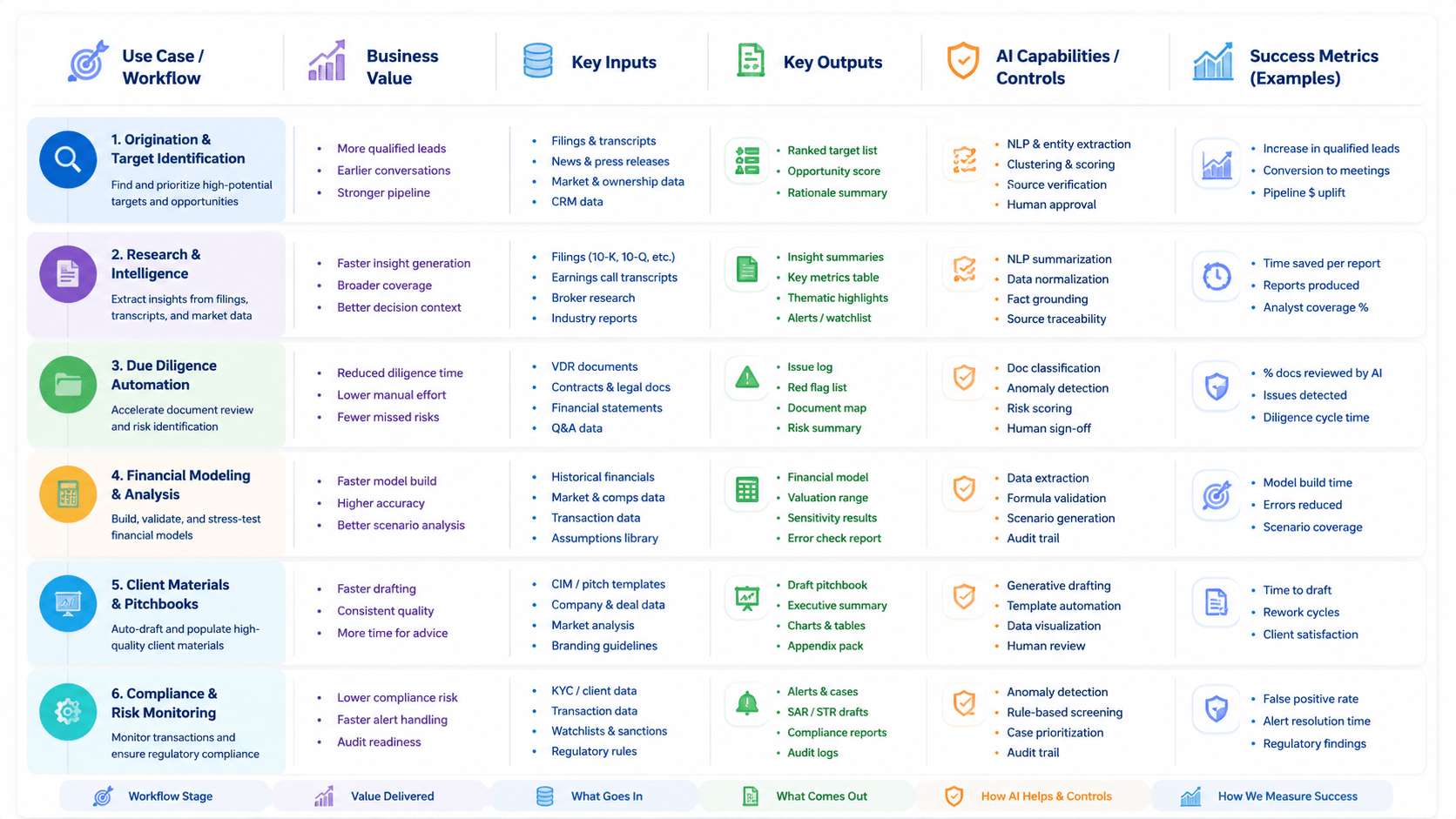
- AI delivers measurable value in six core investment-banking workflows: origination, research, due diligence, modeling, client materials, and compliance.
- Deloitte projects that the top 14 global investment banks could boost front-office productivity by 27–35% through generative AI, adding up to USD 3.5 million per front-office employee by 2026 (Deloitte, 2023).
- Human approval remains mandatory at every high-stakes decision point: valuation sign-off, compliance escalation, and deal recommendation.
- Confidential deal data and MNPI require permissioned, isolated environments—not general-purpose consumer AI tools.
- Governance, explainability, and vendor due diligence are implementation prerequisites—not afterthoughts.
- The right sequencing question is not “where can AI help?” but “which workflow has the data readiness, risk tolerance, and measurable KPIs to support a pilot now?”
- Model risk management, audit trails, and source traceability are non-negotiable operating requirements for any deployed system.
- Start with a prioritization scorecard—value, data readiness, risk, integration, adoption, measurability—before committing to any use case.
Introduction
Investment banking has always run on information advantage and execution speed. What has changed is the scale at which AI can now deliver both—across origination, research, diligence, modeling, materials, and risk control.
This guide focuses specifically on investment banking: M&A advisory, capital raising, debt and equity underwriting, and related deal-team functions. It is not a guide to retail banking, wealth management, or generic enterprise AI. Those are adjacent topics addressed elsewhere.
What follows covers where AI fits in the deal lifecycle, which workflows offer verified value, how governance must frame every deployment, and how teams can sequence their first initiatives. For a broader map of AI applications across industries, see the SmartDev AI use cases hub.
Where AI Fits in Investment Banking
AI’s Role Across the Deal Lifecycle
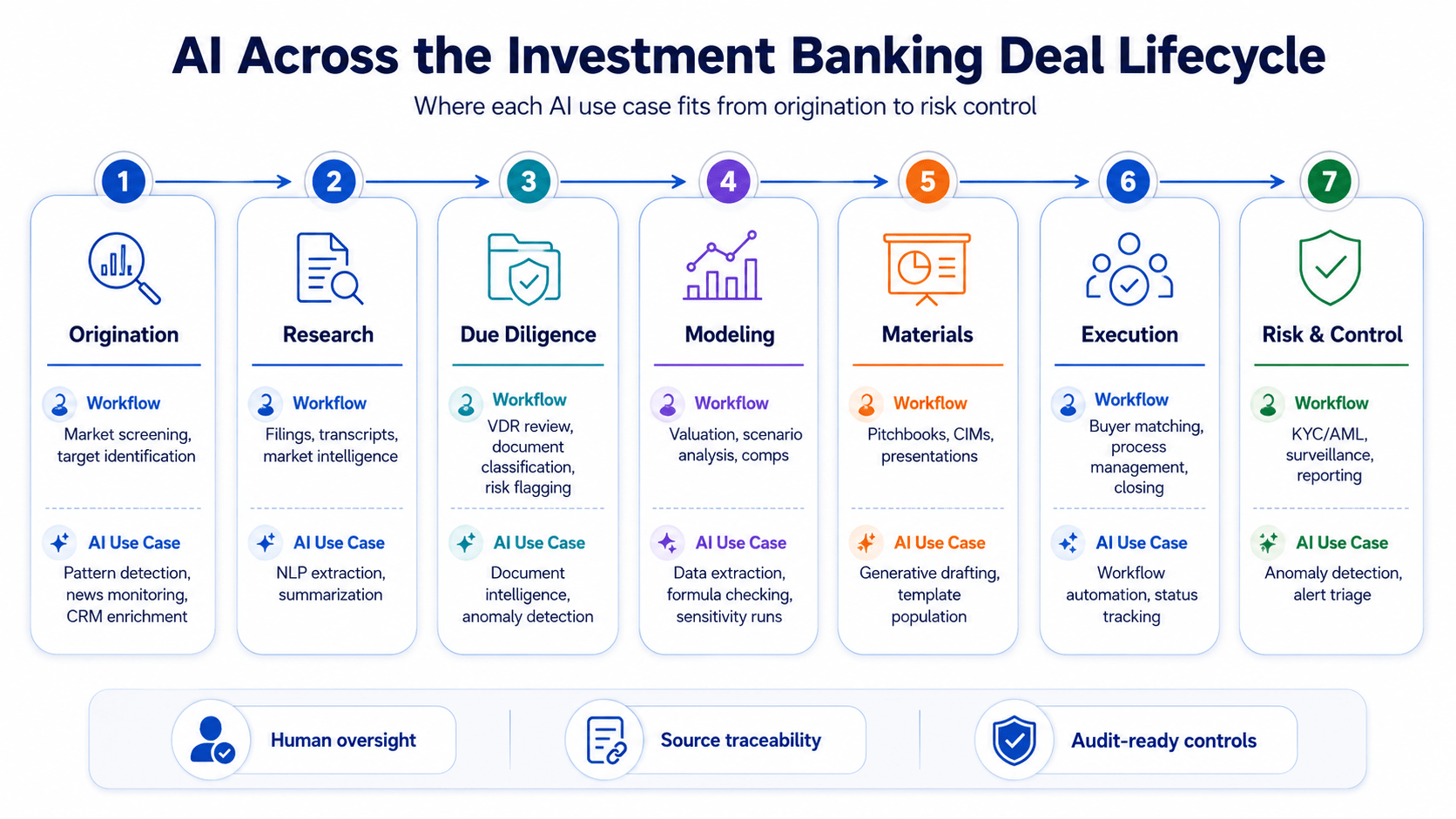
AI in investment banking means systems that automate, augment, or accelerate specific workflow steps within the deal cycle—from origination through execution. The deal lifecycle provides the correct organizing framework:
| Stage | Core Activities | AI Entry Points |
|---|---|---|
| Origination | Market screening, target identification, client coverage | Pattern detection, news monitoring, CRM enrichment |
| Research | Filings analysis, transcript review, market intelligence | NLP extraction, summarization |
| Due Diligence | VDR review, document classification, risk flagging | Document intelligence, anomaly detection |
| Modeling | Valuation, scenario analysis, comps | Data extraction, formula checking, sensitivity runs |
| Materials | Pitchbooks, CIMs, management presentations | Generative drafting, template population |
| Execution | Buyer matching, process management, closing | Workflow automation, status tracking |
| Risk & Control | KYC/AML, trade surveillance, regulatory reporting | Anomaly detection, alert triage |
This lifecycle view is essential. AI does not operate as a single tool—it addresses specific bottlenecks at specific stages.
What AI Can—and Cannot—Do for Deal Teams
AI can: extract and classify information at volume, draft structured content from verified inputs, flag anomalies against defined patterns, and surface ranked options for human review.
AI cannot: exercise professional judgment on deal strategy, sign off on valuations, apply contextual relationship knowledge, or take regulatory accountability for compliance decisions. These remain human responsibilities at every stage.
Investment Banking vs. Adjacent Financial-Services Use Cases
This article covers investment banking deal-team workflows. Retail banking, wealth management, portfolio management, and insurance use AI in meaningfully different contexts. Trading and execution analytics are referenced where they directly intersect with the deal cycle; they are not the primary focus.
2. High-Value AI Use Cases for Investment Banking
2.1 Deal Origination, Market Screening, and Target Identification
What AI does: Machine learning models analyze regulatory filings, news sources, earnings transcripts, and ownership data to surface M&A targets or capital-raising candidates that match a bank’s coverage criteria.
Workflow: Structured data (financials, share prices, ownership) and unstructured data (filings, press releases) feed into clustering and NLP models. Outputs are ranked lead lists with confidence scores, delivered into the bank’s CRM or origination platform.
Human approval point: Relationship managers and coverage bankers review and qualify AI-generated leads before any outreach. No AI output bypasses human screening.
Risk/control: False positive management, data source validation, and coverage conflict checks are mandatory. Models must be monitored for drift as market conditions shift.
Measurable outcome: Increased qualified pipeline volume per banker; reduced time-to-first-outreach on emerging opportunities.
McKinsey notes that gen AI is being deployed across banking to accelerate content generation and surface insights from large document sets, with some institutions reporting near-elimination of manual research tasks for specific workflows (McKinsey, December 2023).
2.2 Research, Filings, Earnings Transcripts, and Market Intelligence
What AI does: NLP models extract key disclosures, risk factors, and guidance from SEC filings, earnings call transcripts, and analyst reports—at a volume and speed no manual team can match.
Workflow: Ingestion of structured documents (10-K, 10-Q, 8-K) and audio transcriptions. Models tag entities, extract financial metrics, and flag material changes versus prior periods.
Human approval point: Analysts verify extracted data against source documents before it enters a model or client deliverable.
Risk/control: Hallucination risk is highest in summarization tasks. Source traceability—every extracted claim must link to a specific document, page, and date—is a non-negotiable operating requirement.
Measurable outcome: Reduction in research preparation hours per transaction; improved coverage breadth without proportional headcount increase.
2.3 Due Diligence and Virtual Data-Room Analysis
What AI does: Document intelligence systems classify, extract, and cross-reference materials in a virtual data room (VDR)—contracts, board minutes, IP schedules, employment agreements—flagging anomalies or missing items against a predefined checklist.
Workflow: Documents are ingested into a permissioned, deal-specific environment. Classification models tag document types; extraction models pull defined data points; comparison models flag deviations from standard representations and warranties.
Human approval point: Legal and financial advisors review every flagged item. AI outputs are inputs to human analysis, not replacements for it.
Risk/control: Confidential deal data and MNPI must remain within isolated, permissioned environments. Vendor access must be scoped and audited. No general-purpose consumer AI tool is appropriate for VDR materials.
Measurable outcome: Reduced diligence cycle time; improved coverage of large document sets; earlier identification of material issues.
2.4 Financial Modeling, Valuation, and Scenario Analysis
What AI does: AI assists with data extraction for model inputs (pulling comparable transaction multiples, public company metrics, historical financials), formula auditing, and running sensitivity scenarios at scale.
What AI does not do: AI does not set valuation assumptions, select methodology, or approve outputs. Every model that informs a client recommendation requires human sign-off from a qualified professional.
Workflow: Data extraction from filings and data providers feeds standardized model templates. AI flags formula errors and inconsistent assumptions. Scenario engines run parameterized sensitivity tables.
Risk/control: Model outputs must be validated against independent sources. Explainability—being able to trace every output to its inputs—is required for any model used in client-facing analysis.
Measurable outcome: Faster model build time; reduced manual data entry error; broader scenario coverage per engagement.
2.5 Pitchbooks, CIMs, Client Materials, and Deal Documentation
What AI does: Generative AI drafts initial slide structures, populates data fields from verified sources, formats content against bank-approved templates, and flags outdated or inconsistent information.
Workflow: Inputs include verified financial data, transaction comps, market context, and executive summaries. LLMs generate draft text and slide structures. Bankers edit, resequence, and apply strategic messaging.
Human approval point: Every client-facing document requires senior banker review before delivery. Generative output is a first draft, not a finished product.
Risk/control: Hallucination in client materials carries reputational and regulatory risk. All factual claims—market data, comparable transactions, financial metrics—must be independently verified before inclusion.
Goldman Sachs rolled out its GS AI Assistant firmwide in June 2025, covering tasks including summarizing complex documents, drafting initial content, and performing data analysis, according to an internal memo reported by Reuters (Reuters/CNBC, June 2025).
Measurable outcome: Reduction in pitch preparation time; improved consistency across materials; more mandates covered per team.
2.6 Buyer Matching, Client Coverage, and Deal Execution Support
What AI does: Models analyze buyer profiles, portfolio mandates, and historical transaction data to rank potential acquirers or investors for a given asset. During execution, workflow tools track process milestones and automate routine communications.
Human approval point: Coverage bankers approve the buyer universe before any outreach. AI rankings are inputs to human judgment, not final lists.
Risk/control: Buyer matching models must account for regulatory restrictions, strategic conflicts, and relationship considerations that data alone cannot capture.
Measurable outcome: Broader buyer universe coverage per process; reduced time on administrative execution tasks.
2.7 Risk, Compliance, KYC/AML, and Trade Surveillance
What AI does: NLP and graph analytics models screen transactions, client onboarding documents, and communications against regulatory watchlists and behavioral baselines—generating alerts for human review.
Workflow: Transaction data, client profiles, and communication logs feed anomaly detection models. Alerts are prioritized by confidence score and routed to compliance analysts.
Human approval point: Compliance officers review and adjudicate every material alert. No AI system autonomously closes a suspicious activity case.
Risk/control: False positive management is critical—alert fatigue reduces the effectiveness of human review. Model retraining schedules and explainability requirements vary by jurisdiction.
Measurable outcome: Reduced alert triage time; improved detection coverage; lower false positive rate relative to rules-based legacy systems.
2.8 Trading and Execution Analytics: Scope, Value, and Constraints
Trading and execution analytics involve AI applications—algorithmic execution, market microstructure analysis, reinforcement learning for order routing—that are adjacent to investment banking deal work but distinct from it. Banks deploying AI in trading contexts face additional regulatory requirements (MiFID II, SEC market structure rules) and model risk management obligations that differ from those governing deal-team applications.
This article references trading AI where it intersects with investment banking workflows (e.g., equity capital markets execution); it does not attempt to provide comprehensive coverage of trading technology. For broader AI applications in financial markets, see SmartDev’s BFSI/Fintech industry page.
3. AI Agents in Investment-Banking Workflows
From Single-Task Automation to Multi-Step Agentic Workflows
An AI agent is a system that executes a sequence of interdependent tasks—retrieving information, making intermediate decisions, calling tools, and producing outputs—with limited step-by-step human instruction. This is distinct from a chatbot (single-turn response) or a rule-based automation (fixed logic).
In investment banking, illustrative agentic workflows include: ingesting a VDR, classifying documents, extracting defined data points, cross-referencing against a checklist, and producing a gap report—all as a connected sequence. The output still requires human review; the agent handles the assembly.
What makes agents different from simpler automation: agents can handle variable inputs, branch based on intermediate outputs, and call multiple tools in sequence. This makes them more powerful and more difficult to govern.
Human-in-the-Loop Review and Escalation Controls
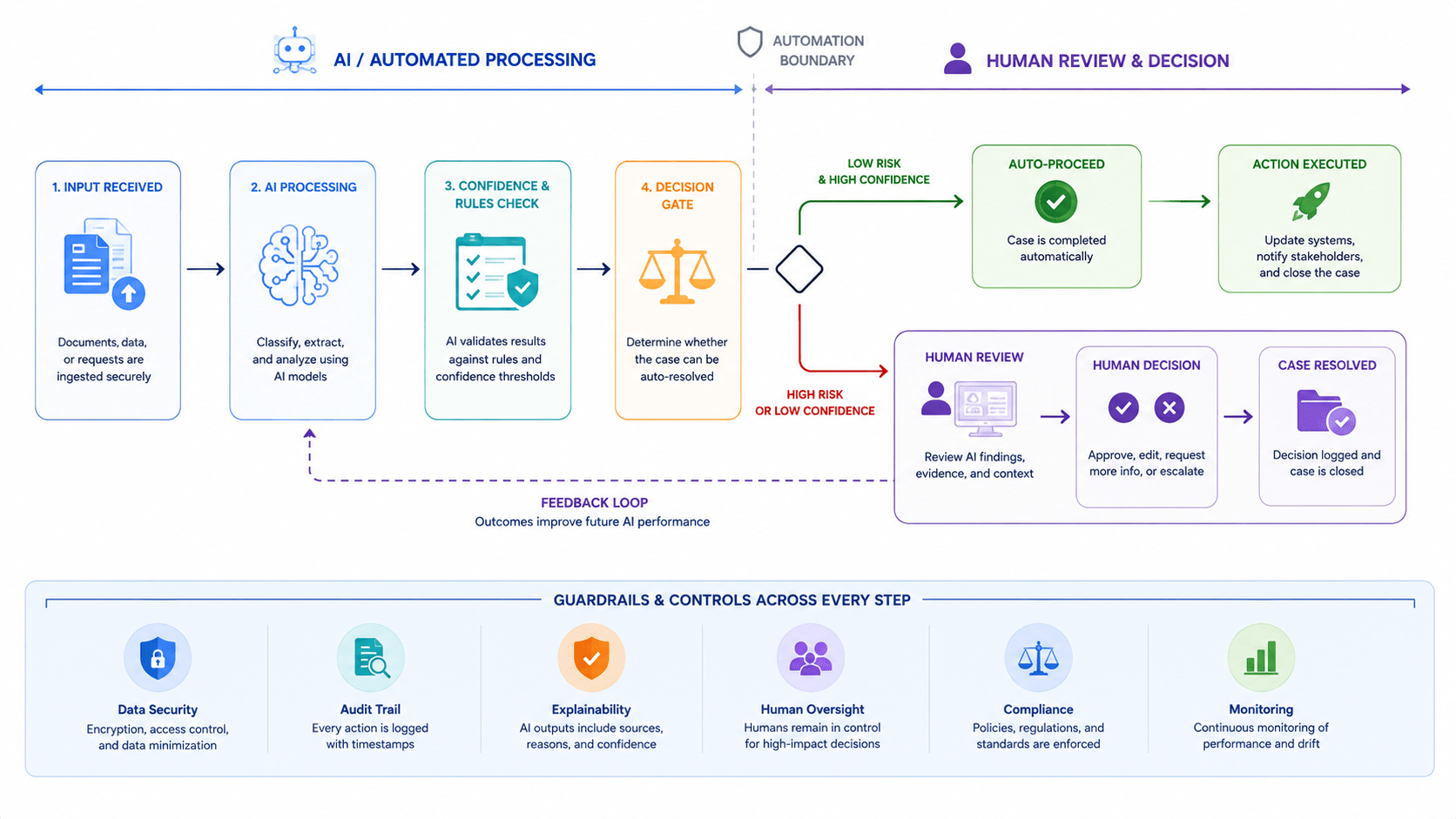
Any agentic system deployed in investment banking must define explicit escalation gates: conditions under which the system stops and routes a decision to a human operator. These include:
- Confidence scores below a defined threshold
- Detection of MNPI or confidential counterparty information in an unexpected context
- Outputs that would trigger regulatory obligations
- Tasks outside the system’s defined scope
Autonomous decision-making is not appropriate for sensitive investment banking activities. Human accountability must be preserved at every material decision point.
For implementation guidance on AI transformation across organizations, see the SmartDev AI consulting services page.
Source Traceability, Citations, and Auditability
Every output from an AI system used in investment banking must be traceable to its source. This means:
- Every factual claim links to a specific document, page, and date
- Every model output can be reconstructed from its inputs
- Every agent action is logged with timestamp, input, and output
This is not optional for regulated financial institutions. Regulators in multiple jurisdictions require explainable, auditable AI in financial services contexts.
4. Business Value: Benefits and ROI by Workflow
Productivity and Deal-Velocity Metrics
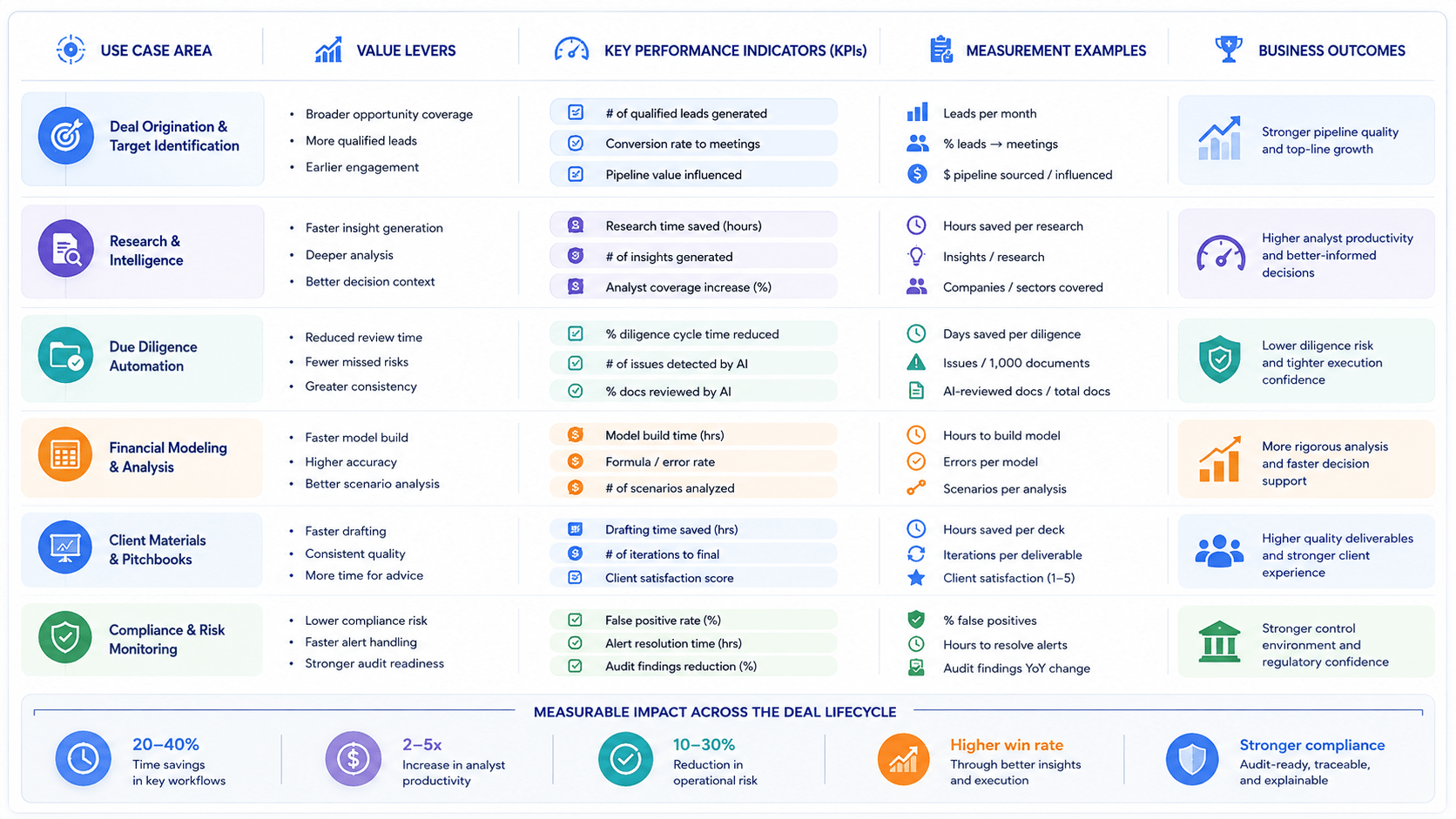
Productivity gains are the most directly measurable AI benefit in investment banking. Relevant metrics include:
- Research preparation time per transaction (before vs. after AI-assisted extraction)
- Pitch preparation time per mandate (hours saved on first draft)
- Diligence cycle time (days from VDR access to issue list)
- Analyst hours redirected from data assembly to analysis and client interaction
Deloitte’s analysis of the top 14 global investment banks projects front-office productivity gains of 27–35% from generative AI adoption, translating to an estimated additional USD 3.5 million in revenue per front-office employee by 2026 (Deloitte, 2023).
McKinsey’s research on gen AI in banking estimates the technology could add between USD 200 billion and USD 340 billion in annual value to the global banking sector, primarily through productivity improvement (McKinsey Global Institute, 2023).
Revenue, Origination, and Client-Coverage Metrics
- Qualified pipeline volume per coverage banker (targets identified and qualified)
- Win rate on mandates where AI-assisted materials were used
- Client-coverage breadth (number of active relationships per banker)
- Time-to-pitch from opportunity identification to first client meeting
Risk, Quality, and Control Metrics
- False positive rate in compliance alert systems (compared to rules-based baseline)
- Material issue identification rate in due diligence (issues flagged by AI vs. issues identified through manual review alone)
- Model validation pass rate for AI-generated financial data
- Audit log completeness as a governance health indicator
Avoiding Unsupported ROI Claims
Specific performance claims—percentage reductions in time, dollar savings per workflow, headcount equivalencies—vary materially by institution, workflow maturity, data quality, and implementation quality. The metrics above should inform a bank’s own measurement framework. Universal benchmarks should not be treated as guaranteed outcomes.
5. Governance, Security, and Implementation Risks
Confidential Deal Data, Data Boundaries, and Vendor Risk
Investment banking involves some of the most sensitive information in financial markets: non-public material information (MNPI), draft transaction structures, client identities, and undisclosed financial projections. These require:
- Isolated, permissioned environments for every deal-specific AI deployment
- Vendor contracts that prohibit use of client data for model training
- Data residency controls aligned with applicable regulatory requirements
- Access logging for every system that touches deal-sensitive information
No general-purpose consumer AI tool is appropriate for investment banking deal data. Vendor due diligence is a prerequisite, not a follow-up step.
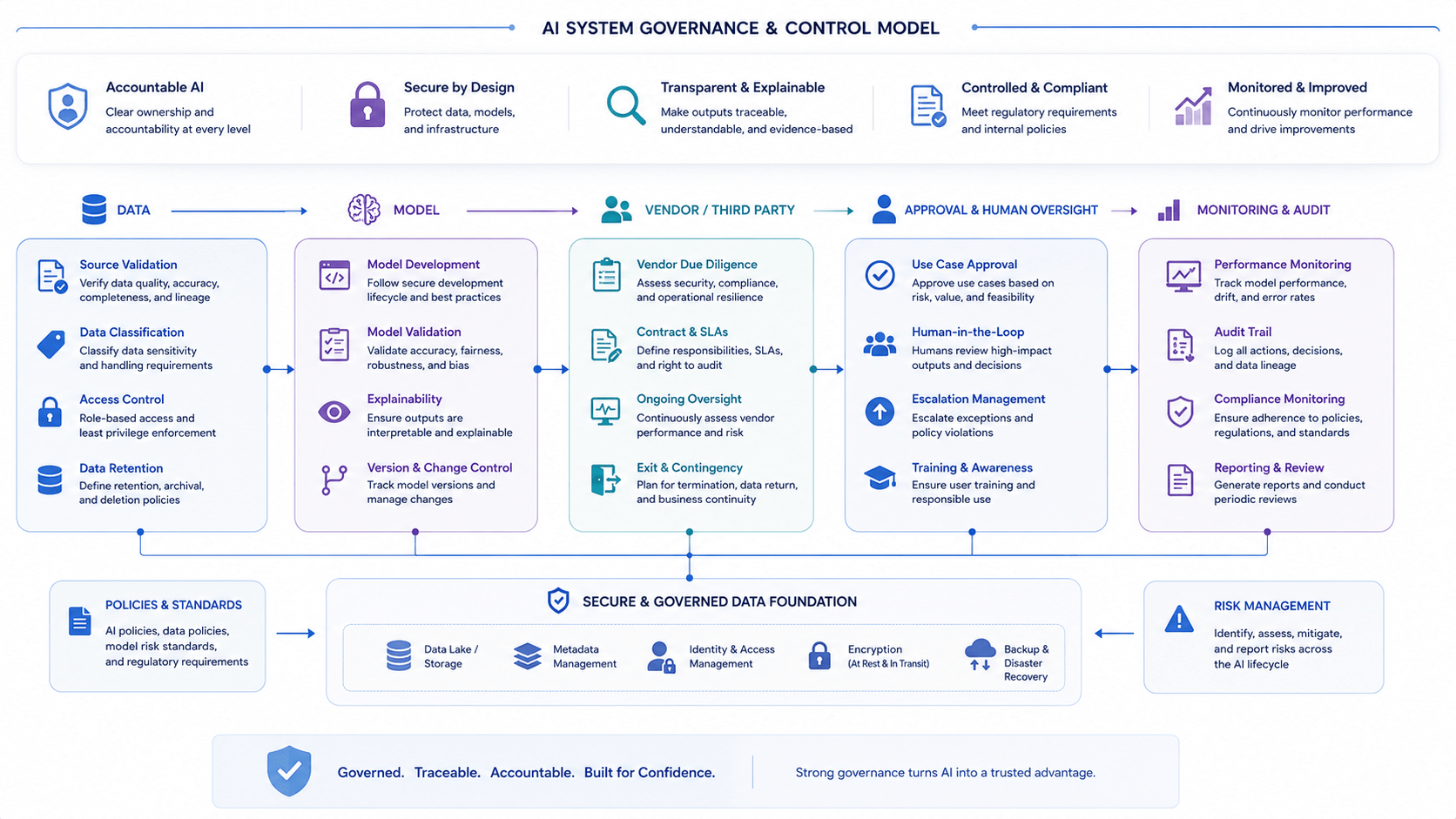
Model Risk, Hallucinations, and Validation Requirements
LLMs generate plausible-sounding text that may be factually incorrect—a property commonly called hallucination. In investment banking contexts, this risk is acute: a hallucinated financial metric in a pitchbook or a fabricated citation in a due diligence report creates both reputational and regulatory exposure.
Mitigations include:
- Retrieval-augmented generation (RAG) that grounds outputs in verified source documents
- Mandatory source citation for every factual claim
- Human review of all generative outputs before client or regulatory use
- Formal model validation processes consistent with model risk management frameworks
For an overview of responsible AI deployment practices, see the SmartDev guide on AI ethics and responsible AI.
Regulatory Explainability and Operational Controls
Regulators in the US (OCC model risk guidance), EU (AI Act), and UK (FCA) expect financial institutions to demonstrate that AI systems used in regulated activities are explainable, auditable, and subject to human oversight. Requirements vary by jurisdiction and activity type. Key operational controls include:
- Documented model inventories
- Validation and back-testing records
- Escalation and override procedures
- Periodic performance monitoring and retraining schedules
Talent, Training, and Operating-Model Change
AI deployment changes how analysts, associates, and senior bankers work—not whether they work. Junior roles shift from data assembly toward validation, judgment, and client interaction. This requires structured training programs, clear role definitions, and change management investment proportional to the scale of deployment.
For AI bias and fairness considerations relevant to model governance, see SmartDev’s guide on addressing AI bias.
6. How to Prioritize and Implement an AI Use Case
Select a Workflow Using Value, Feasibility, and Risk
Before selecting a use case, score each candidate workflow on six dimensions:
| Dimension | What to Assess |
|---|---|
| Value | Revenue impact, time savings, or risk reduction if successful |
| Data readiness | Availability, quality, and accessibility of required inputs |
| Risk | Regulatory exposure, reputational risk, and consequence of model error |
| Integration | Complexity of connecting AI to existing systems and workflows |
| Adoption | Team readiness and willingness to change working practices |
| Measurability | Availability of baseline metrics and ability to track improvement |
High-value, lower-risk workflows with available clean data are the correct starting point. “Start small” is not sufficient guidance without this selection criteria.
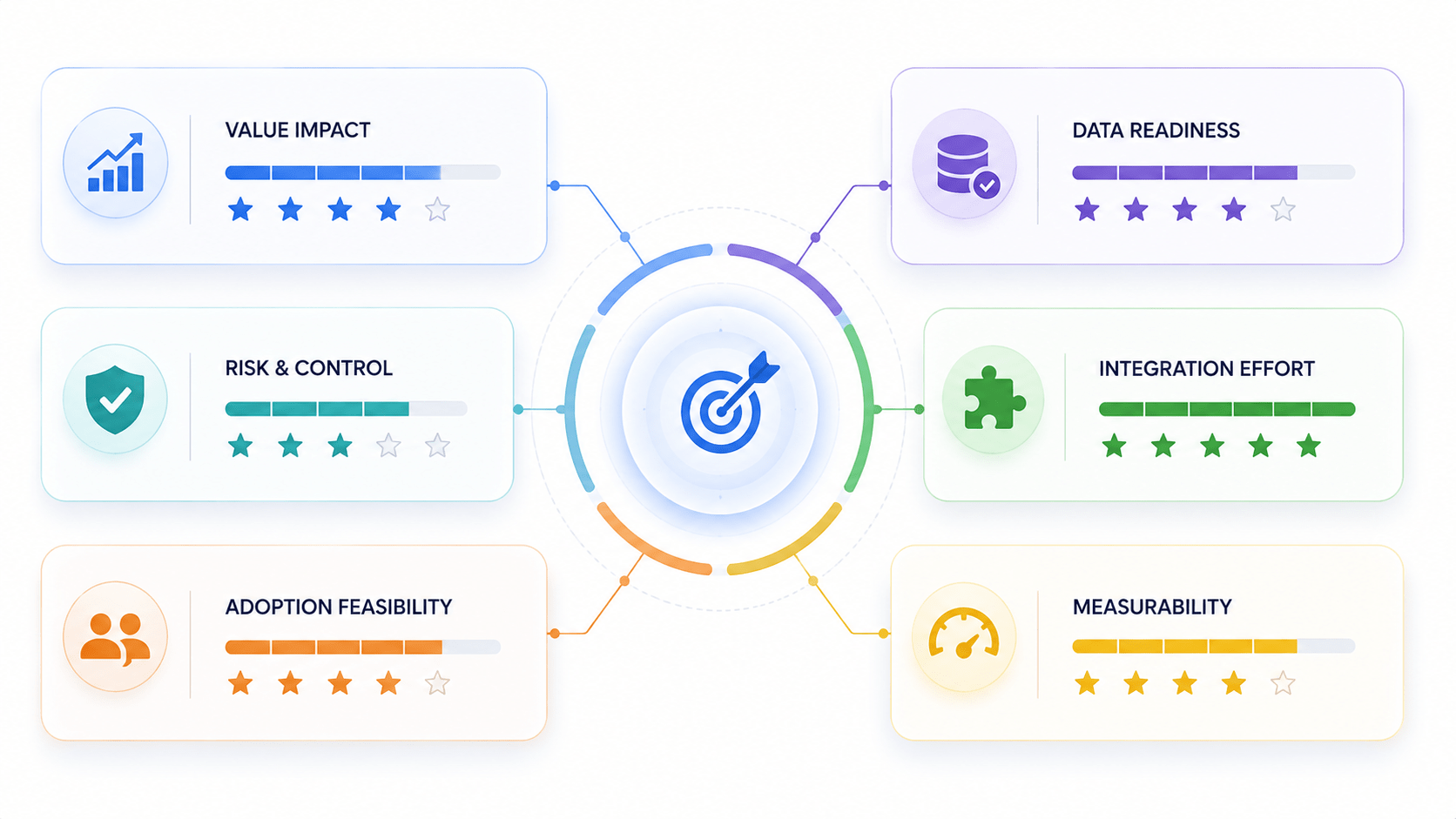
Assess Data Readiness and Integration Requirements
AI models perform only as well as the data that trains and grounds them. Before committing to a use case, assess:
- Is the required data structured, accessible, and clean?
- Are data sources properly permissioned and compliant with regulatory requirements?
- Can the AI system connect to required data sources without creating new security exposure?
- Is there a metadata and lineage standard that enables auditability?
For a structured approach to AI proof of concept design, see the SmartDev AI Proof of Concept page.
Evaluate Tools and Vendors for Banking Workflows
Vendor evaluation for investment banking AI should address:
- Data handling: Does the vendor contractually prohibit use of your data for model training?
- Explainability: Can the system produce traceable reasoning for its outputs?
- Integration: Does the tool connect to your existing document management, CRM, and compliance systems?
- Regulatory posture: Does the vendor understand model risk management requirements in your jurisdiction?
- Track record: Has the tool been deployed in comparable regulated financial services environments?
Pilot Design: Scope, KPIs, Controls, and Adoption
A well-scoped pilot runs 6–12 weeks on a defined workflow with a single team. It establishes:
- Baseline metrics before AI deployment (time, error rate, coverage)
- Target metrics and the threshold that defines success
- Human review checkpoints at every output stage
- Feedback mechanisms for the team using the tool
Track both system performance and human adoption. A tool that produces good outputs but is not used by the team is not a successful pilot.
Scale What Works Without Losing Governance
Scaling AI is not replicating a pilot across all desks simultaneously. It is identifying adjacent workflows that benefit from shared data infrastructure and operating patterns—then extending governance controls alongside capability. Governance frameworks must scale with deployment.
7. Real-World Investment-Banking AI Patterns
Note: The examples below are drawn from publicly disclosed information. Readers should verify claims against original sources before using any example as a performance benchmark. Specific outcome figures may reflect particular conditions not present in other institutions.
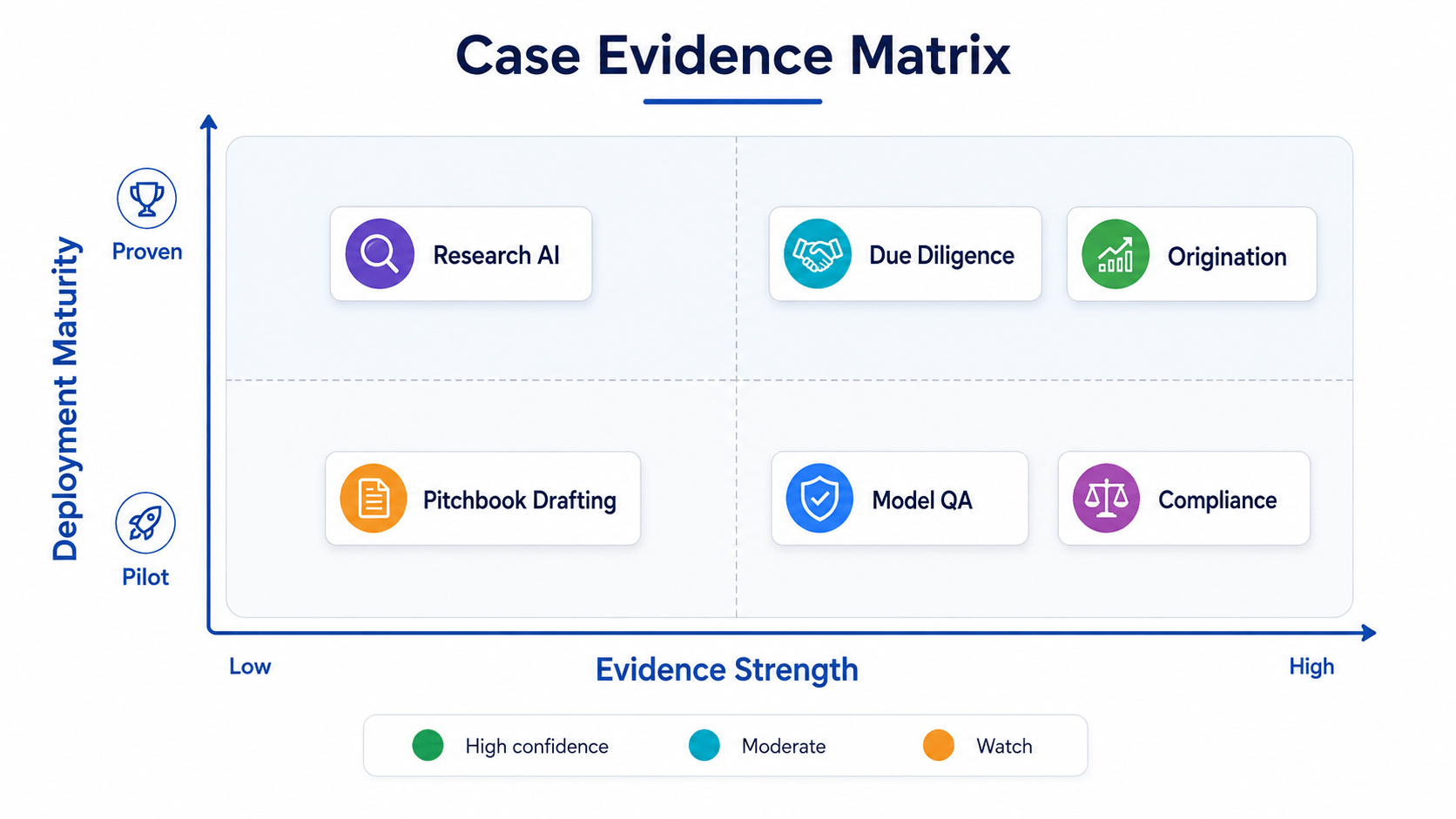
Deal Origination and Market Intelligence
Goldman Sachs — GS AI Assistant (June 2025): Goldman Sachs rolled out its GS AI Assistant firmwide in June 2025 following testing with approximately 10,000 employees. The tool covers summarizing complex documents, drafting initial content, and performing data analysis, according to an internal memo reported by Reuters and confirmed by CIO Marco Argenti in a CNBC interview. The firm also maintains a separate Banker Copilot designed specifically for investment banking workflow support (Reuters, June 2025; CNBC, January 2025).
What to verify: Goldman has not published specific productivity or time-saving metrics for the GS AI Assistant. Claims of 50% pitch time reduction circulating in secondary sources are not confirmed in official disclosures.
Pitchbook and Document Production
McKinsey documents that at least one leading bank has used gen AI to cut the time to produce an investment brief by more than 90%, from nine hours to approximately 30 minutes—though the institution is unnamed (McKinsey, December 2023). This represents a documented benchmark from a credible primary source; it is a single reported case, not a universal outcome.
Diligence, Risk, and Compliance Operations
Multiple major institutions have publicly disclosed AI deployment in compliance and KYC/AML functions. JPMorgan’s annual reports and executive disclosures reference broad AI deployment across risk and compliance, though specific workflow-level performance data is not publicly detailed. The McKinsey corporate and investment banking gen AI report documents early-mover institutions implementing gen AI in compliance document review and regulatory reporting.
What Readers Should Verify Before Relying on Any Case Claim
Before citing any AI case study as a benchmark:
- Identify the primary source: Is it an official institutional disclosure, annual report, or first-party case study? Or a secondary summary?
- Check the date: AI capabilities and deployment contexts change rapidly. A 2022 pilot may not reflect 2025 capabilities or constraints.
- Confirm the scope: What specific workflow was addressed? What was the baseline? What were the control conditions?
- Note the limitations: Single-institution results reflect specific data quality, team readiness, and integration conditions.
8. What’s Next: Agentic AI, Workflow Orchestration, and the Future of Deal Teams
Emerging Capabilities Relevant to Investment Banking
Several AI capabilities are in active deployment or advanced pilot at leading institutions:
- RAG-based research assistants that retrieve and cite verified source documents rather than generating unsupported claims
- Agentic document review systems that execute multi-step VDR workflows with human-in-the-loop escalation gates
- Governed copilots for pitch preparation that enforce template standards and flag unverified data
- Compliance monitoring systems with improved false-positive management through contextual scoring
Emerging but not yet standard:
- Multi-agent orchestration across deal stages (origination through execution)
- Real-time regulatory intelligence integration
- Voice-to-workflow tools for meeting documentation
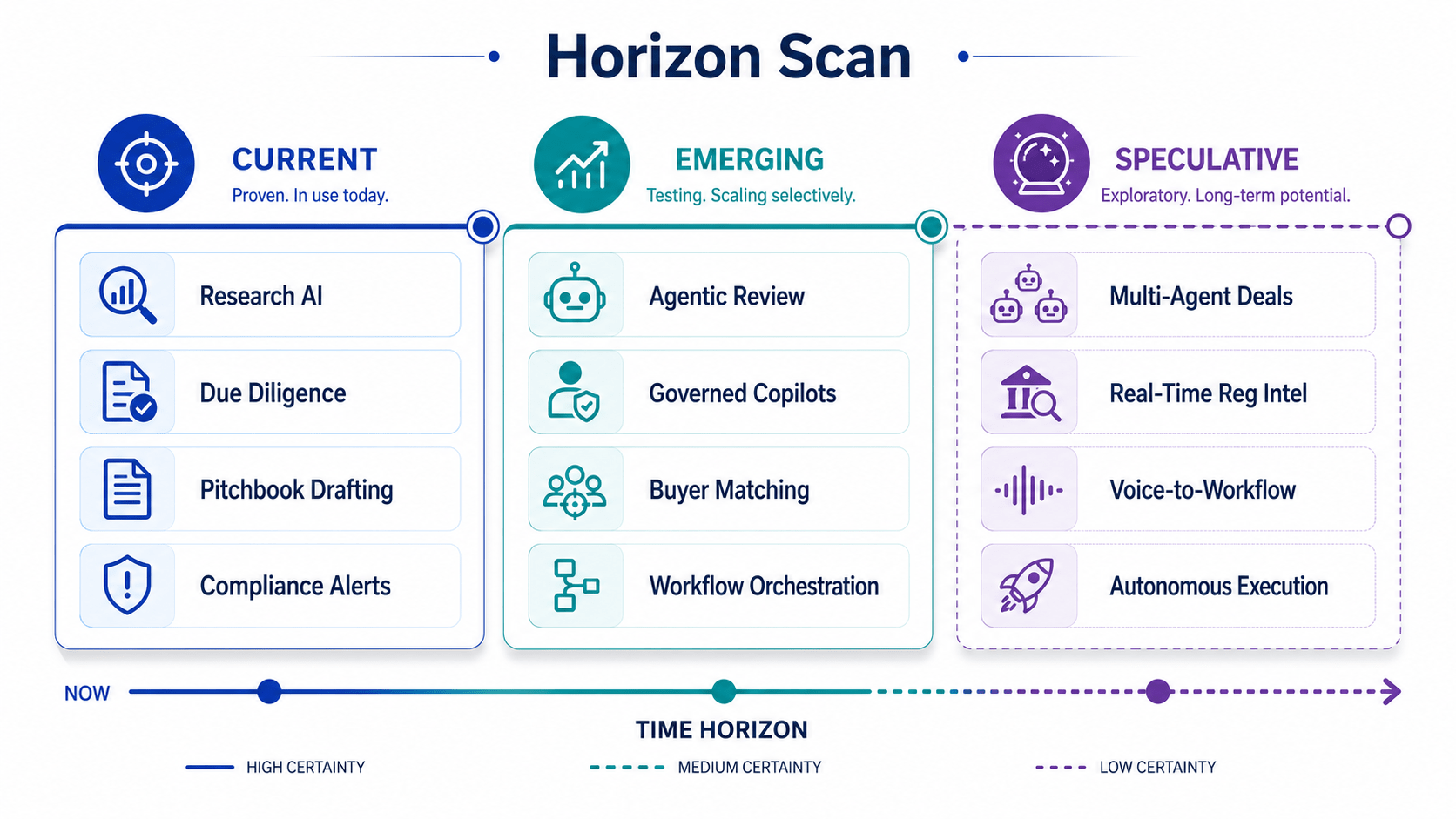
Changes to Analyst, Associate, and Senior-Banker Work
AI is reshaping—not eliminating—investment banking roles. The shift is from data assembly to data validation and judgment. Analysts spend less time collecting and formatting; they spend more time verifying AI outputs, identifying edge cases, and applying contextual knowledge that models cannot replicate.
Senior bankers retain responsibility for strategy, client relationships, and final recommendation sign-off. AI extends their capacity; it does not transfer their accountability.
Practical Signals to Monitor
Teams tracking AI development in investment banking should watch:
- Regulatory guidance from OCC, FCA, ESMA, and MAS on AI in regulated financial services
- Model risk management updates from supervisory bodies as AI-specific frameworks develop
- Vendor disclosures from major document intelligence, LLM, and workflow automation providers serving financial institutions
- Bank annual reports for disclosed AI investments and capability updates
For ongoing coverage of AI transformation developments, see SmartDev’s AI & Machine Learning solutions.
FAQ
What are the most practical AI use cases in investment banking?
The most immediately deployable use cases—based on data availability, workflow fit, and risk profile—are research summarization, pitchbook drafting assistance, and compliance alert triage. These workflows have defined inputs, verifiable outputs, and clear human review checkpoints. See Section 2 for workflow-level detail.
How can AI support due diligence without replacing human judgment?
AI handles the assembly and classification layer: ingesting VDR documents, tagging types, extracting defined data points, and flagging gaps or anomalies against a checklist. Human advisors—legal, financial, and operational—review every flagged item and make the judgments that determine materiality. AI changes the volume and speed of intake; it does not change who is accountable for the analysis. See Section 2.3.
Can AI produce pitchbooks, CIMs, and financial models safely?
AI can produce verified first drafts of pitchbooks and CIMs when inputs are clean and sourced. It can assist with financial model data extraction and scenario generation. It cannot set valuation assumptions, select methodology, or approve client-facing outputs. Every AI-assisted deliverable requires senior banker review before use. The key control is source traceability: every factual claim must link to a verified, dated source. See Section 2.5.
How should an investment bank protect confidential deal data when using AI?
The minimum controls are: isolated, permissioned environments for deal-specific data; vendor contracts prohibiting use of client data for model training; access logging for all systems touching deal-sensitive information; and data residency controls consistent with applicable regulations. General-purpose consumer AI tools are not appropriate for MNPI or confidential deal data. See Section 5.
What should a bank measure in an AI pilot?
Measure baseline and post-deployment performance on the same workflow: time per task, error rate, coverage breadth, and human adoption rate. Add risk indicators: hallucination or error rate in AI outputs, escalation frequency, and audit log completeness. A pilot that improves speed but produces unverified outputs is not a successful pilot. See Section 6.
Conclusion
AI delivers real, measurable value in investment banking when it is deployed in the right workflows, with the right data, under the right governance. The determining factors are not the model itself—they are workflow fit, data quality, human oversight design, and the discipline to measure outcomes against baselines.
The institutions gaining competitive advantage from AI are not those with the most tools. They are those who have matched specific AI capabilities to specific workflow bottlenecks, built the governance infrastructure to operate safely, and invested in the human change management that makes adoption stick.
Value follows from that sequence—not from the technology alone.
Next Steps
If your team is beginning to assess AI readiness for investment banking workflows, the logical starting points are:
- Map your deal lifecycle against the workflow table in Section 1 and identify where your highest-friction bottlenecks sit.
- Score candidate use cases against the prioritization dimensions in Section 6 before committing to any pilot.
- Review SmartDev’s AI Proof of Concept service for a structured approach to validating AI capability in your specific workflow context.
- Speak with SmartDev‘s advisory team about your institution’s specific data environment, regulatory context, and implementation readiness.
–
References
- Deloitte. Unleashing a new era of productivity in investment banking through the power of generative AI. 2023. https://www.deloitte.com/us/en/insights/industry/financial-services/generative-ai-in-investment-banking.html
- McKinsey & Company. Capturing the full value of generative AI in banking. December 2023. https://www.mckinsey.com/industries/financial-services/our-insights/capturing-the-full-value-of-generative-ai-in-banking
- McKinsey Global Institute. Scaling gen AI in banking: Choosing the best operating model. March 2024. https://www.mckinsey.com/industries/financial-services/our-insights/scaling-gen-ai-in-banking-choosing-the-best-operating-model
- McKinsey & Company. Been there, doing that: How corporate and investment banks are tackling gen AI. 2024. https://www.mckinsey.com/industries/financial-services/our-insights/been-there-doing-that-how-corporate-and-investment-banks-are-tackling-gen-ai
- Reuters / Yahoo Finance. Goldman Sachs launches AI assistant firmwide, memo shows. June 2025. https://finance.yahoo.com/news/goldman-sachs-launches-ai-assistant-140930373.html
- CNBC. Goldman Sachs rolls out an AI assistant for its employees as artificial intelligence sweeps Wall Street. January 2025. https://www.cnbc.com/2025/01/21/goldman-sachs-launches-ai-assistant.html
- Deloitte. Harnessing gen AI in financial services: Why pioneers lead the way. February 2025. https://www.deloitte.com/us/en/insights/industry/financial-services/generative-ai-financial-services-pioneers.html