
Ninety-five percent of generative AI pilots never move the needle on profit or loss. The gap between a working demo and a governed production system is not a technology gap. It is an ownership gap, and this guide draws the line.
TL; DR:
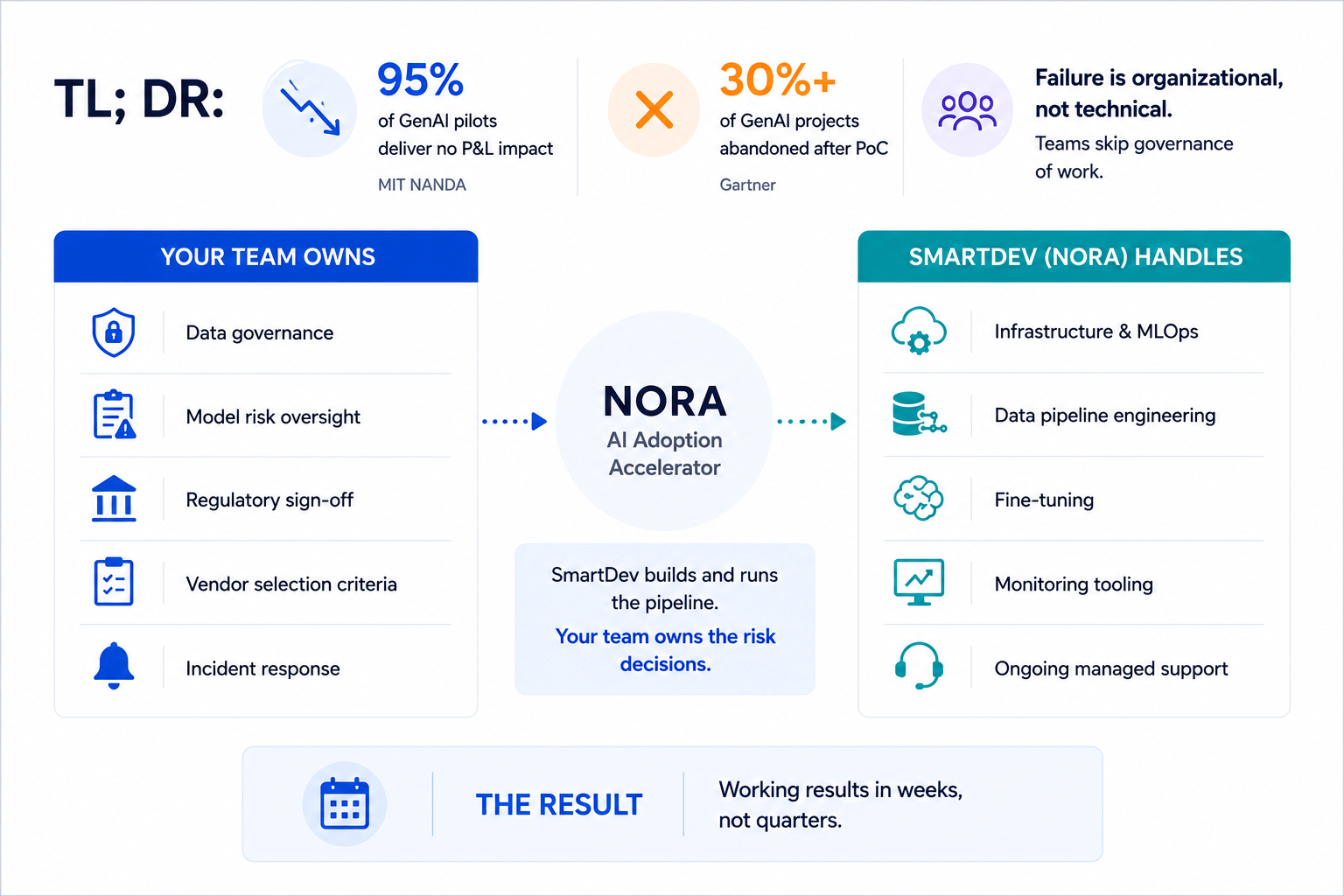
- Most AI pilots die quietly. MIT’s NANDA initiative found that 95% of generative AI pilots deliver no measurable profit-and-loss impact, and Gartner expects at least 30% of GenAI projects to be abandoned after proof of concept.
- The failure is organizational, not technical. Teams bolt AI onto legacy workflows and skip the governance of work that production requires.
- Five things belong to your team: data governance, model risk oversight, regulatory sign-off, vendor selection criteria, and incident response.
- Five things you can responsibly outsource: infrastructure and MLOps, data pipeline engineering, fine-tuning, monitoring tooling, and ongoing managed support.
- NORA, SmartDev’s AI Adoption Accelerator, is built around exactly this split: SmartDev owns the build and the plumbing; your team owns the risk decisions, and clients typically see a working result within weeks.
Introduction
An AI pilot is easy to fall in love with. A model reads a hundred sample invoices correctly; a chatbot answers a dozen scripted questions without stumbling, and a leadership team greenlights a company-wide rollout on the strength of that demo. Then the system meets real data: duplicate vendor names, scanned PDFs at odd angles, ambiguous customer intent, and edge cases nobody scripted for. MIT’s NANDA initiative studied 300 public AI deployments and found that this pattern repeats across industries: pilots that look impressive rarely survive in contact with production conditions.
This piece is a working guide for teams that already ran a pilot, or are about to, and now face the harder question. Who inside the company must own the outcome when an AI system makes a wrong call-in front of a regulator, a customer, or an auditor? And which parts of the build can responsibly move to an outsourced partner without creating that same risk? We answer both questions with a concrete ownership map, grounded in the NIST AI Risk Management Framework and the obligations now taking effect under the EU AI Act, and we show how SmartDev’s NORA AI Adoption Accelerator is structured around that same line. If some of the terminology here is unfamiliar, SmartDev’s AI Adoption & ITO Glossary is a useful reference to keep open alongside this article.
1. Why Most AI Pilots Never Reach Production
Before deciding what to own and what to outsource, it helps to understand exactly where pilots break down. The failure point is rarely the model itself. It is almost always the surrounding structure, or the lack of one, that was supposed to carry the pilot into daily operations.
The Pilot Trap: Demo Success, Production Failure
A pilot succeeds under conditions nobody plans to keep. Teams hand-pick clean data, assign a subject-matter expert to babysit every output, and run the system for a few weeks in a controlled sandbox. None of that infrastructure carries forward automatically. When the same system touches the full data volume, with all its noise and exceptions, accuracy drops and trust erodes fast. Analysts at Gartner describe this gap directly: agents perform well in pilots because of narrow scope and heavy human oversight, and those conditions rarely survive in contact with production environments.
The Numbers Behind the Failure Rate
The scale of the problem is larger than most executives expect. MIT’s NANDA initiative, drawing on 150 leadership interviews and an analysis of 300 public AI deployments, found that roughly 95% of enterprise generative AI pilots fail to deliver measurable financial return. Gartner’s own research points the same direction: the firm predicts that at least 30% of generative AI projects will be abandoned after proof of concept, citing poor data quality, inadequate risk controls, and unclear business value as the leading causes. For agentic AI specifically, Gartner goes further, forecasting that over 40% of agentic AI projects will be canceled by the end of 2027.
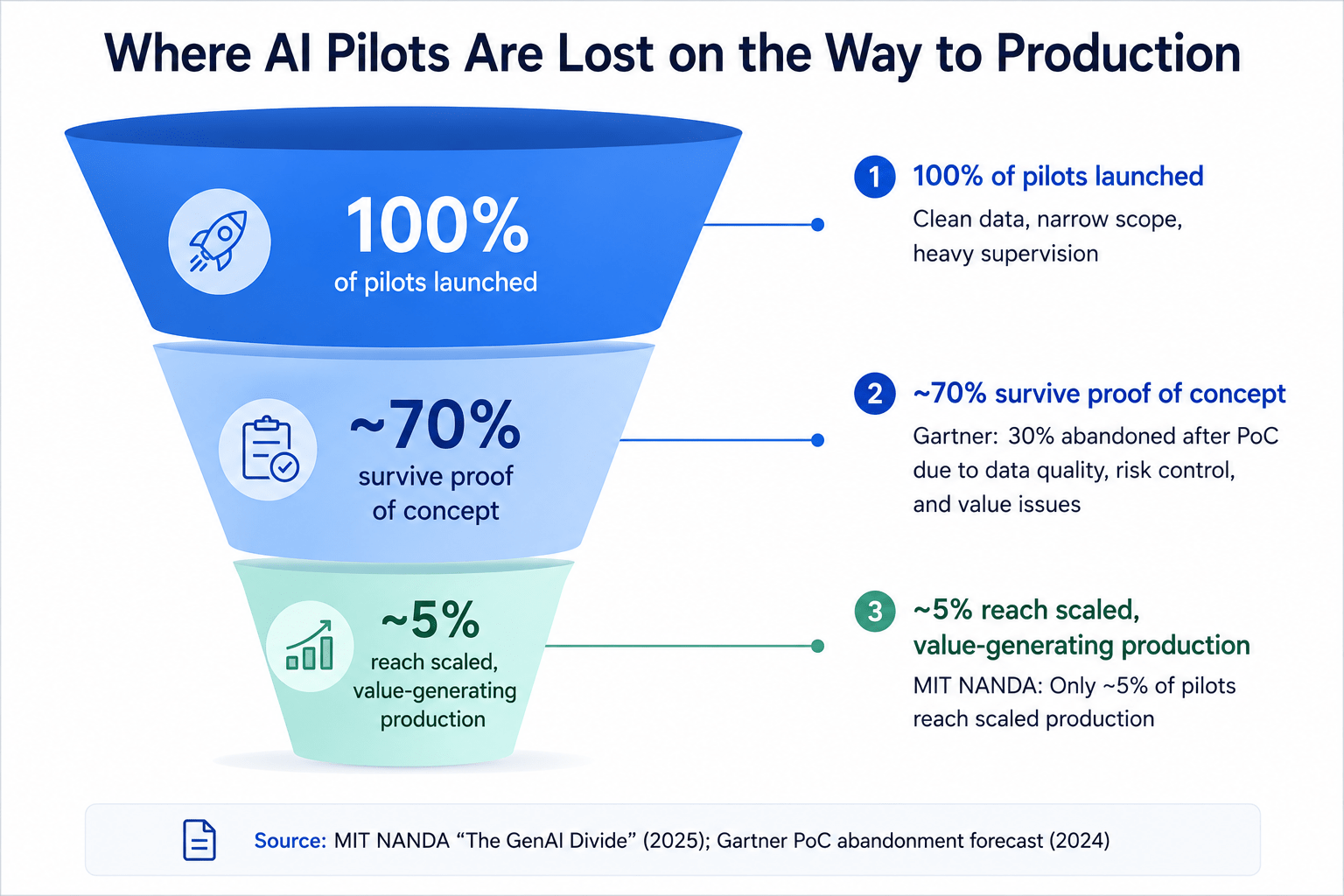
The problem extends beyond whether AI can technically perform a task. Many organizations struggle to move from a promising pilot to a workflow that delivers consistent business value because they lack clear ownership, reliable data, measurable success criteria, and the operational controls needed for production.
This gap becomes particularly important as AI moves into more complex, business-critical workflows. Without a structured approach to data readiness, process integration, risk management, and ongoing measurement, even technically successful pilots can struggle to generate sustainable returns at scale.
Legacy Processes and Bolt-On AI
A recurring theme in the MIT research is what the report’s authors call the “learning gap.” Teams add an AI layer on top of an unchanged workflow instead of redesigning the workflow around what AI does well. A chatbot bolted onto a rigid ticketing system inherits every flaw of that system, plus new failure modes of its own. The research also found a mismatch in spending: more than half of generative AI budgets go to visible, front-office tools such as sales and marketing assistants, while the strongest measured return actually came from back-office automation that eliminates manual processing and outside agency costs.
The Governance Gap Nobody Budgets For
Pilots rarely include a governance line item, because governance feels overhead until the moment it prevents a real incident. Production AI needs a named risk owner, a documented escalation path, and an audit trail that can withstand external scrutiny. MIT’s research reinforces this point from a different angle: purchasing AI tools from specialized vendors and forming partnerships succeeded roughly 67% of the time, while internal builds succeeded only about one-third as often, largely because vendor partnerships more often arrived with production-grade guardrails already built in. This is precisely the risk we unpack in our related post on AI hallucination in compliance automation, where an ungoverned model output can move directly into an audit file.
What “Controlled Production” Actually Means
Controlled production is not simply “the pilot, but for everyone.” It means the system runs under a named accountable owner, with defined thresholds for automated action versus human review, logged decisions that a compliance officer can reconstruct after the fact, and a tested rollback procedure. It also means the organization has decided, in writing, who signs off when the model is wrong. Without that structure, scaling a pilot only scales the risk, not the value.
Takeaway: Pilots fail in production because organizations underinvest in governance, not because the underlying models are weak. MIT and Gartner both point to the same root cause: unclear ownership, unmanaged risk, and AI bolted onto workflows that were never redesigned around it.
2. The Ownership Boundary: What Your Team Must Own
Some decisions inside an AI system carry legal, financial, and reputational weight that cannot transfer to a vendor’s contract, no matter how good that vendor is. These five areas define the non-negotiable core of internal ownership.
Data Governance and Access Policy
Your team decides what data the AI system can see, how long it retains outputs, and who can query it. A vendor can build the access controls, but only your organization can define what “appropriate use” of customer or employee data means under your specific regulatory footprint. This decision sits upstream of every other governance choice, because a system with the wrong data access cannot be fixed by better monitoring downstream.
Model Risk Oversight and Human-in-the-Loop Design
Someone inside the organization must decide where automated decisions stop, and human review begins. That threshold is a risk of judgment, not an engineering one. The NIST AI Risk Management Framework frames this as the “Govern” function: the structures, policies, and accountability that must exist before any system reaches a meaningful scale. A model risk committee, even a small one, gives the organization a place to make these calls consistently rather than case by case.
Regulatory Interpretation and Compliance Sign-Off
Interpreting how a regulation applies to your specific AI use case is a judgment call that only your compliance and legal teams can make defensible. Under the EU AI Act’s obligations for deployers of high-risk systems, the organization using the system, not the vendor who built it, must assign competent overseers, run impact assessments, and monitor anomalies on an ongoing basis. A vendor can supply the tooling to support that work, but the sign-off itself must stay internal.
Vendor and Tool Selection Criteria
Choosing which vendor builds or operates part of your AI stack is a governance decision. Your team should define the selection criteria: security certifications, data residency, model explainability, and exit terms if the relationship ends. Outsourcing the build without first setting these criteria hands away leverage before the contract is even signed. SmartDev’s IT Outsourcing Due Diligence Checklist is a practical starting point for building that criteria list, and our AI in finance use cases post shows how this plays out in a heavily regulated sector.
Incident Response and Escalation Ownership
When an AI system produces a harmful or incorrect output in production, someone must be reachable, accountable, and empowered to pause the system immediately. That role cannot sit entirely with an external partner, because the organization, not the vendor, ultimately answers regulators, customers, and its own board when something goes wrong.
Takeaway: Ownership of data governance, model risk decisions, compliance sign-off, vendor criteria, and incident response must stay inside the organization. These are accountability decisions, and accountability is the one thing a services contract cannot fully transfer.
3. What You Can Safely Outsource
Once the ownership core is locked down internally, a wide range of execution work becomes safe, and often smarter, to hand to a specialized partner. These are the areas where an experienced team consistently outperforms an internal build on speed and cost. Teams that are still validating a use case, rather than scaling one, often start with AI proof of concept engagements or structured AI consulting services before committing to a full build.
Infrastructure, MLOps, and Model Hosting
Standing up training pipelines, deployment infrastructure, and model versioning is repeatable, specialized engineering work. A partner offering dedicated MLOps services has already solved the operational problems your team would otherwise hit for the first time, from rollback strategy to environment parity between staging and production.
Data Pipeline Engineering and Document Intake
Building the extraction, cleaning, and indexing layer that feeds an AI system is intricate, detail-heavy work that benefits enormously from prior repetition. Teams offering dedicated data analytics services bring pre-built connectors and validation logic that would otherwise take months to develop from scratch internally.
Model Fine-Tuning and Prompt Engineering
Adapting a foundation model to your domain, whether through fine-tuning, retrieval design, or structured prompting, is specialized craft. External teams offering generative AI development services and machine learning development services stay current on techniques that shift every few months, faster than most internal teams can track alongside their day jobs.
Monitoring Dashboards and Drift Detection Tooling
The tooling that flags model drift, tracks accuracy over time, and surfaces anomalies for human review is a build-once, reuse-often asset. A partner who has built this tooling across multiple clients brings a maturity level that is hard to replicate on a single internal project budget and timeline.
Ongoing Managed Service and Support
Day-to-day operation, patching, and support are exactly where a managed service model shines. This work is high-volume and process-driven, and it frees your internal team to focus on the governance and risk decisions only they can make. Combined with DevOps as a Service, this arrangement keeps the system running reliably without pulling scarce internal engineers off higher-value work.
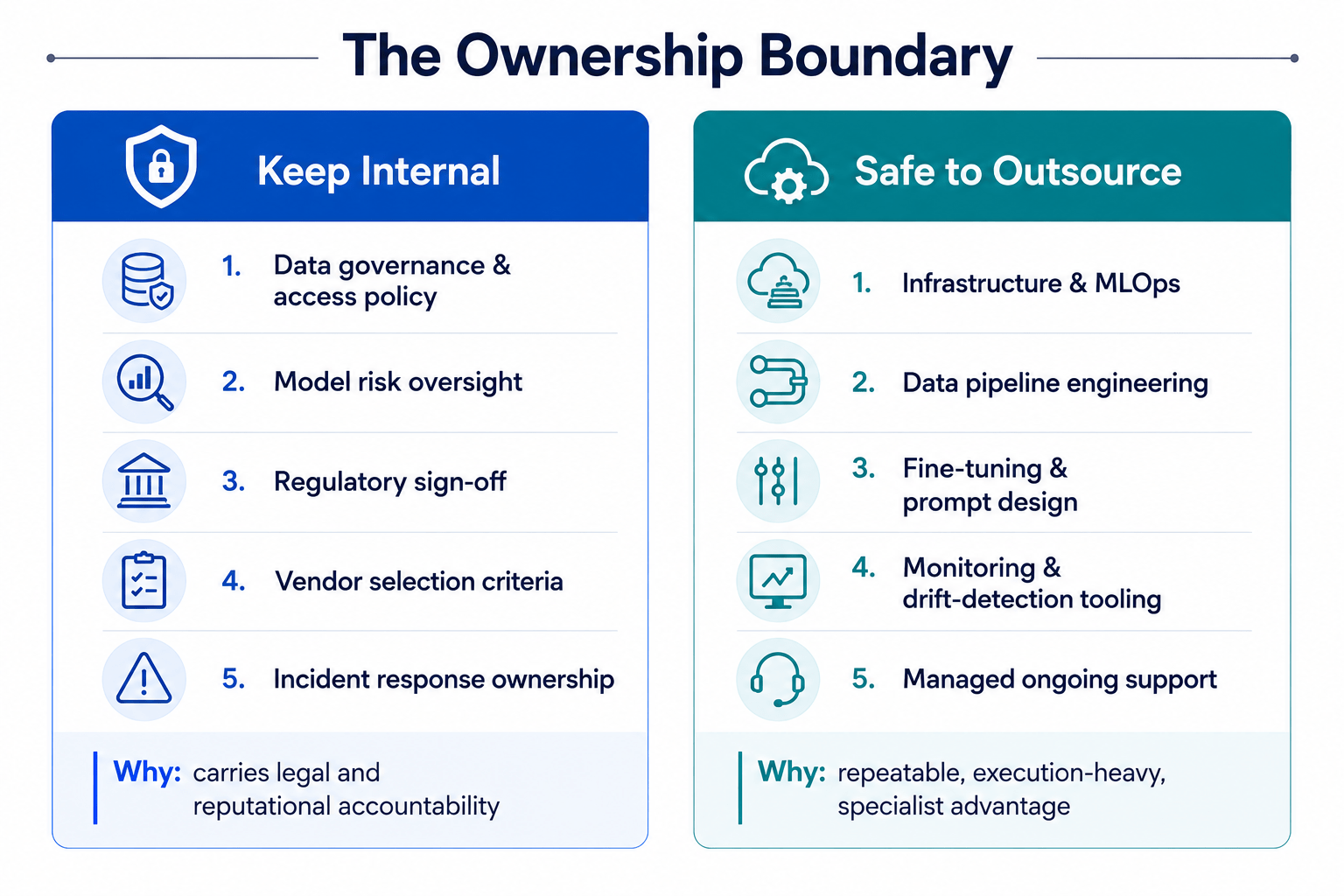
The key is to separate accountability from execution. Keep governance, risk oversight, regulatory decisions, vendor accountability, and incident ownership internal, while outsourcing repeatable technical work such as infrastructure, data pipelines, model tuning, monitoring, and ongoing support.
Takeaway: Infrastructure, pipeline engineering, fine-tuning, monitoring tooling, and ongoing support are execution-heavy and repeatable. A specialized partner typically delivers these faster and at lower risk than a first-time internal build, as long as the ownership boundary from Section 2 stays intact.
4. Building the Governance Framework That Bridges Pilot and Production
Ownership only works if it is written down and tested before scale, not discovered after an incident. This section turns the boundary from Sections 2 and 3 into an operating framework. For teams still deciding which category of automation fits their workflow, our guide on IDP vs. AI workflow automation is a useful companion read before you scope the governance work below. SmartDev’s AI Delivery Blueprint white paper walks through a similar planning structure in more depth.
Applying NIST AI RMF’s Four Functions
The NIST AI Risk Management Framework organizes AI governance into four interconnected functions: Govern, Map, Measure, and Manage. Govern establishes policies and accountability structures. Map documents the system’s intended purpose and stakeholder impact. Measure builds the metrics and monitoring that catch drift or bias early. Manage turns findings into corrective action. Treating these as a one-time checklist misses the point; NIST designed them to run continuously across the AI system lifecycle, not just at launch.
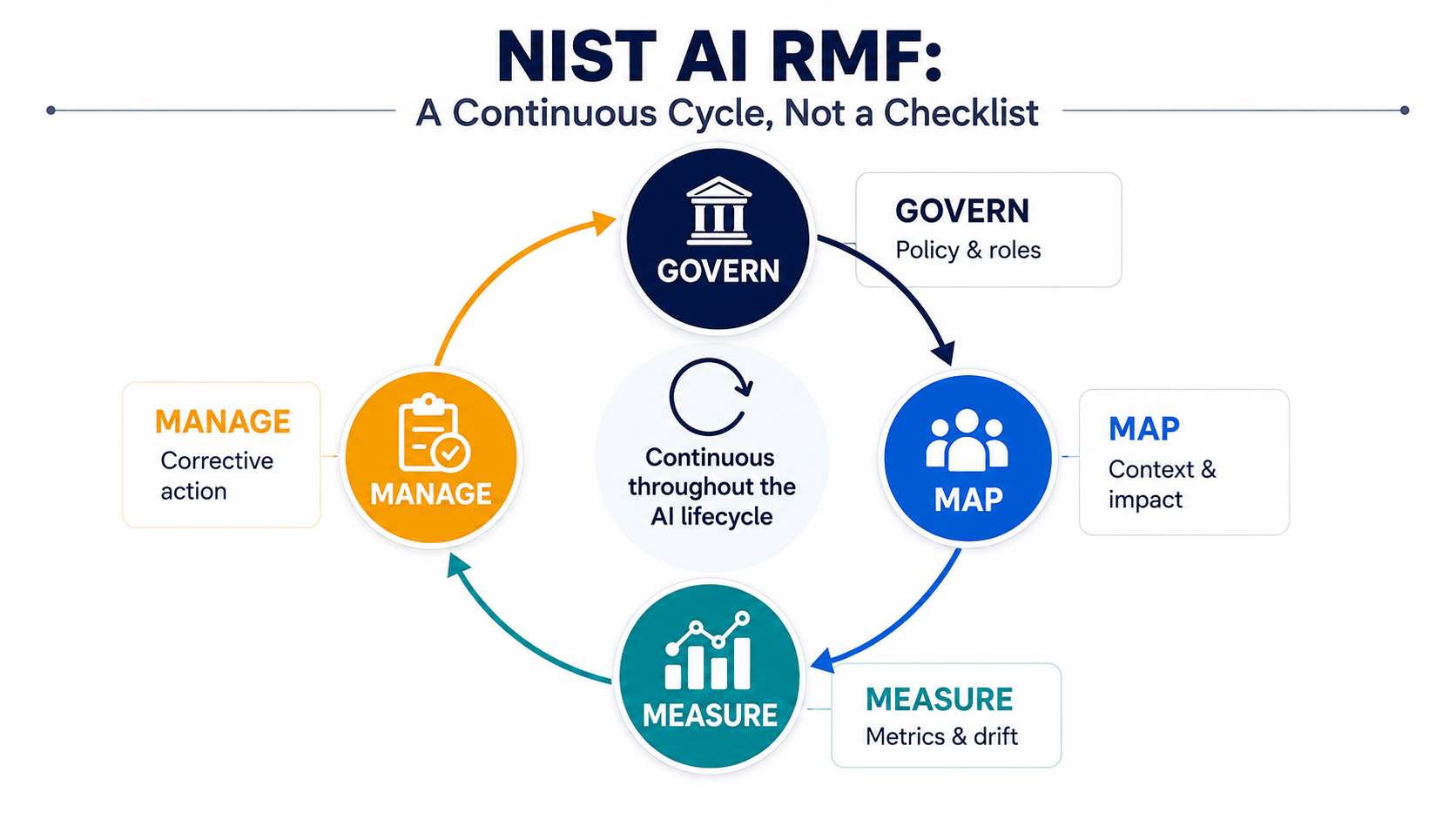
The value of this approach lies in creating a feedback loop between governance and day-to-day AI operations. As monitoring reveals performance changes, emerging risks, or unexpected impacts, organizations can use those findings to reassess controls and adjust the system before problems become material.
This makes AI governance an operational discipline rather than a documentation exercise. The framework provides a structured way to connect accountability, risk monitoring, and corrective action as the system evolves.
Mapping EU AI Act Obligations to Internal Roles
For any organization deploying AI in or affecting the EU, the AI Act’s obligations for deployers of high-risk systems give a useful template even outside strict legal scope. The Act requires assigning trained overseers, running fundamental rights impact assessments, and continuously monitoring anomalies. Translating those obligations into named internal roles, before a system launches, prevents the scramble that happens when a regulator or auditor asks, “who owns this” and nobody has a clear answer.
Designing a RACI for AI Decisions
A simple Responsible-Accountable-Consulted-Informed matrix, applied specifically to AI decisions, resolves most ownership disputes before they happen. Who is accountable when a model flags a false positive in compliance screening? Who is consulted before a new use case goes live? Writing these answers down, and revisiting them quarterly, keeps governance from becoming theoretical.
Setting Guardrails Before Scaling, Not After
Confidence of thresholds, human review triggers, and automatic pause conditions all need to exist before pilot scales, not after the first incident. Teams that wait until something breaks to define these guardrails end up building governance reactively, under pressure, which produces weaker controls than a calm, upfront design process would.
Documentation and Audit Trails as Default
Every production AI decision should leave a trace: what data it used, what confidence score it produced, and whether a human reviewed it. This is not bureaucratic overhead. It is the evidence an organization needs to defend a decision months later, whether to a regulator, an auditor, or its own board. Building this logging into the system from day one is far cheaper than retrofitting it after a compliance review flags the gap.
Takeaway: NIST and the EU AI Act both emphasize clear ownership and accountability. Assign roles, document responsibilities in a RACI, and build audit logging from day one.
5. How NORA Bridges the Pilot-to-Production Gap
Everything above describes the ownership split in principle. NORA, SmartDev’s AI Adoption Accelerator, is the concrete example of that split built into a product. Instead of a custom build from a blank page, NORA assembles proven, standardized building blocks around each client’s specific workflow, which is exactly why it can reach production faster than a from-scratch project.
The Four-Layer Accelerator Model
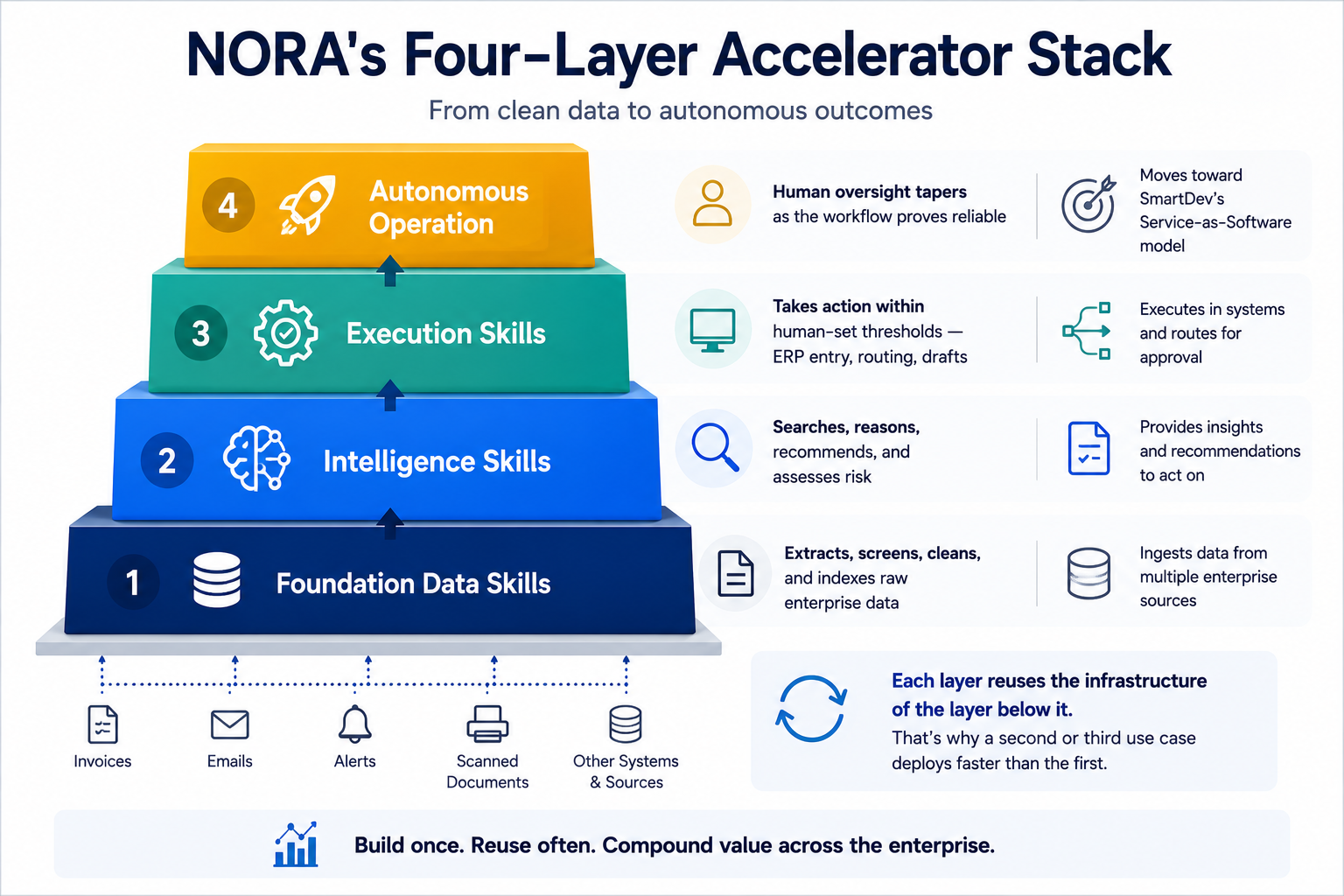
NORA is not a single tool that tries to do everything at once. It is a layered capability stack, and each layer earns the right to exist by proving itself before the next one gets switched on. The four layers build from the bottom up: foundation data skills, intelligence skills, execution skills, and, eventually, autonomous operation. This sequencing matters, because it mirrors exactly the caution this article recommends in Section 6: prove stability at a narrow scope before expanding into the next stage of automation.
Layer 1: Foundation Data Skills
Is where every NORA deployment starts. This layer collects, extracts, screens, cleans, and indexes raw enterprise data from wherever it actually lives invoices, emails, alerts, spreadsheets, scanned PDFs, and operational systems that were never designed to talk to each other. Without a solid foundation layer, every layer above it inherits bad data, so SmartDev deliberately spends the first weeks of any engagement getting this layer right rather than rushing toward visible automation.
Layer 2: Intelligence Skills
Sits on top of that clean data and does the reasoning work: it searches the client’s knowledge base, recommends actions, and assesses risk, turning raw extracted data into something a human or downstream system can act on. This is the layer where NORA’s compliance screening logic lives, deciding which flagged transactions genuinely warrant a human’s attention.
Layer 3: Execution Skills
Is where NORA moves from suggesting to doing, but only within thresholds a human has explicitly set during discovery. It pushes validated invoice data into an ERP system, routes a flagged email to the right person, or drafts a reply for approval. Execution never happens blind; every action ties back to the confidence thresholds, and human review triggers defined in Section 4 of this article.
Layer 4: Autonomous Operation
Is the layer NORA earns access to over time, not on day one. As a specific workflow proves reliable across enough production cycles, human oversight gradually tapers, and NORA’s roadmap frames this progression explicitly: the MVP stage relies on SmartDev engineers with targeted automation, version 1.0 pushes automation coverage higher as trust builds, and the long-term vision moves toward a largely autonomous, Service-as-Software model. Each layer reuses the infrastructure of the layer below it, which is precisely why adding a second or third use case to an existing NORA deployment is dramatically faster than the first one.
What NORA’s Team Owns vs What Your Team Owns
SmartDev’s engineers own the build, the deployment, and the day-to-day operation of the underlying automation. Your team retains the decisions this article defines as non-negotiable: what data NORA can access, where human review sits in the workflow, and who signs off before a new use case goes live. This mirrors the ownership boundary from Section 2, applied inside an actual production system rather than left as a policy document.
Compliance Screening in Production: The 99% Fewer False Positives Benchmark
NORA’s compliance screening service checks incoming transactions or messages against sanctions lists and internal compliance rules, and flags only genuine matches. In production, this has cut false positives by up to 99%, which matters enormously for a compliance team that would otherwise drown in manual review queues. Fewer false positives mean the human reviewers who remain can focus entirely on the matches that need judgment, which is the human-in-the-loop design this article recommends in Section 2.
Weeks to First Useful Result, Not Months
Because NORA reuses proven building blocks instead of starting a blank architecture, clients typically see a working result within weeks of kickoff. That stands in sharp contrast to the six-to-twelve-month timelines common with large consultancy engagements, and it directly addresses the “slow ROI” failure mode that MIT’s research flags as a leading cause of pilot abandonment.
Case Study: Invoice Processing from Kickoff to Production in Six Weeks
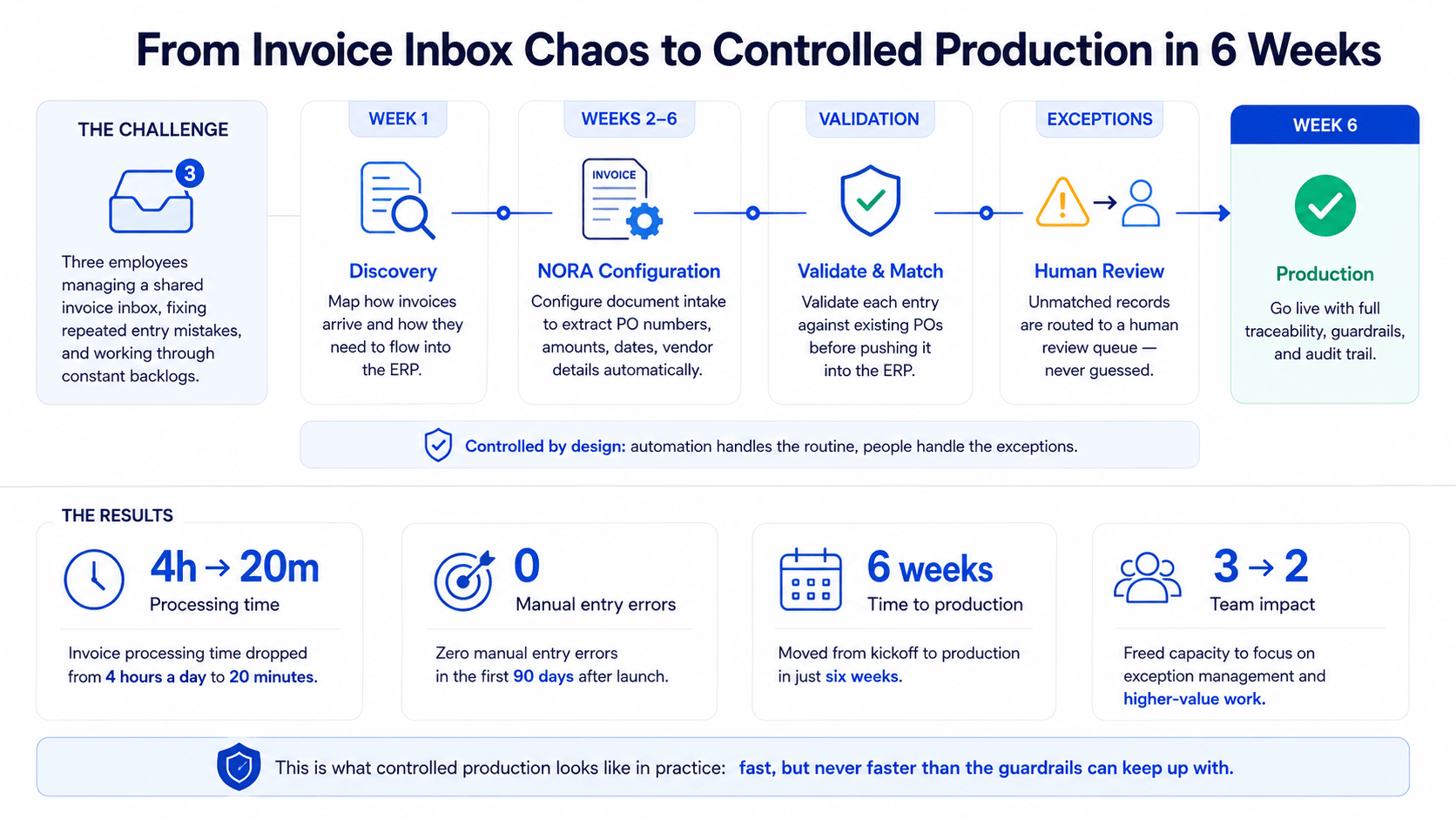
One client’s finance team relied on three employees to manage a shared invoice inbox, correcting repeated entry mistakes, and working through constant backlogs. SmartDev started the NORA invoice processing implementation with a one-week discovery phase to map how invoices arrived and how they needed to flow into the client’s ERP system. Over the following five weeks, SmartDev configured NORA’s document intake capability to extract purchase order numbers, amounts, dates, and vendor details automatically, validating each entry against existing purchase orders before pushing it into the ERP. When the system detected unmatched records, it routed them to a human review queue rather than guessing.
The result: the client moved from kickoff to production in six weeks, invoice processing time dropped from four hours a day to twenty minutes, and the operations team recorded zero manual entry errors in the first ninety days after launch. This is what controlled production looks like in practice: fast, but never faster than the guardrails can keep up with.
Takeaway: NORA operationalizes the ownership split this article recommends: SmartDev builds and runs the infrastructure, your team keeps the risk decisions, and the four-layer model means a new use case reuses existing plumbing instead of starting over.
6. A Practical Roadmap from Pilot to Controlled Production
Turning the ownership boundary into an actual rollout plan takes a few defined stages. This roadmap works whether you build internally, outsource the execution layer, or use an accelerator model like NORA.
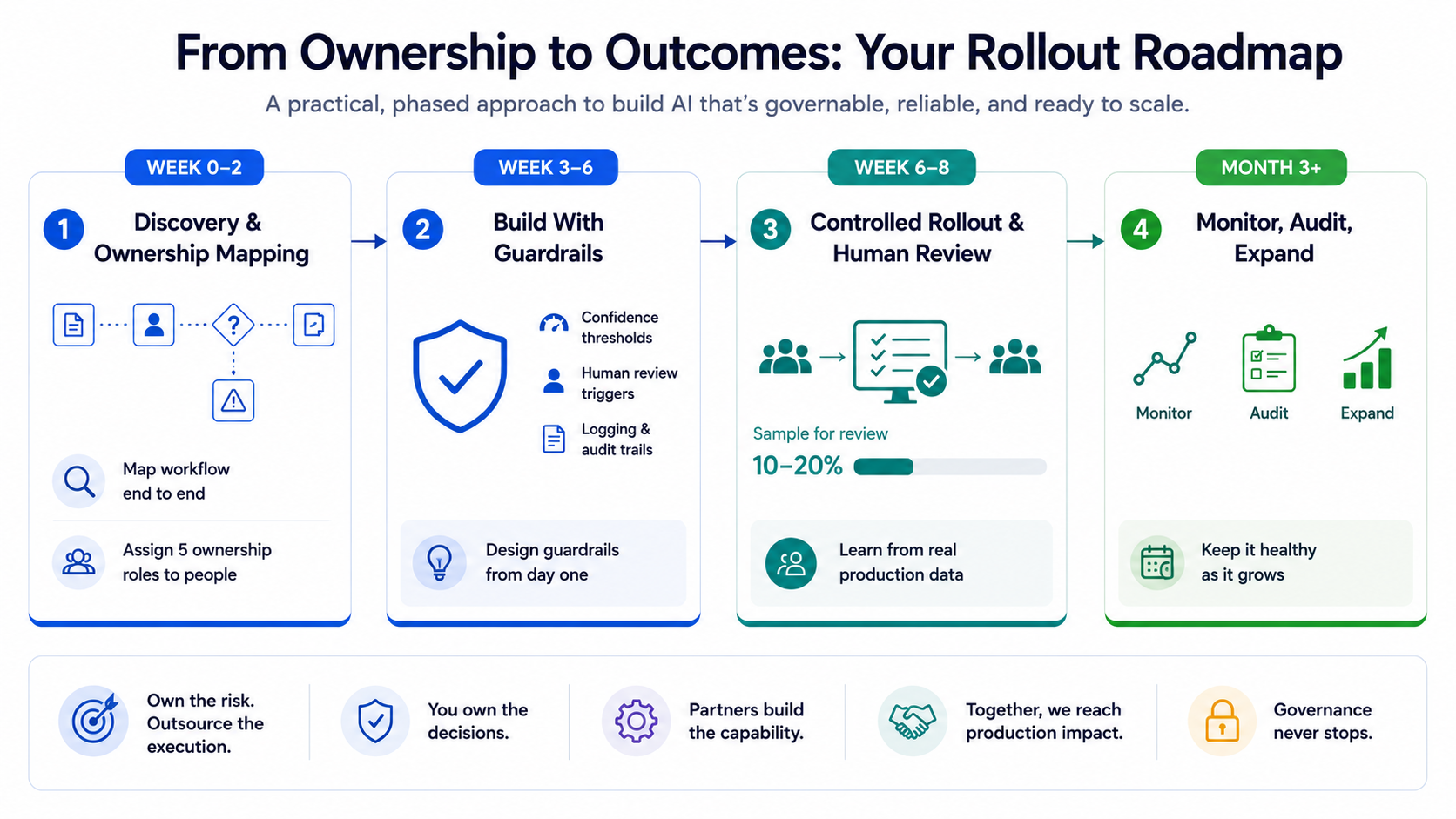
Week 0-2: Discovery and Ownership Mapping
Start by mapping the workflow you plan to automate end to end, including every exception path a human currently handles manually. In parallel, assign the five ownership roles from Section 2 to named individuals, not job titles. A discovery phase that skips this step almost always has to redo it later, once the first governance question comes to mid-build.
Week 3-6: Build With Guardrails
Whether your outsourced partner or your internal team leads the build, guardrails go in from day one: confidence thresholds, human review triggers, and logging. Retrofitting guardrails after the build is finished costs significantly more than designing them in from the start, both in engineering hours and in the political capital needed to reopen a “finished” system.
Week 6-8: Controlled Rollout and Human Review
Launch to a limited population first, with human reviewers checking a meaningful sample of every automated decision. This stage is where most of the real learning happens, because production data always surfaces edge cases that discovery interviews missed. Resist the pressure to expand scope until the review data shows the system is stable.
Month 3+: Monitor, Audit, Expand
Once the system proves stable at a limited scale, expand gradually while keeping the same monitoring cadence. Schedule a recurring audit, quarterly at minimum, that revisits the RACI matrix and confirms the named owners from Section 2 are still the right people for the role as the system’s scope grows.
Signs You’re Scaling Too Fast
Watch for a few warning signs: human reviewers rubber-stamping outputs without real scrutiny, a growing backlog of flagged exceptions nobody has time to review, or a use case expanding into a new department without anyone updating the original risk assessment. Any of these signals mean it is time to pause expansion and revisit governance before adding more scope.
Takeaway: A staged rollout, discovery, guarded build, controlled launch, then gradual expansion, keeps speed and control in balance. The warning signs of scaling too fast are almost always visible early, if someone is watching them.
Frequently Asked Questions
What is the real difference between an AI pilot and controlled production?
A pilot proves that a model can work on clean, narrow, hand-picked data with heavy human supervision. Controlled production means the same system runs on messy real-world inputs, under a named owner, with documented risk controls, audit logs, and a rollback plan that a regulator or auditor could review at any time.
Why do most AI pilots fail to reach production?
MIT’s NANDA initiative found that 95% of generative AI pilots fail to deliver measurable profit-and-loss impact, largely because organizations bolt AI onto legacy processes instead of redesigning the workflow and skip the governance work needed to survive contact with real data.
What should our internal team always own when deploying AI?
Keep data governance and access policy, model risk oversight, regulatory interpretation and compliance sign-off, vendor selection criteria, and incident response ownership inside the organization. These decisions carry legal and reputational accountability that cannot be delegated to a vendor.
What parts of an AI deployment can we safely outsource?
Infrastructure and MLOps, data pipeline engineering, model fine-tuning, monitoring tooling, and ongoing managed support are well suited to an experienced partner. These are execution-heavy, repeatable tasks where a specialist team moves faster and cheaper than an internal build.
How does NORA help a team move from pilot to controlled production faster?
NORA, SmartDev’s AI Adoption Accelerator, packages the foundation data, reasoning, and execution layers as ready-to-deploy services with built-in human review queues. Clients typically see a working result within weeks instead of the six to twelve months a from-scratch build or a large consultancy engagement usually takes.
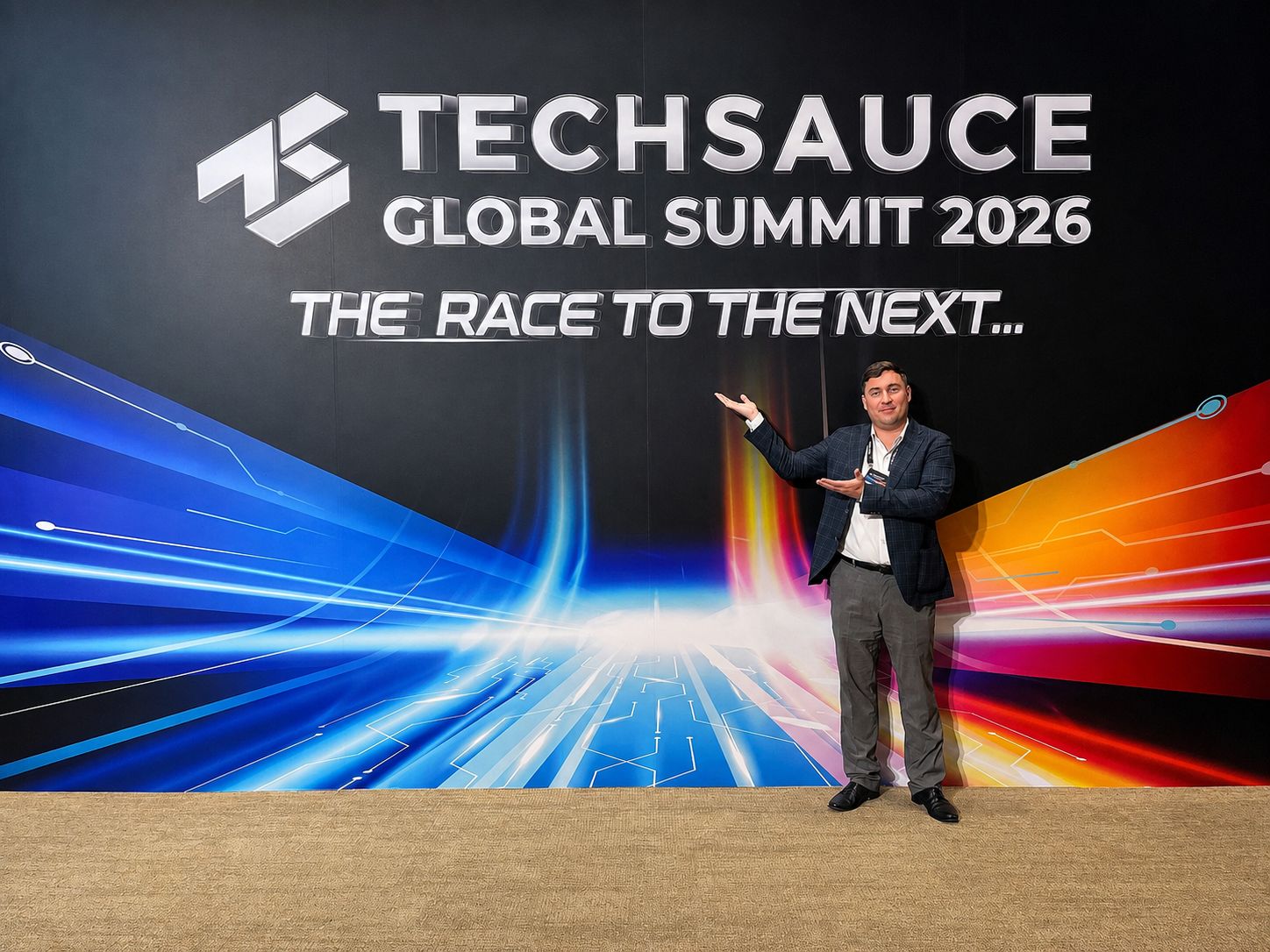
On 26th to 28th August 2026, at Techsauce Global Summit 2026 in Bangkok, SmartDev joined enterprises, startups, investors, and technology leaders to exchange perspectives on one of the most pressing challenges in enterprise AI adoption: how to move AI from proof-of-concept and pilot stages into reliable production environments.
Representing Verysell AI, Pavel Veselovskiy, Senior Sales Director, highlighted that scaling AI successfully is not simply a technology challenge. While the right AI infrastructure and engineering capabilities provide the foundation, achieving measurable business value also requires organizations to rethink workflows, redesign existing processes, strengthen change management, and ensure that AI initiatives are closely aligned with clear business objectives.
 Instead of treating AI as an isolated experiment, enterprises need to embed AI capabilities into core operations and redesign processes around what the technology makes possible.
As Pavel noted, “To capture the full ROI of AI, companies need to look beyond simply implementing new technology and ask how their processes can be redesigned and re-engineered around what AI makes possible.”
or SmartDev, this reflects a broader shift in the market from experimenting with AI pilots to building production-ready AI systems that deliver measurable outcomes at scale. Techsauce Global Summit 2026 provided a valuable opportunity to discuss these priorities with technology leaders and partners across the region, reinforcing the importance of combining AI engineering, organizational readiness, and process transformation to turn promising AI pilots into sustainable business value.
Conclusion
The gap between a promising AI pilot and a governed production system is rarely about model quality. It is about whether an organization decided, in advance, who owns the risk and who builds the plumbing. MIT’s research puts a hard number on the cost of skipping that step: 95% of pilots never deliver measurable value, and Gartner’s data shows a similar pattern in both generative and agentic AI projects. The fix is not more caution or less ambition. It is a clear ownership boundary, applied before scale, not discovered after an incident.
Keep data governance, model risk oversight, regulatory sign-off, vendor criteria, and incident response inside your organization. Move infrastructure, pipeline engineering, fine-tuning, monitoring, and ongoing support to a partner built for exactly that work. Whether you assemble that partner relationship piece by piece or adopt an accelerator model like NORA that packages it end to end, the underlying principle stays the same: speed and control are not opposites when the ownership line is drawn correctly from day one.
Ready to Move Your AI Pilot into Controlled Production?
Tell us more about your current pilot, your workflow, and your compliance requirements. SmartDev’s team will map exactly what your organization should own and what NORA can take off your plate, with a scoped plan in days, not months.