

TL, DR:
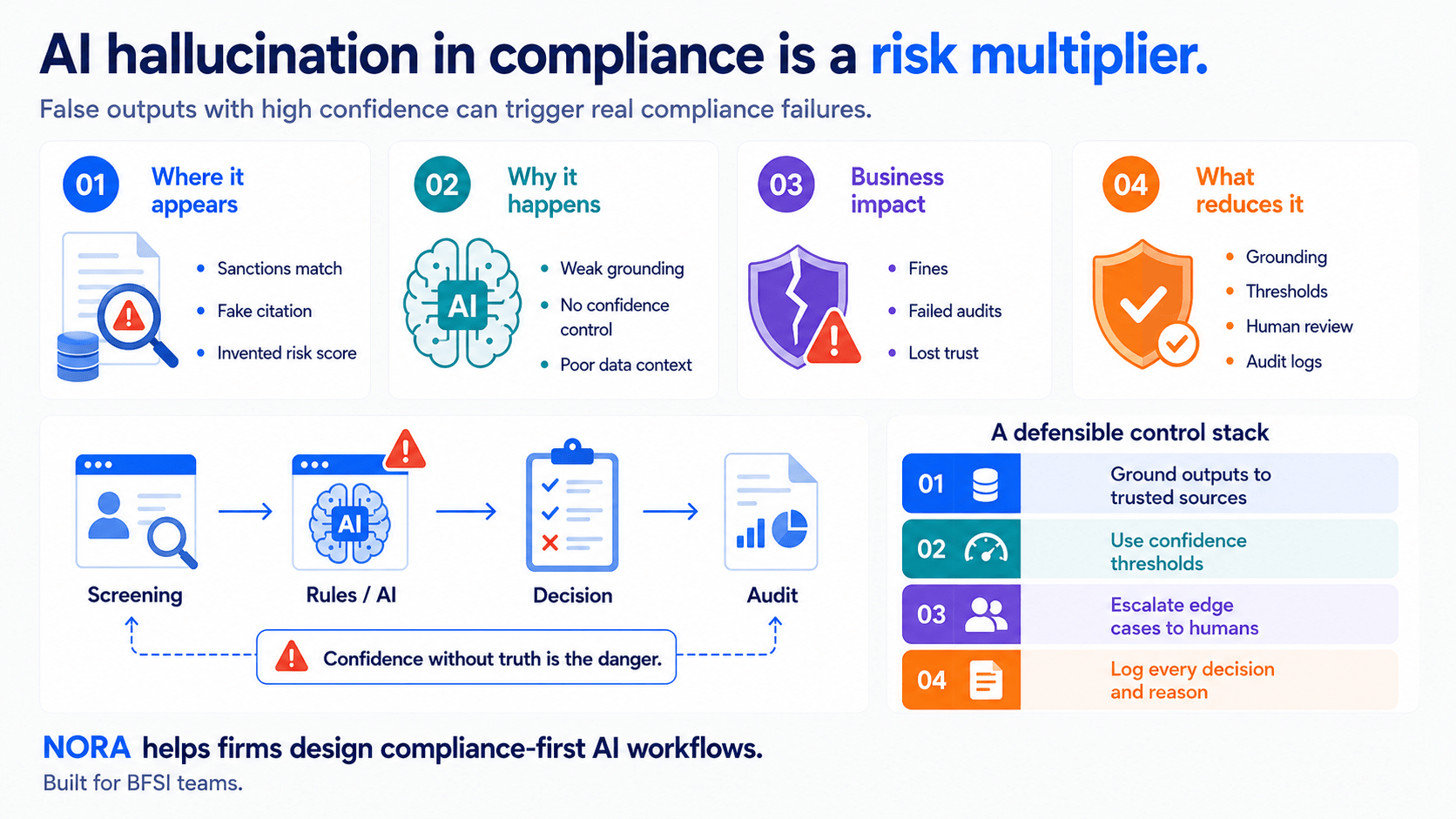
AI hallucination happens when a model states something false with total confidence, and in compliance work that confidence is the danger. A hallucinated sanctions match, a fabricated regulatory citation, or an invented risk score can trigger fines, failed audits, and lost trust. Courts have already sanctioned lawyers for filing fake AI-generated case citations, and industry estimates put global losses from AI hallucinations in the tens of billions of dollars.
This post breaks down where hallucinations enter compliance automation pipelines, why they happen, and how a layered mitigation framework, grounding, confidence thresholds, human review, and audit logging, keeps AI-assisted compliance decisions defensible. It also looks at how NORA, SmartDev’s AI Adoption Accelerator, is built around exactly this framework for financial services firms.
Introduction
What Is an AI Hallucination in a Compliance Context?
A confident, false statement – not a random error
An AI hallucination is a plausible-sounding output that contains false information. The model may not express uncertainty or distinguish verified information from content it generated without evidence.
Instead, it presents fabricated information with the same fluency, structure, and confidence as a correct answer. This makes hallucinations fundamentally different from obvious system errors, such as broken links, missing fields, or formatting issues.
A broken link reveals its failure immediately, while a hallucinated statement can remain inside a report, customer email, or risk memo for months. In compliance, this risk becomes especially serious because teams often expect AI outputs to support trusted, time-sensitive decisions.
How hallucinations differ from ordinary data errors
Types of hallucination that show up in compliance workflows
Why models generate hallucinations with such confidence
Large language models predict the next likely word from patterns learned during training rather than checking facts against verified, current sources. This process differs fundamentally from database lookup, even though the resulting answers can look remarkably similar.
When a model lacks grounded information, it can still generate a fluent response instead of admitting uncertainty or declining to answer. Training typically rewards helpful-looking responses more than explicit uncertainty, which encourages the model to keep producing answers.
In effect, the model favors a confident guess over an honest “I don’t know.” This structural bias explains why teams must build mitigation into the surrounding system rather than relying on the model to self-correct.
Takeaway: A hallucination is not a glitch a user will notice immediately; it is a fluent, confident, false statement that can slip past a first read. Compliance teams need controls built for that specific failure mode, not just standard QA.
Why Hallucinations Are a Distinct Risk in Regulated Environments
Regulatory exposure multiplies the cost of a single error
A hallucinated fact in a casual consumer chatbot usually creates minor confusion, and users can often verify it elsewhere within seconds. However, the same failure inside a regulated workflow carries far greater consequences. Maxim AI’s research on enterprise AI reliability notes that one erroneous output can trigger compliance incidents and legal liabilities far beyond the automation’s expected efficiency gains.
Regulators also examine more than whether a decision produced the correct outcome. They expect compliance teams to show how teams reached the decision, which data supported it, and who owned each step. A fabricated data point therefore cannot remain isolated within one report; it weakens the entire evidentiary chain. Once an auditor identifies one unreliable link, they may scrutinize other AI-assisted decisions across the organization.
Courts are already sanctioning professionals over AI-generated errors
The pattern appears repeatedly in legal filings, showing how the same mistake can recur even after courts explicitly warn professionals. Scientific American reported that the Alabama Supreme Court sanctioned an attorney for citing nonexistent cases. After receiving a direct warning, the attorney cited additional fabricated cases in the next filing. This suggests that warnings alone rarely change behavior without corresponding process changes.
Separately, Fortune reported that a federal judge in Oregon fined two lawyers $110,000 for submitting twenty-three fabricated citations and eight invented quotations. The judge described the penalty as the largest U.S. legal sanction for AI hallucinations at that time. In another Oregon case, Bloomberg Law reported that a lawyer received a $15,500 fine after the court found him insufficiently forthcoming about the error.
None of these professionals intended to mislead the court; AI tools generated confident but false material that they failed to verify. The lesson for compliance teams is not that professionals are careless, but that fluent AI output can overcome human skepticism without deliberate verification.
The financial-services numbers behind the headlines
Reputational and customer-trust damage compounds the direct cost
Beyond fines and sanctions, a hallucinated answer about rates, fees, or dispute rights can erode trust in the institution itself. Customers do not distinguish between “the chatbot was wrong” and “the bank was wrong” – the institution owns the mistake, regardless of which AI vendor sits behind it.
More importantly, once one fabricated answer is exposed, customers, journalists, and regulators may begin questioning other automated outputs as well. Rebuilding that trust through manual re-verification, public statements, and expanded audits can cost far more than the original error. That is why prevention is ultimately cheaper than remediation.
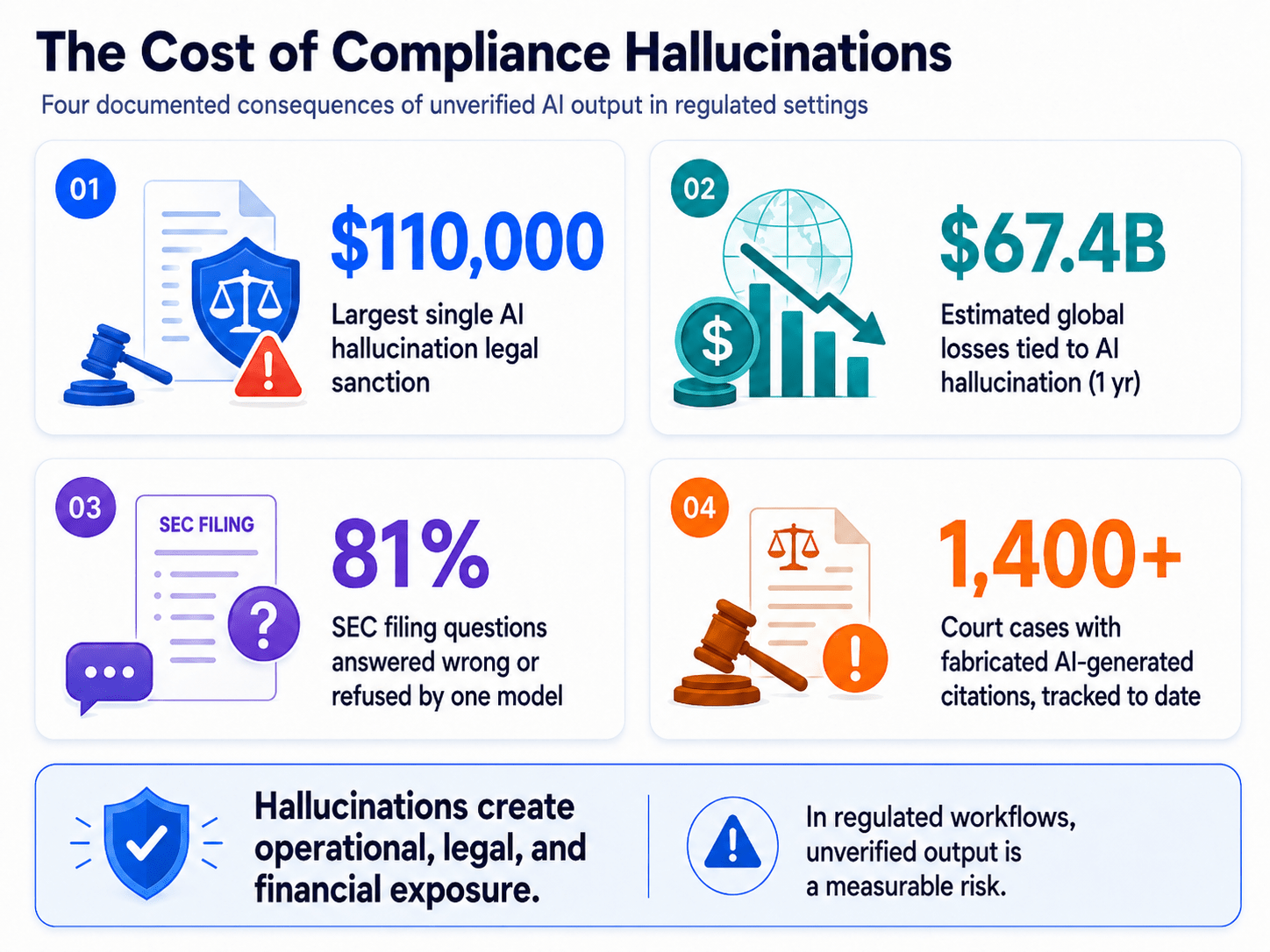
The chart is not intended to compare the absolute size of the four numbers, since $67.4B, 1,400+, 81%, and $110K represent fundamentally different types of metrics. Instead, it illustrates the scale and variety of risks created by AI hallucinations, from tens of billions in estimated financial losses and legal sanctions, to high error rates in real regulatory tasks and thousands of documented cases.
The key takeaway is that hallucination is no longer an isolated failure of a few weak models. It can create legal, financial, and operational consequences at multiple levels, and even retrieval-augmented systems designed to reduce hallucinations can still struggle with the precision required for regulatory-grade financial work.
Takeaway: Hallucination risk in regulated environments is not hypothetical; it already has a dollar figure, a case count, and a growing list of sanctioned professionals. Compliance leaders should treat it as a quantifiable operational risk, not a rare edge case.
Where Hallucinations Creep into Compliance Automation Workflows
Document extraction and KYC intake
When AI reads identity documents, financial statements, or onboarding forms, it can misread a field – a smudged date, an unfamiliar document format, a currency symbol from an unexpected jurisdiction – and then confidently fill in a plausible but entirely wrong value rather than flagging the gap for human attention.
In know-your-customer workflows, a single fabricated data point rarely stays contained within the original document or extraction step. It can propagate into the risk score, onboarding decision, and potentially even a regulatory filing. Because each downstream stage relies on the previous one, earlier hallucinations become increasingly difficult and costly to trace, verify, and correct.
Regulatory research and citation generation
Compliance teams researching obligations under frameworks like Basel III, MiFID II, or fast-moving local regulatory updates face exactly the same exposure whenever the AI is not explicitly grounded in verified, current source text, and the risk only grows as regulations change more frequently than any static training dataset can keep up with.
Risk scoring and narrative generation
Many compliance tools ground the numeric risk score in verified data, but the explanatory narrative generated around it may remain loosely grounded. This creates a dangerous gap: the score may be correct while the explanation cites the wrong risk factor, overstates a minor flag, or omits the actual driver behind the decision.
The result is a mismatch between the decision and its explanation, making the output harder to defend to regulators, auditors, or customers. The narrative therefore needs to be grounded in the same evidence and reasoning that produced the score, not generated as a separate layer afterward.
Transaction monitoring and alert triage
AI-assisted alert systems typically summarize why the system flagged a transaction, giving an analyst a starting point instead of asking them to trace the raw data from scratch under time pressure. A hallucinated summary can point out that analyst toward entirely the wrong pattern, describing a structuring concern when the actual anomaly is a sanctions-adjacent counterparty, for example, which produces two failure modes at once.
First, the analyst may waste scarce investigation time chasing a false lead the AI invented, delaying attention on genuinely urgent cases in the same queue. Second, and more seriously, the analyst may close out a case believing they have properly investigated it when the summary simply described the wrong risk altogether, leaving the real exposure unaddressed. Both failure modes tend to surface at the worst possible time: during a regulatory examination, when an examiner asks why a specific alert was cleared, and the recorded reasoning does not hold up.
Audit and regulatory reporting narratives
The final report a regulator reads are, ironically, often the last place a hallucination gets caught rather than the first, because by that stage every reviewer in the chain has already assumed the upstream data is correct. Each step in a compliance pipeline is designed to trust the step before it, which is efficient when the data is accurate and catastrophic when it is not, because no one downstream is specifically looking for an error that “should” have already been caught earlier. A fabricated detail that survives all the way into a final, submitted report is therefore the most visible and most damaging place for a hallucination to surface, since it is the document a regulator, auditor, or court will actually scrutinize line by line, precisely the audience least forgiving of a confident, well-formatted error.
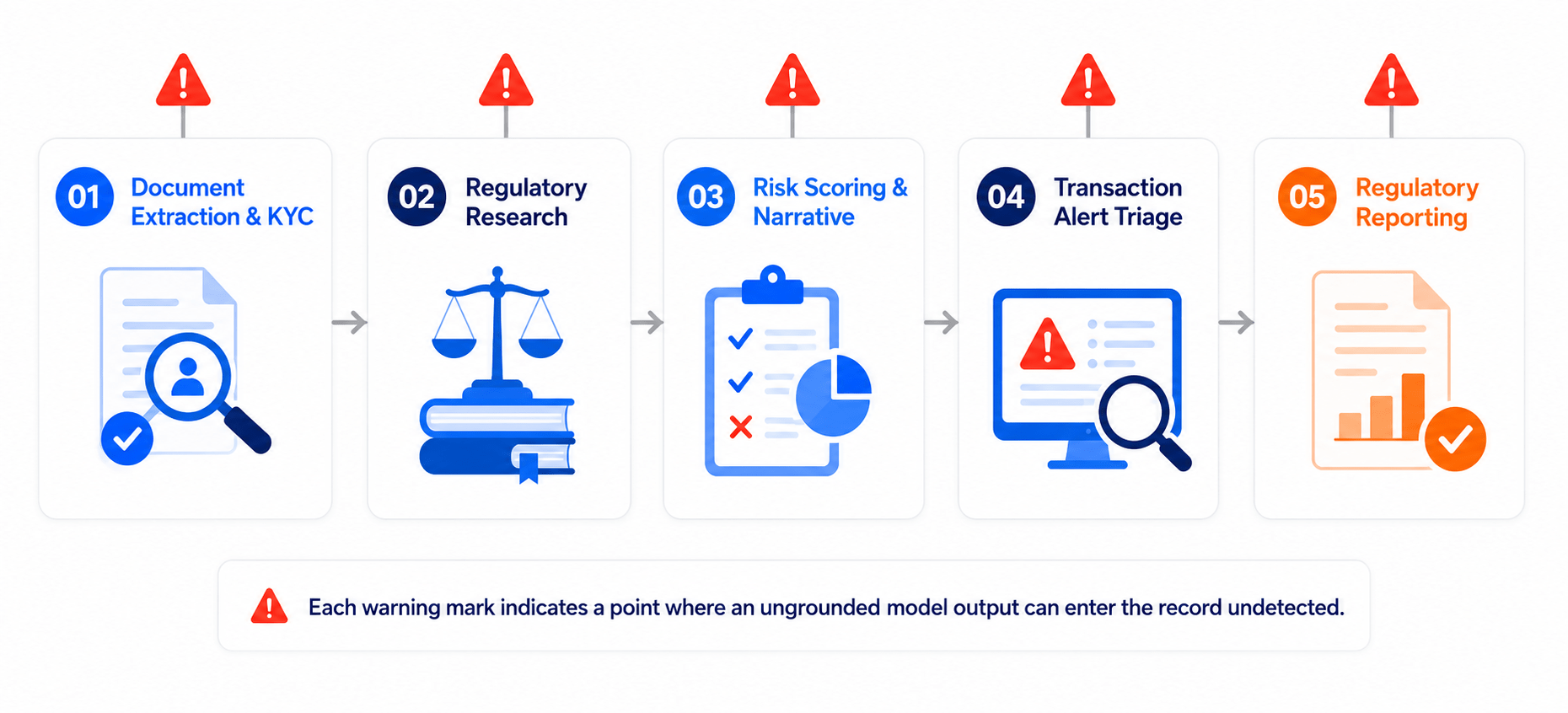
The diagram maps a typical compliance automation pipeline across five key stages:
- Document Extraction & KYC – AI extracts and structures information from customer and compliance documents.
- Regulatory Research – AI identifies relevant regulations, requirements, and regulatory sources.
- Risk Scoring & Narrative – AI assesses risk levels and generates the rationale or narrative behind each assessment.
- Transaction Alert Triage – AI reviews and prioritizes transaction alerts to identify cases requiring further investigation.
- Regulatory Reporting – AI consolidates findings into reports submitted to regulators.
A warning marker above each stage highlights that hallucination can enter anywhere in the workflow, meaning an error introduced early can potentially propagate through every subsequent stage.
Takeaway: Hallucination risk is not confined to one step. It can enter at intake, during research, inside a generated narrative, or in the final report, which is why point fixes rarely work, and pipeline-wide grounding matters more.
Root Causes: Why Compliance AI Hallucinates
Training data staleness
Regulations change constantly, new guidance, amended thresholds, updated reporting formats, and a model trained on a fixed dataset has no built-in awareness of any update issued after its training cutoff, no matter how significant that update turns out to be. The model has no internal signal telling it “This knowledge might be stale”; from its perspective, everything it learned during training feels equally current and equally reliable.
Without a live connection to current source material, the model answers confidently from outdated knowledge while sounding exactly as assured as it would if the information were fully up to date, which means a compliance team cannot tell staleness apart from accuracy just by reading the tone of the response.
Missing or weak grounding
A model without retrieval access to verified documents simply has nothing external to check its answer against, so instead of returning “I don’t have that information,” it generates whatever continuation is statistically most likely given the patterns it learned and presents that continuation as though it were a verified fact.
This distinction, retrieving an answer versus generating a plausible one, is invisible in the output but decisive in terms of reliability. Maxim AI identifies this as the single largest structural cause of hallucination in enterprise deployments, which is why grounding is consistently the first control any serious mitigation framework introduces, rather than an optional refinement added later.
Ambiguous or underspecified prompts
Vague instructions push the model to fill gaps with its own assumptions, and those assumptions are rarely flagged as assumptions in the output. A prompt asking for “the relevant sanctions list” without specifying a jurisdiction, an effective date, or which regulatory body list is meant invites the model to guess at the missing context on the user’s behalf. The guess is not presented as a guess, it is delivered with the same fluent, declarative confidence as a fully specified, correctly grounded answer, so the reader has no way of knowing that the model silently filled in details the prompt never actually provided. Compliance teams that write precise, unambiguous prompts as a matter of policy close off one of the easiest paths to hallucination, essentially for free.
No mechanism to signal uncertainty
Most deployed systems return a single answer without a confidence score, making low-confidence guesses look identical to well-grounded facts. This is a design choice, not an inevitability, because models often generate internal signals of uncertainty that interfaces discard before human reviewers see them. Systems that expose these signals help reviewers prioritize limited attention more effectively. A compliance analyst reviewing one hundred AI-assisted decisions can focus on the cases flagged as uncertain rather than applying equal scrutiny to every output.
Architectural limits of next-token prediction
Takeaway: Hallucination is not primarily a training failure; it is a structural feature of how generative models work. Effective mitigation therefore should work around the model, through grounding and process design, rather than waiting for a “smarter” model to solve it alone.
Mitigation Framework: Building Hallucination-Resistant Compliance AI
Ground every answer in retrieved, verified source data
Retrieval-augmented generation (RAG) connects the model to a curated set of verified documents at query time, giving it specific sources to consult before answering. Maxim AI’s research shows that RAG can improve accuracy on knowledge-intensive tasks compared with ungrounded models. However, grounding reduces hallucinations rather than eliminating them, because models can still misread or misapply retrieved information.
For compliance teams, this means grounding answers in current policies, regulatory requirements, and verified customer records rather than relying on potentially outdated training data. Equally important, retrieval quality matters as much as model quality, because stale or incomplete source documents can still produce confidently incorrect answers.
Set confidence thresholds and automatic escalation
Build human-in-the-loop review into high-stakes steps
As AWS’s engineering team notes, human oversight remains the most reliable backstop for high-impact decisions where errors could create serious consequences. This matters particularly when incorrect outputs affect regulatory filings, credit decisions, or customer-facing financial outcomes that prove difficult to reverse.
However, effective review cannot become a rubber stamp added to an already overloaded workflow. A reviewer handling fifty AI outputs per hour without supporting context will likely approve most without genuinely checking them. That approach defeats the purpose of human oversight and creates false confidence in the control itself.
Reviewers therefore need underlying source documents displayed alongside each AI output rather than hidden within separate systems. This setup allows reviewers to verify specific claims within seconds instead of spending several minutes searching for supporting evidence. When verification takes too long, time pressure gradually turns meaningful review into rubber-stamping, regardless of the original workflow design.
Log a structured, queryable audit trail
Monitor continuously and re-test after every material change
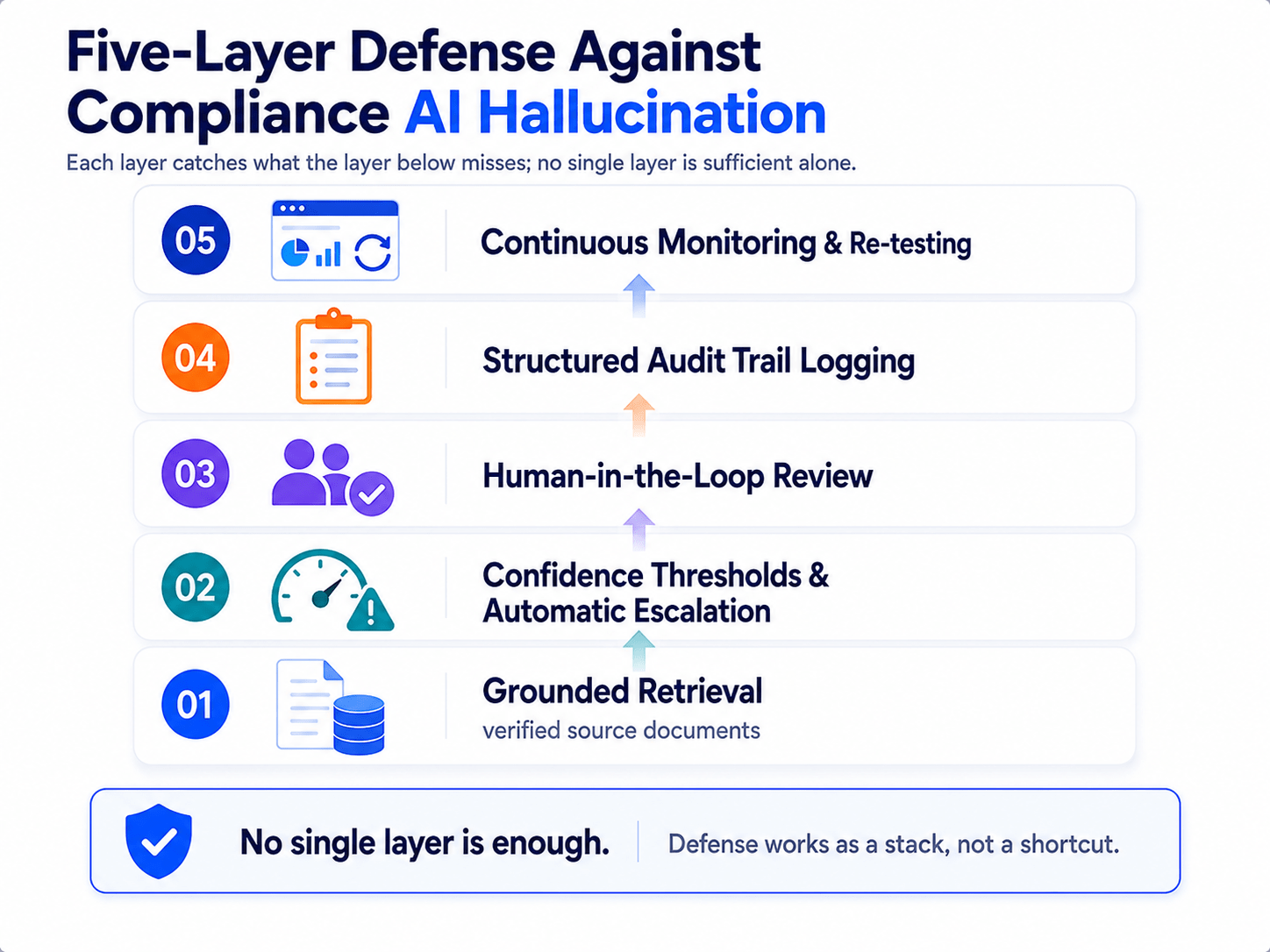
Five-Layer Defense Against Compliance AI Hallucination
- Grounded Retrieval – Anchors the model to current, verified sources such as regulations, internal policies, and customer records, reducing reliance on potentially outdated model knowledge.
- Confidence Thresholds & Escalation – Prevents the system from confidently answering when uncertainty is high. Low-confidence or high-risk cases are automatically flagged for further review.
- Human-in-the-Loop Review – Qualified reviewers verify high-impact outputs against the underlying evidence, catching errors that automated controls may miss.
- Structured Audit Trail – Records the model’s output, sources, decisions, and human interventions, making errors traceable and supporting compliance audits.
- Continuous Monitoring & Re-testing – Regularly tests performance as models, regulations, and source documents change, preventing previously reliable systems from quietly degrading.
The key principle is defense in depth: no single layer can eliminate hallucination. Together, these controls reduce, detect, and contain errors across the entire AI workflow.
Takeaway: No single control stops hallucination. Grounding, confidence thresholds, human review, audit logging, and continuous monitoring work as a stack, remove one layer, and the others carry more risk than they can absorb.
Regulatory and Governance Expectations
NIST AI Risk Management Framework
As researchers writing on operationalizing the NIST AI RMF explain, NIST’s voluntary framework organizes AI governance into four functions – Govern, Map, Measure, and Manage – that apply across the full AI lifecycle rather than treating governance as a one-time approval gate before launch.
Govern establishes policy and ownership before anything is built; Map identifies where and how teams actually use AI across the organization, including shadow use cases that teams may not always disclose; Measure quantifies performance and failure rates against defined benchmarks; and Manage turns those measurements into ongoing action. Together, these functions give compliance teams a structured and defensible way to document hallucination controls, even in jurisdictions where no binding legal mandate exists. The practical point is simple: “we have no legal obligation to do this” is rarely a position regulators, customers, or boards find reassuring after something goes wrong.
EU AI Act obligations for high-risk financial systems
According to the FinGround research team, the EU AI Act sets an August 2026 compliance deadline for high-risk financial AI systems, requiring human oversight, interpretable outputs, and explicit accuracy guarantees under its core provisions. Unlike voluntary frameworks, this creates a binding legal obligation with enforcement consequences, changing the calculation for firms operating in or serving EU markets from “this would be good practice” to “this is a compliance deadline with a specific date.”
Firms in scope therefore need hallucination controls that can produce concrete, inspectable evidence against these requirements, not simply an assurance that the team “takes AI quality seriously,” but documented accuracy testing, interpretability measures, and human oversight records that an examiner can review.
Regional regulators and evidentiary expectations
Regulators, including Singapore’s MAS, increasingly expect firms to show how an AI-assisted decision was reached, not simply that the final decision was correct or that the required process was followed. This mirrors established audit-trail expectations in AML and sanctions screening, where firms must document the reasoning behind a clearance or escalation, not just the outcome.
As AI takes more of that reasoning work, the same evidentiary standard naturally extends to the AI-assisted portion of the process. A regulator reviewing a cleared alert may therefore expect to see what the model considered, which evidence it relied on, and why it reached its conclusion, at a level of detail comparable to a human analyst’s case notes. SmartDev’s guide to AI-powered MAS regulatory change monitoring explores how institutions across Southeast Asia can build this capability and stay ahead of regulatory updates.
Sector-specific rules layered on top of general AI governance
Fair-lending laws, anti-discrimination statutes, and financial frameworks such as Basel III and IFRS 9 add sector-specific accuracy and fairness requirements on top of general AI governance expectations. Importantly, these requirements do not operate in isolation. A hallucinated output that also produces a discriminatory outcome – for example, a fabricated risk factor that systematically disadvantages one demographic group in a lending decision – can create compounding legal exposure under both AI governance and established anti-discrimination laws.
This overlap is why hallucination, and fairness controls should be designed together rather than treated as separate workstreams. SmartDev’s guide to AI bias and fairness provides a useful companion resource for understanding how these risks intersect in practice.
Accountability sits with the deploying firm, not the AI vendor
LawSites’ analysis of a recent California appellate ruling makes one point particularly clear: the professional who submits the material remains responsible for it, regardless of which AI tool produced the underlying error or how confidently the tool presented the information.
Courts have shown little sympathy for the argument that an AI vendor’s output should shift accountability away from the human who relied on it without verification. Compliance teams should apply the same principle to AI-assisted regulatory work by building explicit sign-off steps, documented verification, and clear individual ownership into each stage of the process. Compliance teams should never treat AI-generated content as pre-approved simply because it came from an approved tool.
Takeaway: Regulators are converging on a common expectation across frameworks: firms must be able to explain and evidence how the system reached an AI-assisted decision. As a result, hallucination controls are increasingly becoming part of that evidentiary requirement, rather than a separate technical concern.
How NORA Reduces Hallucination Risk in Compliance Workflows
NORA is SmartDev’s AI Adoption Accelerator, a fully managed service that designs, builds, and continuously operates AI-assisted compliance workflows for financial services firms rather than handing over a model and leaving the firm to manage risk alone. Rather than deploying a general-purpose model directly against regulatory tasks and hoping for the best, NORA is architected specifically around the mitigation layers described earlier in this article – grounding, confidence thresholds, human review, and audit logging – so those controls are built into the system from day one instead of retrofitted after a problem surfaces. The sections below walk through how each layer works in practice.
A normalized, grounded data layer
NORA connects to core banking systems, CRM platforms, transaction databases, and third-party risk feeds through pre-built API connectors, normalizing everything into a single unified compliance data model before any model reasoning happens at all. This ordering matters: grounding is not something layered on top of the AI reasoning after the fact, it is the foundation the reasoning step is built on.
Because of that sequencing, NORA’s outputs are grounded in the firm’s own current records, actual account histories, actual policy documents, actual transaction data, rather than the model’s general training knowledge, which may be outdated, generic, or simply irrelevant to a specific institution’s products and jurisdiction.
Rule engine and LLM reasoning working together, not alone
NORA combines a configurable rule engine with LLM-based reasoning, ensuring that hard compliance logic, including regulatory thresholds, jurisdictional rules, and product-specific requirements, is enforced deterministically and cannot drift or be reinterpreted by the model. The LLM is instead reserved for narrative generation and pattern recognition within those predefined guardrails.
This division of labor plays to each component’s strengths: rules provide reliable, auditable decisions for fixed requirements, while LLMs are better suited to synthesizing unstructured information and explaining findings in plain language. The key is keeping the LLM from making decisions where a precise threshold or regulatory rule must be applied consistently. NORA’s risk and compliance workflow automation applies this approach to lending and onboarding decisions, where getting a threshold wrong can have direct regulatory consequences.
Human review checkpoints built into the workflow, not bolted on
NORA does not replace the compliance team; it is designed to route exceptions and low-confidence cases to human reviewers as an integral part of the workflow, rather than an afterthought. The system operates on the premise that no model, however capable, should make the final call on a high-stakes case alone.
Instead, reviewers receive the context they need, including source documents, confidence signals, and similar past cases, to make informed decisions efficiently rather than starting from scratch each time. SmartDev’s guide to workflow design for compliance screening explains why this integration, rather than the raw accuracy of any single model, ultimately determines whether a compliance automation program succeeds in production.
An audit trail generated automatically, not reconstructed later
NORA builds a compliance audit trail for every decision automatically, capturing what the AI assessed, which sources it consulted, its confidence level, and the human reviewer’s final decision. Because the process is automated, it does not rely on staff remembering to document each step, a common weakness in manual audit trails.
When auditors request evidence months or years later, the system can generate a structured record without forcing compliance teams to reconstruct the decision from scattered emails, spreadsheets, and institutional memory. This speed and completeness can make the difference between a routine audit request and a more intensive investigation.
Documented results from live deployments
Firms using NORA for compliance workflow automation have reported up to an 80% reduction in review time, freeing experienced compliance staff to focus on genuinely ambiguous cases rather than routine documentation. Compliance workflow automation The approach also produces a more consistent and defensible audit record than manually compiled documentation, particularly across large teams.
Consistency is especially important: machine-generated logs apply the same structure and level of detail to every case, while manual documentation naturally varies depending on an analyst’s workload, attention, and thoroughness. SmartDev’s work on AI-native compliance for RegTech firms and AI workflow automation for audit-ready deliverables shows how this grounded, human-reviewed architecture can extend beyond financial crime screening into broader compliance and reporting workflows.
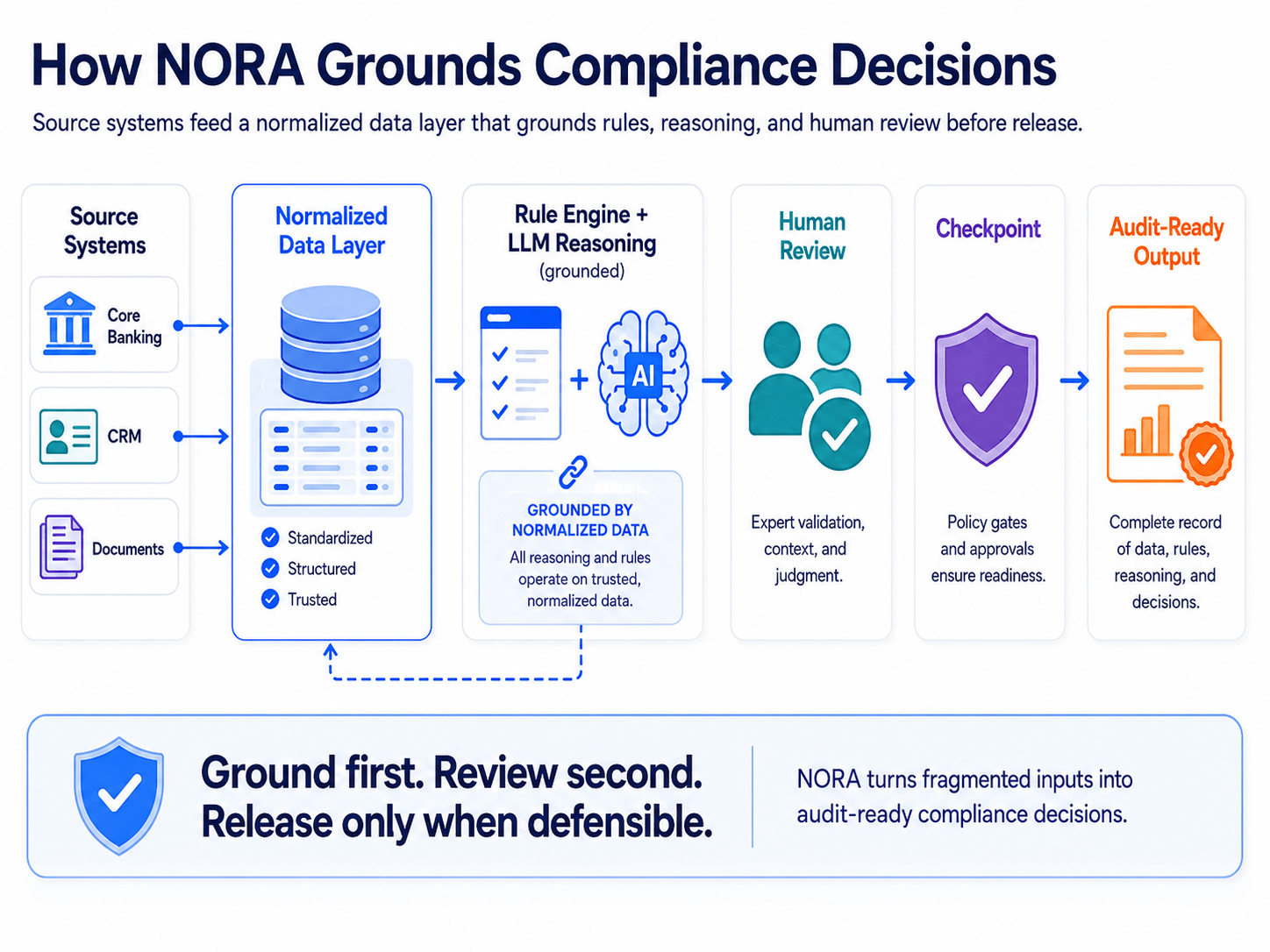
How NORA Grounds Compliance Decisions
NORA combines data grounding, deterministic rules, AI reasoning, and human oversight into one controlled compliance workflow:
- Source Systems – Core banking, CRM platforms, and documents provide the raw data needed for compliance processing.
- Normalized Data Layer – Data from different sources is standardized and unified, creating a consistent foundation for downstream analysis.
- Rule Engine + Grounded LLM Reasoning – Deterministic rules handle fixed requirements and thresholds, while the LLM analyzes and explains unstructured information using verified data as its grounding context.
- Human Review Checkpoint – Uncertain, exceptional, or high-stakes cases are automatically routed to human reviewers rather than being decided by the model alone.
- Audit-Ready Output – The final decision is accompanied by the relevant evidence and decision trail, creating a structured, defensible record for compliance and audit purposes.
The key idea is a controlled chain from raw data to defensible decisions, with rules, grounding, and human review acting as safeguards at every critical point.
Takeaway: NORA’s design reflects the layered mitigation framework directly: grounded data first, deterministic rules paired with LLM reasoning second, human review third, and an automatic audit trail as the output, rather than relying on a single model to get every answer right unassisted.
Building a Hallucination Risk Roadmap for Your Organization
Assess where AI already touches compliance decisions
Start by mapping every point where a model output, even an informal one, such as an analyst using a general-purpose chatbot, feeds into a compliance decision, report, or customer communication. This exercise is often more revealing than teams expect, as many organizations uncover significant shadow AI use before identifying any formally approved system.
More importantly, this mapping should be done without treating discovery as a disciplinary issue. Staff often adopt accessible AI tools to save time before formal systems are built or approved. Identifying these use cases openly is the first step toward controlling the real exposure, rather than just the visible, sanctioned portion of it.
Pick one workflow to pilot grounding and review controls
Rather than retrofitting every process at once, which can spread limited attention too thin, select one high-volume, high-risk workflow first, such as sanctions screening or KYC document review, and apply the full mitigation stack deliberately.
Then, use the focused pilot to generate concrete evidence of what works and what needs adjustment before expanding further. This approach avoids repeating the same discovery process across every workflow independently. SmartDev’s guide to AI model training covers the key decisions shaping accuracy and risk during this phase, from data selection through evaluation.
Define confidence thresholds and escalation rules explicitly
Write down, in advance and before launching, exactly what confidence level triggers automatic human review, and assign clear, named ownership for who reviews escalated cases once they land in the queue. Vague thresholds set during a planning meeting tend to drift once real volume arrives, and ambiguity about who owns a flagged case is one of the most common, and most avoidable, reasons pilot programs stall after launch, cases pile up in a queue nobody has been explicitly told is theirs to clear, and the program quietly loses credibility even though the underlying technology may be working exactly as intended.
Measure hallucination rate as an ongoing metric, not a launch checkbox
Track how often AI outputs require correction after human review, as a standing operational metric rather than a one-time launch statistic that gets reported once and then forgotten. Treat any rising correction rate as an early warning signal, it usually means the grounding data has gone stale, a regulation has changed and the corpus has not caught up, or usage has expanded into a new scenario the system was never actually tested against. This measurement discipline connects directly to the broader governance practices covered in SmartDev’s guide to ethical AI development, and it is the single habit most likely to catch a degrading system before a regulator or customer does instead.
Scale governance alongside the technology, not after it
As AI expands across more compliance workflows, governance capacity should grow alongside adoption, rather than being rushed into place after problems surface. Building governance proactively is far cheaper, both financially and reputationally, than fixing gaps under pressure.
Firms planning this investment can review SmartDev’s AI development cost guide to understand the cost of building proper governance capacity. Similar considerations apply to regulated use cases such as AI-powered insurance underwriting and risk assessment, where many of the same bias, accuracy, and hallucination controls are required.
Takeaway: A hallucination risk roadmap works best as a staged rollout: assess exposure, pilot one workflow with full controls, and define clear thresholds. Then, measure performance continuously and scale governance alongside adoption rather than behind it.
Frequently Asked Questions
What is an AI hallucination in a compliance context?
It is a confident but incorrect output from a model, such as a fabricated regulation, a wrong risk score, or an invented audit citation presented as though it were fully verified. The output reads as entirely plausible, matches the tone and formatting of a correct answer, and can pass unnoticed through normal review until a regulator, auditor, or customer eventually challenges it directly.
How common are AI hallucinations in regulated industries?
Rates vary by task and model, but the FinGround research team found that a retrieval-augmented model incorrectly answered or refused most curated SEC filing questions, and Scientific American reported that a research database now tracks well over a thousand U.S. court filings containing fabricated AI-generated citations.
Can retrieval-augmented generation fully eliminate hallucinations?
No. RAG meaningfully reduces hallucination rates by grounding answers in retrieved documents rather than pure model memory, but Maxim AI’s evaluation research shows a model can still misread a retrieved source, blend conflicting evidence from two documents into one wrong answer, or answer confidently even when no genuinely relevant document exists in the corpus. Grounding lowers risk substantially; it does not remove the ongoing need for confidence thresholds, monitoring, and human review layered on top of it.
Who is legally responsible when AI hallucinates in a compliance report?
The deploying organization and the human reviewer typically carry responsibility, not the AI vendor. As LawSites has reported, court rulings on fabricated legal citations have already established that professionals bear accountability for AI-generated content they submit without verification.
How does NORA reduce hallucination risk in compliance workflows?
NORA grounds every output in a normalized data layer pulled directly from core banking, CRM, and document systems, pairs a deterministic rule engine with LLM reasoning so hard compliance logic cannot drift, routes uncertain or high-stakes cases to human reviewers as a designed step rather than an exception handler, and logs a structured, queryable audit trail for every decision automatically as it happens.
What regulatory frameworks address AI hallucination risk?
The NIST AI Risk Management Framework organizes governance into Govern, Map, Measure, and Manage functions, as detailed in research on operationalizing the framework. The EU AI Act, per the FinGround study, imposes human oversight and accuracy obligations on high-risk financial AI systems, and regional regulators such as Singapore’s MAS expect documented evidence of how automated decisions were reached.
Conclusion
AI hallucination is not a rare technical glitch that occasionally surfaces in compliance automation. It is a predictable, structural risk that scales with every new AI-assisted workflow a firm deploys, whether formally approved or quietly adopted by an individual analyst.
The evidence is already public: six-figure legal sanctions, billions in estimated financial-services losses, and growing case law showing that professionals – not AI tools – remain accountable for what they submit. This is not an argument against AI adoption. It is an argument for building compliance AI around grounding, confidence thresholds, human review, and audit-ready logging from day one.
That layered approach is what SmartDev built into NORA, helping compliance teams gain the speed of automation without sacrificing the defensibility regulators, auditors, and customers expect. Contact us to explore how NORA can help your team build safer, more defensible compliance workflows.