
TL;DR
- AI in policing should inform, not decide – every output is a lead requiring human confirmation, never an autonomous verdict.
- Lower-intrusiveness use cases have the strongest evidence: document processing and report drafting are more verifiable than facial recognition or predictive policing.
- Screen every use case on four dimensions before piloting: mission value, intrusiveness, data readiness, and human-review feasibility.
- Read reported outcomes with a scorecard – source, scope, baseline, outcome, limitation, and transferability – before trusting any agency or vendor figure.
- Deployment is a lifecycle, not a launch event: assess, govern data, evaluate vendors, pilot narrowly, train broadly, and monitor continuously.
- Measure safety and equity as rigorously as efficiency, using clear baselines and limitations for each metric.
- Regulatory and public expectations are still unsettled – monitor your own jurisdiction rather than assuming a static baseline.
- The responsible path is proportional deployment: start low-risk, prove governance works, then extend to more complex use cases.
Introduction
Law enforcement agencies face a capacity problem that ordinary business automation doesn’t have to solve: evidence and documentation volume now regularly exceeds what investigators can review manually, but the tools closing that gap operate on decisions that can cost someone their liberty – not just a company’s margin. A misclassified invoice is a correctable inconvenience; a facial-recognition match treated as confirmation instead of a lead is a wrongful arrest. Business automation is judged on efficiency alone; law enforcement AI has to clear that bar and a second, non-negotiable bar of legality, fairness, and public trust.
This article treats “does it work” and “is it safe, fair, and accountable” as two separate questions, both requiring a documented answer before, during, and after deployment. Sections 1-3 cover what AI does and what must govern it; 4-6 turn that into a selection framework, an evidence-reading discipline, and an implementation lifecycle; 7–8 cover measurement and what to watch next. Other sectors face similar deployment questions – see SmartDev’s AI Use Cases hub – but few carry policing’s stakes for getting the second bar wrong.
What AI Means in Law Enforcement
Core AI Capabilities Used in Policing
Artificial Intelligence (AI) refers to computer systems that perform tasks traditionally requiring human intelligence — learning from data, identifying patterns, and supporting decisions. In law enforcement, three underlying technologies do most of the work:
- Machine learning (ML) – detects patterns across historical crime data, sensor readings, and behavioral records to power forecasting and anomaly-detection tools.
- Computer vision – processes video and image feeds to identify objects, movement, or faces (e.g., surveillance analytics, facial recognition, license-plate readers).
- Natural language processing (NLP) – transcribes, translates, and extracts meaning from call transcripts, case files, and written reports.
Together, these technologies let agencies process volumes of structured and unstructured data – surveillance footage, 911 transcripts, case files – that would be infeasible to review manually, surfacing patterns and flags for human responders to act on. For a deeper technical breakdown of how these model categories work and where each is best suited, see SmartDev’s AI Model Types: A Practical Guide to Categories, Examples, and Selection.
What AI Can Support – and What Must Remain a Human Decision
AI in policing is best understood as a capability layer that informs, not a decision layer that replaces. Every credible deployment – from facial recognition to predictive policing – treats AI output as a lead or a signal requiring human confirmation, not as an autonomous verdict. The table below draws this line explicitly.
| Task | What AI Can Do | What Remains a Human Decision |
|---|---|---|
| Suspect identification | Surface candidate matches from facial recognition or database search | Confirming identity, deciding to detain or arrest |
| Crime forecasting | Flag statistically elevated-risk areas or time windows | Deciding patrol deployment, stop-and-search actions |
| Call triage | Transcribe, translate, and flag keywords in emergency calls | Dispatch prioritization, response classification |
| Case document review | Extract entities, relationships, and patterns from files | Interpreting evidentiary weight, building prosecutorial narrative |
| Officer conduct monitoring | Flag statistical outliers in use-of-force or complaint data | Disciplinary determinations, intervention decisions |
This distinction – AI surfaces, humans decide – is the operating principle threaded through every use case discussed later in this article, and it is the basis on which agencies, courts, and oversight bodies increasingly evaluate whether a deployment is defensible.
The Operational Problems AI Is Intended to Address
Agencies adopt AI to solve specific, persistent operational constraints rather than to modernize for its own sake:
- Data volume outpacing human review capacity: A single case can generate terabytes of digital evidence, hundreds of camera feeds, or thousands of pages of documentation – more than investigators can manually process within useful timeframes.
- Slow administrative cycles: Report writing, document classification, and records processing consume hours that could otherwise go to fieldwork and community engagement.
- Reactive rather than proactive resource allocation: Without pattern analysis, patrol and staffing decisions rely on intuition or outdated historical averages rather than current risk signals.
- Inconsistent internal oversight: Manual review of officer conduct, complaints, and use-of-force incidents is uneven across large departments, making early warning signs easy to miss.
Adoption in U.S. agencies illustrates the scale of this shift: according to the U.S. Department of Justice, more than 90% of large law enforcement agencies now use some form of AI or data analytics, concentrated in surveillance and crime analysis. The market is following the same trajectory – global spending on AI in public safety is projected to grow from $9.3 billion in early 2020s to $71 billion by 2030, an implied CAGR of roughly 29.3%. Law enforcement is one industry among many working through this same adoption curve; see how organizations across 30+ sectors are approaching it in SmartDev’s AI Use Cases hub.
Responsible AI Foundations for Law Enforcement
Before any specific use case is deployed, agencies need a governing framework that establishes legal footing, human control, data integrity, and public legitimacy. This section sets out those conditions; the use cases in Section 3 should be read against them, not as substitutes for them.
Legal Authority, Privacy, and Civil-Liberties Considerations
Most jurisdictions still lack comprehensive, AI-specific legal frameworks for policing, which leaves agencies exposed to uncertainty around data use, retention, and citizen rights. This gap is being addressed unevenly: the EU’s AI Act and the U.S. Executive Order on AI represent early steps toward domain-specific regulation, but neither offers full operational clarity for law enforcement specifically.
Practically, this means agencies must:
- Confirm the legal basis for each data source used (e.g., CCTV, license-plate readers, call recordings) under applicable surveillance and privacy statutes.
- Track jurisdictional restrictions – several cities restrict or ban facial recognition outright, requiring agencies to adapt use cases locally rather than assume a single national standard.
- Run a legal gap analysis, ideally with counsel, before procurement – not after a tool is already operational – to anticipate where a deployment might conflict with existing civil-liberties protections.
For a broader framework on weighing these trade-offs, SmartDev’s AI Ethics Concerns: A Business-Oriented Guide to Responsible AI covers how fairness, transparency, and accountability requirements translate into practice.
Civil-liberties risk is not hypothetical: facial recognition systems have been documented to disproportionately misidentify people of color, and without governance, AI can reinforce rather than correct discriminatory enforcement patterns.
Human Oversight, Accountability, and Explainability
A responsible AI deployment defines, in advance, who reviews an AI output, at what stage, and with what authority to override it. Three elements make this concrete:
- Human-in-the-loop checkpoints – for any output that could affect a person’s liberty (arrest, detention, use-of-force response), a human must confirm before action is taken, not after.
- Explainability requirements – officers and supervisors need to understand why a system produced a given output, not just what it output. Vendors should be required to document model accuracy, known failure modes, and validation methodology as a condition of procurement.
- Assigned accountability – contracts and internal policy should state clearly who is responsible if an AI-assisted action leads to a wrongful outcome (e.g., a misidentification-driven arrest), including how remediation is handled.
Wrongful arrests linked to over-reliance on facial recognition matches, and the high false-positive rates reported for some gunshot-detection systems, illustrate what happens when this layer is missing: several cities have cancelled contracts after AI-generated alerts failed to translate into actual crime reduction. SmartDev’s Master Ethical AI Development: The Definitive Guide goes deeper into building explainability and accountability into an AI development pipeline from the outset.
Data Quality, Bias, and Model Validation
AI systems are only as reliable as the data they are trained on, and law enforcement data is a particular risk area because historical crime records often reflect patterns of over-policing in specific communities. Feeding that data into a model without intervention risks amplifying – not correcting – those patterns.
A defensible data foundation requires:
- Data consolidation and hygiene – standardized naming conventions, metadata tagging, and timestamp accuracy across previously siloed systems (incident logs, arrest records, video, forensic databases).
- Bias auditing – systematic testing of model outputs against demographic and geographic variables, using representative and balanced training data rather than raw historical records.
- External validation – independent review processes that assess whether model decisions align with fairness principles, separate from the vendor and the deploying agency.
- Governance and access control – encryption, access logging, and documented data provenance, particularly for personally identifiable information.
Two SmartDev resources go further on these points: AI Bias and Fairness: How to Measure and Reduce Risk covers how to define and test for fairness in a deployed model, and – since siloed, scattered records are what make agency data hard to trust in the first place – this article explains how organizations unify and clean fragmented data sources before feeding them into AI systems.
Transparency, Community Engagement, and Public Trust
AI deployed without visibility into how it is used tends to erode trust fastest in the communities most affected by enforcement activity, and public backlash has been enough to stall or reverse programs entirely. Public legitimacy is not a communications afterthought – it is a precondition for sustainable deployment.
Practical measures include:
- Publishing explainability reports describing what a system does, what data it uses, and where its limits are.
- Establishing community oversight boards with real input into deployment decisions, not just notification after the fact.
- Hosting public forums before deployment, not after concerns surface, so residents understand both how AI will be used and – just as importantly – how it will not be used.
- Committing to regular audits with findings made available externally, so trust is demonstrated rather than asserted.
AI Use Cases by Operational Workflow
The use cases below are grouped by the operational workflow they support rather than by underlying technology, since risk profile, data sensitivity, and human-review requirements vary more by task than by tool. The matrix summarizes this before the detailed discussion.
| Workflow | Operational Value | Data Sensitivity | Typical Failure Mode | Human-Review Requirement |
|---|---|---|---|---|
| Document processing & case-file analysis | Faster case assembly, reduced admin burden | Medium-High (case/evidence data) | Misclassification of records | Analyst review before filing |
| Digital forensics & evidence triage | Faster review of large digital evidence sets | High (personal/device data) | False linkage between entities | Investigator confirmation for court use |
| Report drafting assistance | Time saved on administrative writing | Medium | Inaccurate summarization | Officer sign-off before submission |
| Call triage & dispatch support | Faster, more consistent call handling | High (real-time personal crisis data) | Missed or misclassified keywords | Dispatcher retains final call |
| Public-service chatbots | 24/7 non-emergency service coverage | Low-Medium | Incorrect guidance on sensitive queries | Escalation path to a human officer |
| Video analytics & anomaly detection | Scaled monitoring beyond human attention span | Medium-High | False alerts, missed context | Operator confirms before response |
| Facial recognition/biometrics | Faster suspect/missing-person identification | Very High | Misidentification, disparate error rates by demographic | Match treated as lead only, never as proof |
| Drone/sensor-enabled response | Faster scene arrival, reduced officer risk | Medium | Misjudged threat assessment from sensor data | Human-directed deployment and response decision |
| Crime-pattern analysis & resource allocation | Better-informed patrol/staffing decisions | Medium | Reinforcing historical bias in hotspots | Commander judgment on deployment |
| Predictive policing | Early risk-area forecasting | High (compounds historical bias) | Feedback loops that over-police flagged areas | Independent fairness review of outputs |
| Early-intervention/officer-support systems | Proactive conduct oversight | High (personnel data) | False flags harming officer due process | Compliance team review before action |
| Auditable AI decision logs | Defensible record for legal/public scrutiny | High | Incomplete or non-reviewable logs | Independent audit function |
Investigation and Digital-Evidence Analysis
Intelligent Document Processing and Case-File Analysis
Law enforcement generates extensive documentation – incident reports, witness statements, court submissions. Intelligent Document Processing (IDP) combines OCR, NLP, and ML to digitize and categorize this material, integrating with case management systems and evidence repositories to improve accessibility and chain-of-custody tracking.
Example: West Midlands Police (UK) deployed AI-powered document processing using automation tools from Capita, digitizing thousands of documents and cutting manual input time by 40% – time redirected to fieldwork and case resolution.
For the underlying mechanics of how modern IDP systems handle varied, unstructured document formats without per-format retraining, see How AI Extracts Data from 50+ Document Types Without Retraining.
Digital Forensics, Evidence Triage, and Entity/Relationship Analysis
Digital evidence from phones, emails, and online activity is central to modern investigations, and AI accelerates extraction, filtering, and correlation across these sources using pattern recognition, keyword extraction, and timeline reconstruction. Because outputs feed directly into prosecutions, chain-of-custody integrity and result verifiability are non-negotiable for admissibility.
Examples:
- Europol’s digital forensic labs use tools like Griffeye and Magnet AXIOM to triage terabytes of seized-device data, accelerating investigations into cybercrime, child exploitation, and terrorism.
- The FBI uses machine learning, in partnership with Palantir, to map criminal networks from communication records, financial transactions, and surveillance data – visualizing relationships and anomalies that help dismantle cybercrime syndicates and support prosecutorial case-building.
Report Drafting and Administrative Workflow Assistance
Generative AI is increasingly used to draft incident summaries, victim statements, and field notes, reducing administrative load and improving documentation consistency. This is explicitly an assistance layer: outputs require officer review and sign-off before filing, since accuracy and legal precision in a report carry direct evidentiary consequences.
Example: Axon’s Draft One reduced police report-writing time by 64–67% in pilot deployments, and San Francisco PD’s trial cut paperwork time by nearly two-thirds – time redirected to patrol and community engagement.
SmartDev’s AI Workflow Automation: The Key to Sustainable AI Performance discusses what separates a durable drafting-assistance workflow like this from a one-off automation script.
Emergency Response and Public Interaction
Call Triage, Transcription, Translation, and Dispatch Support
NLP tools integrated into emergency dispatch systems transcribe and analyze 911 calls in real time, flagging keywords associated with domestic violence, mental health crises, or active-shooter scenarios to prompt faster or more specialized escalation. Because these systems operate on real-time crisis communication, the dispatcher – not the model – retains final call authority; the AI’s role is to reduce triage time and catch signals a single human listener might miss under pressure.
Non-Emergency Public-Service Chatbots
AI chatbots handle high-volume, low-complexity citizen inquiries – filing reports, court schedules, public safety information – via NLP trained on department FAQs and protocols, with escalation paths to human staff when a query exceeds the bot’s scope.
Example: The Singapore Police Force’s chatbot, built on Microsoft Azure, handles over 100,000 inquiries annually, improving citizen satisfaction while reducing call-center load.
For agencies scoping a similar buildout, SmartDev’s guide to generative AI chatbot development costs – written for banking but directly applicable to any high-volume, regulated public-facing service – breaks down the cost and integration factors involved.
Video, Imagery, and Situational Awareness
Video Analytics and Anomaly Detection
Computer vision and deep learning process live video streams to detect predefined activities – loitering, intrusion, abandoned objects, unusual crowd movement – triggering alerts for human responders rather than autonomous action.
Examples:
- NYPD uses AI video analytics (BriefCam, IBM) to monitor subway stations and public events, identifying unusual crowd movement and supporting faster response to disturbances.
- A campus deployment of Smart Video Solutions processed multiple camera feeds at roughly 16.5 frames per second, raising alerts to stakeholders with about 27-second latency – illustrating how quickly computer vision can scale monitoring across large camera networks.
Biometrics and Facial Recognition: Scope, Safeguards, and Limits
Facial recognition is the most legally and ethically scrutinized capability in this article, and it should be scoped narrowly: as an investigative lead-generation tool, never as standalone proof of identity or guilt.
Where it has shown documented value:
- The Metropolitan Police (London) used facial recognition to scan live CCTV feeds against known-individual databases during major public events, contributing to a reported 19% increase in arrests during pilot phases through faster suspect verification.
- Miami Police report roughly 450 Clearview AI searches annually, each treated as an investigative lead requiring traditional follow-up rather than a final match.
- Research examining cities that adopted facial recognition technology found an average 14% drop in homicide rates following implementation, sustained across a study of 268 cities.
Where the risks are most acute:
- Documented disparities in misidentification rates disproportionately affect people of color, and several wrongful arrests have been traced to over-reliance on a facial recognition match without adequate human confirmation.
- Because match accuracy varies by lighting, image quality, and demographic group, agencies should require vendor-disclosed accuracy benchmarks broken out by these variables – not an aggregate accuracy figure alone.
Necessary safeguards: narrowly defined use cases (e.g., specific investigations or alerts, not continuous public scanning), mandatory human confirmation before any enforcement action, jurisdiction-specific legal compliance given that several cities restrict or ban the technology outright, and regular independent bias audits.
Drone-Enabled and Sensor-Enabled Response
Drones equipped with AI-assisted sensors are increasingly deployed as rapid first responders, in some cases reaching an emergency scene faster than a patrol car – extending situational awareness, supporting medical supply delivery, and conducting threat assessment before officers arrive on scene. During large public gatherings or disaster response, drone-based visual analytics help command staff direct resources while reducing the physical risk to responding personnel. As with video analytics broadly, sensor output should inform – not substitute for – a human-directed response decision.
Sensor- and drone-enabled operations raise a similar set of autonomy and oversight questions to those seen in other high-stakes public-sector deployments; SmartDev’s AI in Military: Use Cases, Benefits, Risks, and Implementation examines these trade-offs in a related high-consequence operational context.
Resource Planning and Intelligence Analysis
Crime-Pattern Analysis and Resource Allocation
Machine learning models analyze crime type, timestamp, and geographic data to detect trends and hotspots, typically visualized through GIS tools and delivered via command-center dashboards or field-operation planning tools.
Examples:
- NYPD’s Domain Awareness System combines CCTV, license-plate data, and crime reports to power Patternizr, enabling faster crime-pattern matching and case resolution; Flock Safety’s license-plate recognition systems are linked to more than 10% of solved investigations in the U.S.
- Atlanta’s data-driven patrol zone redesign delivered a 5.8% improvement in high-priority 911 response time and a 43% more balanced officer workload across zones.
Predictive Policing: Potential Value, Limitations, and Heightened Safeguards
Predictive policing forecasts potential crime locations from historical data, helping departments allocate patrols proactively. It is also the use case most exposed to bias amplification, since it learns directly from historical enforcement patterns – including any over-policing embedded in that history – and risks creating a feedback loop where areas flagged for extra patrol generate more recorded incidents, reinforcing the original flag.
Examples of reported value:
- LAPD’s pilot with PredPol’s algorithm was linked to a reported 12% drop in property crime in test areas.
- Predictive hotspot mapping in Delhi, Hyderabad, and Bengaluru, delivered to officers via mobile apps, was linked to a reduction of more than 25% in street-level crimes such as theft and assault in trial zones.
Required safeguards given the elevated bias risk: independent fairness review of model outputs (not just accuracy metrics), regular re-auditing against demographic and geographic distribution, transparency with the public about what data feeds the model, and explicit caps preventing predictive flags from becoming the sole basis for stop-and-search activity.
Agencies weighing whether a predictive tool’s reported gains justify its bias and legitimacy risks may find SmartDev’s AI Return on Investment (ROI): Unlocking the True Value of Artificial Intelligence for Your Business useful for framing that value assessment beyond headline percentage gains.
Accountability and Internal Oversight
Early-Intervention and Officer-Support Systems
AI analyzes body-camera footage, incident reports, and personnel records to flag statistical outliers in officer conduct or use-of-force patterns, surfacing early-warning signals for compliance teams and leadership – supporting proactive intervention rather than reactive discipline after an incident.
Example: The Chicago Police Department’s Strategic Subject List initiative used predictive analytics to flag officers at elevated risk of misconduct for early intervention, contributing to improved oversight and a reduction in serious incidents over time.
Auditable AI Use in Operational Decision-Making
Every use case above depends on the same underlying requirement: a reviewable record of when AI was used, what it output, and what human decision followed. Without this, agencies cannot defend a deployment under legal challenge, respond credibly to a public records request, or identify where a system is systematically underperforming for a specific community.
A defensible audit function includes:
- Decision logs that capture the AI output, the human reviewer, and the final action taken – not just the final action alone.
- Independent audit access, separate from the vendor and the unit using the tool, with authority to flag patterns of concern.
- Retention and reporting standards aligned with existing public-records and evidentiary requirements, so audit logs are usable in both internal review and external oversight.
- Regular reporting cadence to leadership and, where appropriate, to community oversight boards – closing the loop back to the transparency principles set out in Section 2.
The underlying discipline – making every AI-assisted decision reconstructable after the fact – is the same one regulated industries are converging on for their own compliance functions; see SmartDev’s AI Compliance Audit Trail: How NORA Makes Every Decision Regulatorily Defensible for how that translates into a concrete, reviewable log design.
Selecting the Right AI Use Case
Sections 1–3 established what AI can do and what conditions must govern it. This section turns that into a decision tool: given a specific operational problem, how should an agency judge whether – and where – to start.
A Decision Framework: Mission Value, Intrusiveness, Readiness, and Risk
No two use cases in Section 3 carry the same risk profile, even when they use similar underlying technology. A defensible screening approach scores each candidate use case across four independent dimensions rather than relying on a single “is this a good idea” judgment.
| Dimension | Guiding Question | Low Score Looks Like | High Score Looks Like |
|---|---|---|---|
| Mission value | Does this address a documented operational bottleneck? | Nice-to-have efficiency gain | Directly reduces a measured backlog, delay, or safety gap |
| Intrusiveness | How directly does this touch an individual’s rights, liberty, or privacy? | Internal administrative process, no public-facing data | Biometric identification, predictive targeting of individuals |
| Data readiness | Is the underlying data clean, representative, and legally usable? | Fragmented, unaudited, or unclear legal basis | Consolidated, bias-tested, clear chain of custody |
| Human-review feasibility | Can a qualified person meaningfully review every consequential output before action? | Volume or speed makes review impractical | Review is built into the workflow by design |
A use case that scores well on mission value but poorly on intrusiveness and human-review feasibility – facial recognition deployed for continuous public scanning, for instance – is not automatically disqualified, but it requires a materially higher governance bar (independent audit, narrow legal authorization, restrictive use policy) before proceeding than a use case like intelligent document processing, which scores well across all four dimensions.
Note: legal thresholds for intrusiveness and data-use authorization vary meaningfully by jurisdiction. This framework identifies where extra scrutiny is warranted; it does not substitute for a jurisdiction-specific legal review.
Lower-Risk Starting Points Versus High-Impact, High-Scrutiny Uses
Agencies new to AI adoption generally get more sustainable traction – and build the internal governance muscle needed for harder use cases later – by sequencing deployments rather than starting with the most visible or ambitious one.
Lower-risk starting points typically share three traits: they operate on internal administrative data rather than public-facing surveillance, human review is already a natural part of the existing workflow, and a failure mode is inconvenient rather than rights-affecting.
- Intelligent document processing and case-file organization
- Report-drafting assistance (with mandatory officer sign-off)
- Non-emergency public-service chatbots with clear escalation paths
High-impact, high-scrutiny uses deliver larger potential value but require governance maturity – established audit trails, independent bias testing, legal sign-off, community engagement – before deployment, not after a pilot has already gone live.
- Facial recognition and biometric identification
- Predictive policing and risk-scoring tools
- Any system feeding directly into arrest, detention, or use-of-force decisions
Treating this as a sequence rather than a menu – start where review is easiest to build in, prove the governance model works, then apply it to harder cases – reduces both operational risk and the likelihood of a program being suspended after a public incident.
Questions to Answer Before Procuring or Piloting an AI System
Before a use case moves from the framework above into procurement, a defensible process answers the following, in writing:
- What specific operational problem does this solve, and how will we know if it worked?
- What is the legal basis for the data this system will use, and does that basis hold in every jurisdiction where it will operate?
- Who has the authority – and the obligation – to review each output before it drives an action?
- What happens when the system is wrong? Who is accountable, and what is the remediation path?
- What does the vendor’s documentation say about accuracy, known failure modes, and demographic performance variation?
- Has legal counsel and, where appropriate, a community oversight body reviewed this before procurement – not after?
- What is the narrowest possible pilot scope that would still produce a meaningful answer?
Agencies structuring this evaluation from scratch, particularly for a first AI deployment, may find it useful to run a scoped proof-of-concept before committing to full procurement – SmartDev’s AI Proof of Concept approach is built around exactly this kind of bounded, evidence-gathering pilot.
Evidence-Led Examples of AI in Practice
The examples in this section are drawn from agency disclosures, vendor case studies, and media reporting on deployed systems. Before drawing conclusions from any of them, it’s worth being explicit about how to read this kind of evidence.
How to Interpret a Law-Enforcement AI Case Example
Not all reported outcomes carry the same evidentiary weight. A useful way to evaluate any example – including the ones below – is to ask six questions:
| Element | What to Check |
|---|---|
| Source | Is this from the agency itself, an independent evaluator, a vendor, or a journalist? Each carries a different level of built-in incentive to report success. |
| Scope | Was this a full deployment or a limited pilot? Over what time period and geography? |
| Baseline | Was there a documented “before” measurement, or is the figure a single post-deployment snapshot? |
| Outcome | What, specifically, was measured – and is that the outcome that actually matters (e.g., crime reduction, not just arrests made)? |
| Limitation | What confounding factors (seasonal trends, concurrent policy changes, other simultaneous interventions) could explain the same result? |
| Transferability | Does this result depend on conditions specific to that city, dataset, or vendor that might not hold elsewhere? |
Reading examples this way doesn’t mean discounting them – it means treating a reported percentage as a starting point for due diligence, not a guarantee of replication.
Investigation, Evidence-Management, and Administrative Examples
West Midlands Police (UK) – Intelligent Document Processing
Using Capita’s automation tools, the department digitized thousands of incident-report documents, reportedly cutting manual input time by 40% and freeing officer time for fieldwork.
Scope note: this is an agency-reported operational metric on an internal administrative process – lower intrusiveness, more directly verifiable than a public-safety outcome claim.
Europol – Digital Forensics Triage
Europol’s forensic labs use tools such as Griffeye and Magnet AXIOM to triage terabytes of seized-device data, which Europol has credited with accelerating investigations into cybercrime, child exploitation, and terrorism.
Scope note: this describes a workflow-efficiency gain (faster triage) rather than a claim about investigative accuracy or case outcomes.
FBI – Criminal Network Mapping
In partnership with Palantir, the FBI uses machine learning to visualize relationships across communication records, financial transactions, and surveillance data, which the agency has linked to disrupting cybercrime syndicates.
Scope note: specific case attribution to the AI tool versus broader investigative work is difficult to isolate from public reporting alone.
Axon Draft One – Report-Drafting Assistance
Pilot deployments, including at San Francisco PD, reported report-writing time reductions of roughly 64-67%.
Scope note: this is a vendor-reported pilot metric with a documented before/after time comparison – one of the more directly measurable claims in this set, though independent replication across a full-scale rollout hasn’t been separately verified in public reporting.
Chicago PD – Strategic Subject List
This early-intervention system flagged officers statistically associated with elevated misconduct risk, which the department linked to improved oversight over time.
Scope note: this program has also drawn documented criticism over false-positive rates and due-process concerns for flagged officers – a reminder that “oversight improved” and “the tool was fair to those it flagged” are separate claims.
Public-Safety, Monitoring, and Resource-Planning Examples
Metropolitan Police (London) – Facial Recognition
Live CCTV facial-recognition matching during major public events was linked to a reported 19% increase in arrests during pilot phases.
Scope note: this figure describes pilot-phase arrests, not convictions, and doesn’t isolate the false-positive rate – a critical omission for any facial-recognition claim, given documented misidentification disparities across demographic groups.
LAPD – Predictive Policing (PredPol)
A pilot using PredPol’s algorithm was associated with a reported 12% drop in property crime in test areas.
Scope note: predictive-policing pilots are especially susceptible to confounding – concurrent patrol changes, seasonal crime variation, and the criticized risk of the tool reinforcing its own historical bias signal all complicate a clean causal read.
Delhi, Hyderabad, and Bengaluru – Hotspot Mapping
Mobile-delivered predictive hotspot maps were linked to a reported reduction of more than 25% in street-level crimes such as theft and assault in trial zones.
Scope note: as with LAPD, this is a trial-zone comparison; the counterfactual (what would have happened without the tool) is not independently established in available public reporting.
NYPD Domain Awareness System / Patternizr
This system combines CCTV, license-plate data, and crime reports to support faster crime-pattern matching; Flock Safety’s license-plate recognition is separately linked to more than 10% of solved investigations in the U.S.
Scope note: “contributed to a solved investigation” is a broader claim than “caused the investigation to be solved” – the tool’s marginal contribution versus standard investigative work is not separately quantified.
Atlanta – Data-Driven Patrol Zone Redesign
Reported outcomes include a 5.8% improvement in high-priority 911 response time and a 43% more balanced officer workload across zones.
Scope note: these are agency-reported operational metrics with a clearer before/after structure than most predictive-policing claims, though independent verification of the underlying data hasn’t been separately published.
What Reported Outcomes Do – and Do Not – Prove
Taken together, these examples support a narrower and more defensible claim than “AI reduces crime” or “AI improves policing.” What they do show:
- AI tools can measurably reduce administrative processing time on internal workflows (document processing, report drafting) – these are the most directly verifiable claims in the set, since they compare a controlled before/after metric on a process internal to the agency.
- Several forecasting and surveillance tools have been associated with reported reductions in specific crime categories in specific trial zones over specific time windows.
What they do not show, based on publicly available reporting:
- Causation, in the strict sense – most figures come from single-agency pilots without a controlled comparison group, published methodology, or independent replication.
- Generalizability – a result in one city, with that city’s demographics, existing policing practices, and data quality, may not transfer to another jurisdiction.
- The full picture on error rates – many of the surveillance and predictive-policing figures report positive outcomes (arrests, crime reduction) without a matched disclosure of false-positive or misidentification rates, which is where most of the documented civil-liberties harm has occurred.
Agencies evaluating a vendor’s case studies – or building their own – should hold internally reported figures to the same scorecard above before using them to justify a procurement decision or a public communication.
Implementing AI Responsibly: From Readiness to Scale
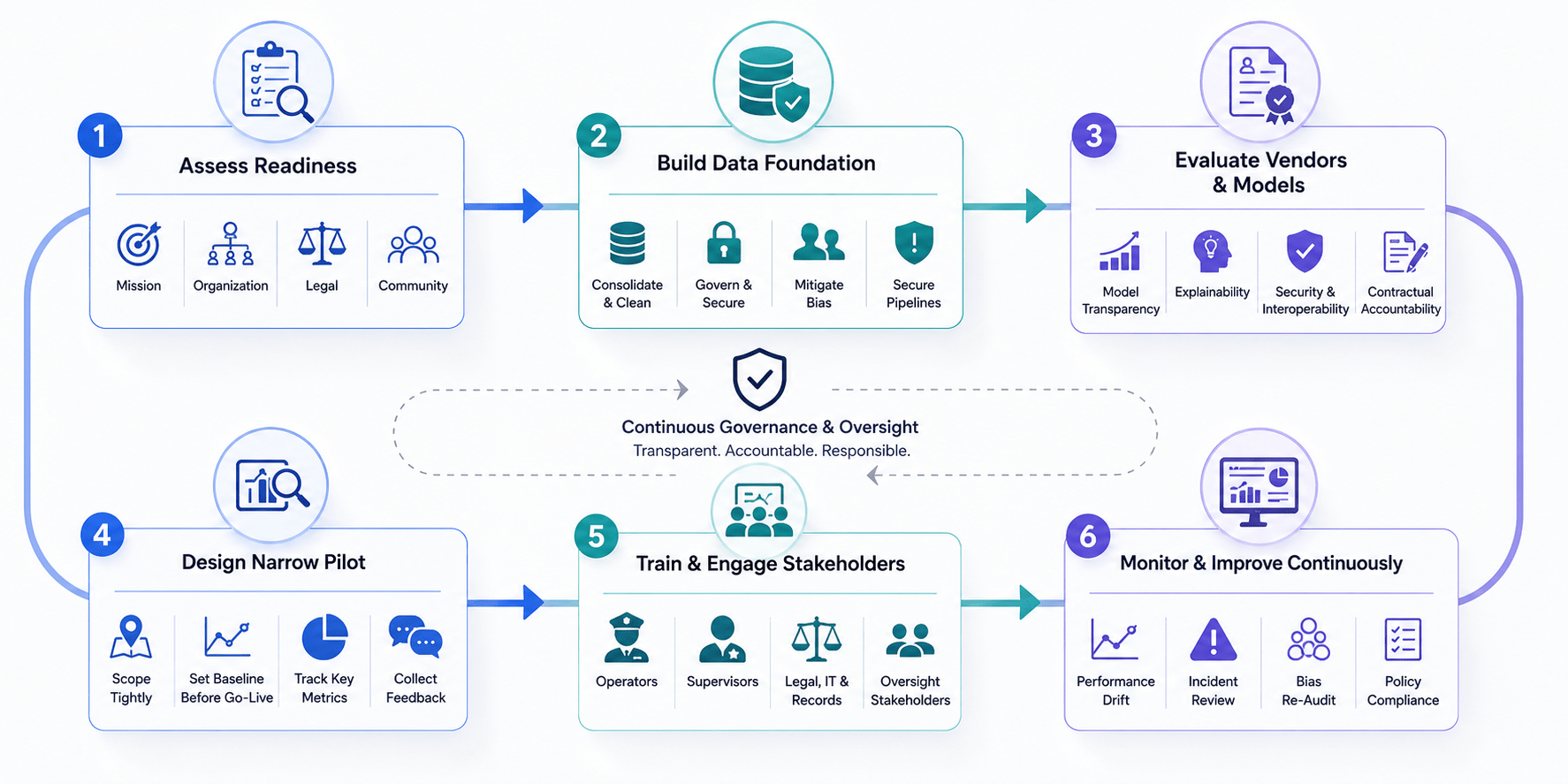
This section lays out the deployment lifecycle referenced throughout the article: assess, govern, prepare data, evaluate vendor, pilot, train, monitor, audit. It applies to any use case selected using the framework in Section 4, though the intensity of each step should scale with that use case’s risk score.
Assess Mission, Organizational, Legal, and Community Readiness
Readiness assessment happens on four tracks simultaneously, not sequentially:
- Mission readiness – is there a specific, measurable operational problem (not a general aspiration to “modernize”)?
- Organizational readiness – does existing infrastructure support the data flows an AI tool would need, and are there internal owners assigned before procurement begins?
- Legal readiness – does a jurisdiction-specific legal gap analysis, run with counsel, confirm the intended data use and system function are currently permitted? Some jurisdictions restrict specific capabilities (facial recognition being the most common example), which may require scoping the use case differently from how it’s marketed by a vendor.
- Community readiness – has the agency engaged community stakeholders and oversight boards before deployment, so that both what the system will do and what it explicitly will not do are publicly understood?
Skipping the community track is the single most common reason otherwise well-governed pilots face public backlash after the fact rather than support during rollout.
Build a Secure, Governed Data Foundation
Nearly every downstream governance requirement – bias testing, explainability, auditability – depends on data infrastructure decisions made before a model is ever selected.
- Consolidation and hygiene: standardized naming conventions, metadata tagging, and timestamp accuracy across previously siloed systems (incident logs, arrest records, video, forensic databases).
- Governance and access control: encryption, role-based access, and internal accountability for personally identifiable information, with documented data lineage from source to use.
- Bias mitigation at the data layer: since historical law-enforcement data often reflects patterns of over-policing in specific communities, agencies need representative training data and ongoing bias auditing – not a one-time check before launch.
- Security posture: data pipelines feeding an AI system are a new attack surface; this should be assessed alongside, not after, model selection. SmartDev’s overview of balancing AI innovation with data security covers the core trade-offs involved.
Evaluate Vendors, Models, Documentation, and Contractual Accountability
Vendor selection is where legal liability, operational outcomes, and public accountability converge into a single decision. A defensible evaluation requires:
- Model documentation: accuracy benchmarks broken out by demographic and environmental variables (not just an aggregate figure), known failure modes, and validation methodology.
- Explainability: officers and supervisors need to understand why a system produced a given output, not just what it output.
- Security and interoperability: data-lineage protections, access logging, system auditing, and confirmed interoperability with existing CAD, RMS, or body-worn camera infrastructure.
- Contractual accountability: liability and remediation responsibilities defined explicitly before signature — if an AI tool contributes to a wrongful arrest or misidentification, the contract should already answer who is responsible and how it gets remediated, rather than leaving that for a dispute to resolve.
Agencies without in-house AI evaluation capacity often benefit from an external technical partner at this stage; SmartDev’s AI Consulting Services and AI Development Services are built around this kind of vendor- and build-evaluation work.
Design a Narrowly Scoped Pilot With Baseline Measures
A pilot’s value depends entirely on whether it can produce a clean before/after comparison – which means the design decisions happen before the pilot starts, not during analysis afterward.
- Scope tightly: by geography, use case, or time window, focused on lower-risk workflows per the Section 4 framework (administrative processing, non-violent incident triage) rather than the highest-visibility use case first.
- Establish a baseline before go-live: if testing AI-generated incident reports, measure the average pre-AI report-writing time first – a metric introduced only after deployment can’t support a real before/after comparison.
- Track more than the headline metric: alongside time savings or efficiency gains, monitor error rates, downstream review burden, and user (officer and community) perception of fairness and trust.
- Collect qualitative feedback in parallel: officers, supervisors, and – for public-facing use cases – community members, to catch usability or legitimacy problems a pure metrics dashboard would miss.
For agencies structuring this stage formally, a short, defined discovery sprint – such as SmartDev’s 3 Weeks AI Discovery Program – can help translate this pilot design into a scoped, time-boxed engagement rather than an open-ended trial.
Train Operators, Supervisors, Legal Teams, and Oversight Stakeholders
Training is an ongoing commitment, not a one-time rollout event, and it needs to reach beyond the officers directly using a tool day to day.
- Operators (officers and analysts) need to understand not just how to use a tool, but its limits – a facial-recognition match is an investigative lead, not evidence of guilt, and training should reinforce that distinction through scenario-based exercises rather than a policy memo alone.
- Supervisors need to be part of the same training so they can reinforce policy expectations and serve as first-line support for judgment calls in the field.
- Legal teams, records staff, and IT administrators need enough operational understanding of the system to respond credibly to audits, legal challenges, or public-records requests – this is often the most under-resourced part of a training rollout.
- Oversight stakeholders (community boards, inspector general functions) need visibility into what the system does and how it’s being monitored, not just a one-time briefing before launch.
Monitor Performance, Incidents, Bias, and Policy Compliance After Deployment
Deployment is the start of an ongoing monitoring obligation, not the finish line of the implementation process. A defensible post-deployment program tracks four things continuously:
- Performance drift: model accuracy and error rates can degrade as real-world conditions shift from the data the system was trained on; scheduled re-validation – not a one-time launch benchmark – catches this before it becomes a pattern of harm.
- Incident review: every case where an AI output contributed to a consequential action (arrest, detention, disciplinary flag) should be logged and periodically reviewed, particularly when the outcome was later found to be incorrect.
- Bias re-auditing: the same demographic and geographic fairness testing done before launch needs to be repeated on an ongoing basis, since a model’s real-world error distribution can shift as usage patterns and input data evolve.
- Policy compliance: confirming, on a set cadence, that actual use in the field still matches the scope the system was authorized and communicated for – scope creep from an approved narrow use case into broader application is one of the more common ways a well-governed pilot becomes a public-trust problem.
This monitoring layer is what makes every other step in this section defensible after the fact – it’s the same discipline described in Section 3’s discussion of auditable AI decision logs, applied continuously rather than only at launch. SmartDev’s AI Development Sprint Audit white paper outlines a structured approach to this kind of ongoing technical and governance review.
Measuring Value, Safety, and Public Trust
Efficiency gains are the easiest outcome to measure and the least sufficient one to report alone. A tool can save hours on report drafting while still producing disparate error rates across demographic groups, or reduce response time while eroding the community trust that made rapid response possible in the first place. A defensible measurement program treats value, reliability, safety, equity, privacy, accountability, and trust as seven linked dimensions of one scorecard – not a menu to report from selectively.
A Balanced Scorecard for AI in Law Enforcement
Each metric below requires three things before it means anything: a baseline measured before deployment, a defined measurement window over which it’s tracked, and a documented statement of what the metric does not capture.
| Dimension | Representative KPIs | Baseline Required | Measurement Window | Known Limitation |
|---|---|---|---|---|
| Operational value | Time-per-case, report-drafting time, response time, case clearance rate | Pre-deployment average for the same process | Rolling, compared pilot-to-pilot | Says nothing about accuracy, fairness, or downstream harm |
| Reliability | Model accuracy, uptime, drift versus training baseline | Initial validation benchmark | Continuous, with scheduled re-validation | Aggregate accuracy can mask large subgroup variation |
| Safety | False positive rate, false negative rate | Vendor-disclosed benchmark, independently tested where possible | Ongoing, reported per incident category | A low false-positive rate can coincide with a high false-negative rate (missed detections), and vendors rarely disclose both |
| Equity | Disparate impact across demographic and geographic groups | Population or historical baseline rate | Recurring audit cycle (e.g., quarterly) | Requires disaggregated data that many agencies do not yet collect |
| Privacy | Data-use compliance findings, access-log audit results | Authorized scope defined at procurement | Scheduled compliance audit | Compliance with stated scope doesn’t confirm the scope itself was appropriate |
| Accountability | Human-review completion rate, override rate | Policy-defined review requirement | Per-decision logging, reviewed periodically | A documented review isn’t the same as a substantive one |
| Trust | Appeal/redress volume and resolution time, complaint trends, community engagement indicators | Pre-deployment complaint baseline where available | Ongoing, reported publicly on a fixed cadence | Low complaint volume can reflect low awareness rather than high trust |
Reading any single row in isolation is where measurement programs go wrong in practice: a strong operational-value result and a weak equity result describe the same tool, not two different ones, and both belong in the same report.
Interpreting the Scorecard
Two disciplines make this scorecard usable rather than decorative. First, false negatives deserve equal billing with false positives – a facial-recognition or predictive tool that rarely flags the wrong person but also frequently misses the right one is not safer, just differently unreliable, and reporting only the false-positive figure produces an incomplete safety picture. Second, appeal and redress data should be tracked as a leading indicator, not an afterthought – a rising volume of appeals against AI-assisted decisions, or slow resolution times, is an earlier warning sign of a governance gap than a public incident is.
Agencies structuring this measurement work as part of a broader value case – particularly when justifying continued investment to budget owners – may find SmartDev’s AI Return on Investment (ROI): Unlocking the True Value of Artificial Intelligence for Your Business useful for framing value beyond the operational row of this scorecard alone.
Emerging AI Capabilities and Future Considerations
The following is a bounded watch list, not a forecast. Each item below is already in some stage of real-world use; none should be read as a recommendation to deploy without first applying the Section 4 framework.
Maturity Versus Risk
| Capability | Current Maturity | Risk Level | What to Watch |
|---|---|---|---|
| Generative AI for report drafting and summarization | Established, multiple documented pilots | Lower | Accuracy of summarization at scale; officer sign-off compliance |
| Multimodal investigative assistants (combining video, audio, text) | Emerging, early deployments | Medium-High | Data concentration risk as more evidence types combine in one system |
| Autonomous incident triage and dispatch routing | Emerging | Medium-High | How many decision points still require affirmative human action |
| Drone-based autonomous response | Emerging to maturing | Medium | Evolving rules on sensor use and airspace authorization |
| Behavioral/emotion-inference tools | Early-stage, limited deployment | High | Very limited independent validation of accuracy; highest misapplication risk in this list |
| “Precrime”-style risk scoring | Established in some custodial settings, contested in open policing | High | Ongoing legal and fairness challenges; treat as a maximum-scrutiny category under Section 4 |
Generative AI, Multimodal Systems, and Investigative Assistants
Generative AI use is expanding from the report-drafting use case in Section 3 toward broader investigative assistance – summarizing case files and combining multiple evidence types (video, audio, transcripts, documents) into a single investigative view. This is commonly referred to as multimodal AI. The governance implication is directional, not certain: a system that connects more evidence types in one place is likely to concentrate more sensitive data as well, which points toward tighter access controls and human-review requirements rather than looser ones. SmartDev’s Multimodal AI Examples: How It Works, Real-World Applications, and Future Trends and Generative AI Development Services cover the underlying capability and controls in more technical depth.
Autonomous Systems, Drones, and Evolving Intrusiveness
Drone-based response (Section 3) sits within a broader trend toward greater system autonomy — tools that act on information rather than only surfacing it, with progressively less direct human initiation at each step. This shift raises the intrusiveness dimension of the Section 4 framework in a specific way: autonomy affects not just what a system observes, but how much of a decision chain completes before a human is meaningfully involved. Agencies expanding into more autonomous triage or dispatch tools should treat the number of decision points still requiring affirmative human action as a tracked governance metric, not an implementation detail to be assumed.
Policy, Standards, and Public Expectations
Regulatory treatment of law-enforcement AI is not settled and should not be read as such. Risk-tiered frameworks — the EU’s AI Act being the most developed example — are pushing toward stricter obligations for higher-risk categories, which most core policing use cases fall into, while other jurisdictions continue to rely on a shifting patchwork of state and local rules, particularly around facial recognition. What can be said with reasonable confidence: public and regulatory expectations are moving from a one-time transparency disclosure at launch toward an ongoing, periodically renewed reporting relationship. What cannot be said with confidence is how quickly any specific jurisdiction’s rules will change, or in which direction — agencies should treat this section as a prompt to monitor their own applicable regulatory environment directly, not as a substitute for doing so.
FAQ (Frequently Asked Questions)
What are the most common uses of AI in law enforcement?
The most established uses of AI in law enforcement are intelligent document processing, AI-assisted report drafting, non-emergency public-safety chatbots, and crime-pattern analysis for resource allocation. Facial recognition and predictive policing are also widely used but carry higher scrutiny and, in some jurisdictions, legal restriction. See Section 3 for the full breakdown by workflow.
Can AI make policing decisions without human review?
No responsible deployment treats AI in policing as an autonomous decision-maker. Across every use case in this article, AI outputs – a facial-recognition match, a predictive flag – function as a lead requiring human confirmation before any consequential action, per the framework in Section 2.
What are the main risks of AI in policing?
The most documented risks are disparate error rates across demographic groups, undisclosed false-positive and false-negative rates, bias inherited from historical crime data, unclear legal authority across jurisdictions, and loss of public trust when AI use isn’t transparently reported and independently reviewed (Section 7).
How should an agency begin an AI pilot?
Start with the screening framework in Section 4: score the candidate use case on mission value, intrusiveness, data readiness, and human-review feasibility. Prioritize a lower-risk starting point, establish a measurable baseline before launch, and scope the pilot narrowly by geography or use case.
Conclusion
The evidence in this article supports a narrower claim than “AI improves policing”: AI delivers its clearest, most measurable value in lower-intrusiveness administrative and investigative workflows, while higher-visibility uses carry real potential value alongside a thinner evidence base and a materially higher governance requirement. The responsible path through this isn’t binary adoption or rejection – it’s proportional deployment, where the scrutiny applied to a use case scales with its intrusiveness and risk, safeguards are built in before launch rather than added after an incident, and measurement covers safety and equity as rigorously as efficiency. Agencies that treat governance as part of the deployment itself, rather than a compliance step layered on afterward, are best positioned to sustain both the value and the public trust an AI program depends on.
Next Steps
Where an agency goes next depends on how far along it already is:
- Learn more about a specific capability. Sections 3 and 8 outline current use cases and their maturity; SmartDev’s AI Consulting Services page covers how these capabilities are typically evaluated for a given operational context.
- Assess readiness before committing to a pilot. The Section 4 framework and Section 6 readiness checklist can be worked through internally, or with outside support – SmartDev’s AI Proof of Concept approach is built around this kind of scoped, evidence-gathering evaluation before full procurement.
- Discuss a specific implementation. For agencies with a defined use case and ready to talk through data, vendor, or build requirements, SmartDev’s team can walk through what that would involve.
Have a use case in mind and want a second opinion before procurement? Talk to SmartDev about where it fits on the Section 4 framework.