
TL;DR:
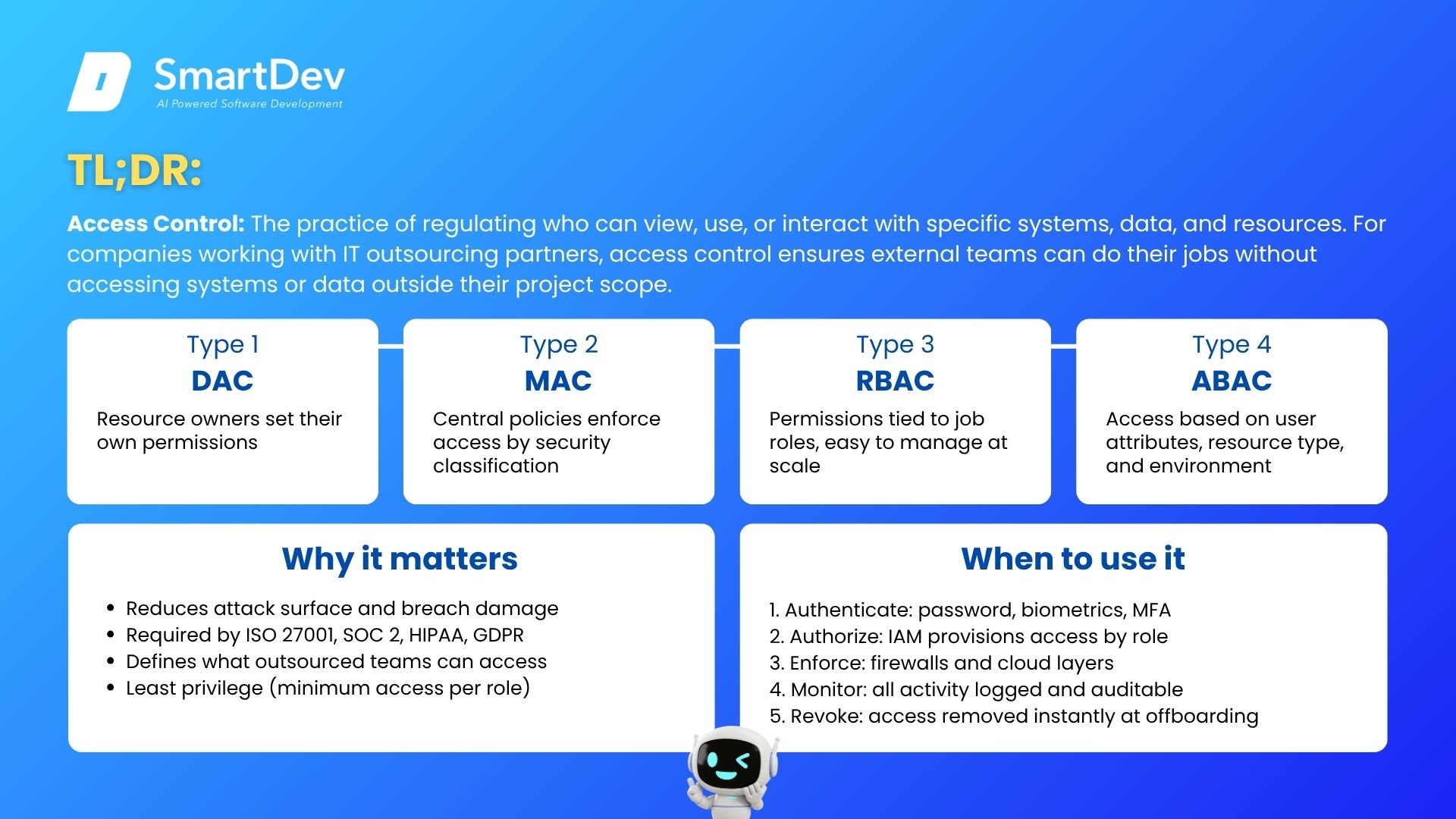
- Access control determines who can view, use, or modify specific systems, data, and resources within an organization.
- It is a critical security layer in IT outsourcing, protecting sensitive business data from unauthorized access by external teams.
- Proper access control policies reduce security risks, support regulatory compliance, and strengthen vendor management.
Managing who can access what within your business systems is not a minor administrative task. It is a foundational security discipline that protects intellectual property, client data, and operational continuity. For companies engaging IT outsourcing partners, access control becomes even more critical when external teams require access to internal systems and environments.
What is Access Control?
Access control is the practice of regulating who can view, use, or interact with specific resources within an organization’s digital environment. These resources include software applications, databases, networks, cloud environments, and physical infrastructure. Access control policies define the rules that govern how permissions are granted, modified, and revoked.
There are four primary types of access control used in enterprise settings. Discretionary Access Control (DAC) allows resource owners to set their own permissions for other users. Mandatory Access Control (MAC) enforces policies centrally based on security classification levels assigned to both users and resources. Role-Based Access Control (RBAC) assigns permissions according to job roles, making it easier to manage access across large teams. Attribute-Based Access Control (ABAC) makes access decisions based on a combination of user attributes, resource types, and environmental conditions, offering the most granular level of control.
In IT outsourcing relationships, access control governs the level of system access granted to external development teams, managed service providers, and third-party vendors. This ensures that outsourced personnel can perform their assigned roles without gaining visibility into unrelated systems or sensitive data outside their project scope. Defining these boundaries upfront is a best practice that protects both the client and the vendor.
Why It Matters for Businesses?
Access control directly impacts a company’s security posture, regulatory compliance, and ability to manage third-party risk. Without clearly defined access policies, organizations face increased exposure to data breaches, insider threats, and compliance violations that can disrupt operations and damage client trust.
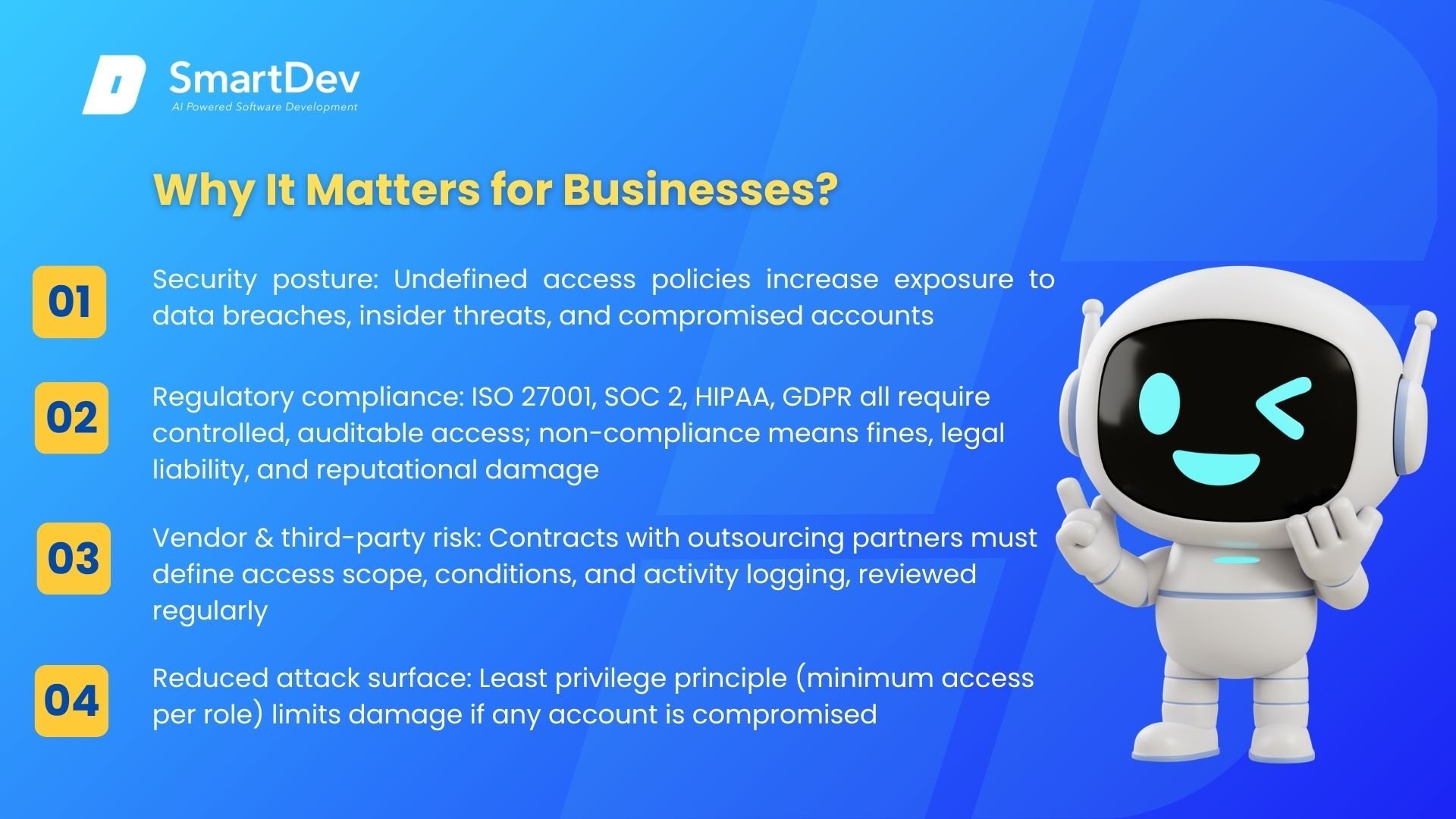
From a regulatory perspective, frameworks such as ISO 27001, SOC 2, HIPAA, and GDPR all require organizations to demonstrate that access to sensitive information is controlled and auditable. Failure to meet these requirements can result in significant financial penalties, legal liability, and lasting reputational damage. For businesses in regulated industries such as financial services, healthcare, and government contracting, access control is not optional.
For C-level executives and IT managers, access control is also a governance concern tied directly to vendor management. When working with outsourcing partners, it is essential to define access scopes clearly within contracts and technical agreements. This includes specifying which systems the vendor team can access, under what conditions, and what logging mechanisms are in place to track all activity. These parameters should be reviewed and updated regularly throughout the engagement.
Operationally, well-managed access control reduces the attack surface available to malicious actors and limits the potential damage if a compromised account occurs. Applying the principle of least privilege, where users are given only the minimum access needed to perform their specific job, is the most effective approach for both internal employees and external vendors.
How Does Access Control Work?
Access control systems operate through a combination of authentication and authorization mechanisms. Authentication verifies the identity of a user attempting to access a system, typically through passwords, biometrics, or multi-factor authentication (MFA). Authorization then determines what that verified user is permitted to do within the system and which resources they can reach.
In a typical enterprise setup, an Identity and Access Management (IAM) platform manages user identities, groups, and permissions centrally. When an outsourcing team member requires access to a development or staging environment, the IAM system provisions their credentials according to predefined roles and access policies. All session activity is logged, and access can be revoked instantly when the engagement concludes or when the individual changes project responsibilities.
Access control enforcement points include operating systems, network firewalls, API gateways, database management systems, and cloud platforms. Each layer adds an additional level of control, reducing the risk of unauthorized lateral movement within the infrastructure if one point is compromised.
Modern access control increasingly incorporates Zero Trust Architecture, which operates on the assumption that no user or system inside or outside the network perimeter should be trusted by default. Every access request must be continuously authenticated and authorized, regardless of the user’s physical location or network connection.
Who Manages Access Control?
Access control is a shared responsibility that spans multiple roles within an organization. The Chief Information Security Officer (CISO) sets the overall access control strategy and policy framework. IT security teams are responsible for implementing and maintaining access control systems, including the configuration of IAM tools and the ongoing monitoring of access logs and alerts.
In outsourcing relationships, the client’s IT department typically retains control over access provisioning for vendor teams. The outsourcing partner may designate a security liaison who coordinates with the client’s team to ensure access requests are processed correctly and permissions are revoked promptly upon offboarding.
Project managers and team leads on both sides play a direct operational role in day-to-day access management. They are typically responsible for submitting access requests on behalf of their team members and for notifying the IT department when access is no longer needed. In regulated industries, compliance officers are also frequently involved in reviewing access control policies and ensuring audit trails meet regulatory standards.
HR departments participate during onboarding and offboarding cycles, particularly in ensuring that access credentials are created at the start of an engagement and immediately disabled when an employee or contractor departs.
Other Related Terms
AI Security & Compliance: The practices and controls that protect AI systems from misuse, data breaches, and regulatory violations. Access Control is a foundational layer within any AI Security and Compliance program, determining who can interact with AI systems, which data they can reach, and what actions they are permitted to take.
Data Privacy: The set of policies and practices that govern how personal and sensitive data is collected, stored, and used. Access Control is one of the primary technical mechanisms that enforces Data Privacy in practice, ensuring that only authorized individuals can view or process protected information within a system.
Data Governance: The framework of policies, roles, and standards that ensure data is accurate, consistent, and used appropriately across an organization. Access Control sits within the Data Governance framework as the enforcement layer, translating governance policies into concrete permissions that determine who can read, modify, or delete specific data assets.