
TL;DR
- Automation Testing uses software tools to run tests on your application automatically, replacing slow and error-prone manual checks.
- It speeds up release cycles, catches bugs earlier, and reduces the cost of quality assurance at scale.
- Many companies outsource automation testing to gain immediate access to expert engineers and established frameworks without building the capability in-house.
Automation Testing has become a standard practice for companies that want to ship software faster without sacrificing quality. As release cycles shorten and applications grow more complex, manual testing alone can no longer keep pace. This article explains what automation testing is, why it matters, and what it costs.
What is Automation Testing?
Automation Testing is the practice of using specialized software tools to execute test cases on an application automatically, compare results against expected outcomes, and report any failures, without requiring manual intervention for each test run. It replaces repetitive manual testing tasks with scripts that can run in seconds across thousands of scenarios.
Common types of automated tests include:
- Unit tests: Test individual functions or components in isolation to confirm they work correctly on their own
- Integration tests: Verify that multiple components or services work correctly when connected
- Regression tests: Re-run a full suite of existing tests after a code change to confirm nothing previously working has broken
- End-to-end tests: Simulate real user journeys through the application from start to finish
Why It Matters for Businesses?
Every time your team releases new code without adequate testing, you risk shipping bugs to customers. Manual testing at scale is slow, inconsistent, and expensive. Automation Testing solves this by making quality assurance repeatable, fast, and cost-effective across every release.
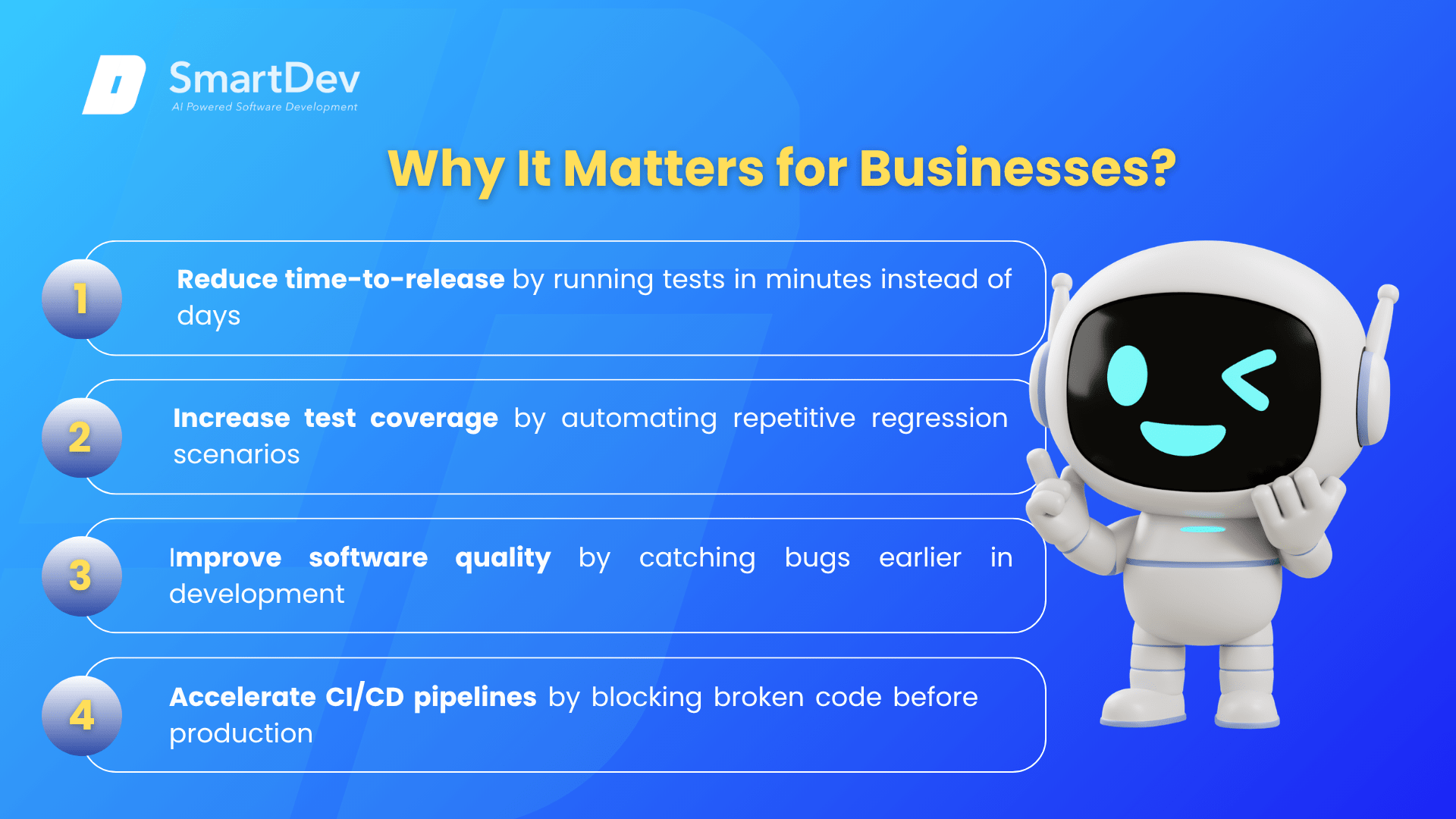
- Reduce time-to-release by running thousands of test cases in minutes instead of days of manual effort
- Increase test coverage by automating repetitive regression scenarios that manual testers cannot realistically run every sprint
- Improve software quality by catching bugs earlier in the development cycle, where they are 5 to 10 times cheaper to fix
- Accelerate CI/CD pipelines (Continuous Integration and Continuous Delivery) by integrating automated tests that block broken code from reaching production
For example, an e-commerce company that automated its regression test suite reduced post-release bug reports by 60% and cut its QA cycle from two weeks to under two hours per release. The team was able to ship new features every week instead of every month.
How Does Automation Testing Work?
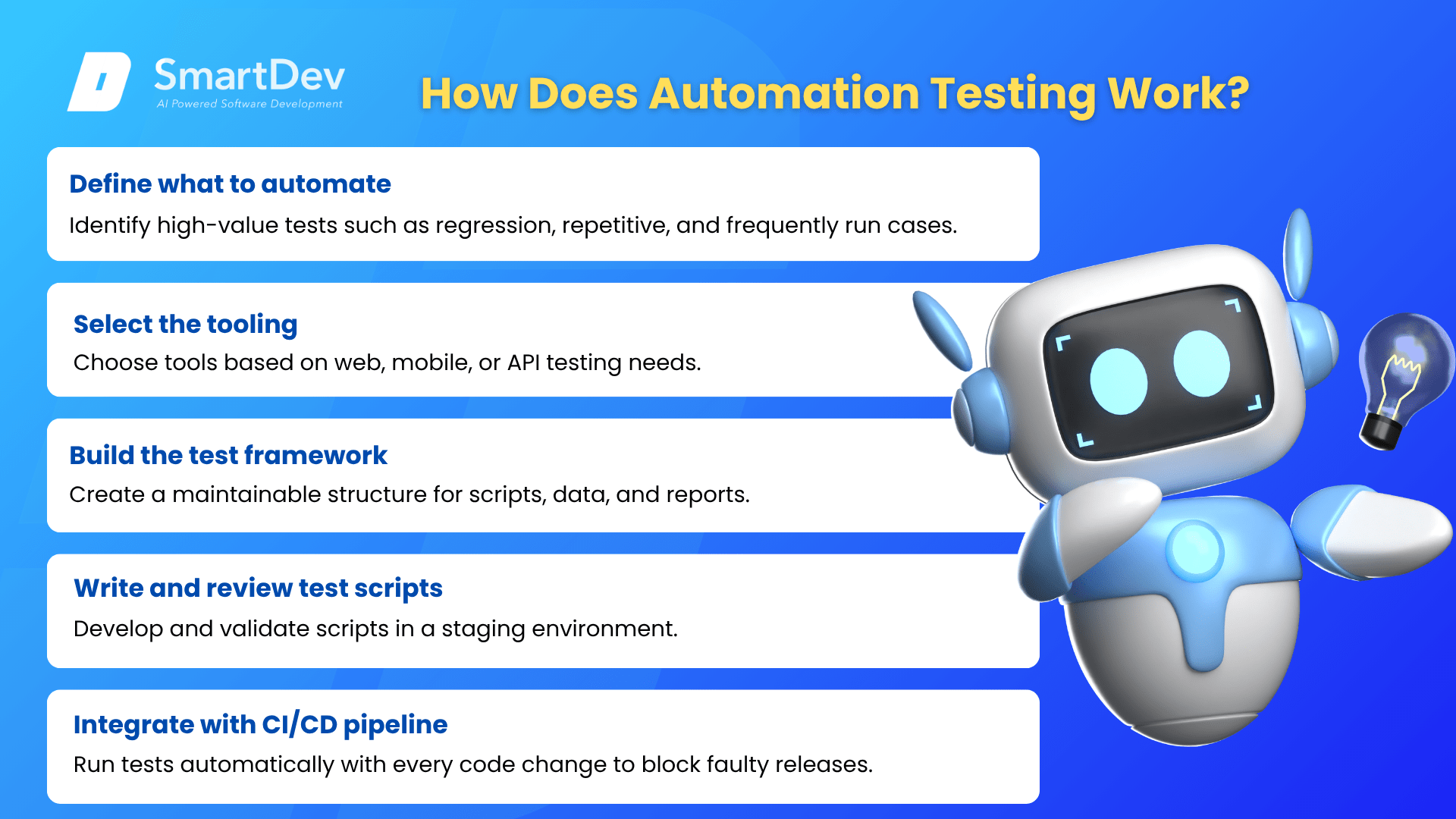
- Define what to automate: Not every test is worth automating. The team identifies high-value candidates: repetitive tests, regression suites, and tests that run with every code change.
- Select the tooling: Tools are chosen based on the application type. Common examples include Playwright or Selenium for web interfaces, Appium for mobile, and Postman or REST Assured for APIs.
- Build the test framework: Engineers design a structured framework for organizing test scripts, managing test data, and generating reports, ensuring tests stay maintainable as the codebase grows.
- Write and review test scripts: Test scripts are written for each automated scenario, reviewed for accuracy, and run against a staging environment to validate they catch the right issues.
- Integrate with CI/CD pipeline: Automated tests are connected to the deployment pipeline so they run automatically every time new code is submitted, blocking releases that fail any critical test.
The result is a quality gate that runs continuously, giving development teams confidence to ship faster without guessing what might break.
How Much Does Automation Testing Cost?
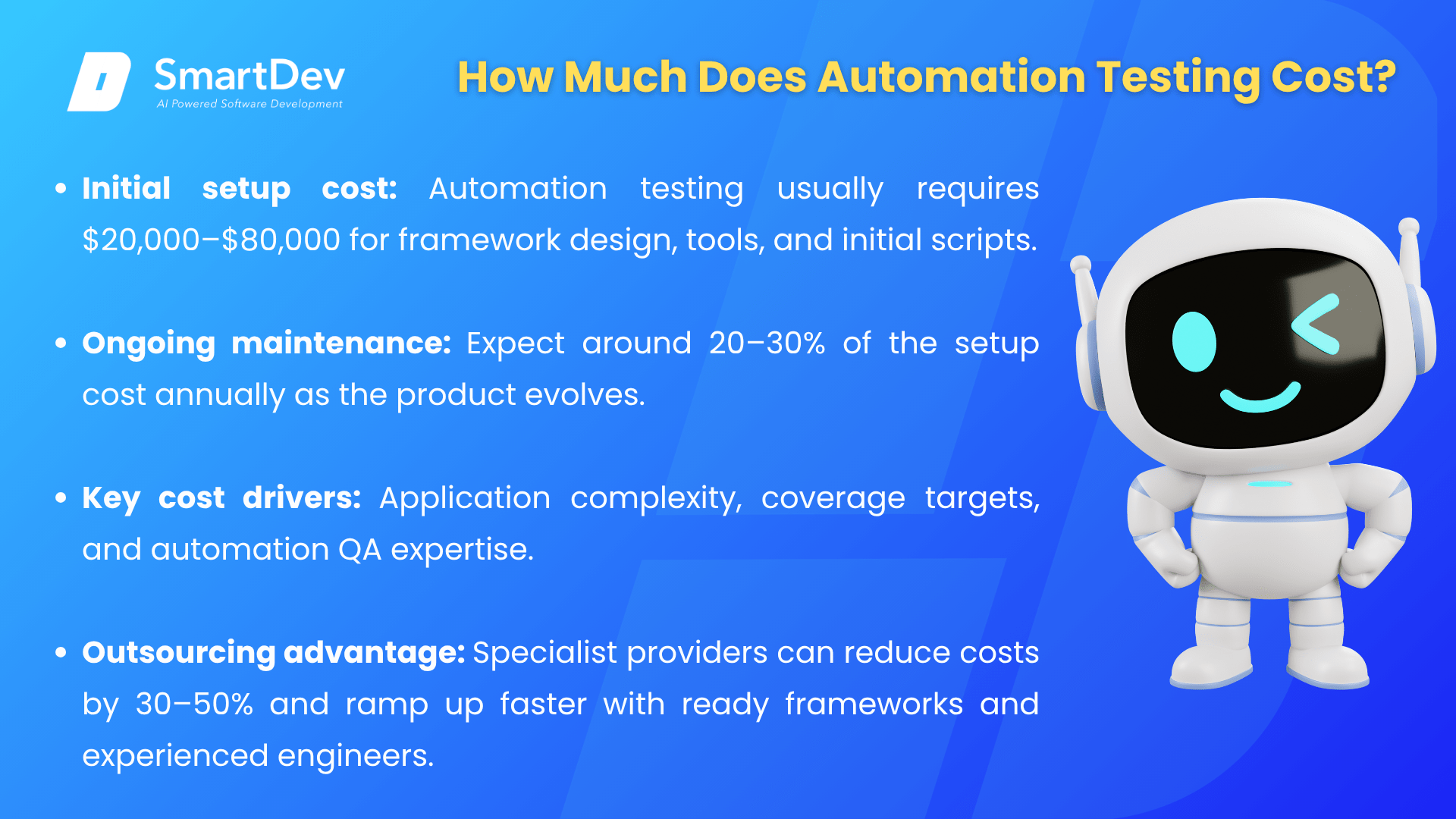
Setting up an automation testing practice typically requires an initial investment of $20,000 to $80,000 for framework design, tooling, and initial script development, depending on the size and complexity of the application. Ongoing maintenance runs at roughly 20 to 30% of that annually as the product evolves.
Three factors that affect automation testing cost:
- Application complexity: More user journeys, integrations, and platforms (web, mobile, API) mean more scripts to build and maintain
- Test coverage targets: Higher coverage (testing more of the application) requires more engineering time and tooling investment
- Team expertise: Building automation in-house requires experienced QA engineers with automation skills, who command higher salaries than manual testers
Outsourcing automation testing to a specialist provider typically costs 30 to 50% less than hiring a dedicated in-house team, while delivering faster ramp-up since the provider brings pre-built frameworks and experienced engineers from day one.
Other Related Terms
- Client Retention: The process of engaging and satisfying customers so they continue doing business with a company over a defined period. It is often measured using metrics such as retention rate, churn rate, and customer lifetime value.
- Technical Proposal: Acts as a foundational document in Business-to-Business (B2B) deals. You see it often in Information Technology (IT), engineering, and construction.
- Delivery Management: The practice of planning, coordinating, and overseeing the successful delivery of products or services from initial concept to final release.