TL;DR:
- A complexity threshold is the tipping point where a system, task, or project becomes too intricate to manage without specialized tools, processes, or expertise.
- For businesses, crossing this threshold signals a need to reassess existing workflows, technology choices, or team capabilities.
- Identifying your complexity threshold early can save significant time, budget, and risk in enterprise IT projects.
Every software project starts simple. But at some point, the moving parts multiply, dependencies stack up, and what once felt manageable becomes overwhelming. That turning point has a name: the complexity threshold. For business leaders overseeing IT projects or outsourcing decisions, understanding this concept is essential to keeping initiatives on track and budgets intact.
What is Complexity Threshold?
A complexity threshold is the point at which a system, process, or project becomes difficult to understand, manage, or control without introducing additional structure, tools, or expertise. Think of it as a limit on how much intricacy humans or systems can absorb before performance degrades, errors multiply, or control is lost.
In software development, this threshold is reached when the number of interconnected components, business rules, or data flows exceeds the capacity of a team or tool to handle without specialized support. Once crossed, teams often encounter slower delivery, higher defect rates, rising costs, and unpredictable outcomes.
In the context of AI, the complexity threshold has additional meaning. An AI system crosses its threshold when it becomes so intricate that human operators can no longer fully understand, predict, or audit its behavior. This introduces risk for enterprises that depend on AI outputs for business-critical decisions.
The concept matters because most organizations do not recognize the threshold until they have already crossed it. Systems grow incrementally. Features are added. Integrations multiply. Before long, what started as a manageable platform becomes a fragile ecosystem that only a handful of specialists can maintain.
Why It Matters for Businesses?
Recognizing the complexity threshold is not an academic exercise. It has direct, measurable impact on business outcomes.
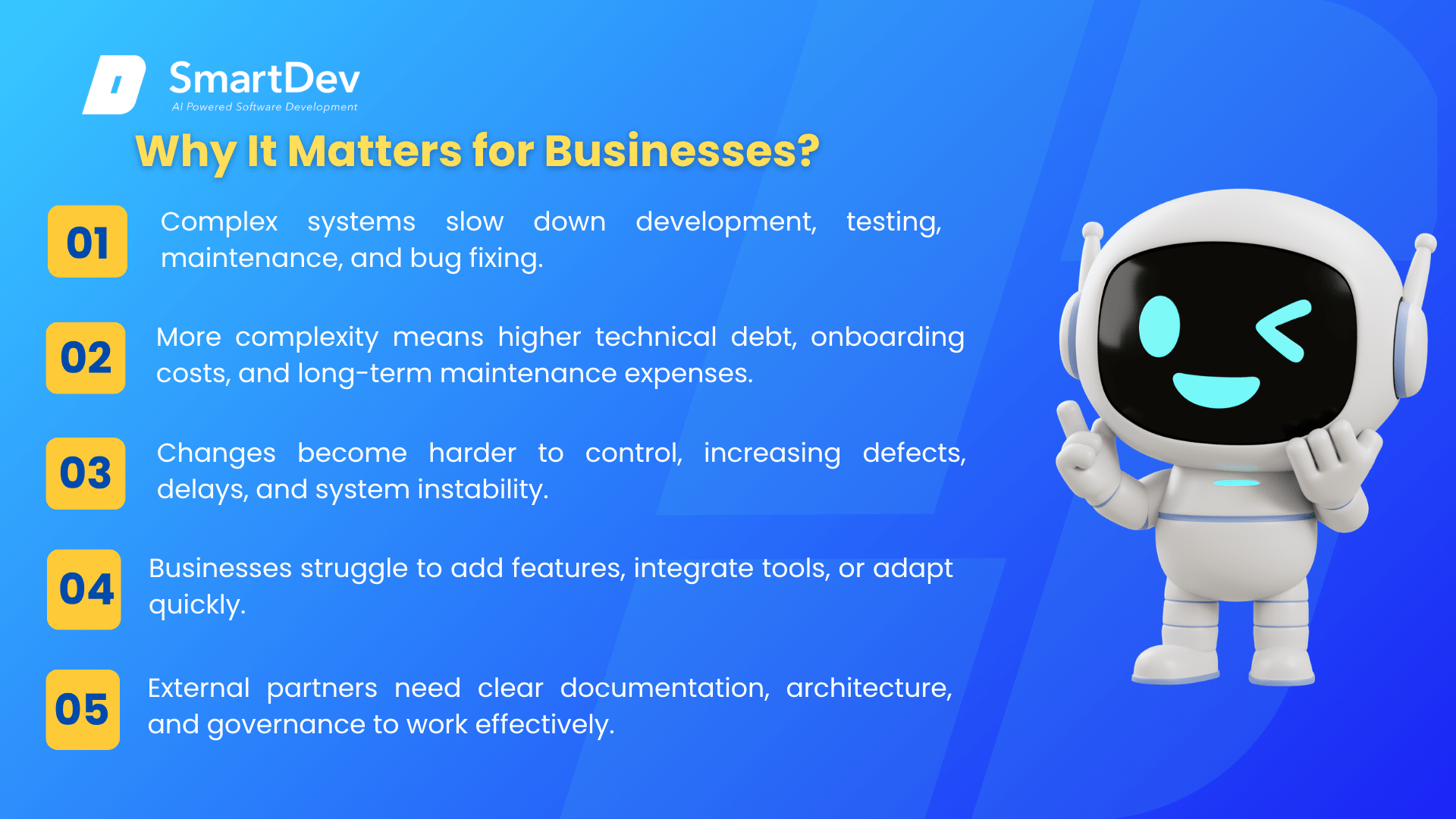
When a software project crosses the complexity threshold without the right safeguards, teams slow down. Code becomes harder to change without causing unintended side effects. Testing takes longer. Onboarding new developers becomes expensive. Bugs that once took hours to fix now take days.
For organizations engaged in IT outsourcing, this threshold is particularly significant. Outsourcing partners are often brought in precisely because complexity has grown beyond what internal teams can handle. But if the threshold is not identified upfront, even skilled outsourcing partners will struggle without proper documentation, clear architecture, and governance structures.
Financially, complexity has a compounding cost. Analysts estimate that technical debt, which often signals a system approaching or past its complexity threshold, costs enterprises billions annually in maintenance and rework. Avoiding or managing this threshold early means lower total cost of ownership and faster time to market.
Leaders who understand complexity thresholds are better positioned to make sound decisions: when to simplify, when to invest in better tooling, when to bring in specialized expertise, and when an outsourcing partner is the right move.
How Do Businesses Identify Their Complexity Threshold?
Identifying a complexity threshold requires both observation and measurement. There is no single metric that applies to every organization, but there are clear warning signs.
On the technical side, indicators include rising defect rates, slower release cycles, and increasing time to diagnose and fix issues. These signal that the system is growing beyond the team’s ability to manage it comfortably.
On the organizational side, warning signs include over-reliance on specific individuals who hold critical knowledge, difficulty onboarding new team members, and recurring miscommunication between business stakeholders and technical teams.
Modern teams use a range of tools to measure and manage complexity. Cyclomatic complexity scores assess how many logical paths exist in code. Dependency maps visualize how tightly coupled systems have become. Architecture review boards flag areas of excessive entanglement before they become crises.
For business decision-makers, the practical approach is to establish regular review points in any IT initiative. At each checkpoint, assess whether the system’s current complexity is still within the team’s control. If the answer is no, that is the threshold being crossed, and action is needed.
How Can Outsourcing Help Manage Complexity Thresholds?
One of the most effective strategies for managing complexity thresholds in enterprise software is strategic outsourcing. When internal teams have reached the limits of what they can manage, bringing in an experienced IT outsourcing partner can provide both immediate relief and long-term structural improvement.
Experienced outsourcing partners bring specialized expertise that may not exist in-house. They have often encountered similar complexity challenges across multiple clients and industries. This cross-industry exposure means they arrive with tested frameworks for breaking down complex systems into manageable components.
Beyond pure technical support, outsourcing partners can provide architectural guidance, documentation practices, and modernization roadmaps, all of which directly address the factors that push systems past their complexity threshold.
For C-suite leaders, the key is selecting partners who will not simply add more complexity to manage, but who will actively reduce it through disciplined engineering practices and clear communication. The right partner understands that the goal is not just to deliver features, but to keep the overall system within a manageable, predictable, and auditable range.
Other Related Terms
Technical Debt – The accumulated cost of shortcuts and suboptimal decisions made during software development. Technical debt is one of the primary drivers that pushes systems toward and past their complexity threshold.
Technical Governance – The framework of policies, roles, and controls that determine how technology systems are approved, built, deployed, monitored, and retired within an organization.
Cognitive Load – The mental effort required to understand and work with a system. When cognitive load becomes too high for a team to handle reliably, it is a strong signal that the complexity threshold has been reached.