
TL;DR:
- A deterministic output is a response or result produced by an AI or software system that is always the same given the same input, with no randomness or variation.
- Deterministic systems are predictable, auditable, and easier to test, making them highly suitable for regulated industries and critical business processes.
- For enterprises evaluating AI tools, understanding whether a system produces deterministic or probabilistic outputs is essential for governance and compliance decisions.
Reliability is not a nice-to-have in enterprise software. It is a requirement. When a system must produce the exact same result under the same conditions, every time, without exception, deterministic output is what that means. As AI becomes embedded in business-critical processes, understanding determinism, and when it matters, is becoming a fundamental competency for enterprise leaders.
What is Deterministic Output?
A deterministic output is a result produced by a system where the same input, under the same conditions, always yields the same output. There is no randomness, no variability, and no element of chance. The system follows fixed, predefined rules, and those rules produce a consistent, predictable outcome every time they are applied.
This contrasts with probabilistic or non-deterministic systems, which introduce variability into their outputs. Large language models, the AI systems behind most modern AI tools, are inherently probabilistic. Ask the same question twice, and you may receive two different answers. The model draws from a statistical distribution of possible responses, producing outputs that vary with each call unless specific settings are applied to constrain that randomness.
In traditional software, most systems are deterministic by design. A payroll calculation that takes an employee’s hours and rate as input produces the same net pay figure every time those inputs are provided. A routing algorithm that receives a set of delivery coordinates produces the same optimal route under the same conditions. Business software has long operated on deterministic principles because predictability is essential to operational reliability.
As AI enters enterprise workflows, the distinction between deterministic and probabilistic behavior becomes a business-critical consideration. Some AI applications benefit from variability: creative writing, brainstorming, or natural customer conversation benefit from varied, human-sounding responses. Other applications demand strict determinism: regulatory reporting, financial calculations, fraud detection rules, and compliance workflows require consistent, auditable outputs that can be defended to a regulator or auditor.
Why It Matters for Businesses?
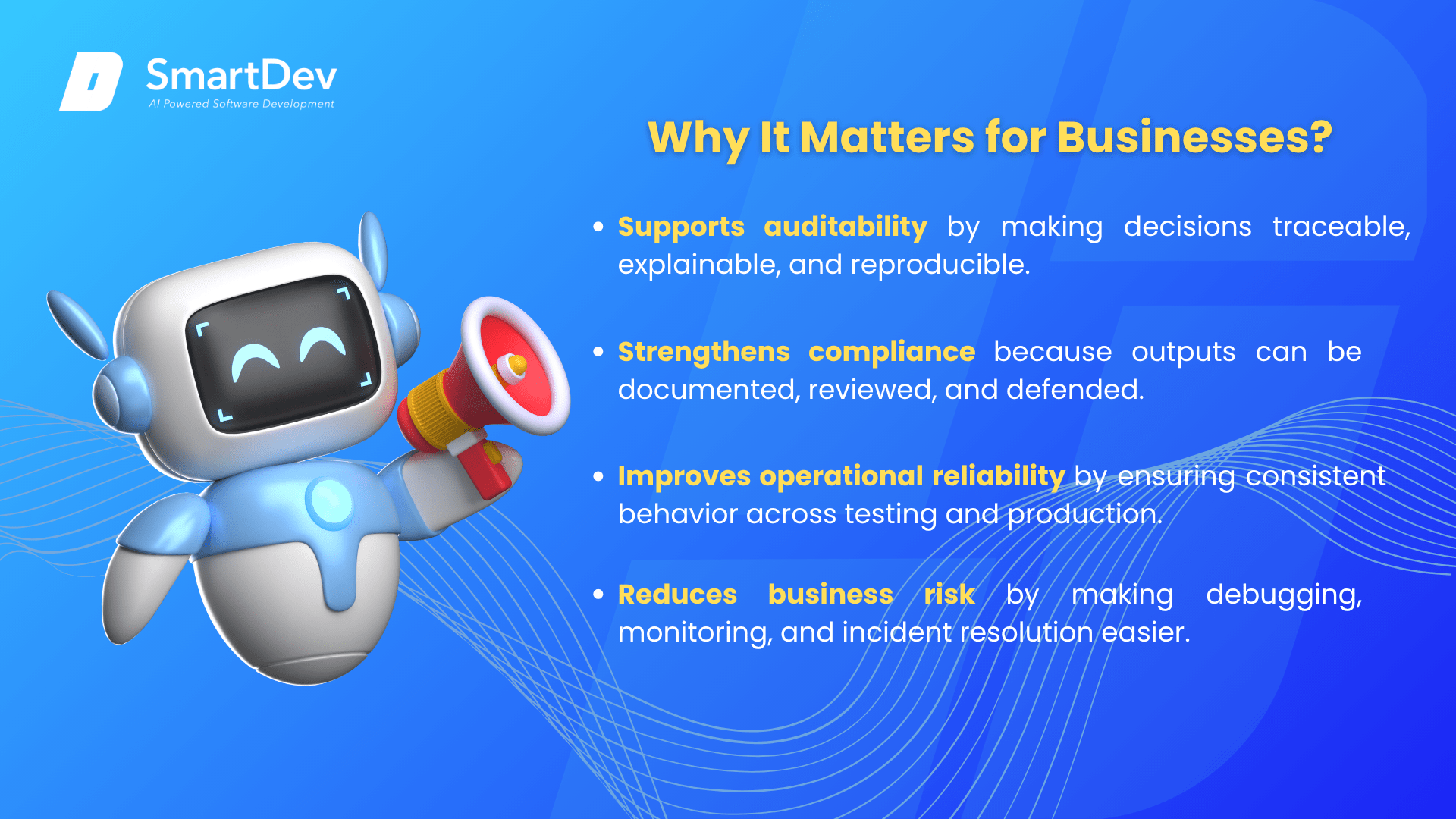
Deterministic output matters to businesses for three fundamental reasons: auditability, compliance, and operational reliability.
Auditability means that when a decision is made, it can be traced, explained, and reproduced. If a loan is approved or denied, a claim is accepted or rejected, or a transaction is flagged as suspicious, regulators and internal auditors expect to see a clear, logical path from input to output. Deterministic systems provide that path every time. Probabilistic systems, by definition, cannot guarantee that the exact same decision would be made again under the same conditions, creating an auditability gap that many regulated organizations cannot afford.
Compliance is closely related. In regulated industries such as financial services, healthcare, and legal services, decisions made by or with the assistance of AI systems must meet explainability standards. Deterministic AI produces outputs that can be documented, reviewed, and defended. Non-deterministic AI, whose outputs vary, creates a compliance challenge that many enterprises are not yet equipped to address at scale.
Operational reliability ensures that systems behave consistently under load, over time, and across environments. A deterministic system that is tested in a staging environment will behave identically in production, given the same inputs. This predictability simplifies testing, debugging, and incident resolution, reducing operational risk and the time engineers spend chasing inconsistent behavior.
How Is Deterministic Output Achieved in AI Systems?
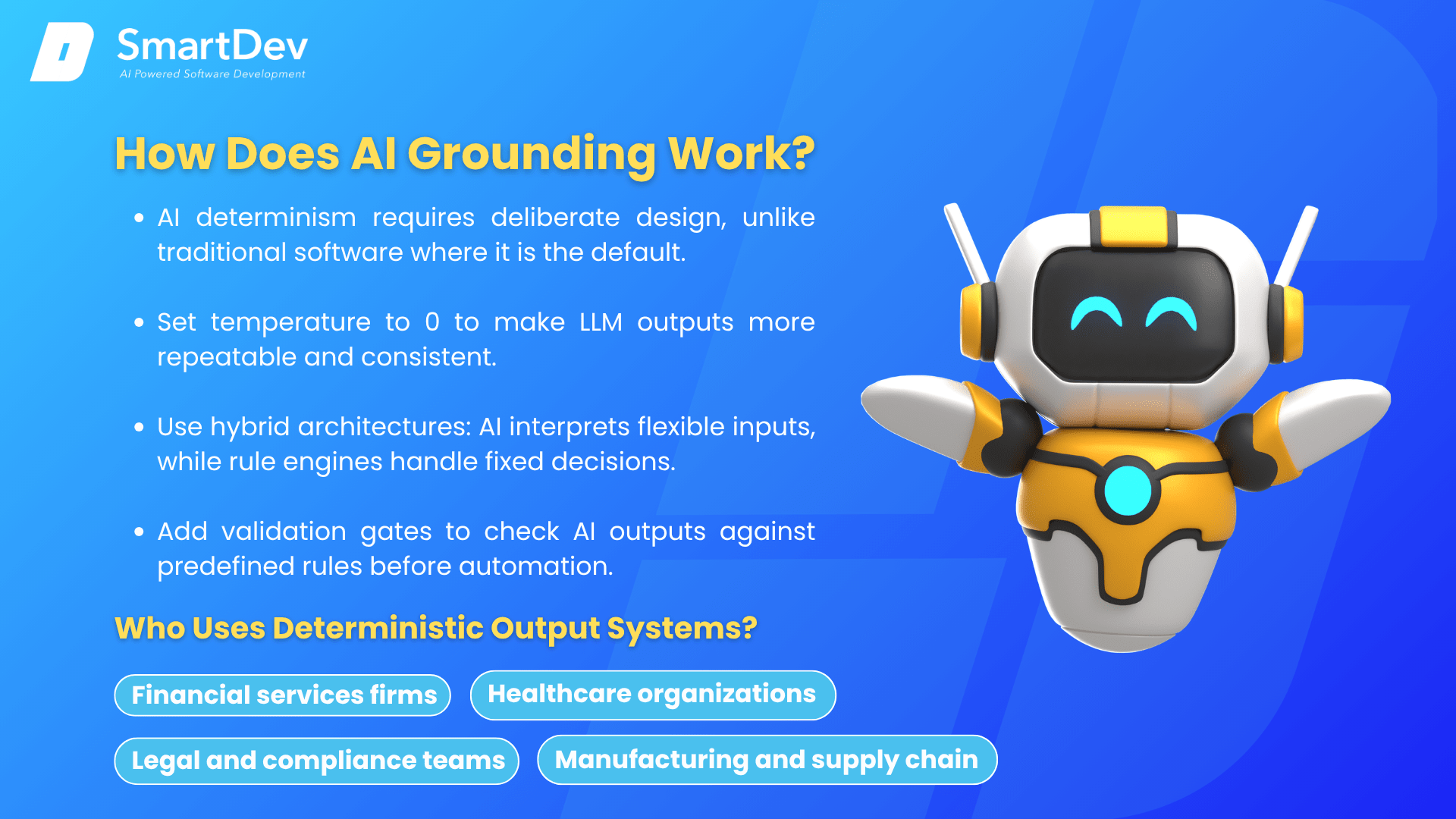
In traditional software, determinism is the default. In AI systems, it requires deliberate design choices.
For large language models, determinism can be approximated by setting the “temperature” parameter to zero. Temperature controls the randomness in the model’s output generation. At zero, the model consistently selects the highest-probability next token, producing highly repeatable outputs for identical inputs. This is not absolute determinism in a strict technical sense, as minor differences in infrastructure can still produce variation, but it delivers outputs consistent enough for many enterprise applications.
Hybrid architectures combine probabilistic AI with deterministic rule layers. In this design, the AI handles the parts of a task where flexibility adds value, such as interpreting a customer’s natural language input, while a deterministic rule engine handles the decision or calculation that follows. This architecture is increasingly common in enterprise AI deployments in financial services, insurance, and enterprise resource planning, where business logic must be consistently applied regardless of how the underlying request was phrased.
Validation gates provide another layer of assurance. After an AI produces an output, a deterministic validation layer checks the result against a set of predefined rules before passing it downstream. If the output does not meet defined criteria, it is flagged for review rather than processed automatically, combining the flexibility of AI with the reliability of rules-based governance.
Who Uses Deterministic Output Systems?
Deterministic output requirements are most common in industries where accuracy and accountability are non-negotiable.
Financial services firms rely on deterministic systems for regulatory reporting, credit scoring, and fraud detection. A fraud detection system that produces variable outputs for the same transaction pattern creates unacceptable audit risk and potential regulatory exposure.
Healthcare organizations use deterministic logic for dosage calculations, eligibility determinations, and insurance claim processing. Variability in these outputs has direct patient safety and financial implications that organizations cannot accept.
Legal and compliance teams apply deterministic AI tools for contract analysis and regulatory compliance checks, where consistent interpretation of specific clauses or requirements is essential to legal defensibility.
Manufacturing and supply chain operations use deterministic systems for production scheduling, quality control thresholds, and logistics optimization, where predictable, repeatable outputs are necessary for operational efficiency and customer commitments.
Other Related Terms
Probabilistic Output – AI systems that produce outputs based on statistical distributions rather than fixed rules, resulting in variability across responses even for identical inputs. The complement to deterministic AI, and the category into which most large language models fall by default.
AI Governance – The policies, processes, and controls that organizations put in place to ensure AI systems behave ethically, reliably, and in compliance with applicable regulations. Deterministic output is a key enabler of effective AI governance, providing the predictability that governance frameworks require.
AI Slop – Refers to low-quality content churned out by AI systems designed to maximize engagement, clicks, or revenue without regard for real value.