TL;DR:
- MCP (Model Context Protocol) is an open standard that lets AI agents connect to any business tool or data source through one universal interface, eliminating custom integration code for each new connection.
- It replaces dozens of point-to-point integrations with a single protocol, reducing integration development time by up to 30% and ongoing maintenance costs by up to 25%.
- MCP itself is free, but implementation costs range from $5,000 for simple setups to $100,000 or more for enterprise-scale deployments with governance and security controls.

Connecting AI to your business systems has always required custom-built integrations, one for each tool and one for each AI platform. MCP changes this by creating a single standard that any AI agent can use to talk to any business application. This article explains what MCP is, why it matters for your organization, and what it costs to implement.
What is MCP (Model Context Protocol)?
MCP (Model Context Protocol) is an open standard introduced by Anthropic in November 2024 that defines a universal interface for AI models to connect to external tools, data sources, and business applications. Often described as “USB-C for AI,” MCP allows any compatible AI agent to discover and use tools without requiring custom integration code for each new connection.
Before MCP, connecting an AI model to your CRM, internal database, and ticketing system required three separate custom integrations, each maintained independently. With MCP, each application exposes one standardized interface, and any MCP-compatible AI agent can use all of them immediately. The standard uses JSON-RPC 2.0 and defines how AI agents discover available tools, call them securely, and interpret responses.
Adoption has been rapid. As of early 2026, 78% of enterprise AI teams report at least one MCP-backed agent in production, up from 31% a year earlier. The protocol is now governed by the Agentic AI Foundation under the Linux Foundation, co-founded by Anthropic, OpenAI, and Block, with backing from Google, Microsoft, AWS, and Cloudflare.
Why It Matters for Businesses?
Every AI automation initiative eventually hits the same wall: integration complexity. Every new tool your business adopts requires a new connector, and every new AI platform requires those connectors to be rebuilt from scratch.
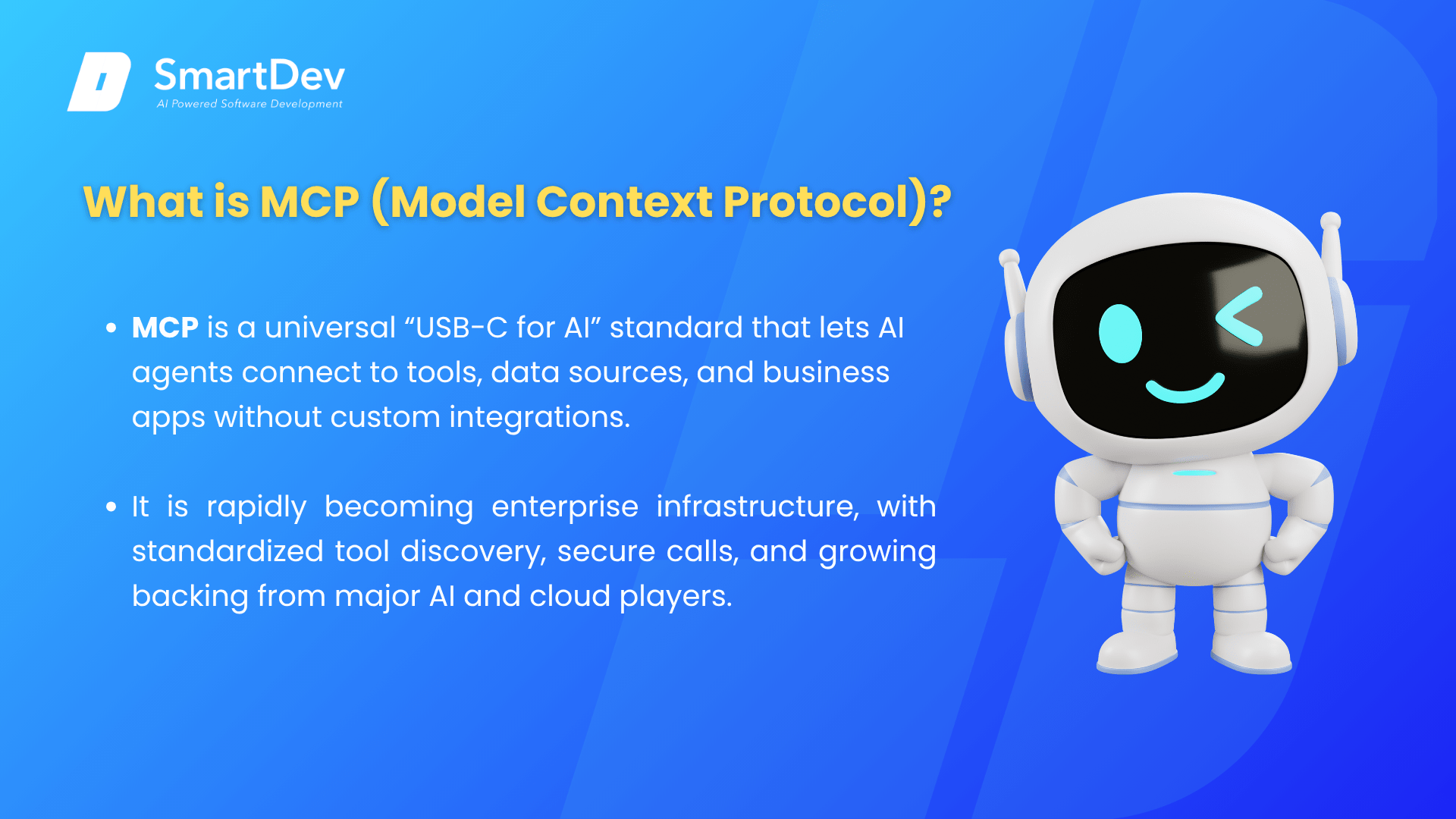
- Reduce integration development time by up to 30% by replacing custom connector code with MCP-compliant server implementations your teams build once and reuse across any AI platform.
- Increase AI agent capability by giving agents structured access to any MCP-enabled tool, from your CRM to your internal databases, without engineering a new integration each time.
- Improve security and governance by centralizing how AI agents are permitted to access business systems through one auditable, standardized protocol layer.
- Accelerate your agentic AI roadmap by building on an industry-wide standard backed by major cloud providers rather than a proprietary solution that creates vendor lock-in.
For example, a logistics company implemented MCP to connect their AI planning agent to their ERP, warehouse management system, and carrier APIs. The integration took three weeks instead of the estimated three months using traditional custom connectors. The agent now generates daily shipping plans autonomously, saving 12 hours of manual planning work each week.
How Does MCP Work?
MCP operates through three components that work together:
- MCP Servers. Each business application or data source runs an MCP Server, a lightweight service layer that translates the application’s existing API into the standardized MCP format. Your CRM, database, or analytics platform each publishes a list of tools it can perform, for example “get customer record,” “create support ticket,” or “run sales report.”
- MCP Clients. Your AI agent or assistant operates as an MCP Client. When the agent needs to take an action, it queries the available MCP Servers, discovers what tools exist, and calls them using the standardized protocol. No custom integration code is required on the agent side, so swapping AI platforms does not require rebuilding your connectors.
- Context management. MCP handles the communication between the agent and your tools, passing structured results back to the AI in a format the model can reason about. This allows agents to chain multiple tool calls together, for example: look up a customer record, check their order history, and then trigger a follow-up workflow, all within a single autonomous session.
The result is an AI agent that can operate across your entire business tool stack without requiring a custom integration for each new system it needs to access.
How Much Does MCP Cost?
MCP itself is free and open-source. All costs come from implementation and infrastructure.
Simple deployment (1 to 3 tools): Connecting a small number of internal tools to an MCP-compatible AI agent typically requires $5,000 to $15,000 in engineering time, primarily to build and configure MCP Servers for each application.
Mid-scale deployment (5 to 15 tools): Connecting a meaningful portion of the enterprise tool stack costs $20,000 to $60,000, including security review, access control configuration, and integration testing across tools.
Enterprise deployment: Large-scale MCP implementations with governance frameworks, audit logging, and custom tool development run $100,000 or more for the initial build, with lower ongoing maintenance costs compared to the equivalent number of custom point-to-point integrations.
The economic case is straightforward. Traditional integrations multiply: connecting five AI agents to ten tools requires 50 custom connectors to build and maintain. MCP replaces that with 10 MCP Servers and 5 MCP Clients, reducing ongoing maintenance costs by up to 25% and eliminating the need to rebuild connectors every time you change AI platforms.

Other Related Terms
AI Agent: An AI system that autonomously uses tools and takes multi-step actions to complete complex tasks. MCP is the primary standard enabling agents to connect to business applications at enterprise scale.
API (Application Programming Interface): The underlying interface that business applications expose to enable data exchange. MCP sits on top of APIs, making them discoverable and usable by AI agents without custom connector code for each new AI platform.
AI Grounding: The practice of anchoring AI responses to verified data sources. MCP supports grounding by giving AI agents structured, controlled access to your authoritative business systems rather than relying on static training data.