
TL;DR
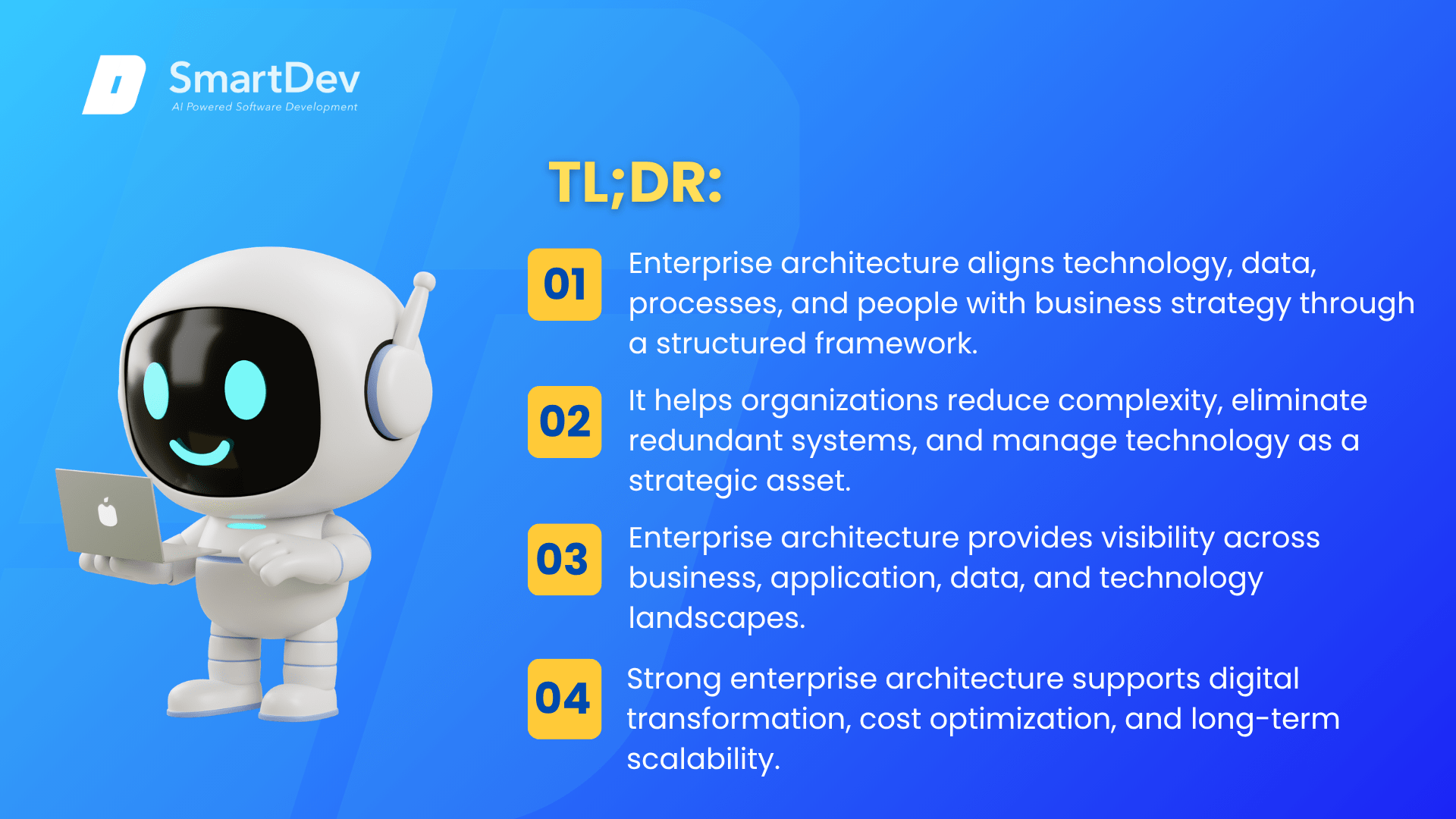
- Enterprise architecture is the discipline of aligning an organization’s technology systems, data, processes, and people with its strategic business goals through a structured planning and governance framework.
- Without it, organizations accumulate disconnected systems, duplicate capabilities, and mounting technical debt that make digital transformation slower and more expensive than it needs to be.
- A well-defined enterprise architecture reduces IT costs, accelerates decision-making, and enables business leaders to understand and manage the technology landscape as a strategic asset.
Enterprise architecture is what prevents a growing organization’s technology landscape from becoming an unmanageable tangle of disconnected systems. It provides the strategic blueprint that ensures technology investments align with business goals and work together rather than against each other. This article explains what enterprise architecture is, who uses it, and how it works in practice.
What is Enterprise Architecture?
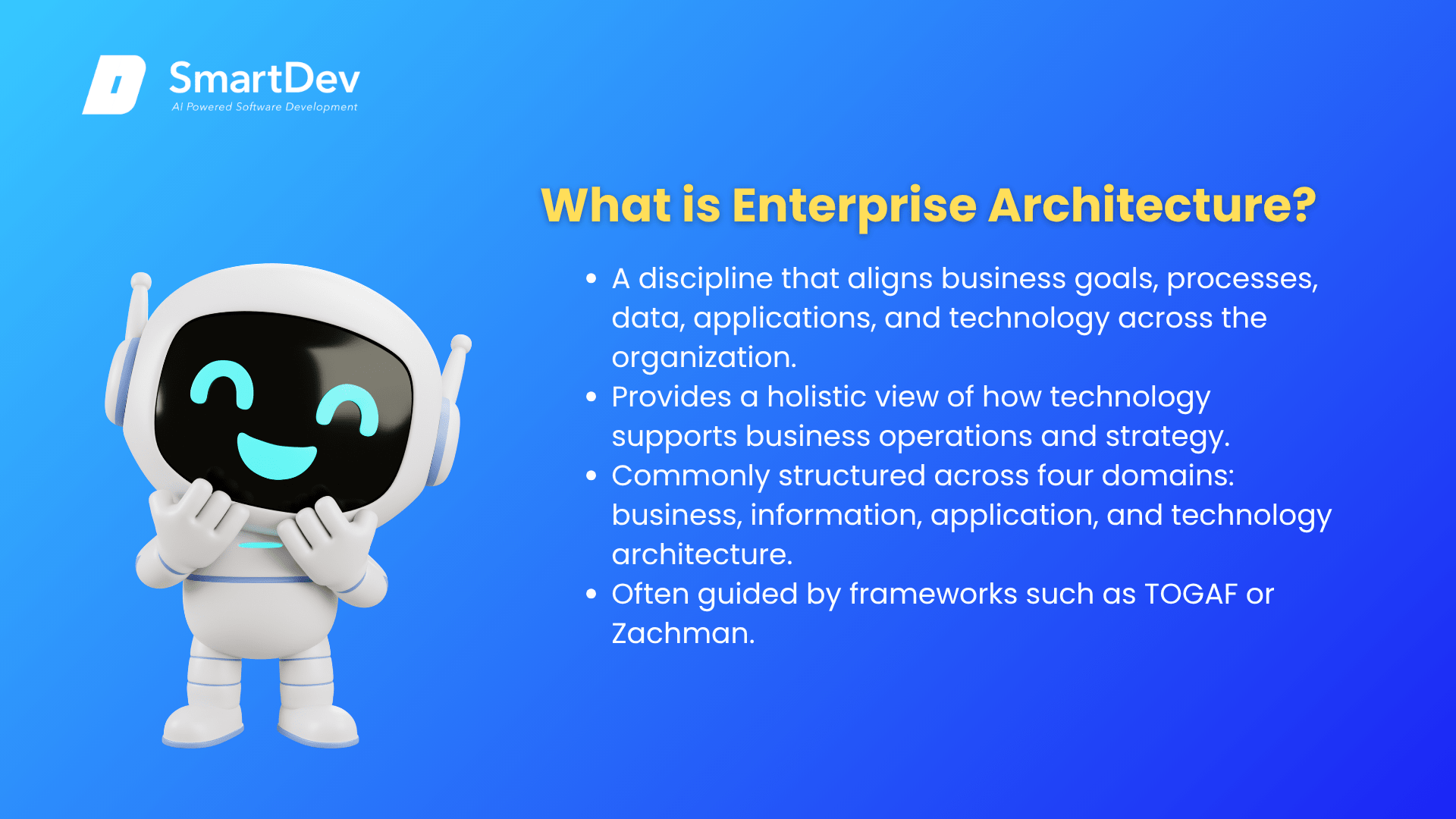
Enterprise architecture (EA) is a management discipline that defines how an organization’s strategy, business processes, information systems, data, and technology infrastructure are structured and aligned with each other to achieve business objectives. It provides a comprehensive view of the organization as a system, making explicit the relationships between business goals and the technology that supports them.
Enterprise architecture is typically documented through frameworks such as TOGAF (The Open Group Architecture Framework) or Zachman, which organize the architecture across multiple layers or domains:
- Business architecture: Defines the organization’s business capabilities, processes, and operating model, describing what the business does and how it creates value
- Information architecture: Describes how data is structured, stored, shared, and governed across the organization to ensure it is accurate, accessible, and used effectively
- Application architecture: Maps the software applications and systems the organization uses, their functions, and how they integrate and interact with each other
- Technology architecture: Defines the hardware, networking, cloud infrastructure, and platforms on which applications and data run, including security and compliance considerations
Why It Matters for Businesses?
Without enterprise architecture, organizations make technology decisions in silos. Individual departments purchase systems that solve their immediate problem but do not integrate with the rest of the organization. Over time, the accumulation of incompatible, duplicative, and unsupported systems creates what is called “technical debt at the enterprise level,” an increasingly expensive and risky technology landscape to maintain and evolve.
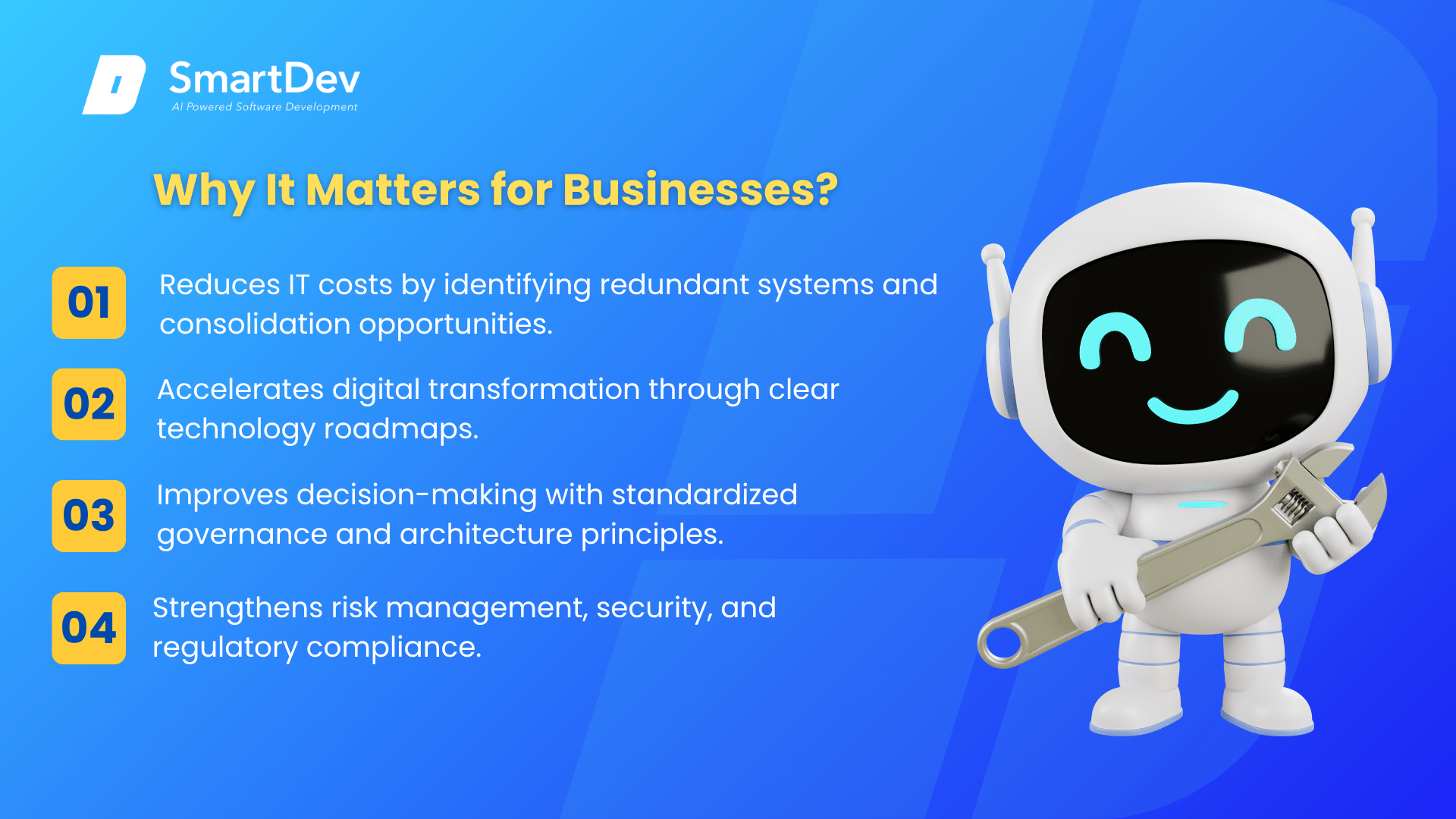
- Reduce IT costs: Enterprise architecture identifies redundant systems, consolidation opportunities, and misaligned investments, allowing organizations to rationalize their technology portfolio and reduce the total cost of IT ownership significantly.
- Accelerate digital transformation: Transformation programs fail at higher rates when organizations lack a clear picture of their current technology landscape. EA provides the baseline map that transformation planners need to design realistic, achievable modernization roadmaps.
- Improve decision-making speed: When the architecture is documented and governed, technology decisions can be evaluated against an agreed framework rather than starting from scratch each time. This reduces the time and effort required for technology planning cycles.
- Manage risk and compliance: EA provides visibility into which systems hold sensitive data, how data flows between systems, and where security vulnerabilities or compliance gaps may exist, enabling proactive risk management rather than reactive incident response.
For example, a multinational retailer with operations in 12 countries had accumulated over 200 separate software systems through years of organic growth and acquisitions. An enterprise architecture program identified 60 systems that could be consolidated, generated a rationalization plan that reduced annual software licensing costs by 22%, and created a standardized integration platform that cut the cost of connecting new acquisitions from months to weeks.
Who Uses Enterprise Architecture?
Enterprise architecture is most commonly practiced in large and mid-sized organizations where the complexity of technology decisions justifies a structured governance approach:
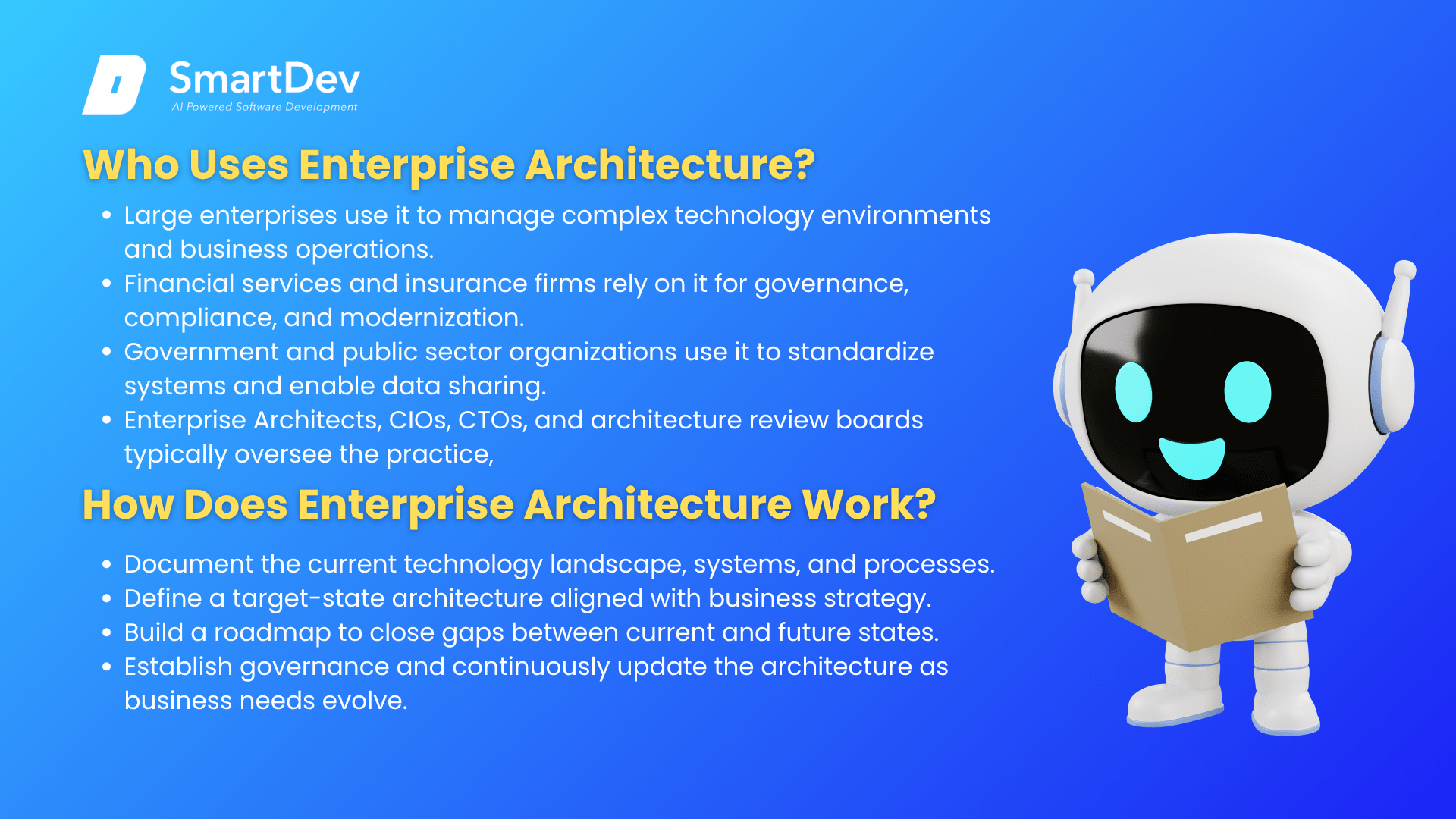
- Large enterprises and multinationals: Complex organizations with many business units, geographies, and legacy systems require EA to prevent the technology landscape from becoming unmanageable. Fortune 500 companies almost universally maintain dedicated enterprise architecture functions.
- Financial services and insurance: Highly regulated industries with complex systems and strict data governance requirements use EA to manage compliance risk, enable auditability, and plan technology modernization programs safely.
- Government and public sector: Government organizations use enterprise architecture frameworks to standardize technology across departments, enable data sharing between agencies, and manage long-lived legacy system modernization programs.
- Healthcare: Health systems with complex clinical, operational, and administrative technology portfolios use EA to enable patient data interoperability, manage compliance with regulations such as HIPAA, and plan digital health transformation programs.
Within organizations, enterprise architecture is led by an Enterprise Architect or Chief Architect, typically reporting to the CTO or CIO. Architecture review boards use the EA framework to evaluate new technology investments and changes against agreed principles and standards.
How Does Enterprise Architecture Work?
- Document the current state: The architecture team inventories existing systems, data flows, business processes, and technology infrastructure to create a baseline view of where the organization is today, often called the “as-is” architecture.
- Define the target state: Working with business and IT leadership, the team designs the target architecture aligned with business strategy, defining which systems to keep, modernize, consolidate, or retire over a defined planning horizon.
- Identify the gaps and roadmap: The gap between current and target architecture defines the transformation roadmap: the prioritized sequence of projects and investments needed to move from where the organization is to where it needs to be.
- Establish governance: Architecture review processes are established to evaluate new technology requests, vendor selections, and project designs against the agreed architecture principles and target state, preventing decisions that would undermine the roadmap.
- Iterate and update: Enterprise architecture is a living practice. As business strategy evolves, as new technologies emerge, and as transformation programs deliver results, the architecture documentation and roadmap are updated to remain a relevant and actionable guide.
The result is a technology landscape that is coherent, cost-efficient, and aligned with business strategy, rather than an accumulation of siloed decisions that limit the organization’s ability to change and grow.
Other Related Terms
Digital Transformation: The strategic program through which organizations modernize their technology and processes, guided by the enterprise architecture blueprint that defines the target state and roadmap for change.
Cloud Native Development: A software engineering approach that builds applications specifically for cloud environments, often the target architecture that enterprise architecture programs define as the destination for application modernization initiatives.
Technical Debt: The accumulated cost of poor technology decisions and deferred modernization that enterprise architecture programs are specifically designed to identify, quantify, and systematically reduce through structured rationalization and modernization planning.