TL;DR:
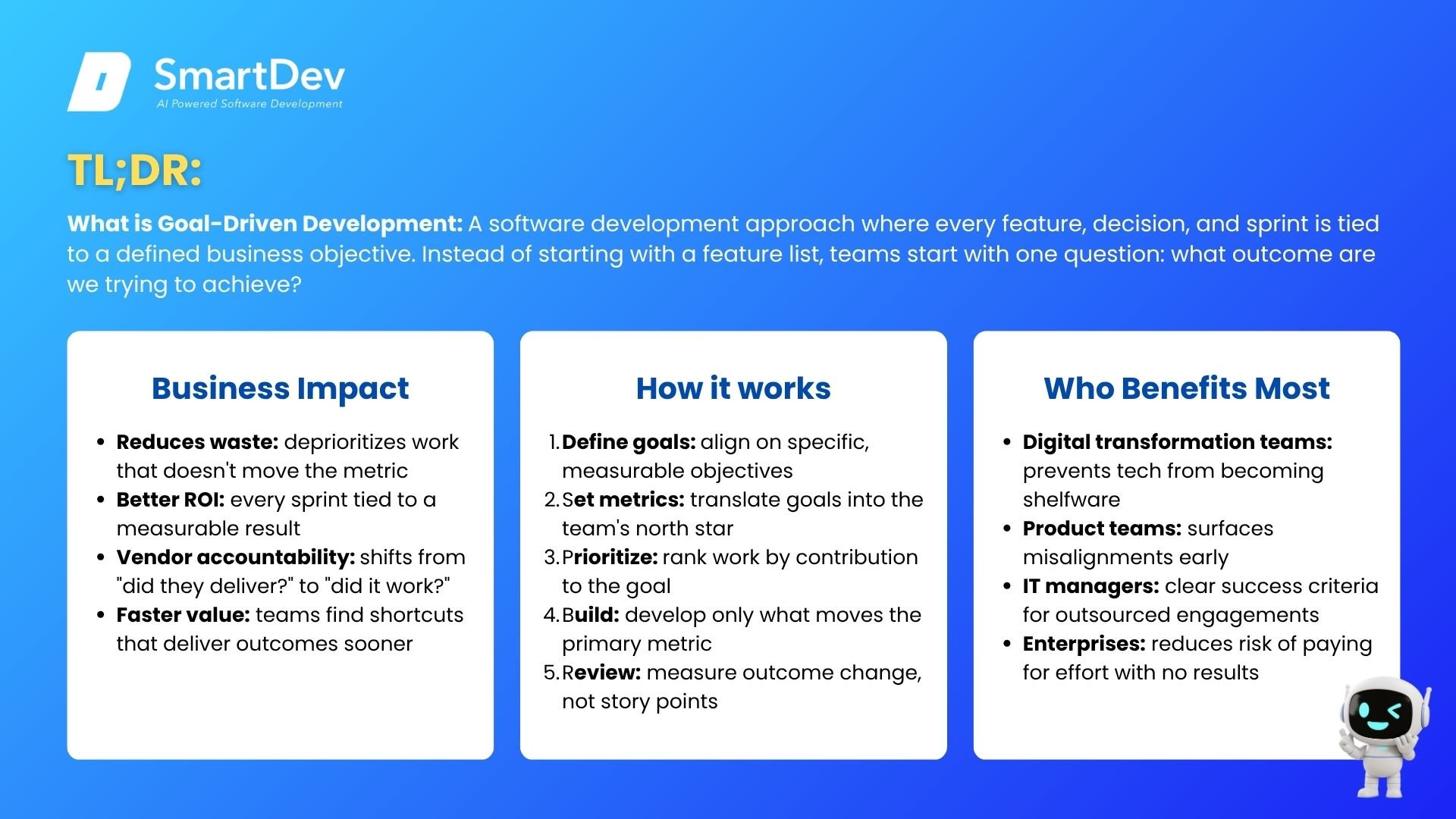
- Goal-driven development is an approach to building software where every decision, feature, and milestone is tied directly to a defined business objective.
- Rather than building for the sake of building, teams continuously validate that their work moves the needle on outcomes that matter.
- For enterprises, this approach reduces wasted investment and ensures that technology initiatives deliver measurable business value.
Too many software projects deliver technically impressive results that nobody uses. The code works, the features are built, and yet the business outcome never improves. Goal-driven development exists precisely to close that gap. It is a methodology that anchors every development decision to a clear, measurable business objective, ensuring that what gets built actually earns its place.
What is Goal-Driven Development?
Goal-driven development is a software development approach in which the team begins with clearly defined business goals and works backward to determine what needs to be built. Rather than starting with a feature list or a technology stack, the team starts with a question: what outcome are we trying to achieve?

This might seem obvious, but traditional development processes often prioritize delivering features over delivering outcomes. Backlogs fill up with requests. Sprints are measured by story points completed. Over time, teams can lose sight of whether any of it actually moves the business forward.
Goal-driven development corrects this by making the business objective the constant reference point. Every feature, every design decision, and every sprint goal is evaluated against a simple test: does this help us achieve the stated outcome?
In AI-assisted and modern agile environments, goal-driven development has gained renewed attention. AI tools can now generate code, suggest features, and automate testing at remarkable speed. But speed without direction amplifies the problem. Goal-driven development provides the direction that ensures faster delivery translates into faster progress toward what the business actually needs.
Why It Matters for Businesses?
The business case for goal-driven development is fundamentally about return on investment. Software development is expensive. For enterprises, it can represent one of the largest capital and operational expenditures in a given year. Goal-driven development ensures that investment is tied to outcomes rather than activity.
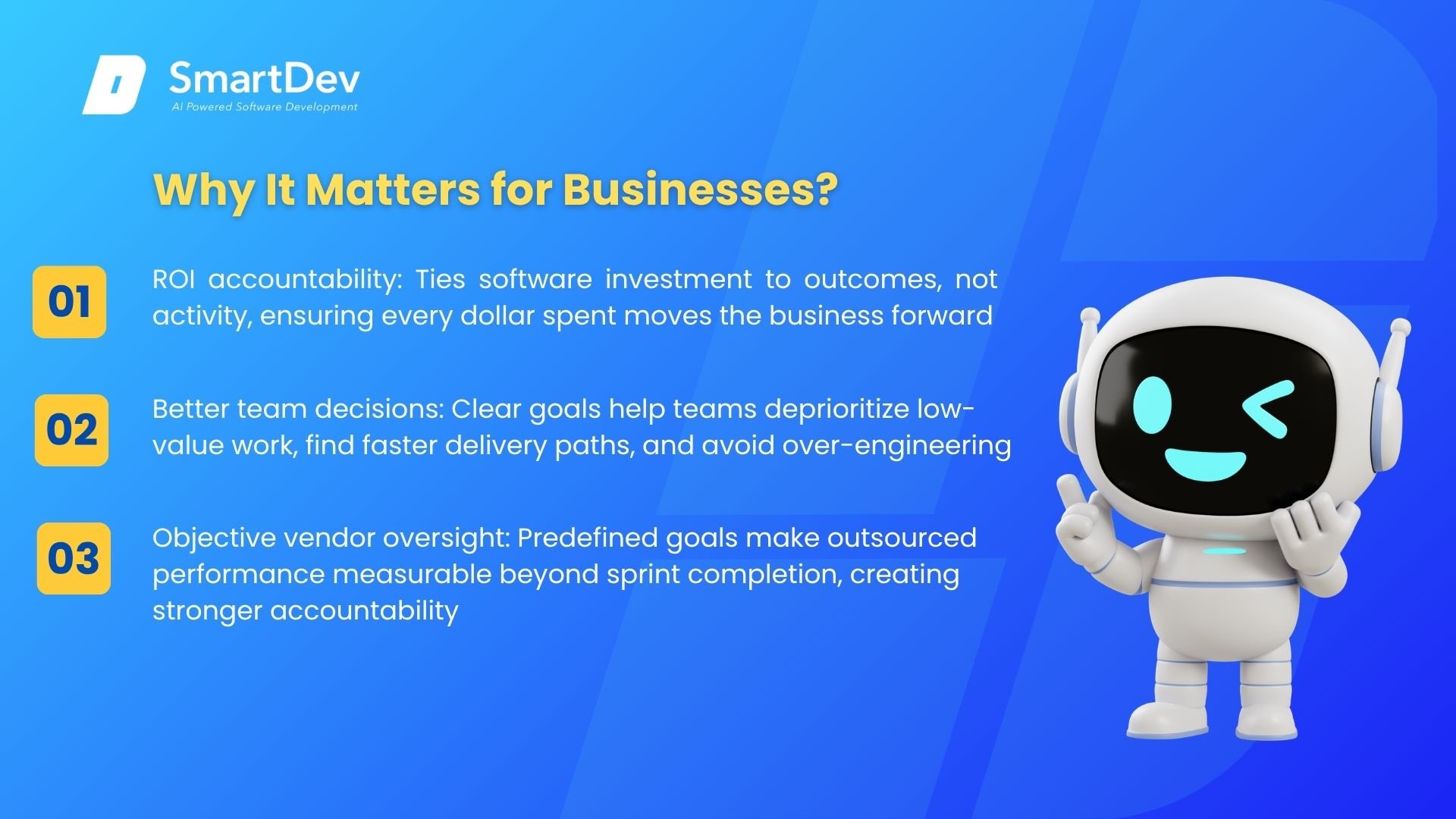
Research consistently shows that enterprises which tie software delivery to business outcomes significantly outperform those that measure success purely by velocity or features shipped. When teams know precisely what they are optimizing for, they make better decisions. They deprioritize work that does not contribute to the goal. They identify shortcuts that deliver business value faster. They avoid over-engineering features that nobody asked for.
For leaders overseeing outsourced development teams, goal-driven development provides an additional governance advantage. When goals are clearly defined upfront, vendor performance becomes objectively measurable. The conversation shifts from “did they deliver the sprint?” to “did their work move us toward the business outcome?” This creates stronger accountability and reduces the risk of paying for effort that does not produce results.
How Is Goal-Driven Development Implemented?
Implementation starts before a single line of code is written. Business stakeholders, product owners, and technical leads align on a set of specific, measurable goals. These might be reducing customer support ticket volume by 30 percent, cutting order processing time in half, or achieving a specific user activation rate.
Once goals are defined, they are translated into success metrics. These metrics become the team’s north star throughout the project. At every planning session, the question is not “what features should we build next?” but “what is the highest-value thing we can build right now to move our metric?”
Work items are then prioritized based on their expected contribution to the goal. This is where goal-driven development diverges most sharply from traditional approaches. A feature that is technically interesting but does not move the primary metric gets deprioritized, regardless of how much stakeholders might want it.
Progress reviews shift focus from velocity to outcome. Instead of celebrating story points completed, teams measure whether their work is producing the desired change in the business environment. This keeps conversations grounded in what the organization actually cares about.
Who Benefits Most from Goal-Driven Development?
Goal-driven development is especially valuable for organizations undergoing digital transformation, building new products, or managing complex outsourced engagements.
For enterprises in transformation, it provides a disciplined filter that prevents new technology investments from becoming shelfware. Every initiative must justify itself against a concrete business outcome before resources are committed.
For product teams, it reduces the time spent building and then discarding features that stakeholders requested but did not actually need. By tying development directly to measurable goals, teams surface misalignments early, when they are cheap to correct rather than after months of development investment.
For IT managers overseeing outsourcing relationships, goal-driven development creates clear success criteria that both the client organization and the vendor can understand and agree upon. This alignment reduces disputes, improves delivery quality, and makes the engagement far easier to manage and demonstrate value from.
Other Related Terms
- Agile Development: The application of Agile principles specifically to software development, organizing work into short sprints with frequent client touchpoints. Agile Development is the delivery framework most commonly used alongside Goal-Driven Development.
- Agile Methodology: A flexible, iterative approach to project delivery that prioritizes collaboration, continuous feedback, and incremental progress. Agile Methodology provides the structure within which Goal-Driven Development operates in practice, using retrospectives and sprint reviews as checkpoint.
- Multi-Agent System is an AI architecture where multiple specialized agents collaborate autonomously to complete complex tasks. In goal-driven development, multi-agent systems are the execution layer — once a goal is defined, individual agents handle planning, coding, testing, and validation in parallel, making goal achievement faster and more scalable than single-agent approaches.
- Agentic Flow is an AI-driven workflow where autonomous agents sense conditions, make decisions, and take actions with minimal human intervention. It describes how goal-driven development operates in practice — the developer declares the desired outcome, and the agentic flow determines the sequence of actions, tool calls, and decisions needed to reach it.