
TL;DR:
- Bench management refers to the process of managing IT professionals who are between project assignments within an outsourcing organization.
- Effective bench management reduces idle time, controls costs, and ensures skilled talent is available and ready to deploy when new projects begin.
- For clients, a vendor’s bench management capability directly affects how quickly teams can be scaled and how consistently quality is maintained.

In IT outsourcing, the time between project assignments is a critical period for both vendors and clients. Vendors must keep their talent engaged, skilled, and ready for deployment. Clients benefit when vendors can rapidly assemble high-quality teams without scrambling at the last minute. Bench management is the operational discipline that makes this possible.
What is Bench Management?
Bench management is the structured process of overseeing IT professionals who are not currently assigned to a billable client project. These individuals, commonly referred to as being “on the bench,” may be transitioning between engagements, waiting for a new project to begin, or completing internal work such as training or presales support.
In a professional services or IT outsourcing firm, bench management encompasses several activities: tracking which resources are available, forecasting when current project engagements will end and capacity will become available, matching bench resources to incoming project requirements, and ensuring that individuals on the bench remain productive and continue developing their skills during idle periods.
The bench represents both a cost and an opportunity. Unmanaged bench time leads to direct financial loss, as the organization continues to pay salaries without generating revenue. However, a well-managed bench ensures that the firm maintains a ready pool of experienced, continuously developing talent that can be deployed quickly as new client needs arise.
In the context of staff augmentation and dedicated development teams, bench management is a key differentiator. Vendors with robust bench management practices can respond to client requests with vetted candidates in days rather than weeks, significantly reducing the time-to-productivity for new team members.
Why It Matters for Businesses?
For businesses that rely on IT outsourcing partners, the quality of a vendor’s bench management practices has a direct impact on engagement quality and responsiveness. When a project requires rapid team scaling or when a key team member needs to be replaced, the vendor’s ability to draw from a prepared bench determines how quickly and smoothly the transition occurs.
From the perspective of a C-level executive, bench management is a proxy for operational maturity. Vendors who invest in maintaining a healthy bench demonstrate that they are thinking beyond the immediate engagement and planning for long-term capacity. This is particularly relevant for organizations with fluctuating technology demand, such as those undergoing digital transformation or scaling product development rapidly.
For IT managers responsible for vendor oversight, bench management directly affects project continuity. When a vendor has no available bench and relies entirely on new recruiting to fill resource gaps, the risk of delays increases substantially. Recruiting, onboarding, and ramping a new team member takes significantly longer than deploying someone already familiar with the vendor’s processes and tools.
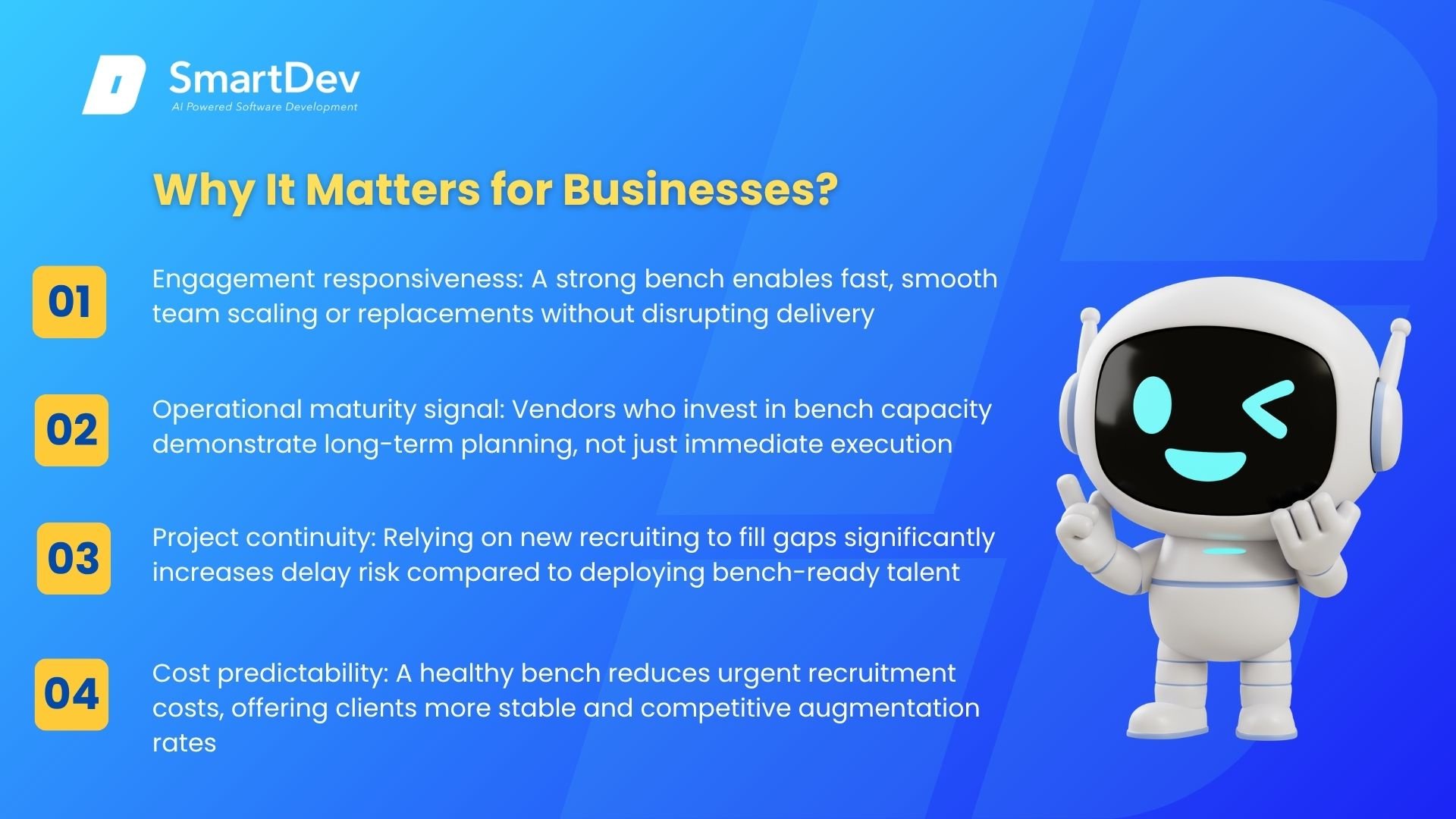
Bench management also affects pricing dynamics. Vendors with a strong bench can offer more competitive rates for team augmentation because they are not absorbing the full cost of urgent recruitment. This creates a more stable and predictable cost structure for clients managing IT budgets across multiple projects.
Who Manages Bench Management?
Bench management is typically owned by the resource management function within an IT outsourcing organization. A Resource Manager or Staffing Manager maintains a real-time view of all bench resources, including their skills, seniority levels, availability dates, and career development progress. This role works closely with delivery managers, sales teams, and HR to align supply with demand.
Delivery managers contribute by providing accurate forecasting of project end dates and skill requirements for upcoming engagements. Sales and presales teams feed demand signals into the resource planning process by communicating expected new project starts and team size requirements. HR and learning teams are responsible for organizing training programs, certifications, and internal projects that keep bench resources engaged and productive.
At a strategic level, the Head of Delivery or COO typically sets bench utilization targets and monitors bench cost as a percentage of overall revenue. In larger outsourcing organizations, dedicated resource planning teams use workforce management software to track bench status and optimize deployment decisions across multiple geographies and service lines.
For clients, visibility into a vendor’s bench management process can be obtained through qualification questions during vendor selection, such as asking for average bench size, time-to-deployment metrics, and the percentage of engagements staffed from the bench versus new hires.
How Does Bench Management Work?
Effective bench management relies on two core processes: accurate resource forecasting and structured bench engagement programs. Resource forecasting involves tracking project timelines and predicting when current team members will complete their assignments. By maintaining a rolling 30, 60, and 90-day view of resource availability, the resource management team can anticipate gaps and opportunities in advance.
Bench engagement programs ensure that resources who are between projects remain active, motivated, and skill-ready. Common activities include internal training and certification programs, contribution to open-source or internal product development, support for presales and proposal efforts, mentoring junior team members, and participation in practice-building initiatives.
Advanced resource management platforms, such as Planview or Microsoft Project Online, allow outsourcing firms to maintain a searchable talent inventory, track skill profiles, and match bench resources to incoming project requirements through automated matching algorithms.
Bench duration is a key performance indicator for resource management teams. Most organizations aim to keep average bench time below a defined threshold, often two to four weeks, beyond which the cost of idle time becomes significant. Regular one-on-one meetings between resource managers and bench professionals help identify career development needs and maintain engagement during transitions.
Other Related Terms
Client Onboarding: The structured process of integrating a new client into an organization’s systems, workflows, and service delivery model. Bench management directly enables faster Client Onboarding by ensuring vetted, project-ready talent can be deployed within days rather than weeks, reducing the ramp-up period between contract signing and productive delivery.
Client Retention: The ability of an organization to keep existing clients engaged and satisfied over time. Strong bench management supports Client Retention by enabling vendors to respond quickly when clients need to scale teams or replace departing members, maintaining continuity and avoiding the disruption that drives clients to look for alternative partners.
Client Satisfaction Score: A metric used to measure how satisfied a client is with the service or product they receive. Bench management quality shows up directly in Client Satisfaction Scores, particularly in how clients rate vendor responsiveness and team stability. Poor bench management leads to resource gaps that erode satisfaction over time.