TL;DR:
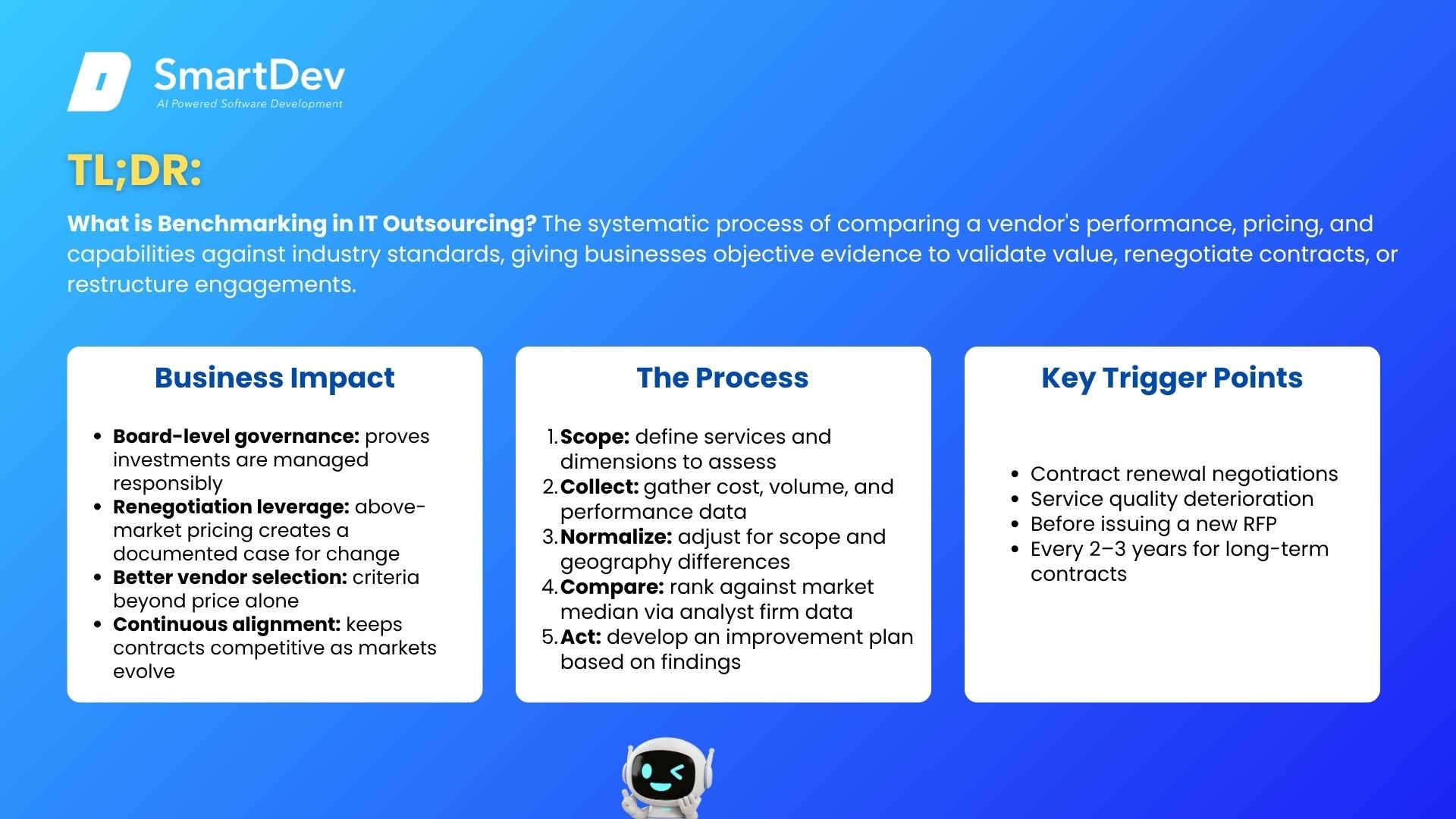
- Benchmarking in IT outsourcing is the process of measuring a vendor’s performance, pricing, and capabilities against industry standards and peer organizations.
- It enables businesses to validate whether they are receiving competitive value from their outsourcing engagements.
- Regular benchmarking supports contract renegotiations, vendor selection decisions, and continuous service improvement.
When a business commits to an IT outsourcing relationship, it needs a reliable method for evaluating whether the arrangement is delivering competitive value. Benchmarking provides that objective reference point. By comparing vendor performance and pricing against established industry standards, organizations can make informed decisions about whether to renew, renegotiate, or restructure their outsourcing contracts.
What is Benchmarking IT Outsourcing?
Benchmarking in IT outsourcing is the systematic process of comparing an outsourcing vendor’s performance, pricing, service quality, and operational efficiency against external standards. These standards may come from industry research databases, peer organizations of similar size and sector, or published frameworks from analyst firms such as Gartner, ISG, or Everest Group.
The practice serves two primary purposes. First, it provides an objective basis for evaluating whether the vendor’s outputs and costs align with what the broader market delivers for equivalent services. Second, it identifies specific areas where the vendor’s performance falls short or exceeds expectations, giving both parties actionable data for improvement planning.
Benchmarking can be applied across multiple dimensions of an outsourcing engagement. Price benchmarking examines whether the rates being charged for services, such as software development, infrastructure management, or IT helpdesk support, are consistent with market rates. Performance benchmarking assesses delivery quality metrics such as defect rates, resolution times, and system availability against industry norms. Capability benchmarking evaluates the vendor’s technical competencies and delivery maturity against competitors.
Third-party benchmarking firms are often engaged to conduct formal assessments, ensuring objectivity and access to proprietary market data that neither the client nor vendor could obtain independently.
Why It Matters for Businesses?
Benchmarking gives IT and procurement leaders an evidence-based foundation for critical decisions about their outsourcing relationships. Without it, businesses risk continuing with arrangements that have drifted out of market alignment, paying above-market rates, or tolerating below-standard performance because they lack the data to make a case for change.
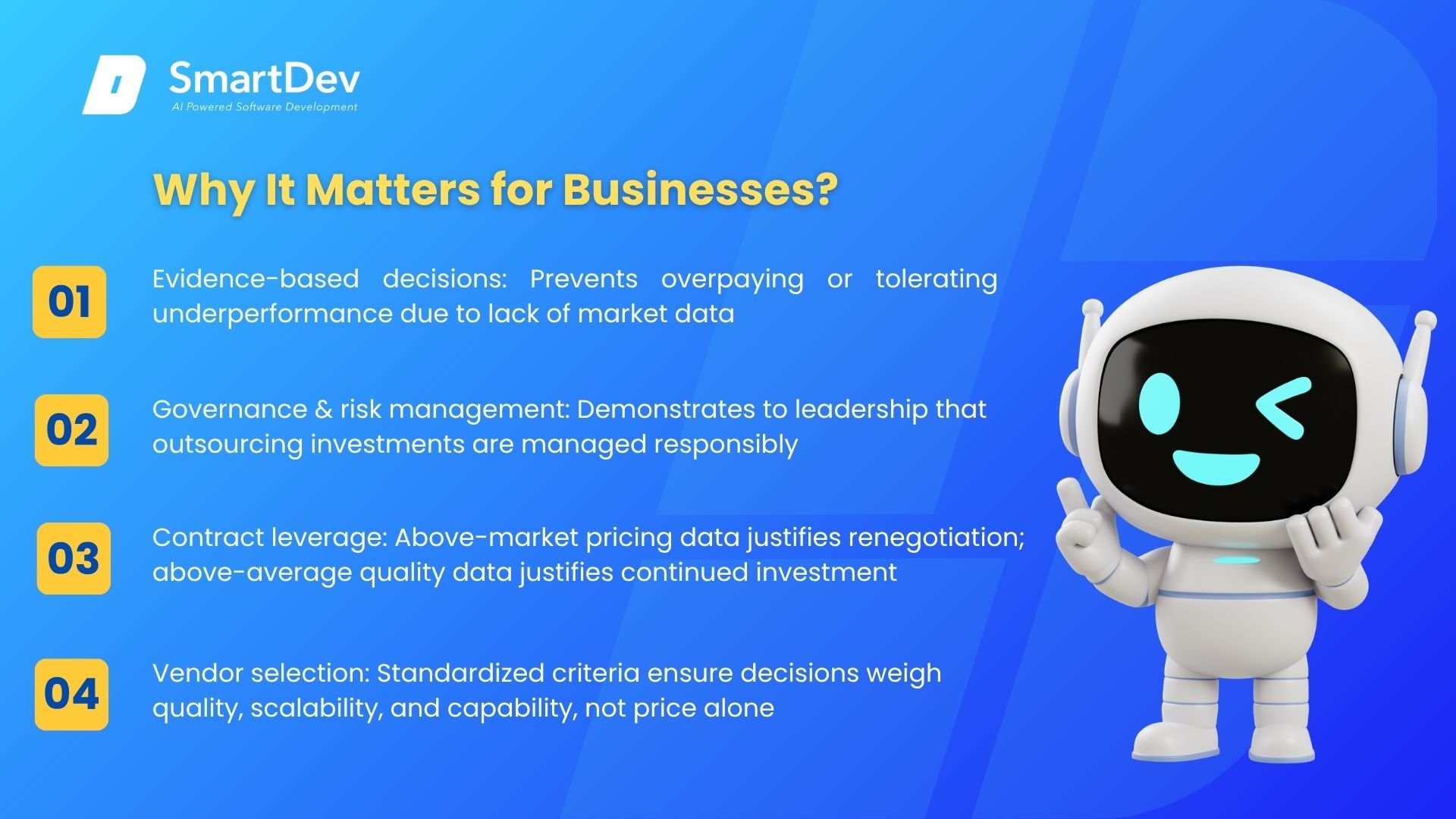
For C-level executives, benchmarking is a governance and risk management tool. It demonstrates to the board and senior leadership that the company’s outsourcing investments are being managed responsibly and that vendor accountability is built into the contract framework. Many enterprise outsourcing contracts include formal benchmarking rights, allowing the client to commission an independent assessment at defined intervals, typically every two to three years.
From an IT manager’s perspective, benchmarking provides practical leverage during contract renewals and scope expansion discussions. Data that shows a vendor’s pricing is above the market median creates a legitimate and documented basis for renegotiation. Conversely, data that demonstrates the vendor is delivering above-average quality can justify continued or expanded investment in the relationship.
Benchmarking also supports the vendor selection process. When evaluating competing proposals, a benchmarking framework provides standardized criteria that prevent decisions from being made on price alone and ensures that quality, scalability, and capability are weighted appropriately.
How Does Benchmarking Work?
The benchmarking process typically follows a structured methodology. It begins with scoping, where the client defines which services, geographies, and performance dimensions will be included in the assessment. This is followed by data collection, where the client and vendor provide operational and financial data, including service volumes, headcount, cost breakdown, and performance metrics.
The benchmarking firm or internal team then normalizes the data to account for differences in scope, geography, and service complexity before comparing it against market reference data. The output is a benchmarking report that places the vendor’s performance and pricing in context relative to market peers, typically expressed as a percentile ranking or a comparison to a market median.
The report identifies specific areas where the engagement is above market, at market, or below market. Based on these findings, the client and vendor develop an action plan, which may include pricing adjustments, service delivery improvements, or changes to the contractual scope.
Benchmarking is most effective when conducted at regular intervals rather than as a one-time exercise. Building benchmarking rights into the original contract and establishing a schedule for periodic assessments ensures that the engagement remains aligned with market standards over the full term of the agreement.
When Should Benchmarking Be Done?
Timing is an important dimension of effective benchmarking. The most common trigger points include contract renewal negotiations, where benchmarking data provides objective leverage for both parties. Businesses also initiate benchmarking when they notice a significant deterioration in service quality or when organizational changes, such as a merger or acquisition, require a fresh assessment of all vendor relationships.
Benchmarking is also advisable before issuing a new Request for Proposal (RFP), as it helps define realistic price ranges and performance expectations that can be used to evaluate incoming bids. In this context, benchmarking serves as a calibration exercise that improves the quality of the procurement process.
For long-term contracts exceeding three years, periodic benchmarking at two-to-three-year intervals is considered a best practice. IT markets evolve rapidly, and rates and performance standards that were competitive at contract signing may be significantly different several years later. Continuous benchmarking, even in a lighter form such as quarterly market price checks, helps organizations stay informed without committing to full formal assessments every year.
Organizations undergoing digital transformation often use benchmarking as part of their IT strategy review, comparing their outsourcing model against peers who have adopted more modern delivery approaches, such as cloud-native development or agile at scale.
Other Related Terms
SLA (Service Level Agreement): A formal agreement between a service provider and a client that defines the expected level of service, including performance standards, response times, and resolution targets. SLAs are the contractual backbone of Account Management, giving account managers a clear standard to measure delivery against and a shared reference point for client conversations about service quality and expectations.
Agile Development: The application of Agile principles specifically to software development, organizing work into short sprints with frequent client touchpoints. Account managers benefit directly from Agile Development because it creates a structured cadence of client visibility, reducing the risk of misaligned expectations and making it easier to manage scope changes transparently.
Cloud Migration: The process of moving an organization’s data, applications, or infrastructure from on-premise systems to cloud-based environments. Cloud Migration projects are among the most relationship-intensive engagements an account manager handles, requiring close coordination between the client’s technical team and the delivery team to manage timelines, risks, and shifting requirements across a long project lifecycle.