
TL;DR
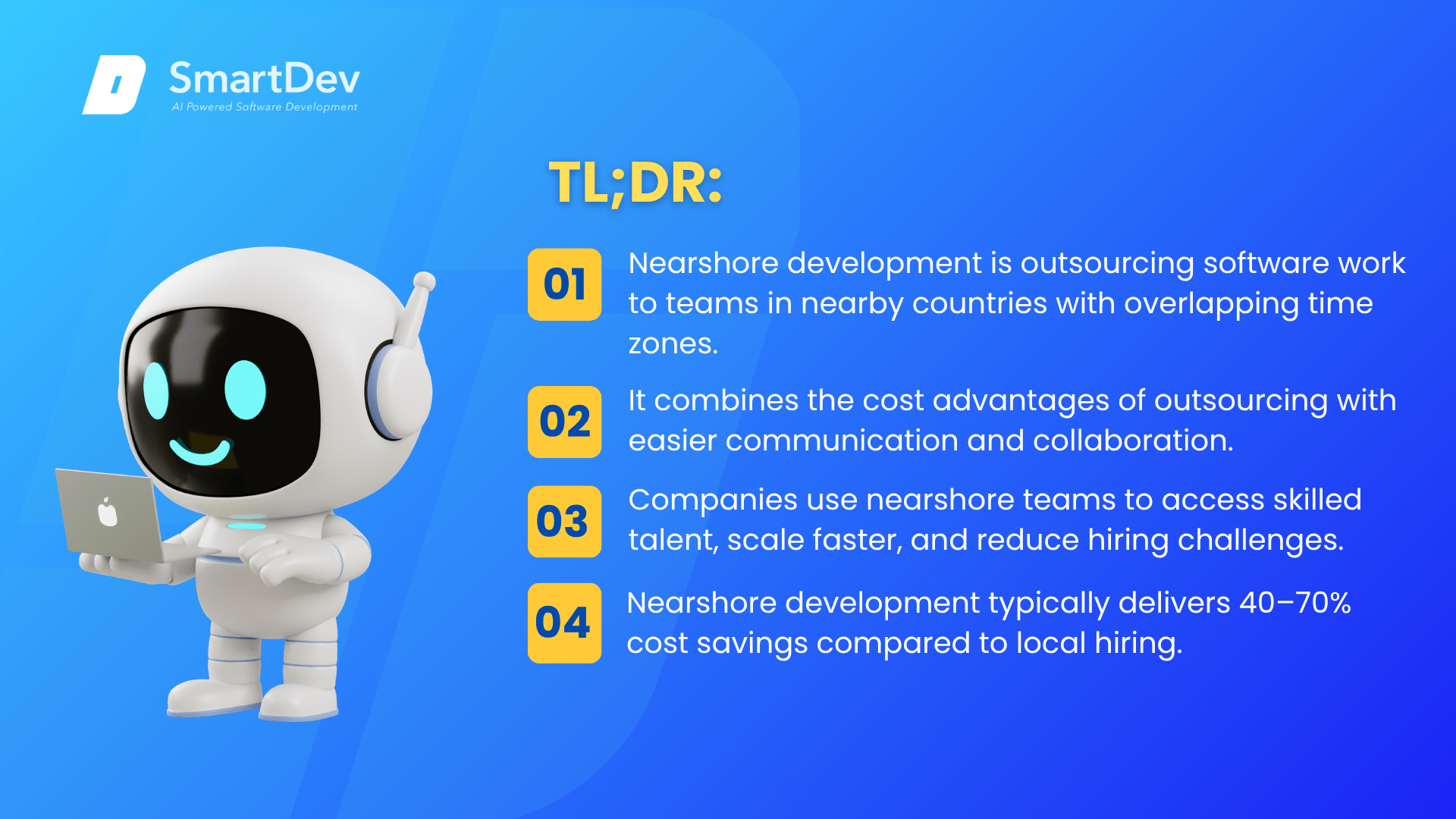
- Nearshore development is the practice of outsourcing software work to teams in nearby countries, typically within one to four time zones of your own.
- It balances the cost savings of offshore outsourcing with the real-time collaboration and cultural alignment closer to onshore models.
- U.S. companies typically nearshore to Latin America, while European companies look to Eastern Europe, saving 40 to 70% on development costs.
Nearshore development has become a preferred outsourcing model for companies that want cost savings without sacrificing the real-time collaboration that long-distance offshore arrangements can complicate. By working with teams in neighboring or nearby countries, businesses get the best of both worlds: lower rates and a working relationship that feels much closer to an in-house team.
What is Nearshore Development?
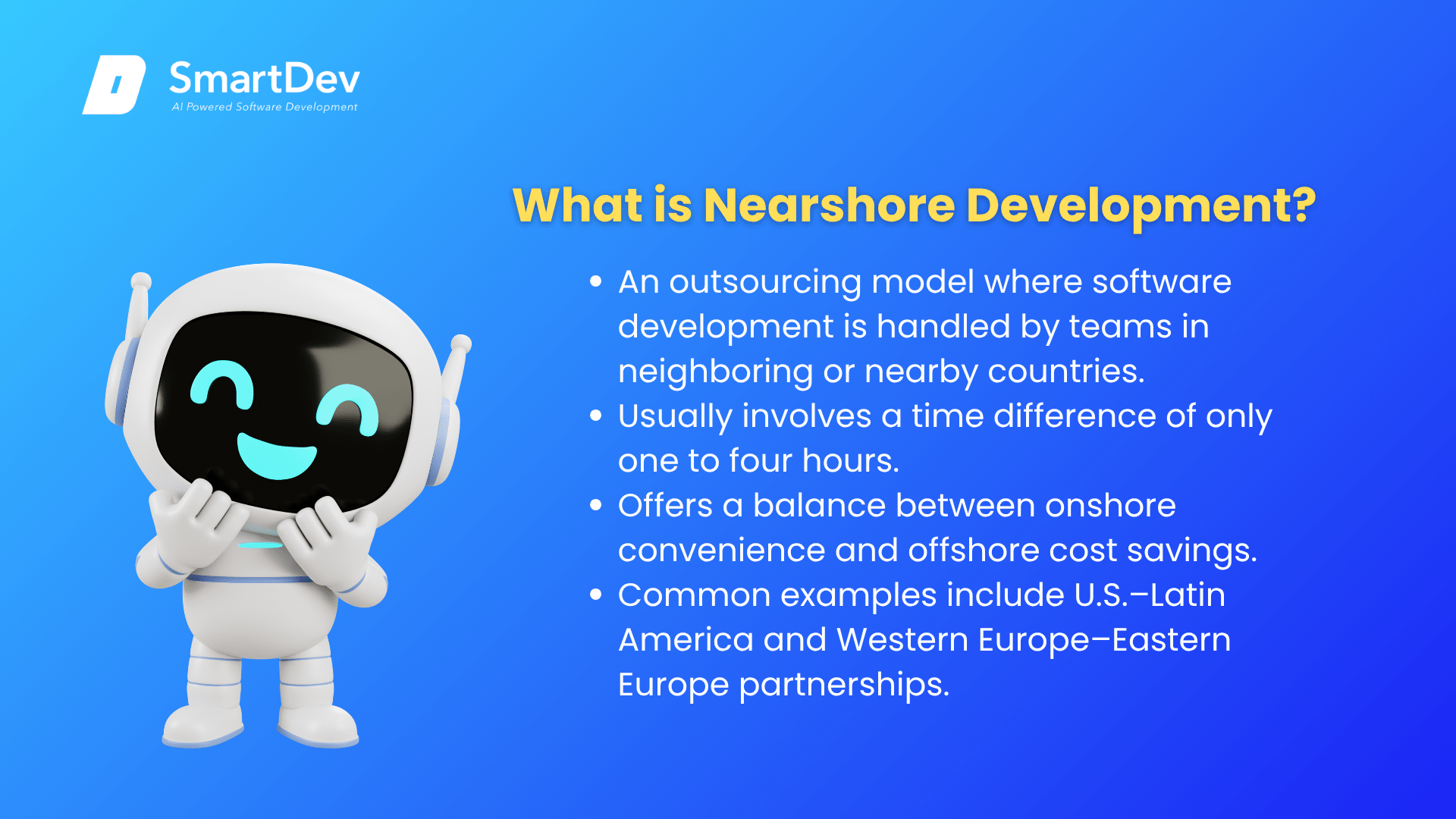
Nearshore development is an IT outsourcing model where a company delegates software development work to a team located in a nearby country, typically within one to four time zones, sharing similar or overlapping business hours and often cultural commonalities.
The term sits between two other outsourcing models. Onshore development refers to working with teams in your own country, which offers maximum alignment but at the highest cost. Offshore development refers to working with teams on the other side of the world, which offers the deepest cost savings but can create friction around time zones and communication. Nearshore development occupies the middle ground.
For U.S.-based companies, nearshore destinations typically include Mexico, Colombia, Brazil, and Argentina. For Western European companies, Poland, Romania, and Ukraine are common nearshore markets.
Why It Matters for Businesses?
Building and retaining an in-house engineering team is expensive and slow. Nearshore development gives businesses access to talent at competitive rates without the time zone headaches of far-offshore arrangements.
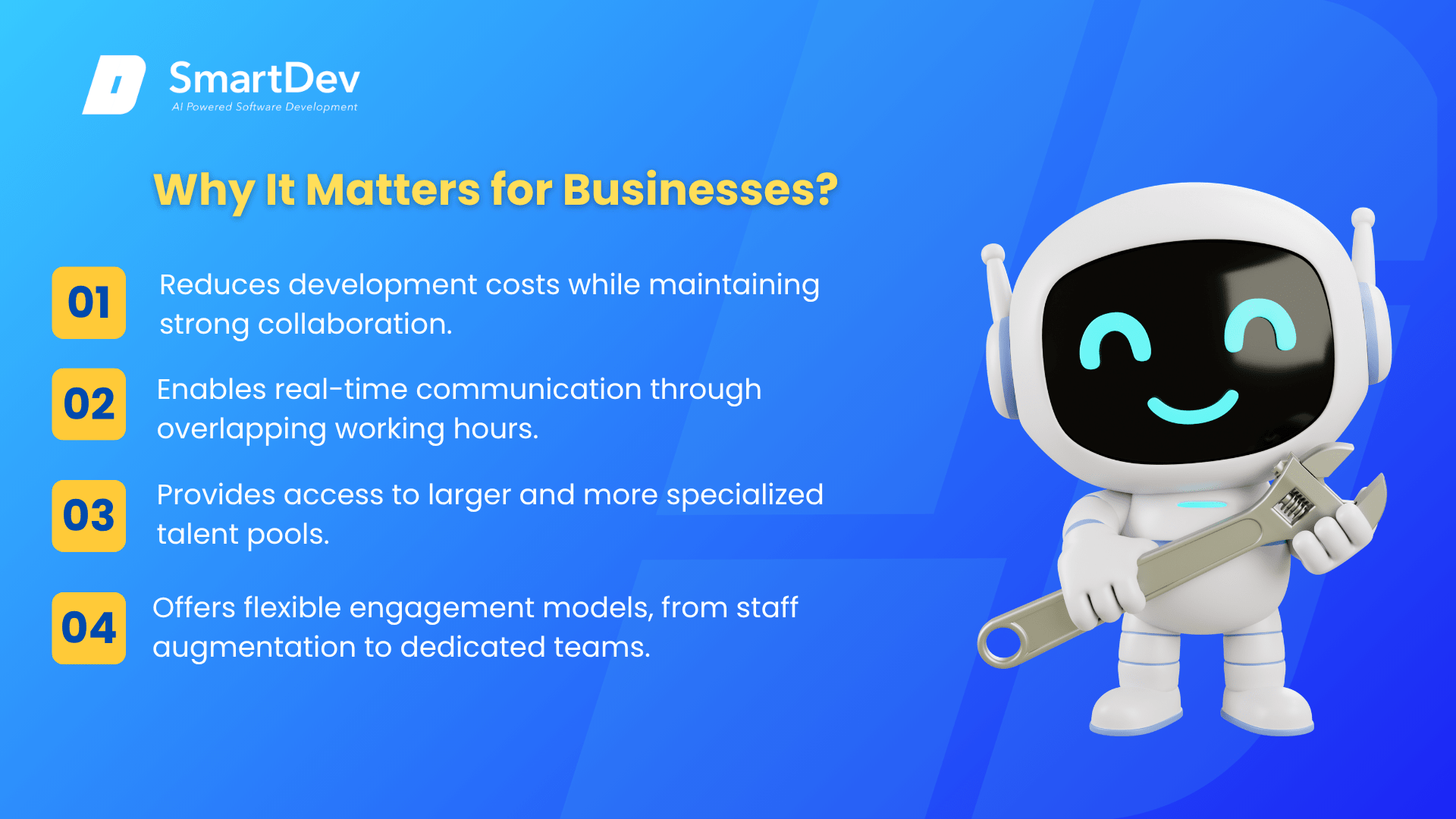
- Reduce development costs by 40 to 70% compared to equivalent in-house hiring in the U.S. or Western Europe.
- Improve collaboration quality through real-time communication during shared business hours, reducing delays and miscommunications.
- Accelerate hiring timelines by accessing established talent pools in mature tech hubs without competing in tight local markets.
- Increase team flexibility with engagement models that range from staff augmentation to fully managed dedicated teams.
For example, a U.S.-based SaaS company that shifted its QA function to a nearshore team in Mexico reduced its testing cycle time by 35% while cutting associated costs by half. Daily morning standups ran in real time with no scheduling gymnastics, making the arrangement feel operationally identical to having local staff.
Where is Nearshore Development Used?
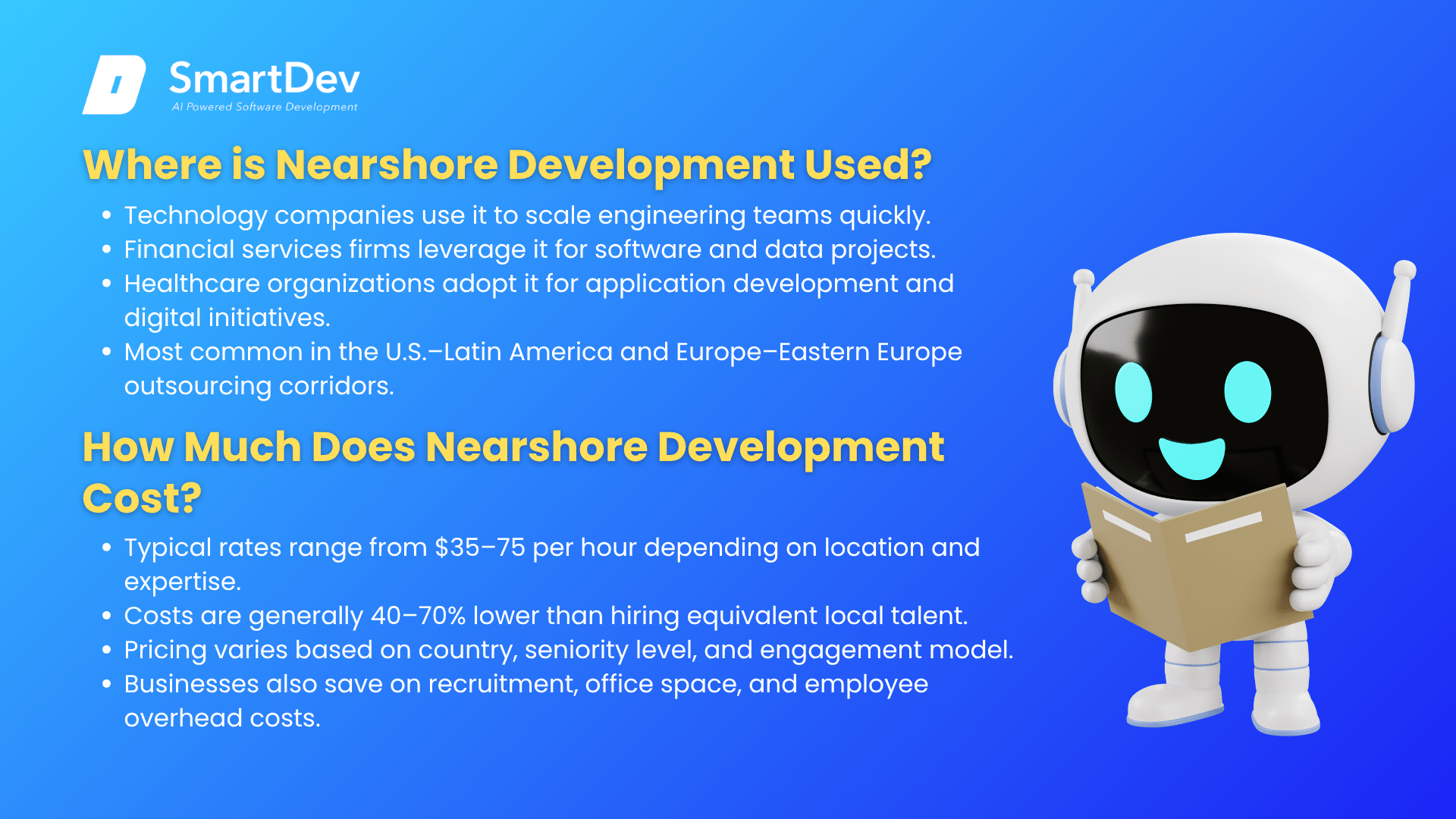
Nearshore development is used across industries wherever software development work can be done remotely. Technology companies use it to scale engineering teams rapidly without the overhead of additional full-time hires. Financial services firms use nearshore teams for application development and data engineering work that does not require on-site presence. Healthcare companies use nearshore providers for software products where data privacy requirements align with regional regulations.
Geographically, the strongest nearshore corridors are the U.S.-Latin America corridor and the Western Europe-Eastern Europe corridor. Vietnam and the Philippines are also growing as nearshore destinations for companies based in Australia and Southeast Asia, given their time zone proximity and English proficiency.
The model suits any company that needs ongoing software development capacity rather than a one-time project, as the cultural fit and time zone alignment make long-term working relationships more effective.
How Much Does Nearshore Development Cost?
Nearshore development rates typically range from $35 to $75 per hour for software engineers, depending on the country, seniority level, and skill set. This compares to $100 to $175 per hour for equivalent U.S.-based engineers, representing savings of 40 to 70%.
Three factors that influence nearshore cost include location (Mexico and Colombia tend to be slightly higher than Argentina due to closer cultural alignment with U.S. markets), seniority mix (a team heavy on senior engineers will cost more but typically produces higher-quality output with less oversight), and engagement model (staff augmentation is flexible but may cost more per head than a dedicated team contract).
Compared to building the equivalent in-house team, nearshore development eliminates recruitment costs, benefits overhead, office space, and equipment expenses, making it significantly more cost-efficient at scale.
Other Related Terms
- Fixed price contract: A type of agreement in which the client and vendor agree on a single total price for a defined scope of work before the project begins.
- Onshore Development Center: A dedicated development facility staffed by an outsourcing provider but located within the client’s own country, offering full alignment at higher cost.
- Commercial Proposal: A formal document submitted by an IT outsourcing vendor that outlines the proposed solution, delivery approach, team composition, timeline, and pricing for a client engagement.