
TL;DR
- Cross-selling is the practice of offering existing customers additional products or services that complement what they have already purchased from your business.
- It is one of the most cost-effective growth strategies available, since selling to an existing customer costs five to seven times less than acquiring a new one.
- Effective cross-selling requires understanding your customer’s actual business goals, not just their purchase history, and proposing solutions that genuinely add new value.
Cross-selling is one of the most efficient revenue growth levers available to any business. Rather than investing in acquiring new customers, it focuses on delivering more value to the customers you already have and trust you. When done well, cross-selling increases revenue, deepens customer relationships, and reduces churn. This article explains what cross-selling is, who uses it, and how to make it work effectively.
What is Cross-Selling?
Cross-selling is the practice of offering a customer additional products or services that are related to, or complement, something they have already purchased. The goal is to deliver more value to the customer while increasing the revenue your business generates from that existing relationship.
Cross-selling differs from upselling, which involves encouraging a customer to upgrade to a higher-tier or more expensive version of their current purchase. Cross-selling introduces a different but related product or service alongside what the customer already has, expanding the breadth of the relationship rather than deepening a single product line.
In business-to-business (B2B) and IT outsourcing contexts, cross-selling commonly takes the form of:
- Offering a complementary software module or add-on service to a client already using a core platform
- Proposing managed services or ongoing support to a client who initially purchased a project-based engagement
- Recommending AI automation, training, or consulting services to clients expanding their use of your technology
- Introducing clients to adjacent service lines that address related business challenges they have not yet solved
Why It Matters for Businesses?
Acquiring a new customer requires significant investment in marketing, sales, proposal cycles, and onboarding. Cross-selling is far more efficient because it builds on an existing trust relationship where the customer already understands your capabilities, your team, and the value you deliver.
- Increase customer lifetime value: Customers who use multiple products or services from your business generate more revenue over time and are substantially less likely to churn, as their switching costs increase with each additional solution integrated into their operations.
- Reduce revenue concentration risk: A customer base where accounts use multiple products is more resilient than one where every customer depends on a single service, reducing vulnerability to single-service cancellations.
- Improve customer retention: Customers who derive value from multiple parts of your product ecosystem are significantly harder to lose to a competitor, because replacing your offering would mean finding multiple alternative vendors simultaneously.
- Accelerate revenue growth without proportional cost increases: Cross-selling to existing customers requires less sales and marketing investment than acquiring new accounts, improving overall business profitability and gross margin.
For example, an IT outsourcing company that began offering AI workflow automation tools to its existing software development clients found that cross-sold accounts had a 40% higher retention rate and a 60% higher average contract value compared to accounts using only the original service.
Who Uses Cross-Selling?
Cross-selling is used across virtually every industry that manages ongoing customer relationships, but it is most common and most structured in:
- Technology and SaaS: Software companies routinely cross-sell add-ons, integrations, and premium tiers to users of their core platforms. Customer success teams are typically responsible for identifying cross-sell opportunities from product usage signals and customer health data.
- IT outsourcing and managed services: IT service providers cross-sell adjacent capabilities such as cloud migration, AI automation, cybersecurity, or QA services to clients already engaged for software development or infrastructure support.
- Financial services: Banks and financial institutions cross-sell products such as insurance, investment accounts, or business financing to customers already holding checking or savings accounts.
Within organizations, cross-selling is typically driven by account managers, customer success managers, and sales teams working from structured playbooks. In mature revenue operations, cross-sell motions are guided by data, using purchase history, product usage signals, and customer health scores to identify the right moment and the right offer for each specific account.
How Does Cross-Selling Work?
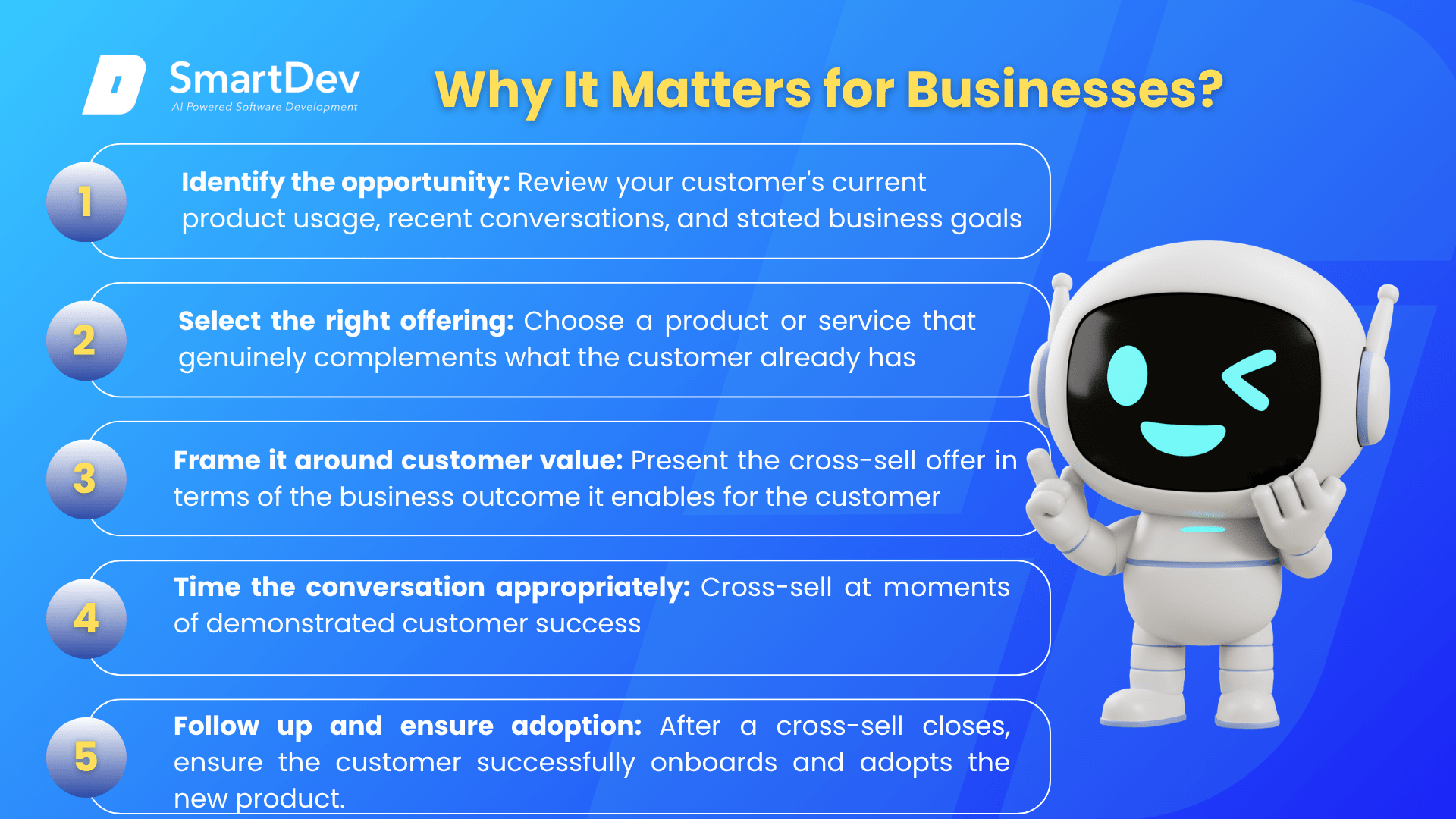
- Identify the opportunity: Review your customer’s current product usage, recent conversations, and stated business goals to identify unmet needs that your other products or services could address. Usage data and customer success signals are the most reliable indicators of readiness.
- Select the right offering: Choose a product or service that genuinely complements what the customer already has and addresses a real challenge they face right now. A poor cross-sell, where the proposed product does not fit the customer’s situation, damages the relationship and trust.
- Frame it around customer value: Present the cross-sell offer in terms of the business outcome it enables for the customer, not the features of the product. “This would reduce your deployment time by 40%” is far more persuasive than “This includes 50 additional automation templates.”
- Time the conversation appropriately: Cross-sell at moments of demonstrated customer success, when the customer is experiencing clear value from their current purchase, or when a specific business trigger arises such as a product launch, team expansion, or strategic initiative.
- Follow up and ensure adoption: After a cross-sell closes, ensure the customer successfully onboards and adopts the new product. A cross-sold product that goes unused creates churn risk rather than the retention and expansion value the cross-sell was intended to generate.
The result is a customer relationship that delivers increasing value over time, with higher revenue per account and stronger loyalty that compounds with each additional product the customer adopts.
Other Related Terms
Lead generation: The process of attracting and converting strangers into potential customers who have shown interest in your product or service
Client retention: The ability to keep customers over time and build long-term relationships.
Customer Success Management: The business function responsible for ensuring customers achieve their goals with your product, and typically the team best positioned to identify, time, and execute cross-sell conversations from a place of established trust.