

TL;DR
- An AI model is a trained mathematical structure – distinct from an algorithm (the learning method), architecture (the structural layout), or AI system (the model plus everything built around it).
- No single classification is “correct” – the right one depends on whether you’re asking about learning method, task, architecture, data type, or deployment.
- Learning approach and architecture are independent – the same architecture can train under different paradigms, and vice versa.
- Narrow AI runs nearly every production system today, including generative models – AGI remains a research objective, not a deployed category.
- Model selection starts from the business decision and available data, not the newest architecture or a benchmark score.
- Traditional ML often beats deep learning on tabular data or when explainability matters – deep learning earns its cost mainly on unstructured data.
- Responsible deployment – bias, privacy, security, governance – is a selection criterion up front, and monitoring continues well past launch.
- Real-world testing in the actual operating environment is what confirms a model choice, not the taxonomy itself.
Introduction
Search “types of AI models” and the lists seem to contradict each other – one splits AI into narrow, general, and superintelligent; another organizes everything around supervised versus unsupervised learning; a third mixes in transformers and large language models as if they sit on the same shelf. None of these lists is wrong. As IBM’s explainer on AI models notes, an algorithm is the logic a model runs on while the model itself is the trained artifact that actually makes predictions – a distinction that alone explains why “transformer” and “supervised learning” don’t belong on one competing list: they describe different layers of the same system, not rival categories.
This guide works through the lenses that actually apply – learning method, task, architecture, data type, deployment – not to add one more list, but to help you ask the right question for the decision in front of you. For most real projects, that question comes down to the business problem and the data on hand, which is where the practical half of this guide focuses; SmartDev’s AI development services cover how that turns into an actual build once the options are narrowed down.
What is an AI Model?
An AI model refers to an algorithm or mathematical structure that is designed to perform intelligent tasks such as recognition, prediction, or decision-making. These models are trained on vast datasets and adjust their parameters to learn patterns. The model’s ability to adapt and improve over time allows it to replicate cognitive processes that were previously exclusive to humans.
For example, an AI model used in natural language processing can understand and generate human-like text after being trained on extensive textual data.
How AI Models Work
AI models work by learning from data through a process called training. During training, an AI algorithm is exposed to large datasets and refines its internal parameters to make accurate predictions or decisions.
For instance, a supervised learning model uses labeled data to train the algorithm to predict outcomes based on the patterns it identifies. Once trained, the model can apply this knowledge to new, unseen data and generate results based on its learned understanding.
Did you know? How to Create an AI Model for Your Business
Difference Between AI, Machine Learning, and Deep Learning Models
AI, machine learning, and deep learning are terms often used interchangeably, but they represent different concepts in the field of artificial intelligence.
- AI refers to the broad goal of machines mimicking human intelligence.
- Machine learning, a subset of AI, focuses on building models that can learn from data and make predictions without being explicitly programmed.
- Deep learning, a further subset of machine learning, uses neural networks with many layers to analyze large and complex datasets, excelling in tasks like speech recognition, image analysis, and autonomous driving.
Model, algorithm, architecture, and AI system: key distinctions
The terms “model,” “algorithm,” “architecture,” and “AI system” get used interchangeably in casual conversation, but each describes a different layer of the same stack – and mixing them up makes it harder to scope a project or read a vendor’s technical documentation accurately.
Algorithm is the logic a model follows to turn inputs into outputs. As IBM’s explainer on AI models puts it, an algorithm is the logic by which an AI model operates, while the model itself is what gets used to make the actual predictions or decisions.
Architecture is the structural layout an algorithm runs on – in a neural network, that means the number and size of layers, how they connect, and which activation functions they use. IBM’s overview of machine learning algorithms notes that a deep learning algorithm is made up of more than just this architecture: it also includes the task the network is being trained to perform and the steps taken to optimize it for that task. Two models can share the same architecture and still be fundamentally different models, because they were trained on different data for different objectives.
Model is the trained artifact: an architecture plus a specific set of learned parameters (weights), shaped by exposure to training data. It’s what gets deployed to actually produce predictions.
AI system is the broader, deployed whole – the model plus the surrounding software that feeds it inputs, applies business logic to its outputs, and puts it in front of users. The NIST AI Risk Management Framework defines an AI system as an engineered or machine-based system that, for a given set of objectives, generates outputs such as predictions, recommendations, or decisions that influence real or virtual environments. A single AI system can contain multiple models working together.
Training vs. inference, in plain terms. Training is the one-time (or periodic) process of exposing a model to data so it can learn patterns and set its parameters. Inference is what happens afterward, every time the deployed model is given new input and asked to produce an output – it’s applying what it already learned, not learning something new in the moment. Most AI systems in production run on models that don’t update their own parameters after deployment; any further learning happens through a separate, deliberate retraining step, not automatically in the background.
Terminology map
| Layer | What it is | Analogy |
|---|---|---|
| Algorithm | The logic/rules for turning input into output | A recipe |
| Architecture | The structural layout the algorithm runs on | The recipe’s list of techniques and equipment |
| Trained model | Architecture + learned parameters from training data | A specific dish, cooked and ready to serve |
| Deployed AI system | The model plus the surrounding software, data pipelines, and interface | The restaurant that takes orders, serves the dish, and handles the whole customer experience |
Getting these layers right matters beyond terminology – it shapes real project decisions, like whether a use case needs a new model architecture or just different training data, and whether “the AI” needs to change or just the system around it. If you’re scoping a project at any of these layers, SmartDev’s AI development services, AI model training, and AI model testing resources go deeper on each stage, and our AI proof of concept guide covers how to validate an idea before committing to a full build.
Broad Categories of AI Models
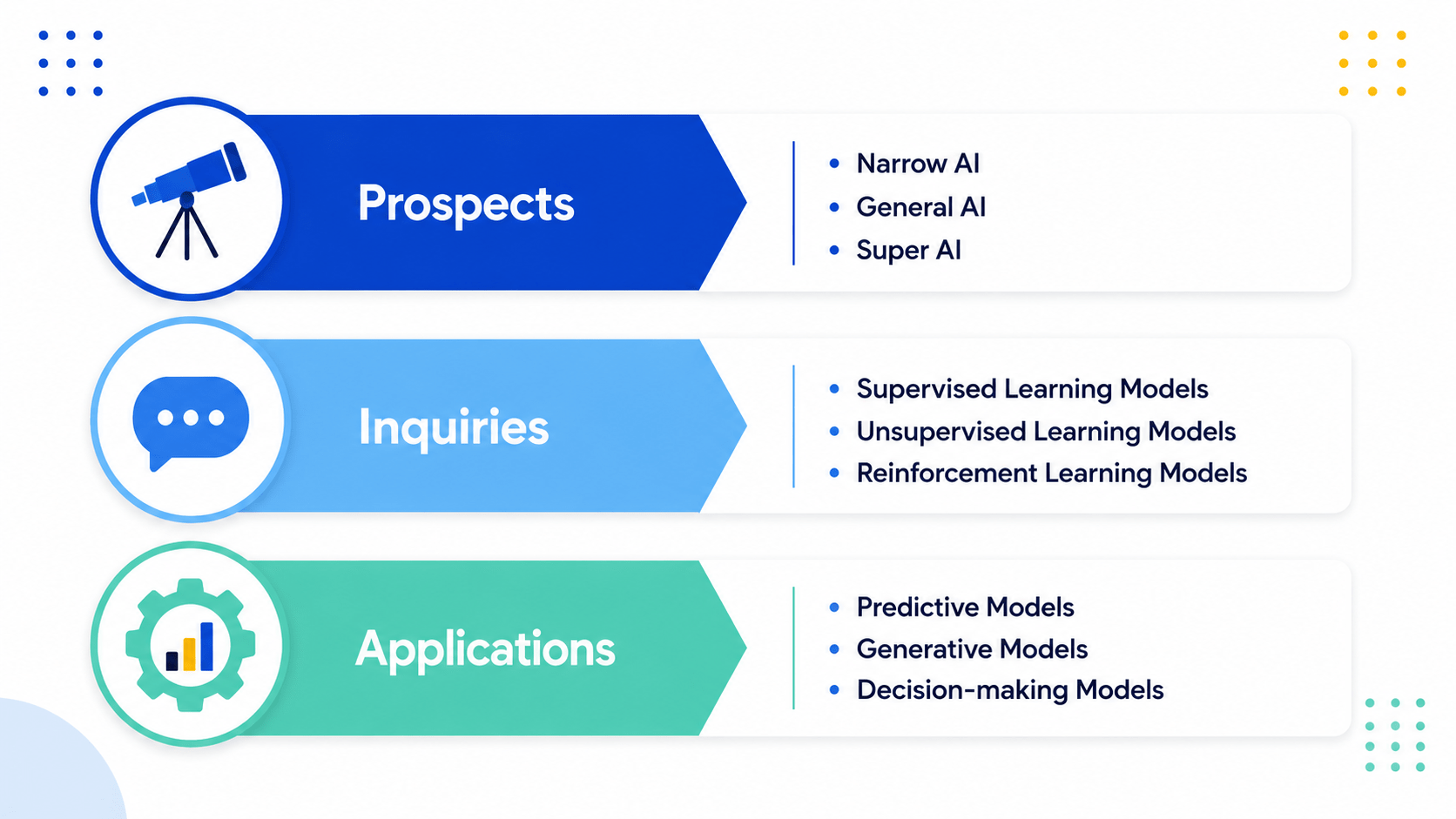
In this section, we will explore the broad categories of AI model types that form the foundation of artificial intelligence. These models can be classified based on their overall approach, learning methods, and specific applications.
Understanding these categories helps in selecting the most appropriate types of AI models for various tasks, from prediction to decision-making.
Keep reading!
AI Models by Capability
AI models are often grouped by capability into three categories: Narrow AI, artificial general intelligence, and superintelligence. These terms get used loosely in marketing and media, so it’s worth being precise about what each one actually describes – and what it doesn’t.
Most AI systems in use today, including advanced generative models, are Narrow AI. That includes large language models, image generators, recommendation engines, and voice assistants. They perform impressively within a defined scope, but that scope is still bounded – none of them constitutes artificial general intelligence in the technical sense.
Narrow AI: systems built for defined tasks
Narrow AI (sometimes called “weak AI”) is designed to perform one task or a bounded set of related tasks – facial recognition, language translation, fraud detection, spam filtering. It can perform exceptionally well, sometimes exceeding human accuracy, but only within its trained domain. A model built for medical image classification cannot generalize to legal document review without being retrained or replaced. Nearly every production AI system deployed by businesses today, including the latest generative AI models, falls into this category.
Artificial general intelligence: a research objective, not a current product category
Artificial general intelligence (AGI) refers to a system capable of performing any intellectual task a human can, across domains, without task-specific retraining. AGI does not currently exist as a deployed product. As a ScienceDirect review of AGI’s development explains, no universally accepted definition of AGI exists, largely because “intelligence” itself is hard to pin down and researchers disagree on which benchmarks would actually demonstrate general capability. That disagreement plays out publicly, too: a Science News examination of the term found that even sharp jumps in benchmark performance from recent models haven’t produced consensus on whether AGI is close, or whether some systems may have already crossed an unmarked line. A more recent industry analysis of AGI progress in 2026 makes a similar point from a different angle: current systems can outperform human experts on narrow, well-defined benchmarks while still falling well short on open-ended reasoning tests, which is why researchers describe today’s landscape as “narrow superintelligence” in pockets rather than general intelligence overall. Treat any claim that a specific product “is” or “achieves” AGI with skepticism – it’s a contested research objective, not a settled milestone.
Superintelligence: a theoretical concept
Superintelligence describes a hypothetical system that would exceed human capability across essentially all cognitive tasks, not just match it. No such system exists, and there is no accepted technical roadmap or timeline for building one. Discussion of superintelligence today belongs to research and policy speculation, not to current engineering practice.
Reality-status comparison
| Category | Capability scope | Current status |
|---|---|---|
| Narrow AI | Performs one task or a bounded set of related tasks (e.g., translation, image classification, text generation) | Deployed at scale today; the category nearly all commercial and generative AI systems fall into |
| Artificial general intelligence (AGI) | Would perform any intellectual task a human can, across domains, without retraining | Active research objective; no universally accepted benchmark confirms it has been achieved |
| Superintelligence | Would exceed human capability across essentially all cognitive tasks | Theoretical concept; no working system or established technical roadmap exists |
Understanding this distinction matters practically, not just academically: it keeps procurement, governance, and strategy decisions grounded in what a model can actually do, rather than in language borrowed from speculative long-term AI discourse. For a closer look at where today’s Narrow AI systems create real business value, see our guide to generative AI development.
AI Models by How They Learn
AI models are also classified by how they get their training signal – what data or feedback shapes the model during learning, and where the “answer” comes from. This is a different lens from architecture: the same neural network architecture can be trained under more than one of these paradigms, so “supervised” or “reinforcement” describes a training approach, not a type of model in itself, a distinction covered in more depth in our AI model training guide.
Supervised learning
Supervised learning trains a model on labeled data, where each input is paired with a known correct output. The model learns a mapping from input to output and is then evaluated on how accurately it predicts outputs for new, unseen inputs. Because the “ground truth” is provided during training, supervised learning is well suited to tasks where accuracy against a known answer is the goal.
- Regression – predicts a continuous numerical value, such as forecasting stock prices or estimating property values.
- Binary classification – sorts inputs into one of two categories, such as flagging an email as spam or not spam.
- Multiclass classification – sorts inputs into one of several categories, such as classifying a support ticket by department.
Unsupervised learning
Unsupervised learning works with unlabeled data – there’s no predefined correct output for the model to match. Instead, the model identifies structure, groupings, or relationships that exist in the data on its own. As IBM’s explainer on AI models puts it, unsupervised learning does not assume the external existence of “right” or “wrong” answers, so it doesn’t require labeling in the first place.
- Clustering – groups similar data points together, such as segmenting customers by purchasing behavior.
- Dimensionality reduction – compresses data into fewer variables while preserving its important structure, often used to simplify data before further analysis.
- Association and pattern discovery – finds relationships between variables, such as identifying which products are frequently purchased together.
Because unsupervised models surface whatever structure already exists in the data, they can also surface – and quietly reinforce – structure that reflects historical bias, which is why fairness testing matters even for approaches with no labels to audit; we cover that in our guide to AI bias and fairness.
Semi-supervised learning
Semi-supervised learning sits between the two: it trains on a small set of labeled data combined with a much larger pool of unlabeled data, using the limited labels to guide how the model interprets the unlabeled portion. As IBM’s overview of machine learning types explains, a semi-supervised model might first use unsupervised learning to identify clusters in the data, then apply supervised learning to label those clusters. This approach is useful when labeling an entire dataset would be too expensive or time-consuming, but some labeled examples are available to anchor the learning process.
Self-supervised learning
Self-supervised learning also works from unlabeled data, but instead of relying on any human-provided labels at all, it generates its own training signal from the structure of the data itself. Per the same IBM overview, self-supervised algorithms – also called predictive or pretext learning algorithms – learn one part of the input from another part, automatically generating labels and effectively turning an unsupervised problem into a supervised one. This is the approach behind most large language model pretraining, where a model learns by predicting a masked or withheld portion of text from the surrounding context – no human labeling required.
Reinforcement learning
Reinforcement learning trains a model, referred to as an agent, to make decisions by interacting with an environment and receiving feedback in the form of rewards or penalties, rather than learning from a fixed labeled dataset. As IBM’s explainer on reinforcement learning describes it, RL operates on interdependent state-action-reward tuples rather than the independent input-output pairs used in supervised learning. The agent takes an action in a given state, receives a reward signal, and adjusts its behavior over time to maximize cumulative reward. This trial-and-error structure is why reinforcement learning dominates use cases like robotics, game-playing agents, and autonomous systems, where there’s no single “correct” labeled answer for every situation.
Within reinforcement learning, algorithms generally fall into two families based on what they learn directly:
- Value-based methods – learn to estimate the expected reward of taking a given action in a given state, then choose whichever action has the highest estimated value. As Zilliz’s technical explainer notes, Q-learning is the classic example: the agent builds a value function, often as a Q-table, and derives its policy by picking the highest-value action in each state.
- Policy-based methods – skip value estimation and directly learn a policy, a mapping from states to actions, that is adjusted to maximize expected reward. This handles continuous or high-dimensional action spaces more naturally, which is why policy gradient methods are common in robotics and control tasks.
Comparison of learning paradigms
| Paradigm | Training signal | Typical output | Suitable use cases |
|---|---|---|---|
| Supervised learning | Labeled input-output pairs | Predicted value or category | Spam detection, price forecasting, medical image classification |
| Unsupervised learning | Unlabeled data | Discovered groupings or structure | Customer segmentation, anomaly detection, dimensionality reduction |
| Semi-supervised learning | Small labeled set + large unlabeled set | Predictions guided by limited labels | Domains where labeling is expensive, e.g., large-scale document tagging |
| Self-supervised learning | Labels generated automatically from the data itself | Learned representations or predictions | Language model pretraining, representation learning |
| Reinforcement learning | Rewards and penalties from environment interaction | A learned policy for sequential decisions | Robotics, game-playing agents, autonomous systems |
A model trained under any of these paradigms doesn’t stay static once deployed – real-world data shifts over time, which is why teams need a process for catching performance decay early, covered in our guide to AI model drift detection and retraining. And regardless of which paradigm shaped a model, validating it properly before and after deployment follows a paradigm-specific playbook – see our AI model testing guide.
AI Models by the Problem They Solve
The most practical way to compare AI models is to start with the problem: does the system need to assign a category, predict a number, spot unusual behavior, group similar records, rank options, generate content, or choose a sequence of actions? This task-first view is more useful for planning than starting from architecture, and it connects each model type directly to our AI model training and AI model testing processes further downstream.
Many of these categories can still be solved well with established methods – linear models, decision trees, random forests, SVMs, k-means, PCA – rather than deep learning. Traditional ML is often the better choice when data is structured/tabular, labeled data is limited, predictions must be explainable to regulators, compute is constrained, or the team needs a fast baseline before testing anything more complex.
Classification models
Classification assigns an input to a predefined category – fraud vs. legitimate, churn vs. retain, which department a support ticket belongs to.
| Method | Best suited to | Key strength | Main trade-off |
|---|---|---|---|
| Logistic regression | Simple, mostly linear relationships | Interpretable probabilities | Weak on nonlinear boundaries |
| Decision tree | Rule-like decisions, mixed features | Easy to visualize | Prone to overfitting/instability |
| Random forest | Nonlinear tabular classification | Strong baseline, low preprocessing | Less transparent than one tree |
| SVM | Small/medium, high-dimensional data | Handles complex feature spaces | Harder to scale and calibrate |
Regression and forecasting models
Regression predicts a continuous value (revenue, price, delivery time); forecasting extends this to time-ordered data and must account for trends, seasonality, and autocorrelation – a random train/test split causes data leakage here, so time-aware validation is essential.
| Method | Best suited to | Key strength | Main trade-off |
|---|---|---|---|
| Linear regression | Stable, understandable relationships | Fast, interpretable | Assumes simplicity |
| Ridge/lasso regression | Many correlated variables | Controls overfitting | May miss nonlinear patterns |
| Random-forest regression | Complex tabular relationships | Robust baseline | Larger, less interpretable |
| Time-series forecasting | Future values from ordered data | Captures trend/seasonality | Sensitive to regime change, leakage |
Clustering and segmentation models
Clustering groups records by similarity when no labels exist- customer segments, machine-behavior profiles, demand regions. Results are exploratory and need business validation, not automatic interpretation.
- K-means – efficient, needs a pre-chosen cluster count, sensitive to scale and shape.
- Hierarchical clustering – reveals nested groupings via a dendrogram; expensive at scale.
- PCA – not clustering itself, but a dimensionality-reduction step often used before it; components can be hard to interpret in business terms.
Anomaly-detection models
Anomaly detection flags observations that deviate from normal behavior – fraud, unusual network activity, equipment faults. “Unusual” isn’t automatically “harmful,” so thresholds need calibration against real risk.
- Statistical/distance-based methods – simple, transparent, weak on high-dimensional or seasonal data.
- Isolation forest – isolates anomalies via random splits, no labels needed; available directly in scikit-learn’s ensemble methods.
- One-class SVM – models complex normal boundaries; sensitive to parameters and scale, better for smaller datasets.
Ranking and recommendation models
Generative models produce new outputs – text, images, code, synthetic records – rather than labels or scores. This spans older probabilistic methods (Gaussian mixtures, HMMs) as well as the deep-learning architectures behind modern generative AI. Outputs are probabilistic, not guaranteed correct, so production use needs evaluation and human review proportionate to risk — see our generative AI development services for how we scope that.
| Method | Best suited to | Main trade-off |
|---|---|---|
| Content-based filtering | Rich item attributes | Repetitive suggestions |
| Collaborative filtering | Large interaction datasets | Cold-start, sparsity |
| Matrix factorization | Structured interaction matrices | Limited context, new items |
| Predictive ranking | Rich contextual features | Can optimize the wrong signal |
Generative models
Generative models produce new outputs – text, images, code, synthetic records – rather than labels or scores. This spans older probabilistic methods (Gaussian mixtures, HMMs) as well as the deep-learning architectures behind modern generative AI. Outputs are probabilistic, not guaranteed correct, so production use needs evaluation and human review proportionate to risk – see our generative AI development services for how we scope that.
Sequential decision-making models
Here, one decision changes the conditions for the next – robotics, dynamic pricing, inventory control, traffic optimization. Reinforcement learning is the primary paradigm: an agent observes state, acts, receives reward, and updates strategy, balancing immediate vs. long-term outcomes. Deployment risks include reward hacking, unsafe exploration, and environment drift after launch – which is also why post-deployment drift detection and retraining matters more here than in static prediction tasks. RL should only be introduced when a problem genuinely involves repeated actions and delayed feedback – using it for a one-shot prediction problem adds complexity without benefit.
When traditional ML beats deep learning
Traditional methods remain the better choice when data is tabular, datasets are modest in size, explainability is operationally required (credit, insurance, healthcare, compliance), compute/latency is constrained, or the team needs a defensible baseline before justifying anything heavier. Deep learning earns its cost when the model must learn representations directly from unstructured inputs – images, text, audio – rather than engineered tabular features.
Choosing by decision, not trend
Use classification for categories, regression for numeric values, forecasting for time-ordered data, clustering for undiscovered groups, anomaly detection for rare deviations, ranking/recommendation for ordered candidates, generative models for new content, and sequential decision-making for actions with long-term consequences. Only after defining the problem should a team pick the algorithm.
For organizations evaluating model choices for operational analytics, automation, or predictive systems, see our data analytics services, AI development services, or AI consulting services.
The practical rule: choose the simplest model that meets the required performance, reliability, interpretability, and operating constraints. More sophisticated does not automatically mean more suitable.
Common Traditional Machine Learning Models
Linear and logistic regression
Linear regression is one of the simplest and most commonly used AI model types for predicting continuous values. It finds the relationship between dependent and independent variables, making it particularly useful for applications like predicting house prices based on factors like size and location. By establishing a linear relationship, this model can make predictions based on historical data.
Logistic regression is used for binary classification tasks, where the output is limited to two categories. A typical application is spam detection in emails, where the model classifies messages as either “spam” or “not spam” based on features like keywords and sender information. While it’s called “regression,” logistic regression is used for classification because it outputs probabilities.
Decision trees and random forests
Decision trees are a versatile AI model type used for both classification and regression tasks. They split data into branches based on different features, creating a tree-like structure. In customer segmentation, for example, decision trees can help divide customers into groups based on behaviors or demographics, providing actionable insights for targeted marketing strategies.
Random Forest is an ensemble method that combines multiple decision trees to improve accuracy and reduce overfitting. It works by building several decision trees and aggregating their results, making it ideal for tasks like credit scoring, where predictions are made based on various financial factors. This AI model type is robust and effective for handling complex datasets with multiple variables.
Support vector machines
Support Vector Machines (SVM) are powerful classification models used for tasks like image recognition. They work by finding the optimal hyperplane that separates data into distinct classes. For example, in image classification, SVM can distinguish between different objects or patterns by analyzing pixel data, making it highly effective for facial recognition and object detection tasks.
K-means and hierarchical clustering
K-Means clustering is a widely used AI model type for grouping similar data points into clusters. The algorithm partitions data into a predefined number of clusters based on their similarities.
A common application is customer segmentation, where K-Means can categorize customers based on behaviors such as purchasing patterns or demographics, helping businesses personalize marketing efforts and improve customer targeting.
Hierarchical clustering is another popular AI model type for organizing data into a tree-like structure. It begins by treating each data point as its own cluster and progressively merges them based on similarity.
This approach is useful for tasks like organizing medical data, where hierarchical clustering can group patients with similar health conditions, making it easier to analyze and draw insights from large datasets.
Principal component analysis
Principal Component Analysis (PCA) is a dimensionality reduction technique that simplifies large datasets while preserving key information. By reducing the number of variables, PCA helps improve the efficiency of other models and visualization tools. It is commonly used in fields like image processing and finance, where it can reduce the complexity of data without losing essential details.
For example, PCA is often applied to reduce the number of features in datasets for machine learning tasks, such as facial recognition.
When traditional machine learning is often the better fit
Deep learning isn’t automatically the stronger choice. Traditional models are often the better fit when the data is structured or tabular, the labeled dataset is modest, predictions need to be explainable to business users or regulators, or compute and latency are constrained. In those cases, a well-tuned linear model, tree, or ensemble can match a neural network’s usefulness at a fraction of the training and infrastructure cost, and gives the organization a defensible baseline before justifying anything heavier.
Teams weighing this trade-off for their own data can review SmartDev’s data analytics services and AI development services, or see how these methods apply to equipment and process monitoring in our machine learning development services, which covers predictive-maintenance use cases.
Deep Learning Model Architectures
Deep learning, a subset of machine learning, uses multi-layered neural networks to model complex tasks that simpler algorithms struggle with – from natural language understanding to image recognition. Architecture here answers a different question than either learning paradigm or business task: it’s about how a model is structured to process a particular form of data, and different architectures are built for fundamentally different data shapes.
Artificial neural networks
Artificial Neural Networks (ANNs) are the foundational architecture in deep learning, loosely inspired by the brain’s neural structure. Data passes through layers of interconnected nodes, allowing the model to learn from data and make predictions – forecasting market trends, predicting customer behavior, or supporting predictive analytics more broadly across finance, healthcare, and marketing. Most of the more specialized architectures below are variations built on this same underlying idea.
Convolutional neural networks for visual data
Convolutional Neural Networks (CNNs) are purpose-built for computer vision and object detection. As Stanford’s CS231n course materials explain, a CNN takes an input image and transforms it through layers of convolution, activation, and pooling that automatically learn to detect features like edges, textures, and shapes directly from pixel data – no hand-engineered features required. This makes CNNs the standard choice for facial recognition, self-driving car perception, and medical image analysis, where visual data needs to be interpreted efficiently and at scale.
Recurrent networks and LSTMs for sequences
Recurrent Neural Networks (RNNs) are built to handle sequential data. Unlike a standard feedforward network, an RNN has feedback loops that let it carry information from previous inputs forward, which historically made it a natural fit for time-series data, speech recognition, and early language models – a chatbot built on an RNN, for example, could factor prior turns of a conversation into its next response.
Long Short-Term Memory networks (LSTMs) are a specialized variant introduced by Hochreiter and Schmidhuber’s original 1997 paper to fix a core weakness of plain RNNs: the vanishing-gradient problem, which makes it hard for a standard RNN to retain information over long sequences. LSTMs were, for a long stretch, the go-to architecture for time-series forecasting and sequence modeling- weather prediction, stock forecasting, earlier-generation language models. It’s worth being precise here: RNNs and LSTMs are useful, well-understood architectures for certain sequential and time-series tasks, particularly where sequences are shorter or strict step-by-step order matters, but they are no longer the default starting point for large-scale language tasks, which brings us to transformers.
Transformers for language and other sequences
Transformers, introduced in the 2017 paper Attention Is All You Need, replaced recurrence with a self-attention mechanism that lets a model weigh the relevance of every other token in a sequence directly, rather than passing information step by step. This enabled far greater parallelization during training and better handling of long-range dependencies, which is why transformers now underpin most modern natural language processing – models like GPT and BERT, and the tools built on them for conversational AI and modern search. The architecture has also been adapted well beyond language, to sequences in audio, code, and other domains, largely displacing RNNs and LSTMs as the default for large-scale sequence modeling.
Autoencoders for representation learning and anomaly detection
Autoencoders are neural networks trained to compress input data into a smaller latent representation and then reconstruct it back to its original form. As TensorFlow’s documentation on autoencoders describes it, the network learns to minimize reconstruction error on the data it’s trained on – which is what makes autoencoders useful for both representation learning and anomaly detection. Trained only on normal data, an autoencoder reconstructs typical patterns well; anything it struggles to reconstruct – an unusual transaction, an odd network request – produces a higher reconstruction error and stands out as a potential anomaly. This makes autoencoders a common choice in cybersecurity and fraud detection, where the goal is catching deviations from expected behavior in real time.
Data-modality-to-architecture map
| Data modality | Typical architecture | Example task |
|---|---|---|
| Tabular / structured | ANN (or traditional ML – see earlier section) | Predictive analytics, forecasting |
| Images / video | CNN | Facial recognition, defect detection |
| Short/medium sequences, time-series | RNN / LSTM | Sensor time-series, legacy speech models |
| Language and long sequences (text, audio, code) | Transformer | Chatbots, search, translation |
| Any modality, unsupervised | Autoencoder | Anomaly detection, denoising, compression |
Choosing deep learning: data, compute, and interpretability trade-offs
None of these architectures are a default choice – they come with real costs traditional methods don’t. Three factors usually decide whether deep learning is worth it for a given problem:
| Factor | What to weigh |
|---|---|
| Data availability | Deep architectures generally need substantially more labeled or unlabeled data than traditional models to learn reliable patterns; with a small dataset, a simpler model often generalizes better. |
| Compute and latency | Training and serving CNNs, transformers, and LSTMs at scale typically requires GPU/accelerator infrastructure and MLOps tooling, raising both cost and operational complexity versus a traditional model that runs on ordinary hardware. |
| Explainability | Deep networks are harder to justify to a regulator or customer than a decision tree or logistic regression – a real constraint in credit, healthcare, or hiring decisions, not just an inconvenience. |
| Accuracy ceiling | Where the problem involves learning representations directly from unstructured data (images, audio, free text), deep architectures typically reach an accuracy ceiling traditional methods can’t match. |
The practical rule carries over from the earlier discussion of traditional ML: deep learning earns its place when the problem genuinely requires learning representations from unstructured inputs – not by default. Teams evaluating where that line falls for their own data can look at SmartDev’s AI & machine learning solutions for how computer vision and NLP projects get scoped, our generative AI development services for transformer-based applications specifically, or our AI development services for custom architecture selection more broadly.
Generative and Foundation Models
Generative models create new outputs – text, images, audio, code – rather than assigning a category or predicting a number. This is a task-and-output classification, not an architecture: a generative model may be built as a transformer, a diffusion process, a GAN, or a VAE. It also isn’t the same thing as a foundation model (a broadly-trained model adaptable to many tasks) or a large language model (a large-scale model centered on language) – a system can be generative, an LLM, and a foundation model all at once, or generative without being either of the other two.
Generative model families at a glance
| Family | Typical output | How it’s adapted | Key strength | Main risk/trade-off | Common enterprise use |
|---|---|---|---|---|---|
| LLM (transformer-based) | Text, code, structured data | Prompting, RAG, fine-tuning | Versatile across language tasks | Fluent but not guaranteed accurate | Chatbots, summarization, extraction |
| Diffusion model | Images, video, audio | Prompting, conditioning, fine-tuning | High output quality and control | Slow, multi-step inference | Image/video generation and editing |
| GAN | Images, synthetic data | Retraining generator/discriminator | Fast, single-pass generation | Unstable training, mode collapse | Synthetic training data, image enhancement |
| VAE | Reconstructed/generated data | Retraining encoder-decoder | Structured latent space, good for anomaly detection | Outputs often less sharp than GANs/diffusion | Anomaly detection, data compression |
Large language models
LLMs are typically transformer-based and pretrained through self-supervised objectives like next-token prediction, which is why they don’t need manually labeled examples for every case. Once trained, the same model can generate text, classify records, extract fields, or support a broader workflow – it isn’t just a “text generator.” Because LLMs produce probabilistic output rather than retrieving verified facts, enterprise deployments typically pair them with retrieval systems, validation rules, access controls, and human review. Retrieval-augmented generation is the most common way of grounding an LLM in current, organization-specific data rather than relying solely on what it learned during training.
Diffusion models and GANs
Diffusion models learn to reverse a gradual noise-adding process, generating output by starting from noise and denoising it step by step – a strong fit for high-quality, controllable image and video generation, at the cost of slower, multi-step inference. GANs instead pit a generator against a discriminator in competition, which allows faster single-pass generation but makes training less stable and prone to mode collapse. Diffusion models now dominate most general-purpose image generation, but GANs remain useful where speed or a narrow, specialized visual task matters more than maximum diversity.
Variational autoencoders
VAEs learn a probabilistic latent representation of data – an encoder maps input into that latent space, and a decoder reconstructs or generates from it. Their structured latent space makes them useful for anomaly detection, compression, and interpolation between examples, even though their outputs are typically less sharp than a GAN’s or a diffusion model’s.
Foundation models
Foundation models are best understood as a general paradigm rather than something specific to language – the Stanford Center for Research on Foundation Models’ influential 2021 report defines them as models trained on broad data, generally through self-supervision at scale, that can be adapted to many downstream tasks. As IBM’s explainer on foundation models puts it, this flexibility and scale set them apart from traditional machine-learning models trained on smaller datasets for one specific task, since a foundation model instead employs transfer learning to apply what it learned on one task to another. Not every generative model qualifies: a GAN trained to generate only one narrow category of product images is generative without being broadly adaptable, while an LLM is one important class of foundation model among others spanning vision, speech, robotics, and multimodal domains.
Common adaptation methods, roughly ordered from lightest to heaviest:
- Prompting / in-context learning – instructions or examples at inference time; fast, no retraining.
- Retrieval-augmented generation – grounding responses in retrieved, current information.
- Fine-tuning / parameter-efficient fine-tuning – updating some or all parameters on narrower data.
- Instruction tuning and preference optimization – shaping the model toward following requests helpfully and safely.
- Tool use – connecting the model to APIs, databases, or business systems.
Because the same foundation model underlies many applications, this concentration is a double-edged sword: it lets teams amortize improvements to robustness and bias across many uses, but it also turns the shared model into a single point of failure that can propagate the same flaws to every application built on it – a risk Stanford’s foundation-model report describes as a direct consequence of homogenization. That’s why evaluation needs to cover both the underlying model and the full system built around it, not just public benchmark scores.
Multimodal models
Multimodal models connect or generate across more than one data type – text, images, audio, video, documents. They range from shared-embedding models (positioning related text and images near each other for cross-modal search) to tool-based systems that coordinate separate vision, speech, and language components. Being multimodal doesn’t mean every modality is understood equally well – a system might handle text and simple images confidently while struggling with dense diagrams or long video, so real-world performance depends on the specific workflow, not the number of formats listed. Teams building this kind of system – whether an AI agent coordinating tools or a custom application on top of GPT, Claude, or open-source LLMs – can see how SmartDev scopes this work through our generative AI development services.
Composite and Context-Specific AI Approaches
Some commonly-cited “AI model types” are actually combinations of models or descriptions of where or how a system runs – mixing them in with architectures like transformers creates category confusion. A simple test cuts through this: does the term describe how a model learns or is structured (a model concern), or does it describe the surrounding system, deployment location, or trust layer (a system concern)?
Neuro-symbolic AI – a composite reasoning approach
Neuro-symbolic AI combines neural pattern-learning with symbolic rules or logic – for example, a neural model extracts entities from a document, then symbolic rules check them against a policy. It’s not one architecture but a way of pairing two different strengths: neural flexibility with unstructured data, and symbolic interpretability and rule adherence. The challenge is integration, since neural and symbolic components represent knowledge in fundamentally different ways.
Hybrid AI – combining model families, not a new one
A hybrid system combines multiple models because no single one covers the full problem – a fraud-detection pipeline might pair a supervised classifier, an anomaly detector, graph analysis, and rule-based blocking. This is a design pattern, best described by its components and how they interact, not filed under one label.
Edge AI – a deployment choice, not a model type
Edge AI processes data locally on a device rather than relying on a continuous connection to centralized cloud infrastructure, which lets it function offline and reduces the latency of transmitting data back and forth. The same classifier, detector, or language model can run in the cloud, on the edge, or both – edge describes where inference happens, not how the model learns. It’s typically chosen for low latency, offline operation, or keeping sensitive data local, and it comes with real constraints: limited memory and compute usually mean the model needs to be compressed via quantization, pruning, or distillation first (Source: IBM).
Blockchain and other trust layers – infrastructure, not a model category
Adding blockchain to an AI system doesn’t create a new model family – it adds tamper-evident records, traceability, or shared governance around a model that’s still a classifier, forecaster, or LLM underneath. The same applies to other trust layers: identity systems, secure enclaves, access controls, and audit tooling change the system’s governance, not the model’s taxonomy.
Describing a composite system properly
Instead of one vague label like “hybrid AI,” describe the system across each relevant dimension:
| Dimension | Example |
|---|---|
| Task and output | Extraction, classification, summarization |
| Learning signal | Self-supervised pretraining + supervised adaptation |
| Architecture | Transformer-based language and vision components |
| Composite approach | Neural extraction + rule-based validation |
| Deployment context | Private cloud with selected edge processing |
| Trust/control layers | Access controls, audit logs, human approval |
This is longer than a single label, but it actually tells you what the system does, how it’s built, and what surrounds it. Teams scoping this kind of architecture – including the IoT and edge computing side or a blockchain trust layer – can use this same breakdown to plan the model layer, deployment layer, and governance layer separately rather than searching for one all-purpose category.
How to Choose the Right AI Model
Choosing the right model isn’t about picking the newest architecture or the one topping a public benchmark. It’s about matching a model to the business decision you’re trying to improve, the data you actually have, and the constraints the system has to operate under – and validating that fit through real testing rather than assuming it from a spec sheet.
A seven-step selection process
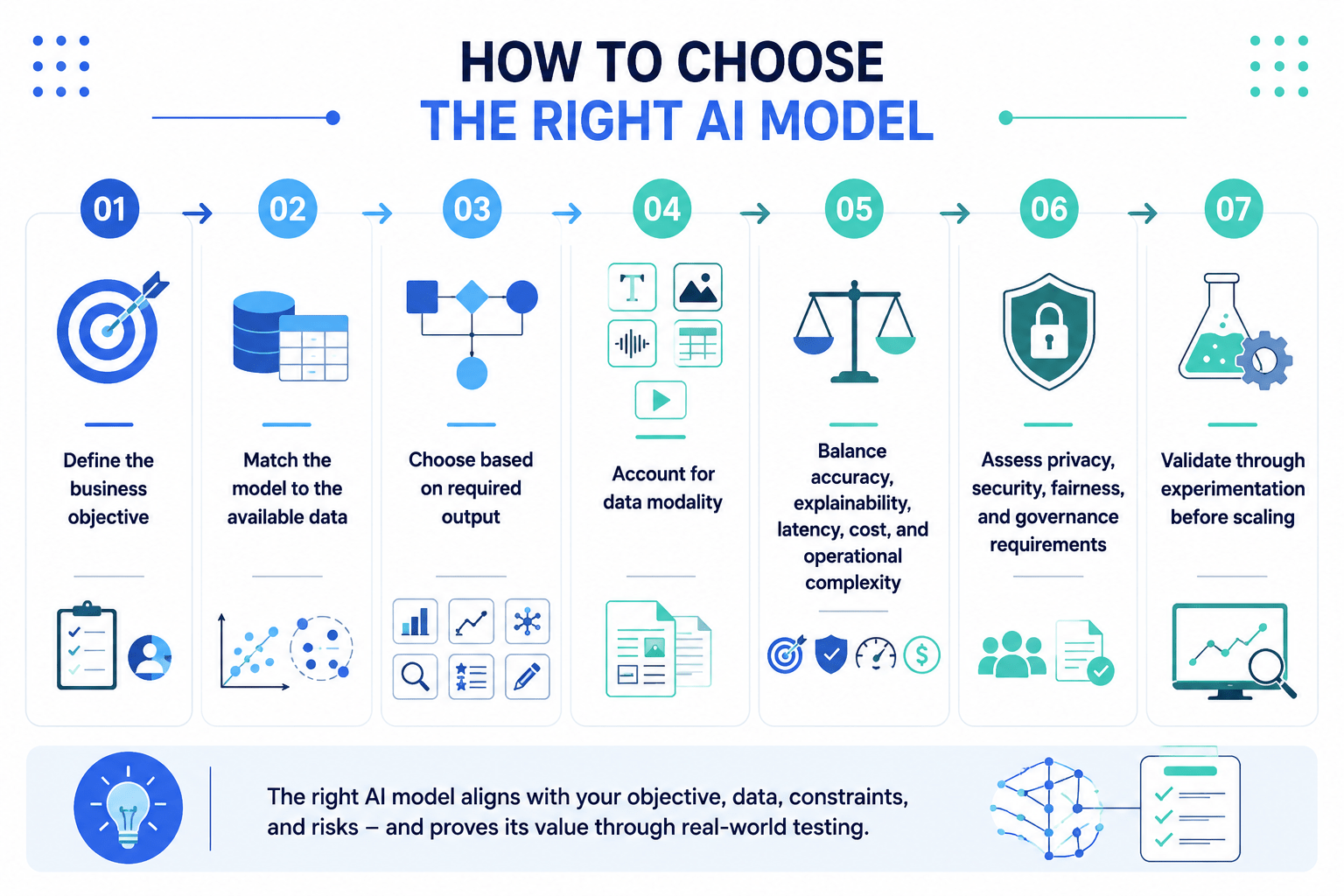
Step 1: Define the business objective
State the specific decision or workflow to improve, who acts on the output, the cost of errors, and how success will be measured – “predict machine failure 7 days out so maintenance can be scheduled,” not “use AI for maintenance.” This step also decides whether AI is needed at all; a fixed rule or database query sometimes beats a model outright.
Step 2: Match the model to the available data
Labeled, tabular data suits supervised methods; unlabeled data points toward clustering or anomaly detection; unstructured text, images, or audio usually need models that learn representations directly; time-series data needs time-aware validation to avoid data leakage.
Step 3: Choose based on required output
A category needs classification, a number needs regression, a future value needs forecasting, a group needs clustering, an unusual event needs anomaly detection, an ordered list needs ranking, new content needs a generative model, and a sequence of decisions needs sequential decision-making.
Step 4: Account for data modality
The same objective needs a different model depending on whether the input is text, images, audio, video, tabular records, sensor streams, or a mix – document workflows, for instance, often need OCR, layout analysis, and extraction layered around a language model, not just the model alone.
Step 5: Balance accuracy, explainability, latency, cost, and operational complexity
The highest-accuracy model isn’t automatically the right one if it can’t be explained to a regulator, costs too much to operate, responds too slowly, or adds failure points to a system that already has enough of them.
Step 6: Assess privacy, security, fairness, and governance requirements
NIST’s AI Risk Management Framework organizes this kind of assessment into four functions – Govern, Map, Measure, and Manage – meant to be applied iteratively across the AI system’s lifecycle rather than as a one-time checklist. Higher-stakes systems need clearer accountability, audit trails, and human oversight before deployment, not after something goes wrong.
Step 7: Validate through experimentation before scaling
No amount of upfront analysis substitutes for testing a model against real data and real edge cases. A focused proof of concept is usually the fastest way to find out whether a model actually holds up in your environment – see SmartDev’s AI Proof of Concept services for how that validation stage is typically scoped, and our AI model testing guide for what rigorous evaluation looks like once a model is built.
AI Model Selection Canvas
| Dimension | Key questions |
|---|---|
| Business objective | What decision improves? Who acts on it? What’s the cost of being wrong? |
| Data | Labeled or not? Structured, unstructured, or time-series? Representative of production? |
| Required output | Category, number, forecast, cluster, anomaly score, ranking, generated content, or action? |
| Modality | Text, image, audio, video, tabular, sensor, or multimodal? |
| Performance trade-offs | Accuracy vs. explainability vs. latency vs. cost vs. complexity – which matters most here? |
| Risk and governance | Sensitive data involved? Fairness risk? Who owns the model and its decisions? |
| Validation path | Can this be proven with a proof of concept before full build-out? |
This canvas is a starting point for structuring the conversation, not a substitute for engineering judgment – two teams can fill it out identically and still land on different models once they get into the data. Teams weighing whether a project justifies the investment can also review our AI consulting services for objective-setting support, our AI development services for build-out, and our AI development cost guide for budgeting realistically across the full lifecycle rather than just initial training.
The best model is the one that meets the business objective within acceptable performance, cost, risk, and operating constraints – not the most advanced one available.
Limitations and Responsible AI Considerations
Strong performance in development doesn’t guarantee a model will hold up in production – data shifts, users behave differently than expected, and real operating conditions surface things training data never showed. This is why responsible deployment needs to be treated as a selection criterion up front, not a disclaimer added after the model is built.
Data quality and bias
A model can only be as reliable as the data it learned from. Missing values, inconsistent labels, and a mismatch between training and production conditions all degrade performance regardless of architecture – a predictive-maintenance model trained only on normal operation, for instance, may miss rare but critical failure patterns.
Bias is the most serious version of this problem: a model trained on historical decisions shaped by unequal treatment can learn to repeat that pattern, and removing an obviously sensitive variable doesn’t remove it, since other features (location, spending patterns) can act as proxies. Teams should specifically check whether error rates differ across groups and whether affected people can challenge a consequential decision – SmartDev’s guide to AI bias and fairness covers this in more depth, including how regulators like the EU are formalizing these expectations. There’s no single universal fairness metric; the right standard depends on the use case and who’s affected.
Explainability and human oversight
Linear models and small decision trees are relatively easy to interpret; large neural networks and foundation models generally are not. That gap matters most in healthcare, financial services, recruitment, and other high-impact settings where someone needs to understand why a decision was made – and it’s worth noting that explanation techniques have limits of their own: a generated rationale can sound convincing without accurately describing why the model actually produced that output, so explanations support review rather than proving a decision correct.
Human oversight matters most when a model affects rights, safety, or financial outcomes, when errors are hard to reverse, or when the system can take actions through connected tools. But oversight has to be meaningful – asking one person to rubber-stamp hundreds of automated decisions without enough time or authority creates the appearance of control without actually reducing risk. SmartDev’s guide to AI ethics concerns walks through how organizations are building oversight into high-stakes deployments in practice.
Privacy, security, and compliance
Privacy questions start with whether the data was collected for this purpose at all, and extend to where it’s stored, whether it’s sent to an external provider, and whether people can request access or deletion. Generative and foundation models add new angles here too – prompts can leak confidential information, and retrieved documents can expose material a user shouldn’t see.
Security risk spans both the model itself (data poisoning, parameter extraction, adversarial inputs) and the application layer around it (prompt injection, insecure tool calls, unauthorized API access) – the more a model is connected to email, databases, or payment systems, the larger that risk surface gets. SmartDev’s AI use cases in security covers how AI itself is increasingly used on the defensive side of this problem. The OECD’s AI Principles – the first intergovernmental standard on AI, adopted by 47 governments – frame this as a lifecycle responsibility spanning transparency, robustness, and accountability, though specific legal obligations still vary significantly by jurisdiction and sector, so general practice shouldn’t be mistaken for a compliance guarantee in any one region.
Cost, energy use, and total lifecycle value
Large deep-learning and foundation models are resource-intensive to train and can be expensive to run at scale, especially with long contexts or multiple model calls per task. The right comparison isn’t model size against model size – it’s business value against total lifecycle cost, including data labeling, fine-tuning, monitoring, security, and human review. Starting with a simpler baseline, reusing an existing model, or routing simple tasks to a smaller model are often the more defensible choices once that full cost is counted.
Monitoring, drift, and why evaluation doesn’t stop at deployment
Production conditions change after launch – customer behavior evolves, fraud tactics adapt, equipment ages – which is exactly why monitoring is required after deployment, not just before it: a model can keep receiving familiar-looking input while its predictions quietly become less useful, because data drift (the inputs themselves change) and concept drift (the relationship between inputs and outcomes changes) don’t always show up as an obvious failure right away. Generative models need broader evaluation still, since many outputs don’t have one correct answer – factual accuracy, hallucination rates, and tool-use accuracy typically need human evaluation alongside automated metrics.
A working monitoring program needs clear action thresholds defined in advance: when an alert fires, who investigates, when retraining is triggered, and when the system should fall back to manual processing. SmartDev’s AI model testing guide and drift detection and retraining guide go into how that evaluation discipline gets built into an operating system rather than treated as a one-time review.
Pre-deployment risk checklist
| Area | Key question |
|---|---|
| Data | Does training data represent the real operating population and conditions? |
| Bias | Do error rates differ meaningfully across relevant groups? |
| Explainability | Can this decision be justified to the person it affects, or to a regulator? |
| Human oversight | Is review meaningful – enough time, information, and authority to actually catch errors? |
| Privacy | Was this data collected for this purpose, and can it legally be used this way? |
| Security | What’s the risk if this model is connected to other systems or tools? |
| Cost | Does business value justify the full lifecycle cost, not just training cost? |
| Monitoring | What triggers an alert, a retrain, or a rollback — and who owns that decision? |
Where AI Models Are Headed
Several developments are durable enough to shape decisions today; others remain research directions worth watching but not yet worth building around. Separating the two matters more than making predictions.
| Act now on | Monitor, don’t over-commit to yet |
|---|---|
| Combining broad foundation models with smaller, specialized models and retrieval – not one model for everything | Fully autonomous AI agents operating without bounded permissions |
| Evaluation discipline and monitoring as standard practice, not a launch-day afterthought | Continual learning that adapts without full retraining |
| Governance frameworks (NIST AI RMF, OECD principles) as a starting structure, mapped to your actual risk level | Artificial general intelligence as a deployable category |
| Reducing labeled-data dependency via transfer learning, few-shot prompting, and retrieval | Quantum machine learning as a near-term infrastructure choice |
| Treating the model as one component in a system – with rules, validation, and human review around it | Neuro-symbolic reasoning at production scale |
More capable multimodal and foundation models
Foundation models are extending beyond text into images, audio, video, and structured documents, and increasingly connect to external tools and business applications. This doesn’t mean one general-purpose model will out-perform every specialist model – the practical direction is a mixture of broad foundation models, smaller task-specific models, retrieval, and deterministic rules working together, with the model as one component in a larger system rather than the whole solution. SmartDev’s piece on building an enterprise AI platform across six core layers covers how that layered architecture gets planned in practice.
Less labeled data, more evaluation discipline
Self-supervised learning, transfer learning, and few-shot prompting are reducing how much labeled data a project needs to get started – but a model that adapts quickly from a handful of examples can still fail quietly on rare cases or underrepresented groups, so this doesn’t reduce the need for representative evaluation data. If anything, as capability spreads faster than labeling effort, standardized evaluation, documentation, and audit trails are becoming more central to whether a system is actually production-ready, not less.
Research directions worth watching, not betting on yet
Artificial general intelligence remains a genuinely uncertain research objective – current models still make basic errors and depend heavily on their training data, so AGI shouldn’t be treated as an established or imminent category available for deployment. AI agents are moving into real workflows, but greater autonomy means errors can accumulate across steps, which is why near-term enterprise use tends toward bounded permissions and approval points rather than unrestricted independence. Neuro-symbolic reasoning and quantum machine learning both remain promising but technically immature – worth tracking, not yet worth treating as infrastructure decisions.
The throughline: capability alone doesn’t determine whether an AI system succeeds. The systems that hold up are the ones pairing a reasonably capable model with representative data, a clear business objective, real evaluation, and governance that matches the actual stakes involved.
Frequently Asked Questions About AI Model Types
- What are the main types of AI models?
There’s no single list, because “type” depends on which lens you’re using: capability (narrow AI vs. the still-theoretical AGI), learning signal (supervised, unsupervised, self-supervised, reinforcement), task (classification, regression, clustering, generation), and architecture (CNNs, transformers, GANs). Most real systems combine several of these dimensions at once rather than fitting neatly into one category.
- What’s the difference between a model and an algorithm?
An algorithm is the method used to learn patterns from data – logistic regression, gradient boosting, backpropagation. A model is the specific trained result of running that algorithm on a dataset: the learned parameters and structure that can then make predictions on new data. The same algorithm trained on different data produces different models.
- Which models work best for prediction?
It depends on what’s being predicted and from what data. For a category or numerical value from structured, tabular data, logistic regression, decision trees, and random forests are typically strong and explainable starting points. For predictions from time-ordered data, forecasting models built for trends and seasonality are needed instead of ordinary regression. For predictions from unstructured data like images or text, deep learning architectures such as CNNs or transformers generally outperform traditional methods. Our AI model training guide covers how that choice shapes the rest of the pipeline.
- What models are used in generative AI?
Generative AI spans several distinct architectures: transformer-based large language models for text, diffusion models for high-quality images and video, GANs for fast image synthesis, and variational autoencoders for representation learning and anomaly detection. “Generative AI” describes what these models produce, not a single underlying architecture – see our generative AI development services for how these get applied in practice.
- What’s the difference between supervised, unsupervised, and self-supervised learning?
Supervised learning trains on labeled input-output pairs; unsupervised learning finds structure in unlabeled data with no predefined “correct” answer; self-supervised learning also uses unlabeled data, but generates its own training signal from the data itself – the approach behind most large language model pretraining. Semi-supervised learning sits between the first two, combining a small labeled set with a larger unlabeled one.
- How should a business choose the right AI model?
Start with the specific decision to improve and the cost of getting it wrong, then work backward through the data available, the required output, and constraints like latency, explainability, and governance — not forward from “which model is newest.” A proof of concept is usually the fastest way to confirm the choice actually holds up; see SmartDev’s AI Proof of Concept services for how that validation step typically works.
Conclusion: Choosing Models by Problem, Data, and Constraints
The six classification lenses covered throughout this guide – capability, learning signal, task and output, architecture, data modality, and deployment context – aren’t competing taxonomies to memorize. They’re different questions that, taken together, describe what a model actually is and whether it fits a given problem. A model can be narrow AI, supervised, a classifier, a random forest, built for tabular data, and deployed on-premise all at once; none of those labels replaces the others.
The selection process that runs through every section here is the same one: define the decision you’re trying to improve, match the model family to the data and required output, then weigh accuracy against explainability, latency, cost, and risk before committing to an architecture. Taxonomy helps you ask better questions earlier and avoid obviously mismatched choices, but it can’t substitute for testing a model against real data in the actual environment it will run in.
That’s the decisive step. A model that looks right on paper – the right architecture, the right learning paradigm, the right benchmark – still has to prove itself under production data, real edge cases, and the operational constraints unique to your business before it’s the right choice in practice.
Next Steps: Explore AI Development and Implementation Support
Key takeaways
| Theme | Takeaway |
|---|---|
| Taxonomy | No single “AI model type” list exists – capability, learning signal, task, architecture, modality, and deployment are separate, combinable lenses |
| Selection | Start from the business decision and its cost of error, not from the newest architecture or a benchmark score |
| Data | The model choice is bounded by what data you actually have – labeled, unlabeled, unstructured, or time-series |
| Trade-offs | Accuracy, explainability, latency, cost, and operational complexity are traded off together, not optimized one at a time |
| Risk | Privacy, security, fairness, and governance need to be assessed before deployment, not after |
| Validation | Real-world testing in your operating environment is the step that actually confirms a model choice – no framework substitutes for it |
If you’ve worked through the options here and are ready to move from evaluation to action, a few resources can help depending on where you are:
- Still validating an idea? Start with an AI Proof of Concept to test feasibility on your own data before committing to full-scale development.
- Need help scoping the right approach? SmartDev’s AI consulting services can help translate a business problem into a concrete model-selection plan.
- Ready to build? Our AI development services cover custom model development, from data pipelines through deployment.
- Need to validate a model before or after launch? See our AI model testing guide for how to structure that evaluation.
- Budgeting the investment? Our AI development cost guide breaks down what a project typically costs across its full lifecycle, not just initial training.