
TL;DR
- Self-service compliance software collects evidence and flags gaps; your team still fixes them.
- A managed compliance workflow runs one specific process against your approved rules, with an accountable operator.
- Choose software for an evidence problem, such as audit preparation. Choose a managed workflow for a conformance problem, where high-volume processes drift.
- Next step: ask who fixes a failed control on an ordinary Tuesday.
1. Introduction
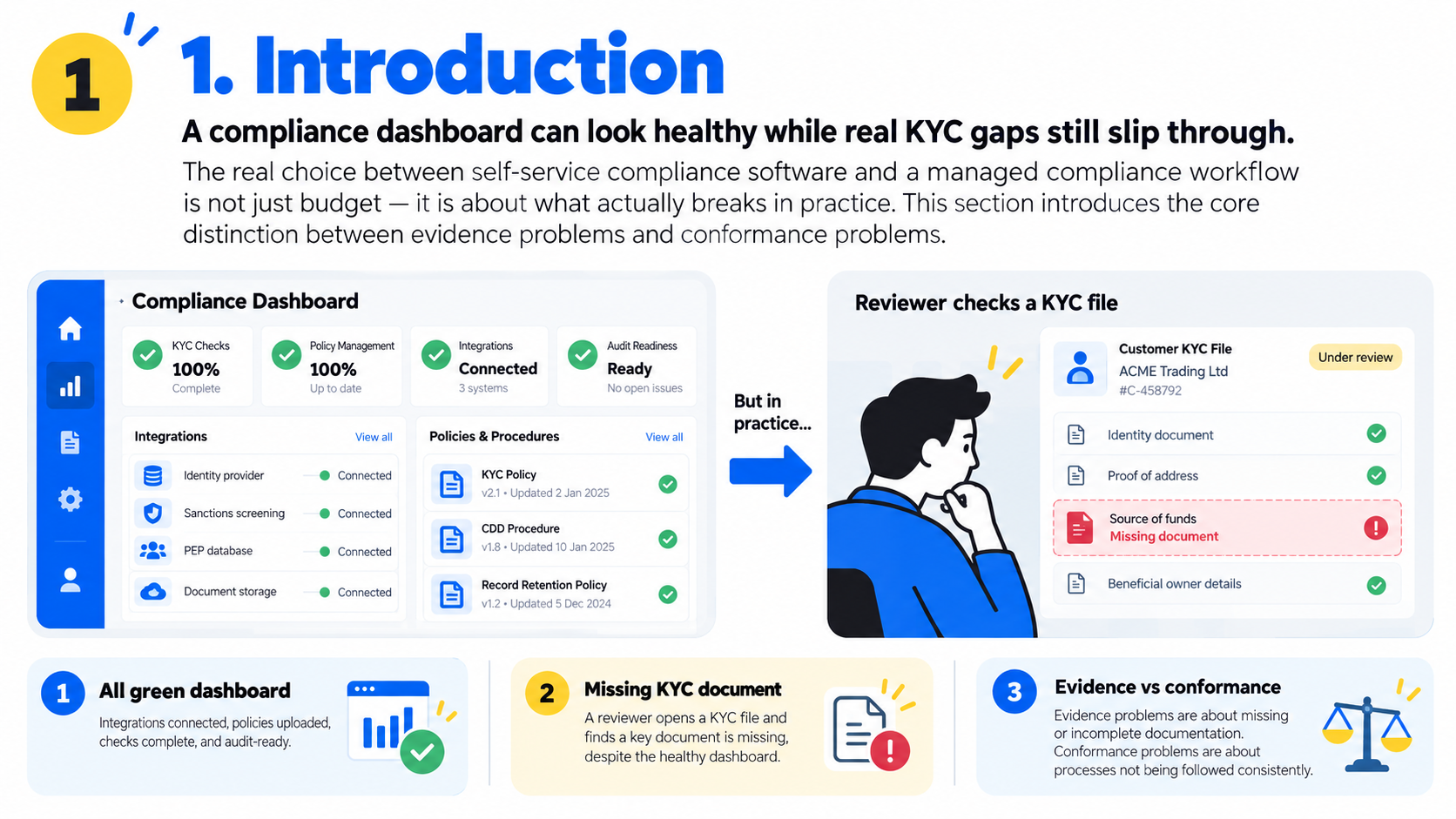
Picture a compliance dashboard that is all green. Every integration is connected, every policy is uploaded, and the audit-readiness score looks healthy. Then a reviewer opens a KYC file and finds a missing document that nobody caught for three weeks.
That gap is where the managed compliance vs compliance software decision really sits. Most comparisons treat it as a budget question: pay for a platform and run it yourself, or pay more for someone to run it for you. That framing misses what actually breaks.
This article gives you a different test. It separates compliance work into two problems, evidence and conformance, and shows which model fits each. Apply it workflow by workflow and the right buy usually becomes obvious.
2. What Self-Service Compliance Software Actually Does
Self-service compliance software connects to your systems, collects evidence automatically, maps it to framework controls and alerts you when something drifts. Your team then implements the controls, closes the gaps and prepares for the audit. The software watches; people act.
Platforms in this category, often sold as GRC (governance, risk and compliance) or compliance automation tools, are built around certification programs such as SOC 2 and ISO 27001. They pull configuration data from cloud accounts, identity providers and code repositories, then show you which controls pass and which fail. Vendors usually market this as continuous compliance monitoring.
Where It Works Well
Self-service software is a strong fit when the work is mostly evidence collection across standard IT controls. Think cloud configuration, access reviews, device encryption and policy acknowledgments.
It also works when you already have someone with compliance judgment in-house. A security lead who knows what an auditor will ask can use the platform to remove the clerical work and keep their attention on decisions.
Where It Stops
Software surfaces problems. It doesn’t resolve them. Remediation, exception handling, judgment calls on edge cases and auditor follow-ups all remain people-work.
The limit becomes obvious in operational processes. A platform can confirm that a KYC policy exists and was approved. It usually can’t tell you whether every KYC file processed this week actually followed that policy.
Takeaway: Self-service compliance software reduces the cost of proving controls exist. It doesn’t reduce the work of keeping them true.
3. What a Managed Compliance Workflow Is
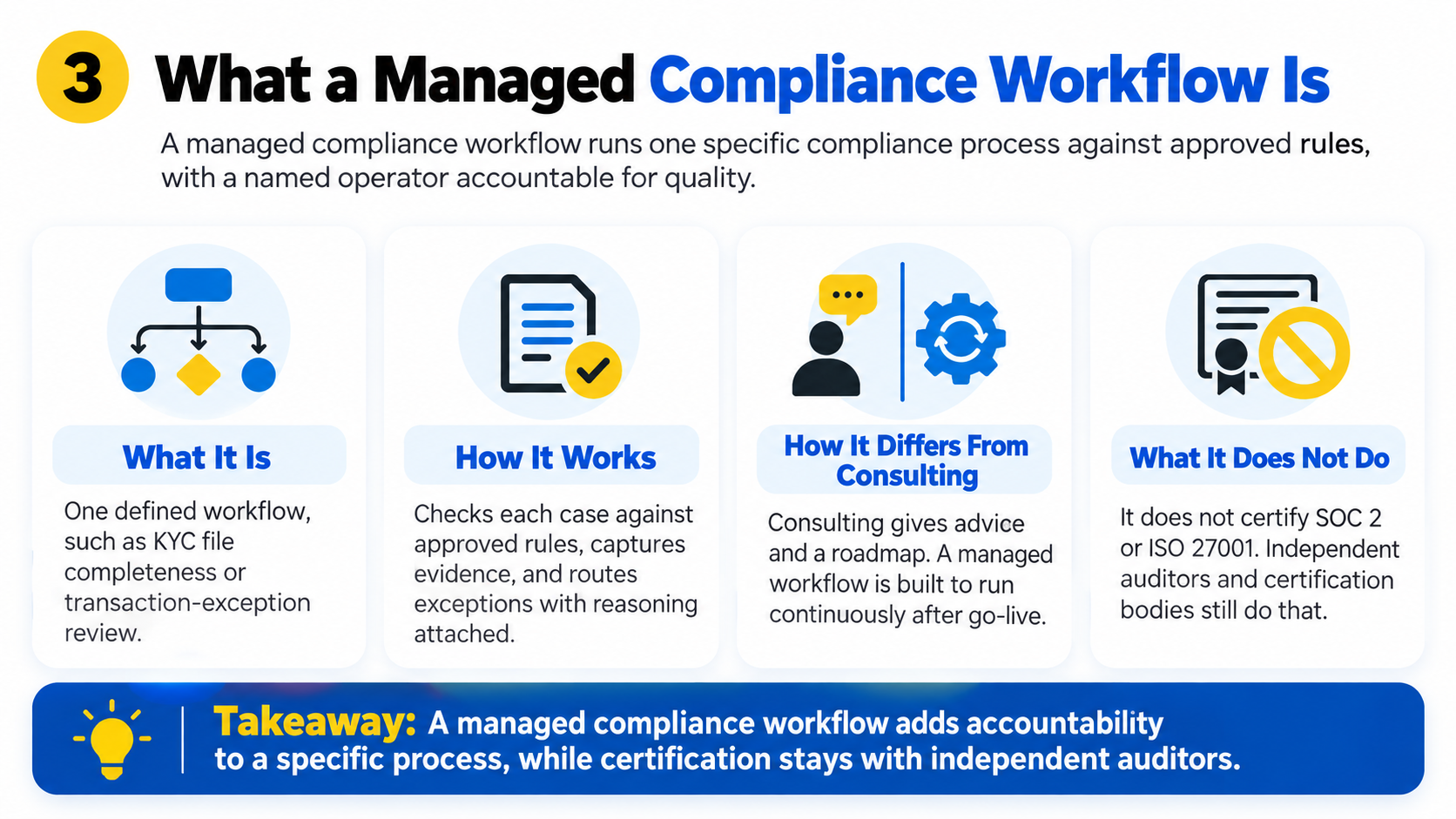
A managed compliance workflow is one specific compliance process, such as KYC file completeness or transaction-exception review, that runs continuously against your approved rules inside your own systems, with a named operator accountable for its quality. You buy an outcome on a defined process, not a tool to configure.
The difference from software is ownership. When a check fails, the workflow routes the exception to a person with the evidence and reasoning attached, and the provider stays responsible for keeping the workflow accurate as rules, volumes and systems change.
How It Differs From Outsourced Consulting
Consultants assess, advise and hand over a roadmap. Then they leave. A managed workflow is the opposite shape: it’s built to run, with ongoing monitoring of quality, exceptions and cost after go-live.
If the engagement ends with a report rather than a running process, it’s consulting, whatever the label says.
What It Still Doesn’t Do
A managed workflow doesn’t certify you. Under the AICPA’s SOC suite of services, SOC 2 reports are engagements performed by independent CPAs, and ISO certificates come from accredited certification bodies. Be wary of any provider, software or managed, that implies otherwise.
What a managed workflow can do is keep the underlying process in continuous, evidenced conformance, so the audit confirms what is already true.
Takeaway: A managed compliance workflow moves accountability for a specific process to an operator, while certification stays with independent auditors.
4. Managed Compliance vs Compliance Software: Side-by-Side Comparison
The two models differ less in features than in who does the work and where the risk sits. The table compares them on the questions buyers tend to ask during evaluation.
| Self-service compliance software | Managed compliance workflow | |
|---|---|---|
| Who operates it | Your team | The provider, with your sign-off on rules |
| Scope | A framework across your IT stack | One defined business process at a time |
| What triggers action | A failing control or alert | A real operational event (a file, a transaction, a case) |
| Who owns remediation | You | Shared: provider routes and tracks, your owner decides |
| Evidence model | Snapshots and integrations mapped to controls | Evidence captured at the source as each event is processed |
| Time to value | Fast to connect; slower to staff | Slower to start; outcome-based once live |
| Best-fit work | SOC 2, ISO 27001, IT general controls | KYC, transaction review, policy adherence at volume |
| Cost structure | Subscription plus internal headcount | Service fee, usually a longer term commitment |
Read the table by row, not by column. If the “who owns remediation” row worries you more than the “cost structure” row, that tells you which model to look at first.
Takeaway: Software and managed workflows solve different problems, so comparing them on price alone produces the wrong decision.
5. A Simple Decision Rule: Evidence Problem or Conformance Problem?
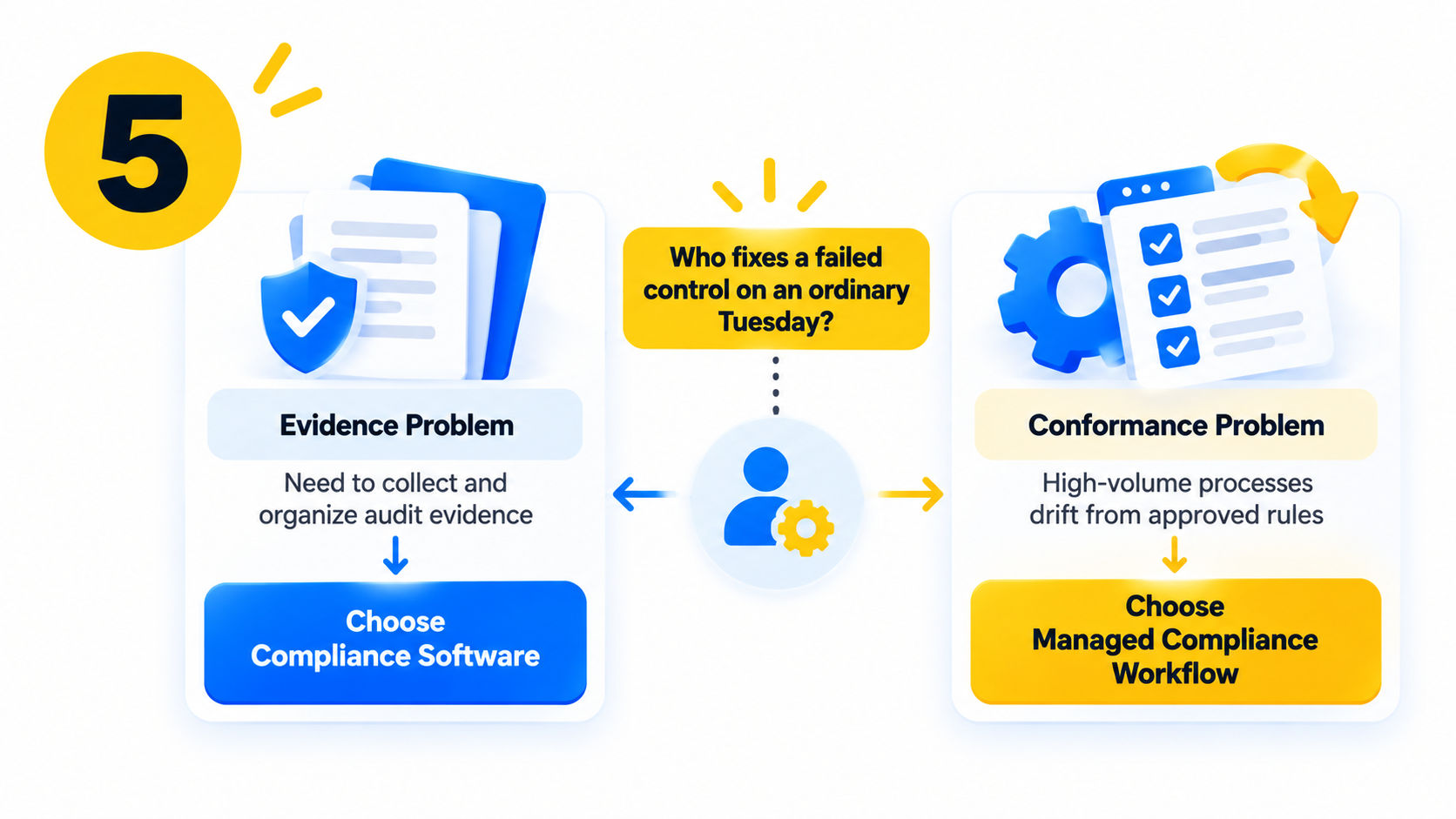
If your compliance pain is proving to an auditor that controls exist, you have an evidence problem, and self-service software is usually the right buy. If your pain is that a live, high-volume process keeps drifting from the approved rule, you have a conformance problem, and a managed workflow is the better fit.
Signs You Have an Evidence Problem
- Audit preparation consumes weeks of screenshots, exports and chasing sign-offs.
- Your controls are mostly technical: access, configuration, logging, encryption.
- You have at least one person who can interpret findings and decide what to fix.
- The process itself works; the audit evidence for it is scattered.
Signs You Have a Conformance Problem
- Volume is high and every case needs a judgment call against a rule.
- Accuracy depends on a few experienced reviewers, and quality drops when they’re busy.
- Exceptions surface at review time, not when they happen.
- One missed check carries real cost, such as a voided application or a regulatory finding.
The “Who Fixes It on a Tuesday?” Test
Picture an ordinary Tuesday. A check fails: a document is missing, a transaction was cleared without a recorded reason. Who notices, who fixes it, and where is the record?
If the honest answer is “our team, eventually, probably at the next review,” a dashboard won’t change that. You need someone accountable for the process, either an internal team you staff for it or a managed operator.
When to Run Both
Many regulated firms need both models at once. A compliance platform can cover SOC 2 or ISO 27001 evidence across the IT estate, while managed workflows run the two or three business processes where drift is expensive. The two don’t compete; they cover different layers.
Takeaway: Classify each workflow as an evidence problem or a conformance problem before you compare vendors. The classification picks the model.
6. How SmartDev Approaches Managed Compliance Workflows
We built NORA Compliance for conformance problems, not for evidence dashboards. It’s a solution family within NORA, our AI Adoption Accelerator, covering workflows such as KYC file completeness, transaction-exception review and policy adherence monitoring.
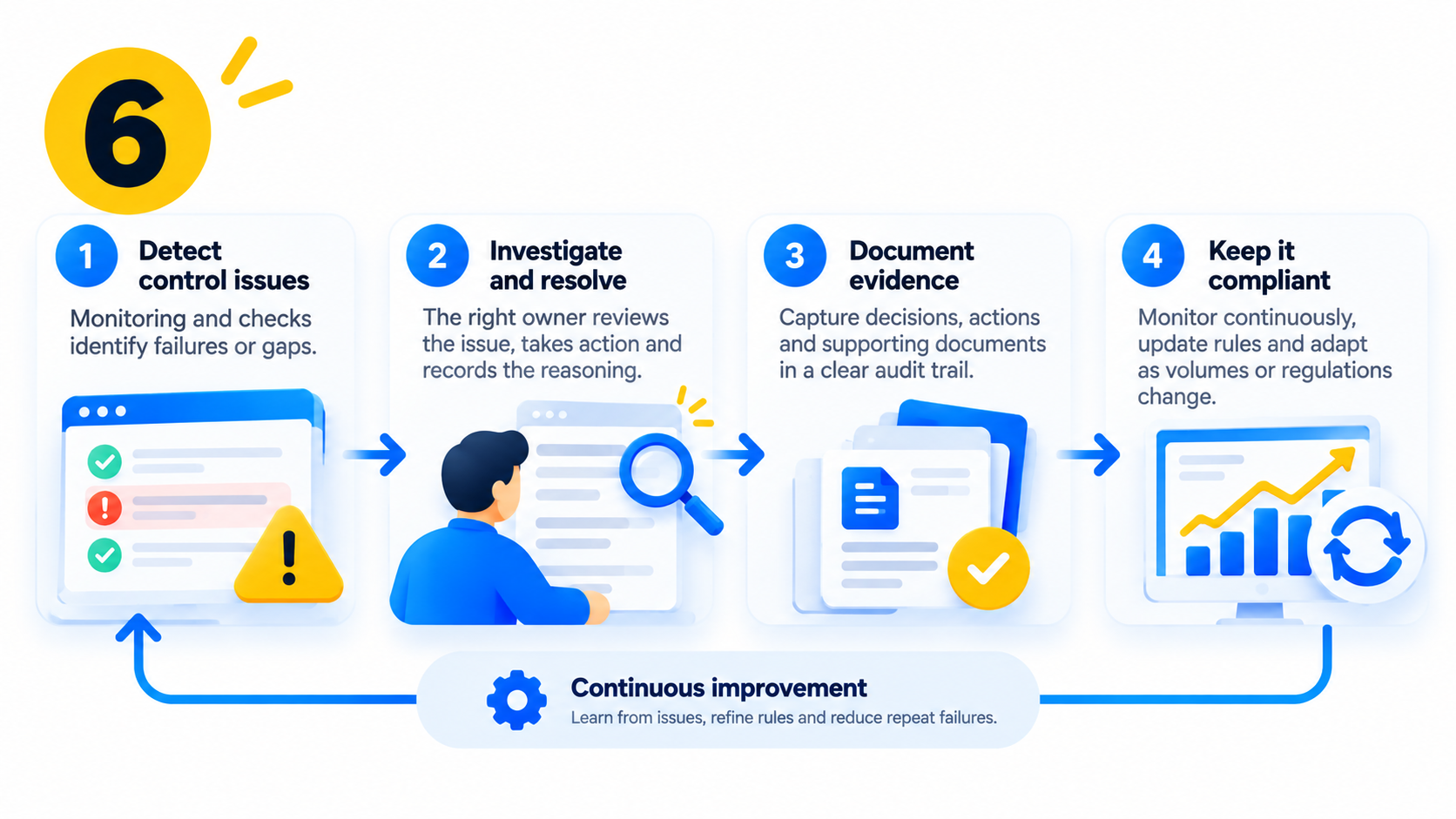
It isn’t a self-serve platform. Each engagement starts with a 1 to 3 week workflow qualification that maps your approved rules, surfaces exceptions and sets baseline KPIs, ending in a clear build, redesign or stop decision. Production deployment then takes 6 to 10 weeks and puts one bounded workflow live in your environment, connected to the systems where the evidence already sits. After that, quality, exceptions, cost and controls are managed continuously, with KPI reviews against the baseline.
Under the hood, that means policies translated into testable controls traceable to source clauses, evidence captured and timestamped at the source, and exceptions routed to an owner with the evidence and reasoning attached.
For a financial advisory firm in Singapore, we built an AI workflow that ingests insurance KYC documents, validates them against product-specific compliance rules and flags missing, inconsistent or high-risk details. The KYC case study reports 60% faster KYC verification, 75% less manual document handling and 40% fewer review inconsistencies.
What you still own: the rules, the sign-off on exceptions and the relationship with your auditor.
7. Conclusion
The managed vs self-service question rarely has one answer for a whole company. It has one answer per workflow. Evidence problems reward automation you run yourself; conformance problems reward an operator who stays accountable when the process drifts.
The firms that get this right stop asking which tool scores best and start asking which processes they can’t afford to get wrong. That list is usually short, and it’s where a managed workflow earns its cost.
If one of your workflows failed the Tuesday test, start a conformance conversation with us. Bring one workflow and its approved rules, and we’ll tell you whether it’s worth building, redesigning or leaving alone. For a deeper look at the approach, read our white paper on NORA in AI Workflow Automation for Risk & Compliance.
Frequently Asked Questions
1. Does a Managed Compliance Workflow Replace My Compliance Platform?
Usually not. A compliance platform covers framework evidence across your IT stack, such as SOC 2 or ISO 27001 controls. A managed compliance workflow runs a specific business process, like KYC review, against your approved rules. Many regulated firms keep the platform for certification evidence and add managed workflows where process drift is costly.
2. Can Compliance Software or a Managed Service Issue Our SOC 2 Report?
No. A SOC 2 report is issued only by an independent licensed CPA firm, and ISO certificates come from accredited certification bodies. Compliance software and managed compliance services prepare evidence and keep processes in conformance, which makes the audit smoother, but neither one can certify you or replace the independent examination.
3. When Is Self-Service Compliance Software Enough?
Self-service compliance software is usually enough when your controls are mostly technical, your processes already work and someone in-house can interpret findings and drive fixes. A typical example is a cloud-native company preparing for SOC 2 or ISO 27001, where the main burden is collecting and organizing evidence rather than checking high volumes of individual cases.
4. Which Workflows Benefit Most From a Managed Compliance Approach?
Managed compliance workflows suit high-volume processes where each case needs a judgment against a rule and a missed check carries real cost. Common examples include KYC file completeness, transaction-exception review and policy adherence monitoring in banking, insurance, fintech and healthcare, especially where accuracy depends on a few experienced reviewers.
5. How Long Does It Take to Put a Managed Compliance Workflow Into Production?
Timelines depend on the workflow and the systems involved. In SmartDev’s NORA Compliance model, a workflow qualification takes 1 to 3 weeks, and production deployment of one bounded workflow takes a further 6 to 10 weeks. The workflow is then operated continuously, typically under a 12-month term with regular KPI reviews.