
TL;DR
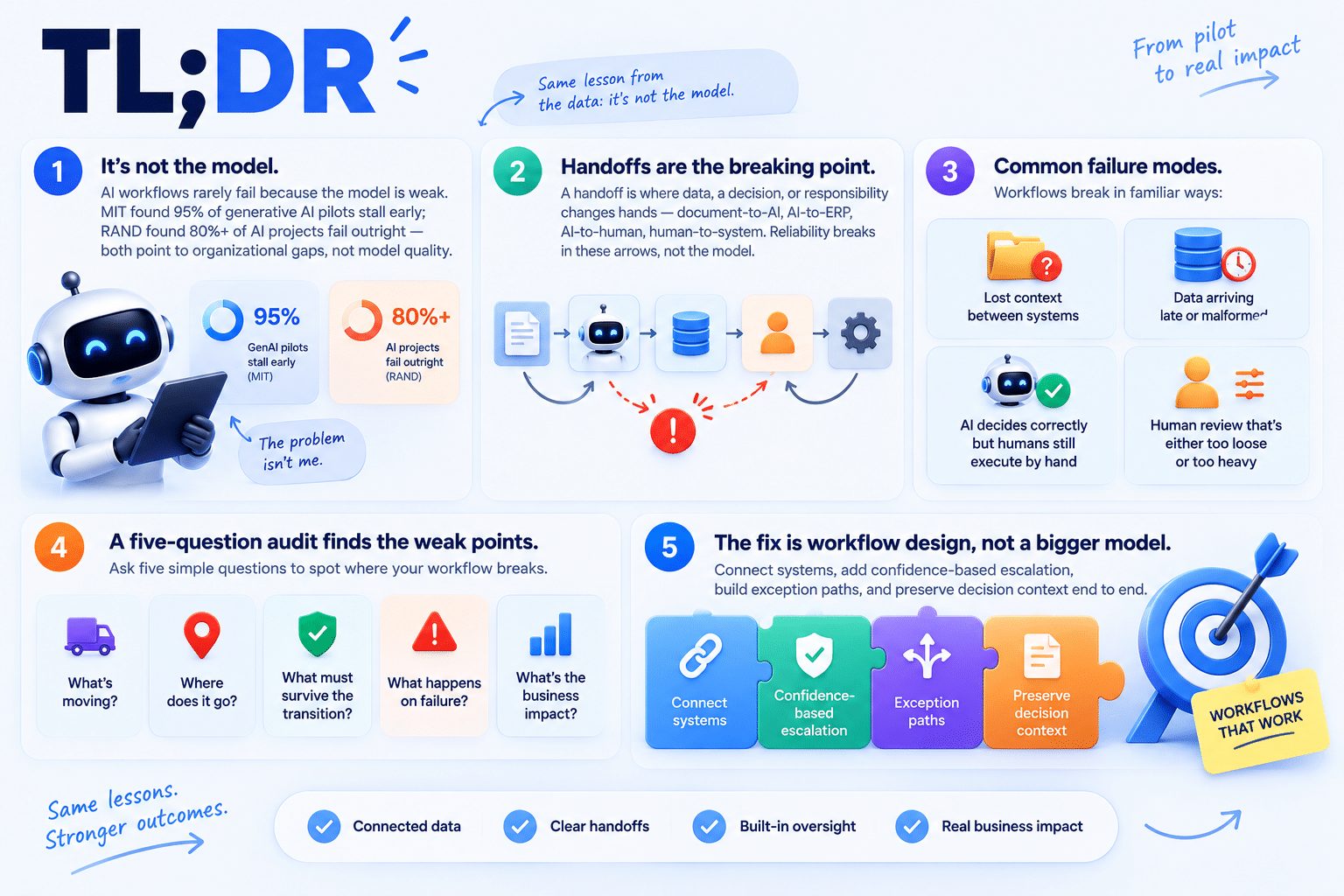
- AI projects often fail because workflows can’t support them, not because the model is incapable.
- A handoff is where data, decisions, or responsibility move between systems, AI, and people – and it’s usually where things break.
- Common breakdowns: lost context, bad data timing, unclear ownership, and automation that stops short of execution.
- A five-question audit pinpoints exactly where handoffs fail and why.
- Fixing handoffs, not upgrading models, is what turns a stalled pilot into a working production workflow.
Why Do Most AI Workflows Fail?
Most enterprises chase the wrong problem first. They obsess over model accuracy, prompt quality, or which tool to plug in next. But in production, AI workflows usually fail because information, context, or responsibility gets dropped somewhere between systems, data, and people.
The numbers back this up. MIT’s NANDA initiative found that 95% of corporate generative AI pilots stall early and never scale, mostly due to a “learning gap” between the tool and the workflow it’s dropped into. RAND Corporation found more than 80% of AI projects fail outright, double the failure rate of non-AI IT projects. Neither study blames the model itself.
The real test is never “does the AI work.” It’s whether the whole workflow holds together end to end. A model can extract a field perfectly and still deliver zero value if the next step can’t use it. That gap – the handoff – is where things actually break.
What Is a Handoff in an AI Workflow?
Picture a simple chain: a document arrives, AI extracts data from it, the data lands in an ERP, a human reviews the result, someone approves it, and the system takes action. Every arrow in that chain is a handoff. KYC onboarding automation that turns document review into a minutes-long process is a working example of exactly this chain, start to finish.
Four types of handoffs show up again and again.
- System-to-system handoffs: Move data between ERPs, CRMs, databases, document platforms, or APIs.
- Data-to-AI handoffs: Transform raw business data into context the model can actually use.
- AI-to-human handoffs: Pass outputs, recommendations, or exceptions to people for review.
- Human-to-system handoffs: Take a human decision and push it back into operational systems, where it needs to be recorded and executed correctly.
Here is the key insight teams miss. The model is only one component in a much longer chain. Reliability rarely fails inside that component. It fails in the arrows connecting it to everything else, and those arrows get almost no design attention compared to the model itself.
Where AI Workflows Actually Break
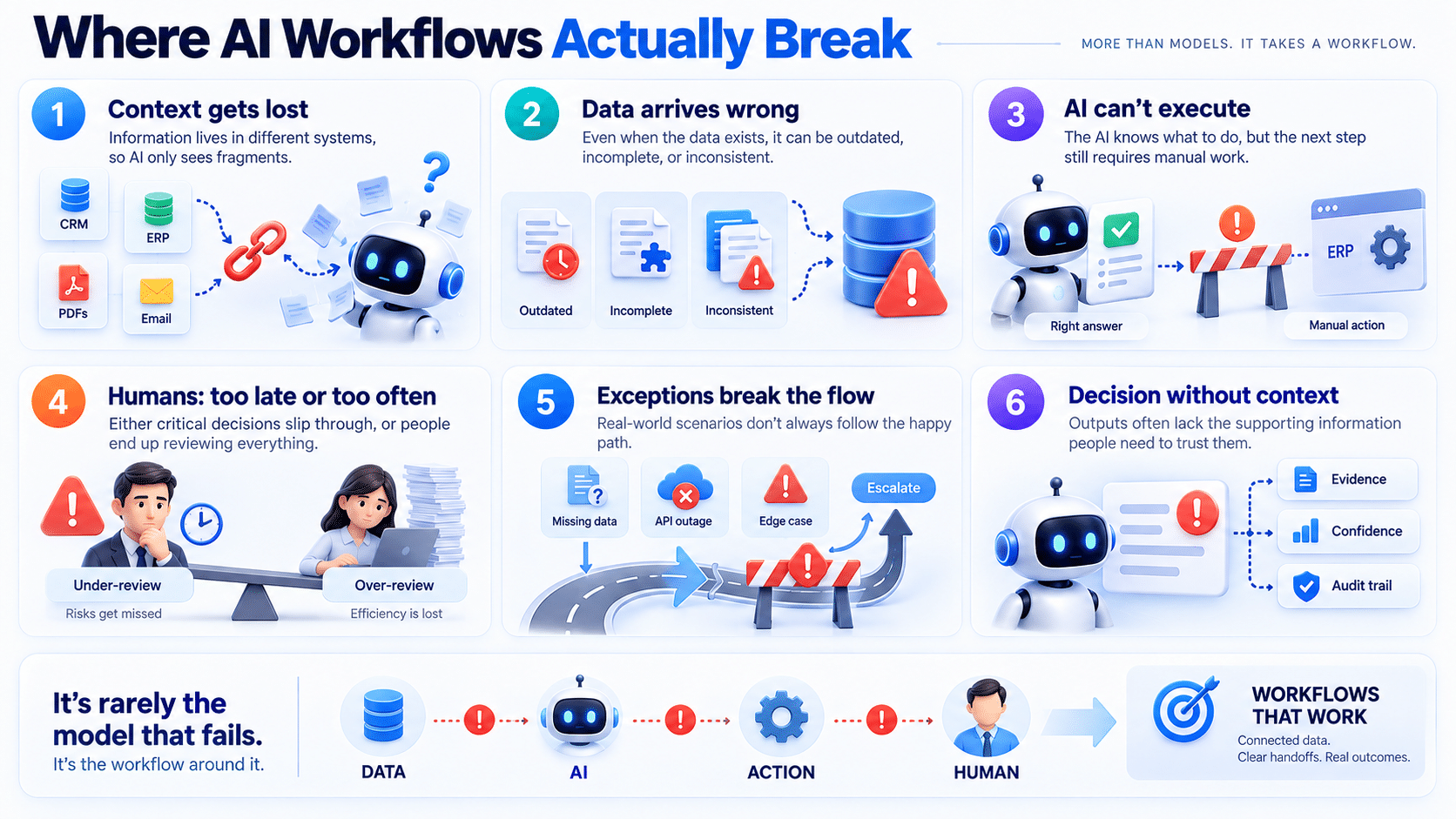
Why AI Loses Context Between Systems
Enterprise information almost never lives in one place. Customer data sits in a CRM. Transactions sit in an ERP. Policies live in a knowledge base. Contracts sit buried in PDFs.
The McKinsey Global Institute found that knowledge workers whose jobs are mostly communication and coordination spend nearly 20% of the workweek looking for internal information or tracking down colleagues. Drop AI into that same fragmented environment, and it inherits the exact same blind spots, since a model filling gaps with confident guesses is often a context problem wearing a hallucination label rather than a model flaw.
When AI only sees a fraction of the context, recommendations come out incomplete, employees have to manually double-check outputs, and different systems start producing conflicting answers to the same question.
Why AI Data Arrives Late or in the Wrong Format
Even when the right data technically exists, the handoff can still collapse. Information shows up outdated, duplicated, missing metadata, or structured differently depending on which team touched it last.
Gartner analyst Roxane Edjlali warned in February 2025 that organizations would abandon 60% of AI projects unsupported by AI-ready data by 2026. What looks like an accuracy problem is often a data-readiness problem in disguise – retraining the model won’t fix a pipeline three systems upstream that nobody has touched in years.
Why AI Can Decide But Can’t Always Act
Some of the most frustrating failures happen after the AI has already succeeded. It extracts the invoice correctly, classifies the request accurately, flags the right risk. Then a human still has to copy that result into another system by hand.
Reading a document and deciding what to do with it are two different jobs, and teams that only solve the first one usually keep the manual bottleneck they were trying to remove. Gartner predicts over 40% of agentic AI projects will be canceled by the end of 2027, citing escalating costs and unclear business value – not model capability.
How Much Human Oversight Does an AI Workflow Need?
Poorly designed human handoffs fail in one of two directions. Too little oversight lets risky decisions through unchecked. Too much oversight means employees verify nearly every output, erasing the efficiency automation was supposed to deliver.
A 2025 survey of more than 500 U.S. operations leaders found only 4% report workflows running without interruption, and 43% say the biggest breakdowns happen during execution, when nobody is sure who owns what. The goal isn’t removing humans — it’s placing them exactly where risk or ambiguity justifies their time.
How to Handle Exceptions in AI Workflows
Pilots look impressive because they’re tested against predictable scenarios. Production throws missing documents, unexpected formats, API outages, and edge cases nobody anticipated during the demo.
Workflow research from Moxo notes a typical business process can spend as little as 20% of its time in active work, with the remaining 80% simply waiting at handoffs. A workflow becomes fragile the moment it has no clear answer to: what happens when automation can’t continue? Exception paths, fallback logic, and clear ownership need to be built in from day one.
Why Can’t Anyone Explain the AI’s Decision?
An AI output often reaches a reviewer stripped of the context that would let them trust it – no source data, no confidence score, no relevant rule. Fraud detection is a sharp example of this: when the model flags something wrong, the accountability question usually lands on whoever configured the review, not the algorithm. The reviewer ends up reconstructing the decision manually anyway, which defeats the point of automating it. Explainability isn’t just a model concern – it’s a handoff design problem, solved by deciding what travels alongside the decision, not just improving the decision itself.
The Handoff Audit: How to Find the Weak Points
Start by mapping the workflow end to end: data sources → systems → AI → human decisions → downstream actions. Then examine every point where information or responsibility changes hands, and ask:
- What’s moving? Data, a document, a decision, an approval?
- From where to where? Which system, AI component, or person is on each end?
- What must survive the transition? Context, metadata, evidence, confidence, history?
- What happens if it fails? Missing data, an API outage, disagreement between systems?
- What’s the business impact? Delay, rework, compliance exposure, customer damage?
A practical validation framework for AI workflow automation runs a similar check, testing every step of the chain rather than just the model’s output.
| Handoff | What Moves | Failure Risk | Control |
|---|---|---|---|
| Document → AI | Input data | Missing fields | Validation |
| AI → ERP | Extracted values | Wrong mapping | Schema checks |
| AI → Human | Decision / exception | Missing evidence | Context + confidence |
| Human → System | Approval | Manual re-entry | Automated execution |
AI Workflow Failure Signals and How to Fix Them
Each symptom the audit surfaces should point to one specific design fix.
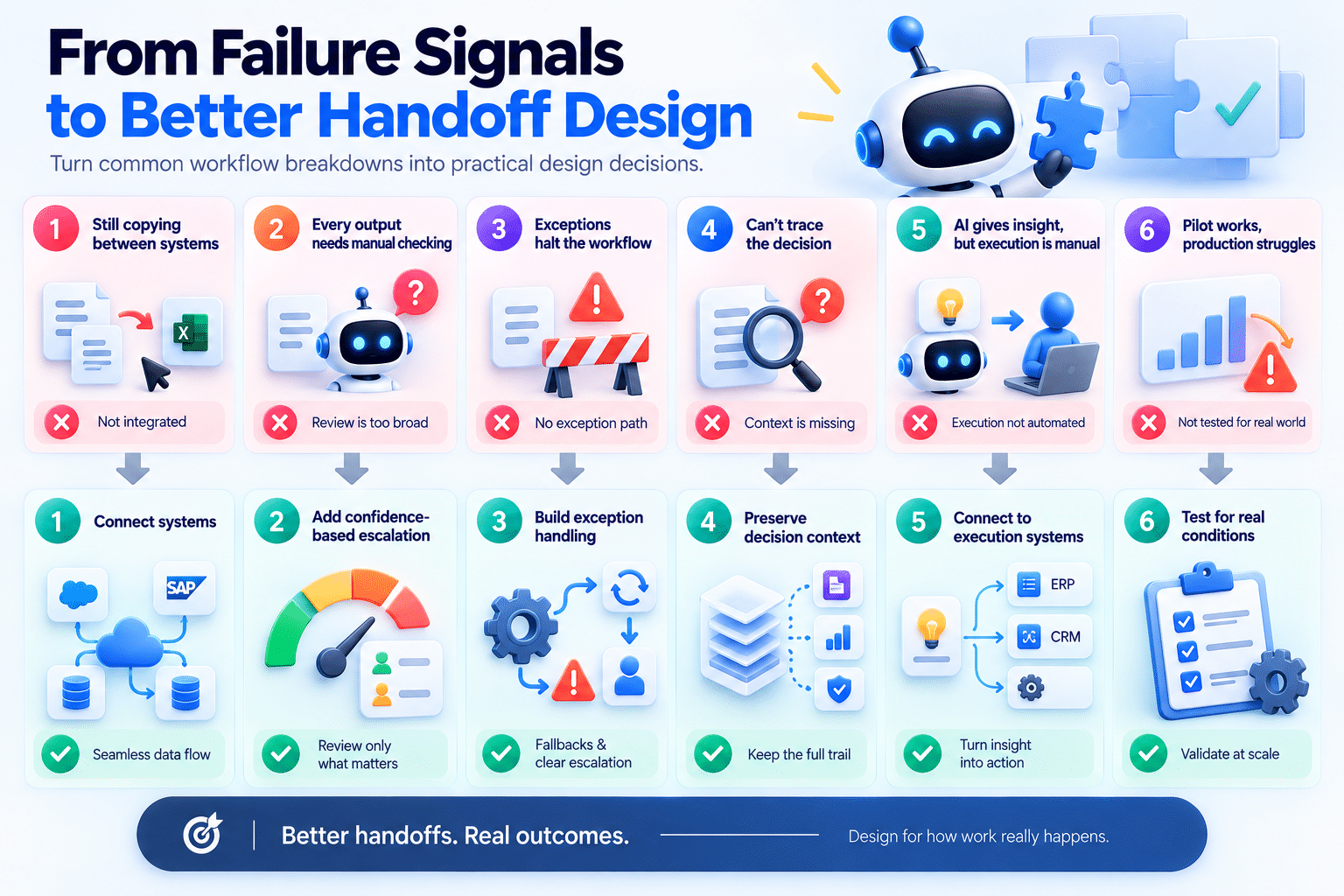
Employees who keep copying data between systems are a sign those systems were never genuinely integrated — connect them through APIs or an orchestration layer.
When every AI output needs manual checking, the review logic is usually too broad — confidence thresholds and risk-based escalation fix that.
Exceptions that keep stopping the workflow point to a system that was only ever built for the happy path — it needs fallback logic and defined ownership.
A reviewer who can’t explain a decision is usually a sign that context got lost at the AI-to-human handoff — preserve the evidence and the decision log, not just the output. It’s the same principle behind making every AI-assisted decision regulatorily defensible: the audit trail matters as much as the decision itself.
AI that recommends correctly while people still execute by hand means the execution layer was never connected — link approved outputs directly to the operational system. One financial compliance team cut review time by 80% by closing exactly that gap.
From Diagnosis to a Working Production Workflow
Naming the failure signal is only half the job – the harder part is sequencing the fix so it survives contact with real operations, not just a demo.
In practice, this tends to work best as three distinct stages rather than one big integration push. The first is a short readiness check: is this specific pilot safe to move forward, and what’s the actual gap list, not just a general accuracy score. The second is getting it running in production under real governance – permissions, monitoring, cost control, and an evidence trail that a risk or audit team can actually sign off on, not a system that only works when nobody looks too closely. The third is staying with it after go-live, since new exceptions, cost drift, and edge cases keep showing up months after launch, not just in the first week.
A closer look at what to own versus what to outsource walks through this same staged approach, including where ownership should sit at each point.
AI Tool vs AI Workflow: What’s the Difference?
An AI tool helps one person complete one task – it summarizes, extracts, classifies, or recommends. An AI workflow connects data, AI, business rules, systems, humans, and actions into one continuous chain.
This is also the key distinction between RPA and AI workflow automation: one automates predefined actions, while the other can combine context, reasoning, and execution.
The business value of enterprise AI rarely comes from the model alone. It comes from whether intelligence can move reliably through the organization and trigger the right downstream action. The question shifts from “can the AI perform this task” to “can the entire workflow act on what the AI produces.”
FAQ
- What is an AI workflow handoff?
A handoff is any point where data, a decision, or responsibility moves between a system, an AI model, or a person – for example, from a document into an AI extraction step, or from an AI recommendation to a human reviewer. - Why do AI pilots fail to reach production?
Most pilots are tested on clean, predictable data and never touch the messy handoffs – legacy systems, exceptions, unclear ownership – that show up at scale. Research from MIT and RAND both trace this to workflow and organizational gaps rather than model quality. - What’s the difference between an AI tool and an AI workflow?
An AI tool completes a single task in isolation. An AI workflow connects that task to the systems, rules, and people needed to actually act on the result, end to end. - How do you know if a specific handoff is the weak point?
Run the five-question audit: what’s moving, where it moves from and to, what must survive the transition, what happens if it fails, and what the business impact is. - How do you move an AI pilot into production safely?
It usually works best as three stages: a readiness check to confirm the pilot is actually safe to move forward, a governed rollout into production with monitoring and an audit trail, and ongoing oversight afterward to catch regressions, cost drift, or new exceptions as they appear.
Conclusion: Audit the Handoffs Before Adding More AI
Swapping in a new model rarely fixes an underperforming workflow. Look instead at where information changes systems, where context gets lost, and where responsibility becomes unclear.
The real question isn’t whether the AI works in isolation. It’s whether systems, data, AI, and humans operate as one continuous process. Map the handoffs first – fix those, and the model usually stops being the problem.