

TLDR
- Manual compliance costs more than it looks like on paper – labor spread across departments, rework, delayed approvals, and audit prep all add up to a much higher real cost than most teams track.
- Automation isn’t free: a credible business case has to include upfront costs (integration, data prep, training) and ongoing costs (platform fees, monitoring, human oversight), not just the subscription price.
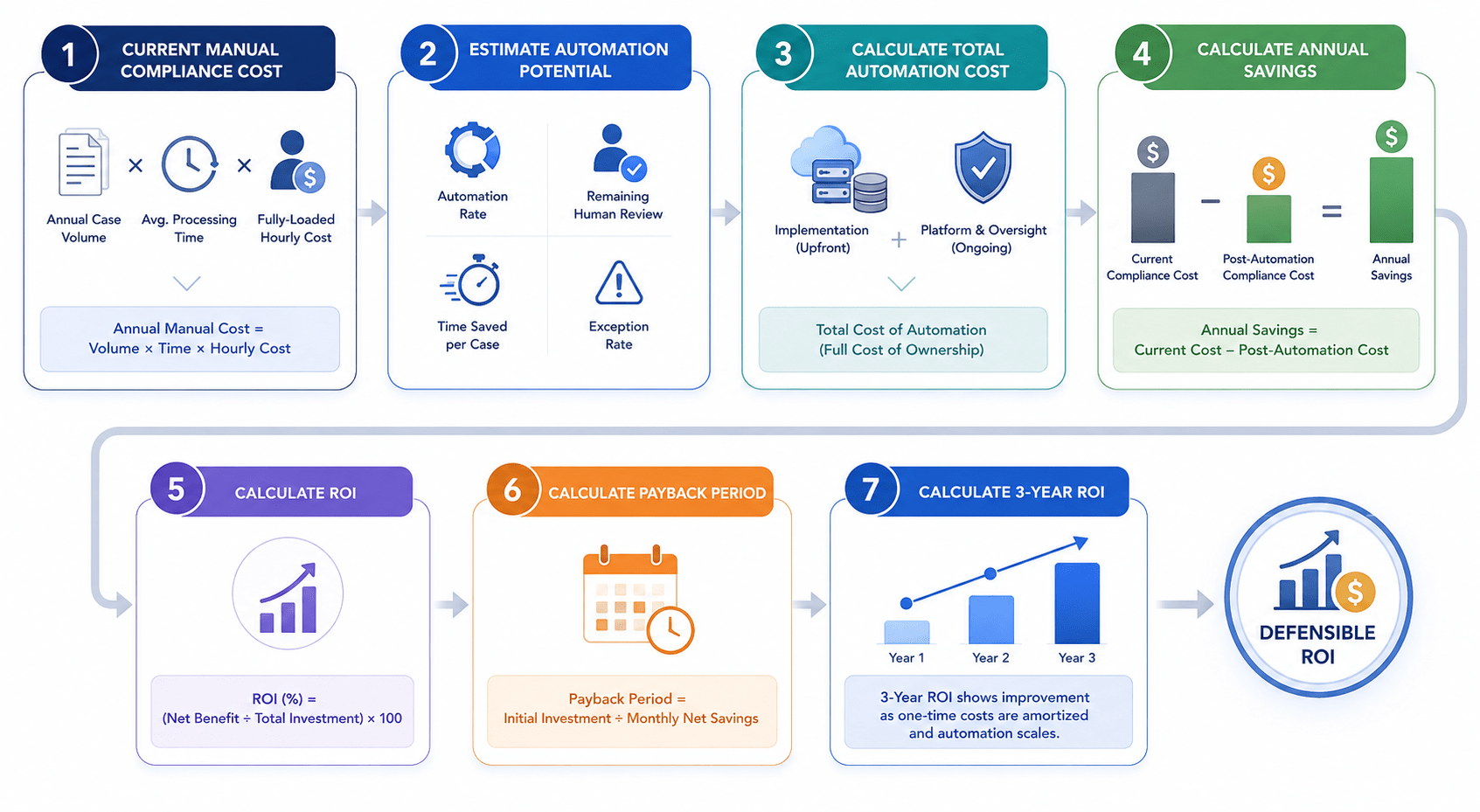
- Use a 7-step framework, starting with current manual cost, then automation potential, total automation cost, annual savings, ROI, payback period, and finally 3-year ROI, to build a number you can defend.
- Don’t assume 100% automation. A realistic, conservative automation rate (50–70%) with defined human review produces ROI figures that survive scrutiny.
- The strongest automation candidates are high-volume, repetitive, rule-based processes – document/evidence review, KYC/AML screening, and audit reporting – not complex judgment-based decisions.
Introduction
Every compliance leader eventually faces the same question from the CFO: is automation actually worth the investment? It’s a fair question. AI compliance tools are easy to pitch and hard to price. After all, vendors show impressive demos, but demos don’t tell you what a platform will actually cost once you factor in integration, data cleanup, and the internal hours your team spends getting it live.
This guide walks through exactly how to build that business case yourself, using your own numbers instead of vendor marketing claims. By the end, you’ll be able to estimate:
- Your current compliance cost (the real one, not just the compliance manager’s salary)
- What automation actually costs to implement and run
- Your expected annual savings
- Your ROI percentage
- Your payback period
Think of this as the framework behind an AI automation ROI calculator – something you can build in a spreadsheet in an afternoon and defend in a budget meeting. If any of the terminology along the way is unfamiliar, SmartDev’s AI & ITO Glossary has plain-language definitions for over 250 AI and outsourcing terms.
Sections 2 and 3 build the context for why this matters right now; the calculator itself – the formulas, the worked example, and the ready-to-use framework – starts at Section 5. Skip ahead if that’s what you’re here for.
Why Compliance Costs Are Rising So Fast
Before comparing manual versus automated compliance, it helps to understand why the baseline keeps climbing. Global regulatory complexity has risen sharply: Thomson Reuters reports that the volume of regulatory change has grown more than 45% in recent years, with the pace expected to keep accelerating through 2026. As a result, that growth is already showing up on the balance sheet – financial institutions now dedicate up to 10% of their operating budgets to compliance activities alone.
A few forces are converging at once:
- Growing regulatory requirements. New frameworks and updated standards (GDPR enforcement, evolving AI governance rules, sector-specific mandates) are expanding faster than most compliance teams can absorb. For a look at how one regulator’s approach plays out in practice, see SmartDev’s guide to AI-powered MAS regulatory change monitoring.
- Increasing compliance workload. More frameworks in scope means more overlapping controls, more evidence to track, and more cross-functional coordination.
- More data and documentation. Every audit cycle now demands a larger, more granular evidence trail than it did a few years ago.
- Higher audit and reporting expectations. Auditors and regulators expect continuous, defensible evidence – not a folder assembled the week before the audit.
- Limited compliance headcount. Hiring hasn’t kept pace with the scope of the job, so the same team is doing more with the same (or fewer) people.
Manual compliance responds to this growth with three recurring cost drivers:
- Labor-intensive reviews and evidence collection. Every new requirement adds another layer of manual work to an already stretched process.
- High error rates that trigger rework and penalties. Manual processes don’t scale cleanly, and mistakes compound as volume grows.
- Slow audit cycles that disrupt business operations. Periodic, manual audit prep can’t keep pace with continuously changing requirements.
As enforcement becomes increasingly data-driven – regulators now expect real-time, auditable evidence rather than a periodic paper trail – traditional manual methods simply can’t keep up.
Put simply: the workload is growing structurally, not just incrementally. That’s the backdrop that makes the automation conversation urgent rather than optional.
The Hidden Cost of Manual Compliance
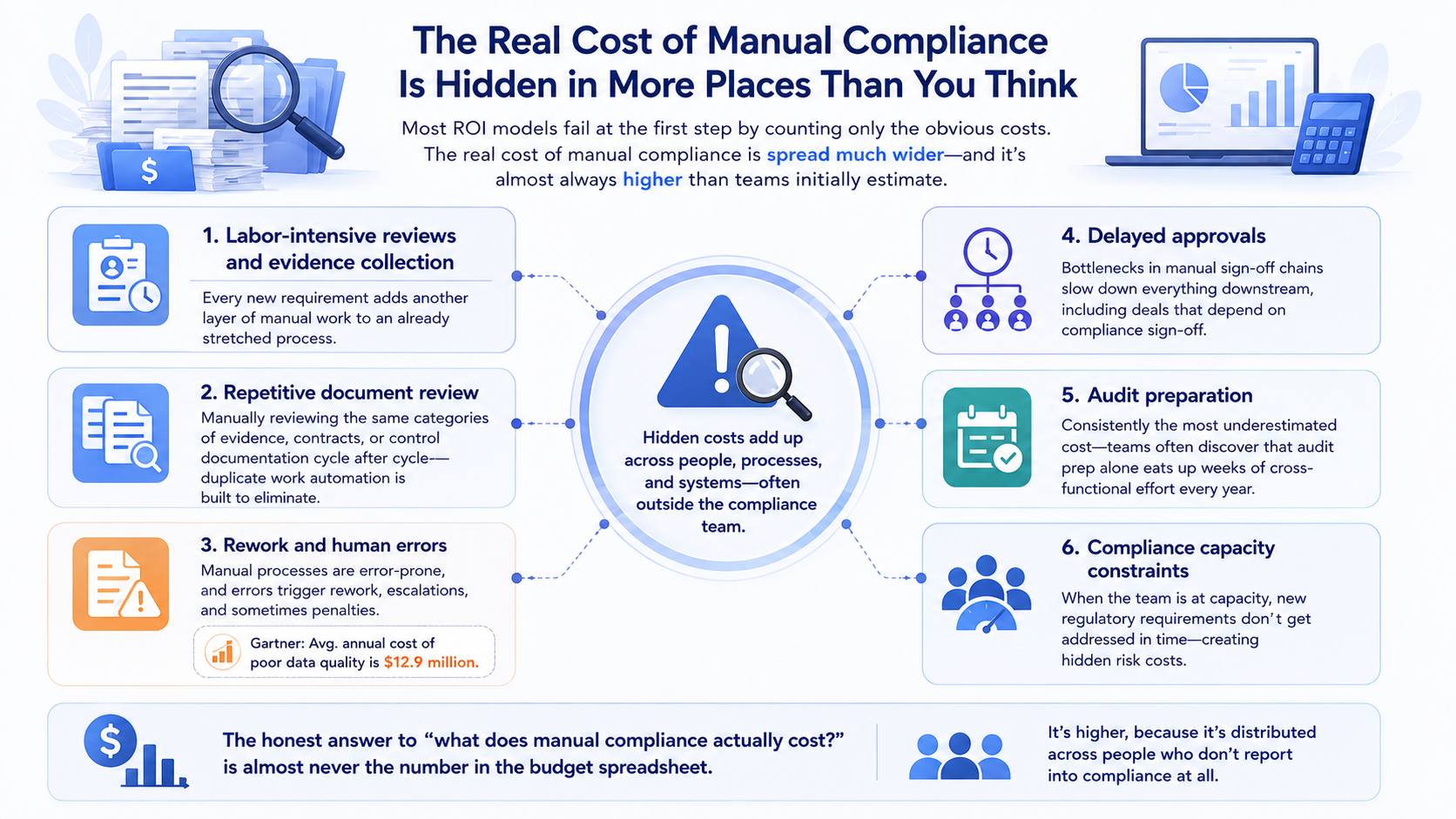
Most ROI models fail at the very first step because they only count the obvious line items – a compliance manager’s salary and the external auditor’s invoice. In reality, the cost of manual compliance is spread much wider than that, and it’s almost always higher than teams initially estimate.
Look for cost hiding in these places:
- Labor hours across departments. Compliance work isn’t confined to the compliance team. Engineering pulls access logs, IT gathers infrastructure evidence, HR compiles onboarding records – and none of that time shows up on the compliance budget line, a pattern LexisNexis Risk Solutions has tracked for years in its True Cost of Compliance research.
- Repetitive document review. Manually reviewing the same categories of evidence, contracts, or control documentation cycle after cycle – the kind of duplicate work automation is built to eliminate.
- Rework and human errors. Manual processes are error-prone, and errors trigger rework, escalations, and sometimes penalties. Gartner puts the average annual cost of poor data quality at $12.9 million.
- Delayed approvals. Bottlenecks in manual sign-off chains slow down everything downstream, including deals that depend on compliance sign-off – a friction point well documented in enterprise security review research.
- Audit preparation. This is consistently the single most underestimated cost category – teams that actually track it often discover that audit prep alone eats up weeks of cross-functional effort every year, as RegScale’s continuous controls monitoring research has found.
- Compliance capacity constraints. When the team is at capacity, new regulatory requirements simply don’t get addressed in time, which is itself a hidden risk cost – and most compliance teams are already feeling that strain.
The honest answer to “what does manual compliance actually cost?” is almost never the number in the budget spreadsheet. It’s higher, because it’s distributed across people who don’t report into compliance at all – which is exactly why the other side of the equation, what automation itself costs, deserves the same scrutiny.
What Does Compliance Automation Actually Cost?
This is the section most ROI pitches skip – and skipping it is exactly what makes those pitches feel like marketing rather than a real business case. In other words, if you only model the savings and never the total cost of ownership, you’ll walk into the budget meeting with a number nobody trusts. This is also where AI security and compliance considerations belong – they’re a cost category, not an afterthought.
Upfront costs
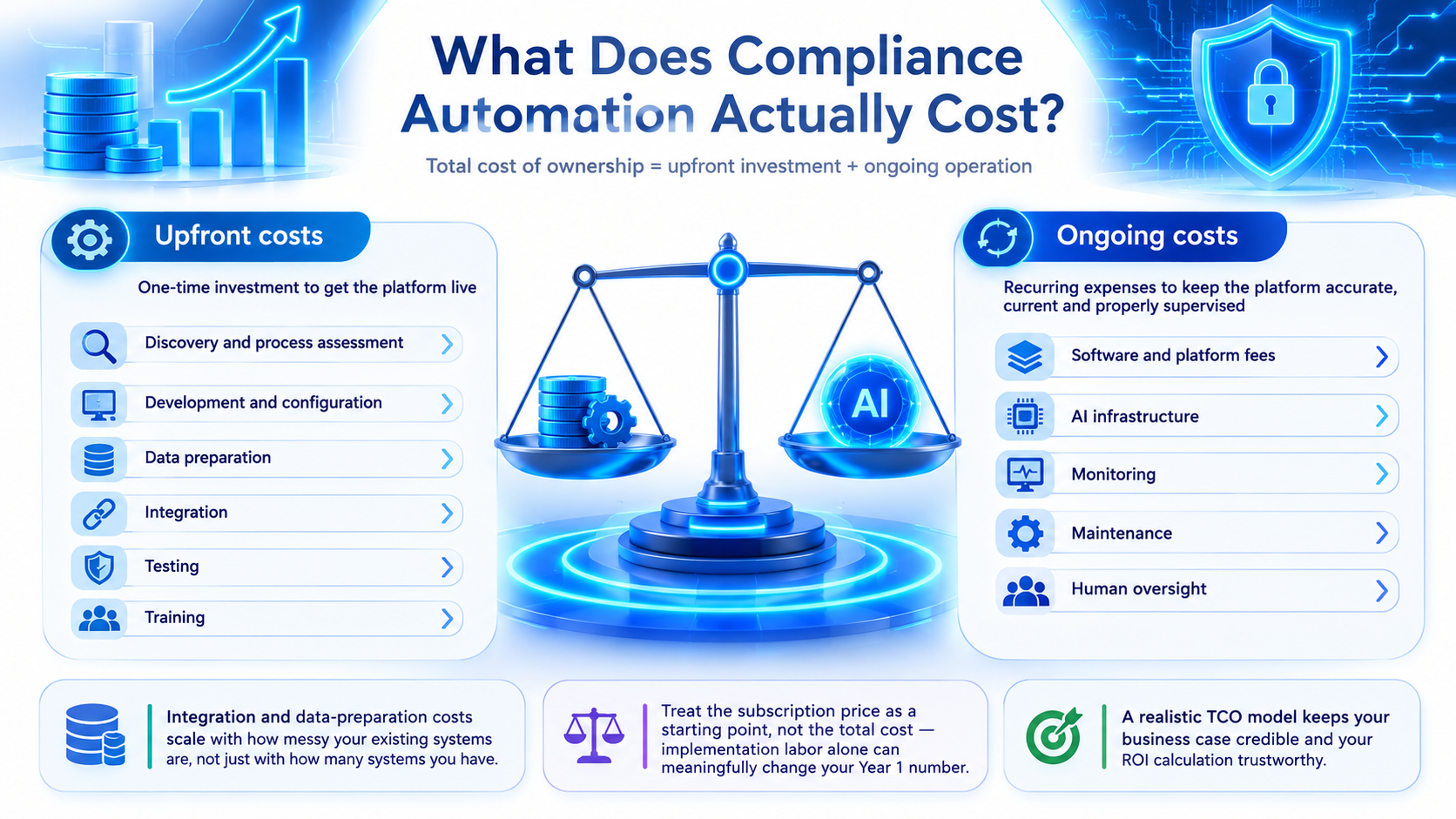
Upfront costs are the one-time expenses you incur to get the platform live – everything required to go from “we signed a contract” to “the system is actually running in production.” These costs don’t recur once implementation is complete, but they’re often the reason a Year 1 ROI looks weaker than the platform’s steady-state economics.
- Discovery and process assessment – mapping your current workflows before anything gets automated
- Development and configuration – setting up the platform to match your control environment
- Data preparation – cleaning and structuring compliance data so the AI has something reliable to work with
- Integration – connecting the platform to your GRC system, identity provider, cloud infrastructure, and document repositories
- Testing – validating that automated workflows actually produce audit-grade evidence
- Training – onboarding your team so the tool gets used, not shelved
Ongoing costs
Ongoing costs are the recurring expenses you carry every year the platform stays in operation. Unlike upfront costs, these don’t disappear after implementation – they’re the steady-state price of keeping the automation accurate, current, and properly supervised, and they belong in every year of your TCO model, not just Year 1.
- Software and platform fees – the subscription itself
- AI infrastructure – compute and model costs where applicable
- Monitoring – keeping automated controls and AI outputs accurate over time
- Maintenance – updating integrations and workflows as systems change
- Human oversight – someone still needs to review exceptions, validate outputs, and own the AI governance relationship with the platform
Integration and data-preparation costs scale with how messy your existing systems are, not just with how many systems you have. For instance, clean APIs and structured data keep implementation lean; legacy systems and fragmented spreadsheets make it expensive. Therefore, treat the subscription price as a starting point, not the total cost – implementation labor alone can meaningfully change your Year 1 number.
Step-by-Step Guide: How to Calculate Compliance Automation ROI
This is the core of the exercise. Work through each step in order, and you’ll end with a defensible ROI figure.
 Step 1: Calculate Your Current Manual Compliance Cost
Start with a simple formula:
Annual Manual Cost = Annual Case Volume × Average Processing Time × Hourly Labor Cost
To make this accurate, gather:
- Number of documents or cases processed per year
- Number of employees involved, across every department that touches compliance work
- Average review time per document or case
- Rework rate (how often something has to be redone)
Use fully-loaded hourly rates – salary plus benefits, taxes, and overhead – not just base pay. That’s the number that reflects what an hour of someone’s time really costs the organization.
Step 2: Estimate Your Automation Potential
Don’t assume AI automates 100% of anything. A credible model separates:
- Automation rate – the share of the workflow the platform genuinely handles end to end
- Remaining human review – the portion that still needs a person, even with automation in place
- Time saved per case – the realistic time reduction, not the vendor’s headline number
- Exception rate – how often a case falls outside the automated path and needs manual handling
As a useful rule of thumb: if a vendor claims an 80% time reduction, model something more conservative – 50-60% – in your own calculation. After all, conservative numbers survive scrutiny; vendor numbers rarely do.
Step 3: Calculate the Total Cost of Automation
Pull in everything from Section 4 above: upfront implementation costs plus ongoing platform and oversight costs. Don’t let the subscription fee stand in for the total cost. In practice, the subscription fee alone is rarely more than half the real number – it’s the implementation and oversight costs sitting around it that most models leave out, and that gap is what turns a confident Year 1 projection into a credibility problem later.
Step 4: Calculate Annual Savings
Annual Savings = Current Compliance Cost – Post-Automation Compliance Cos
Post-automation cost includes the remaining human review time plus the ongoing platform costs from Step 3. Additionally, be explicit about which savings are “hard” (headcount you won’t need to add) versus “soft” (time redirected to higher-value work) – finance teams weight the two very differently.
Step 5: Calculate ROI
ROI (%) = (Net Benefit ÷ Total Automation Investment) × 10
Where net benefit is your annual savings minus the total automation investment, and total investment is your full first-year (or multi-year) cost of ownership from Step 3.
Step 6: Calculate the Payback Period
Payback Period = Initial Investment ÷ Monthly Net Saving
This is often the single most persuasive number in a budget conversation. It answers, “when do we get our money back?” with a specific figure instead of a percentage that requires interpretation.
Step 7: Calculate the 3-Year ROI
Year 1 is almost always dragged down by implementation cost. However, Years 2 and 3 reflect the steady-state economics of the platform, once setup is behind you. Ultimately, modeling three years shows the trajectory finance teams actually want to see: ROI improving as one-time costs are amortized and the automation compounds across more of your workflow.
Compliance Automation ROI Calculator: A Worked Example
Here’s how the framework looks with real numbers plugged in.
Scenario: A compliance team processes 5,000 documents per month, each requiring roughly 12 minutes of manual review, at a fully-loaded hourly labor cost of $45.
Before automation
- Monthly hours: 5,000 × 0.2 hours = 1,000 hours
- Monthly labor cost: 1,000 × $45 = $45,000
- Annual manual cost: $540,000
After automation
- Assume a conservative 55% automation rate (not the vendor’s claimed 80%)
- Remaining manual hours: 450 hours/month
- Remaining monthly labor cost: 450 × $45 = $20,250 → $243,000/year
- Platform and oversight costs: $90,000/year (subscription, monitoring, human oversight)
- Total post-automation annual cost: $333,000
Results
- Annual savings: $540,000 − $333,000 = $207,000
- First-year implementation investment (setup, integration, training): $120,000
- Total Year 1 investment: $120,000 + $90,000 = $210,000
- ROI (Year 1): ($207,000 − $210,000) ÷ $210,000 ≈ −1.4% (Year 1 is roughly break-even once implementation is included)
- Payback period: ≈ 12–13 months
- 3-year benefit: with implementation cost only incurred once, Years 2 and 3 each net roughly $117,000 in savings ($207,000 minus the $90,000 ongoing platform cost), putting cumulative 3-year ROI well above 100%
Notice how much the picture changes once implementation cost stops being a recurring line item: initially, the same $207,000 in annual savings barely covers the investment in Year 1, but by Year 2 it’s pure upside. Ultimately, that’s the trajectory worth bringing into a budget meeting – not the Year 1 figure alone.
Which Compliance Processes Usually Deliver the Highest Automation ROI?
Not every compliance process is a good automation candidate. However, the ones that deliver the strongest ROI share a pattern: high volume, repetitive steps, and standardized decision rules. Specifically, here’s how that plays out across the five process types compliance teams automate most often.
Document and evidence review – High volume, repetitive, and standardized, which makes it one of the strongest automation candidates in almost any compliance program. PwC’s internal audit practice expects audits to stop being scheduled, point-in-time events altogether – moving instead toward AI agents that test controls continuously across entire data populations rather than samples. Read more on how SmartDev’s workflow automation approach cut financial compliance review time by 80%.
Compliance screening – KYC, AML, sanctions, and third-party screening all involve checking structured data against defined rules at scale, which automates cleanly. McKinsey’s research on agentic AI in banking found that agentic AI applied to KYC/AML workflows can deliver productivity gains of 200% to 2,000%, with a single compliance professional able to oversee dozens of AI agents running end-to-end processes. See how SmartDev’s KYC document review automation applies this in practice for onboarding packs.
Control assessment – Continuous monitoring against frameworks like ISO 27001 or SOC 2 replaces periodic manual checks with always-on evidence collection. Deloitte’s 2026 Internal Audit Hot Topics report names agentic AI as one of the priorities reshaping how internal audit and control functions operate this year, alongside cyber risk and regulatory shifts.
Audit preparation and reporting – Automating evidence collection turns weeks of manual gathering into an always-current repository, cutting prep time dramatically. PwC has stated it expects end-to-end AI-driven audit automation to arrive within 2026, covering everything from planning and risk assessment to evidence collection and testing. For a closer look at keeping that evidence trail defensible, see SmartDev’s guide to building a regulatorily defensible compliance audit trail.
Remediation tracking – Automated workflows keep findings visible and assigned instead of buried in spreadsheets.
| Process | Automation Potential | ROI Potential |
| Document review | High | High |
| Evidence collection | High | High |
| Compliance screening (KYC/AML) | High | High |
| Reporting | High | Medium-High |
| Control assessment | Medium-High | Medium-High |
| Complex regulatory decisions | Low-Medium | Medium |
Complex judgment-based decisions – the ones requiring genuine regulatory interpretation – automate poorly and shouldn’t be forced into the model. That’s fine. They’re rarely where the volume-driven cost sits anyway.
Is Your Compliance Process Ready for AI Automation? A Checklist
Before you build a business case around a specific process, run it through this checklist:
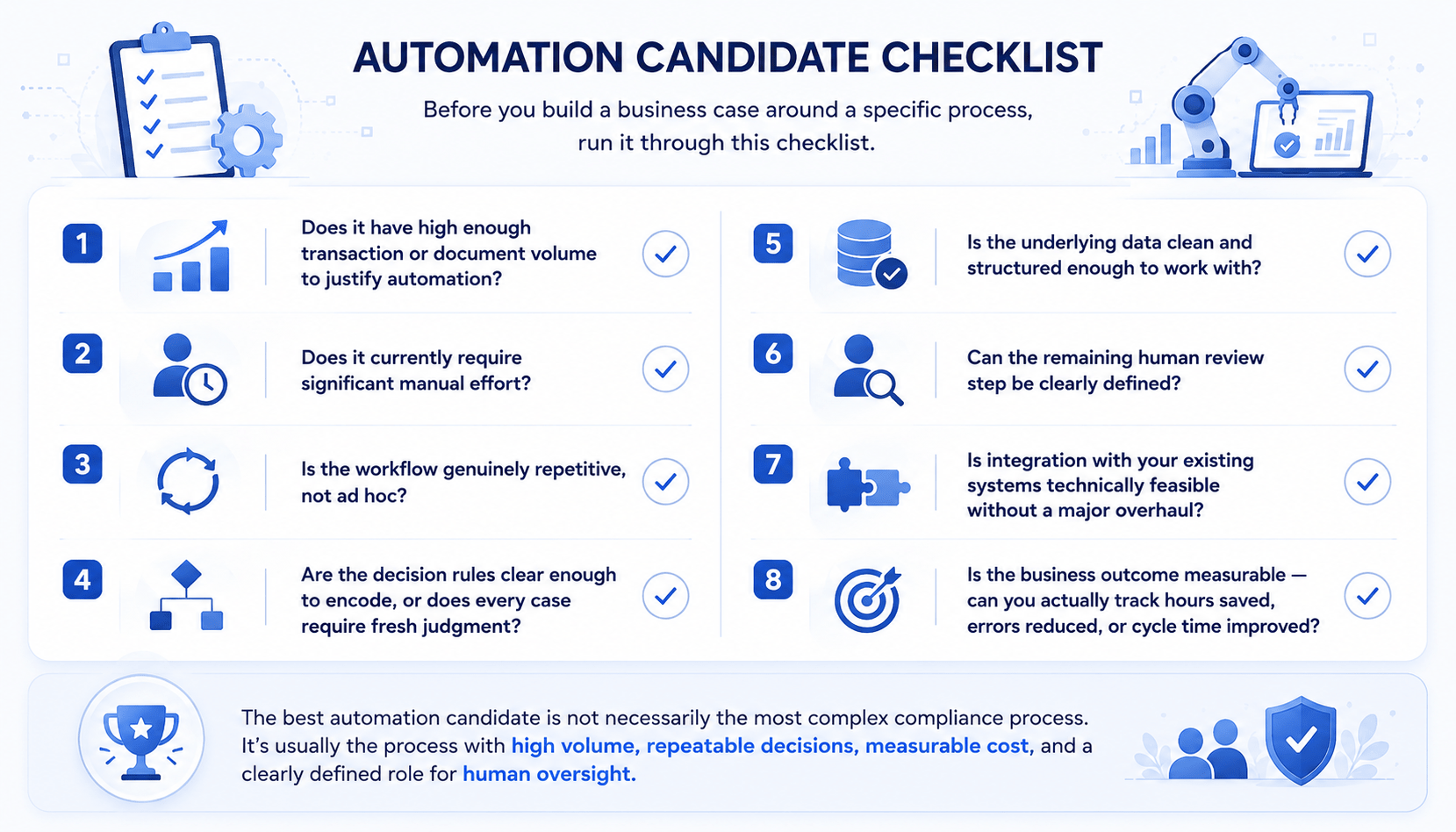
- Does it have high enough transaction or document volume to justify automation?
- Does it currently require significant manual effort?
- Is the workflow genuinely repetitive, not ad hoc?
- Are the decision rules clear enough to encode, or does every case require fresh judgment?
- Is the underlying data clean and structured enough to work with?
- Can the remaining human review step be clearly defined?
- Is integration with your existing systems technically feasible without a major overhaul?
- Is the business outcome measurable – can you actually track hours saved, errors reduced, or cycle time improved?
The best automation candidate is not necessarily the most complex compliance process. It’s usually the process with high volume, repeatable decisions, measurable cost, and a clearly defined role for human oversight.
FAQ (Frequent Asked Questions)
What is a good ROI for compliance automation?
Most organizations aim for positive ROI within the first 12–18 months and expect the multi-year ROI to be substantially higher as implementation costs are amortized. A single-digit or negative Year 1 ROI is common and not a red flag on its own – it’s the 3-year trajectory that matters most.
How long does compliance automation take to pay back?
Payback periods commonly fall in the 6-18 month range, depending on current compliance spend, team size, data readiness, and how many frameworks are in scope. Multi-framework programs tend to pay back faster because efficiency gains compound across overlapping controls.
What costs should be included in an AI automation ROI calculation?
Beyond the subscription fee: discovery and configuration, data preparation, integration, testing, training, ongoing monitoring, maintenance, and human oversight. Leaving out implementation labor is the most common way ROI models overstate the return.
Can compliance automation ROI include risk reduction?
Yes, and it should. Faster audit cycles, fewer compliance incidents, and reduced deal friction from faster security questionnaire turnaround are all quantifiable benefits, even though they don’t show up as direct labor savings. Use your own risk data – like cyber insurance premiums or past audit findings – rather than industry-average figures, since those are easier to defend in a budget conversation.
Which compliance processes should companies automate first?
Start with the highest-volume, most repetitive, most standardized process – usually document or evidence review, or compliance screening. These tend to produce the fastest, most measurable wins and build the internal case for automating more complex processes later.
How much manual work can AI realistically automate?
It depends on the process, but assuming 100% automation is a modeling mistake. A conservative, defensible range for well-suited processes is 50-70% time reduction, with the remainder still requiring human review, especially for exceptions and edge cases.
Conclusion: Build the Business Case Before You Automate
A defensible automation decision starts with an honest view of your current costs. Then, estimate the realistic impact of automation, not the vendor-promised one. Finally, compare the full benefits against the total cost of ownership.
In short, skip any one of those three steps and the resulting number won’t survive a finance review. Conversely, do all three, and you’ll walk into that budget conversation with a figure you can defend line by line.
Want to estimate the ROI of automating your compliance workflow? Map your current process, workload, and automation potential first. The numbers will show whether the investment makes sense.
Explore SmartDev for more practical insights on how AI can enhance compliance, strengthen risk management, and streamline operational workflows.